REVIEW 4 major objections 5 minor 50 references
YOLO-PEFT: Parameter-Efficient Fine-Tuning on YOLO Family
T0 review · 4 major / 5 minor · reviewed 2026-08-10 · deepseek-v4-flash
Pith's one-line read This paper claims that adapter placement for PEFT on real-time detectors should be solved by constraint planning on the detector graph, and that the resulting plans match or exceed full fine-tuning on YOLO11s and YOLO12s while returning…
desk verdict A real engineering contribution with an honest limitation: the Refuse mechanism is a calibrated description of seven collapses, not yet a prediction for unseen architectures; the placement results are plausible and worth referee time. read the letter →
The pith
A machine-rendered reading of the paper's core claim, the machinery that carries it, and where it could break.
The reading
What carries the argument
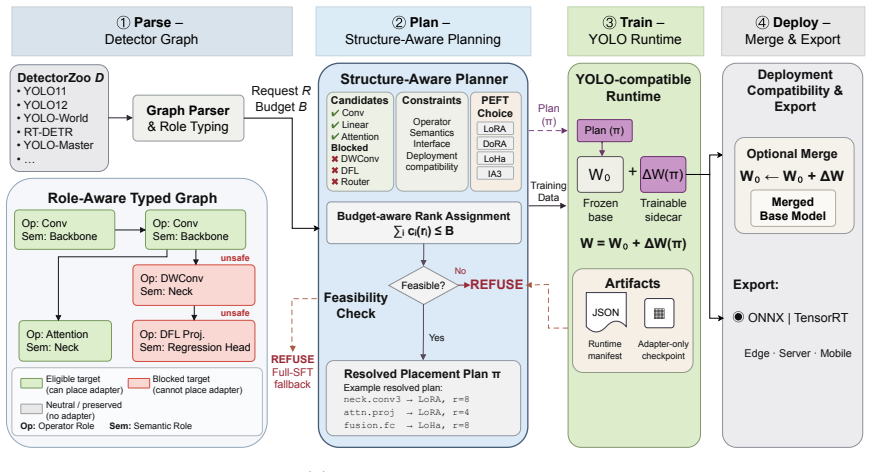
The load-bearing object is the role-aware typed graph $G=(V,E)$ of the detector: each module $i$ carries operator metadata $o_i$, semantic role $s_i$, graph-interface metadata $q_i$, and deployment metadata $h_i$. The planner evaluates predicates such as dense conv supported by the backend, grouped conv requires $G \mid r$, depthwise and normalization excluded, DFL bins and MoE routers frozen, and shape, arity, and residual-preserving substitution, then solves budget-aware rank assignment $\max_{\pi} \sum_i u(i,\pi(i))$ subject to $\sum_i c_p(i,\pi(i)) \le B$. Reliability is estimated by a linear calibration $\Delta \mathrm{mAP} \approx \beta_0 + \beta_1 \varphi_{\mathrm{attn}} + \beta_2 \varphi_{\mathrm{text}} + \beta_3 \varphi_{\mathrm{dw}} + \beta_4 \xi_p$, where the fingerprint includes attention, text-fusion, MoE, depthwise, and dense, grouped, or convolution fractions; a prediction below $\Delta = -0.05$ triggers Refuse. The runtime contract preserves train-save-merge-export invariants, with merge equivalence for the fallback grouped-convolution LoRA backend proven as $\mathrm{conv}(W_0,x) + s\, g((A_g,B_g)_g,x) = \mathrm{conv}(W_0 + s\Delta W, x)$ up to floating-point tolerance.
What would settle it
Run a full VOC fine-tuning on a held-out detector family (for example a mixture-of-transformers detector) with planner-selected RS-LoRA: if an accepted plan produces $\Delta\mathrm{mAP}$ below $-0.05$, or a refused configuration would have matched or exceeded Full-SFT, then the calibration's predictive claim fails. The paper's own absence of a held-out family makes this test the decisive one.
Extended reading notes
Core claim
The central claim, stated for a fair reader, is that the reason PEFT often fails on real-time detectors is structural misplacement, not the low-rank parameterization itself. YOLO-PEFT formulates placement as an auditable multi-constraint decision problem on a directed acyclic graph of the detector, where every module carries operator metadata, a semantic role, graph-interface metadata, and deployment metadata. The planner applies explicit constraint classes in a fixed order: operator validity, detection-semantic safety, graph-interface compatibility, architecture-conditioned policies, budget feasibility, deployment compatibility, and reliability calibration, and returns either an accepted plan with a rank assignment or Refuse with a terminal reason code. Within the evaluated VOC protocol and detector families, planner-selected RS-LoRA matches or exceeds full fine-tuning on YOLO11s and YOLO12s, while RT-DETR-L produces a calibrated Refuse because every one of the seven swept LoRA-family configurations falls below $\Delta = -0.05$; the paper explicitly scopes these results to the evaluated families and calibration coverage.
Load-bearing premise
The load-bearing premise is that the reliability calibration, with coefficients fitted on the same five detector families used for evaluation, can make pre-training Refuse decisions meaningful within claimed calibrated coverage; because no family is held out, the RT-DETR-L refusal is validated on data that already determined that refusal.
Editorial extensions
If this is right
- Planner-selected PEFT can replace full fine-tuning for YOLO11s and YOLO12s on the VOC protocol, gaining +7.1 and +6.5 mAP50-95 over Full-SFT while freezing most of the detector weights.
- Refuse is a legitimate planner outcome: on RT-DETR-L it avoids seven training runs that would each collapse below $\Delta = -0.05$, and Full-SFT becomes the fallback rather than a failure.
- Adapter training trades memory for time: on the controlled YOLO11 audit, LoRA cuts peak VRAM by 43.9 percent but runs 1.72 times longer, so efficiency claims must separate VRAM from wall-clock.
- Accepted plans survive the full deployment contract: adapters can be saved, reloaded, merged, and exported through ONNX and TensorRT, with merged models recovering base operator cost.
Reading between the lines
- If the planner is applied to a detector family outside the five calibrated ones, the Refuse decision should be re-derived from that family's own collapses; the paper's own admission that held-out-architecture validation remains open suggests the core value is the auditable decision log rather than the refusal threshold itself.
- The same graph-role filters could block unsafe placements for cross-modal and mixture-of-transformers detectors before any training, because the predicates are structural rather than task-specific.
- A decisive test of the calibration's predictive power would hold out an entire detector family at calibration time and measure false-refusal and false-acceptance rates on that held-out family.
Editorial analysis
A structured set of objections, weighed in public.
Referee Report
Summary. The paper proposes YOLO-PEFT, a structure-aware constraint-planning framework for adapter placement on real-time detectors. Given a detector graph, a PEFT request, and a resource budget, the framework parses operator and semantic roles, applies hard constraints (operator validity, detection-head semantics, graph-interface, deployment), allocates ranks under a budget, and either emits a placement plan or returns a Refuse decision with a Full-SFT fallback. The main empirical claim is that under the official VOC07+12 trainval-to-VOC07 test protocol, planner-selected RS-LoRA reaches 0.7138 and 0.7307 mAP50-95 on YOLO11s and YOLO12s, versus 0.6428 and 0.6662 for Full-SFT, while RT-DETR-L returns Refuse because all seven evaluated LoRA-family configurations cross a predefined catastrophe threshold of Δ = −0.05. The paper also reports a controlled efficiency audit (LoRA reduces peak VRAM by 43.9% but training takes 1.72× longer), a merge-equivalence proof for a fallback grouped-convolution LoRA backend, and an scoped MoE stress test. The authors repeatedly and explicitly state that the Refuse rule is calibrated only within the evaluated families and that refusal on unseen detector architectures remains an open validation problem.
Significance. If the results hold, the paper makes a useful contribution by recasting PEFT placement as an auditable constraint-satisfaction problem rather than module-name matching, and by demonstrating on two YOLO variants that graph-aware placement can substantially beat full fine-tuning on a mid-scale detection benchmark. The paper is unusually transparent about its limitations: it discloses test-set involvement in checkpoint selection, reports a controlled memory/time trade-off rather than a universal speedup, and scopes the Refuse mechanism to calibrated coverage. It also ships a deployment contract with ONNX/TensorRT checks and a merge-equivalence proof for the fallback backend. The main weakness is that the Refuse-before-training capability is not yet validated as a predictive tool for unseen architectures; current evidence is a within-sample classification of observed collapses on the evaluated families.
major comments (4)
- [Sec. 4.2, Eq. (5)] The reliability calibration in Eq. (5) is fitted and assessed on the same seven RT-DETR-L runs, and the paper itself states that this 'is not a held-out-architecture test.' The variant-level LOVO (86.7% accuracy, F1 = 0.850) holds out variants, not detector families, so it does not demonstrate that the Refuse rule can predict a collapse for an unseen architecture-adapter combination. Since the framework's advertised contribution is 'Refuse before training,' the authors should either add a held-out-family validation (e.g., calibrate on four of the five families and test the refusal decision on the fifth) or explicitly reframe the contribution as a within-coverage post-hoc risk assessment and remove any implication of pre-training prediction for new architectures.
- [Sec. 4.1 and Appendix H] The primary mAP comparisons are obtained by selecting the best checkpoint on the VOC2007 test set for every method. The paper discloses this and calls the results 'controlled relative comparisons,' but model selection on the test set can inflate absolute scores and potentially alter rankings in ways not captured by the shared protocol. Because the central claim is that planner-selected PEFT outperforms Full-SFT, the authors should report at least one validation-based selection (for example, on a held-out subset of the training set or on VOC2012 val) to confirm that the superiority holds when the test set is not used for checkpoint selection.
- [Sec. 4.3, Table 4] In the YOLO-Master-EsMoE-S stress test, the Full-SFT anchor is taken from a run whose W&B state is logged as 'crashed.' Using metrics from a crashed run as a baseline anchor is not reliable, even if the row is secondary and marked with a dagger. This row should be re-run to completion or omitted from the stress-test table; as presented, the 'HRA beats Full-SFT' observation in that table rests on a possibly corrupted anchor.
- [Sec. 3.2, Eq. (5)] The catastrophe threshold Δ = −0.05 is described as 'predefined' but no justification or sensitivity analysis is provided. Since the RT-DETR-L Refuse decision is driven entirely by this threshold, a short analysis showing that the decision is robust to reasonable variations (for example, Δ = −0.03 or −0.08) would materially strengthen the claim that the rule is not an artifact of a single manually chosen constant.
minor comments (5)
- [Sec. 3.2, Eq. (4)] The utility function u(i, π(i); p, ψ) is not fully specified in the main text; the rule-only decomposition u = u_op + u_sem + u_range + u_rank − λc_p is given only in words. Please provide explicit definitions or a more detailed supplementary reference in the main text.
- [Supplementary Tab. S2] The heatmap in Fig. 2 clips colors below −0.30, but several entries are −0.600 (the clipped failure value). The caption and table should state this clipping explicitly so readers do not interpret the clipped cells as equal to −0.30.
- [Sec. 4.1] The explanation that the W&B field 'val2007' is an alias for the VOC2007 test set is important and easily overlooked; consider moving it from Appendix H into the main experimental setup for greater prominence.
- [Fig. 1] In the top pipeline, the 'Feasible? No' branch leads to 'REFUSE' and then to 'Full-SFT fallback'; consider labeling this fallback as a valid, auditable outcome in the figure, matching the paper's framing that Refuse is a first-class planning result.
- [Sec. 4.2] The LOVO accuracy of 86.7% and F1 of 0.850 are reported without a description of the exact folds (e.g., number of variants, class balance, or variance across folds). A one-sentence fold description would improve reproducibility.
Circularity Check
RT-DETR-L Refuse is calibrated and counted on the same seven collapses, so the refusal is an in-sample fit rather than an independent prediction.
-
fitted input called prediction
[Sec. 3.2 'Reliability calibration' (Eq. 5); Sec. 4.2 'Refusal within Evaluated Coverage'; Tab. 1 footnote]
"calibrated mode estimates ∆mAP≈β0 +β1ϕattn +β2ϕtext +β3ϕdw +β4ξp, (5) where ξp is a variant coefficient fitted on the canonical matrix. ... The RT-DETR-L rule is calibrated on seven observed collapses, not an unseen architecture. ... Treating ∆<−0.05 as unsafe, these seven attempted configurations have a 7/7 (100%) unsafe-placement rate."
The coefficients in Eq. (5) are fitted on the same seven RT-DETR-L LoRA-family runs that are then reported as all crossing the catastrophe threshold, so the 7/7 refusal is a re-statement of the calibration data rather than a before-training prediction for a new architecture-adapter combination. The paper explicitly disclaims held-out-architecture status ('this is not a held-out-architecture test'), but the abstract's 'calibrated Refuse-to-Full-SFT decision' and the claimed pre-training risk-estimation contribution still rely on an in-sample classification. The Refuse outcome is forced by the fitted model plus the manually chosen threshold, and it cannot by itself demonstrate that the planner detects high-risk combinations before training.
full rationale
The central empirical claims are not circular: the YOLO11s/YOLO12s mAP comparisons use the official VOC07+12 trainval-to-VOC07 test protocol, and the memory/time audit is a controlled measurement with disclosed scope. The constraint-planning rules, budget allocation, and merge-equivalence proof are deterministic and independent of the reliability model. The one load-bearing circular step is the RT-DETR-L Refuse mechanism: Eq. (5) is fitted on the canonical matrix that includes RT-DETR-L, the catastrophe threshold is applied to those same seven runs, and the resulting 7/7 refusal is presented as supporting a calibrated Refuse decision. The paper is unusually transparent about this limitation, which lowers the severity, but the 'prediction' still reduces to the fit by construction. Score 6: partial circularity in the refusal/safety contribution while the placement and efficiency contributions retain independent content.
Assumptions & free parameters
free parameters (4)
- Reliability calibration coefficients beta_0..beta_4 =
Not reported numerically; fitted on canonical matrix (Tab. 1)
- Catastrophe threshold delta =
-0.05 mAP50-95
- Default rank and alpha =
r=16, alpha=32
- Training-prior hyperparameters =
lambda_ortho=0.5, rho=0.85, dropout 0 to 0.15
assumptions (4)
- domain assumption Manual operator-validity and semantic-safety predicates are correct (depthwise unsafe, DFL projections unsafe, MoE routers unsafe, geometry-sensitive regression paths unsafe).
- domain assumption Family-scoped architecture policies calibrated on evaluated families apply to new configurations within the same families.
- domain assumption VOC2007 test-set-based best-checkpoint selection yields controlled relative comparisons.
- standard math Standard linear algebra and im2col convolution-to-matrix equivalence hold for the merge-equivalence proof.
invented entities (1)
-
10-dimensional architecture fingerprint phi(G)
Cite this review
Pith. "Pith review of YOLO-PEFT: Parameter-Efficient Fine-Tuning on YOLO Family." pith.science (2026). https://pith.science/paper/35VWECDK
@misc{pith2026260807051,
  author       = {Pith},
  title        = {Pith review of: YOLO-PEFT: Parameter-Efficient Fine-Tuning on YOLO Family},
  year         = {2026},
  howpublished = {\url{https://pith.science/paper/35VWECDK}},
  note         = {Machine review of arXiv:2608.07051}
}
read the original abstract
Generic parameter-efficient fine-tuning (PEFT) methods transferred from language models can fail silently on real-time detectors, whose heterogeneous operators and detection-specific components impose placement constraints absent from regular Transformer stacks. We propose YOLO-PEFT, a structure-aware framework that formulates adapter placement as an auditable constraint-planning problem. Given a detector graph, a PEFT request, and a resource budget, YOLO-PEFT assigns operator and semantic roles, evaluates explicit operator-validity, detector-semantic, graph-interface, and deployment predicates, records a reason code for each excluded module, and either emits a budgeted target-module plan or returns Refuse before training. Under the official VOC07+12 trainval-to-VOC07 test protocol, planner-selected RS-LoRA reaches 0.7138 and 0.7307 mAP50-95 on YOLO11s and YOLO12s, respectively, compared with 0.6428 and 0.6662 for Full-SFT. On RT-DETR-L, all seven evaluated LoRA-family configurations cross the predefined catastrophic threshold, supporting a calibrated Refuse-to-Full-SFT decision within the evaluated coverage. A controlled YOLO11 audit further shows that LoRA reduces peak training memory by 43.9 percent, although training takes 1.72 times longer. Within the evaluated detector families, placement policies, and calibration coverage, YOLO-PEFT replaces manual target-module trial and error with explicit, inspectable planning while preserving verified train-save-merge-export paths; refusal on unseen detector architectures remains an open validation problem. Project Page: github.com/Tencent/YOLO-Master
Figures


Figures from the paper (1 more)

Reference graph
Works this paper leans on
-
[1]
Conv-Adapter: Exploring parameter efficient transfer learning for ConvNets
Hao Chen, Ran Tao, Han Zhang, Yidong Wang, Xiang Li, Wei Ye, Jindong Wang, Guosheng Hu, and Marios Savvides. Conv-Adapter: Exploring parameter efficient transfer learning for ConvNets. InCVPR Workshops, pages 1551–1561, 2024. doi: 10.1109/CVPRW63382.2024.00162. URLhttps://arxiv.org/abs/2208.07463
arXiv 2024
-
[2]
AdaptFormer: Adapting vision transformers for scalable visual recognition
Shoufa Chen, Chongjian Ge, Zhan Tong, Jiangliu Wang, Yibing Song, Jue Wang, and Ping Luo. AdaptFormer: Adapting vision transformers for scalable visual recognition. InNeurIPS, 2022
work page 2022
-
[3]
Zheng Chen, Yu Zeng, Zehui Chen, Hongzhi Gao, Lin Chen, Jiaming Liu, and Feng Zhao. VFM-Adapter: Adapting visual foundation models for dense prediction with dynamic hybrid operation mapping. InAAAI, volume 39, pages 2385–2393, 2025. doi: 10.1609/aaai.v39i3.32239. URLhttps://ojs.aaai.org/index.php/AAAI/article/ view/32239
-
[4]
YOLO-World: Real-time open-vocabulary object detection
Tianheng Cheng, Lin Song, Yixiao Ge, Wenyu Liu, Xinggang Wang, and Ying Shan. YOLO-World: Real-time open-vocabulary object detection. InCVPR, 2024
work page 2024
-
[5]
Mark Everingham, S. M. Ali Eslami, Luc Van Gool, Christopher K. I. Williams, John Winn, and Andrew Zisserman. The PASCAL visual object classes challenge: A retrospective.International Journal of Computer Vision, 111:98–136, 2015
work page 2015
-
[6]
Lightweight modular parameter-efficient tuning for open- vocabulary object detection, 2024
Bilal Faye, Hanane Azzag, and Mustapha Lebbah. Lightweight modular parameter-efficient tuning for open- vocabulary object detection, 2024. URLhttps://arxiv.org/abs/2408.10787
-
[7]
Pet-dino: Unifying visual cues into grounding dino with prompt-enriched training
Weifu Fu, Jinyang Li, Bin-Bin Gao, Jialin Li, Yuhuan Lin, Hanqiu Deng, Wenbing Tao, Yong Liu, and Chengjie Wang. Pet-dino: Unifying visual cues into grounding dino with prompt-enriched training. InProceedings of the IEEE/CVF Conference on Computer Vision and Pattern Recognition (CVPR), pages 13039–13048, June 2026
work page 2026
-
[8]
Multi-point positional insertion tuning for small object detection
Kanoko Goto, Takumi Karasawa, Takumi Hirose, Rei Kawakami, and Nakamasa Inoue. Multi-point positional insertion tuning for small object detection. InICASSP, pages 1–5, 2025. doi: 10.1109/ICASSP49660.2025.10888925. URLhttps://arxiv.org/abs/2412.18090. 19
arXiv 2025
Show all 50 references
-
[9]
Parameter-efficient fine-tuning for large models: A comprehensive survey, 2024
Zeyu Han, Chao Gao, Jinyang Liu, Jeff Zhang, and Sai Qian Zhang. Parameter-efficient fine-tuning for large models: A comprehensive survey, 2024
2024
-
[10]
Sensitivity-aware visual parameter- efficient fine-tuning
Haoyu He, Jianfei Cai, Jing Zhang, Dacheng Tao, and Bohan Zhuang. Sensitivity-aware visual parameter- efficient fine-tuning. InICCV, pages 11791–11801, 2023. doi: 10.1109/ICCV51070.2023.01086. URL https: //arxiv.org/abs/2303.08566
2023
-
[11]
Towards a unified view of parameter-efficient transfer learning
Junxian He, Chunting Zhou, Xuezhe Ma, Taylor Berg-Kirkpatrick, and Graham Neubig. Towards a unified view of parameter-efficient transfer learning. InICLR, 2022
2022
-
[12]
Parameter-efficient model adaptation for vision transformers
Xuehai He, Chunyuan Li, Pengchuan Zhang, Jianwei Yang, and Xin Eric Wang. Parameter-efficient model adaptation for vision transformers. InAAAI, volume 37, pages 817–825, 2023. doi: 10.1609/aaai.v37i1.25160. URLhttps://ojs.aaai.org/index.php/AAAI/article/view/25160
2023 doi
-
[13]
Hu, Yelong Shen, Phillip Wallis, Zeyuan Allen-Zhu, Yuanzhi Li, Shean Wang, Lu Wang, and Weizhu Chen
Edward J. Hu, Yelong Shen, Phillip Wallis, Zeyuan Allen-Zhu, Yuanzhi Li, Shean Wang, Lu Wang, and Weizhu Chen. LoRA: Low-rank adaptation of large language models. InICLR, 2022
2022
-
[14]
Visual prompt tuning
Menglin Jia, Luming Tang, Bor-Chun Chen, Claire Cardie, Serge Belongie, Bharath Hariharan, and Ser-Nam Lim. Visual prompt tuning. InECCV, 2022
2022
-
[15]
Convolutional bypasses are better vision transformer adapters
Shibo Jie, Zhi-Hong Deng, Shixuan Chen, and Zhijuan Jin. Convolutional bypasses are better vision transformer adapters. InECAI, pages 202–209, 2024. doi: 10.3233/FAIA240489. URLhttps://arxiv.org/abs/2207.07039
2024 arXiv
-
[16]
YOLOv8 by Ultralytics.https://github.com/ultralytics/ult ralytics, 2023
Glenn Jocher, Ayush Chaurasia, and Jing Qiu. YOLOv8 by Ultralytics.https://github.com/ultralytics/ult ralytics, 2023. GitHub repository, Accessed: 2026-05-10
2023
-
[17]
YOLO11 by Ultralytics.https://github.com/ultralytics/ult ralytics, 2024
Glenn Jocher, Ayush Chaurasia, and Jing Qiu. YOLO11 by Ultralytics.https://github.com/ultralytics/ult ralytics, 2024. GitHub repository and documentation, Accessed: 2026-05-10
2024
-
[18]
DA-Ada: Learning domain-aware adapter for domain adaptive object detection
Haochen Li, Rui Zhang, Hantao Yao, Xin Zhang, Yifan Hao, Xinkai Song, Xiaqing Li, Yongwei Zhao, Ling Li, and Yunji Chen. DA-Ada: Learning domain-aware adapter for domain adaptive object detection. InNeurIPS, volume 37, pages 103574–103598, 2024. doi: 10.52202/079017-3289. URLh...
2024 arXiv
-
[19]
Lors: Low-rank residual structure for parameter-efficient network stacking
Jialin Li, Qiang Nie, Weifu Fu, Yuhuan Lin, Guangpin Tao, Yong Liu, and Chengjie Wang. Lors: Low-rank residual structure for parameter-efficient network stacking. InProceedings of the IEEE/CVF conference on computer vision and pattern recognition, pages 15866–15876, 2024
2024
-
[20]
Generalized focal loss: Learning qualified and distributed bounding boxes for dense object detection
Xiang Li, Wenhai Wang, Lijun Wu, Shuo Chen, Xiaolin Hu, Jun Li, Jinhui Tang, and Jian Yang. Generalized focal loss: Learning qualified and distributed bounding boxes for dense object detection. InNeurIPS, 2020
2020
-
[21]
Scaling & shifting your features: A new baseline for efficient model tuning
Dongze Lian, Daquan Zhou, Jiashi Feng, and Xinchao Wang. Scaling & shifting your features: A new baseline for efficient model tuning. InNeurIPS, 2022
2022
-
[22]
YOLO-Master: MOE-accelerated real-time detection,
Xu Lin, Jinlong Peng, Zhenye Gan, Jiawen Zhu, and Jun Liu. YOLO-Master: MOE-accelerated real-time detection,
-
[23]
Few-shot parameter-efficient fine-tuning is better and cheaper than in-context learning
Haokun Liu, Derek Tam, Mohammed Muqeeth, Jay Mohta, Tenghao Huang, Mohit Bansal, and Colin A Raffel. Few-shot parameter-efficient fine-tuning is better and cheaper than in-context learning. InNeurIPS, 2022
2022
-
[24]
DoRA: Weight-decomposed low-rank adaptation
Shih-Yang Liu, Chien-Yi Wang, Hongxu Yin, Pavlo Molchanov, Yu-Chiang Frank Wang, Kwang-Ting Cheng, and Min-Hung Chen. DoRA: Weight-decomposed low-rank adaptation. InICML, 2024
2024
-
[25]
RT-DETR: DETRs beat YOLOs on real-time object detection
Wenyu Lv, Yi Zhao, Shangliang Xu, Jinman Wei, Guanzhong Wang, Cheng Cui, Yuning Du, Qingqing Dang, and Yi Liu. RT-DETR: DETRs beat YOLOs on real-time object detection. InCVPR, 2024
2024
-
[26]
PEFT: State-of-the-art parameter-efficient fine-tuning methods.https://github.com/huggingface/peft, 2022
Sourab Mangrulkar, Sylvain Gugger, Lysandre Debut, Younes Belkada, and Sayak Paul. PEFT: State-of-the-art parameter-efficient fine-tuning methods.https://github.com/huggingface/peft, 2022. Accessed: 2026-05-10
2022
-
[27]
Munish Monga, Vishal Chudasama, Pankaj Wasnik, and C. V. Jawahar. EW-DETR: Evolving world object detection via incremental low-rank detection transformer, 2026. URLhttps://arxiv.org/abs/2602.20985
2026
-
[28]
Pro-Tuning: Unified prompt tuning for vision tasks.IEEE Transactions on Circuits and Systems for Video Technology, 34(6):4653–4667, 2024
Xing Nie, Bolin Ni, Jianlong Chang, Gaofeng Meng, Chunlei Huo, Zhaoxiang Zhang, Shiming Xiang, Qi Tian, and Chunhong Pan. Pro-Tuning: Unified prompt tuning for vision tasks.IEEE Transactions on Circuits and Systems for Video Technology, 34(6):4653–4667, 2024. doi: 10.1109/TCSV...
2024
-
[29]
Xinyang Pu and Feng Xu. Low-rank adaption on transformer-based oriented object detector for satellite onboard processing of remote sensing images.IEEE Transactions on Geoscience and Remote Sensing, 63:1–13, 2025. doi: 10.1109/TGRS.2024.3524578. URLhttps://arxiv.org/abs/2406.02385
2025
-
[30]
Learning multiple visual domains with residual adapters
Sylvestre-Alvise Rebuffi, Hakan Bilen, and Andrea Vedaldi. Learning multiple visual domains with residual adapters. InNeurIPS, 2017
2017
-
[31]
VL-Adapter: Parameter-efficient transfer learning for vision- and-language tasks
Yi-Lin Sung, Jaemin Cho, and Mohit Bansal. VL-Adapter: Parameter-efficient transfer learning for vision- and-language tasks. InCVPR, pages 5217–5227, 2022. doi: 10.1109/CVPR52688.2022.00516. URL https: //arxiv.org/abs/2112.06825
2022
-
[32]
Analyzing the impact of low-rank adaptation for cross-domain few-shot object detection in aerial images,
Hicham Talaoubrid, Anissa Mokraoui, Ismail Ben Ayed, Axel Prouvost, Sonimith Hang, Monit Korn, and Rémi Harvey. Analyzing the impact of low-rank adaptation for cross-domain few-shot object detection in aerial images,
-
[33]
YOLOv12: Attention-centric real-time object detectors
Yunjie Tian, Qixiang Ye, and David Doermann. YOLOv12: Attention-centric real-time object detectors. In NeurIPS, 2025
2025
-
[34]
Source-free domain adaptation for YOLO object detection
Simon Varailhon, Masih Aminbeidokhti, Marco Pedersoli, and Eric Granger. Source-free domain adaptation for YOLO object detection. InComputer Vision – ECCV 2024 Workshops, pages 218–235. Springer, 2025. doi: 10.1007/978-3-031-91672-4_14
2024 doi
-
[35]
SIA-OVD: Shape-invariant adapter for bridging the image-region gap in open-vocabulary detection
Zishuo Wang, Wenhao Zhou, Jinglin Xu, and Yuxin Peng. SIA-OVD: Shape-invariant adapter for bridging the image-region gap in open-vocabulary detection. InACMMM, pages 4986–4994, 2024. doi: 10.1145/3664647.3680642. URLhttps://arxiv.org/abs/2410.05650
2024
-
[36]
CoPEFT: Fast adaptation framework for multi-agent collaborative perception with parameter-efficient fine-tuning
Quanmin Wei, Penglin Dai, Wei Li, Bingyi Liu, and Xiao Wu. CoPEFT: Fast adaptation framework for multi-agent collaborative perception with parameter-efficient fine-tuning. InAAAI, volume 39, pages 23351–23359, 2025. doi: 10.1609/aaai.v39i22.34502. URLhttps://ojs.aaai.org/index...
2025 doi
-
[37]
DroneFINE: Domain-aware parameter-efficient fine-tuning of vision-language detectors for drone images, 2026
Ke Wu, Yanan Zhang, Yingjie Gao, Wenhao Li, Chenyu Zhou, Xinzhu Ma, Jiaxin Chen, and Di Huang. DroneFINE: Domain-aware parameter-efficient fine-tuning of vision-language detectors for drone images, 2026. URLhttps://arxiv.org/abs/2607.00338
2026 arXiv
-
[38]
VMT-Adapter: Parameter-efficient transfer learning for multi-task dense scene understanding
Yi Xin, Junlong Du, Qiang Wang, Zhiwen Lin, and Ke Yan. VMT-Adapter: Parameter-efficient transfer learning for multi-task dense scene understanding. InAAAI, volume 38, pages 16085–16093, 2024. doi: 10.1609/aaai.v38i1 4.29541. URLhttps://arxiv.org/abs/2312.08733
2024 arXiv
-
[39]
Pre-train, adapt and detect: Multi-task adapter tuning for camouflaged object detection, 2023
Yinghui Xing, Dexuan Kong, Shizhou Zhang, Geng Chen, Lingyan Ran, Peng Wang, and Yanning Zhang. Pre-train, adapt and detect: Multi-task adapter tuning for camouflaged object detection, 2023. URLhttps: //arxiv.org/abs/2307.10685. Preprint
2023 arXiv
-
[40]
Component-coordinated and uncertainty-enhanced LoRA for few-shot source-free domain adaptive object detection.Neurocomputing, 650:130787, 2025
Xudong Yao, Hao Liu, and Xiaoshan Yang. Component-coordinated and uncertainty-enhanced LoRA for few-shot source-free domain adaptive object detection.Neurocomputing, 650:130787, 2025. doi: 10.1016/j.neucom.2025.13 0787
2025 doi
-
[41]
SpotPatch: Parameter-efficient transfer learning for mobile object detection
Keren Ye, Adriana Kovashka, Mark Sandler, Menglong Zhu, Andrew Howard, and Marco Fornoni. SpotPatch: Parameter-efficient transfer learning for mobile object detection. InComputer Vision – ACCV 2020, pages 239–256. Springer, 2021. doi: 10.1007/978-3-030-69544-6_15. URLhttps://a...
2020 arXiv
-
[42]
1% vs 100%: Parameter- efficient low rank adapter for dense predictions
Dongshuo Yin, Yiran Yang, Zhechao Wang, Hongfeng Yu, Kaiwen Wei, and Xian Sun. 1% vs 100%: Parameter- efficient low rank adapter for dense predictions. InCVPR, pages 20116–20126, 2023. doi: 10.1109/CVPR52729.20 23.01926. URL https://openaccess.thecvf.com/content/CVPR2023/html/...
2023 doi
-
[43]
Parameter-efficient is not sufficient: Exploring parameter, memory, and time efficient adapter tuning for dense predictions
Dongshuo Yin, Xueting Han, Bin Li, Hao Feng, and Jing Bai. Parameter-efficient is not sufficient: Exploring parameter, memory, and time efficient adapter tuning for dense predictions. InACMMM, pages 1398–1406, 2024. doi: 10.1145/3664647.3680940. URLhttps://arxiv.org/abs/2306.09729
2024
-
[44]
Bridging the gap between low-rank and orthogonal adaptation via householder reflection adaptation
Shen Yuan, Haotian Liu, and Hongteng Xu. Bridging the gap between low-rank and orthogonal adaptation via householder reflection adaptation. InNeurIPS, 2024
2024
-
[45]
REAL-OW: Rehearsal-free open world object detection with low-rank adaptation and dual-stage objectness modeling, 2026
Huazhong Zhang, Xiaowen Fu, Yang Zhang, Linlin Shen, and Jinbao Wang. REAL-OW: Rehearsal-free open world object detection with low-rank adaptation and dual-stage objectness modeling, 2026. URL https: //arxiv.org/abs/2607.03004. Preprint. 21
2026 arXiv
-
[46]
AdaLoRA: Adaptive budget allocation for parameter-efficient fine-tuning
Qingru Zhang, Minshuo Chen, Alexander Bukharin, Pengcheng He, Yu Cheng, Weizhu Chen, and Tuo Zhao. AdaLoRA: Adaptive budget allocation for parameter-efficient fine-tuning. InICLR, 2023
2023
-
[47]
YOLO- IOD: Towards real time incremental object detection
Shizhou Zhang, Xueqiang Lv, Yinghui Xing, Qirui Wu, Di Xu, Chen Zhao, and Yanning Zhang. YOLO- IOD: Towards real time incremental object detection. InAAAI, volume 40, pages 12744–12752, 2026. doi: 10.1609/aaai.v40i15.38271. URLhttps://arxiv.org/abs/2512.22973
2026
-
[48]
SCT: A simple baseline for parameter-efficient fine-tuning via salient channels.International Journal of Computer Vision, 132(3): 731–749, 2024
Henry Hengyuan Zhao, Pichao Wang, Yuyang Zhao, Hao Luo, Fan Wang, and Mike Zheng Shou. SCT: A simple baseline for parameter-efficient fine-tuning via salient channels.International Journal of Computer Vision, 132(3): 731–749, 2024. doi: 10.1007/s11263-023-01918-3. URLhttps://a...
2024 arXiv
-
[49]
AutoPEFT: Automatic configuration search for parameter-efficient fine-tuning
Han Zhou, Xingchen Wan, Ivan Vulić, and Anna Korhonen. AutoPEFT: Automatic configuration search for parameter-efficient fine-tuning. InTACL, 2024. 22
2024
- [2025]
Reviewed August 10, 2026 · model on record in the stance chip above.
Discussion (0). Continue with ORCID to comment.