REVIEW 4 major objections 4 minor 68 references
PTQ4SNN: Membrane-Aware Post-Training Quantization for Spiking Neural Networks
T0 review · 4 major / 4 minor · reviewed 2026-08-10 · deepseek-v4-flash
Pith's one-line read A calibration-only method quantizes SNN membrane states to about 4 bits with under 1-point accuracy drops across architectures.
desk verdict Solid, incremental PTQ for SNN membranes with controlled experiments; deserves a serious referee despite calibration-stability caveats. read the letter →
The pith
A machine-rendered reading of the paper's core claim, the machinery that carries it, and where it could break.
The reading
What carries the argument
The central object is the projection-LIF pair, where an LIF neuron is a leaky integrate-and-fire spiking neuron. Two mechanisms carry the argument: the Unified Scale Bridge, defined by the identity $s_{\text{mem},c} = s_{w,c} \cdot 2^{k_c}$, couples each membrane channel's quantization scale to the preceding weight channel's scale by an integer power of two, so scale conversion becomes a shift while the quantization range adapts to the membrane distribution; and Mixed-Precision Bit Allocation, which computes per-channel firing rates $r_c$ and a gradient-based sensitivity $g_c$, combines them into a score $a_c = \beta \hat{r}_c + \gamma \hat{g}_c$, and assigns 2/4/8-bit widths by score quantiles under an element-count-weighted average budget $\sum_c b_c N_c / \sum_c N_c \approx b_m$. The bridge exponent $k_c$ is calibrated only after the per-channel bit width is assigned.
What would settle it
A concrete check would be to measure per-channel membrane firing rates on the held-out test set and compare them with calibration-set rates; if a substantial fraction of channels have test firing rates outside the calibrated range, or if a long event stream much longer than the calibration stream degrades accuracy monotonically, the representativeness assumption is false. A direct experiment: calibrate on only two of the ten CIFAR10-DVS temporal bins and evaluate on all ten; accuracy should stay near the all-bin calibration result if the claim is robust.
Extended reading notes
Core claim
On its own terms, the paper claims that membrane states are quantizable at the same precision as weights, provided the quantization is done channel-wise and is aware of firing activity and sensitivity. The central discovery is that a channel-wise power-of-two bridge between weight scale and membrane scale, combined with mixed 2/4/8-bit allocation under an average-bit budget, prevents the temporal error accumulation that makes naive membrane quantization collapse. Direct weight-scale reuse drops ImageNet accuracy by 71 points on SDT-8-768, while PTQ4SNN drops only 0.74 points. The method is formulated over reusable projection-LIF pairs and reports strong W4/M4 results across static classification, event-based classification, and Pascal VOC2012 segmentation, all without backbone retraining.
Load-bearing premise
The per-channel firing rates and sensitivity scores gathered on a small calibration set remain representative over the whole inference trajectory, so the chosen 2/4/8-bit assignments and power-of-two scales do not clip or under-quantize membrane channels when longer or different inputs arrive.
Editorial extensions
If this is right
- A pretrained SNN can be deployed with both weights and membrane states quantized to near 4 bits using only calibration inputs, with no retraining and no original training data.
- The same projection-LIF recipe applies across convolutional SNNs and spike-driven Transformers, so membrane quantization no longer needs an architecture-specific training pipeline.
- Channel-wise mixed precision beats uniform 4-bit membrane precision at the same average bit budget: +0.440 points on CIFAR-10 and +0.522 points on ImageNet-1K on SEW-ResNet18.
- A hardware-oriented estimate shows packed membrane resident state shrinking from 30.29 MiB at M32 to 5.28 MiB under an average M4 budget with per-channel tags and shift metadata, roughly an 8x reduction in state storage; actual latency and energy gains depend on a target integer implementation.
Reading between the lines
- A natural extension would be to test the shift-compatible bridge in an integer-only accelerator, where the recurrent membrane update could run with shifts instead of floating-point multiplies; the paper's cost model counts this benefit but does not measure silicon-level latency or energy.
- The sensitivity score built from a gradient-spike inner product is a local proxy, and one could test whether tracking firing-rate drift over longer sequences, such as T=100 event streams, improves allocation without increasing calibration cost.
- The same activity-and-sensitivity bit allocation could transfer to other recurrent stateful layers such as RNNs or state-space models that store per-channel hidden states, though the paper evaluates only LIF membrane channels.
- A potential failure point the paper does not resolve is that channels silent during calibration but active at inference would receive 2 bits and may clip; a calibration set covering rare-event channels would be needed before deployment on long or distribution-shifted streams.
Signed reviews
Editorial analysis
A structured set of objections, weighed in public.
Referee Report
Summary. The paper presents PTQ4SNN, a post-training quantization framework that jointly quantizes weights and recurrent membrane states in spiking neural networks using only a small calibration set. It introduces two components: a channel-wise Unified Scale Bridge that constrains each membrane scale as s_mem,c = s_w,c * 2^{k_c}, enabling shift-compatible scale conversion, and a Mixed-Precision Bit Allocation that assigns 2/4/8-bit membrane precision per channel according to firing activity and a gradient-based sensitivity score under an element-count-weighted average bit budget. The method is evaluated on ImageNet-1K classification (SDT-8-768, Meta-SpikeFormer, SEW-ResNet18), CIFAR10-DVS event classification, and Pascal VOC2012 semantic segmentation, reporting drops of 0.38-1.00 percentage points from floating-point checkpoints at W4/M4, with comparisons against weight-PTQ baselines (BRECQ, GPTQ) and a reimplemented FlowQ baseline.
Significance. If the results are robust, this is a useful contribution: it extends PTQ to recurrent membrane states, which are a substantial and previously mostly unquantized component of SNN inference cost. The reusable projection-LIF pair abstraction is clean, and the Unified Scale Bridge is a practical way to keep scale conversion shift-compatible. The paper is commendable for running controlled comparisons (same checkpoints, calibration samples, and first/last-layer settings across methods) and for explicitly disclaiming measured hardware gains and including a candid resource-accounting discussion in the appendix. The MPBA idea is interesting, and its independent benefit over uniform M4 is demonstrated on two datasets (Table 6).
major comments (4)
- [Experiments, Tables 1-3] The main results are single runs from one calibration set, with no error bars or calibration-split sensitivity analysis. Because the membrane scales (Eq. 9) and the 2/4/8-bit allocation (Eqs. 13-16) are fitted to calibration statistics, and membrane errors accumulate over the T-step trajectory (especially for CIFAR10-DVS at T=10), the central robustness claim needs evidence that the reported drops are stable across calibration draws and calibration sizes. Please report mean +/- standard deviation over at least three calibration splits/seeds and a calibration-size sweep.
- [Mixed-Precision Membrane Bit Allocation, Eq. (14)] The sensitivity score g_c is computed at a 4-bit reference and used to allocate 2-bit channels. Since 2-bit quantization errors are strongly nonlinear and threshold-sensitive, the paper should validate that the 4-bit sensitivity ranking transfers to 2-bit channels. A direct check is to compare, on the calibration set, the g_c ranking with the actual per-channel loss error when quantizing to 2 bits, or to ablate the sensitivity term specifically for the 2-bit assignment. Without such evidence, the MPBA gain in Table 6 may be attributable to the activity term alone.
- [Experimental Details vs. Abstract/Tables] The appendix states that 'the first projection and classifier remain at higher precision in the SDT classification experiments,' but Tables 1 and 2 and the abstract claim W4 quantization without this caveat. This is a material omission: for SDT-8-768 and Meta-SpikeFormer the effective weight precision is higher than 4 bits for some layers. Please state the actual bit widths in the main text and tables, and report the corresponding average weight precision and the resulting memory savings, or adjust the W4 label to avoid overstating the configuration.
- [Baselines and Evaluation Protocol] All FlowQ rows in Tables 1-3 are from the authors' reimplementation, but the paper does not validate this reimplementation against FlowQ's original results or release the code. Given that PTQ4SNN outperforms the reimplemented FlowQ by large margins in some settings (e.g., 75.16 vs. 63.74 on SDT-8-768), the comparison's fairness depends on the reimplementation's fidelity. Please provide a validation against published FlowQ numbers where checkpoints are available, a more detailed specification of the reimplementation, or a public code release.
minor comments (4)
- [Main text near Table 1] The phrase 'the completeBRECQreusebaseline' is missing spaces and should read 'the complete BRECQ reuse baseline.'
- [Table 4] The variables b_nonstem and b_all are used in the caption but their computation, especially the exclusion of the protected 16-bit stem, should be defined explicitly in the table caption.
- [Equation (14)] The term z^2 is ambiguous between an element-wise square and a squared norm; please state the intended operation.
- [Unified Scale Bridge, Eq. (11)] Please clarify whether the reported experiments quantize the leak factor tau and, if so, how; if tau remains floating-point, the 'shift-compatible' claim should be qualified.
Circularity Check
No significant circularity: PTQ4SNN's calibration-based allocation is evaluated on separate test sets, and the only self-citation is contextual.
full rationale
PTQ4SNN fits membrane scales (Eq. 9-12), firing rates (Eq. 13), sensitivity scores (Eq. 14), and bit assignments (Eq. 15-16) on a calibration set; however, all headline accuracy numbers (Tables 1-3) are measured on standard held-out test sets (ImageNet-1K, CIFAR10-DVS, Pascal VOC2012), not on the calibration data. The M4 label is definitional: Eq. 16 enforces an element-count-weighted average of roughly 4 bits, and the paper discloses that individual channels may use 2/4/8 bits. This is a setting, not a derived prediction. The one self-citation to QSD-Transformer (Qiu et al. 2025, which shares co-author Jinyang Guo) appears only in related-work context and does not support any load-bearing premise. No equation reduces the reported accuracy to the fitted parameters by construction; the robustness concern that a small calibration set may not represent the T-step membrane trajectory is a correctness or calibration risk, not circularity.
Assumptions & free parameters
free parameters (5)
- k_c (membrane scale shift exponent) =
per-channel integer chosen by minimizing Eq. (12) on calibration data
- beta (activity vs sensitivity weight) =
0.6 for VGG16; model-specific grid search
- sparse-protection percentile =
P99 for VGG16
- lambda_mem (membrane error weight) =
not reported
- weight scale s_w,c =
calibrated per channel from data
assumptions (5)
- domain assumption LIF neuron dynamics (Eq. 1-5) accurately model the pretrained SNNs being quantized.
- domain assumption Uniform symmetric quantization with clipping (Eq. 7-8) matches the target hardware.
- ad hoc to paper The sensitivity metric g_c in Eq. (14), based on a Taylor-like expansion of loss changes with spike output differences, approximates the true per-channel quantization sensitivity.
- domain assumption The calibration set is representative of the test distribution.
- ad hoc to paper Power-of-two scale conversion via shift remains valid when leakage is also quantized.
Cite this review
Pith. "Pith review of PTQ4SNN: Membrane-Aware Post-Training Quantization for Spiking Neural Networks." pith.science (2026). https://pith.science/paper/PQD2OA2W
@misc{pith2026260807066,
  author       = {Pith},
  title        = {Pith review of: PTQ4SNN: Membrane-Aware Post-Training Quantization for Spiking Neural Networks},
  year         = {2026},
  howpublished = {\url{https://pith.science/paper/PQD2OA2W}},
  note         = {Machine review of arXiv:2608.07066}
}
read the original abstract
Spiking neural networks (SNNs) enable sparse and event-driven computation, but their low-bit deployment remains incomplete because recurrent membrane states are commonly retained in floating point even after weight quantization. Quantizing these states is challenging because their distributions differ across channels and from the preceding weights, while small perturbations near the firing threshold may alter spike decisions and accumulate over time. We propose PTQ4SNN, a membrane-aware post-training quantization framework that jointly quantizes weights and recurrent membrane states using only a small calibration set. First, a channel-wise Unified Scale Bridge constrains the membrane scale as s_mem,c = s_w,c * 2^k_c, adapting to membrane distributions while enabling shift-compatible scale conversion. Second, Mixed-Precision Bit Allocation assigns 2/4/8-bit precision to membrane channels according to firing activity and quantization sensitivity under an average-bit budget. The framework operates on reusable projection-LIF pairs and supports both convolutional SNNs and spike-driven Transformers without backbone retraining. Experiments on static and event-based classification and semantic segmentation show that PTQ4SNN effectively preserves model accuracy under W4 quantization and approximately 4-bit membrane precision.
Figures
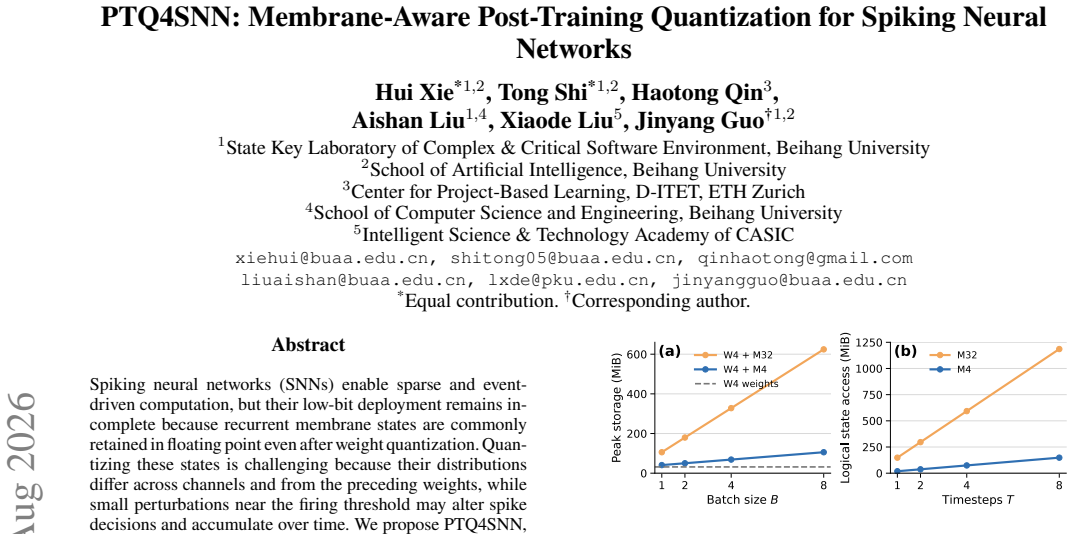


Figures from the paper (3 more)


Reference graph
Works this paper leans on
-
[1]
Communication, Simulation, and Intelligent Agents: Implications of Personal Intelligent Machines for Medical Education
Clancey, William J. Communication, Simulation, and Intelligent Agents: Implications of Personal Intelligent Machines for Medical Education. Proceedings of the Eighth International Joint Conference on Artificial Intelligence (IJCAI-83)
-
[2]
Classification Problem Solving
Clancey, William J. Classification Problem Solving. Proceedings of the Fourth National Conference on Artificial Intelligence
-
[3]
, title =
Robinson, Arthur L. , title =. 1980 , doi =. https://science.sciencemag.org/content/208/4447/1019.full.pdf , journal =
1980
-
[4]
New Ways to Make Microcircuits Smaller---Duplicate Entry
Robinson, Arthur L. New Ways to Make Microcircuits Smaller---Duplicate Entry. Science
-
[5]
Clancey and Glenn Rennels , abstract =
Diane Warner Hasling and William J. Clancey and Glenn Rennels , abstract =. Strategic explanations for a diagnostic consultation system , journal =. 1984 , issn =. doi:https://doi.org/10.1016/S0020-7373(84)80003-6 , url =
-
[6]
and Rennels, Glenn R
Hasling, Diane Warner and Clancey, William J. and Rennels, Glenn R. and Test, Thomas. Strategic Explanations in Consultation---Duplicate. The International Journal of Man-Machine Studies
-
[7]
Poligon: A System for Parallel Problem Solving
Rice, James. Poligon: A System for Parallel Problem Solving
-
[8]
Transfer of Rule-Based Expertise through a Tutorial Dialogue
Clancey, William J. Transfer of Rule-Based Expertise through a Tutorial Dialogue
Show all 68 references
-
[9]
The Engineering of Qualitative Models
Clancey, William J. The Engineering of Qualitative Models
-
[10]
2023 , eprint=
Attention Is All You Need , author=. 2023 , eprint=
2023
-
[11]
Pluto: The 'Other' Red Planet
NASA. Pluto: The 'Other' Red Planet
-
[12]
Advances in Neural Information Processing Systems , year =
Attention Is All You Need , author =. Advances in Neural Information Processing Systems , year =
-
[13]
International Conference on Learning Representations , year =
An Image is Worth 16x16 Words: Transformers for Image Recognition at Scale , author =. International Conference on Learning Representations , year =
-
[14]
International Conference on Learning Representations , year =
Spikformer: When Spiking Neural Network Meets Transformer , author =. International Conference on Learning Representations , year =
-
[15]
Thirty-Seventh Conference on Neural Information Processing Systems , year =
Spike-driven Transformer , author =. Thirty-Seventh Conference on Neural Information Processing Systems , year =
-
[16]
The Twelfth International Conference on Learning Representations , year =
Spike-driven Transformer V2: Meta Spiking Neural Network Architecture Inspiring the Design of Next-generation Neuromorphic Chips , author =. The Twelfth International Conference on Learning Representations , year =
-
[17]
IEEE Transactions on Pattern Analysis and Machine Intelligence , year =
Scaling Spike-driven Transformer with Efficient Spike Firing Approximation Training , author =. IEEE Transactions on Pattern Analysis and Machine Intelligence , year =
-
[18]
2024 , eprint =
QKFormer: Hierarchical Spiking Transformer using Q-K Attention , author =. 2024 , eprint =
2024
-
[19]
International Conference on Learning Representations , year =
TP-Spikformer: Token Pruned Spiking Transformer , author =. International Conference on Learning Representations , year =
-
[20]
The Thirteenth International Conference on Learning Representations , year =
Quantized Spike-driven Transformer , author =. The Thirteenth International Conference on Learning Representations , year =
-
[21]
Proceedings of the International Conference on Machine Learning , year =
Up or Down? Adaptive Rounding for Post-Training Quantization , author =. Proceedings of the International Conference on Machine Learning , year =
-
[22]
International Conference on Learning Representations , year =
BRECQ: Pushing the Limit of Post-Training Quantization by Block Reconstruction , author =. International Conference on Learning Representations , year =
-
[23]
International Conference on Learning Representations , year =
QDrop: Randomly Dropping Quantization for Extremely Low-bit Post-Training Quantization , author =. International Conference on Learning Representations , year =
-
[24]
International Conference on Learning Representations , year =
GPTQ: Accurate Post-Training Quantization for Generative Pre-trained Transformers , author =. International Conference on Learning Representations , year =
-
[25]
European Conference on Computer Vision , year =
PTQ4ViT: Post-Training Quantization for Vision Transformers with Twin Uniform Quantization , author =. European Conference on Computer Vision , year =
-
[26]
International Joint Conference on Artificial Intelligence , year =
FQ-ViT: Post-Training Quantization for Fully Quantized Vision Transformer , author =. International Joint Conference on Artificial Intelligence , year =
-
[27]
2024 29th Asia and South Pacific Design Automation Conference , pages =
MINT: Multiplier-less INTeger Quantization for Energy Efficient Spiking Neural Networks , author =. 2024 29th Asia and South Pacific Design Automation Conference , pages =. 2024 , organization =. 2305.09850 , archivePrefix =
2024 arXiv
-
[28]
2026 , eprint =
Post-Training Second-order Compression for Spiking Neural Networks , author =. 2026 , eprint =
2026
-
[29]
Proceedings of the IEEE/CVF Conference on Computer Vision and Pattern Recognition , year =
RecDis-SNN: Rectifying Membrane Potential Distribution for Directly Training Spiking Neural Networks , author =. Proceedings of the IEEE/CVF Conference on Computer Vision and Pattern Recognition , year =
-
[30]
2023 , eprint =
RMP-Loss: Regularizing Membrane Potential Distribution for Spiking Neural Networks , author =. 2023 , eprint =
2023
-
[31]
2025 , eprint =
Membrane Potential-Aware Distillation on Quantized Spiking Neural Networks , author =. 2025 , eprint =
2025
-
[32]
Proceedings of the IEEE Conference on Computer Vision and Pattern Recognition , pages =
ImageNet: A Large-Scale Hierarchical Image Database , author =. Proceedings of the IEEE Conference on Computer Vision and Pattern Recognition , pages =
-
[33]
Frontiers in Neuroscience , volume =
CIFAR10-DVS: An Event-Stream Dataset for Object Classification , author =. Frontiers in Neuroscience , volume =. 2017 , doi =
2017
-
[34]
Learning Multiple Layers of Features from Tiny Images , author =
-
[35]
Neural Networks , volume =
Networks of Spiking Neurons: The Third Generation of Neural Network Models , author =. Neural Networks , volume =
-
[36]
Spiking Neuron Models: Single Neurons, Populations, Plasticity , author =
-
[37]
IEEE Transactions on Neural Networks , volume =
Simple Model of Spiking Neurons , author =. IEEE Transactions on Neural Networks , volume =
-
[38]
IEEE Signal Processing Magazine , volume =
Surrogate Gradient Learning in Spiking Neural Networks: Bringing the Power of Gradient-Based Optimization to Spiking Neural Networks , author =. IEEE Signal Processing Magazine , volume =. 2019 , doi =
2019
-
[39]
Frontiers in Neuroscience , volume =
Spatio-Temporal Backpropagation for Training High-Performance Spiking Neural Networks , author =. Frontiers in Neuroscience , volume =. 2018 , doi =
2018
-
[40]
Nature , volume =
Towards Spike-Based Machine Intelligence with Neuromorphic Computing , author =. Nature , volume =
-
[41]
IEEE Micro , volume =
Loihi: A Neuromorphic Manycore Processor with On-Chip Learning , author =. IEEE Micro , volume =
-
[42]
Science , volume =
A Million Spiking-Neuron Integrated Circuit with a Scalable Communication Network and Interface , author =. Science , volume =
-
[43]
Proceedings of the IEEE , volume =
The SpiNNaker Project , author =. Proceedings of the IEEE , volume =
-
[44]
International Conference on Learning Representations , year =
Very Deep Convolutional Networks for Large-Scale Image Recognition , author =. International Conference on Learning Representations , year =
-
[45]
Proceedings of the IEEE/CVF Conference on Computer Vision and Pattern Recognition , pages =
Deep Residual Learning for Image Recognition , author =. Proceedings of the IEEE/CVF Conference on Computer Vision and Pattern Recognition , pages =
-
[46]
Frontiers in Neuroscience , volume =
Going Deeper in Spiking Neural Networks: VGG and Residual Architectures , author =. Frontiers in Neuroscience , volume =. 2019 , doi =
2019
-
[47]
Everingham, Mark and Van Gool, Luc and Williams, Christopher K. I. and Winn, John and Zisserman, Andrew , journal =. The Pascal Visual Object Classes (. 2010 , doi =
2010
-
[48]
Advances in Neural Information Processing Systems , year =
Deep Residual Learning in Spiking Neural Networks , author =. Advances in Neural Information Processing Systems , year =
-
[49]
Science Advances , volume =
SpikingJelly: An Open-Source Machine Learning Infrastructure Platform for Spike-Based Intelligence , author =. Science Advances , volume =
-
[50]
Proceedings of the IEEE/CVF International Conference on Computer Vision , pages =
Data-Free Quantization Through Weight Equalization and Bias Correction , author =. Proceedings of the IEEE/CVF International Conference on Computer Vision , pages =
-
[51]
Advances in Neural Information Processing Systems , year =
Post Training 4-bit Quantization of Convolution Networks for Rapid-Deployment , author =. Advances in Neural Information Processing Systems , year =
-
[52]
International Conference on Learning Representations , year =
Learned Step Size Quantization , author =. International Conference on Learning Representations , year =
-
[53]
Proceedings of the IEEE/CVF International Conference on Computer Vision , pages =
HAWQ: Hessian AWare Quantization of Neural Networks with Mixed-Precision , author =. Proceedings of the IEEE/CVF International Conference on Computer Vision , pages =
-
[54]
Proceedings of the IEEE/CVF Conference on Computer Vision and Pattern Recognition , pages =
HAQ: Hardware-Aware Automated Quantization with Mixed Precision , author =. Proceedings of the IEEE/CVF Conference on Computer Vision and Pattern Recognition , pages =
-
[55]
Advances in Neural Information Processing Systems , year =
HAWQ-V2: Hessian Aware Trace-Weighted Quantization of Neural Networks , author =. Advances in Neural Information Processing Systems , year =
-
[56]
Proceedings of the IEEE/CVF Conference on Computer Vision and Pattern Recognition , pages =
Quantization and Training of Neural Networks for Efficient Integer-Arithmetic-Only Inference , author =. Proceedings of the IEEE/CVF Conference on Computer Vision and Pattern Recognition , pages =
-
[57]
Proceedings of the IEEE/CVF International Conference on Computer Vision , pages =
RepQ-ViT: Scale Reparameterization for Post-Training Quantization of Vision Transformers , author =. Proceedings of the IEEE/CVF International Conference on Computer Vision , pages =
-
[58]
International Conference on Learning Representations , year =
Temporal Efficient Training of Spiking Neural Networks via Gradient Re-weighting , author =. International Conference on Learning Representations , year =
-
[59]
International Conference on Learning Representations , year =
Deep Compression: Compressing Deep Neural Networks with Pruning, Trained Quantization and Huffman Coding , author =. International Conference on Learning Representations , year =
-
[60]
arXiv preprint arXiv:1805.06085 , year =
PACT: Parameterized Clipping Activation for Quantized Neural Networks , author =. arXiv preprint arXiv:1805.06085 , year =
-
[61]
Proceedings of the 32nd ACM International Conference on Multimedia , pages =
Wei, Wenjie and Liang, Yu and Belatreche, Ammar and Xiao, Yichen and Cao, Honglin and Ren, Zhenbang and Wang, Guoqing and Zhang, Malu and Yang, Yang , title =. Proceedings of the 32nd ACM International Conference on Multimedia , pages =. 2024 , doi =
2024
-
[62]
Proceedings of the 30th Asia and South Pacific Design Automation Conference , pages =
Li, Haomin and Liu, Fangxin and Sun, Zewen and Wang, Zongwu and Huang, Shiyuan and Yang, Ning and Jiang, Li , title =. Proceedings of the 30th Asia and South Pacific Design Automation Conference , pages =. 2025 , doi =
2025
-
[63]
2026 31st Asia and South Pacific Design Automation Conference (ASP-DAC) , pages =
Asim, Faaiz and Aung, Sanhtet and Lee, Jongeun , title =. 2026 31st Asia and South Pacific Design Automation Conference (ASP-DAC) , pages =. 2026 , doi =
2026
-
[64]
, title =
Venkatesh, Sreyes and Marinescu, Razvan and Eshraghian, Jason K. , title =. 2024 Neuro Inspired Computational Elements Conference (NICE) , pages =. 2024 , doi =
2024
-
[65]
Proceedings of the AAAI Conference on Artificial Intelligence , volume =
Liu, Hanwen and Shi, Kexin and Zhang, Jieyuan and Shan, Yimeng and Wu, Jibin and Chen, Wenyu and Zhang, Malu , title =. Proceedings of the AAAI Conference on Artificial Intelligence , volume =. 2026 , doi =
2026
-
[66]
2026 IEEE International Symposium on Circuits and Systems (ISCAS) , pages =
Zhang, Wenlun and Yoshioka, Kentaro , title =. 2026 IEEE International Symposium on Circuits and Systems (ISCAS) , pages =. 2026 , doi =
2026
-
[67]
Proceedings of the International Conference on Neuromorphic Systems 2021 , pages =
Lui, Hin Wai and Neftci, Emre , title =. Proceedings of the International Conference on Neuromorphic Systems 2021 , pages =. 2021 , doi =
2021
-
[68]
2021 International Joint Conference on Neural Networks (IJCNN) , pages =
Putra, Rachmad Vidya Wicaksana and Shafique, Muhammad , title =. 2021 International Joint Conference on Neural Networks (IJCNN) , pages =. 2021 , doi =
2021
Reviewed August 10, 2026 · model on record in the stance chip above.
Discussion (0). Continue with ORCID to comment.