REVIEW 3 major objections 7 minor 59 references
Origin of the superconductor-insulator transition in disordered two-dimensional films
T0 review · 3 major / 7 minor · reviewed 2026-08-10 · deepseek-v4-flash
Pith's one-line read Phase fluctuations of the superconducting order parameter, not the destruction of pairing, drive the superconductor-insulator transition in disordered two-dimensional NbN films.
desk verdict Careful NbN stiffness and transport study; the BKT analysis is strong, but the key contrast between finite Tc0 and suppressed Js(0) near the SIT depends on an inflection-point Tc0 that lacks an independent cross-check. read the letter →
The pith
A machine-rendered reading of the paper's core claim, the machinery that carries it, and where it could break.
The reading
What carries the argument
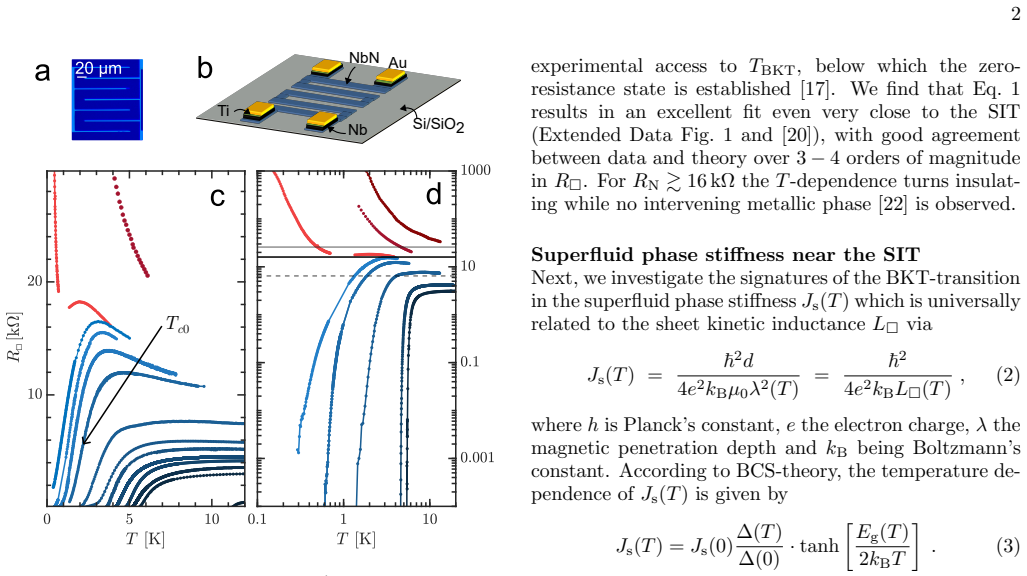
The argument is carried by three objects: the superfluid phase stiffness $J_s(T)$, extracted from the sheet kinetic inductance in a resonant circuit; the mean-field pairing temperature $T_{c0}$, assigned to the inflection point of $R(T)$ where phase- and amplitude-fluctuation regimes meet; and the BKT universal line $J_s(T_{BKT}) = 2T_{BKT}/\pi$. Resistance in the phase-fluctuation window is fitted to the Halperin-Nelson formula $R(T) = C \exp(-b/\sqrt{T/T_{BKT}-1})$, and $T_{c0}$ is compared with the fermionic suppression formula and with the Ginzburg-Levanyuk correction. Vortex core energy $\mu$ extracted from numerical solution of the Kosterlitz renormalization-group equations links the thermally activated depletion of $J_s$ to vortex-antivortex pairs, and a mapping between normal-state resistance and Anderson disorder strength $W$ ties the experiment to mean-field Bogoliubov-de Gennes simulations of the pairing landscape.
What would settle it
A direct falsifier would be tunneling spectroscopy on the same NbN films for $R_N$ between roughly 12 and 16 kΩ: if the single-particle gap $E_g$ closes as $J_s(0)$ vanishes near the critical resistance, the fermionic (pairing-destruction) scenario is correct; if the gap stays open on the insulating side while the stiffness approaches zero, the phase-fluctuation claim survives. A sharper version is to measure $E_g$ and $J_s(0)$ on the same device and check whether $J_s(0)$ reaches zero at a disorder strength where $E_g$ is still a finite fraction of its clean value.
Extended reading notes
Core claim
On the authors' own terms, the paper establishes that the superconductor-insulator transition in homogeneously disordered two-dimensional NbN films is driven by quantum phase fluctuations. The evidence: as disorder increases toward the critical value, the mean-field pairing temperature $T_{c0}$ extracted from the inflection point of $R(T)$ remains finite and follows the fermionic suppression law, while the zero-temperature superfluid stiffness $J_s(0)$ and the BKT temperature $T_{BKT}$ drop sharply below their mean-field and Ginzburg-Levanyuk expectations. Near the transition $J_s(0)$ and $T_{BKT}$ vanish together, consistent with the universal BKT relation and with $J_s(0) \propto (\delta g)^{\nu}$ and $T_{BKT} \propto (\delta g)^{z\nu}$, where $\delta g = (R_N - R_c)/R_c^2$, $\nu \simeq 0.67$, and $z \simeq 1$. The finite-temperature transition remains of BKT type throughout, so the zero-temperature SIT is a continuous quantum phase transition of the phase variable.
Load-bearing premise
The load-bearing assumption is that the inflection point of the resistance curve continues to mark the mean-field pairing temperature $T_{c0}$ in the high-disorder regime, where the independent quasiparticle cross-check used at lower disorder is no longer available; if the inflection point stops tracking $T_{c0}$ near the SIT, the contrast between a finite $T_{c0}$ and a sharply suppressed $J_s(0)$ collapses.
Editorial extensions
If this is right
- The zero-temperature superconductor-insulator transition in disordered NbN films is a continuous (second-order) quantum phase transition driven by phase fluctuations, not by destruction of the pairing amplitude.
- The finite-temperature transition remains of BKT type up to the critical disorder; the zero-resistance state is always bounded by the BKT line $J_s = 2T/\pi$.
- Very close to the SIT, $J_s(0) \propto (\delta g)^{\nu}$ and $T_{BKT} \propto (\delta g)^{z\nu}$ with $\nu \simeq 0.67$ and $z \simeq 1$, following the bosonic quantum-phase-fluctuation scenario.
- Thermal depletion of superfluid stiffness crosses over from quasiparticle-dominated to vortex-like excitations near the transition, which matters for quantum circuits built from disordered superconductors.
- The SIT in NbN is distinct from the first-order, glassy transition reported in InO$_x$; the difference is attributed to material parameters such as thickness, disorder strength, and screening.
Reading between the lines
- If pairing indeed survives into the insulating phase, one expects a regime of preformed or localized Cooper pairs on the insulating side; a testable prediction is that diamagnetic or kinetic-inductance signatures should continue tracking the gap rather than the stiffness.
- Because the inflection-point $T_{c0}$ is the only anchor for the pairing scale at high disorder, the paper's central contrast would be strengthened by a concurrent tunneling measurement of the single-particle gap on the same films used for stiffness data; the authors note this cross-check is currently missing.
- The $\mu \simeq (\pi^2/2)J_s(0)$ result and the near-power-law stiffness depletion reported in other disordered superconductors suggest that a single vortex-core-energy scale may govern low-temperature electrodynamics of high-kinetic-inductance films; if so, the design rules for microwave circuits should account for vortex excitations rather than only quasiparticles.
- A direct extension of the comparison to other materials with the same combined resistance-plus-stiffness protocol could test whether the order of the transition (continuous versus first-order) is controlled by screening strength and dimensionality, as the authors conjecture.
Editorial analysis
A structured set of objections, weighed in public.
Referee Report
Summary. The manuscript reports a systematic study of the disorder-driven superconductor-insulator transition (SIT) in ultrathin NbN films, measuring both sheet resistance R□(T) and superfluid stiffness Js(T) on the same meander devices for fifteen superconducting and three insulating samples with normal-state resistance up to the critical range 16-18 kΩ. The finite-temperature transition is found to remain of Berezinskii-Kosterlitz-Thouless (BKT) type across the whole superconducting range: Halperin-Nelson fits describe R□(T) over 3-4 decades, and the vortex-unbinding temperature TBKT from resistance agrees with that from the universal stiffness jump Js(TBKT) = 2TBKT/π. The central claim is that close to the SIT the zero-temperature stiffness Js(0) and TBKT drop sharply below the mean-field expectation, quantified through a one-parameter Finkel'stein fit for Tc0 and the Ginzburg-Levanyuk formula, while the pairing temperature Tc0, assigned to the inflection point of R(T), remains finite and follows the Finkel'stein curve. This is interpreted as evidence that the SIT is a second-order quantum phase transition driven by quantum phase fluctuations, with pairing surviving into the insulator, in contrast to the first-order scenario reported for InOx [26]. The paper also reports the vortex-core energy µ and the activation energy E* extracted from the low-temperature stiffness, and comparisons with self-consistent BdG simulations of the pairing amplitude distribution.
Significance. If correct, the main payoff is a clean discrimination between fermionic (pairing-destruction) and bosonic (phase-fluctuation) mechanisms for the SIT in a canonical disordered two-dimensional superconductor, together with the demonstration that the BKT character of the finite-T transition survives up to critical disorder. The manuscript has genuine strengths: simultaneous R□(T) and Js(T) measurements on identical devices; two fully independent determinations of TBKT (Halperin-Nelson resistance fits and the universal stiffness jump) that agree across the entire disorder range, which solidly grounds the BKT-character claim; a cross-check of Js from nonlinear IV characteristics near the SIT (Extended Data Fig. 2); a one-parameter Finkel'stein baseline for Tc0; and falsifiable predictions (power-law suppression of Js(0) and TBKT with z ≃ 1) that connect to quantum-critical scaling. The persistence of the tunneling gap Eg across the SIT (Fig. 3g) gives partial independent support for surviving pairing at strong disorder.
major comments (3)
- [Supplementary Sec. I.E.a and Fig. S7; Fig. 3f; Fig. 2a] The central contrast of the paper—a finite Tc0 (light blue diamonds in Fig. 3f) coexisting with a sharply suppressed Js(0) (black circles) in regime III—rests on identifying Tc0 with the center of the linear segment / inflection point of R(T) at disorder levels where tc0 = (Tc0 - TBKT)/Tc0 reaches 0.65-0.8, i.e., where the phase-fluctuation window is about 80% of Tc0. Supplementary Sec. I.E.a states explicitly that the previous independent sanity check (quasiparticle suppression of Js(T) consistent with Eq. 3) is no longer possible for strongly disordered samples because Js(T) is almost rectangular (Fig. 2a). The near-SIT validation shown in Fig. S7 (red line) is a fit of the same amplitude-fluctuation theory to the same R(T) data that motivates the inflection-point convention, so it does not constitute an independent determination. In the regime tc0 = 0.65-0.8, the curvature crossover that defines the inflection point is itself shaped by the vortex-unbinding regime that spans most of the transition; if the true pairing temperature actually tracks Js(0) and TBKT near Wc, the apparent drop of Js(0) below the mean-field expectation would be an artifact of an overestimated Tc0, and the quantum-phase-fluctuation conclusion would lose its experimental foundation. I request (i) a sensitivity analysis of the Fig. 3f comparison under alternative Tc0 assignments (e.g., extrapolating the low-disorder amplitude-fluctuation fits without anchoring to the inflection point, or bounding Tc0 by the tunneling-gap scale), and (ii) an explicit statement of how much the regime-III Tc0 values would have to change for the claimed drop of Js(0) and TBKT relative to the Finkel'stein baseline to disappear. The zero-temperature tunneling gap Eg persisting into the insulator (Fig. 3g) supports the survival of pairing in the ground state, but it does not by itself pin the temperature scale Tc0, so it does not remove this concern.
- [Methods (Finkel'stein fit, Eq. 6); Fig. 3f; Extended Data Fig. 4] The mean-field baselines against which the regime-III drop is measured are not independent of the disputed Tc0 convention. The black line in Fig. 3f is obtained by inserting the Finkel'stein fit for Tc0(RN)—a one-parameter fit (γc = 5.312, Extended Data Fig. 4) to the very same inflection-point-based Tc0 data—into Eq. 4, and the red line by inserting that fit into Eq. 5. Any systematic error in the inflection-point assignment in regime III therefore enters both the data points and the baselines, and the manuscript does not quantify how robust the regime-III deviation is to this shared input. Please (i) report the residuals and confidence interval of the one-parameter Finkel'stein fit, and (ii) re-examine the deviation of Js(0) and TBKT from the baselines when the Finkel'stein fit is performed on regime I-II data only (RN ≲ 10-12 kΩ) and extrapolated into regime III, where the inflection-point assignment is least constrained. This test would separate the claimed drop from the calibration of the baseline.
- [Fig. 3f inset] The quantum-critical part of the conclusion (second-order transition, z ≃ 1) leans on the power-law analysis in the inset of Fig. 3f, where Js(0) ∝ (δg)^ν and TBKT ∝ (δg)^(zν) are stated to be 'consistent with' ν = 0.67. No fitting procedure, goodness-of-fit, or uncertainty is given, and the number of superconducting samples in regime III is small (of order four). Moreover δg = (Rc - RN)/Rc² depends on Rc, which is only bracketed as 16 kΩ < Rc < 18 kΩ; the resulting spread in δg can be large for near-critical points, and the implied uncertainty in (ν, z) is not propagated. Please provide the fit range, confidence intervals for ν and z, the number of points, and the sensitivity of the exponents to the choice of Rc within the stated bracket. If the exponent is too weakly constrained by the present data, the claim should be softened accordingly, since the first-order-versus-second-order distinction drawn from the InOx comparison in the Summary partly rests on this scaling analysis.
minor comments (7)
- [Abstract] The closing sentence of the abstract invokes the experimental discovery by Haviland, Liu, and Goldman, but the original paper (Phys. Rev. Lett. 62, 2180 (1989)) is not among the references; it should be cited there and where the SIT is introduced in the opening paragraph.
- [Eq. (6) vs. Supplementary Eq. S.11] The definition of the Finkel'stein parameter is inconsistent between the main text (γc = ln[ħ/(kBTc00τ)] in Eq. 6) and the Supplement (γc = 1/log(Tc00τ) in Eq. S.11), and the supplementary form is dimensionally inconsistent as written. Since γc = 5.312 is the single free parameter of the central baseline fit, the two definitions must be reconciled.
- [Main text, 'Similarly, Eq. 5 ...' and 'Close to the SIT ...' paragraphs] The universal BKT relation appears with an inverted factor in two places: 'TBKT = 2Js(TBKT)/π' and 'Js(TBKT) = πTBKT/2' should both read Js(TBKT) = 2TBKT/π (equivalently TBKT = (π/2)Js(TBKT)); elsewhere the paper uses the correct form (Fig. 2 caption), so this is presumably a typographical slip, but it should be corrected because the 2/π factor is invoked in the inset of Fig. 3f.
- [Methods; Supplementary Sec. I.D.c; Extended Data Fig. 4 caption] Several typographical errors should be cleaned up: 'One film film with lower disorder' (Methods), 'previous tudies' (Supplementary Sec. I.D.c), 'the the measured Tc0' (Methods, analysis of Tc0), and 'Rychaudhuri' (Extended Data Fig. 4 caption, for Raychaudhuri).
- [References [10], [12], [56]] The Kosterlitz 1974 paper is cited twice with different page numbers (J. Phys. C 7, 1060 in [10] and 1046 in [56]); reference [12] also contains a garbled author string ('V. Ambegaokar, D. R. N., B. I. Halperin & Siggia, E. D.'). These should be normalized.
- [Methods, two-coil comparison] The claim that broadening in two-coil measurements 'occurs for the two-coil method only' and is caused by roughly 10% edge-to-center variations of Js(0) and RN is supported only by an 'in preparation' citation; since this claim is used to reinterpret previously published BKT broadening results [27], it should either be presented with its supporting data or clearly flagged as preliminary.
- [Abstract and Summary] Given the sensitivity of the Tc0 assignment discussed in the major comments, the phrases 'unambiguous evidence for quantum phase fluctuations' (Abstract) and 'strongly suggest' (Summary) overstate the present support; I recommend qualifying these statements until the near-SIT Tc0 determination is independently corroborated.
Circularity Check
No circularity: the central deviation is an observed quantity compared against semi-empirical baselines, and the acknowledged missing cross-check is a validation gap, not a reduction of the conclusion to its inputs.
full rationale
Walking the paper's derivation chain, the central claim is an observed comparison: the measured superfluid stiffness Js(0) and BKT temperature TBKT deviate from semi-empirical baselines near the SIT, while Tc0 does not. The baselines are constructed from a one-parameter Finkel'stein fit to Tc0(RN) together with standard BCS and BKT relations (Eqs. 4 and 5); the measured Js(0) and TBKT are not inputs to that fit, so the reported sharp drop is not statistically forced. The extraction of Tc0 from the R(T) inflection point (Supplementary Sec. I.E.a) is a definitional convention, and the authors explicitly state that the independent quasiparticle suppression cross-check is no longer possible for strongly disordered samples. This is a real validation gap for the finite-Tc0 claim, but it is not a circular reduction: no equation equates the conclusion to the definition of Tc0, and the paper does not claim to derive Tc0 from the phase-fluctuation scenario. Self-citations ([19], [20], [21], [25]) are used for methods, fit forms, and computational procedures, not as the sole justification of the central conclusion. The BKT character is tested against standard Halperin-Nelson fits over 3–4 decades of resistance, which could have failed, and TBKT is also cross-checked independently via Js(TBKT)=2TBKT/pi. The RN-to-W mapping via tc0 is a coordinate calibration with explicitly listed caveats, not a hidden prediction. No fitted parameter is renamed as the claimed result, no uniqueness theorem is imported from the authors' prior work, and no ansatz is smuggled in solely through self-citation. The paper is therefore self-contained in the sense required for a circularity finding.
Assumptions & free parameters
free parameters (6)
- gamma_c in Finkel'stein fit =
5.312
- Numerical conversion factor for Js =
42.0 K/t
- Numerical conversion factor for Eg and E* =
113.4 K/t
- TLS subtraction parameters f0(0) and F*delta0_TLS =
F*delta0_TLS = 0.191
- Power-law exponent nu =
0.67
- Halperin-Nelson fit parameters C, b, TBKT per sample =
reported per sample
assumptions (7)
- standard math The zero-resistance transition in a 2D superconductor is governed by the BKT mechanism, including the Halperin-Nelson resistance form and the universal jump Js(TBKT) = 2 TBKT / pi.
- standard math The superfluid stiffness follows the Mattis-Bardeen/BCS form Eq. 3, with Eg and Delta allowed to differ.
- domain assumption Finkel'stein theory describes the fermionic suppression of Tc0 with a single parameter gamma_c.
- ad hoc to paper The inflection point of R(T) marks the mean-field pairing temperature Tc0 even at high disorder where the phase fluctuation window spans 80% of Tc0.
- domain assumption The level of disorder is represented by the normal-state resistance RN = R(Tmax), and RN maps to Anderson disorder W through the dimensionless ratio (Tc0 - TBKT)/Tc0 common to experiment and BdG numerics.
- domain assumption The attractive-U BdG mean-field model on a 96x96 lattice captures the relevant physics of the NbN films.
- standard math Two-level system contributions to the resonance frequency are described by Eq. S.9 and can be subtracted using a fit.
Cite this review
Pith. "Pith review of Origin of the superconductor-insulator transition in disordered two-dimensional films." pith.science (2026). https://pith.science/paper/FFUM6HNH
@misc{pith2026260807101,
  author       = {Pith},
  title        = {Pith review of: Origin of the superconductor-insulator transition in disordered two-dimensional films},
  year         = {2026},
  howpublished = {\url{https://pith.science/paper/FFUM6HNH}},
  note         = {Machine review of arXiv:2608.07101}
}
abstract
Theory predicts the superconductor-to-insulator transition (SIT) to emerge from the competition between Anderson localization, which tends to localize single-particle wavefunctions, and superconductivity, which establishes long-range correlations in the superconducting order parameter. In two-dimensional (2D) superconducting films, the transition temperature $T_\text{c}$ at which resistance vanishes, $R_\Box(T_\text{BKT}){=}0$, is set by the Berezinskii-Kosterlitz-Thouless (BKT) mechanism and satisfies $T_\text{BKT}< T_{c0}$, where $T_{c0}$ is the mean-field transition temperature. In weakly disordered samples $T_\text{BKT}\lesssim T_{c0}$, whereas increasing disorder drives $T_\text{BKT}\ll T_{c0}$ near the SIT. Whether the finite-temperature transition retains its BKT character throughout this crossover remains an open question. Here, we investigate the evolution of both sheet resistance $R_\Box(T)$ and superfluid stiffness $J_s(T)$ over a wide range of disorder strength $W$. We establish that even near the SIT, the finite-temperature transition from the superconducting to the resistive state remains of BKT type. However, as disorder approaches the critical value, the zero temperature superfluid phase stiffness, $J_s(0)$, is found to vanish rapidly while $T_{c0}$ remains finite, which we attribute to quantum phase fluctuations as the drive for the zero-temperature transition. Three decades after its experimental discovery by Haviland, Liu, and Goldman, our measurements clarify the origin of the SIT in 2D films.
Figures


Figures from the paper (3 more)


Reference graph
Works this paper leans on
-
[26]
Charpentier, T.et al.First-order quantum breakdown of superconductivity in an amorphous superconductor.Nat. Phys.21, 104–109 (2025)
work page 2025
-
[1]
Sondhi, S. L., Girvin, S. M., Carini, J. P. & Shahar, D. Continuous quantum phase transitions.Rev. Mod. Phys. 69, 315–333 (1997)
work page 1997
-
[2]
Gantmakher, V. F. & Dolgopolov, V. T. Superconductor–insulator quantum phase transition. Phys.–Usp.53, 1–49 (2010). 7
work page 2010
-
[3]
Finkel’stein, A. M. Suppression of superconductivity in homogeneously disordered systems.Physica B Condens. Matter197, 636–648 (1994)
work page 1994
-
[4]
Fisher, M. P., Weichman, P. B., Grinstein, G. & Fisher, D. S. Boson localization and the superfluid-insulator transition.Phys. Rev. B Condens. Matter40, 546–570 (1989)
work page 1989
-
[5]
Fisher, M. P. Quantum phase transitions in disordered two-dimensional superconductors.Phys. Rev. Lett.65, 923–926 (1990)
work page 1990
-
[6]
Fisher, M. P., Grinstein, G. & Girvin, S. M. Presence of quantum diffusion in two dimensions: Universal resis- tance at the superconductor-insulator transition.Phys. Rev. Lett.64, 587–590 (1990)
work page 1990
-
[7]
Emery, V. J. & Kivelson, S. A. Importance of phase fluc- tuations in superconductors with small superfluid den- sity.Nature374, 434–437 (1995)
work page 1995
Show all 59 references
-
[8]
Berezinskii, V. L. Destruction of long-range order in one- dimensional and two-dimensional systems possessing a continuous symmetry group. ii. quantum systems.Zh. Eksp. Teor. Fiz.34, 1144 (1972)
1972
-
[9]
Kosterlitz, J. M. & Thouless, D. J. Ordering, metasta- bility and phase transitions in two-dimensional systems. J. Phys.6, 1181–1203 (1973)
1973
-
[10]
Kosterlitz, J. M. The critical properties of the two- dimensional xy model.J. Phys.7, 1046–1060 (1974)
1974
-
[11]
Halperin, B. I. & Nelson, D. R. Resistive Transition in Superconducting Films.J. Low Temp. Phys.36, 599–616 (1979)
1979
-
[12]
Ambegaokar, D
V. Ambegaokar, D. R. N., B. I. Halperin & Siggia, E. D. Dynamics of superfluid films.Phys. Rev. B.21, 1806– 1826 (1980)
1980
-
[13]
& Ovadyahu, Z
Shahar, D. & Ovadyahu, Z. Superconductivity near the mobility edge.Phys. Rev. B46, 10917–10922 (1992)
1992
-
[14]
Sac´ ep´ e, B.et al.Disorder-induced inhomogeneities of the superconducting state close to the superconductor- insulator transition.Phys. Rev. Lett.101, 157006 (2008)
2008
-
[15]
A.et al.Thickness-tuned superconductor-insulator transitions under magnetic field ina-NbSi.Phys
Marrache-Kikuchi, C. A.et al.Thickness-tuned superconductor-insulator transitions under magnetic field ina-NbSi.Phys. Rev. B Condens. Matter Mater. Phys.78(2008)
2008
-
[16]
Linzen, S.et al.Structural and electrical properties of ultrathin niobium nitride films grown by atomic layer deposition.Superconductor Science and Technology30, 035010 (2017)
2017
-
[17]
I.et al.Superconducting phase transitions in ultrathin TiN films.Europhys
Baturina, T. I.et al.Superconducting phase transitions in ultrathin TiN films.Europhys. Lett.97, 17012 (2012)
2012
-
[18]
L., Aronov, A
Altshuler, B. L., Aronov, A. G. & Khmelnitsky, D. E. Effects of electron-electron collisions with small energy transfers on quantum localisation.J. Phys.15, 7367– 7386 (1982)
1982
-
[19]
J.et al.Berezinskii-kosterlitz-thouless transi- tion in homogeneously disordered superconducting films
K¨ onig, E. J.et al.Berezinskii-kosterlitz-thouless transi- tion in homogeneously disordered superconducting films. Phys. Rev. B92, 214503 (2015)
2015
-
[20]
Supplementary information
-
[21]
Weitzel, A.et al.Sharpness of the berezinskii-kosterlitz- thouless transition in disordered nbn films.Phys. Rev. Lett.131, 186002 (2023)
2023
-
[22]
Kapitulnik, A., Kivelson, S. A. & Spivak, B. Anomalous metals: Failed superconductors.Rev. Mod. Phys.91, 011002 (2019)
2019
-
[23]
& Trivedi, N
Ghosal, A., Randeria, M. & Trivedi, N. Role of spatial amplitude fluctuations in highly disordered s-wave super- conductors.Phys. Rev. Lett.81, 3940–3943 (1998)
1998
-
[24]
& Trivedi, N
Ghosal, A., Randeria, M. & Trivedi, N. Inhomoge- neous pairing in highly disordered s-wave superconduc- tors.Phys. Rev. B65, 014501 (2001)
2001
-
[25]
& Evers, F
Stosiek, M., Lang, B. & Evers, F. Self-consistent-field en- sembles of disordered hamiltonians: Efficient solver and application to superconducting films.Phys. Rev. B101, 144503 (2020)
2020
-
[27]
& Giamarchi, T
Benfatto, L., Castellani, C. & Giamarchi, T. Broaden- ing of the Berezinskii-Kosterlitz-Thouless superconduct- ing transition by inhomogeneity and finite-size effects. Phys. Rev. B80, 214506 (2009)
2009
-
[28]
& Castellani, C
Maccari, I., Benfatto, L. & Castellani, C. Broadening of the Berezinskii-Kosterlitz-Thouless transition by cor- related disorder.Phys. Rev. B96, 060508 (2017)
2017
-
[29]
Dieplinger,et al
J. Dieplinger,et al. in preparation
-
[30]
Weitzel,et al
A. Weitzel,et al. in preparation (2026)
2026
-
[31]
& Varlamov, A.Theory of fluctuations in superconductors
Larkin, A. & Varlamov, A.Theory of fluctuations in superconductors. International Series of Monographs on Physics (Oxford University Press, London, England, 2005)
2005
-
[32]
D.et al.Electric field control of the LaAlO3/SrTiO3 interface ground state.Nature456, 624–627 (2008)
Caviglia, A. D.et al.Electric field control of the LaAlO3/SrTiO3 interface ground state.Nature456, 624–627 (2008)
2008
-
[33]
A.et al.Electrostatic tuning of the superconductor-insulator transition in two dimensions
Parendo, K. A.et al.Electrostatic tuning of the superconductor-insulator transition in two dimensions. Phys. Rev. Lett.94, 197004 (2005)
2005
-
[34]
Aubin, H.et al.Magnetic-field-induced quan- tum superconductor-insulator transition inNb0.15Si0.85. Phys. Rev. B Condens. Matter Mater. Phys.73(2006)
2006
-
[35]
Chand, M.et al.Phase diagram of the strongly disordereds-wave superconductor NbN close to the metal- insulator transition.Phys. Rev. B Condens. Matter Mater. Phys.85(2012)
2012
-
[36]
Mondal, M.et al.Phase Fluctuations in a Strongly Disordereds-Wave NbN Superconductor Close to the Metal-Insulator Transition.Phys. Rev. Lett.106, 047001 (2011)
2011
-
[37]
Noat, Y.et al.Unconventional superconductivity in ul- trathin superconducting nbn films studied by scanning tunneling spectroscopy.Phys. Rev. B88, 014503 (2013)
2013
-
[38]
Carbillet, C.et al.Confinement of superconducting fluctuations due to emergent electronic inhomogeneities. Phys. Rev. B93, 144509 (2016)
2016
-
[39]
& Giamarchi, T
Benfatto, L., Castellani, C. & Giamarchi, T. Berezin- skii–Kosterlitz–Thouless transition within the sine- Gordon approach: The role of the vortex-core en- ergy.40 Years of Berezinskii–Kosterlitz–Thouless Theory 161–199 (2013)
2013
-
[40]
V., Charpentier, T., Roch, N., Sac´ ep´ e, B
Khvalyuk, A. V., Charpentier, T., Roch, N., Sac´ ep´ e, B. & Feigel’man, M. V. Near power-law temperature depen- dence of the superfluid stiffness in strongly disordered superconductors.Phys. Rev. B.109(2024)
2024
-
[41]
Levy-Bertrand, F.et al.Electrodynamics of granular aluminum from superconductor to insulator: Observa- tion of collective superconducting modes.Phys. Rev. B. 99(2019)
2019
-
[42]
2607.20096
Sharma, M.et al.Power-law suppression of superfluid stiffness in high-kinetic-inductance NbN films (2026). 2607.20096
2026 arXiv
-
[43]
I., Mironov, A
Baturina, T. I., Mironov, A. Y., Vinokur, V. M., Bak- lanov, M. R. & Strunk, C. Localized superconductiv- 8 ity in the quantum-critical region of the disorder-driven superconductor-insulator transition in TiN thin films. Phys. Rev. Lett.99, 257003 (2007)
2007
-
[44]
Sac´ ep´ e, B.et al.High-field termination of a cooper-pair insulator.Phys. Rev. B Condens. Matter Mater. Phys. 91(2015)
2015
-
[45]
& Feigel’man, M
Poboiko, I. & Feigel’man, M. V. Mean-field theory of first-order quantum superconductor-insulator transition. SciPost Phys.17(2024)
2024
-
[46]
Mondal, M.et al.Role of the Vortex-Core Energy on the Berezinskii-Kosterlitz-Thouless Transition in Thin Films of NbN.Phys. Rev. Lett.107, 217003 (2011)
2011
-
[47]
Baumgartner, C.et al.Josephson Inductance as a Probe for Highly Ballistic Semiconductor-Superconductor Weak Links.Phys. Rev. Lett.126, 037001 (2021)
2021
-
[48]
R., Benfatto, L., Ilin, K
Yong, J., Lemberger, T. R., Benfatto, L., Ilin, K. & Siegel, M. Robustness of the Berezinskii-Kosterlitz- Thouless transition in ultrathin NbN films near the superconductor-insulator transition.Phys. Rev. B87, 184505 (2013)
2013
-
[49]
Mandal, S.et al.Destruction of superconductivity through phase fluctuations in ultrathina-MoGe films. Phys. Rev. B102, 060501 (2020)
2020
-
[50]
Hebard, A. F. & Fiory, A. T. Critical-exponent measure- ments of a two-dimensional superconductor.Phys. Rev. Lett.50, 1603–1606 (1983)
1983
-
[51]
P., Vissers, M
Pappas, D. P., Vissers, M. R., Wisbey, D. S., Kline, J. S. & Gao, J. Two level system loss in superconducting mi- crowave resonators.IEEE Trans. Appl. Supercond.21, 871–874 (2011)
2011
-
[52]
Phd thesis, Universit¨ at Regensburg, Univer- sit¨ at Regensburg (2021)
Fuchs, L.Interplay of Spin-Orbit Interaction and Two- Dimensional Superconductivity in Al/InAs Heterostruc- tures. Phd thesis, Universit¨ at Regensburg, Univer- sit¨ at Regensburg (2021). Available athttps://epub. uni-regensburg.de/50819
2021
-
[53]
Glatz, A., Varlamov, A. A. & Vinokur, V. M. Fluctu- ation spectroscopy of disordered two-dimensional super- conductors.Phys. Rev. B Condens. Matter Mater. Phys. 84(2011)
2011
-
[54]
V.et al.Superconducting phase tran- sitions in disordered NbTiN films.Sci
Burdastyh, M. V.et al.Superconducting phase tran- sitions in disordered NbTiN films.Sci. Rep.10, 1471 (2020)
2020
-
[55]
Finkel’stein, A M, A. M. Superconductivity-transition temperature in amorphous films.Pisma v Zhur- nal Eksperimentalnoi i Teoreticheskoi Fiziki45, 37–40 (1987)
1987
-
[56]
Kosterlitz, J. M. The critical properties of the two- dimensional xy-model.J. Phys. C: Solid State Phys.7, 1046 (1974)
1974
-
[57]
Nelson, D. R. & Kosterlitz, J. M. Universal Jump in the Superfluid Density of Two-Dimensional Superfluids. Phys. Rev. Lett.39, 1201–1205 (1977)
1977
-
[58]
Lee, P. A. & Ramakrishnan, T. V. Disordered electronic systems.Rev. Mod. Phys.57, 287–337 (1985). Methods Samples and control of the disorder We investigate ALD grown NbN films [16] with a thick- nessd= 3.5±0.3 nm on top of an 550 nm thick amorphous SiO 2 (thermally oxidized s...
1985
-
[100]
One film film with lower disorder (RN ≃880 Ω) was prepared by magnetron sputtering on a MgO substrate and is similar to the films presented in Ref
orientation). One film film with lower disorder (RN ≃880 Ω) was prepared by magnetron sputtering on a MgO substrate and is similar to the films presented in Ref. [46]. For the ALD-grown films, the normal state re- sistance can be controlled in two ways: (i) variation of theN 2...
Reviewed August 10, 2026 · model on record in the stance chip above.
Discussion (0). Continue with ORCID to comment.