REVIEW 4 major objections 4 minor 56 references
Morphology Engineering of Mixed Ionic Electronic Conductors through Aqueous Phase Separation
T0 review · 4 major / 4 minor · reviewed 2026-08-10 · deepseek-v4-flash
Pith's one-line read Interconnected pores from pH-induced aqueous phase separation let 120–200 µm-thick PEDOT:PSS:PEI OECT channels reach 30 mS transconductance and 13 ms response at 0.05 V gate voltage.
desk verdict A promising water-based route to porous OECT channels, but the morphology-dominance claim is not yet proven because composition and pore architecture are confounded. read the letter →
The pith
A machine-rendered reading of the paper's core claim, the machinery that carries it, and where it could break.
The reading
What carries the argument
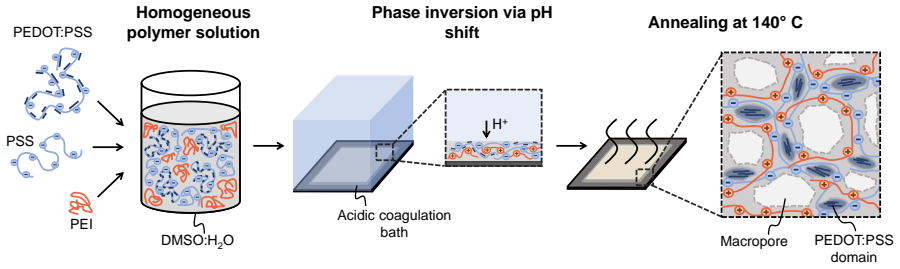
The central object is the interconnected macroporous network formed in PEDOT:PSS:PEI films by aqueous phase separation (APS): casting a homogeneous solution and immersing it in an acidic coagulation bath protonates PEI amines, triggering complexation with PSS sulfonate groups and phase separation into polymer-rich and pore phases. The pore network is what carries the argument: it provides continuous electrolyte-accessible pathways that shorten the effective ion-diffusion length, and it increases the internal surface area available for electrochemical doping. Two auxiliary mechanisms complete the picture: DMSO acts as a secondary dopant that improves PEDOT ordering and electronic connectivity, and annealing at 140 °C triples the film conductivity while consolidating the polyelectrolyte matrix. The 1:2 PSS:PEI ratio matters because it gives near-stoichiometric charge compensation, so the porous architecture survives annealing and rehydration instead of collapsing as the 1:1 film does.
What would settle it
Measure the electronic conductivity of both films in the hydrated state (for example, four-probe or impedance measurements in 0.1 M NaCl) and determine the electrochemically active volume from thickness-dependent capacitance. If the wet conductivity of the 1:1 film is markedly lower than the 1:2 film, or if the transconductance normalized by electrochemically active volume is the same for both morphologies, the claim that pore connectivity dominates the performance difference would be falsified.
Extended reading notes
Core claim
On its own terms, the paper's central claim is that an interconnected pore network generated by pH-triggered aqueous phase separation lets a thick OECT channel combine high amplification with fast switching, because electrolyte can penetrate the channel volume instead of modulating only the outer surface. The evidence is a side-by-side comparison of PSS:PEI 1:1 and 1:2 films coagulated in 1 M H2SO4: the two have comparable dry electronic conductivity, but the 1:2 film keeps a well-connected porous architecture after annealing and rehydration, whereas the 1:1 film largely collapses and swells. The 1:2 device reaches a maximum transconductance of 30 ± 6.4 mS at $V_G = 0.05$ V and a response time of 13 ms, against 18 ± 5.3 mS and 39 ms for the 1:1 device, despite both channels being 120–200 µm thick. The authors attribute the difference to shorter local ion-transport distances and a larger electrochemically addressable volume supplied by the pores, with DMSO treatment and annealing preserving electronic percolation in the PEDOT-rich phase. They are careful to state that the resulting operation is consistent with a shift from surface-limited toward spatially distributed mixed ionic-electronic transport, and that quantitative confirmation would require impedance, capacitance, and ionic-conductivity measurements.
Load-bearing premise
The load-bearing premise is that the two film compositions have essentially the same electronic conductivity when wet and operating inside the transistor, even though only dry two-probe conductivities were measured; the 1:1 film is described as swelling more strongly in water, which could lower its hydrated conductivity and explain part of the performance gap without invoking pore connectivity.
Editorial extensions
If this is right
- Thick OECT channels no longer necessarily sacrifice speed: the interconnected pore network allows high transconductance and short response time to be achieved together.
- Internal morphology becomes a design parameter that complements molecular structure and device geometry, so optimizing pore connectivity and electronic-phase continuity should be part of OECT design.
- The water-based APS route produces freestanding, processable porous films without freeze-drying, aerogel processing, or templating, offering a scalable fabrication path for thick-channel devices.
- The best formulation in the paper, PSS:PEI 1:2 coagulated in 1 M H2SO4 with DMSO and annealing, reaches 15.65 mS/cm conductivity, 30 mS transconductance, and 13 ms response in a 120–200 µm channel.
- Direct confirmation of fully volumetric modulation still requires quantitative measurements of volumetric capacitance, ionic conductivity, and diffusion impedance, as the paper itself states.
Reading between the lines
- A direct test the paper does not run: if pore connectivity is the active ingredient, then filling or collapsing the pores after film formation (for example, by infiltrating an insulating gel) should erase the transconductance and speed advantage while leaving the dry conductivity roughly unchanged.
- Because the 1:1 film swells more, its hydrated electronic conductivity is plausibly lower than the 1:2 film; a wet four-probe measurement could attribute part of the 66.7% transconductance gap to electronic conductivity rather than pore architecture, which would soften the morphology-dominance claim.
- The same aqueous phase separation route should transfer to other weak polyelectrolyte/conducting-polymer pairs, so that pore size, tortuosity, and phase continuity could be screened as independent variables for any mixed ionic-electronic conductor, not only PEDOT:PSS.
- If the volumetric-modulation picture is right, the normalized transconductance of these thick films (currently 0.069–0.08 mS/µm) should improve with optimized width and length without changing the material, because the pore network already provides volumetric access; the paper's own geometry normalization leaves this implication implicit.
Editorial analysis
A structured set of objections, weighed in public.
Referee Report
Summary. This manuscript reports a water-based fabrication route, pH-induced aqueous phase separation, for producing porous PEDOT:PSS:PEI films, and it characterizes the resulting morphology, dry electronic conductivity, and organic electrochemical transistor performance. The central claim is that an interconnected pore network increases electrolyte access and reduces effective ion-transport distance, so that thick (>100 µm) channels can simultaneously achieve high transconductance and fast response; the authors present a comparison of PSS:PEI 1:1 and 1:2 films as their most direct evidence. The paper also contains explicit acknowledgements that impedance, capacitance, and ion-transport measurements are needed to confirm volumetric modulation, which is a genuine strength of the presentation.
Significance. If the central claim were fully supported, the work would establish internal morphology as an independent design parameter for mixed ionic-electronic conductors and would offer a scalable, water-based alternative to freeze-drying, aerogel, and hydrogel-templating routes. The paper is also valuable for clearly situating itself against recent literature on the chemistry-dependent role of porosity and for stating its own limitations. However, the current experimental design does not yet isolate morphology from composition and device geometry, so the significance is conditional on additional control experiments or a substantially more cautious interpretation.
major comments (4)
- [§1.3.3 and Table 1] The central morphology-dominance claim rests on comparing PSS:PEI 1:1 and 1:2 films, but these films differ in PEI content (3.4 vs 5.8 wt%, Table 1) as well as in pore architecture. The manuscript itself states that 'incorporation of PEI may further support ion transport by increasing water uptake and lowering the elastic modulus of the hydrated matrix' (§1.3.3), which provides a composition-based mechanism independent of pore connectivity. Because the dry two-probe conductivity match in Figure 3 does not control for hydrated electronic conductivity, ionic conductivity, or volumetric capacitance, the 66.7% higher transconductance of the 1:2 device cannot be uniquely attributed to morphology. The authors should either add wet-state impedance or capacitance measurements, use thickness-matched and composition-controlled devices, or soften the 'morphology as the dominant factor' claim.
- [§1.3.2 vs §1.1] The claim that 'both devices have identical macroscopic geometries' (Section 1.3.2) is contradicted by the reported nonuniform film thicknesses of approximately 80–200 µm in Section 1.1 for the very samples used. Since transconductance scales with channel thickness, a systematic thickness difference between the 1:1 and 1:2 devices could explain part of the observed 66.7% transconductance increase without invoking pore connectivity. Please report the thickness of each measured device, normalize per-device geometry, or use thickness-matched films for the central comparison.
- [§3.4 and §1.1] The electronic conductivity used to match the two compositions is measured on dry, air-dried films by a two-probe method (Section 3.4), whereas the OECT operates in an aqueous electrolyte. Section 1.1 states that the 1:1 film swells more strongly in water, which would lower its hydrated electronic conductivity and alter its ionic accessibility. Therefore the dry conductivity overlap in Figure 3 does not exclude conductivity differences under operating conditions. Wet-state conductivity or electrochemical impedance data are needed before pore connectivity can be identified as the dominant variable.
- [Abstract and §3.7] The abstract states that porous channels achieve 'a transconductance of 30 mS and a response time of 13 ms at an ultralow gate voltage of 0.05 V', but the transient response is measured for a gate-voltage step from 0 to 0.6 V (Section 3.7). The 0.05 V value is the gate bias at which the transconductance peaks, not the bias condition used for the 13 ms response time. This conflation of two different operating conditions in the abstract should be corrected.
minor comments (4)
- [§1.3.4] The thickness range is reported as 80–200 µm in Section 1.1 but as 120–200 µm in Section 1.3.4; please harmonize the two descriptions or explain why the ranges differ.
- [Figure 5B] The normalized transconductance is introduced as gm,n = gm,max/(W d L^-1), but the units and the exact definition of 'mS/µm' should be stated explicitly in the caption so that comparison with literature values is unambiguous.
- [§3.7] The text uses 'reaction time' when describing the 90% saturation time; this should be replaced with 'response time' for consistency with the rest of the manuscript.
- [Figure 4] The text refers to 'Figure 4 D–E' for transconductance, but the figure panel labels are not described in the caption; please make the panel labeling consistent between the text, figure, and caption.
Circularity Check
No significant circularity: all central claims are direct measurements, and self-citations are limited to methods and background.
full rationale
This paper contains no mathematical derivation chain or fitted model; every central performance claim (30 mS transconductance, 13 ms response time, pore-network retention) is a directly reported measurement, not a quantity produced by substituting inputs into an equation. The morphology-dominance interpretation rests on an empirical two-composition comparison (PSS:PEI 1:1 vs 1:2) with matched dry two-probe conductivity, and while that comparison is confounded by composition and hydrated-state unknowns, confounding is a correctness risk, not a circularity. The self-citations are not load-bearing evidence for the performance claims: Rauer et al. [56] is cited only as the protocol for the two-probe conductivity measurement; Restrepo et al. [26] is cited as background for aqueous phase separation; Baig et al. [23] is cited for pH-shift-induced PEI:PSS complexation. None of these supplies the transconductance, response time, or pore-connectivity result. The paper explicitly flags its own missing validation: Section 1.3.3 states that 'Direct determination of ionic conductivity, electronic conductivity, volumetric capacitance, and diffusion impedance by electrochemical impedance spectroscopy or thickness-dependent capacitance measurements would provide quantitative validation of the proposed transport mechanism,' and Section 1.3.4 states that 'A definitive demonstration of complete volumetric modulation would nevertheless require thickness-dependent capacitance or impedance measurements.' These are honest limitations, not disguised inputs. No fitted parameter is renamed as a prediction, no uniqueness theorem is imported from the authors' prior work, and no ansatz is smuggled in by citation. The 'most direct evidence' passage is an observed correlation between morphology and device metrics, not a derivation that reduces to its own assumptions. Under the hard rules, an unverified assumption about hydrated conductivity is not circularity, so the appropriate verdict is no significant circularity.
Assumptions & free parameters
free parameters (2)
- DMSO content =
25 wt%
- Annealing temperature and time =
140°C, 90 min
assumptions (4)
- domain assumption The dry two-probe conductivity measurement reflects the electronic conductivity of the hydrated film during OECT operation.
- domain assumption The freeze-dried SEM cross-sections preserve the pore structure of the hydrated films.
- ad hoc to paper Only primary and secondary amine groups of branched PEI participate effectively in charge compensation.
- domain assumption The compared 1:1 and 1:2 OECT devices have identical macroscopic geometry (W and L), and thickness differences do not confound the comparison.
Cite this review
Pith. "Pith review of Morphology Engineering of Mixed Ionic Electronic Conductors through Aqueous Phase Separation." pith.science (2026). https://pith.science/paper/MLXMSKDB
@misc{pith2026260807130,
  author       = {Pith},
  title        = {Pith review of: Morphology Engineering of Mixed Ionic Electronic Conductors through Aqueous Phase Separation},
  year         = {2026},
  howpublished = {\url{https://pith.science/paper/MLXMSKDB}},
  note         = {Machine review of arXiv:2608.07130}
}
read the original abstract
The performance of organic electrochemical transistors (OECTs) is fundamentally governed by the interplay between ionic accessibility and electronic transport within organic mixed ionic-electronic conductors. Although increasing channel thickness enhances transconductance, it also prolongs ion transport, resulting in the well-known gain-speed trade-off. Here, we demonstrate that engineering the internal morphology of PEDOT:PSS:PEI films through pH-induced aqueous phase separation provides an effective route to mitigate this limitation. The resulting interconnected pore network promotes electrolyte penetration and increases the electrochemically addressable volume, while DMSO treatment and annealing enhance the continuity and ordering of the PEDOT-rich electronic phase. Consequently, porous OECT channels achieve a transconductance of 30 mS and a response time of 13 ms at an ultralow gate voltage of 0.05 V despite channel thicknesses exceeding 100 um. Comparison of films with comparable electronic conductivity but different pore architectures identifies morphology as the dominant factor governing device performance, supporting a transition from predominantly surface-limited modulation toward spatially distributed mixed ionic-electronic transport. Beyond demonstrating a scalable water-based fabrication strategy, this work establishes internal morphology as a design parameter that complements molecular structure and device geometry in organic mixed conductors, providing a general framework for the development of high-performance OECTs, soft bioelectronics, and future neuromorphic materials.
Figures


Figures from the paper (2 more)


Reference graph
Works this paper leans on
-
[1]
Omid Yaghmazadeh, Fabio Cicoira, Daniel A Bernards, Sang Y Yang, Yvan Bonnassieux, and George G Malliaras. Optimization of organic electrochemical transistors for sensor applications.Journal of Polymer Science, Part B: Polymer Physics, 49:34–39, 2011
work page 2011
-
[2]
Peter Andersson Ersman, Roman Lassnig, Jan Strandberg, Deyu Tu, Vahid Keshmiri, Robert Forchheimer, Simone Fabiano, Göran Gustafsson, and Magnus Berggren. All- printed large-scale integrated circuits based on organic electrochemical transistors.Nature Communications, 10:5053, 2019
work page 2019
-
[3]
Organic electrochemical transistors (oects) toward flexible and wearable bioelectronics, 2020
Ariana Villarroel Marquez, Niall McEvoy, and Amir Pakdel. Organic electrochemical transistors (oects) toward flexible and wearable bioelectronics, 2020
work page 2020
-
[4]
Flexible and stretchable organic electrochemical transistors for physiological sensing devices, 2023
Yao Yao, Wei Huang, Jianhua Chen, Xiaoxue Liu, Libing Bai, Wei Chen, Yuhua Cheng, Jianfeng Ping, Tobin J Marks, and Antonio Facchetti. Flexible and stretchable organic electrochemical transistors for physiological sensing devices, 2023
work page 2023
-
[5]
Gregg P Kittlesen, Henry S White, and Mark S Wrighton. Chemical derivatization of microelectrode arrays by oxidation of pyrrole and n-methylpyrrole: Fabrication of molecule- based electronic devices.Journal of the American Chemical Society, 106:7389–7396, 1984
work page 1984
-
[6]
How does pedot combine with pss? insights from structural studies.RSC Advances, 4:43912–43920, 2014
Rupali Gangopadhyay, Bidisa Das, and Mijanur Rahaman Molla. How does pedot combine with pss? insights from structural studies.RSC Advances, 4:43912–43920, 2014
work page 2014
-
[7]
Ehsan Hosseini, Vinayaraj Ozhukil Kollath, and Kunal Karan. The key mechanism of conductivity in pedot:pss thin films exposed by anomalous conduction behaviour upon solvent-doping and sulfuric acid post-treatment.Journal of Materials Chemistry C, 8:3982– 3990, 2020
work page 2020
- [8]
Show all 56 references
-
[9]
Irina Crˇ aciun, Zsolt Miklós Kovács- Vajna, Paul W.M
Matteo Ghittorelli, Leona Lingstedt, Paolo Romele, N. Irina Crˇ aciun, Zsolt Miklós Kovács- Vajna, Paul W.M. Blom, and Fabrizio Torricelli. High-sensitivity ion detection at low voltages with current-driven organic electrochemical transistors.Nature Communications, 9(1):1–10, 2018
2018
-
[10]
Koutsouras, Dion Khodagholy, Marc Ramuz, Xenofon Strakosas, Roisin M
Jonathan Rivnay, Pierre Leleux, Marc Ferro, Michele Sessolo, Adam Williamson, Dimitrios A. Koutsouras, Dion Khodagholy, Marc Ramuz, Xenofon Strakosas, Roisin M. Owens, Christian Benar, Jean-Michel Badier, Christophe Bernard, and George G. Malliaras. High-performance transistor...
2015
-
[11]
Simple approach for building high transconductance paper-based organic electrochemical transistor (oect) for chemical sensing.ACS Applied Electronic Materials, 3:1886–1895, 2021
Adil Ait Yazza, Pascal Blondeau, and Francisco J Andrade. Simple approach for building high transconductance paper-based organic electrochemical transistor (oect) for chemical sensing.ACS Applied Electronic Materials, 3:1886–1895, 2021
2021
-
[12]
Friedlein, Robert R
Jacob T. Friedlein, Robert R. McLeod, and Jonathan Rivnay. Device physics of organic electrochemical transistors, 12 2018
2018
-
[13]
Organic thin-film transistors for chemical and biological sensing, 2012
Peng Lin and Feng Yan. Organic thin-film transistors for chemical and biological sensing, 2012
2012
-
[14]
High performance fully inkjet-printed organic electrochemical transistor (oect) based sensor.SSRN Electronic Journal, 169:87518, 2022
Walid AlChamaa and Massoud Khraiche. High performance fully inkjet-printed organic electrochemical transistor (oect) based sensor.SSRN Electronic Journal, 169:87518, 2022
2022
-
[15]
3d conducting polymer platforms for electrical control of protein conformation and cellular functions.Journal of Materials Chemistry B, 3:5040–5048, 2015
Alwin Ming Doug Wan, Sahika Inal, Tiffany Williams, Karin Wang, Pierre Leleux, Luis Estevez, Emmanuel P Giannelis, Claudia Fischbach, George G Malliaras, and Delphine Gourdon. 3d conducting polymer platforms for electrical control of protein conformation and cellular functions...
2015
-
[16]
Nanofiber channel organic electrochemical transistors for low-power neuromorphic computing and wide-bandwidth sensing platforms
SolKyuLee, YoungWoonCho, JongSungLee, YoungRanJung, SeungHyunOh, JeongYun Sun, Sang Bum Kim, and Young Chang Joo. Nanofiber channel organic electrochemical transistors for low-power neuromorphic computing and wide-bandwidth sensing platforms. Advanced Science, 8:2001544, 2021
2021
-
[17]
Marks, and Antonio Facchetti
Lizhen Huang, Zhi Wang, Jianhua Chen, Binghao Wang, Yao Chen, Wei Huang, Lifeng Chi, Tobin J. Marks, and Antonio Facchetti. Porous semiconducting polymers enable high-performance electrochemical transistors.Advanced Materials, 33(14):2007041, 2021
2021
-
[18]
Nanoporous conjugated poly- mer aerogel films for high-performance electrochemical transistors.Advanced Functional Materials, 34(52):2410788, 2024
Zhenyu Hu, Puzhong Gu, Xiao Yang, Zejun Sun, Linlin Lu, Xing Liang, Xiaoyu Zhang, Zhiying Deng, Muxiang Liu, Guoqing Zu, and Jia Huang. Nanoporous conjugated poly- mer aerogel films for high-performance electrochemical transistors.Advanced Functional Materials, 34(52):2410788, 2024
2024
-
[19]
Electrical characteristics of porous-structured PEDOT:PSS channel organic electrochemical transistor for biosensing applications.MRS Communications, 16(2):443–448, 2025
Kensuke Ito and Toshiya Sakata. Electrical characteristics of porous-structured PEDOT:PSS channel organic electrochemical transistor for biosensing applications.MRS Communications, 16(2):443–448, 2025
2025
-
[20]
Cunin, Rebecca F
Geon Gug Yang, Camille E. Cunin, Rebecca F. Meacham, Sang Ouk Kim, and Aristide Gumyusenge. A material-agnostic strategy for uniform patterning of conjugated polymers unveils the true role of porosity in organic electrochemical transistors.Advanced Functional Materials, page 7...
2026
-
[21]
Herzig, Mukundan Thelakkat, Keying Guo, and Christopher R
Qizhe Tang, Isabelle Barwick, Qi Han, Benjamin Watts, Lars Thomsen, Julian Hungenberg, Matthew Gebert, Fabian Eller, Eva M. Herzig, Mukundan Thelakkat, Keying Guo, and Christopher R. McNeill. Tuning mixed conduction between ionic and electronic transport in blended OMIECs via ...
2026
-
[22]
Malliaras, and Shiming Zhang
Dingyao Liu, Jing Bai, Xinyu Tian, Yan Wang, Binbin Cui, Shilei Dai, Wensheng Lin, Zhuowen Shen, Chun Kit Lai, George G. Malliaras, and Shiming Zhang. Increasing the dimensionality of transistors with hydrogels.Science, 390(6775):824–830, November 2025. 18
2025
-
[23]
Sustainable aqueous phase separation membranes prepared through mild ph shift induced polyelectrolyte complexation of pss and pei.Journal of Membrane Science, 625:119114, 2021
Muhammad Irshad Baig, Putu Putri Indira Sari, Jiaying Li, Joshua D Willott, and Wiebe M de Vos. Sustainable aqueous phase separation membranes prepared through mild ph shift induced polyelectrolyte complexation of pss and pei.Journal of Membrane Science, 625:119114, 2021
2021
-
[24]
Versatile and high-throughput polyelectrolyte complex membranes via phase inversion.ACS Applied Materials and Interfaces, 11:16018–16026, 2019
Kazi Sadman, David E Delgado, Yechan Won, Qifeng Wang, Kimberly A Gray, and Kenneth R Shull. Versatile and high-throughput polyelectrolyte complex membranes via phase inversion.ACS Applied Materials and Interfaces, 11:16018–16026, 2019
2019
-
[25]
Organic solvent-free polyelectrolyte complex membrane preparation: Effect of monomer mixing ratio and casting solution temperature.Journal of Membrane Science, 668:121197, 2023
Md Mizanul Haque Mizan, Masoud Rastgar, Sadegh Aghapour Aktij, Asad Asad, Pooria Karami, Ahmad Rahimpour, and Mohtada Sadrzadeh. Organic solvent-free polyelectrolyte complex membrane preparation: Effect of monomer mixing ratio and casting solution temperature.Journal of Membra...
2023
-
[26]
Self-supporting biocatalytic polyelectrolyte complex hollow fiber membranes via salt-dilution induced phase separation.Journal of Membrane Science, 689:122157, 2024
Maria A Restrepo, Stephan Emonds, Ang Zhao, Fehmi Karakas, Johannes Kamp, Hannah Roth, and Matthias Wessling. Self-supporting biocatalytic polyelectrolyte complex hollow fiber membranes via salt-dilution induced phase separation.Journal of Membrane Science, 689:122157, 2024
2024
-
[27]
Polyelectrolyte complexes.Industrial & Engineering Chemistry, 57(10):32– 40, 1965
Alan S Michaels. Polyelectrolyte complexes.Industrial & Engineering Chemistry, 57(10):32– 40, 1965
1965
-
[28]
The polyelectrolyte complex/coacervate continuum
Qifeng Wang and Joseph B Schlenoff. The polyelectrolyte complex/coacervate continuum. Macromolecules, 47:3108–3116, 2014
2014
-
[29]
Influence of non- stoichiometry on the viscoelastic properties of a polyelectrolyte complex.Macromolecules, 54:7890–7899, 2021
Yuhui Chen, Mo Yang, Samir Abou Shaheen, and Joseph B Schlenoff. Influence of non- stoichiometry on the viscoelastic properties of a polyelectrolyte complex.Macromolecules, 54:7890–7899, 2021
2021
-
[30]
Itamar Willner, Yoav Eichen, Arthur J Frank, and Marye Anne Fox. Photoinduced electron- transfer processes using organized redox-functionalized bipyridinium-polyethylenimine-tio2 colloids and particulate assemblies.Journal of Physical Chemistry, 97:7264–7271, 1993
1993
-
[31]
Biophysical characterization of pei/dna complexes.Journal of pharmaceutical sciences, 92:1710–1722, 2003
Sirirat Choosakoonkriang, Brian A Lobo, Gary S Koe, Janet G Koe, and C Russell Middaugh. Biophysical characterization of pei/dna complexes.Journal of pharmaceutical sciences, 92:1710–1722, 2003
2003
-
[32]
Xiufeng Hu, Hongbo Wang, Jianhai Yang, Wenguang Liu, and Wei Wang. Introducing primary and tertiary amino groups into a neutral polymer: A simple way to fabricating highly efficient nonviral vectors for gene delivery.Journal of Applied Polymer Science, 131, 2014
2014
-
[33]
Protonation of polyethylenimine.Journal of Macromolecular Science—Chemistry, 23:801–804, 1986
Sara Harden and Nick Loverro. Protonation of polyethylenimine.Journal of Macromolecular Science—Chemistry, 23:801–804, 1986
1986
-
[34]
Characterization of commercially available and synthesized polyethylenimines for gene delivery.Journal of Controlled Release, 69:309–322, 2000
Anke Von Harpe, Holger Petersen, Youxin Li, and Thomas Kissel. Characterization of commercially available and synthesized polyethylenimines for gene delivery.Journal of Controlled Release, 69:309–322, 2000. 19
2000
-
[35]
Water and the glass transition temperature in a polyelectrolyte complex.ACS Macro Letters, 6:1114–1118, 2017
Jingcheng Fu, Rachel L Abbett, Hadi M Fares, and Joseph B Schlenoff. Water and the glass transition temperature in a polyelectrolyte complex.ACS Macro Letters, 6:1114–1118, 2017
2017
-
[36]
A theoretical mechanistic study on electrical conductivity enhancement of dmso treated pedot:pss.Journal of Materials Chemistry C, 6:5122–5131, 2018
Erol Yildirim, Gang Wu, Xue Yong, Teck Leong Tan, Qiang Zhu, Jianwei Xu, Jianyong Ouyang, Jian Sheng Wang, and Shuo Wang Yang. A theoretical mechanistic study on electrical conductivity enhancement of dmso treated pedot:pss.Journal of Materials Chemistry C, 6:5122–5131, 2018
2018
-
[37]
On the mechanism of conductivity enhancement in poly(3,4- ethylenedioxythiophene):poly(styrene sulfonate) film through solvent treatment.Polymer, 45:8443–8450, 2004
Jianyong Ouyang, Qianfei Xu, Chi Wei Chu, Yang Yang, Gang Li, and Joseph Shinar. On the mechanism of conductivity enhancement in poly(3,4- ethylenedioxythiophene):poly(styrene sulfonate) film through solvent treatment.Polymer, 45:8443–8450, 2004
2004
-
[38]
Simultaneously enhancing the cohesion and electrical conductivity of pedot:pss conductive polymer films using dmso additives.ACS Applied Materials and Interfaces, 8:302–310, 2016
Inhwa Lee, Gun Woo Kim, Minyang Yang, and Taek Soo Kim. Simultaneously enhancing the cohesion and electrical conductivity of pedot:pss conductive polymer films using dmso additives.ACS Applied Materials and Interfaces, 8:302–310, 2016
2016
-
[39]
Recent advances of synthesis, properties, film fabrication methods, modifications of poly(3,4-ethylenedioxythiophene), and applications in solution-processed photovoltaics, 2020
Youyu Jiang, Tiefeng Liu, and Yinhua Zhou. Recent advances of synthesis, properties, film fabrication methods, modifications of poly(3,4-ethylenedioxythiophene), and applications in solution-processed photovoltaics, 2020
2020
-
[40]
Role of the interface on electron transport in electro-conductive polymer-matrix composite: A review, 2021
Raj Kumar Mondal, Kumar Abhinav Dubey, and Yatender Kumar Bhardwaj. Role of the interface on electron transport in electro-conductive polymer-matrix composite: A review, 2021
2021
-
[41]
CRC Press, 2019
Nara Kim, Ioannis Petsagkourakis, Shangzhi Chen, Magnus Berggren, Xavier Crispin, Magnus P Jonsson, and Igor Zozoulenko.Electric Transport Properties in PEDOT Thin Films, pages 45–128. CRC Press, 2019
2019
-
[42]
Progress in understanding structure and transport properties of pedot-based materials: A critical review, 2020
Magatte N Gueye, Alexandre Carella, Jérôme Faure-Vincent, Renaud Demadrille, and Jean Pierre Simonato. Progress in understanding structure and transport properties of pedot-based materials: A critical review, 2020
2020
-
[43]
Processing optimization of pedot:pss and pedot:pss/tween 80 films.Polymer Journal, 55:253–260, 2023
Joseph L Carter, Catherine A Kelly, and Mike J Jenkins. Processing optimization of pedot:pss and pedot:pss/tween 80 films.Polymer Journal, 55:253–260, 2023
2023
-
[44]
Saloplastics: Processing compact polyelectrolyte complexes.Advanced Materials, 27:2420–2432, 2015
Pierre Schaaf and Joseph B Schlenoff. Saloplastics: Processing compact polyelectrolyte complexes.Advanced Materials, 27:2420–2432, 2015
2015
-
[45]
Chan, and Shiming Zhang
Xinyu Tian, Dingyao Liu, Jing Bai, Kai San Chan, Long Ching Ip, Paddy K.L. Chan, and Shiming Zhang. Pushing oects toward wearable: Development of a miniaturized analytical control unit for wireless device characterization.Analytical Chemistry, 94:6156–6162, 2022
2022
-
[46]
Applications of poly (3,4- ethylenedioxythiophene):poly(styrene sulfonate) transistors in chemical and biological sensors.Chemical Record, 8:13–22, 2008
Maria Nikolou and George G Malliaras. Applications of poly (3,4- ethylenedioxythiophene):poly(styrene sulfonate) transistors in chemical and biological sensors.Chemical Record, 8:13–22, 2008
2008
-
[47]
Ponder, Andrew Wadsworth, Alexander Giovannitti, and Iain McCulloch
Maximilian Moser, James F. Ponder, Andrew Wadsworth, Alexander Giovannitti, and Iain McCulloch. Materials in organic electrochemical transistors for bioelectronic applications: Past, present, and future, 2019. 20
2019
-
[48]
Lateral intercalation-assisted ionic transport towards high-performance organic electrochemical transistor.Nature Communications 2024 15:1, 15:1–10, 11 2024
Chaoyi Yan, Lanyi Xiang, Yu Xiao, Xuefeng Zhang, Ziling Jiang, Boya Zhang, Chenyang Li, Siyu Di, and Fengjiao Zhang. Lateral intercalation-assisted ionic transport towards high-performance organic electrochemical transistor.Nature Communications 2024 15:1, 15:1–10, 11 2024
2024
-
[49]
Malliaras
Dion Khodagholy, Jonathan Rivnay, Michele Sessolo, Moshe Gurfinkel, Pierre Leleux, Leslie H Jimison, Eleni Stavrinidou, Thierry Herve, Sébastien Sanaur, Róisín M Owens, and George G. Malliaras. High transconductance organic electrochemical transistors.Nature Communications, 4:...
2013
-
[50]
An all-solid-state biocompatible ion-to- electron transducer for bioelectronics.Materials Horizons, 5:256–263, 2018
M Sheliakina, A B Mostert, and Paul Meredith. An all-solid-state biocompatible ion-to- electron transducer for bioelectronics.Materials Horizons, 5:256–263, 2018
2018
-
[51]
Ionic-liquid doping enables high transconductance, fast response time, and high ion sensitivity in organic electrochemical transistors.Advanced Materials, 31:1805544, 2019
Xihu Wu, Abhijith Surendran, Jieun Ko, Oliver Filonik, Eva M Herzig, Peter Müller- Buschbaum, and Wei Lin Leong. Ionic-liquid doping enables high transconductance, fast response time, and high ion sensitivity in organic electrochemical transistors.Advanced Materials, 31:1805544, 2019
2019
-
[52]
Ion buffering and interface charge enable high performance electronics with organic electro- chemical transistors.Nature Communications, 10:3044, 2019
Paolo Romele, Matteo Ghittorelli, Zsolt Miklós Kovács-Vajna, and Fabrizio Torricelli. Ion buffering and interface charge enable high performance electronics with organic electro- chemical transistors.Nature Communications, 10:3044, 2019
2019
-
[53]
3d printed high transconductance organic electrochemical transistors on flexible substrates.Organic Electronics, 73:122–129, 2019
Jiaxin Fan, Carlo Montemagno, and Manisha Gupta. 3d printed high transconductance organic electrochemical transistors on flexible substrates.Organic Electronics, 73:122–129, 2019
2019
-
[54]
Breathable and stretchable organic electrochemical transistors with laminated porous structures for glucose sensing.Sensors, 23:6910, 8 2023
Haihong Guo, Changjian Liu, Yujie Peng, Lin Gao, and Junsheng Yu. Breathable and stretchable organic electrochemical transistors with laminated porous structures for glucose sensing.Sensors, 23:6910, 8 2023
2023
-
[55]
Boosting the performance of pedot:pss based electronics via ionic liquids, 3 2024
Yang Li, Yuncong Pang, Liwei Wang, Qiqi Li, Baoguang Liu, Jianmin Li, Shujuan Liu, and Qiang Zhao. Boosting the performance of pedot:pss based electronics via ionic liquids, 3 2024
2024
-
[56]
Pedot:pss-cnt composite particles overcome contact resistances in slurry electrodes for flow-electrode capacitive deionization.Advanced Functional Materials, 33:2303606, 2023
Sebastian Bernhard Rauer, Siqi Wang, Niklas Köller, Daniel Josef Bell, Yunpeng Zhang, Xuejiao Wang, Christian J Linnartz, Matthias Wessling, and John Linkhorst. Pedot:pss-cnt composite particles overcome contact resistances in slurry electrodes for flow-electrode capacitive de...
2023
Reviewed August 10, 2026 · model on record in the stance chip above.
Discussion (0). Continue with ORCID to comment.