REVIEW 3 major objections 5 minor 64 references
Emergent magnetic pseudogap from phase fluctuations and hierarchy of scales in two-dimensional superconductors
T0 review · 3 major / 5 minor · reviewed 2026-08-10 · deepseek-v4-flash
Pith's one-line read Pure phase fluctuations, with no competing order, produce the magnetic pseudogap in two-dimensional superconductors and, for s-wave pairing, a normal-state coherence peak in $1/T_1T$.
desk verdict A clean, honest extension of the phase-fluctuation program to NMR; the s-wave vertex-correction scale 2.22ℓ is a truncation-dependent prediction that needs a closer look, but the magnetic-pseudogap result is robust and the paper deserves refereeing. read the letter →
The pith
A machine-rendered reading of the paper's core claim, the machinery that carries it, and where it could break.
The reading
What carries the argument
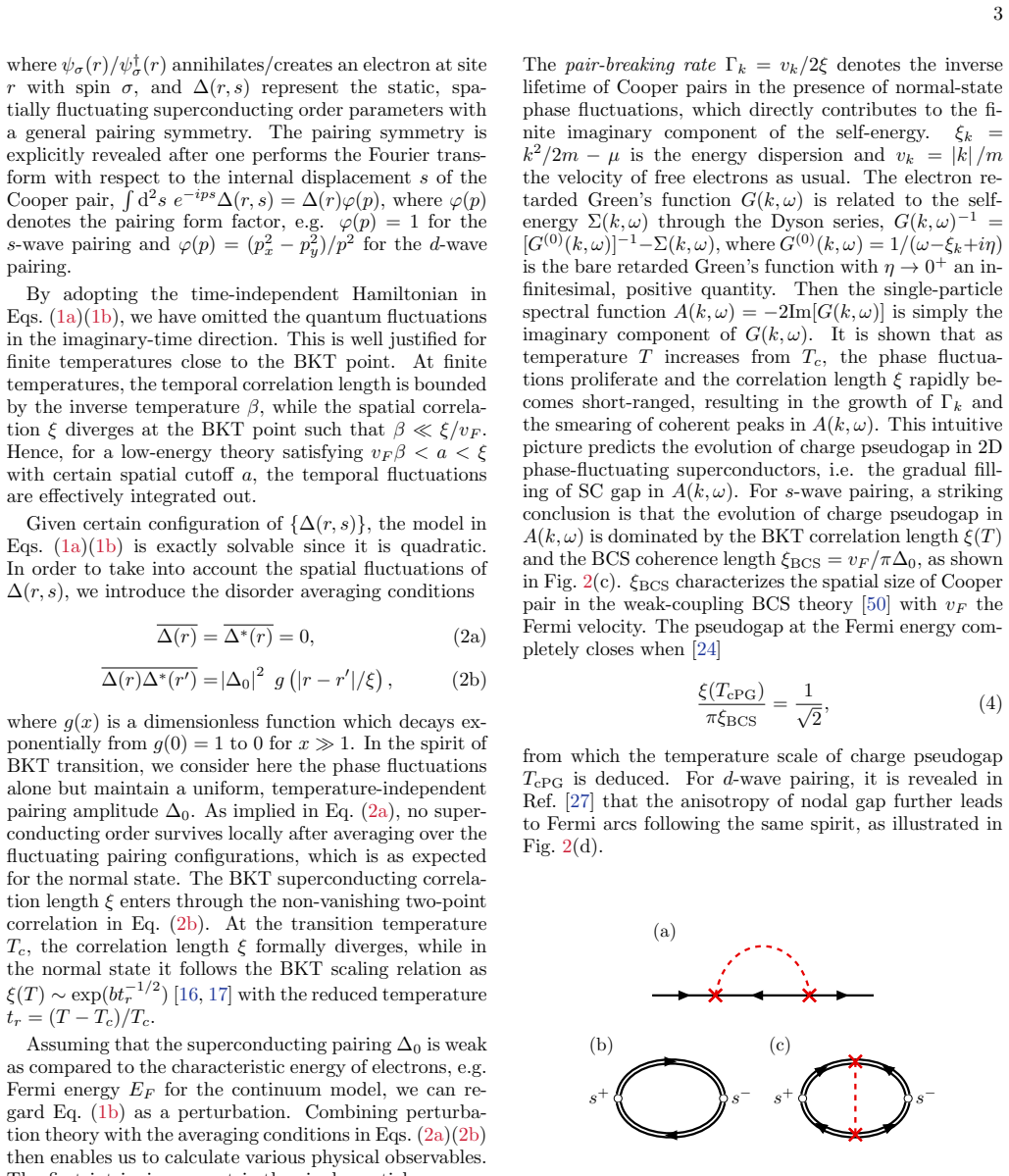
The load-bearing machinery is the phase-fluctuating spectral function generated by the disorder-averaged pairing correlation. The two central identities are the Gaussian correlator $\langle\Delta(r)\Delta^*(r')\rangle = |\Delta_0|^2 \exp(-|r-r'|^2/2\xi^2)$ and the self-energy $\Sigma(k,\omega) = |\Delta_k|^2/(\omega+\xi_k+2i\Gamma_k)$ with pair-breaking rate $\Gamma_k = v_k/2\xi$; this self-energy turns the BKT correlation length $\xi(T)$ into a scale for the smearing of the spectral peaks, so that all single-particle pseudogap physics is expressed as a competition between $\xi(T)$ and the BCS coherence length $\xi_{\mathrm{BCS}} = v_F/\pi\Delta_0$. On top of this, the Kubo formula $1/T_1T = (2|A_{\mathrm{hf}}|^2/V)\sum_q \lim_{\omega\to 0^+} \mathrm{Im}\,\chi^{-+}(q,\omega)/\omega$ converts the spectral functions into the spin response, with the bubble term (Eq. 13) carrying the magnetic pseudogap and the leading vertex term (Eqs. 14a, 14b) carrying the $s$-wave coherence peak whose divergence is regularized by the scattering length $\ell = v_F/\Gamma_0$. The emergence of all temperature scales from length ratios is what the authors call the hierarchy of scales.
What would settle it
Run a sign-problem-free quantum Monte Carlo simulation of the attractive-U Hubbard model in two dimensions and compute the NMR relaxation rate $1/T_1T$, or perform NMR on a quasi-2D $s$-wave superconductor with tunable disorder. The central claim would be falsified if the normal-state $1/T_1T$ does not begin to drop when the BKT correlation length reaches $\xi_{\mathrm{BCS}}$, if an $s$-wave system with small $\Gamma_0$ shows no normal-state coherence peak just above $T_c$, if a $d$-wave system shows such a peak, or if the onset of the $s$-wave peak obeys a ratio $\xi(T_{\mathrm{coh}})/\ell$ far from $2.22(3)$ while the Gaussian correlator is in force.
Extended reading notes
Core claim
The central discovery, stated on the paper's own terms, is that a magnetic pseudogap — a smooth suppression of $1/T_1T$ beginning well above $T_c$ — is an unavoidable consequence of phase-only superconducting fluctuations in two dimensions, and that the same fluctuation physics reproduces the charge pseudogap and (for $d$-wave pairing) Fermi arcs without invoking any competing order. The calculation is carried out in a quadratic Hamiltonian with static, spatially fluctuating pairing $\Delta(r)$ whose correlation is $\langle\Delta(r)\Delta^*(r')\rangle = |\Delta_0|^2 e^{-|r-r'|^2/2\xi^2}$, and the resulting Born self-energy $\Sigma(k,\omega)=|\Delta_k|^2/(\omega+\xi_k+2i\Gamma_k)$, with $\Gamma_k=v_k/2\xi$, supplies a pair-breaking rate controlled by the BKT correlation length. In the weak-fluctuating regime $k_F\xi \gg 1$, the bubble contribution to $1/T_1T$ drops rapidly when $\xi(T)$ becomes comparable to $\xi_{\mathrm{BCS}}$, defining the magnetic-pseudogap scale $T_{\mathrm{mPG}}$; numerically $\xi(T_{\mathrm{mPG}})/\xi_{\mathrm{BCS}}$ lies between about 0.5 and 0.7 and is essentially independent of $\ell$. The leading vertex correction is exactly zero for $d$-wave pairing in this regime (the nodal form factor kills the angular integral), but for $s$-wave pairing it diverges at $T_c$ because the spectral function develops an infinitely sharp coherence peak at the gap edge. A finite background scattering rate $\Gamma_0$, equivalently a length $\ell=v_F/\Gamma_0$, regularizes this divergence and turns it into a normal-state coherent enhancement of $1/T_1T$, with the numerical scaling $\xi(T_{\mathrm{coh}})/\ell = 2.22(3)$; the authors identify this effect as the normal-state analogue of the Hebel-Slichter peak. The paper further extracts the dip scale $T_m$ and shows that the full $1/T_1T$ curve is organized by the competition among $\xi(T)$, $\xi_{\mathrm{BCS}}$, and $\ell$.
Load-bearing premise
The calculation assumes the pairing amplitude keeps a fixed size while its phase wanders with a Gaussian bell-shaped spatial correlation of width $\xi$, that only the leading-order self-energy is kept, and that the weak-fluctuation regime $k_F\xi \gg 1$ holds; if the actual fluctuations are non-Gaussian, if the amplitude itself shrinks with temperature, or if the scattering rate $\Gamma_0$ depends on temperature, the numerical ratios $\xi(T_{\mathrm{mPG}})/\xi_{\mathrm{BCS}}\approx 0.5\text{--}0.7$ and $\xi(T_{\mathrm{coh}})/\ell = 2.22(3)$ could shift or smear.
Editorial extensions
If this is right
- In any quasi-2D superconductor with preformed pairs, $1/T_1T$ should start falling well above $T_c$ even with no spin gap, and the fall begins when the BKT correlation length $\xi(T)$ is comparable to the BCS coherence length $\xi_{\mathrm{BCS}}$.
- The magnetic-pseudogap temperature $T_{\mathrm{mPG}}$ is a distinct energy scale, separate from both $T_c$ and $\Delta_{\mathrm{SC}}$, and can be predicted from the known BKT correlation length and the weak-coupling value $\xi_{\mathrm{BCS}}=v_F/\pi\Delta_0$.
- For $s$-wave pairing, a coherent enhancement of $1/T_1T$ in the normal state just above $T_c$ should appear when the background scattering is weak enough ($\ell > \ell^*$), with its onset scale fixed by $\xi(T_{\mathrm{coh}}) \approx 2.22\,\ell$; this is the phase-fluctuation analogue of the Hebel-Slichter peak.
- For $d$-wave pairing, the vertex correction is negligible, so no normal-state coherence peak is expected; the absence of such a peak in nodal superconductors is consistent with the theory.
- Measuring $\xi(T_{\mathrm{mPG}})$ and $\xi(T_{\mathrm{coh}})$ from NMR data would provide a direct extraction of $\xi_{\mathrm{BCS}}$ and $\ell$, making $1/T_1T$ a quantitative probe of the coherence and scattering hierarchy.
Reading between the lines
- The same hierarchy of $\xi(T)$, $\xi_{\mathrm{BCS}}$, and $\ell$ likely controls other two-particle probes, such as the optical conductivity or Raman response, so the paper's picture could be tested without NMR; a normal-state coherence peak in $s$-wave systems might show up there too.
- The Gaussian assumption for $\langle\Delta\Delta^*\rangle$ is an input, not a derivation; if real BKT fluctuations produce a different short-distance correlator, the numerical ratios 0.5–0.7 and 2.22(3) may change even though the qualitative competition of lengths survives.
- A clean experimental test would be a quasi-2D $s$-wave superconductor with weak disorder: the theory predicts a double feature in $1/T_1T$ — first a pseudogap drop, then a rise just above $T_c$ — which is unusual and easy to look for.
- Including spin fluctuations (which the paper explicitly sets aside) might suppress the $s$-wave coherence peak, as it does for the BCS Hebel-Slichter peak, so the predicted normal-state peak is most likely to be seen in systems with weak magnetic correlations.
Editorial analysis
A structured set of objections, weighed in public.
Referee Report
Summary. The manuscript studies the NMR spin-lattice relaxation rate 1/T1T in two-dimensional superconductors with strong phase fluctuations. Building on the authors' previous Gaussian-disorder description of static superconducting phase fluctuations, they evaluate the spin susceptibility in perturbation theory, keeping the bubble diagram and the leading vertex correction. For both s-wave and d-wave pairing, they find a magnetic pseudogap in the normal state whose onset is set by the competition between the BKT correlation length ξ(T) and the BCS coherence length ξ_BCS (Eq. 16). For s-wave pairing, the vertex correction leads to a normal-state coherent enhancement of 1/T1T, regularized by a background scattering rate Γ0; the associated coherence scale is claimed to satisfy ξ(T_coh)/ℓ = 2.22(3) with ℓ = v_F/Γ0 (Eq. 17, Fig. 7d). The vertex correction is shown to vanish for d-wave in the large-ξ limit. The paper argues that the full temperature dependence of 1/T1T can be understood as an interplay of the three length scales ξ(T), ξ_BCS, and ℓ.
Significance. The proposed mechanism is physically appealing and, if correct, would unify the charge pseudogap, magnetic pseudogap, and Hebel-Slichter-like coherence effects in quasi-2D superconductors without invoking competing orders. The paper's main strength is that it makes specific, falsifiable predictions: the magnetic pseudogap scale is tied to ξ_BCS, and the coherent enhancement scale is linear in ℓ. The analytic demonstration of the d-wave suppression of the vertex correction is elegant. The authors also point to a recent independent Monte Carlo study (Ref. [60]) that finds a normal-state coherence peak in s-wave BKT superconductors, which supports the qualitative conclusion. The numerical integrations are carried out with a documented adaptive Monte Carlo method. However, the quantitative s-wave prediction rests on a one-loop truncation whose validity near the transition is not established.
major comments (3)
- [III B, Eqs. (14a)-(14b), Fig. 7] The headline ratio ξ(T_coh)/ℓ = 2.22(3) is extracted from the leading-order vertex correction, but the perturbative expansion in |Δ0|² is not controlled in the regime where the coherence scale is determined. From Eq. (3), the on-shell self-energy is Σ(k_F,0) ≈ −i |Δ0|² ξ/v_F, so |Σ|/E_F ≈ (1/2)(Δ0/E_F)² k_F ξ (for m=1). With the parameters of Fig. 7 (E_F=2, Δ0/E_F=1/4, Γ0/Δ0=0.05) and the claimed scaling ξ(T_coh)=2.22ℓ, one finds k_F ξ ~ 350 and |Σ|/E_F ~ 10, i.e., the self-energy is no longer a small correction. The higher-order vertex diagrams of the same Gaussian model carry additional factors of |Δ0|² ξ/v_F and are therefore of order one in this regime; no small parameter justifies their neglect. The regularization by Γ0 makes the leading vertex finite, but it does not by itself make the one-loop truncation reliable. Thus the derivative maximum that defines ξ(T_coh), and the fitted ratio 2.22(3), may be an artifact of the truncation. The authors should either compute the exact disorder average for the Gaussian model (feasible in principle since the model is quadratic) to test the one-loop result, or provide an explicit estimate of the omitted diagrams and restrict the quantitative claim to a regime where the expansion parameter |Δ0|² ξ/v_F ≪ 1.
- [II A, Eq. (3) and Sec. III B] The paper does not provide any estimate of the size of the omitted higher-order self-energy and vertex diagrams. The only stated smallness condition is that Δ0 ≪ E_F (Sec. II A), but the actual expansion parameter for the disorder average is |Δ0|² ξ/v_F, which diverges as T → T_c. Even if the Dyson resummation of the leading self-energy is accepted, the consistency of the approximation requires a conservation law or a small dimensionless parameter; neither is demonstrated. The analogy with the Hebel-Slichter peak is suggestive, but in BCS theory the coherence peak is obtained from a nonperturbative anomalous Green's function, whereas here the normal-state vertex is computed only to leading order. I would like the authors to state clearly the range of ξ (or T) for which the perturbative treatment is valid, and to provide a numerical estimate of the first neglected diagram (e.g., the two-vertex diagram) in that range.
- [III A, Eq. (16), Fig. 5] The magnetic pseudogap scale is identified with the maximum of the derivative of (1/T1T)_bd with respect to log(ξ_BCS/ξ). This is a reasonable operational definition, but the resulting coefficient ξ(T_mPG)/ξ_BCS ≈ 0.5–0.7 is obtained for a single Gaussian correlation function and for fixed Γ0. The paper would be strengthened by showing that this coefficient is insensitive to the shape of g(x) and to the regularization Γ0, or by stating explicitly that only the parametric scaling (Eq. 16) is claimed to be universal. Without such a check, the 'quantitative' hierarchy in Fig. 5 may be partly a model artifact.
minor comments (5)
- [II A, Eq. (3)] The symbol ξ is used both for the BKT correlation length and for the single-particle dispersion ξ_k in Eq. (3). This is confusing; consider using ε_k or ζ_k for the dispersion.
- [II A] The statement that the temporal fluctuations are integrated out uses β ≪ ξ/v_F; this condition breaks down well above T_c where ξ becomes short. The model is therefore best justified only in a window near T_c, which conflicts with the use of the same formalism to describe the high-temperature Fermi-liquid limit.
- [III B] The comparison with the recent Monte Carlo study (Ref. [60]) is only qualitative. A side-by-side plot of the normalized 1/T1T from the two approaches, or a table of the extracted ξ(T_mPG) and ξ(T_coh) values, would substantially increase confidence in the leading-order vertex result.
- [III B, Fig. 7(d)] The linear regression in Fig. 7(d) is performed over four points at each β|Δ0|; the reported uncertainty 2.22(3) is the statistical fit error. It would be useful to state the number of independent Monte Carlo samples used in the vegas integration and the criteria for convergence, as the numerical error may be correlated across points.
- [Introduction, final paragraph] The phrase 'quantitatively in a unified picture' overstates the certainty given the uncontrolled truncation; suggest softening to 'semi-quantitatively' or adding a caveat about the perturbative regime.
Circularity Check
No significant circularity: the magnetic pseudogap and coherent-enhancement scales are computed outputs of the stated model, not assumed inputs.
full rationale
The paper does not exhibit the circularity patterns targeted by this pass. The magnetic pseudogap scale is obtained by computing the bubble contribution to 1/T1T from the interacting Green's function, locating the maximal derivative of (1/T1T)_bd versus log(ξ_BCS/ξ), and then comparing the resulting ξ(T_mPG) with ξ_BCS (Eq. 16; Figs. 4-5). That relation is a numerical output, not a definitional input. Similarly, the s-wave coherent-enhancement scale is extracted by evaluating the leading-order vertex correction Eq. (14), identifying ξ(T_coh) as the maximum of the derivative, and then regressing ξ(T_coh) against ℓ to obtain the coefficient 2.22(3) (Fig. 7d). The claim ξ(T_coh) ~ ℓ is an established numerical result, not a pre-imposed assumption; although dimensional analysis makes a linear relation natural, the coefficient is computed. The framework does rely on the authors' prior derivations, especially the self-energy Eq. (3) from Refs. [24,27], and on the stated Gaussian pairing-correlation ansatz. This is a normal and explicit use of prior work, and the cited prior results are not themselves the target claims of this paper. The bubble contribution is explicitly related to the square of the single-particle density of states, so the magnetic-pseudogap suppression is tied to the previously studied charge pseudogap; this is a stated consequence of the model rather than a circular renaming. Concerns about the uncontrolled one-vertex truncation near Tc are substantive accuracy/validity concerns, not circularity, because the calculation still follows from the stated perturbative expansion rather than assuming the conclusion.
Assumptions & free parameters
free parameters (5)
- Pairing amplitude Δ0 =
0.6 (Fig. 2), EF/4 (Figs. 4-8)
- Background scattering rate Γ0 =
0.01-0.4
- BKT exponent b =
1.4
- BKT length prefactor ξ0 =
0.1
- Inverse transition temperature βc =
7.75 (Fig. 2)
assumptions (5)
- standard math Kubo formula and fluctuation-dissipation theorem relate 1/T1T to the imaginary part of the transverse spin susceptibility (Eq. 8).
- domain assumption The BKT correlation length diverges as ξ(T) = ξ0 exp(b t_r^{-1/2}) near Tc.
- ad hoc to paper Phase fluctuations are static, Gaussian-distributed, with a uniform temperature-independent pairing amplitude Δ0 and correlation exp(-|r-r'|^2/2ξ^2).
- ad hoc to paper Leading-order Born self-energy (Eq. 3) and perturbation theory in |Δ0|^2 with a one-loop vertex correction suffice for the normal state.
- ad hoc to paper The Tc divergence in 1/T1T is regularized by a temperature-independent background scattering Γ0.
Cite this review
Pith. "Pith review of Emergent magnetic pseudogap from phase fluctuations and hierarchy of scales in two-dimensional superconductors." pith.science (2026). https://pith.science/paper/HCAVNY42
@misc{pith2026260807238,
  author       = {Pith},
  title        = {Pith review of: Emergent magnetic pseudogap from phase fluctuations and hierarchy of scales in two-dimensional superconductors},
  year         = {2026},
  howpublished = {\url{https://pith.science/paper/HCAVNY42}},
  note         = {Machine review of arXiv:2608.07238}
}
abstract
Preformed pairs and phase fluctuations are believed to play a vital role in predicting the charge pseudogap in the normal state of two-dimensional superconductors. In this work, we extend this idea and further identify the emergent magnetic pseudogap from pure phase fluctuations without invoking any competing order. We examine the NMR relaxation rate $1/T_1T$ by evaluating the bubble contribution and leading-order vertex correction within perturbation theory. It is found that the magnetic pseudogap, manifesting as a smooth suppression of $1/T_1T$ in the normal state, is characterized by a temperature scale $T_\text{mPG}$ distinct from the superconducting gap $\Delta_\text{SC}$ and transition temperature $T_c$. The onset scales of both charge and magnetic pseudogap are dominated by the competition of BKT correlation length $\xi(T)$ and BCS coherence length $\xi_\text{BCS}$. Moreover, the vertex correction is shown to be irrelevant for $d$-wave pairing, while it becomes prominent in $s$-wave systems and drives a coherent enhancement of $1/T_1T$ at lower temperatures just above $T_c$. We attribute this normal-state enhancement of $1/T_1T$ to the diverging coherence peak at the $s$-wave superconducting gap edge, which shares the same spirit as the celebrated Hebel-Slichter peak in the BCS theory. Analogous to the coherent Hebel-Slichter peak, regularization by Fermi-liquid-like scatterings is important and is characterized by a scattering length $\ell$. The normal-state coherent enhancement of $1/T_1T$ is hence described by the competition of $\xi(T)$ and $\ell$, through which the coherence scale $T_\text{coh}$ is determined. As a result, the complete evolution of $1/T_1T$ is understood quantitatively in a unified picture as the interplay among hierarchy of scales $\xi(T)$, $\xi_\text{BCS}$ and $\ell$.
Figures


Figures from the paper (4 more)


Reference graph
Works this paper leans on
-
[60]
Z. Li, W. Hong, H. Zhou, X. Ma, U. Stuhr, K. Zeng, L. Ma, Y. Xiang, H. Yang, H.-H. Wen, J. Hu, S. Li, and H. Luo, Science China Physics, Mechanics & Astronomy 68, 10.1007/s11433-024-2596-6 (2025)
-
[1]
=S +−(−q, ω→0) by explicitly checking their spec- tral decompositions. Further we define thedynamic transverse spin susceptibilityχ −+(q, ω), the imaginary part of which is related to the structure factor through thefluctuation-dissipation theoremas Im χ−+(q, ω) = 1−e−βω 2 S−+(q, ω). This will eventually give 1/T1T= 2|A hf|2 1 V X q lim ω→0+ Im χ−+(q, ω) ...
-
[2]
M. Hashimoto, I. M. Vishik, R.-H. He, T. P. Devereaux, and Z.-X. Shen, Nature Physics10, 483 (2014)
work page 2014
-
[3]
Keimer, S
B. Keimer, S. A. Kivelson, M. R. Norman, S. Uchida, and J. Zaanen, Nature518, 179 (2015)
2015
-
[4]
J. A. Sobota, Y. He, and Z.-X. Shen, Rev. Mod. Phys. 93, 025006 (2021)
2021
- [5]
-
[6]
B. B. Zhou, S. Misra, E. H. Da Silva Neto, P. Aynajian, R. E. Baumbach, J. D. Thompson, E. D. Bauer, and A. Yazdani, Nature Physics9, 474 (2013)
work page 2013
- [7]
Show all 64 references
-
[8]
Z. Wu, Y. Fang, H. Su, W. Xie, P. Li, Y. Wu, Y. Huang, D. Shen, B. Thiagarajan, J. Adell, C. Cao, H. Yuan, F. Steglich, and Y. Liu, Phys. Rev. Lett.127, 067002 (2021)
2021
-
[9]
Smidman, O
M. Smidman, O. Stockert, E. M. Nica, Y. Liu, H. Yuan, Q. Si, and F. Steglich, Rev. Mod. Phys.95, 031002 (2023)
2023
-
[10]
Song, Y.-L
C.-L. Song, Y.-L. Wang, P. Cheng, Y.-P. Jiang, W. Li, T. Zhang, Z. Li, K. He, L. Wang, J.-F. Jia, H.-H. Hung, C. Wu, X. Ma, X. Chen, and Q.-K. Xue, Science332, 1410 (2011)
2011
-
[11]
B. L. Kang, M. Z. Shi, S. J. Li, H. H. Wang, Q. Zhang, D. Zhao, J. Li, D. W. Song, L. X. Zheng, L. P. Nie, T. Wu, and X. H. Chen, Phys. Rev. Lett.125, 097003 (2020)
2020
-
[12]
B. D. Faeth, S.-L. Yang, J. K. Kawasaki, J. N. Nelson, P. Mishra, C. T. Parzyck, C. Li, D. G. Schlom, and K. M. Shen, Phys. Rev. X11, 021054 (2021)
2021
-
[13]
Jiang, M
X. Jiang, M. Qin, X. Wei, L. Xu, J. Ke, H. Zhu, R. Zhang, Z. Zhao, Q. Liang, Z. Wei, Z. Lin, Z. Feng, F. Chen, P. Xiong, J. Yuan, B. Zhu, Y. Li, C. Xi, Z. Wang, M. Yang, J. Wang, T. Xiang, J. Hu, K. Jiang, Q. Chen, K. Jin, and Z. Zhao, Nature Physics19, 365 (2023)
2023
-
[14]
Y. Cao, V. Fatemi, S. Fang, K. Watanabe, T. Taniguchi, E. Kaxiras, and P. Jarillo-Herrero, Nature556, 43 (2018)
2018
-
[15]
M. Oh, K. P. Nuckolls, D. Wong, R. L. Lee, X. Liu, K. Watanabe, T. Taniguchi, and A. Yazdani, Nature600, 240 (2021)
2021
-
[16]
H. Kim, Y. Choi, C. Lewandowski, A. Thomson, Y. Zhang, R. Polski, K. Watanabe, T. Taniguchi, J. Al- icea, and S. Nadj-Perge, Nature606, 494 (2022)
2022
-
[17]
J. M. Kosterlitz and D. J. Thouless, Journal of Physics C: Solid State Physics6, 1181 (1973)
1973
-
[18]
J. M. Kosterlitz, Journal of Physics C: Solid State Physics 7, 1046 (1974)
1974
-
[19]
Z. A. Xu, N. P. Ong, Y. Wang, T. Kakeshita, and S. Uchida, Nature406, 486 (2000)
2000
-
[20]
S. Wang, Y. Yu, J. Hao, K. Liang, B. Xiang, J. Zhu, Y. Lin, Y. Pan, G. Gu, K. Watanabe, T. Taniguchi, Y. Qi, Y. Zhang, and Y. Wang, National Science Review 11, nwad249 (2023)
2023
-
[21]
Weitzel, L
A. Weitzel, L. Pfaffinger, I. Maccari, K. Kronfeldner, T. Huber, L. Fuchs, J. Mallord, S. Linzen, E. Il’ichev, N. Paradiso, and C. Strunk, Phys. Rev. Lett.131, 186002 (2023)
2023
-
[22]
V. J. Emery and S. A. Kivelson, Nature374, 434 (1995)
1995
-
[23]
Franz and A
M. Franz and A. J. Millis, Phys. Rev. B58, 14572 (1998)
1998
-
[24]
Kwon and A
H.-J. Kwon and A. T. Dorsey, Phys. Rev. B59, 6438 (1999)
1999
-
[25]
Wang and Y
X.-C. Wang and Y. Qi, Phys. Rev. B107, 224502 (2023)
2023
-
[26]
Berg and E
E. Berg and E. Altman, Phys. Rev. Lett.99, 247001 (2007)
2007
-
[27]
Q. Han, T. Li, and Z. D. Wang, Phys. Rev. B82, 052503 (2010)
2010
-
[28]
X.-C. Wang, X. Y. Xu, and Y. Qi, The interplay of phase fluctuations and nodal quasiparticles: ubiquitous fermi arcs in two-dimensional d-wave superconductors (2023), arXiv:2310.05376 [cond-mat.supr-con]
2023
-
[29]
R. E. Walstedt,The NMR Probe of High-Tc Materials and Correlated Electron Systems, 2nd ed. (2018)
2018
-
[30]
L. C. Hebel and C. P. Slichter, Phys. Rev.107, 901 (1957)
1957
-
[31]
L. C. Hebel and C. P. Slichter, Phys. Rev.113, 1504 (1959)
1959
-
[32]
Coleman,Introduction to Many-Body Physics(Cam- bridge University Press, 2015)
P. Coleman,Introduction to Many-Body Physics(Cam- bridge University Press, 2015)
2015
-
[33]
Monien and D
H. Monien and D. Pines, Phys. Rev. B41, 6297 (1990)
1990
-
[34]
Bulut and D
N. Bulut and D. J. Scalapino, Phys. Rev. B45, 2371 (1992)
1992
-
[35]
W. W. Warren, R. E. Walstedt, G. F. Brennert, R. J. Cava, R. Tycko, R. F. Bell, and G. Dabbagh, Phys. Rev. Lett.62, 1193 (1989)
1989
-
[36]
Kambe, H
S. Kambe, H. Yasuoka, A. Hayashi, and Y. Ueda, Phys. Rev. B47, 2825 (1993)
1993
-
[37]
Ya´ suoka, Physica C: Superconductivity282-287, 119 (1997)
H. Ya´ suoka, Physica C: Superconductivity282-287, 119 (1997)
1997
-
[38]
A. Goto, H. Yasuoka, K. Otzschi, and Y. Ueda, Phys. Rev. B55, 12736 (1997)
1997
-
[39]
Grafe, D
H.-J. Grafe, D. Paar, G. Lang, N. J. Curro, G. Behr, J. Werner, J. Hamann-Borrero, C. Hess, N. Leps, R. Klin- geler, and B. B¨ uchner, Phys. Rev. Lett.101, 047003 (2008)
2008
-
[40]
Kotegawa, S
H. Kotegawa, S. Oshiro, Y. Shimizu, H. Tou, Y. Kasa- hara, T. Kishiume, Y. Taguchi, and Y. Iwasa, Phys. Rev. 12 B90, 020503 (2014)
2014
-
[41]
T. Imai, C. P. Slichter, K. Yoshimura, and K. Kosuge, Phys. Rev. Lett.70, 1002 (1993)
1993
-
[42]
Bankay, M
M. Bankay, M. Mali, J. Roos, and D. Brinkmann, Phys. Rev. B50, 6416 (1994)
1994
-
[43]
Suter, M
A. Suter, M. Mali, J. Roos, and D. Brinkmann, Phys. Rev. Lett.84, 4938 (2000)
2000
-
[44]
Uldry and P
A. Uldry and P. F. Meier, Phys. Rev. B72, 094508 (2005)
2005
-
[45]
J´ anossy, T
A. J´ anossy, T. Feh´ er, G. Oszl´ anyi, and G. V. M. Williams, Phys. Rev. Lett.79, 2726 (1997)
1997
-
[46]
G. V. M. Williams, J. L. Tallon, E. M. Haines, R. Micha- lak, and R. Dupree, Phys. Rev. Lett.78, 721 (1997)
1997
-
[47]
Ishida, K
K. Ishida, K. Yoshida, T. Mito, Y. Tokunaga, Y. Ki- taoka, K. Asayama, Y. Nakayama, J. Shimoyama, and K. Kishio, Phys. Rev. B58, R5960 (1998)
1998
-
[48]
Raffa, T
F. Raffa, T. Ohno, M. Mali, J. Roos, D. Brinkmann, K. Conder, and M. Eremin, Phys. Rev. Lett.81, 5912 (1998)
1998
-
[49]
Zheng, H
G.-q. Zheng, H. Ozaki, W. G. Clark, Y. Kitaoka, P. Kuhns, A. P. Reyes, W. G. Moulton, T. Kondo, Y. Shi- makawa, and Y. Kubo, Phys. Rev. Lett.85, 405 (2000)
2000
-
[50]
Korringa, Physica16, 601 (1950)
J. Korringa, Physica16, 601 (1950)
1950
-
[51]
J. F. Annett,Superconductivity, Superfluids and Conden- sates, 1st ed. (Oxford University, Oxford, 2003)
2003
-
[52]
A. W. Sandvik, Phys. Rev. B52, R9831 (1995)
1995
-
[53]
M. Sato, T. Momoi, and A. Furusaki, Phys. Rev. B79, 060406 (2009)
2009
-
[54]
Dupont, S
M. Dupont, S. Capponi, and N. Laflorencie, Phys. Rev. B94, 144409 (2016)
2016
-
[55]
Nasu and Y
J. Nasu and Y. Motome, Phys. Rev. B104, 035116 (2021)
2021
-
[56]
Sachdev,Quantum Phase Transitions, 2nd ed
S. Sachdev,Quantum Phase Transitions, 2nd ed. (Cam- bridge University Press, 2011)
2011
-
[57]
Peskin,An Introduction To Quantum Field Theory, 1st ed
M. Peskin,An Introduction To Quantum Field Theory, 1st ed. (1995)
1995
-
[58]
Abramowitz and I
M. Abramowitz and I. A. Stegun,Handbook of mathe- matical functions with formulas, graphs, and mathemati- cal tables, Vol. 55 (US Government printing office, 1968)
1968
-
[59]
P. F. Byrd and M. D. Friedman,Handbook of Elliptic Integrals for Engineers and Scientists, 2nd ed. (1971)
1971
-
[61]
Yang, S.-H
W.-W. Yang, S.-H. Shi, Z. Zhou, Z.-X. Li, K. Jiang, and J. Hu, Spin-lattice relaxation in two-dimensional su- perconducting bkt transition (2025), arXiv:2511.13486 [cond-mat.supr-con]
2025
-
[62]
Moreo and D
A. Moreo and D. J. Scalapino, Phys. Rev. Lett.66, 946 (1991)
1991
-
[63]
Moreo, D
A. Moreo, D. J. Scalapino, and S. R. White, Phys. Rev. B45, 7544 (1992)
1992
-
[64]
D. C. Cavanagh and B. J. Powell, Phys. Rev. Res.3, 013241 (2021)
2021
Reviewed August 10, 2026 · model on record in the stance chip above.
Discussion (0). Continue with ORCID to comment.