REVIEW 3 major objections 4 minor 19 references
LitTraceQA: A Benchmark for Multi-Stage Grounding and Verification in Scientific Question Answering
T0 review · 3 major / 4 minor · reviewed 2026-08-15 · deepseek-v4-flash
Pith's one-line read LitTraceQA reframes scientific question answering as a three-stage trace: retrieve the papers, ground the answer in typed evidence, and only then generate.
desk verdict A well-specified evaluation contract for traceable scientific QA, but the dataset is not yet a working benchmark: no baselines, no human-validated gold, and a tiny public split. read the letter →
The pith
A machine-rendered reading of the paper's core claim, the machinery that carries it, and where it could break.
The reading
What carries the argument
The trace contract is the load-bearing object: each gold record is a triple of gold papers, typed evidence items, and a gold answer, and the system output is scored component-wise against that triple. The five typed evidence categories, table, figure, text span, equation or algorithm, and citation context, define what counts as a grounding location, with coarse locators (page plus object ID where supported) used for scoring. The second load-bearing mechanism is the closed-book hardness filter: candidate questions that challenger models can answer from memory are removed, so the retained collection is aimed at questions that require actual retrieval and grounding.
What would settle it
Take a random sample of, say, 100 LitTraceQA gold records, have two independent expert annotators re-locate the evidence and re-derive the gold answer from the declared paper, and measure agreement; if a nontrivial fraction of gold answers cannot be recovered from the cited evidence, the ground-truth assumption fails.
Extended reading notes
Core claim
The central claim is that scientific-paper QA should be evaluated as a retrieval-grounding problem, not an answer-generation problem. LitTraceQA requires three connected outputs: canonical paper identifiers, typed evidence locations, and an answer in a requested format (free-form, multiple-choice, or structured table), and it scores each stage separately while also requiring a strict conjunction of all three for joint success. The evaluation includes an oracle diagnostic ladder (end-to-end, oracle paper, oracle evidence) to isolate where a system fails. The paper further claims that closed-book hardness filtering, which retains only questions that challenger models could not answer reliably without paper access, changes the benchmark target so that retrieval-grounded answering is rewarded more than answering from model memory.
Load-bearing premise
The benchmark's ground truth is only as good as the automatically generated gold answers and evidence, which come from a single language-model generator with no human review, so if that generator produced confident but wrong labels the entire benchmark would be unreliable despite its careful evaluation protocol.
Editorial extensions
If this is right
- Answer-only accuracy becomes insufficient: a system that retrieves the wrong paper or grounds the answer in the wrong evidence is marked failed even if the answer string is correct.
- Failure diagnosis is localized: the oracle-paper and oracle-evidence settings separate retrieval errors from grounding errors from answer-generation errors, telling developers which stage to fix.
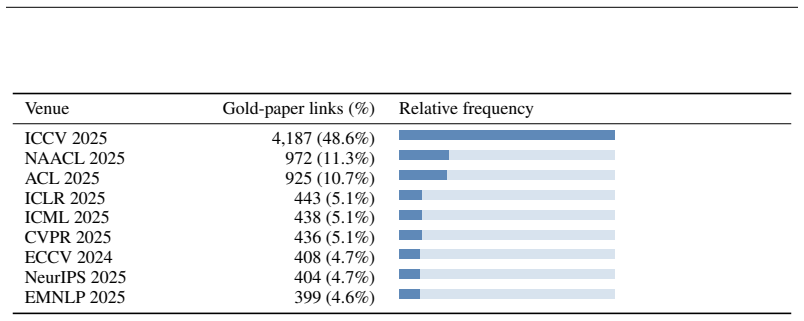
- Multi-paper questions dominate the local collection at 64.85%, so the benchmark mostly tests cross-paper retrieval and alignment across papers.
- The closed-book hardness labels, with all challenger models wrong on 61.9% of records, indicate that the collection targets questions that cannot be answered from parametric memory alone.
- The paper's own release checklist identifies what remains before a complete benchmark release: normalized locators, official splits, deliberate handling of the single-paper subset, documented licensing, human quality control, and retrieval-augmented baseline evaluations.
Reading between the lines
- If the trace contract works, the same schema could be extended to other evidence types, such as code execution outputs, dataset cards, or supplementary materials, without changing the scoring logic.
- The oracle diagnostic ladder suggests a development protocol: optimize the full pipeline, then use oracle-paper and oracle-evidence scores to decide whether to invest in retriever or reader improvements.
- A direct validity test would be an expert human agreement study checking whether the gold evidence locators uniquely determine the gold answers; the paper does not yet provide such a study.
- The closed-book hardness filter has a shelf life: as models improve, questions once hard without paper access may become answerable from memory, so the hardness labels would need periodic re-challenging.
Signed reviews
Editorial analysis
A structured set of objections, weighed in public.
Referee Report
Summary. The paper introduces LitTraceQA, a benchmark task for multi-stage scientific question answering in which a system must output canonical paper identifiers, typed evidence locations, and an answer in a requested format (free-form, multiple choice, or structured table). The public development split contains 55 examples, and the paper also analyzes a larger local annotation collection of 4,978 unique questions over 4,859 gold papers, with five evidence types (table, figure, text span, equation/algorithm, citation context) and closed-book hardness metadata produced by three challenger models. The evaluation protocol separates paper retrieval, evidence grounding, and answer correctness, and defines a strict joint-success criterion plus oracle diagnostic settings. The paper reports corpus statistics but no retrieval-augmented baseline results, and it explicitly lists human quality control, normalized locators, official splits, licensing, and baseline evaluations as open requirements for a final release.
Significance. If the gold traces are trustworthy, LitTraceQA addresses a real gap: existing scientific QA benchmarks typically evaluate either retrieval or answer accuracy, while LitTraceQA explicitly separates paper retrieval, typed evidence grounding, and answer correctness, and requires a checkable trace. The paper's strengths include a clearly specified evaluation contract with separated metrics and an oracle diagnostic ladder, internally consistent corpus statistics, and an unusually candid limitations section that identifies the release requirements. The task design around typed evidence artifacts (tables, figures, equations, citation contexts) is a useful contribution to the community. However, the central claim that LitTraceQA is a testbed for verifiable scientific QA is not yet empirically demonstrated: no end-to-end or retrieval-augmented baseline is run, and the gold annotations rest on a single LLM generator with automated string-matching checks rather than human verification or answer-entailment validation. These issues are load-bearing because every evaluation metric depends on the correctness of the gold trace.
major comments (3)
- [§4 and Appendix B] The gold answers are produced by a single open-book generator (Claude opus 4) and validated only by automated grounding checks that confirm evidence strings are recoverable from the declared paper text; the verification metadata in every appendix example is 'generate loop' with no human review. Because the evaluation protocol in §6 scores predicted answers against these gold answers, any incorrect or non-entailed gold answer corrupts retrieval F1, grounding F1, answer accuracy, and joint success simultaneously. Section 8 acknowledges human quality control as an open requirement, but this is not optional for the central claim that LitTraceQA is a benchmark; the paper should either add an expert spot-check or entailment-validation stage or explicitly restrict its claim to a development set.
- [§8 and §7] No retrieval-augmented baseline is evaluated anywhere in the paper; the closed-book challenger results are construction-time hardness metadata and are explicitly not leaderboard results. Without at least one end-to-end retrieval-augmented system evaluated under the §6 metrics (paper retrieval, evidence grounding, answer correctness, joint success), the central claim that LitTraceQA provides a testbed for verifiable scientific QA is not empirically demonstrated. The authors should add baseline results on the public development split, for example using a PaperQA-style or OpenScholar-style pipeline, or should soften the contribution claim to one of task definition and corpus construction.
- [§4, ev_001–ev_004 and Appendix B] The automated grounding checks verify that distinctive strings are recoverable from local paper text, but they do not verify that a table or figure locator contains the claimed value, nor that the gold answer is entailed by the cited evidence. For figure and table evidence, needle matching over captions or abstract sentences cannot detect misread values or incorrect row/column associations, as the appendix examples themselves show. Since LitTraceQA's value depends on the correctness of the trace, the paper should add value-level verification for non-textual evidence or report a manual audit on a representative sample.
minor comments (4)
- [§7, Finding 3] The sentence 'This supports the intended evaluation target' overstates what the closed-book labels show; the labels only demonstrate that three specific models cannot answer from memory without paper context, not that retrieval-grounded systems will be rewarded. Consider rephrasing to say the labels are consistent with the goal but require retrieval-augmented evaluation to confirm.
- [§6] The oracle-paper and oracle-evidence diagnostic settings are well defined, but the paper reports no results under any of these settings; including illustrative diagnostic numbers on the public development split in a future revision would help validate the protocol.
- [General] The manuscript does not provide a data URL, code URL, or hosted version of the public development split; for reproducibility, the final version should include release links and a detailed schema description file.
- [Title and headers] The extracted title and some section headers contain spacing artifacts such as 'FORMULTI-STAGE'; an editorial pass should ensure the camera-ready rendering is clean.
Circularity Check
No significant circularity: LitTraceQA is a dataset-assembly and evaluation-protocol paper whose central claims are design goals and descriptive statistics, not predictions derived from fitted parameters or from a self-citation chain.
full rationale
LitTraceQA does not contain a derived prediction or first-principles result that reduces to its inputs. The construction pipeline in Section 4 (generate, ground, challenge) uses an open-book LLM to propose gold traces, automated grounding checks to verify evidence membership, and closed-book challengers to filter instances. The paper explicitly labels the resulting difficulty as metadata rather than as a measured system capability: 'Closed-book outcomes describe construction-time hardness metadata rather than retrieval-augmented baseline performance' (Figure 2 caption), and Finding 3 states that the challenger models 'were not evaluated with paper retrieval.' Therefore the 61.9% all-wrong statistic is a report of the filter's output, not a fitted parameter renamed as a prediction. The self-citations to VISTAQA and Wang et al. (2026) are used to motivate the value of measuring evidence grounding explicitly, but they are not load-bearing as a uniqueness theorem or as the sole justification for the benchmark's central claim; the contribution is the released task contract and separated trace-evaluation protocol, which have independent content. The paper itself identifies the real limitation in Section 8: 'a submission-ready benchmark should also document human review or expert spot-check procedures' and inter-annotator agreement 'should be reported for evidence type, evidence locator, answer format, and final answer correctness.' This is a ground-truth quality risk, not a circularity: incorrect gold annotations would corrupt all three evaluation stages, but correctness is not defined in terms of the systems being evaluated, and no equation-level reduction, ansatz-smuggling citation, or imported uniqueness theorem appears in the paper.
Assumptions & free parameters
assumptions (4)
- domain assumption Automated grounding checks (evidence membership and distinctive text recovery) are sufficient for annotation validity.
- ad hoc to paper Gold answers generated by an LLM can serve as ground truth.
- domain assumption Closed-book hardness filtering improves the benchmark target.
- domain assumption The paper metadata pool is sufficiently representative of scientific literature.
Cite this review
Pith. "Pith review of LitTraceQA: A Benchmark for Multi-Stage Grounding and Verification in Scientific Question Answering." pith.science (2026). https://pith.science/paper/QYNIPXUC
@misc{pith2026260807370,
  author       = {Pith},
  title        = {Pith review of: LitTraceQA: A Benchmark for Multi-Stage Grounding and Verification in Scientific Question Answering},
  year         = {2026},
  howpublished = {\url{https://pith.science/paper/QYNIPXUC}},
  note         = {Machine review of arXiv:2608.07370}
}
read the original abstract
Scientific literature is increasingly used as a knowledge source for language models, retrieval-augmented generation systems, and research assistants, but answering research questions from papers requires more than fluent generation. A reliable system must identify the relevant papers, locate the concrete evidence that supports the answer, and produce a response that is faithful to that evidence. We present LitTraceQA, a benchmark for literature-grounded question answering over scientific papers. Given a research question and a metadata pool of papers, a system must return three connected outputs: canonical paper identifiers, supporting evidence locations, and answers in one or more requested formats, including free-form text, multiple-choice answers, and structured tables. LitTraceQA targets evidence types common in scientific reading: tables, figures, text spans, equations or algorithms, and citation contexts. The public development split contains 55 examples, including 26 hidden-source single-paper questions and 29 multi-paper questions, and provides gold papers, evidence annotations, and answers for local validation. We also analyze a larger final annotation collection with 4,978 unique-question records over 4,859 unique gold papers. By evaluating paper retrieval, evidence grounding, and answer accuracy separately, LitTraceQA provides a testbed for scientific QA systems that produce verifiable answers rather than unsupported summaries.
Figures


Figures from the paper (1 more)
Reference graph
Works this paper leans on
-
[2]
URLhttps://arxiv. org/abs/2411.14199. Bernd Bohnet, Vinh Q. Tran, Pat Verga, Roee Aharoni, Daniel Andor, Livio Baldini Soares, Massimiliano Ciaramita, Jacob Eisenstein, Kuzman Ganchev, Jonathan Herzig, Kai Hui, Tom Kwiatkowski, Ji Ma, Jianmo Ni, Lierni Sestorain Saralegui, Tal Schuster, William W. Cohen, Michael Collins, Dipanjan Das, Donald Metzler, Slav...
-
[7]
10 Yoonjoo Lee, Kyungjae Lee, Sunghyun Park, Dasol Hwang, Jaehyeon Kim, Hong-In Lee, and Moontae Lee
URLhttps://arxiv.org/abs/2312.07559. 10 Yoonjoo Lee, Kyungjae Lee, Sunghyun Park, Dasol Hwang, Jaehyeon Kim, Hong-In Lee, and Moontae Lee. QASA: Advanced question answering on scientific articles. InProceedings of the 40th International Conference on Machine Learning, volume 202 ofProceedings of Machine Learning Research, pp. 19036–19052. PMLR,
-
[8]
M3SciQA: A Multi-Modal Multi-Document Scientific QA Benchmark for Evaluating Foundation Models
URLhttps://arxiv.org/abs/2411.04075. Kyle Lo, Lucy Lu Wang, Mark Neumann, Rodney Kinney, and Daniel S. Weld. S2ORC: The semantic scholar open research corpus. InProceedings of the 58th Annual Meeting of the Association for Computational Linguistics,
-
[9]
URL https://arxiv.org/abs/1911.02782
doi: 10.48550/arXiv.1911.02782. URL https://arxiv.org/abs/1911.02782. Mozhgan Nasr Azadani, Yimu Wang, Yongpeng Zhu, Lihong Chen, Milan Ganai, Sean Sedwards, Marco Pavone, and Krzysztof Czarnecki. VISTAQA: Benchmarking joint visual question answer- ing and pixel-level evidence,
-
[11]
SciRepEval: A multi-format benchmark for scientific document representations
Amanpreet Singh, Mike D’Arcy, Arman Cohan, Doug Downey, and Sergey Feldman. SciRepEval: A multi-format benchmark for scientific document representations. InProceedings of the 2023 Conference on Empirical Methods in Natural Language Processing,
work page 2023
-
[12]
doi: 10.48550/arXiv. 2211.13308. URLhttps://arxiv.org/abs/2211.13308. David Wadden, Shanchuan Lin, Kyle Lo, Lucy Lu Wang, Madeleine van Zuylen, Arman Cohan, and Hannaneh Hajishirzi. Fact or fiction: Verifying scientific claims. InProceedings of the 2020 Conference on Empirical Methods in Natural Language Processing,
-
[13]
doi: 10.48550/arXiv. 2004.14974. URLhttps://arxiv.org/abs/2004.14974. Yimu Wang, Yee Man Choi, Barry Zhang, Mozhgan Nasr Azadani, Sean Sedwards, and Krzysztof Czarnecki. Where does the answer come from? benchmarking view-level visual evidence iden- tification in multi-view mllms for autonomous driving,
-
[14]
URLhttps://arxiv.org/ abs/2606.09644. Li S. Yifei, Allen Chang, Chaitanya Malaviya, and Mark Yatskar. ResearchQA: Evaluating scholarly question answering at scale across 75 fields with survey-mined questions and rubrics,
Show all 19 references
-
[16]
URLhttps://aclanthology.org/2025.findings-acl.199/
Association for Computational Linguistics. URLhttps://aclanthology.org/2025.findings-acl.199/. A REPRODUCIBILITYNOTES The corpus statistics in this draft are generated from the local LitTraceQA annotation directory. Be- fore statistics are exported, exact repeated question tex...
2025
-
[17]
1.ev 001:naacl2025 00963, source typecitation context, Section 2.1 Model Compression–Quantization
Collected evidence. 1.ev 001:naacl2025 00963, source typecitation context, Section 2.1 Model Compression–Quantization. Evidence value: “In a separate line of work, Frantar and Alistarh (2022) adapt the OBS framework to quantization. GPTQ (Frantar et al.,
2022
-
[18]
Frantar and Alistarh (2022) adapt the OBS framework to quantization
builds upon this work to enable second-order low-bit quantization for LLMs.” Search needles include “Frantar and Alistarh (2022) adapt the OBS framework to quantization”. 2.ev 002:naacl2025 01064, source typecitation context, Section 2 Related Work. Evidence value: “Xu and Hu ...
2022
-
[19]
Gold answer object.The answer options are: A, Frantar et al
presents an approximate weight reconstruction approach, enabling efficient LLM pruning without compro- mising performance.” This auxiliary citation context helps distinguish pruning from the OBS-to- quantization citation. Gold answer object.The answer options are: A, Frantar e...
2023
-
[2020]
URLhttps://arxiv.org/ abs/2005.04177
doi: 10.48550/arXiv.2005.04177. URLhttps://arxiv.org/ abs/2005.04177. Tianyu Gao, Howard Yen, Jiatong Yu, and Danqi Chen. Enabling large language models to generate text with citations. InProceedings of the 2023 Conference on Empirical Methods in Natural Language Processing,
-
[2021]
URL https://arxiv.org/abs/2105.03011
doi: 10.48550/arXiv.2105.03011. URL https://arxiv.org/abs/2105.03011. Jay DeYoung, Eric Lehman, Ben Nye, Iain J. Marshall, and Byron C. Wallace. Evidence inference 2.0: More data, better models. InProceedings of the 19th SIGBioMed Workshop on Biomedical Language Processing,
-
[2022]
Pradeep Dasigi, Kyle Lo, Iz Beltagy, Arman Cohan, Noah A
URL https://arxiv.org/abs/2212.08037. Pradeep Dasigi, Kyle Lo, Iz Beltagy, Arman Cohan, Noah A. Smith, and Matt Gardner. A dataset of information-seeking questions and answers anchored in research papers. InProceedings of the 2021 Conference of the North American Chapter of th...
2021 arXiv
-
[2023]
URLhttps://arxiv.org/ abs/2305.14627
doi: 10.48550/arXiv.2305.14627. URLhttps://arxiv.org/ abs/2305.14627. Tiancheng Huang, Ruisheng Cao, Yuxin Zhang, Zhangyi Kang, Zijian Wang, Chenrun Wang, Yijie Luo, Hang Zheng, Lirong Qian, Lu Chen, and Kai Yu. AirQA: A comprehensive qa dataset for ai research with instance-l...
- [2024]
-
[2025]
Xuanliang Zhang, Dingzirui Wang, Baoxin Wang, Longxu Dou, Xinyuan Lu, Keyan Xu, Dayong Wu, and Qingfu Zhu
URL https://arxiv.org/abs/2509.00496. Xuanliang Zhang, Dingzirui Wang, Baoxin Wang, Longxu Dou, Xinyuan Lu, Keyan Xu, Dayong Wu, and Qingfu Zhu. SCITAT: A question answering benchmark for scientific tables and text covering diverse reasoning types. InFindings of the Associatio...
2025
-
[2026]
Shraman Pramanick, Rama Chellappa, and Subhashini Venugopalan
URLhttps://arxiv.org/abs/2605.20676. Shraman Pramanick, Rama Chellappa, and Subhashini Venugopalan. Spiqa: A dataset for multi- modal question answering on scientific papers. InAdvances in Neural Information Processing Systems, volume 37, pp. 118807–118833,
Reviewed August 15, 2026 · model on record in the stance chip above.
Discussion (0). Continue with ORCID to comment.