REVIEW 3 major objections 6 minor 40 references
Harnessing bound states in the continuum for quantum and nonlinear photonics in silicon nitride microresonators
T0 review · 3 major / 6 minor · reviewed 2026-08-10 · deepseek-v4-flash
Pith's one-line read The paper demonstrates that a bound state in the continuum, a cavity mode that cannot be excited or extracted through the bus waveguide, remains fully active in four-wave mixing and can be read out through its radiative twin.
desk verdict Dark idler claim holds up: the coherence-time measurement already bounds residual coupling, so the paper's main results are direct and credible. read the letter →
The pith
A machine-rendered reading of the paper's core claim, the machinery that carries it, and where it could break.
The reading
What carries the argument
The central object is the Friedrich-Wintgen bound state in the continuum: a square-integrable cavity mode at a frequency inside the radiation continuum whose net radiative amplitude vanishes by destructive interference of multiple leakage paths, leaving only intrinsic loss to limit its lifetime. In the device, the leakage paths are the two effective couplings of the main ring to the bus through a Mach-Zehnder interferometer, and an auxiliary ring provides a resonant phase shift that makes the cancellation wavelength-selective. The theoretical machinery is a quantization of the displacement field that explicitly includes the discrete BIC operator alongside the continuum asymptotic-in operators; the four-wave-mixing Hamiltonian then contains a term that creates one BIC photon and one continuum photon from two pump photons. Because the BIC mode is orthogonal to the asymptotic fields even at the same frequency, it can be populated only internally by the nonlinearity and read out through its twin. The measured effects—idler escape suppression, signal coherence transfer, and gain enhancement—follow from the same rate asymmetry $\gamma_i \ll \gamma_s$ between the dark idler and the radiative signal.
What would settle it
At the BIC heater setting, measure the spectral width of the idler generated by stimulated four-wave mixing after removing pump and seed broadening; an intrinsic-loss-limited dark idler should show a linewidth near $\gamma_{\rm int}/2\pi = 74$ MHz, while a broader idler or a signal coherence time that saturates below $Q_{\rm int}/\omega$ would show that residual radiative coupling is not negligible and the BIC is quasi-dark rather than dark.
Extended reading notes
Core claim
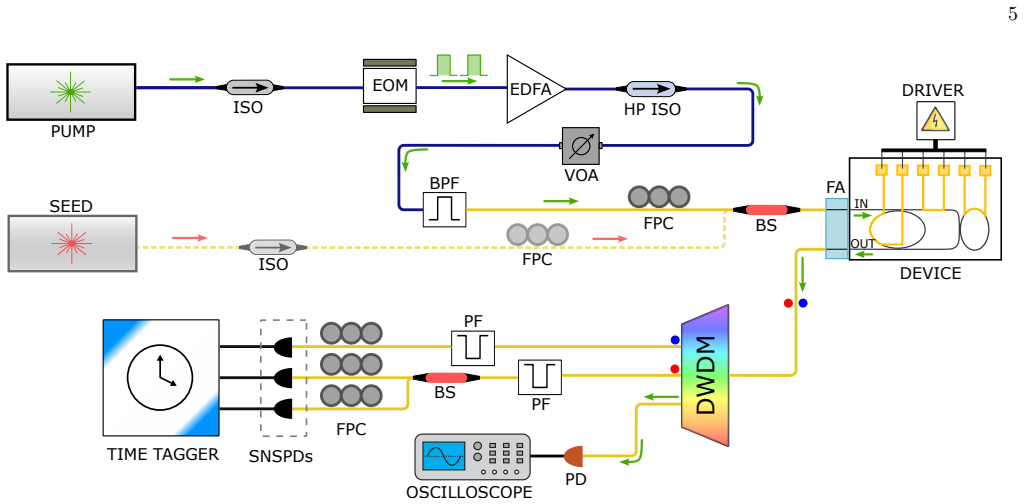
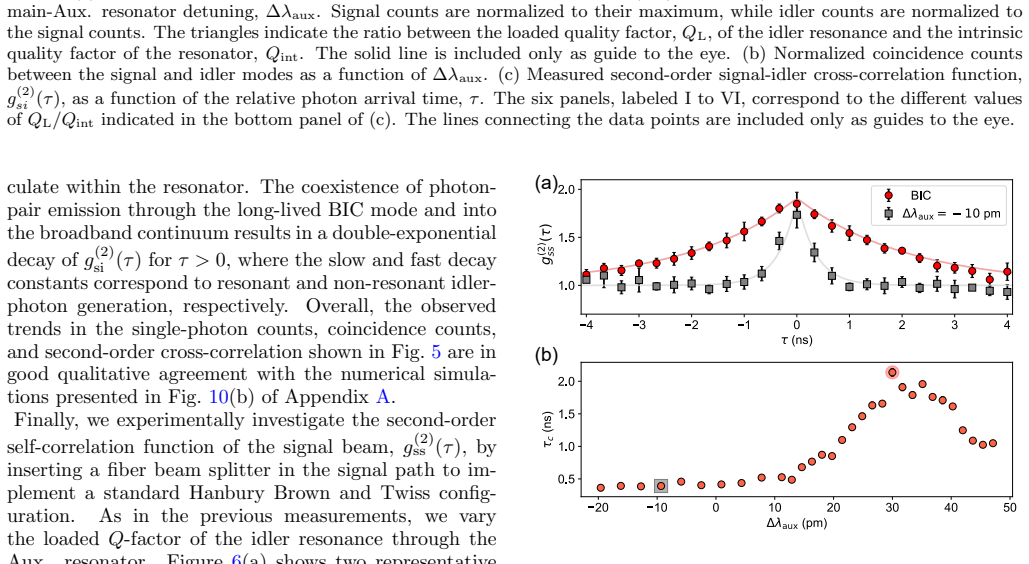
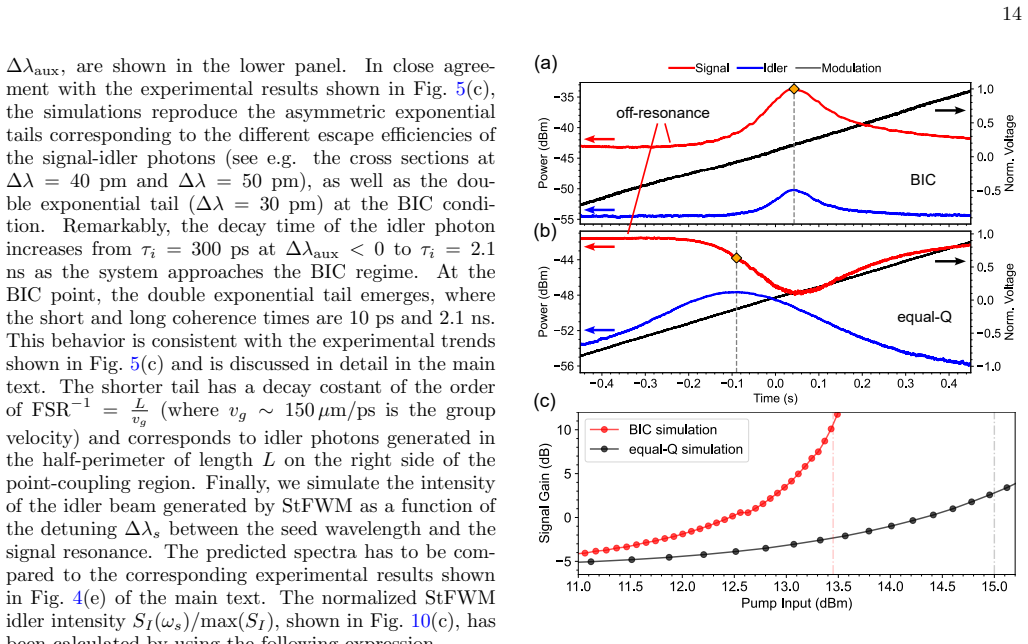
The central claim is that suppressing linear access to one participating mode does not remove that mode from the nonlinear dynamics, and the dark mode's long lifetime can be transferred to a radiatively coupled partner. The authors realize electrically tunable Friedrich-Wintgen BICs with quality factors above $10^6$ in a silicon nitride microresonator, and place the idler of spontaneous four-wave mixing at the BIC. The idler generated inside the resonator cannot escape to the output waveguide (suppression of about 22 dB), yet the pair-generation process is not suppressed: signal singles roughly double, and the extracted signal photon inherits the dark idler's lifetime, reaching 2.14 ns against the expected $Q_{\rm int}/\omega = 2.13$ ns. In the stimulated regime, optical parametric amplification with the idler as a BIC gives about 12 dB more signal gain at 13.5 dBm on-chip pump power and a 1.6 dB lower oscillation threshold than the equal-Q configuration. The paper's central statement is that wavelength-selective suppression of radiative loss controls nonlinear interaction, spectral bandwidth, and photon extraction as distinct degrees of freedom within a single integrated device.
Load-bearing premise
The central claim that the dark idler's lifetime is set purely by intrinsic loss depends on the residual radiative coupling at the BIC being negligible; the paper states this but gives no quantitative bound, so if residual coupling were comparable to intrinsic loss, the loaded Q at the BIC would drop and all the quoted effects would shrink.
Editorial extensions
If this is right
- The internal pair-generation rate is not suppressed when the idler becomes dark: signal singles roughly double at the BIC condition while extracted idler singles drop by about 9 dB and signal-idler coincidences by about 7 dB.
- The signal photon inherits the spectral bandwidth of its dark partner, so the emitted photon's coherence time can be much longer than the loaded lifetime of the emitting resonance, reaching 2.14 ns against the 2.13 ns intrinsic-loss limit.
- With the idler as a BIC, the same device gives roughly 12 dB higher optical parametric amplification at 13.5 dBm on-chip pump power and a 1.6 dB lower oscillation threshold than the equal-Q configuration.
- The BIC condition is electrically tunable and wavelength-selective: the auxiliary ring affects only one out of every four main-ring resonances, so pump and signal resonances remain radiatively accessible while the idler is dark.
- These results establish mode-selective lifetime engineering as a way to control photon extraction, biphoton wavepacket shape, and parametric threshold independently within one integrated device.
Reading between the lines
- Because the joint spectral amplitude is set by the dark idler's linewidth, BIC-assisted spontaneous four-wave mixing should generate two-mode squeezed states with strongly asymmetric marginal bandwidths, which could be matched to narrow-band quantum memory interfaces.
- A direct consequence not tested here is that the dark-mode population should ring up on the intrinsic-loss timescale; time-resolving the radiative signal after a pump pulse would confirm that the idler really lives for $Q_{\rm int}/\omega$ and not a shorter quasi-BIC lifetime.
- The residual 22 dB idler suppression is attributed to point-coupler imbalance; if fabrication symmetry improves, the suppression should grow and the signal coherence time should approach the full intrinsic limit, a testable scaling relation between escape suppression and coherence transfer.
- The same selective-dark-mode architecture could be applied to frequency comb generation, where a single dark comb line may suppress mode competition or reshape comb bandwidth by the same loss-asymmetry mechanism used here for optical parametric amplification.
Editorial analysis
A structured set of objections, weighed in public.
Referee Report
Summary. The paper reports a reconfigurable silicon-nitride microresonator platform in which a Friedrich-Wintgen bound state in the continuum is realized by an interferometric coupler with an auxiliary ring, and it uses this device to study spontaneous four-wave mixing when the idler mode is tuned to the BIC. The authors report linear decoupling of the idler resonance, about 22 dB suppression of the output idler power under stimulated FWM, spontaneous-regime data on single counts, coincidences, cross-correlation and signal self-correlation, a signal coherence time of 2.14 +/- 0.06 ns at the BIC condition, and a BIC-assisted OPA gain advantage of about 12 dB with a 1.6 dB lower oscillation threshold. The interpretation is supported by a quantum Hamiltonian treatment that explicitly includes the BIC mode and by simulations of the photon-pair generation and OPA gain.
Significance. If the quantitative claims hold, this is a significant advance: it demonstrates that a mode linearly decoupled from the bus waveguide remains dynamically active in a chi^(3) process, transferring its long intrinsic lifetime to the radiatively coupled twin photon. The experimental work is direct, internally consistent, and contains a strong falsifiable prediction: the measured signal coherence time at the BIC, 2.14 +/- 0.06 ns, matches Q_int/omega = 2.13 ns. The imaging and 22 dB suppression data provide visual and spectral evidence of a dark idler, and the OPA/OPO results show practical utility. The principal weakness is that the central 'intrinsic-loss-limited' claim relies on an unquantified statement about residual coupling, and several headline numbers are presented without uncertainties. The theoretical framework is mostly parameter-free; the only fitted parameter in the supporting models is the thermo-optic coupling-rate coefficient xi in Appendix B, which affects the simulated gain curves but not the measured values.
major comments (3)
- [III A and III B] The claim that the BIC idler is intrinsic-loss-limited is load-bearing and currently rests on the statement in Section III A that 'the residual coupling plays a negligible role in determining the lifetime of the BIC,' which is not quantified. The supporting evidence, Q_L/Q_int = 1 extracted from a transmission dip that vanishes at the decoupling point, is ill-conditioned: at vanishing extinction, a Lorentzian fit to the disappearing resonance cannot reliably distinguish Q_L = Q_int from, say, Q_L = 0.83 Q_int. The 2.14 ns versus 2.13 ns agreement is encouraging, but the predicted 2.13 ns inherits the systematic calibration of Q_int = 2 Q_L at critical coupling, for which no uncertainty is reported. Please provide a quantitative upper bound on gamma_ext/gamma_int; one constructive route is to convert the 22 dB output suppression into an escape-efficiency bound after characterizing the Raman/bus-waveguide background, and another is an independent, extinction-free measurement of the idler linewidth, such as nonlinear or pump-probe spectroscopy of the dark mode.
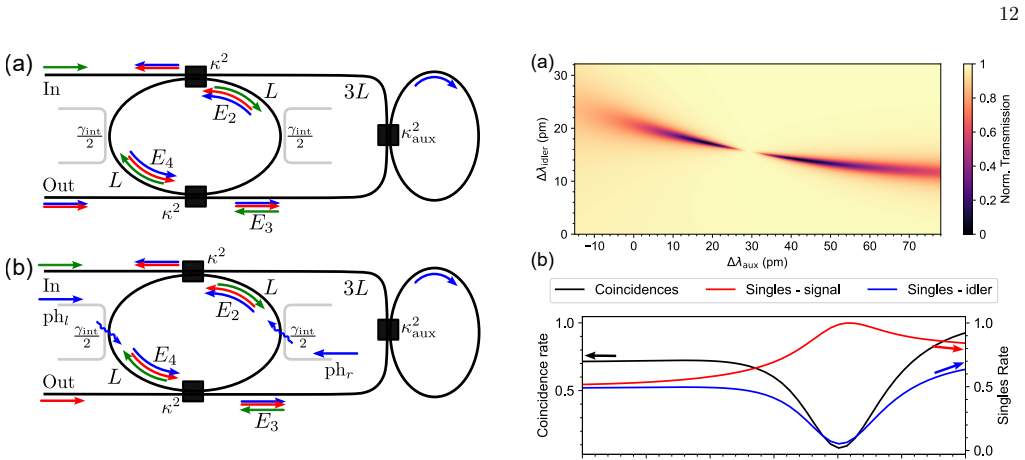
- [III B, Figs. 5 and 6] The quantitative reductions of idler singles by about 9 dB, coincidences by about 7 dB, and the doubling of signal counts are quoted without error bars or a background-subtraction protocol. The manuscript itself attributes residual counts to Raman scattering and SFWM in the access waveguide, and the Appendix A simulation predicts a much deeper coincidence dip than observed. Because these numbers quantify the central claim that the BIC suppresses extraction while enhancing internal generation, the paper should report uncertainties on all points in Fig. 5(a,b) and describe how the background is modeled or subtracted before the dB values are computed.
- [III B and III C] Two quantitative conclusions are based on fits whose systematic uncertainty is not addressed. First, at the BIC condition the cross-correlation has a double-exponential tail arising from the coexistence of resonant and continuum components, yet the signal self-correlation is fitted with a single exponential; a residual fast component could bias the extracted tau_c, which is a central number. Second, the 12 dB gain advantage and 1.6 dB threshold reduction are point estimates, and the corroborating simulation uses a fitted coefficient xi with no reported uncertainty or sensitivity analysis. Please justify the single-exponential model for tau_c and provide error bars or confidence intervals for the gain and threshold data, together with a brief analysis of how the simulated gain curves depend on xi.
minor comments (6)
- [Abstract] The phrase 'In particularly' should read 'In particular.'
- [III A, fourth paragraph] The sentence describing the broad background of the BIC StFWM lineshape—'which tracks the form of the field enhancement of only the seed wave, still close to the expected value of 1.5 GHz, following the same procedure'—is grammatically incomplete and should be rewritten for clarity.
- [Fig. 5 caption] The bottom panel of Fig. 5(c) displays Q_L/Q_int values, but the caption does not define the symbol Q_L/Q_int or state how the loaded Q-factor was extracted; please add the definition and the extraction procedure.
- [II, Eq. (4)] The nonlinear coupling amplitude S(omega_1, omega_BIC, omega_3, omega_4) is used before its normalization and dependence are described; a brief definition would help the reader connect Eq. (4) to the asymptotic-field formalism of Ref. [32].
- [Appendix B, Eq. (B1)] The pump and seed input terms contain a factor FSR that is not explicitly defined in the equation; please state its value and units, and clarify whether it is the same for all three modes.
- [III B] The text refers to 'CAR = g_si^(2) - 1' as a coincidence-to-accidental ratio; please define CAR explicitly and use consistent nomenclature, since the usual CAR definition differs from this expression by a factor involving the coincidence window and singles rates.
Circularity Check
No significant circularity: the central BIC, SFWM, and OPA results are direct measurements, and the 2.13 ns predicted coherence time is computed from an independently determined Q_int rather than from the measured coherence time.
full rationale
The paper's central claims are experimental observations rather than derived quantities: BIC formation is evidenced by vanishing transmission dips and top-view imaging, the idler output is suppressed by about 22 dB, the signal coherence time reaches 2.14 +/- 0.06 ns at the BIC condition, and the BIC-assisted OPA gain is about 12 dB higher with a 1.6 dB lower threshold. None of these values is produced by fitting the model to the quantity being claimed. The expected coherence time tau_max = Q_int/omega_BIC = 2.13 ns is computed from Q_int = 2 Q_L measured at critical coupling in the equal-Q configuration (Section III A), before the Aux resonator is tuned to the BIC condition; the measured 2.14 +/- 0.06 ns is therefore an independent comparison, not a reinjection of the fitted input. The simulations in Appendices A and B reproduce the trends using measured Q values, and the only fitted parameter, xi in Appendix B, affects the simulated OPA gain curves but does not construct the experimental gain or coherence data. The self-citations in the paper are background references for the device design and the asymptotic-field formalism, and they are not used as a uniqueness theorem or as a substitute for the measured demonstration. One evidentiary gap is noted: Section III A states without a quantitative bound that 'the residual coupling plays a negligible role in determining the lifetime of the BIC,' which weakens the dark-idler interpretation if residual coupling is not actually negligible. That is a support gap and a correctness risk, but not a circular reduction, because the Q_L/Q_int = 1 condition is an extracted operational condition rather than a definition of the measured coherence-time result. Overall, no load-bearing step is equivalent to its input by construction.
Assumptions & free parameters
free parameters (2)
- Thermo-optic coupling-rate coefficient xi =
-1 x 10^8 W^-1 s^-1
- Nonlinear coefficient gamma_nl =
138 MHz/W
assumptions (5)
- domain assumption The electromagnetic field can be quantized by adding a single discrete BIC mode to the asymptotic continuum, with the BIC mode orthogonal to all continuum modes at the same frequency (Eq. 1).
- domain assumption At the BIC frequency, even with intrinsic loss, Maxwell's equations admit two distinct solutions: a propagating continuum solution and a square-integrable confined mode.
- domain assumption Intrinsic losses of the main resonator can be modeled by two phantom waveguides, each with coupling rate gamma_int/2.
- domain assumption At the BIC setting, residual radiative coupling of the idler to the bus waveguide is negligible compared with the intrinsic loss rate.
- standard math Temporal coupled-mode equations (Eq. B1), adapted from Ref. [37], describe degenerately pumped OPA in the microresonator.
Cite this review
Pith. "Pith review of Harnessing bound states in the continuum for quantum and nonlinear photonics in silicon nitride microresonators." pith.science (2026). https://pith.science/paper/A45JGX2V
@misc{pith2026260807426,
  author       = {Pith},
  title        = {Pith review of: Harnessing bound states in the continuum for quantum and nonlinear photonics in silicon nitride microresonators},
  year         = {2026},
  howpublished = {\url{https://pith.science/paper/A45JGX2V}},
  note         = {Machine review of arXiv:2608.07426}
}
read the original abstract
In this work we theoretically and experimentally investigate bound states in the continuum (BICs) in a reconfigurable integrated photonic structure, focusing on spontaneous four-wave mixing. We consider a configuration in which only one mode, the idler, is tuned to the BIC condition, and show that suppressing the radiative loss of this single mode profoundly reshapes the overall nonlinear dynamics. In particularly, we realize electrically tunable Friedrich-Wintgen BICs with Q > 10^6 in an interferometrically coupled silicon-nitride microresonator. Although inaccessible through linear excitation, the BIC is populated by four-wave mixing and read out through its radiative photon partner. In the low-gain regime, we investigate the spectral, correlation, and coherence properties of the generated photon pairs, revealing distinctive signatures in the signal-idler correlations and an extracted signal whose coherence time approaches the intrinsic-loss-limited lifetime of the dark idler. In the high-gain regime, making one mode participating in optical parametric amplification a BIC enhances the parametric gain by 12 dB and lowers the oscillation threshold by 1.6 dB. These results establish BICs as a tool for mode-selective lifetime engineering, enabling control over both biphoton wavepackets and the threshold dynamics of integrated parametric devices.
Figures


Figures from the paper (7 more)




Reference graph
Works this paper leans on
-
[1]
J. von Neumann and E. Wigner, ¨Uber merkw¨ urdige diskrete eigenwerte, Physikalische Zeitschrift30, 465 (1929)
work page 1929
-
[2]
H. S. Khaliq and H.-R. Kim, Recent advances in photonic bound states in the continuum: From fundamentals to engineering and implementation, Laser & Photonics Re- views20, e01883 (2026)
work page 2026
-
[3]
H. Friedrich and D. Wintgen, Interfering resonances and bound states in the continuum, Physical Review A32, 3231 (1985)
work page 1985
-
[4]
R. F. Ndangali and S. V. Shabanov, Electromagnetic bound states in the radiation continuum for periodic dou- ble arrays of subwavelength dielectric cylinders, Journal of Mathematical Physics51, 102901 (2010)
work page 2010
-
[5]
M.-S. Hwang, H.-C. Lee, K.-H. Kim, K.-Y. Jeong, S.- H. Kwon, K. Koshelev, Y. Kivshar, and H.-G. Park, Ultralow-threshold laser using super-bound states in the continuum, Nature Communications12, 4135 (2021)
work page 2021
-
[6]
S. T. Ha, Y. H. Fu, N. K. Emani, Z. Pan, R. M. Bakker, R. Paniagua-Dom ´ ınguez, and A. I. Kuznetsov, Direc- tional lasing in resonant semiconductor nanoantenna ar- rays, Nature Nanotechnology13, 1042 (2018)
work page 2018
-
[7]
X. Zong, L. Li, and Y. Liu, Merging bound states in the continuum in all-dielectric metasurfaces for ultrahigh-q resonances, Optics Letters48, 5045 (2023)
work page 2023
-
[8]
H. Ren, J. Liu, Z. Jiang, L. Zhuang, B. Jiang, C. Xu, B. Cheng, and G. Song, Dynamically tunable robust ultrahigh-q merging bound states in the continuum in phase-change materials metasurface, Nanophotonics14, 343 (2025)
work page 2025
Show all 40 references
-
[9]
Z. Yu, X. Xi, J. Ma, H. K. Tsang, C.-L. Zou, and X. Sun, Photonic integrated circuits with bound states in the con- tinuum, Optica6, 1342 (2019)
2019
-
[10]
Zhou, H.-Z
P. Zhou, H.-Z. Zhang, T. Li, Z.-S. Zhang, Y.-H. Chen, and X. Zhang, Efficient on-chip platform for coherent light-matter coupling using bound states in the contin- uum, Science Advances11, eadu0976 (2025)
2025
-
[11]
F. Ye, Y. Qin, C. Cui, X. Sun, and H. K. Tsang, Inte- grated bound-state-in-the-continuum photon-pair source, Photonics Research12, 1322 (2024)
2024
-
[12]
Yang, Z.-T
J.-H. Yang, Z.-T. Huang, D. N. Maksimov, P. S. Pankin, I. V. Timofeev, K.-B. Hong, H. Li, J.-W. Chen, C.-Y. Hsu, Y.-Y. Liu, T.-C. Lu, T.-R. Lin, C.-S. Yang, and K.- P. Chen, Low-threshold bound state in the continuum lasers in hybrid lattice resonance metasurfaces, Laser & Pho...
2021
-
[13]
and to enhance pump conversion efficiency in Kerr- soliton microcombs [28]. In this work, we present an integrated SiN photonic cir- arXiv:2608.07426v1 [physics.optics] 7 Aug 2026 2 cuit exhibiting Friedrich-Wintgen bound states in the continuum with quality factors exceeding ...
2026 arXiv
-
[14]
F. Lei, Z. Ye, K. Twayana, Y. Gao, M. Girardi,´O. B. Hel- gason, P. Zhao, and V. Torres-Company, Hyperparamet- ric oscillation via bound states in the continuum, Physical Review Letters130, 093801 (2023)
2023
-
[15]
F. Ye, X. Sun, and H. K. Tsang, Sum-frequency gener- ation in bound-state-in-continuum microring resonators, Optics Letters50, 4034 (2025)
2025
-
[16]
J. Wang, M. Clementi, M. Minkov, A. Barone, J.-F. Carlin, N. Grandjean, D. Gerace, S. Fan, M. Galli, and R. Houdr´ e, Doubly resonant second-harmonic generation of a vortex beam from a bound state in the continuum, Optica7, 1126 (2020)
2020
-
[17]
T. Liu, M. Qin, F. Wu, and S. Xiao, High-efficiency opti- cal frequency mixing in an all-dielectric metasurface en- abled by multiple bound states in the continuum, Physi- cal Review B107, 075441 (2023)
2023
-
[18]
G. Q. Moretti, T. Weber, T. Possmayer, E. Cort´ es, L. d. S. Menezes, A. V. Bragas, S. A. Maier, A. Tittl, and G. Grinblat, Si metasurface supporting multiple quasi- bics for degenerate four-wave mixing, Nanophotonics13, 3421 (2024)
2024
-
[19]
Y. Shi, S. Wan, Z. Wang, R. Rao, and Z. Li, On-chip non- 16 local metasurface for color router: conquering efficiency- loss from spatial-multiplexing, Light: Science & Applica- tions15, 66 (2026)
2026
-
[20]
Yesilkoy, E
F. Yesilkoy, E. R. Arvelo, Y. Jahani, M. Liu, A. Tittl, V. Cevher, Y. Kivshar, and H. Altug, Ultrasensitive hy- perspectral imaging and biodetection enabled by dielec- tric metasurfaces, Nature Photonics13, 390 (2019)
2019
-
[21]
Xu and Y
H. Xu and Y. Shi, Silicon-waveguide-integrated high- quality metagrating supporting bound state in the con- tinuum, Laser & Photonics Reviews14, 1900430 (2020)
2020
-
[22]
M. Kang, Z. Zhang, T. Wu, X. Zhang, Q. Xu, A. Kras- nok, J. Han, and A. Al` u, Coherent full polarization con- trol based on bound states in the continuum, Nature Communications13, 4536 (2022)
2022
-
[23]
S. I. Azzam and A. V. Kildishev, Photonic bound states in the continuum: from basics to applications, Advanced Optical Materials9, 2001469 (2021)
2021
-
[24]
G. Xu, H. Xing, Z. Xue, D. Lu, J. Fan, J. Fan, P. P. Shum, and L. Cong, Recent advances and perspective of photonic bound states in the continuum, Ultrafast Sci- ence3, 0033 (2023)
2023
-
[25]
Zhong, W
C. Zhong, W. Zou, T. Guo, and C. Argyropoulos, En- hanced entangled photon-pair generation rate with dual quasi-bound states in the continuum metasurfaces, Op- tics Express33, 48515 (2025)
2025
-
[26]
Y. Deng, Y. Fan, and J. Li, Enhancement of single- photon purity and brightness via bound states in the continuum, Physical Review A112, 033711 (2025)
2025
-
[27]
W. Wen, W. Yan, C. Lu, L. Lu, X. Wu, Y. Lu, S. Zhu, and X.-S. Ma, Polarization-entangled quantum frequency comb from a silicon nitride microring resonator, Physical Review Applied20, 064032 (2023)
2023
-
[28]
X. Jia, C. You, C. Zhai, X. Zhu, Y. Zheng, T. Dai, Z. Fu, X. Su, Q. Gong, and J. Wang, Monolithic integration of continuous-variable cluster-state generation, manipula- tion and measurement, Nature Photonics20, 428 (2026)
2026
-
[29]
J. M. C. Boggio, D. Bodenm¨ uller, S. Ahmed, S. Wabnitz, D. Modotto, and T. Hansson, Efficient Kerr soliton comb generation in micro-resonator with interferometric back- coupling, Nature Communications13, 1292 (2022)
2022
-
[30]
P. L. Pagano, M. Borghi, F. Moroni, A. Viola, F. Malaspina, M. Liscidini, D. Bajoni, and M. Galli, Se- lective linewidth control in a micro-resonator with a reso- nant interferometric coupler, Journal of Lightwave Tech- nology43, 5731 (2025)
2025
-
[31]
Borghi, P
M. Borghi, P. L. Pagano, M. Liscidini, D. Bajoni, and M. Galli, Uncorrelated photon pair generation from an integrated silicon nitride resonator measured by time- resolved coincidence detection, Optics Letters49, 3966 (2024)
2024
-
[32]
Y. Liu, C. Wu, X. Gu, Y. Kong, X. Yu, R. Ge, X. Cai, X. Qiang, J. Wu, X. Yang, and P. Xu, High-spectral- purity photon generation from a dual-interferometer- coupled silicon microring, Optics Letters45, 73 (2020)
2020
-
[33]
Liscidini, L
M. Liscidini, L. Helt, and J. Sipe, Asymptotic fields for a hamiltonian treatment of nonlinear electromagnetic phe- nomena, Physical Review A85, 013833 (2012)
2012
-
[34]
Banic, L
M. Banic, L. Zatti, M. Liscidini, and J. Sipe, Two strate- gies for modeling nonlinear optics in lossy integrated pho- tonic structures, Physical Review A106, 043707 (2022)
2022
-
[35]
Brusaschi, M
E. Brusaschi, M. Liscidini, M. Galli, D. Bajoni, and M. Borghi, Time-resolved characterization of pulsed squeezed light from a strongly driven silicon nitride microresonator, Physical Review Applied25, 034008 (2026)
2026
-
[36]
Liscidini and J
M. Liscidini and J. Sipe, Stimulated emission tomogra- phy, Physical Review Letters111, 193602 (2013)
2013
-
[37]
Christ, K
A. Christ, K. Laiho, A. Eckstein, K. N. Cassemiro, and C. Silberhorn, Probing multimode squeezing with cor- relation functions, New Journal of Physics13, 033027 (2011)
2011
-
[38]
Y. Zhao, J. K. Jang, X. Ji, Y. Okawachi, M. Lipson, and A. L. Gaeta, Large regenerative parametric amplification on chip at ultra-low pump powers, Optica10, 819 (2023)
2023
-
[39]
Calaj` o, Y.-L
G. Calaj` o, Y.-L. L. Fang, H. U. Baranger, and F. Cic- carello, Exciting a bound state in the continuum through multiphoton scattering plus delayed quantum feedback, Physical Review Letters122, 073601 (2019)
2019
-
[40]
J. M. Lukens, K. V. Myilswamy, A. Miloshevsky, and H.- H. Lu, Beyond critical coupling: optimal design consid- erations for spontaneous four-wave mixing in microring resonators, Optics Express34, 2782 (2026)
2026
Reviewed August 10, 2026 · model on record in the stance chip above.
Discussion (0). Continue with ORCID to comment.