REVIEW 3 major objections 3 minor 72 references
Active Control of Extreme Ultraviolet Photon Flux and Resolution with a Plane Ruled Reflection Grating Spectrometer that Measures Diverging High-Harmonics
T0 review · 3 major / 3 minor · reviewed 2026-08-10 · deepseek-v4-flash
Pith's one-line read The paper shows that a motorized iris in the entrance slit of a plane-ruled grating XUV spectrometer lets users tune spectral resolution and photon flux continuously, with the best signal-to-noise ratio between 0.4 and 0.8 milliradians…
desk verdict A genuinely useful knob for XUV spectrometers—the motorized iris clearly works—but the volcano plot's divergence axis is miscalibrated at small iris sizes because the finite source waist is ignored, so the 0.4–0.8 mrad optimum is qualitative, not quantitative. read the letter →
The pith
A machine-rendered reading of the paper's core claim, the machinery that carries it, and where it could break.
The reading
What carries the argument
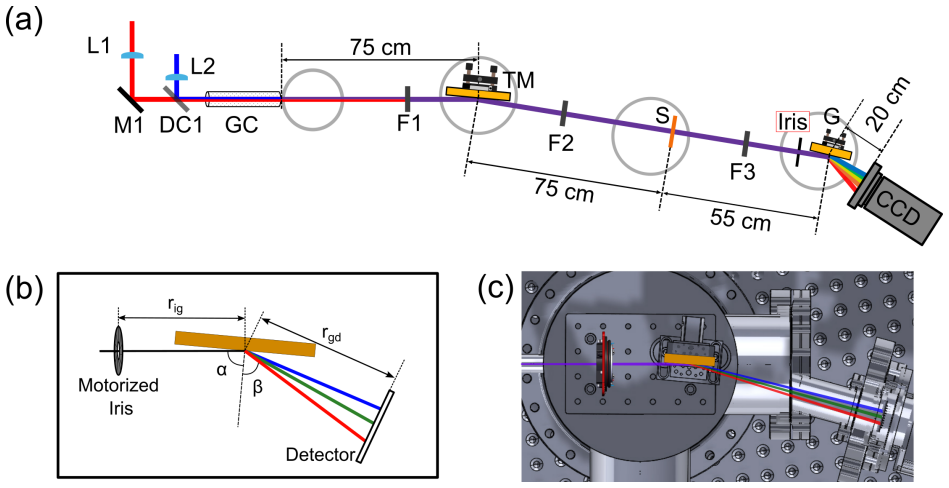
The central object is a plane-ruled reflection grating (600 lines/mm) used at grazing incidence to disperse a diverging XUV beam that has passed through the sample, combined with a circular motorized iris placed at the entrance slit about 45 cm downstream of the sample point. The iris sets the effective angular divergence of the rays that reach the grating: the half-angle is modeled as theta/2 = arctan(r/45 cm), where r is the iris radius. Smaller apertures improve spectral contrast by narrowing the spread of incidence angles on the grating, but they reduce flux roughly as the aperture area and eventually hit a diffraction limit near 40 to 60 microns; larger apertures cause neighboring harmonic orders to overlap, filling the valleys between peaks and suppressing harmonic-induced spectral modulations. This divergence-to-resolution mapping, along with a gaussian-plus-error-function fit to the Fe M2,3 edge, is what converts the measured spectra into quantitative resolution and SNR trends.
What would settle it
Measure the same 10-nm Fe film on a calibrated high-resolution reference spectrometer and compare the M2,3 edge FWHM with the roughly 500 meV reported here at the smallest usable iris; a substantially narrower reference width would show that intrinsic broadening is not negligible and the claimed instrumental resolution is too pessimistic.
Extended reading notes
Core claim
The paper's central claim is that a motorized iris aperture at the entrance slit of a plane-ruled grating XUV spectrometer that intentionally measures diverging high harmonics gives the user live control over spectral resolution and photon flux, so that the alternating peak-and-valley structure of high-harmonic sources can be smoothed by partial overlap of neighboring harmonics rather than by post-correction. Quantitatively, tuning the effective half-angle divergence from about 0.03 to 1.9 milliradians changes the detected flux from about 1.0 x $10^{6}$ to 1.5 x $10^{7}$ photons per second per eV near 40 eV, while the spectral resolution varies from about 500 meV to about 1.8 eV at the Fe M2,3 edge. A volcano plot of signal-to-noise ratio versus effective divergence shows a maximum (SNR greater than 120) between 0.4 and 0.8 milliradians, and the authors argue this plateau is the optimal operating configuration. The Fe and Ti near-edge spectra measured in this configuration match the known reference shapes, which supports the assertion that moderate resolution does not distort broad core-to-valence absorption features.
Load-bearing premise
The quantitative claims rely on the assumptions that the Fe near-edge FWHM extracted from the fit is purely instrumental (negligible intrinsic broadening) and that the iris behaves as a circular aperture looking back at a point source 45 cm away; if either assumption is violated, the reported resolution and divergence values would shift.
Editorial extensions
If this is right
- A single motorized iris gives on-the-fly control over spectral resolution and photon flux, so the same spectrometer can serve both high-resolution static scans and high-flux rapid acquisitions without realignment.
- At moderate resolution (about 500 meV to 1.8 eV), neighboring harmonics overlap and fill the low-flux valleys, suppressing harmonic-induced modulations in thin-film XUV absorption spectra without post-correction.
- The volcano plot of SNR versus effective divergence identifies an operating plateau between 0.4 and 0.8 milliradians where SNR exceeds 120, giving a quantitative design target for entrance apertures.
- Loss of resolution from 600 meV to 1.8 eV does not shift or distort the Fe M2,3 near-edge resonance, so broad features in correlated metals can be measured accurately at high flux.
- The same trade-off applies to the neon harmonics used here, extending the method to edges up to about 72 eV, limited only by the grating's fixed groove density and available spectral coverage.
Reading between the lines
- The same iris-control principle should transfer directly to time-resolved XUV absorption experiments, where a high-fluence configuration can be dialed in for each shot and then traded for resolution when the dynamics require it.
- Because the resolution penalty scales with linear dispersion, the slope of resolution versus divergence (3.4 eV/mrad here) should predictably change with groove density and grating-to-detector distance, making the optimum aperture transferable across spectrometers.
- The paper's shape-preservation result suggests that for samples with features broader than the Ti giant resonance, users could operate at even lower resolution than 1.8 eV and still obtain trustworthy edge shapes, enabling higher-throughput surveys.
Editorial analysis
A structured set of objections, weighed in public.
Referee Report
Summary. The paper reports a plane-ruled grating XUV spectrometer with a motorized iris in the entrance slit that controls the accepted angular divergence of a diverging high-harmonic beam. By closing the iris, harmonic peaks narrow and harmonic valleys are suppressed at the cost of photon flux; by opening it, valleys fill and the signal-to-noise ratio improves. Argon and neon harmonic spectra are characterized versus iris size, Fe and Ti M2,3 absorption spectra are recorded, and a volcano-style SNR-versus-divergence plot is used to identify an optimum operating range (claimed 0.4–0.8 mrad). SHADOW3 ray tracing is presented as supporting the qualitative contrast/flux trend.
Significance. If the quantitative claims hold, the spectrometer is a simple and low-cost addition to tabletop HHG beamlines and directly addresses a known distortion problem in XUV absorption spectroscopy of thin films. The central control effect is clearly demonstrated in Fig. 5: harmonic narrowing and flux scaling with iris size are measured directly, and the comparison with SHADOW3 adds useful context. The main weaknesses are calibration of the divergence axis, the interpretation of the Fe near-edge FWHM as pure instrumental resolution, and the absence of propagated uncertainties in the quantitative trade-off plots.
major comments (3)
- [Trade-off between Spectral Resolution and SNR at the Fe M2,3 edge] The effective divergence is defined by θ/2 = tan^-1(r/45 cm), treating the source as a point located 45 cm before the iris. However, the knife-edge measurement in the section 'Experimental High Harmonic Images - XUV Beam Divergence' gives a 140±20 µm XUV waist at the sample, and the SHADOW3 input is a 65 µm source. For the small iris settings that anchor the high-resolution end of Fig. 7 (r = 50–100 µm), the source radius is comparable to or larger than the iris radius, so the angular acceptance of the spectrometer is not simply arctan(r/45 cm); the finite source size contributes a comparable additional term. Consequently, the x-axis of Fig. 7(b,c), the reported 0.4–0.8 mrad SNR plateau, and the 3.4 eV/mrad resolution slope are not calibrated for the actual beam. Please recompute the effective divergence from a measured or modeled source-size-convolved angular distribution and propagate the resulting uncertainty; the qualitative trade-off can remain, but the quantitative operating recommendation needs revision.
- [Trade-off between Spectral Resolution and SNR at the Fe M2,3 edge] The FWHM extracted from the Fe near-edge fit is presented as the instrumental resolution, but the Fe M2,3 edge has intrinsic core-hole, Coster-Kronig, and many-body broadening. If the intrinsic width is not negligible compared with the reported 500 meV, the measured FWHM is a convolution of the spectrometer response with the material response rather than the spectrometer resolution itself. The authors should justify this interpretation with a reference measurement or literature value for the intrinsic width, or explicitly deconvolve it; otherwise the absolute resolution values and the slope in Fig. 7(b) are overstated.
- [Trade-off between Spectral Resolution and SNR at the Fe M2,3 edge] The central quantitative claims rest on single spectra without propagated errors. Figure 7(c) has no error bars on the SNR values; Fig. 7(b) shows no error bars on the FWHM values, and the linear regression excludes the two largest iris settings (1150 and 1750 µm) based only on a qualitative statement that extreme broadening removes the gaussian resonance. Please report repeated measurements or propagated uncertainties, show the full fit range and residuals/confidence intervals, and state explicitly how the excluded points affect the claimed slope and SNR maximum. This is necessary to make the volcano plot a quantitative trade-off rather than a guide to the eye.
minor comments (3)
- [Trade-off between Spectral Resolution and SNR at the Fe M2,3 edge] The parenthetical conversion '3.4 eV/mrad (3.8 meV/µm, or 3.8×10^-3 eV/µm)' is internally inconsistent: with θ/2 = tan^-1(r/45 cm), a 1 µm change in iris radius corresponds to about 2.2×10^-3 mrad, so the slope should be approximately 7.6 meV/µm, not 3.8 meV/µm. Please correct the conversion or show the distance/angle convention that produces the stated value.
- [Experimental High Harmonic Images - XUV Beam Divergence] The harmonic order labeling is inconsistent: Fig. 4 identifies H25 as 38.8 eV, while the Fig. 5 caption lists H25 at 37.3 eV for argon. With an 800 nm driver the expected photon energy for H25 is about 38.8 eV, so the lower value is likely a typo that should be corrected.
- [References] Reference [15] is cited as '2026, xx, xxxx–xxxx' and appears to be an unpublished or in-press companion paper; please update it to a completed citation or clearly mark it as a preprint.
Circularity Check
No circular derivation; the resolution/SNR trade-off is measured directly and the ray-tracing comparison is not load-bearing.
full rationale
The paper's central claim—that a motorized iris tunes spectral resolution and photon flux, with an SNR plateau between 0.4 and 0.8 mrad effective divergence—rests on direct experimental measurement: spectra are collected at different iris sizes and the Fe M2,3 edge FWHM and SNR are extracted from those spectra. The conversion θ/2 = tan⁻¹(r/45 cm) is a geometric definition of the control variable, not a fitted parameter or a prediction derived from the measured resolution; both the resolution and SNR axes are independently measured functions of iris setting. The SHADOW3 simulations are used only as a qualitative comparison ('Consistent with ray tracing simulations') and take the experimentally determined 813 µrad half-angle divergence as an input; the central trade-off conclusion does not reduce to the simulation output. The self-citations (e.g., ref. [15]) describe the beamline setup and general XUV losses, and are not invoked to justify the central result. The finite-source-size caveat raised by the skeptic concerns the accuracy of the divergence calibration, not a circular reduction between input and output, and therefore does not change the circularity score.
Assumptions & free parameters
free parameters (6)
- Linear FWHM versus divergence slope =
3.4 eV/mrad (3.8 meV/um)
- Argon flux scaling factor alpha =
60897 photons/s/eV/um^2
- Neon flux scaling factor alpha =
622144 photons/s/eV/um^2
- Ray tracing inverse gaussian sigma =
175 um
- Per-spectrum edge fit parameters (A, PG, H, PE, Gamma) =
varies per spectrum (Figs S7-S12)
- Volcano plot fit parameters (A, n, tau) =
not reported
assumptions (4)
- standard math The grating equation in first order converts CCD pixel position to photon energy.
- domain assumption The XUV beam can be treated as a point source at the sample, located 45 cm from the iris, so that the effective half-angle divergence is theta/2 = arctan(r/45 cm).
- domain assumption The near-edge resonance shape is modeled as a Gaussian plus an error function with a symmetric broadening Gamma, following Stoehr.
- domain assumption SHADOW3 simulation source is initialized with 1 eV FWHM harmonics separated by 1.55 eV with constant flux, and a 65 um source size.
Cite this review
Pith. "Pith review of Active Control of Extreme Ultraviolet Photon Flux and Resolution with a Plane Ruled Reflection Grating Spectrometer that Measures Diverging High-Harmonics." pith.science (2026). https://pith.science/paper/QA7FHSEM
@misc{pith2026260807441,
  author       = {Pith},
  title        = {Pith review of: Active Control of Extreme Ultraviolet Photon Flux and Resolution with a Plane Ruled Reflection Grating Spectrometer that Measures Diverging High-Harmonics},
  year         = {2026},
  howpublished = {\url{https://pith.science/paper/QA7FHSEM}},
  note         = {Machine review of arXiv:2608.07441}
}
abstract
High harmonic generation is a versatile tabletop source for the investigation of ultrafast dynamics with atomic fidelity and few-femtosecond time resolution. However, intensity modulations in the high harmonic spectra due to an alternating peak-and-valley structure in femtosecond extreme ultraviolet (XUV) sources can lead to significant distortions in measured XUV absorption spectra. We report a broadband extreme ultraviolet (XUV) spectrometer with a plane ruled reflection grating that can be spectrally adjusted on the fly using a motorized iris aperture in the entrance slit to control the divergence of the XUV beam prior to its dispersive detection. The effective divergence is tuned between 0.03 to 1.9 milli-radian with concomitant variation in the detected XUV photon counts of 1.0 $\times$ 10$^6$ photons/s/eV to 1.5 $\times$ 10$^7$ near 40 eV. Metallic samples of Fe (10 nm) and Ti (10 nm) deposited on Si$_3$N$_4$ membranes (100 nm) are measured under these conditions, with a spectral coverage of > 30 eV and a resolution of up to 500 meV. A volcano plot between signal-to-noise ratio (SNR) and spectral resolution determines the trade-off point in measuring elemental near-edge absorption spectra of thin film samples. Consistent with ray tracing simulations, we show that this design parameter offers on-demand high resolution or high SNR configurations for the rapid acquisition of XUV absorption spectra of thin film solid-state samples, especially strongly correlated materials.
Figures


Figures from the paper (4 more)


Reference graph
Works this paper leans on
-
[1]
Ryan Ash and Kaili Zhang and Josh Vura-Weis , doi =. Photoinduced valence tautomerism of a cobalt-dioxolene complex revealed with femtosecond M-edge XANES , volume =. Journal of Chemical Physics , month =
-
[2]
Ryan Ash and Zain Abhari and Roberta Candela and Noah Welke and Jake Murawski and S. Minhal Gardezi and Nikhilesh Venkatasubramanian and Muneeza Munawar and Frank Siewert and Andrey Sokolov and Zachary LaDuca and Jason Kawasaki and Uwe Bergmann , doi =. X-FAST: A versatile, high-throughput, and user-friendly XUV femtosecond absorption spectroscopy tableto...
-
[3]
The Journal of Chemical Physics , volume=
Core-to-valence spectroscopic detection of the CH2Br radical and element-specific femtosecond photodissociation dynamics of CH2IBr , author=. The Journal of Chemical Physics , volume=. 2014 , publisher=
work page 2014
-
[4]
The Journal of chemical physics , volume=
Transition state region in the A-Band photodissociation of allyl iodide—A femtosecond extreme ultraviolet transient absorption study , author=. The Journal of chemical physics , volume=. 2016 , publisher=
work page 2016
-
[5]
Accounts of chemical research , volume=
Ultrafast x-ray transient absorption spectroscopy of gas-phase photochemical reactions: A new universal probe of photoinduced molecular dynamics , author=. Accounts of chemical research , volume=. 2018 , publisher=
work page 2018
-
[6]
Accounts of chemical research , volume=
Extreme ultraviolet reflection--absorption spectroscopy: Probing dynamics at surfaces from a molecular perspective , author=. Accounts of chemical research , volume=. 2022 , publisher=
work page 2022
-
[7]
W. Cao and G. Laurent and Cheng Jin and H. Li and Z. Wang and C. D. Lin and I. Ben-Itzhak and C. L. Cocke , doi =. Spectral splitting and quantum path study of high-harmonic generation from a semi-infinite gas cell , volume =. Journal of Physics B: Atomic, Molecular and Optical Physics , month =
-
[8]
Annual Review of Physical Chemistry , volume=
Tabletop Core-to-Valence Transient Absorption Spectroscopy of Ultrafast Gas-Phase Chemical Dynamics , author=. Annual Review of Physical Chemistry , volume=. 2025 , publisher=
work page 2025
Show all 72 references
-
[9]
Paul Alivisatos and Stephen R Leone , doi =
Lucas M Carneiro and Scott K Cushing and Chong Liu and Yude Su and Peidong Yang and A. Paul Alivisatos and Stephen R Leone , doi =. Excitation-wavelength-dependent small polaron trapping of photoexcited carriers in -Fe2O3 , volume =. Nature Materials , pages =
-
[10]
Review of Scientific Instruments , volume=
Modular soft x-ray spectrometer for applications in energy sciences and quantum materials , author=. Review of Scientific Instruments , volume=. 2017 , publisher=
2017
-
[11]
Science advances , volume=
Layer-resolved ultrafast extreme ultraviolet measurement of hole transport in a Ni-TiO2-Si photoanode , author=. Science advances , volume=. 2020 , publisher=
2020
-
[12]
Physical Review B , volume=
Initial electron thermalization in metals measured by attosecond transient absorption spectroscopy , author=. Physical Review B , volume=. 2024 , publisher=
2024
-
[13]
Ultrafast Spectroscopy with an Edge – Basic Concepts and Tabletop Applications of Femtosecond X-ray Transient Absorption Spectroscopy: A Tutorial Review , volume =
Caleb H DeWitt and Aditi Bhattacherjee , journal =. Ultrafast Spectroscopy with an Edge – Basic Concepts and Tabletop Applications of Femtosecond X-ray Transient Absorption Spectroscopy: A Tutorial Review , volume =
-
[14]
Investigation of Vibrational Cooling in a Photoexcited Dichloro-Ruthenium Charge Transfer Complex Using Transient Electronic Absorption Spectroscopy , volume =
Caleb H DeWitt and Austin D Heidbreder and Griffin W Hancock and Aditi Bhattacherjee , doi =. Investigation of Vibrational Cooling in a Photoexcited Dichloro-Ruthenium Charge Transfer Complex Using Transient Electronic Absorption Spectroscopy , volume =. The Journal of Physica...
-
[15]
Optics express , volume=
High flux coherent super-continuum soft X-ray source driven by a single-stage, 10mJ, Ti: sapphire amplifier-pumped OPA , author=. Optics express , volume=. 2014 , publisher=
2014
-
[16]
Atomic phenomena in bichromatic laser fields , volume =
Fritz Ehlotzky , doi =. Atomic phenomena in bichromatic laser fields , volume =. Physics Reports , month =
-
[17]
Optics Express , volume=
Removal of correlated background in a high-order harmonic transient absorption spectra with principal component regression , author=. Optics Express , volume=. 2021 , publisher=
2021
-
[18]
Frank and C
F. Frank and C. Arrell and T. Witting and W. A. Okell and J. McKenna and J. S. Robinson and C. A. Haworth and D. Austin and H. Teng and I. A. Walmsley and J. P. Marangos and J. W.G. Tisch , doi =. Invited review article: Technology for attosecond science , volume =. Review of ...
-
[19]
Communications Physics , volume=
High efficiency ultrafast water-window harmonic generation for single-shot soft X-ray spectroscopy , author=. Communications Physics , volume=. 2020 , publisher=
2020
-
[20]
Philosophical Transactions of the Royal Society A: Mathematical, Physical and Engineering Sciences , volume=
Transient absorption spectroscopy using high harmonic generation: a review of ultrafast X-ray dynamics in molecules and solids , author=. Philosophical Transactions of the Royal Society A: Mathematical, Physical and Engineering Sciences , volume=. 2019 , publisher=
2019
-
[21]
Optics express , volume=
Source noise suppression in attosecond transient absorption spectroscopy by edge-pixel referencing , author=. Optics express , volume=. 2021 , publisher=
2021
-
[22]
High-sensitivity extreme-ultraviolet transient absorption spectroscopy enabled by machine learning , volume =
Tobias Gutberlet and Hung-Tzu Chang and Sergey Zayko and Murat Sivis and Claus Ropers , doi =. High-sensitivity extreme-ultraviolet transient absorption spectroscopy enabled by machine learning , volume =. Optics Express , month =
-
[23]
Nature Photonics , volume=
High photon flux table-top coherent extreme-ultraviolet source , author=. Nature Photonics , volume=. 2014 , publisher=
2014
-
[24]
Physical Review X , volume=
Electronic and structural fingerprints of charge-density-wave excitations in extreme ultraviolet transient absorption spectroscopy , author=. Physical Review X , volume=. 2023 , publisher=
2023
-
[25]
The Journal of Physical Chemistry C , volume=
Visible light absorption and hot carrier trapping in anatase TiO2: The role of surface oxygen vacancies , author=. The Journal of Physical Chemistry C , volume=. 2022 , publisher=
2022
-
[26]
Synchrotron Radiation , volume=
Dispersive X-ray absorption spectroscopy using independent grazing-incidence focusing and convexly bent Bragg-crystal dispersing optics , author=. Synchrotron Radiation , volume=. 2025 , publisher=
2025
-
[27]
Science Advances , volume=
Ultrafast creation of a light-induced semimetallic state in strongly excited 1T-TiSe2 , author=. Science Advances , volume=. 2024 , publisher=
2024
-
[28]
Chemical science , volume=
Surface electron dynamics in hematite ( -Fe 2 O 3): correlation between ultrafast surface electron trapping and small polaron formation , author=. Chemical science , volume=. 2017 , publisher=
2017
-
[29]
Science , volume=
Full momentum-and energy-resolved spectral function of a 2D electronic system , author=. Science , volume=. 2017 , publisher=
2017
-
[30]
Spatially resolved Fourier transform spectroscopy in the extreme ultraviolet , volume =
G S M Jansen and D Rudolf and L Freisem and K S E Eikema and S Witte , doi =. Spatially resolved Fourier transform spectroscopy in the extreme ultraviolet , volume =. Optica , month =
-
[31]
Robert Baker and J
Chang Ming Jiang and L. Robert Baker and J. Matthew Lucas and Josh Vura-Weis and A. Paul Alivisatos and Stephen R. Leone , doi =. Characterization of photo-induced charge transfer and hot carrier relaxation pathways in spinel cobalt oxide (Co3O4) , volume =. Journal of Physica...
-
[32]
Leahy and Josh Vura-Weis , doi =
Clare A. Leahy and Josh Vura-Weis , doi =. Femtosecond Extreme Ultraviolet Spectroscopy of an Iridium Photocatalyst Reveals Oxidation State and Ligand Field Specific Dynamics , volume =. Journal of Physical Chemistry A , month =
-
[33]
Light: Science & Applications , volume=
Highly efficient and aberration-free off-plane grating spectrometer and monochromator for EUV—soft X-ray applications , author=. Light: Science & Applications , volume=. 2024 , publisher=
2024
-
[34]
Optics Express , volume=
Broadband imaging spectrometer based on conical diffraction for extreme ultraviolet source , author=. Optics Express , volume=. 2025 , publisher=
2025
-
[35]
Verkamp and Elizabeth S
Ming-Fu Lin and Max A. Verkamp and Elizabeth S. Ryland and Kaili Zhang and Josh Vura-Weis , doi =. Impact of spatial chirp on high-harmonic extreme ultraviolet absorption spectroscopy of thin films , volume =. Journal of the Optical Society of America B , month =
-
[36]
Review of Scientific Instruments , volume=
A tabletop femtosecond time-resolved soft x-ray transient absorption spectrometer , author=. Review of Scientific Instruments , volume=. 2008 , publisher=
2008
-
[37]
The Journal of Physical Chemistry Letters , volume=
Capturing ultrafast quantum dynamics with femtosecond and attosecond x-ray core-level absorption spectroscopy , author=. The Journal of Physical Chemistry Letters , volume=. 2013 , publisher=
2013
-
[38]
Review of Scientific Instruments , volume=
High-order harmonic generation using a high-repetition-rate turnkey laser , author=. Review of Scientific Instruments , volume=. 2014 , publisher=
2014
-
[39]
Motorized unilateral slit mechanism for use in monochromators , volume =
Thomas M Niemczyk and G W Gobeli , issue =. Motorized unilateral slit mechanism for use in monochromators , volume =. Applied Optics , pages =
-
[40]
Applied Physics Letters , volume=
Pressure induced spin transition revealed by iron M2, 3-edge spectroscopy , author=. Applied Physics Letters , volume=. 2014 , publisher=
2014
-
[41]
Journal of Applied Physics , volume=
Charge carrier density of organics with Gaussian density of states: analytical approximation for the Gauss--Fermi integral , author=. Journal of Applied Physics , volume=. 2010 , publisher=
2010
-
[42]
Single attosecond pulse generation in the multicycle-driver regime by adding a weak second-harmonic field , volume =
Thomas Pfeifer and Lukas Gallmann and Mark J Abel and Daniel M Neumark and Stephen R Leone , doi =. Single attosecond pulse generation in the multicycle-driver regime by adding a weak second-harmonic field , volume =. Opt. Lett. , month =
-
[43]
Optical Engineering , volume=
Grazing-incidence flat-field spectrometer for high-order harmonic diagnostics , author=. Optical Engineering , volume=. 2001 , publisher=
2001
-
[44]
Science , pages =
Bright Coherent Ultrahigh Harmonics in the keV X-ray Regime from Mid-Infrared Femtosecond Lasers , volume =. Science , pages =. doi:10.1126/science.1218497 , author =
-
[45]
Synchrotron Radiation , volume=
ShadowOui: a new visual environment for X-ray optics and synchrotron beamline simulations , author=. Synchrotron Radiation , volume=. 2016 , publisher=
2016
-
[46]
Ryland and Ming Fu Lin and Max A
Elizabeth S. Ryland and Ming Fu Lin and Max A. Verkamp and Kaili Zhang and Kristin Benke and Michaela Carlson and Josh Vura-Weis , doi =. Tabletop Femtosecond M-edge X-ray Absorption Near-Edge Structure of FeTPPCl: Metalloporphyrin Photophysics from the Perspective of the Meta...
-
[47]
Ryland and Kaili Zhang and Josh Vura-Weis , doi =
Elizabeth S. Ryland and Kaili Zhang and Josh Vura-Weis , doi =. Sub-100 fs Intersystem Crossing to a Metal-Centered Triplet in Ni(II)OEP Observed with M-Edge XANES , volume =. Journal of Physical Chemistry A , month =
-
[48]
Synchrotron Radiation , volume=
SHADOW3: a new version of the synchrotron X-ray optics modelling package , author=. Synchrotron Radiation , volume=. 2011 , publisher=
2011
-
[49]
High-order harmonic source spanning up to the oxygen K-edge based on filamentation pulse compression , volume =
Cédric Schmidt and Yoann Pertot and Tadas Balciunas and Kristina Zinchenko and Mary Matthews and Hans Jakob Wörner and Jean-Pierre Wolf , doi =. High-order harmonic source spanning up to the oxygen K-edge based on filamentation pulse compression , volume =. Optics Express , month =
-
[50]
The journal of physical chemistry letters , volume=
Tracing the 267 nm-induced radical formation in dimethyl disulfide using time-resolved x-ray absorption spectroscopy , author=. The journal of physical chemistry letters , volume=. 2019 , publisher=
2019
-
[51]
Ballistic : S = 2 intersystem crossing in a cobalt cubane following ligand-field excitation probed by extreme ultraviolet spectroscopy , volume =
Yusef Shari'Ati and Josh Vura-Weis , doi =. Ballistic : S = 2 intersystem crossing in a cobalt cubane following ligand-field excitation probed by extreme ultraviolet spectroscopy , volume =. Physical Chemistry Chemical Physics , month =
-
[52]
Steingrube and Tobias Vockerodt and Emilia Schulz and Uwe Morgner and Milutin Kovačev , doi =
Daniel S. Steingrube and Tobias Vockerodt and Emilia Schulz and Uwe Morgner and Milutin Kovačev , doi =. Phase matching of high-order harmonics in a semi-infinite gas cell , volume =. Physical Review A - Atomic, Molecular, and Optical Physics , month =
-
[53]
1992 , publisher=
Stohr, Joachim , volume=. 1992 , publisher=
1992
-
[54]
High harmonic generation in a semi-infinite gas cell , volume =
J R Sutherland and E L Christensen and N D Powers and S E Rhynard and J C Painter and J Peatross and K R Smith and S Rhynard and B W Pratt , doi =. High harmonic generation in a semi-infinite gas cell , volume =. Optics Express , pages =
-
[55]
Sye and Clare A
Kori M. Sye and Clare A. Leahy and Josh Vura-Weis , doi =. Low quantum efficiency of -oxo iron bisporphyrin photocatalysts explained with femtosecond M-edge XANES , volume =. Catalysis Science and Technology , month =
-
[56]
Applied physics letters , volume=
Low-divergence coherent soft x-ray source at 13 nm by high-order harmonics , author=. Applied physics letters , volume=. 2004 , publisher=
2004
-
[57]
Attosecond screening dynamics mediated by electron localization in transition metals , volume =
M Volkov and S A Sato and F Schlaepfer and L Kasmi and N Hartmann and M Lucchini and L Gallmann and A Rubio and U Keller , doi =. Attosecond screening dynamics mediated by electron localization in transition metals , volume =. Nature Physics , pages =
-
[58]
Phillips and Fabian Schlaepfer and Lukas Gallmann and Ursula Keller , doi =
Mikhail Volkov and Justinas Pupeikis and Christopher R. Phillips and Fabian Schlaepfer and Lukas Gallmann and Ursula Keller , doi =. Reduction of laser-intensity-correlated noise in high-harmonic generation , volume =. Optics Express , month =
-
[59]
Review of Scientific Instruments , volume=
A table-top monochromator for tunable femtosecond XUV pulses generated in a semi-infinite gas cell: Experiment and simulations , author=. Review of Scientific Instruments , volume=. 2016 , publisher=
2016
-
[60]
Annual Review of Physical Chemistry , volume=
Femtosecond extreme ultraviolet absorption spectroscopy of transition metal complexes , author=. Annual Review of Physical Chemistry , volume=. 2025 , publisher=
2025
-
[61]
Femtosecond M2,3-Edge Spectroscopy of Transition-Metal Oxides: Photoinduced Oxidation State Change in -Fe2O3 , volume =
Josh Vura-Weis and Chang-Ming Jiang and Chong Liu and Hanwei Gao and J Matthew Lucas and Frank M F de Groot and Peidong Yang and A Paul Alivisatos and Stephen R Leone , doi =. Femtosecond M2,3-Edge Spectroscopy of Transition-Metal Oxides: Photoinduced Oxidation State Change in...
-
[62]
Applied Optics , volume=
In situ calibration of an extreme ultraviolet spectrometer for attosecond transient absorption experiments , author=. Applied Optics , volume=. 2013 , publisher=
2013
-
[63]
Nature communications , volume=
Bright high-repetition-rate source of narrowband extreme-ultraviolet harmonics beyond 22 eV , author=. Nature communications , volume=. 2015 , publisher=
2015
-
[64]
Review of Scientific Instruments , volume=
A flexible beamline combining XUV attosecond pulses with few-femtosecond UV and near-infrared pulses for time-resolved experiments , author=. Review of Scientific Instruments , volume=. 2024 , publisher=
2024
-
[65]
Westerberg and M
S. Westerberg and M. Redon and A. K. Raab and G. Beaufort and M. Arias Velasco and C. Guo and I. Sytcevich and R. Weissenbilder and D. O’Dwyer and P. Smorenburg and C. L. Arnold and A. L’Huillier and A. L. Viotti , doi =. Influence of the laser pulse duration in high-order har...
-
[66]
Optics letters , volume=
High-harmonic generation in H 2 O , author=. Optics letters , volume=. 2010 , publisher=
2010
-
[67]
Journal of the American Chemical Society , volume=
Electron-withdrawing effects in the photodissociation of CH2ICl to form CH2Cl radical, simultaneously viewed through the carbon K and chlorine L2, 3 X-ray edges , author=. Journal of the American Chemical Society , volume=. 2018 , publisher=
2018
-
[68]
Journal of Physics B: Atomic, Molecular and Optical Physics , volume=
Roadmap of ultrafast x-ray atomic and molecular physics , author=. Journal of Physics B: Atomic, Molecular and Optical Physics , volume=. 2018 , publisher=
2018
-
[69]
Applied optics , volume=
Effect of CCD readout noise in astronomical speckle imaging , author=. Applied optics , volume=. 1998 , publisher=
1998
-
[70]
Girolami and Josh Vura-Weis , doi =
Kaili Zhang and Ryan Ash and Gregory S. Girolami and Josh Vura-Weis , doi =. Tracking the Metal-Centered Triplet in Photoinduced Spin Crossover of Fe(phen)32+ with Tabletop Femtosecond M-Edge X-ray Absorption Near-Edge Structure Spectroscopy , volume =. Journal of the American...
-
[71]
Applied optics , volume=
Simple spectral stray light correction method for array spectroradiometers , author=. Applied optics , volume=. 2006 , publisher=
2006
-
[72]
Applied Optics , volume=
Noise and stray light characterization of a compact CCD spectrophotometer used in biomedical applications , author=. Applied Optics , volume=. 2010 , publisher=
2010
Reviewed August 10, 2026 · model on record in the stance chip above.
Discussion (0). Continue with ORCID to comment.