REVIEW 4 major objections 4 minor 103 references
Tracing sources of epistemic uncertainty in deep learning predictions: homo- and hetero-scedastic linearized estimators
T0 review · 4 major / 4 minor · reviewed 2026-08-11 · deepseek-v4-flash
Pith's one-line read Using only a single trained network, the paper derives two linearized variance estimators—Ho for homoscedastic response noise and HeC3 for finite-sample variability—and shows empirically that their ratio tells whether a test point's…
desk verdict A solid, honest adaptation of classical HC variance estimators to deep learning; the source-attribution ratio is heuristic, but the experiments support it. read the letter →
The pith
A machine-rendered reading of the paper's core claim, the machinery that carries it, and where it could break.
The reading
What carries the argument
The load-bearing object is the tangent-feature linearization: replace the network by its first-order Taylor expansion around the trained weights $\hat w$, with tangent features $\phi_{\hat w}(x) = \partial f_w(x)/\partial w|_{w=\hat w}$ treated as fixed. This makes the deep network formally identical to linear ridge regression, with design matrix $\Phi_{\hat w}$ and regularized Fisher information matrix $F_{\hat w\lambda} = \Phi_{\hat w}^\top \Phi_{\hat w} + \lambda I$, so textbook variance formulas apply. The two estimators are a homoscedastic ridge estimator, Ho, and a jackknife/sandwich estimator, HeC3, whose middle term uses leave-one-out residuals rather than raw residuals. To scale the inverses to deep architectures, the paper approximates $\Phi_{\hat w}^\top \Phi_{\hat w}$ with block-diagonal EKFAC, an eigenvalue-corrected Kronecker factorization that makes inverse Fisher-vector products efficient.
What would settle it
Take one architecture and one data distribution, draw many bootstrap training sets, retrain from scratch on each, and record the true per-test-point prediction variance; if the ranks produced by the Ho and HeC3 estimates diverge from this true variance as width shrinks or as test inputs move outside the training support, the fixed-tangent-features linearization is the assumption to reject.
Extended reading notes
Core claim
The central claim is that the distinction between aleatoric and finite-sample epistemic uncertainty can be estimated per test point from a single trained model. For a network trained by ridge-regularized mean squared error, the paper linearizes the predictor as $f_w(x) \approx f_{\hat w}(x) + \phi_{\hat w}(x)^\top \Delta w$, where $\phi_{\hat w}(x)$ are the tangent features, the gradients of the output with respect to the weights at the trained parameters. This turns deep-learning prediction into linear ridge regression with design matrix $\Phi_{\hat w}$ and pseudo-responses $r = y - f_{\hat w}(X)$, so the classical estimators carry over directly. Equation 16, $\hat{\mathrm{var}}_{\mathrm{Ho}} = \hat\sigma^2 \phi_{\hat w}(x)^\top F_{\hat w\lambda}^{-1} F_{\hat w} F_{\hat w\lambda}^{-1} \phi_{\hat w}(x)$, estimates the variance that would remain if the training inputs were fixed and only response noise were resampled under a homoscedastic assumption. Equation 17, $\hat{\mathrm{var}}_{\mathrm{HeC3}} = \phi_{\hat w}(x)^\top F_{\hat w\lambda}^{-1} \Phi_{\hat w}^\top \mathrm{diag}(\hat u^2) \Phi_{\hat w} F_{\hat w\lambda}^{-1} \phi_{\hat w}(x)$, is a jackknife and sandwich estimator built from leave-one-out residuals $\hat u_i = \hat e_i / (1 - h_{ii})$, and estimates the total variance from resampling both inputs and responses. The paper argues that the two estimators respond differently to the two sources: HeC3 is relatively larger around overlapping classes or noisy labels, while both are large in data-sparse regions, making the ratio a practical source-attribution tool.
Load-bearing premise
The load-bearing premise is that the network's prediction depends linearly on its weights across the random training sets being averaged over, so tangent features computed once at the trained weights stay representative; if higher-order terms matter under retraining or distribution shift, both variance estimates become biased and the source attribution may fail.
Editorial extensions
If this is right
- At a test point where HeC3 is large and Ho is small, the dominant source is local label noise; the paper's controlled experiments indicate that cleaning noisy labels improves those predictions.
- At points where both HeC3 and Ho are large, the dominant source is scarce local data; adding training examples in that region is the indicated remedy.
- The ratio of HeC3 to Ho nearly identifies a noisy subpopulation in controlled settings, with AUROC up to about 0.99, so a single number per test point can flag heteroscedastic noise.
- Computed with EKFAC, the estimators need only inverse Fisher-vector products and are competitive with a ten-model ensemble for misclassification detection on CIFAR-10, at a fraction of the compute.
Reading between the lines
- Because the HeC3/Ho ratio is a linear smoother of leave-one-out squared residuals with tangent-feature alignment weights, it naturally doubles as a local conditional-variance estimator; a testable extension is to calibrate a threshold on this ratio for selective prediction.
- The fixed-tangent-features premise is most credible for wide networks after the initial representation-learning phase; comparing these estimates against full-retraining Monte Carlo variances on narrow networks or shifted test distributions would map where the linearization breaks.
- For very large models, using only last-layer features is cheaper, and the paper finds HeC3 more stable in that regime; an implicit extension is to deploy HeC3 on last-layer features when full EKFAC is too costly.
- A natural next step, flagged by the authors, is to derive analogous estimators through logistic-regression diagnostics, which would give source-aware uncertainty for softmax classifiers and generative transformers.
Editorial analysis
A structured set of objections, weighed in public.
Referee Report
Summary. The paper adapts two classical linear-regression variance estimators to deep neural networks. The homoscedastic estimator Ho (Eq. 16) is derived from the fixed-design, homoscedastic-noise variance formula after replacing inputs by tangent features; the heteroscedastic-consistent estimator HeC3 (Eq. 17) is derived from the jackknife estimator for random designs. The authors scale both estimators with an EKFAC approximation of the Fisher information matrix, and evaluate them on 1D/2D toy tasks, MNIST/Fashion-MNIST meta-class tasks with controlled noisy and missing subpopulations, and CIFAR-10/IMDB benchmarks. The central claim is that Ho and HeC3 quantify distinct sources of predictive uncertainty: response noise versus finite sampling of (X, ε), and that their ratio identifies test points whose uncertainty stems mainly from local label noise or from locally scarce data.
Significance. If the source-attribution claim holds, the paper provides a practical, single-model alternative to ensembles for decomposing predictive uncertainty into aleatoric and finite-sample components, with an approximation that scales to modern architectures. The paper has clear strengths: the linear-regression derivations are clean and the toy experiments include Monte Carlo ground truth, which supports the behavior of both estimators for small models. The controlled meta-class experiments are a good design for probing subpopulation-level source attribution, and the comparison against Deep Ensemble on CIFAR-10 is informative. The main weakness is that the deep-learning version of the estimators relies on an unquantified linearization assumption: tangent features are anchored at a single fitted ŵ that is itself a random function of the training data, and the authors explicitly state in Section 2.3 that this requires higher-order terms to be negligible across different draws of X and ε. Since the source-attribution claim is exactly about variability across training samples, this assumption is load-bearing and is not yet validated by a retraining-based ground truth on the real-scale tasks.
major comments (4)
- [§2.3, Eq. (12) and Eqs. (16)–(17)] The central claim that Eq. 16 and Eq. 17 estimate variance from response noise ε and from finite sampling of (X, ε) relies on the validity of the first-order expansion around a single fitted ŵ across different training draws. The paper states in Section 2.3 that this is 'equivalent to making the assumption that orders greater than 1 are negligible when considering different samples X and ε,' but no evidence is provided that the tangent features φ_{ŵ} remain representative when ŵ changes under retraining. The missing-subpopulation experiments in Section 5 are precisely the regime where test points lie far from the training manifold, so quadratic terms can be large. I recommend adding a bootstrap-retraining comparison on the meta-class tasks: retrain the model on multiple subsamples (or with different label-noise draws), compute the empirical variance of predictions, and compare it with the Ho/HeC3 estimates. This directly tests whether the fixed-feature approximation preserves the source attribution.
- [§2.3 and Appendix A.2] The deep-learning HeC3 estimator uses the Sherman–Morrison leave-one-out formula with tangent features anchored at the full-data optimum ŵ, but the leave-one-out prediction of the actual nonlinear network under retraining is not equal to this linearized quantity. In linear regression the jackknife formula is exact; in the nonlinear setting it is an additional approximation whose error is not measured. The 1D toy experiment provides Monte Carlo ground truth for one small MLP, but the meta-class and CIFAR experiments do not compare HeC3 against retrained ensembles or jackknife-by-retraining. A concrete experiment with a small number of retrained models on the meta-class tasks (or on a subset of MNIST) would clarify whether the estimator tracks the true leave-one-out variability.
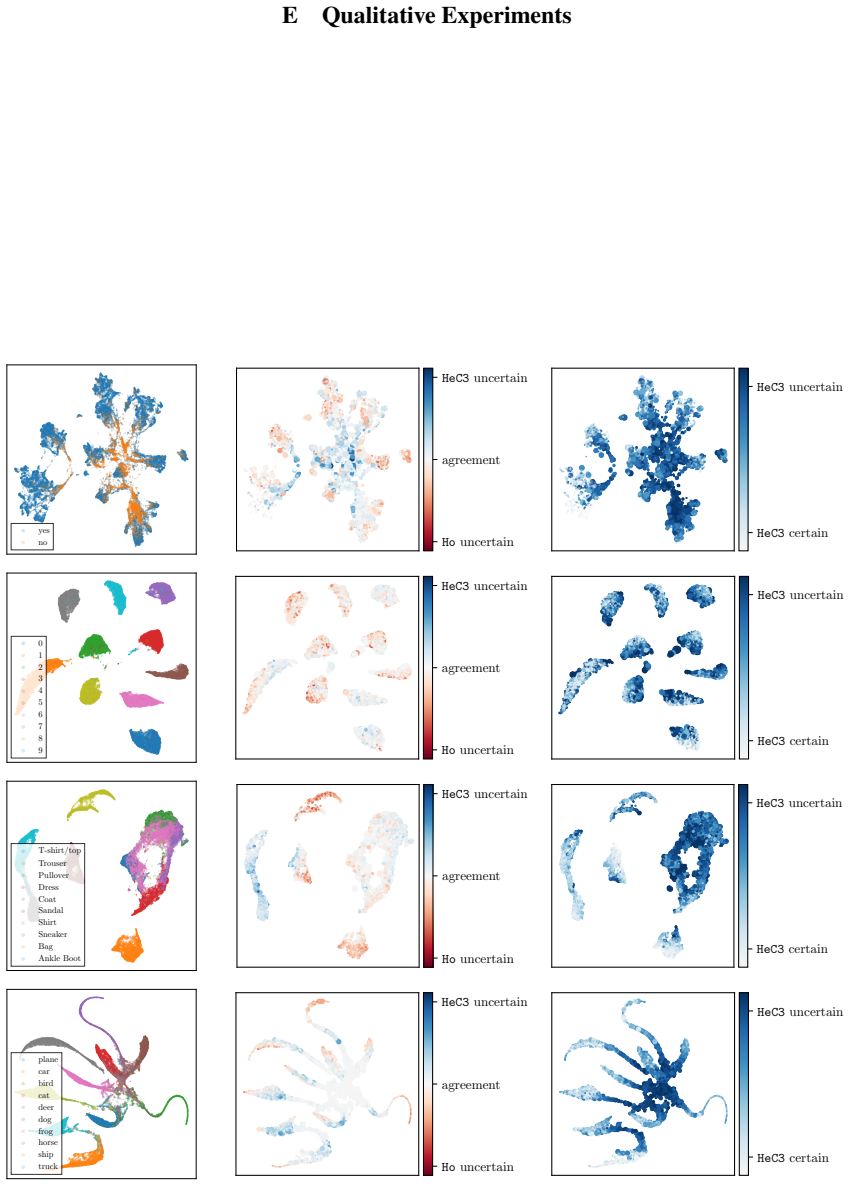
- [§5, Table 1, and Appendix A.5] The 'source disentanglement' is presented as a heuristic ratio analysis rather than a formal decomposition. Appendix A.5 shows that HeC3/Ho is a linear smoother of squared jackknife residuals normalized by the global variance; it is therefore a conditional variance estimator, not a direct estimator of the aleatoric component of the total predictive variance. The empirical support for source attribution is strong only for the noisy subpopulation (HeC3/Ho AUROC 0.97–0.99), while the missing subpopulation AUROCs are moderate (0.58–0.80 for Ho and HeC3 individually). The text says 'both variances are equally high' for the missing subpopulation, but the reported AUROC values do not clearly demonstrate that both estimators reliably identify the missing subpopulation. The claims in this section should be softened or supplemented with additional statistics, such as the actual separation of variance distributions for the two subpopulations.
- [§2.2 and §2.3] The jackknife estimator is described as 'free of any assumptions,' but this is only true in the linear-regression setting from which it is borrowed. After linearization, the deep-learning HeC3 estimator inherits the pseudo-response substitution r = y − f_{ŵ}(X), the fixed-feature approximation, and the EKFAC approximation with leverage clipping described in Appendix B.6. The pseudo-responses are not centered and include model misspecification, so interpreting Eq. 17 as the variance due to finite sampling of (X, ε) requires an additional assumption that the misspecification term is absorbed into the noise. This should be stated explicitly and, if possible, tested by comparing the deep-learning estimators with true retraining-based variances on a small-scale task.
minor comments (4)
- [§2.3, Eq. (15)–(16)] The symbol F_{ŵ} is used in Eqs. (15) and (16) but is not defined; it should be defined as F_{ŵ} = Φ_{ŵ}^T Φ_{ŵ}, to distinguish it from F_{ŵλ} = Φ_{ŵ}^T Φ_{ŵ} + λI.
- [Abstract and throughout] There are several formatting and spelling errors, including 'uncertaintytomoderndeeplearning' in the abstract and 'each test points' instead of 'each test point'. The text also has missing spaces in a few places (e.g., 'experimentsaremeant' and 'GalandGhahramani2016'). A careful copyedit is needed.
- [§4 and Appendix A.4] The EKFAC approximation of the meat matrix Φ^T diag(û^2) Φ is not jointly diagonalizable with Φ^T Φ, and the paper considers two approximations: one using the same basis U and one using a different basis V. The accuracy of these approximations is not evaluated. A small experiment comparing exact (or Cholesky-based) and EKFAC-based HeC3 variances would help assess how much of the source-attribution signal is lost in the approximation.
- [Appendix B.6] The clipping of approximate leverages to [0, 1−ε] with ε = 1×10⁻⁴ is an ad hoc correction that may affect the jackknife residuals for high-leverage points. The sensitivity of the HeC3/Ho ratio to this clipping choice is not reported.
Circularity Check
No significant circularity: estimators are adapted from classical linear-regression statistics, validated against independent Monte Carlo ground truth, and the residual-smoother identity is explicitly derived rather than hidden.
full rationale
The paper's derivation chain is self-contained and non-circular. Equations (8)-(11) reproduce textbook linear-regression variance estimators with proofs in Appendix A, and Equations (12)-(17) are obtained by an explicitly stated linearization ansatz (Section 2.3: 'This is equivalent to making the assumption that orders greater than 1 are negligible when considering different samples X and ε'), not by fiat or by fitting the target result. The toy experiments of Section 3 validate Ho and HeC3 against Monte Carlo estimates computed by independent resampling procedures, so the agreement is not imposed by construction. The Appendix A.5 identity (HeC3/Ho as a linear smoother of jackknife residuals) is an explicit algebraic reduction proved by the authors; it transparently explains the mechanism behind the noisy-subpopulation result instead of covertly assuming it, and the cited econometrics literature is acknowledged. The EKFAC approximation is a self-citation to George et al. (2018), but it is a published, independently evaluated algorithm used as an implementation tool, and the paper additionally reports last-layer (Dense) results that bypass EKFAC, so no load-bearing claim reduces to the self-citation. The main limitation—the quality of fixing tangent features at the trained weights under different training samples—is flagged by the authors in Section 6 as needing further quantification; it is an accuracy/robustness assumption, not a circular dependence. No circular step meeting the quoted-evidence bar was found.
Assumptions & free parameters
free parameters (2)
- ridge regularization lambda =
weight decay value used during optimization, e.g. 1e-2 for MNIST/CIFAR/IMDB
- EKFAC leverage clipping epsilon =
1e-4
assumptions (5)
- domain assumption Training converges to a minimizer of the ridge-regularized MSE, and the loss landscape near ŵ is such that the linearization in Eq. 12 has negligible higher-order terms.
- domain assumption The tangent features φ_{ŵ} are fixed and independent of the particular noise realization or training sample, so variance over X and ε can be computed as if the design matrix were fixed.
- standard math IID samples from p(x,y) and existence of a ridge penalty λ ≥ 0; the Bayes predictor y*(x) = E[y|x] exists.
- domain assumption For classification, training the network on one-hot encoded targets with MSE loss approximates the classification task well enough for uncertainty estimation.
- domain assumption The EKFAC block-diagonal plus Kronecker approximation of the Fisher information matrix and of the meat matrix preserves the ranking properties of the exact estimators.
Cite this review
Pith. "Pith review of Tracing sources of epistemic uncertainty in deep learning predictions: homo- and hetero-scedastic linearized estimators." pith.science (2026). https://pith.science/paper/4LDTHVKZ
@misc{pith2026260807630,
  author       = {Pith},
  title        = {Pith review of: Tracing sources of epistemic uncertainty in deep learning predictions: homo- and hetero-scedastic linearized estimators},
  year         = {2026},
  howpublished = {\url{https://pith.science/paper/4LDTHVKZ}},
  note         = {Machine review of arXiv:2608.07630}
}
read the original abstract
We adapt two classical statistical estimators for quantifying uncertainty to modern deep learning, in order to provide clearer insights into uncertainty attributable to two sources : aleatoric uncertainty, or locally scarce data. Our approach leverages recent advances in approximate Fisher Information Matrices, to enable scaling to actual architectures. Experimental results demonstrate how each test points is differentially impacted by both sources, highlighting the practical utility of our estimators in improving the robustness of real-world applications.
Figures


Figures from the paper (7 more)




Reference graph
Works this paper leans on
-
[1]
International Conference on Artificial Intelligence and Statistics , pages =
Relatif: Identifying explanatory training samples via relative influence , author =. International Conference on Artificial Intelligence and Statistics , pages =. 2020 , organization =
2020
-
[2]
International economic review , pages =
Using least squares to approximate unknown regression functions , author =. International economic review , pages =. 1980 , publisher =
1980
-
[3]
Journal of Financial Econometrics , volume =
The power of (non-) linear shrinking: A review and guide to covariance matrix estimation , author =. Journal of Financial Econometrics , volume =. 2022 , publisher =
2022
-
[4]
Econometrica: journal of the Econometric Society , pages =
A heteroskedasticity-consistent covariance matrix estimator and a direct test for heteroskedasticity , author =. Econometrica: journal of the Econometric Society , pages =. 1980 , publisher =
1980
-
[5]
2000 , publisher =
Asymptotic statistics , author =. 2000 , publisher =
2000
-
[6]
Statistical Science , volume =
Models as approximations I , author =. Statistical Science , volume =. 2019 , publisher =
2019
-
[7]
Slutsky, Eugen , journal =
-
[8]
Advances in neural information processing systems , volume =
Language models are few-shot learners , author =. Advances in neural information processing systems , volume =
Show all 103 references
-
[9]
On the stability of inverse problems , author =. Dokl. akad. nauk sssr , volume =
-
[10]
Proceedings of the IEEE conference on computer vision and pattern recognition , pages =
Deep residual learning for image recognition , author =. Proceedings of the IEEE conference on computer vision and pattern recognition , pages =
-
[11]
2009 , publisher =
Learning multiple layers of features from tiny images , author =. 2009 , publisher =
2009
-
[12]
arXiv preprint arXiv:1708.07747 , year =
Fashion-mnist: a novel image dataset for benchmarking machine learning algorithms , author =. arXiv preprint arXiv:1708.07747 , year =
-
[13]
A method of solving a convex programming problem with convergence rate O bigl(k\^
Nesterov, Yurii Evgen'evich , booktitle =. A method of solving a convex programming problem with convergence rate O bigl(k\^. 1983 , organization =
1983
-
[14]
Ussr computational mathematics and mathematical physics , volume =
Some methods of speeding up the convergence of iteration methods , author =. Ussr computational mathematics and mathematical physics , volume =. 1964 , publisher =
1964
-
[15]
2005 , url =
The mnist database of handwritten digits , author =. 2005 , url =
2005
-
[16]
Statistics & Probability Letters , volume =
Sparse spatial autoregressions , author =. Statistics & Probability Letters , volume =. 1997 , publisher =
1997
-
[17]
Decision Support Systems , volume =
A data-driven approach to predict the success of bank telemarketing , author =. Decision Support Systems , volume =. 2014 , publisher =
2014
-
[18]
The annals of mathematical statistics , volume =
On information and sufficiency , author =. The annals of mathematical statistics , volume =. 1951 , publisher =
1951
- [19]
-
[20]
arXiv preprint arXiv:2308.13431 , year =
Six lectures on linearized neural networks , author =. arXiv preprint arXiv:2308.13431 , year =
-
[21]
Journal of statistical software , volume =
Object-oriented computation of sandwich estimators , author =. Journal of statistical software , volume =
-
[22]
Advances in neural information processing systems , volume =
Not all images are worth 16x16 words: Dynamic transformers for efficient image recognition , author =. Advances in neural information processing systems , volume =
-
[23]
Bert: Pre-training of deep bidirectional transformers for language understanding , author =. Proceedings of the 2019 conference of the North American chapter of the association for computational linguistics: human language technologies, volume 1 (long and short papers) , pages =
2019
-
[24]
The Annals of Mathematical Statistics , volume =
The limiting distributions of certain statistics , author =. The Annals of Mathematical Statistics , volume =. 1935 , publisher =
1935
-
[25]
Metrologia , volume =
Uncertainty propagation in non-linear measurement equations , author =. Metrologia , volume =. 2007 , publisher =
2007
-
[26]
1972 , publisher =
The infinitesimal jackknife , author =. 1972 , publisher =
1972
-
[27]
Advances in neural information processing systems , volume =
Neural tangent kernel: Convergence and generalization in neural networks , author =. Advances in neural information processing systems , volume =
-
[28]
Advances in neural information processing systems , volume =
Fast approximate natural gradient descent in a kronecker factored eigenbasis , author =. Advances in neural information processing systems , volume =
-
[29]
International conference on machine learning , pages =
Optimizing neural networks with kronecker-factored approximate curvature , author =. International conference on machine learning , pages =. 2015 , organization =
2015
-
[30]
Journal of Applied Statistics , volume =
On the asymptotic distribution of Cook's distance in logistic regression models , author =. Journal of Applied Statistics , volume =. 2009 , publisher =
2009
-
[31]
British Journal of Mathematical and Statistical Psychology , volume =
Using Cook's distance in polytomous logistic regression , author =. British Journal of Mathematical and Statistical Psychology , volume =. 2015 , publisher =
2015
-
[32]
Biometrika , volume =
A new measure of rank correlation , author =. Biometrika , volume =. 1938 , publisher =
1938
-
[33]
Mathematical programming , volume =
On the limited memory BFGS method for large scale optimization , author =. Mathematical programming , volume =. 1989 , publisher =
1989
-
[34]
Advances in Neural Information Processing Systems , volume =
If influence functions are the answer, then what is the question? , author =. Advances in Neural Information Processing Systems , volume =
-
[35]
Technometrics , volume =
Detection of influential observation in linear regression , author =. Technometrics , volume =. 1977 , publisher =
1977
-
[36]
Mathematics of computation , volume =
Updating quasi-Newton matrices with limited storage , author =. Mathematics of computation , volume =
-
[37]
arXiv preprint arXiv:2308.03296 , year =
Studying large language model generalization with influence functions , author =. arXiv preprint arXiv:2308.03296 , year =
-
[38]
Biometrika , volume =
Leverage, local influence and curvature in nonlinear regression , author =. Biometrika , volume =. 1993 , publisher =
1993
-
[39]
Biometrika , volume =
Notes on bias in estimation , author =. Biometrika , volume =. 1956 , publisher =
1956
-
[40]
Technometrics , volume =
Jackknife-based estimators and confidence regions in nonlinear regression , author =. Technometrics , volume =. 1986 , publisher =
1986
-
[41]
the Annals of Statistics , volume =
Jackknife, bootstrap and other resampling methods in regression analysis , author =. the Annals of Statistics , volume =. 1986 , publisher =
1986
-
[42]
Advances in neural information processing systems , volume =
On lazy training in differentiable programming , author =. Advances in neural information processing systems , volume =
-
[43]
Advances in Neural Information Processing Systems , volume =
Deep learning versus kernel learning: an empirical study of loss landscape geometry and the time evolution of the neural tangent kernel , author =. Advances in Neural Information Processing Systems , volume =
-
[44]
Biometrics , pages =
Asymptotic confidence bands for generalized nonlinear regression models , author =. Biometrics , pages =. 1995 , publisher =
1995
-
[45]
Neural computation , volume =
Fast curvature matrix-vector products for second-order gradient descent , author =. Neural computation , volume =. 2002 , publisher =
2002
-
[46]
International Conference on Artificial Intelligence and Statistics , pages =
Implicit regularization via neural feature alignment , author =. International Conference on Artificial Intelligence and Statistics , pages =. 2021 , organization =
2021
-
[47]
, title =
Tukey, John W. , title =. Annals of Mathematical Statistics , volume =. 1958 , jstor =
1958
-
[48]
Scaling Down Deep Learning with
Greydanus, Samuel James and Kobak, Dmitry , booktitle =. Scaling Down Deep Learning with. 2024 , editor =
2024
-
[49]
Neural Computation , author =
Fast. Neural Computation , author =. 2002 , pages =. doi:10.1162/08997660260028683 , abstract =
2002 doi
-
[50]
Journal of econometrics , volume =
Some heteroskedasticity-consistent covariance matrix estimators with improved finite sample properties , author =. Journal of econometrics , volume =. 1985 , publisher =
1985
-
[51]
Biometrika , volume =
Assessing the accuracy of the maximum likelihood estimator: Observed versus expected Fisher information , author =. Biometrika , volume =. 1978 , publisher =
1978
-
[52]
Biometrika , volume=
Efficient estimation of conditional variance functions in stochastic regression , author=. Biometrika , volume=. 1998 , publisher=
1998
-
[53]
Journal of the Royal Statistical Society Series B: Statistical Methodology , volume=
Variance function estimation in regression: the effect of estimating the mean , author=. Journal of the Royal Statistical Society Series B: Statistical Methodology , volume=. 1989 , publisher=
1989
-
[54]
The Annals of Statistics , pages=
Estimation of heteroscedasticity in regression analysis , author=. The Annals of Statistics , pages=. 1987 , publisher=
1987
-
[55]
arXiv preprint arXiv:1802.03426 , year=
Umap: Uniform manifold approximation and projection for dimension reduction , author=. arXiv preprint arXiv:1802.03426 , year=
-
[56]
International Conference on Learning Representations , year=
An Image is Worth 16x16 Words: Transformers for Image Recognition at Scale , author=. International Conference on Learning Representations , year=
-
[57]
Proceedings of the 49th annual meeting of the association for computational linguistics: Human language technologies , pages=
Learning word vectors for sentiment analysis , author=. Proceedings of the 49th annual meeting of the association for computational linguistics: Human language technologies , pages=
-
[58]
The annals of mathematical statistics , pages =
A stochastic approximation method , author =. The annals of mathematical statistics , pages =. 1951 , publisher =
1951
-
[59]
The Annals of Mathematical Statistics , volume =
Adjustment of an inverse matrix corresponding to a change in one element of a given matrix , author =. The Annals of Mathematical Statistics , volume =. 1950 , publisher =
1950
-
[60]
Food quality and preference , volume =
Modified Jack-knife estimation of parameter uncertainty in bilinear modelling by partial least squares regression (PLSR) , author =. Food quality and preference , volume =. 2000 , publisher =
2000
-
[61]
The Eleventh International Conference on Learning Representations , year=
Beyond calibration: estimating the grouping loss of modern neural networks , author=. The Eleventh International Conference on Learning Representations , year=
-
[62]
Breakthroughs in statistics: Methodology and distribution , pages =
Bootstrap methods: another look at the jackknife , author =. Breakthroughs in statistics: Methodology and distribution , pages =. 1992 , publisher =
1992
-
[63]
Machine learning , volume =
Bagging predictors , author =. Machine learning , volume =. 1996 , publisher =
1996
-
[64]
Neural Networks , volume =
Construction of confidence intervals for neural networks based on least squares estimation , author =. Neural Networks , volume =. 2000 , publisher =
2000
-
[65]
International Conference on Machine Learning , pages =
A kronecker-factored approximate fisher matrix for convolution layers , author =. International Conference on Machine Learning , pages =. 2016 , organization =
2016
-
[66]
Neural Computation , volume =
On “natural” learning and pruning in multilayered perceptrons , author =. Neural Computation , volume =. 2000 , publisher =
2000
-
[67]
Neural processing letters , volume =
Least squares support vector machine classifiers , author =. Neural processing letters , volume =. 1999 , publisher =
1999
-
[68]
Sociological Methodology , volume =
Effect displays for multinomial and proportional-odds logit models , author =. Sociological Methodology , volume =. 2006 , publisher =
2006
-
[69]
Journal of the American statistical association , volume =
The monte carlo method , author =. Journal of the American statistical association , volume =. 1949 , publisher =
1949
-
[70]
Hinkley , journal =
David V. Hinkley , journal =. Jackknifing in Unbalanced Situations , urldate =
-
[71]
Journal of the Korean Statistical Society , volume =
Diagnostics in logistic regression models , author =. Journal of the Korean Statistical Society , volume =. 2008 , publisher =
2008
-
[72]
arXiv preprint arXiv:1412.6980 , year =
Adam: A method for stochastic optimization , author =. arXiv preprint arXiv:1412.6980 , year =
-
[73]
The annals of statistics , volume =
Logistic regression diagnostics , author =. The annals of statistics , volume =. 1981 , publisher =
1981
-
[74]
What Neural Networks Memorize and Why: Discovering the Long Tail via Influence Estimation , url =
Feldman, Vitaly and Zhang, Chiyuan , booktitle =. What Neural Networks Memorize and Why: Discovering the Long Tail via Influence Estimation , url =
-
[75]
Journal of the Royal Statistical Society
Multiple-. Journal of the Royal Statistical Society. Series C (Applied Statistics) , author =. 1989 , note =. doi:10.2307/2347731 , abstract =
1989 doi
-
[76]
International conference on machine learning , pages =
Understanding black-box predictions via influence functions , author =. International conference on machine learning , pages =. 2017 , organization =
2017
-
[77]
An Exact Cholesky Decomposition and the Generalized Inverse of the Variance-Covariance Matrix of the Multinomial Distribution, with Applications , urldate =
Kunio Tanabe and Masahiko Sagae , journal =. An Exact Cholesky Decomposition and the Generalized Inverse of the Variance-Covariance Matrix of the Multinomial Distribution, with Applications , urldate =
-
[78]
Advances in neural information processing systems , volume=
Simple and scalable predictive uncertainty estimation using deep ensembles , author=. Advances in neural information processing systems , volume=
-
[79]
, author=
Visualizing data using t-SNE. , author=. Journal of machine learning research , volume=
- [80]
-
[81]
2024 , eprint =
Training Data Attribution via Approximate Unrolled Differentiation , author =. 2024 , eprint =
2024
-
[82]
Jeffares, Alan and Curth, Alicia and Schaar, Mihaela van der , month = oct, year =. Deep
-
[83]
Conference on learning theory , pages=
Random design analysis of ridge regression , author=. Conference on learning theory , pages=. 2012 , organization=
2012
-
[84]
Annals of statistics , volume=
Surprises in high-dimensional ridgeless least squares interpolation , author=. Annals of statistics , volume=
- [85]
- [86]
-
[87]
Neurocomputing , volume =
Withdrawing an example from the training set: An analytic estimation of its effect on a non-linear parameterised model , author =. Neurocomputing , volume =. 2000 , publisher =
2000
-
[88]
Charpiat, Guillaume and Girard, Nicolas and Felardos, Loris and Tarabalka, Yuliya , year =. Input. Advances in
-
[89]
Stability and
Bousquet, Olivier and Elisseeff, Andre , pages =. Stability and
-
[90]
On the mean and variance of the generalized inverse of a singular
Cook, R Dennis and Forzani, Liliana , year =. On the mean and variance of the generalized inverse of a singular
-
[91]
Machine learning , volume =
Aleatoric and epistemic uncertainty in machine learning: An introduction to concepts and methods , author =. Machine learning , volume =. 2021 , publisher =
2021
-
[92]
The Thirty-ninth Annual Conference on Neural Information Processing Systems , year =
Better Training Data Attribution via Better Inverse Hessian-Vector Products , author =. The Thirty-ninth Annual Conference on Neural Information Processing Systems , year =
-
[93]
Neural Comput
A comparison of some error estimates for neural network models , volume =. Neural Comput. , author =. 1996 , pages =. doi:10.1162/neco.1996.8.1.152 , abstract =
1996 doi
-
[94]
Neural Computation , author =
Natural. Neural Computation , author =. 1998 , pages =. doi:10.1162/089976698300017746 , abstract =
1998 doi
-
[95]
and Bagdanov, Andrew D
Liu, Xialei and Masana, Marc and Herranz, Luis and Van de Weijer, Joost and López, Antonio M. and Bagdanov, Andrew D. , year =. Rotate your. doi:10.1109/ICPR.2018.8545895 , booktitle =
2018
-
[96]
Proceedings of the AAAI Conference on Artificial Intelligence , author =
General. Proceedings of the AAAI Conference on Artificial Intelligence , author =. 2025 , pages =. doi:10.1609/aaai.v39i19.34238 , abstract =
2025 doi
-
[97]
Taylor approximations , author =
-
[98]
Neural Networks , author =
Epistemic uncertainty quantification in deep learning classification by the. Neural Networks , author =. 2022 , keywords =. doi:https://doi.org/10.1016/j.neunet.2021.10.014 , abstract =
2022 doi
-
[99]
Dropout as a
Gal, Yarin and Ghahramani, Zoubin , month = jun, year =. Dropout as a. Proceedings of
-
[100]
Ritter, Hippolyt and Botev, Aleksandar and Barber, David , month = feb, year =. A
-
[101]
Practical
Botev, Aleksandar and Ritter, Hippolyt and Barber, David , month = jul, year =. Practical. Proceedings of the 34th
- [102]
-
[103]
Daxberger, Erik and Kristiadi, Agustinus and Immer, Alexander and Eschenhagen, Runa and Bauer, Matthias and Hennig, Philipp , month = nov, year =. Laplace
Reviewed August 11, 2026 · model on record in the stance chip above.
Discussion (0). Continue with ORCID to comment.