REVIEW 3 major objections 5 minor 32 references
PACE: A Playback-Aligned Context Engine for LLM-Based Full-Duplex Voice Dialogue
T0 review · 3 major / 5 minor · reviewed 2026-08-11 · deepseek-v4-flash
Pith's one-line read The paper claims that a middleware layer which anchors model-facing dialogue context to the client's playback boundary can repair full-duplex voice assistants' tendency to answer questions about assistant content the user never heard.
desk verdict A real failure mode, a clean abstraction, and a solid end-to-end implementation—but the headline number rests on a judge that can't see the unplayed continuation for a third of the cases. read the letter →
The pith
A machine-rendered reading of the paper's core claim, the machinery that carries it, and where it could break.
The reading
What carries the argument
The load-bearing object is the playback boundary, represented as a turn-local pair (audio_turn_id, played_samples) that the client reports on every uplink tick and the server snapshots at speech onset. Around it PACE builds an OutputTurnLedger that records generated audio, optional text, and optional semantic spans for each assistant turn, plus a forward gate that forces the ordering cancel, injected context, then held user audio. The implemented adhesive is the audio re-injection adapter: it slices the most recent five seconds of played audio from the turn-indexed buffer, resamples it to the model's input rate, appends a pre-synthesized spoken delimiter such as "That was what I heard before interrupting...", and sends the concatenation to the model's audio input before releasing post-interruption speech. That adapter carries the argument because it grounds the next response at the playback boundary using only audio, which every target runtime accepts, and it never assumes text transcripts, conversation-item truncation, or KV-cache access.
What would settle it
Have human annotators judge all 'next' cases with access to the full generated-but-unplayed continuation and compare their verdicts to the automated judge's; if agreement is clearly below the reported 97.2% 'next' accuracy, the headline 96.3% Referent Anchoring Accuracy is inflated. A second check is to re-run GCM-Bench with two additional LLM judges and measure inter-judge agreement.
Extended reading notes
Core claim
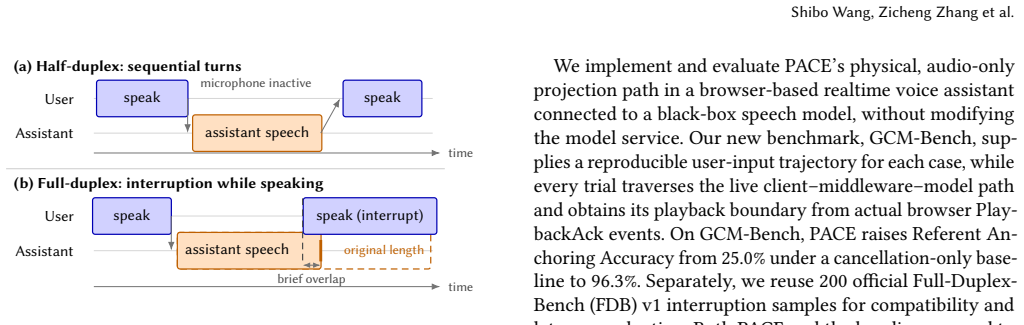
The paper's central claim is that the divergence among generated output, client playback, and model-facing dialogue state is a distributed consistency failure, and that a turn-local playback boundary is the right system-observable anchor for repairing it. PACE assigns each assistant response a turn id, keeps a server-side ledger with a copy of the delivered audio, and has the client continuously report how many samples of that turn have been rendered. On a confirmed interruption it snapshots this boundary, cancels and revokes everything beyond it, then projects the played prefix into the model before the user's post-interruption speech, so the model's next response is grounded at the point the user could have heard. The implemented audio-only path works against a black-box speech model with no transcript or cache access: it slices the last five seconds of played audio, appends a spoken delimiter, and injects that audio into the model's input buffer. The paper reports 96.3% Referent Anchoring Accuracy on its 108-case GCM-Bench (versus 25.0% for cancellation alone, McNemar p<0.001), repairing 78 baseline failures while introducing one regression, and unchanged interruption quality on the 200-sample compatibility study.
Load-bearing premise
The headline accuracy figure assumes the automated judge can tell which list item a response anchors to, and the paper concedes that for one third of the benchmark ('next' requests) the judge cannot always verify the true next item because the generated-but-unplayed continuation is invisible to it.
Editorial extensions
If this is right
- Any full-duplex voice assistant whose context advances with generation can silently answer about unheard content; the paper turns this into a named, measurable failure (GCM) and a benchmark (GCM-Bench) that interruption metrics do not detect.
- Playback-aligned context repair works through a black-box speech model: the implemented path needs only an audio input buffer and a way to cancel output, not provider-specific truncation or model internals.
- A short spoken delimiter and a five-second lookback are enough to anchor referents in the tested setting; widening the lookback to ten seconds degrades anchoring because it introduces competing candidates.
- Ordinary topic-switching interruptions are not harmed by the repair: on the 200 official samples every interruption receives a response and judged quality is essentially unchanged, with the added latency confined to the interruption path.
- The mechanism generalizes to cascaded systems in principle: when a runtime provides reliable audio-to-text alignment, the same playback boundary can rewrite prompt history instead of re-injecting audio.
Reading between the lines
- Editorial inference: the same boundary could gate irreversible actions — PACE already separates generation from action commitment, so a natural extension is to block any tool call whose triggering proposal was never played, which the paper motivates but does not implement.
- Editorial inference: because the paper concedes that the automated judge cannot verify 'next' responses without the unplayed continuation, the true gain on that third of the benchmark is the number to scrutinize; a human-annotated version of GCM-Bench would either confirm or lower the headline 96.3%.
- Editorial inference: the audio re-injection adapter should transfer to cascaded ASR-LLM-TTS pipelines by substituting transcript re-injection for audio re-injection, giving a testable cross-runtime extension the paper leaves implicit.
Editorial analysis
A structured set of objections, weighed in public.
Referee Report
Summary. The paper identifies Generative Context Mis-anchoring (GCM), a failure mode in full-duplex LLM-based voice dialogue where user speech is interpreted against assistant content that was generated but never played. It proposes PACE, a middleware layer that tracks the client playback boundary via an output-turn ledger and playback acknowledgments, and after an interruption projects only the played prefix into the model context, using an audio re-injection adapter for black-box speech models. The authors implement this path in a browser-based assistant with a black-box model, release a new 108-case benchmark (GCM-Bench), and report a Referent Anchoring Accuracy improvement from 25.0% to 96.3% over a cancellation-only baseline, along with a compatibility study on 200 Full-Duplex-Bench v1 samples showing no loss in response quality and modest added latency. The paper also includes ablations of delimiter wording and lookback window and discusses the limitations of the automated judge for the 'next' operation.
Significance. If the results hold, the paper makes a valuable contribution: it identifies and names a real distributed-consistency failure (GCM) that existing full-duplex benchmarks do not measure, and it demonstrates a provider-independent, deployment-relevant remedy. The work is notable for pairing a controlled, reproducible benchmark with a live end-to-end implementation in which playback boundaries come from actual browser PlaybackAck events rather than simulation. The paired 108-case design with McNemar testing, the 78:1 improvement-to-regression count, the delimiter and lookback ablations, and the external Full-Duplex-Bench compatibility check are concrete strengths. The released dataset and the explicit separation of physical vs. semantic commit boundaries will be useful to the community even if the headline accuracy changes after human validation.
major comments (3)
- [§5.3, Table 2] The pooled RAA of 96.3% is not fully supported for the 'next' operation. As the paper acknowledges in §5.3 and §8, the ChatGPT-5.5 judge observes only the played prefix and the post-interruption response, not the generated-but-unplayed continuation, so it cannot verify whether a response advances from the item at the playback boundary or from an unheard internal item. Since 'next' constitutes 36 of the 108 cases, the 35/36 next successes and the resulting 78:1 improvement-to-regression ratio may be inflated by judge acceptance of plausible novel items. The central claim in the abstract and conclusion should be conditioned on human validation of these cases (or on a re-analysis that excludes or re-labels them), or the headline should be explicitly restricted to elaborate and repeat operations.
- [§5.2, §6.3] Several design choices that affect the reported RAA were selected using the same 108 evaluation cases: the interruption delays (12/16/20 s) were chosen after pilot runs on the same task, and the delimiter wording (P1) and lookback window (5 s) were selected by ablating on the same 108 cases. This does not invalidate the paired comparison, but it means the reported 96.3% is a tuned estimate on the evaluation set rather than an out-of-sample performance. Please provide a validation split or otherwise clarify what, if anything, was held out; without this, the absolute accuracy is difficult to interpret, even though the direction of the effect is likely robust.
- [§6.3, Table 4] The lookback ablation is not fully paired: the 2.5-s and 10-s conditions were collected in a later realtime batch than the 5-s condition. The paper states this and interprets the near-tie cautiously, but the conclusion that '5 s is a conservative default' and the interpretation of the 10-s degradation depend on cross-batch comparisons that cannot separate batch effects from window length. At minimum, the claim should be softened to acknowledge that the 5-s versus 2.5-s comparison is not a same-batch paired test.
minor comments (5)
- [Abstract] There is a formatting error in the abstract: 'failureGenerative Context Mis-anchoring' should be 'failure Generative Context Mis-anchoring' with a space.
- [§3.3] The notation P_delim is used in the audio re-injection adapter description before it is formally defined; please introduce it earlier or add a brief parenthetical definition at first use.
- [§5.3] The definition of TOR is only given implicitly as 'turn-obedience rate' from Full-Duplex-Bench; the manuscript should state explicitly how a response is judged as turn-obedient in GCM-Bench, especially since TOR is reported as 100% for all conditions.
- [§6.4] The FDB compatibility result is reported with a 0.020-point quality difference and a 58.7 ms latency increase; it would be helpful to report the distribution of the quality scores (e.g., fraction of 5s) to show the effect is not driven by a ceiling artifact.
- [§8] The discussion of future work mentions 'case-level human inspection against both the playback boundary and the generated-but-unplayed sequence'; this is precisely the validation needed for the current headline result, and the paper would be stronger if a small-scale version of this protocol were included in this revision.
Circularity Check
No significant circularity: PACE's headline result is an empirical end-to-end comparison against a cancellation-only baseline, with an external FDB v1 compatibility check; the flagged judge limitation for 'next' is a measurement-validity concern, not a circular derivation.
full rationale
The paper does not derive PACE's performance from its own definitions or from self-citation. The 25.0% to 96.3% RAA change is an observed outcome on 108 paired trials in which the baseline and PACE share the same model, user-input trajectories, and interruption timing; the only manipulated variable is playback-context projection. Nothing in the benchmark definition or the metric equation (Eq. 5) forces PACE to score 96.3%: the model can and does fail on four cases, and the baseline succeeds on 27. The design choices (delimiter P1, 5-s lookback) were selected using the same 108 cases and are reported with ablations and statistical tests, which is a tuning/overfitting concern rather than a circularity, because the selection does not make the outcome a logical consequence of the inputs. The paper explicitly discloses the main measurement limitation: Section 5.3 states that for 'next' the ChatGPT judge 'cannot always verify the identity and order of the true next item' and 'may accept a new, non-repeated item even when the model has advanced from an internal item beyond the playback boundary,' and it accordingly reports 'next' separately and treats 'elaborate' as the cleanest measure. This is a validity limitation that could inflate the pooled headline number, but it is not an equation-level reduction of the claimed result to its inputs. The references are external prior work (Full-Duplex-Bench, OpenAI Realtime API, Moshi, etc.); there are no load-bearing self-citations or imported uniqueness theorems. The external FDB v1 study (200 samples) provides an independent compatibility check, with the paper reporting descriptive quality changes and a modest latency increase. For these reasons, no circular step is exhibited, and the paper is best assessed as self-contained with respect to circularity, while correctness risk remains on the 'next' judging protocol and the tuning-on-benchmark design.
Assumptions & free parameters
free parameters (3)
- lookback window L (played audio slice) =
5 seconds
- instruction delimiter P_delim =
P1 text: 'That was what I heard before interrupting. Now, here is what I want to say:'
- GCM-Bench interruption delays =
12s, 16s, 20s
assumptions (5)
- domain assumption The client playback boundary (played_samples) is a valid proxy for what the user could have heard.
- domain assumption A black-box speech model will treat audio re-injected before the user utterance, prefixed by the spoken delimiter, as already-heard assistant context and will anchor referents accordingly.
- domain assumption The LLM judge (ChatGPT 5.5) correctly identifies whether the post-interruption response anchors to the item at the playback boundary.
- domain assumption The browser Web Audio clock and PlaybackAck events accurately reflect actual rendering position.
- domain assumption VAD-based interruption detection and the user-speech onset tick are reliable enough to snapshot the boundary.
invented entities (4)
-
OutputTurnLedger
-
PlaybackAck
-
GCM-Bench dataset
independent evidence
-
semantic commit boundary B_s
Cite this review
Pith. "Pith review of PACE: A Playback-Aligned Context Engine for LLM-Based Full-Duplex Voice Dialogue." pith.science (2026). https://pith.science/paper/H6JSYZWL
@misc{pith2026260807631,
  author       = {Pith},
  title        = {Pith review of: PACE: A Playback-Aligned Context Engine for LLM-Based Full-Duplex Voice Dialogue},
  year         = {2026},
  howpublished = {\url{https://pith.science/paper/H6JSYZWL}},
  note         = {Machine review of arXiv:2608.07631}
}
read the original abstract
LLM-based full-duplex voice services allow users to speak while the assistant is responding. Because servers can generate output and advance dialogue state faster than clients can play it, subsequent user speech may be interpreted based on content the user never heard. We call this failure Generative Context Mis-anchoring (GCM). To address GCM issues, we present PACE, a provider-independent middleware layer that anchors model-facing context to the client playback boundary, a system-observable proxy for what the user could have heard. After an interruption, PACE repairs this context to exclude assistant content that never reached playback, while preserving low-latency generation across heterogeneous voice runtimes. We implement PACE's audio-only projection path end to end in a browser-based realtime voice assistant using a black-box speech model, without modifying the model service. We also construct GCM-Bench, a new controlled benchmark dataset of 108 playback-relative referent-anchoring cases. On GCM-Bench, PACE raises Referent Anchoring Accuracy from 25.0% to 96.3% over a cancellation-only baseline. On 200 Full-Duplex-Bench v1 interruption samples, it preserves interruption response quality. These results show that grounding model-facing context in actual playback is a practical way to maintain consistency in full-duplex voice dialogue.
Figures

Reference graph
Works this paper leans on
-
[1]
Junjie Chen, Yao Hu, Junjie Li, Kangyue Li, Kun Liu, Wenpeng Li, Xu Li, Ziyuan Li, Feiyu Shen, Xu Tang, Manzhen Wei, Yichen Wu, Fenglong Xie, Kaituo Xu, and Kun Xie. 2025. FireRedChat: A Pluggable, Full- Duplex Voice Interaction System with Cascaded and Semi-Cascaded Implementations. arXiv:2509.06502 [cs.CL] https://arxiv.org/abs/2509. 06502
arXiv 2025
-
[2]
Yuxuan Chen and Haoyuan Yu. 2025. From Turn-Taking to Synchro- nous Dialogue: A Survey of Full-Duplex Spoken Language Models. arXiv:2509.14515 [cs.CL] https://arxiv.org/abs/2509.14515
arXiv 2025
-
[3]
Herbert H. Clark. 1996.Using Language. Cambridge University Press, Cambridge, UK
work page 1996
-
[4]
Herbert H. Clark and Susan E. Brennan. 1991. Grounding in Com- munication. InPerspectives on Socially Shared Cognition. American Psychological Association, Washington, DC, USA, 127–149
work page 1991
-
[5]
Junbo Cui, Bokai Xu, Chongyi Wang, Tianyu Yu, Weiyue Sun, et al
-
[6]
Alexandre Défossez, Laurent Mazaré, Manu Orsini, Amélie Royer, Patrick Pérez, Hervé Jégou, Edouard Grave, and Neil Zeghidour. 2024. Moshi: A Speech-Text Foundation Model for Real-Time Dialogue. arXiv:2410.00037 [eess.AS] https://arxiv.org/abs/2410.00037 13 Shibo Wang, Zicheng Zhang et al
arXiv 2024
-
[7]
Yuhao Du, Qianwei Huang, Guo Zhu, Zhanchen Dai, Shunian Chen, et al . 2025. MTalk-Bench: Evaluating Speech-to-Speech Models in Multi-Turn Dialogues via Arena-style and Rubrics Protocols. arXiv:2508.18240 [cs.CL] https://arxiv.org/abs/2508.18240
arXiv 2025
-
[8]
Google. 2026. Live API Capabilities Guide. https://ai.google.dev/ gemini-api/docs/live-api/capabilities
work page 2026
Show all 32 references
-
[9]
Zhang He, Wenqian Cui, Haoning Xu, Xiao-Hui Li, Lei Zhu, Haoli Bai, Ma Shaohua, and Irwin King. 2026. MTR-DuplexBench: Towards a Comprehensive Evaluation of Multi-Round Conversations for Full- Duplex Speech Language Models. InFindings of the Association for Computational Lingu...
2026 doi
-
[10]
Borui Liao, Yulong Xu, Jiao Ou, Kaiyuan Yang, Weihua Jian, Pengfei Wan, and Di Zhang. 2025. FlexDuo: A Pluggable System for Enabling Full-Duplex Capabilities in Speech Dialogue Systems. arXiv:2502.13472 [cs.CL] https://arxiv.org/abs/2502.13472
2025 arXiv
-
[11]
Guan-Ting Lin, Chen Chen, Zhehuai Chen, and Hung-yi Lee. 2026. Full-Duplex-Bench-v3: Benchmarking Tool Use for Full-Duplex Voice Agents Under Real-World Disfluency. arXiv:2604.04847 [cs.CL] https: //arxiv.org/abs/2604.04847
2026 arXiv
-
[12]
Guan-Ting Lin, Shih-Yun Shan Kuan, Jiatong Shi, Kai-Wei Chang, Siddhant Arora, Shinji Watanabe, and Hung-yi Lee. 2025. Full-Duplex- Bench-v2: A Multi-Turn Evaluation Framework for Duplex Dialogue Systems with an Automated Examiner. arXiv:2510.07838 [cs.CL] https: //arxiv.org/a...
2025 arXiv
-
[13]
Liu, and Hung-yi Lee
Guan-Ting Lin, Jiachen Lian, Tingle Li, Qirui Wang, Gopala Anu- manchipalli, Alexander H. Liu, and Hung-yi Lee. 2025. Full-Duplex- Bench: A Benchmark to Evaluate Full-duplex Spoken Dialogue Mod- els on Turn-taking Capabilities. arXiv:2503.04721 [cs.CL] https: //arxiv.org/abs/2...
2025 arXiv
-
[14]
Ting-En Lin, Yuchuan Wu, Fei Huang, Luo Si, Jian Sun, and Yongbin Li. 2022. Duplex Conversation: Towards Human-Like Interaction in Spoken Dialogue Systems. InProceedings of the 28th ACM SIGKDD Conference on Knowledge Discovery and Data Mining. Association for Computing Machine...
2022
-
[15]
LiveKit. 2026. Turns Overview. https://docs.livekit.io/agents/logic/ turns/
2026
-
[16]
Ziyang Ma, Yakun Song, Chenpeng Du, Jian Cong, Zhuo Chen, Yuping Wang, Yuxuan Wang, and Xie Chen. 2025. Language Model Can Listen While Speaking.Proceedings of the AAAI Conference on Artificial Intelligence39, 23 (2025), 24831–24839. doi:10.1609/aaai.v39i23.34665
2025 doi
-
[17]
OpenAI. 2026. Realtime Client Events: Conversation Item Trun- cate. https://platform.openai.com/docs/api-reference/realtime-client- events/conversation/item/truncate
2026
-
[18]
OpenAI. 2026. Voice Activity Detection (VAD) in the Realtime API. https://developers.openai.com/api/docs/guides/realtime-vad
2026
-
[19]
Yizhou Peng, Yi-Wen Chao, Dianwen Ng, Yukun Ma, Chongjia Ni, Bin Ma, and Eng Siong Chng. 2025. FD-Bench: A Full-Duplex Bench- marking Pipeline Designed for Full Duplex Spoken Dialogue Systems. arXiv:2507.19040 [cs.CL] https://arxiv.org/abs/2507.19040
2025 arXiv
-
[20]
2026.𝜏-Voice: Benchmarking Full-Duplex Voice Agents on Real-World Domains
Soham Ray, Keshav Dhandhania, Victor Barres, and Karthik Narasimhan. 2026.𝜏-Voice: Benchmarking Full-Duplex Voice Agents on Real-World Domains. arXiv:2603.13686 [cs.CL] https://arxiv.org/ abs/2603.13686
2026
-
[21]
2003.RTP: A Transport Protocol for Real-Time Applications
Henning Schulzrinne, Stephen Casner, Ron Frederick, and Van Jacob- son. 2003.RTP: A Transport Protocol for Real-Time Applications. RFC
2003
-
[22]
Peloquin, Bokai Yu, Hongyu Gong, and Shyamnath Gollakota
Bandhav Veluri, Benjamin N. Peloquin, Bokai Yu, Hongyu Gong, and Shyamnath Gollakota. 2024. Beyond Turn-Based Interfaces: Synchro- nous LLMs as Full-Duplex Dialogue Agents. InProceedings of the 2024 Conference on Empirical Methods in Natural Language Process- ing. Association ...
2024 doi
-
[23]
Peng Wang, Songshuo Lu, Yaohua Tang, Sijie Yan, Wei Xia, and Yuan- jun Xiong. 2024. A Full-duplex Speech Dialogue Scheme Based on Large Language Models. arXiv:2405.19487 [cs.CL] https://arxiv.org/ abs/2405.19487
2024 arXiv
-
[24]
Qichao Wang, Ziqiao Meng, Wenqian Cui, Yifei Zhang, Pengcheng Wu, Bingzhe Wu, Irwin King, Liang Chen, and Peilin Zhao. 2025. NTPP: Generative Speech Language Modeling for Dual-Channel Spoken Dia- logue via Next-Token-Pair Prediction. InProceedings of the 42nd Inter- national C...
2025
-
[25]
Xiong Wang, Yangze Li, Chaoyou Fu, Yunhang Shen, Lei Xie, Ke Li, Xing Sun, and Long Ma. 2024. Freeze-Omni: A Smart and Low Latency Speech-to-Speech Dialogue Model with Frozen LLM. arXiv:2411.00774 [cs.CL] https://arxiv.org/abs/2411.00774
2024 arXiv
-
[26]
World Wide Web Consortium. 2021. Web Audio API. https://www. w3.org/TR/webaudio/
2021
-
[27]
Ruiqi Yan, Xiquan Li, Wenxi Chen, Zhikang Niu, Chen Yang, Ziyang Ma, Kai Yu, and Xie Chen. 2025. URO-Bench: Towards Com- prehensive Evaluation for End-to-End Spoken Dialogue Models. arXiv:2502.17810 [cs.CL] https://arxiv.org/abs/2502.17810
2025 arXiv
-
[28]
Jianing Yang, Yusuke Fujita, and Yui Sudo. 2026. Duplex- Cascade: Full-Duplex Speech-to-Speech Dialogue with VAD-Free Cascaded ASR–LLM–TTS Pipeline and Micro-Turn Optimization. arXiv:2603.09180 [cs.CL] https://arxiv.org/abs/2603.09180
2026
-
[29]
Haoyuan Yu, Yuxuan Chen, and Minjie Cai. 2026. Unit- Based Agent for Semi-Cascaded Full-Duplex Dialogue Systems. arXiv:2601.20230 [cs.CL] https://arxiv.org/abs/2601.20230
2026
-
[30]
Hao Zhang, Weiwei Li, Rilin Chen, Vinay Kothapally, Meng Yu, and Dong Yu. 2025. LLM-Enhanced Dialogue Management for Full-Duplex Spoken Dialogue Systems. arXiv:2502.14145 [cs.CL] https://arxiv.org/ abs/2502.14145 14
2025 arXiv
-
[2026]
arXiv:2604.27393 [cs.CL] https://arxiv.org/abs/2604.27393
MiniCPM-o 4.5: Towards Real-Time Full-Duplex Omni-Modal Interaction. arXiv:2604.27393 [cs.CL] https://arxiv.org/abs/2604.27393
-
[3550]
https://www.rfc-editor.org/ rfc/rfc3550
Internet Engineering Task Force. https://www.rfc-editor.org/ rfc/rfc3550
Reviewed August 11, 2026 · model on record in the stance chip above.
Discussion (0). Continue with ORCID to comment.