REVIEW 5 minor 50 references
State Preparation Protocols for Entangled States via Open Quantum Walks
T0 review · 0 major / 5 minor · reviewed 2026-08-11 · deepseek-v4-flash
Pith's one-line read Open quantum walks with engineered nonunitary Kraus operators prepare W, Dicke, and GHZ states, with a closed-form spectral gap governing Dicke convergence.
desk verdict Worth a serious referee: the GHZ and Dicke OQW constructions are new, the appendix derivations check out, and the flagged spectral-gap concern evaporates once you include the Z1 edge correction. read the letter →
The pith
A machine-rendered reading of the paper's core claim, the machinery that carries it, and where it could break.
The reading
What carries the argument
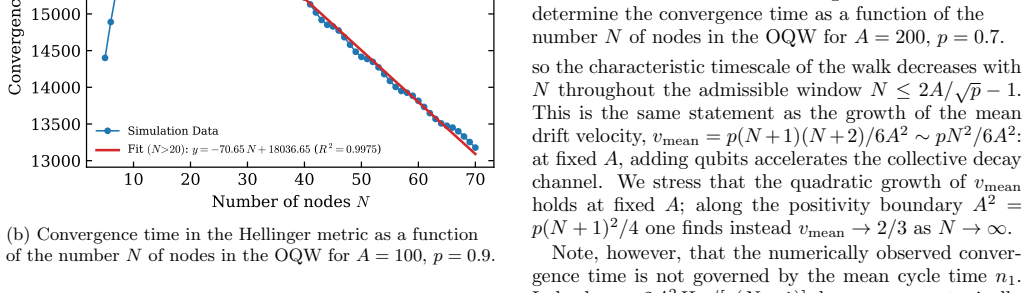
The central object is the open quantum walk itself, specified by edge operators $M^i_j=B^i_j\otimes|j\rangle\langle i|$ with the completeness condition $\sum_j B^{j\dagger}_i B^j_i=I$; the graph degree of freedom simultaneously drives the dissipation and acts as a classical record of the outcome. For the GHZ protocol the load-bearing operators are the stabilizer projectors $K_\pm=(I\pm X^{\otimes N})/2$, with the unitary correction $Z_1$ inserted on the $|1\rangle\to|0\rangle$ edge to break the periodicity of the unconditioned walk, and the invariant manifold $\mathcal{M}=\mathrm{span}\{|0^N\rangle,|1^N\rangle\}$ that contains the initial state. For the Dicke protocol the load-bearing pair is the collective jump $J_c=(J_1+\cdots+J_N)/A$ and the no-jump operator $K_c=\sqrt{I-J_c^\dagger J_c}$, whose actions on Dicke states are $J_c|D_N^k\rangle=\sqrt{kp(N-k+1)/A^2}|D_N^{k-1}\rangle$ and $K_c|D_N^k\rangle=\sqrt{1-kp(N-k+1)/A^2}|D_N^k\rangle$; these turn the ring graph into a ladder in excitation number. The convergence analysis rests on the induced cyclic bidiagonal Markov chain with hop probability $p_k=p(N-k)(k+1)/A^2$, whose characteristic equation yields the approximate spectral gap and hence the relaxation time.
What would settle it
Run the corrected two-node walk on $N$ qubits from $|0^N\rangle|0\rangle$ and measure the graph and internal register after two steps: the claim predicts the state $|GHZ_+\rangle\langle GHZ_+|\otimes|0\rangle\langle 0|$ with probability one. Observing any weight on node 1, or any internal component outside the $\pm1$ eigenspaces of $X^{\otimes N}$ (beyond numerical error), would falsify deterministic GHZ preparation.
Extended reading notes
Core claim
On its own terms, the paper's central discovery is that open quantum walks with nonunitary, graph-dependent Kraus operators constitute a state-preparation language broad enough to cover the three prototypical entangled resources of quantum communication and distributed computation. For GHZ states, the pair $K_{\pm}=(I\pm X^{\otimes N})/2$ defines a two-node walk whose first step splits the register into $|GHZ_+\rangle$ at node 0 and $|GHZ_-\rangle$ at node 1; inserting the correction $Z_1$ into the edge $|1\rangle\to|0\rangle$ makes the walk reach $|GHZ_+\rangle\langle GHZ_+|\otimes|0\rangle\langle 0|$ in exactly two steps and stay there, with uniqueness of this attractor holding inside the invariant manifold $\mathcal{M}=\mathrm{span}\{|0^N\rangle,|1^N\rangle\}$. For Dicke states, the ring walk with jump $J_c$ and no-jump $K_c$ sends the node label to the excitation sector: after $m$ steps the internal state is $\sum_k p^{(m)}_k |D_N^{N-k}\rangle\langle D_N^{N-k}|\otimes|k\rangle\langle k|$, and measuring the graph gives the corresponding Dicke state; the steady-state node distribution is $\pi_k=2H_N/[(N+1)(N-k)(k+1)]$, independent of $p$ and $A$, and the subdominant eigenvalues of the transition matrix yield the approximate gap $\Delta\simeq \pi^2 p[2(N+1)H_N^{(2)}+4H_N]/(4A^2H_N^3)$. The paper also establishes that the quantum trajectories method is the OQW with $M^i_j=K_j\otimes|j\rangle\langle i|$ and vertex-independent $K_j$, which is structurally a collision model.
Load-bearing premise
The load-bearing premise is that the $N$-body, nonlocal Kraus operators at the heart of the protocols—$K_\pm=(I\pm X^{\otimes N})/2$ and $J_c=(J_1+\cdots+J_N)/A$ with $K_c=\sqrt{I-J_c^\dagger J_c}$—can be physically realized as engineered dissipation, and for the GHZ protocol that the evolution never leaves the invariant manifold $\mathcal{M}=\mathrm{span}\{|0^N\rangle,|1^N\rangle\}$.
Editorial extensions
If this is right
- The GHZ protocol produces $|GHZ_+\rangle$ deterministically in two walk steps for any $N$, without measuring the walker, provided the evolution is confined to the invariant manifold $\mathcal{M}$.
- The Dicke protocol prepares any desired Dicke state $|D_N^{N-k}\rangle$ by postselecting node $k$, with success probability $\pi_k$; the W state at node $N-1$ needs about $2H_N$ repetitions, a logarithmic overhead.
- The steady-state node distribution of the Dicke walk is independent of the decay rates $p$ and $A$, so the long-time ensemble is fixed once the graph size is fixed, even though the transient dynamics depends on both parameters.
- With unsharp measurements of sharpness $\eta$, the unconditional GHZ fidelity is $(1+\eta)/2$ and the spectral gap is $1-\sqrt{1-\eta^2}$, so weak measurements slow convergence quadratically.
- Since the quantum trajectories method is an OQW with vertex-independent Kraus operators, any Lindblad evolution discretized by Kraus operators admits a collision-model graph representation.
Reading between the lines
- Inference: the parameter-independence of the Dicke steady state suggests a robustness test—if the collective decay rates drift during a run, the long-time node distribution should remain $\pi_k$, which would make the ensemble-preparation protocol self-calibrating in a way unitary circuits are not.
- Inference: the closed-form gap for a cyclic bidiagonal chain is a transferable result; similar slowly varying birth-death chains appear in classical load-balancing and population dynamics, where the same second-order expansion could estimate mixing times.
- Inference: because the GHZ claim is restricted to $\mathcal{M}$, a natural extension the paper does not pursue is to add a second stabilizer measurement that projects the full Hilbert space onto a unique attractor, at the price of an additional graph register.
- Inference: the nonlocality caveat implies that a practical implementation would likely need a shared bosonic mode for $J_c$ and an ancilla-assisted readout for $X^{\otimes N}$; the paper names these resources but does not quantify their overhead.
Editorial analysis
A structured set of objections, weighed in public.
Referee Report
Summary. The manuscript proposes state-preparation protocols for entangled states based on open quantum walks with nonunitary Kraus operators. Section III gives a two-node OQW that prepares GHZ-type states: with ideal projectors (I±X^⊗N)/2 and a Z_1 edge correction, the target |GHZ+> is reached deterministically in two steps, with uniqueness only on the invariant manifold M; replacing the projectors by unsharp measurements yields a stationary ensemble whose unconditional fidelity is (1+η)/2, improves to F0>F under walker postselection, and relaxes with spectral gap 1−√(1−η^2). Section IV constructs a ring OQW with collective jump operator Jc and no-jump operator Kc that prepares an ensemble of Dicke states |D_N^{N−k}> at node k; the underlying Markov chain has a p,A-independent steady state, mean cycle time n1=2A^2H_N/[p(N+1)], and a closed-form approximate spectral gap whose large-N form gives tconv ≈ ln(C/ε)·12A^2H_N^3/[π^4p(N+1)]. Section V embeds the quantum trajectories method as a complete-graph OQW. Appendices A and B supply the Dicke relations and the Markov-chain steady-state calculation, and a public code repository is cited.
Significance. If correct, the paper offers a clean graph-theoretic reformulation of dissipative Dicke and GHZ state preparation, with an analytic handle on convergence time. I found the central derivations sound: the Dicke action in Eqs. (A1)–(A3), the steady state in Eq. (35), the cycle time in Eq. (40), and the spectral-gap expansion in Eqs. (48)–(51) all check out, as does the reported agreement with exact numerical diagonalization. The GHZ two-step convergence and the unsharp stationary state in Eqs. (15)–(16) are also consistent. I specifically verified the spectral claim in Sec. III C: on the invariant block-diagonal sector reachable from the walker-product initial state, the eigenvalues of Λ_η are {1, 2cs, 0}, so Eq. (19) is not afflicted by the suspected η eigenvalue; that concern does not land. The authors are also explicit about operator nonlocality and about the probabilistic Θ(N log N) overhead for balanced Dicke states, and they provide a public code repository. The protocols are more structural than immediately practical, but the paper's claims are appropriately scoped.
minor comments (5)
- [Sec. IV C, Eq. (50)] The displayed expression for S2 contains a typographical error: the correct partial-fraction result is S2 = (A^4/p^2)[2H_N^{(2)} + 4H_N/(N+1)]/(N+1)^2. The final gap formula in Eq. (51) is consistent with the corrected expression, so this is a local typo, but it should be fixed.
- [Abstract and Sec. IV B] The phrase 'any individual Dicke state' is too broad. The protocol generates |D_N^k> for k=1,...,N (nodes 0,...,N-1 after reset), but not the vacuum state |D_N^0>; please state this explicitly, for example as 'all Dicke states except |D_N^0>'.
- [Sec. IV C, text after Eq. (52)] The sentence 'Equation (52) reproduces the observed non-monotonicity ... broad maximum near N≃17' is misleading as printed. Equation (52) is the large-N surrogate H_N^3/(N+1), which peaks near N≃12, as the next sentence itself notes; the maximum near 17 comes from the fuller Eq. (51). The attribution should be corrected.
- [Sec. IV B, Eq. (36)] The notation 'v(k)=p k' should read 'v(k)=p_k' to match the hop probability defined immediately before.
- [Figs. 6 and 7 captions] The fitted equations display '¡' in place of a minus sign; please correct the typography in the captions.
Circularity Check
No significant circularity: central Dicke and GHZ derivations are self-contained, with only non-load-bearing self-citations.
full rationale
The paper's load-bearing derivations are self-contained rather than circular. The GHZ protocol is defined by explicit Kraus projectors K±=(I±X^⊗N)/2 and the Z1 edge correction; the two-step convergence to |GHZ+> is computed directly (Eqs. 7–12), and the unsharp steady state and fidelities are obtained from the stated map. The claimed spectrum in Eq. (19) is an internal spectral computation from that map, so any concern about it is a correctness matter, not a circularity. The Dicke protocol derives the relations Jc|D_N^k> and Kc|D_N^k> in Appendix A from the definitions of Jc and the Dicke states; the Markov-chain transition probabilities p_k=(p/A^2)(N−k)(k+1), the steady state π_k∝1/p_k, and the closed-form gap (51) follow from those definitions without assuming the target result. The only fitted quantity is the constant C in t_conv, which the paper explicitly states is 'not predicted by the gap alone.' Self-citations to Refs. [6,7] are used for the standard OQW framework and diagrams, not to supply the target states or convergence claims. The quantum-trajectories section is explicitly presented as a reformulation ('rather than a claim of computational speedup'), so its equivalence to the known method is disclosed rather than disguised as a prediction. No circular step meets the evidentiary bar.
Assumptions & free parameters
free parameters (3)
- p
- A
- eta
assumptions (6)
- standard math OQW completeness and block-diagonalization from Ref [4]
- domain assumption Initial state and walk remain in the invariant manifold M = span{|0N>, |1N>} for the GHZ deterministic claim
- domain assumption Positivity of the no-jump operator Kc requires A^2 >= p max_k k(N-k+1)
- domain assumption The collective jump Jc and no-jump Kc are physically realizable as nonlocal dissipation
- domain assumption Second-order expansion in p_k for the spectral gap
- domain assumption Quantum trajectories Kraus operators are trace preserving to first order in dt
Cite this review
Pith. "Pith review of State Preparation Protocols for Entangled States via Open Quantum Walks." pith.science (2026). https://pith.science/paper/IRXE2UMR
@misc{pith2026260807695,
  author       = {Pith},
  title        = {Pith review of: State Preparation Protocols for Entangled States via Open Quantum Walks},
  year         = {2026},
  howpublished = {\url{https://pith.science/paper/IRXE2UMR}},
  note         = {Machine review of arXiv:2608.07695}
}
read the original abstract
Open quantum walks couple transitions on a graph to quantum operations on an internal degree of freedom. We use this structure to formulate protocols for quantum state preparation with nonunitary Kraus operators. We construct a ring-shaped OQW preparing an ensemble of Dicke states, with W states appearing as the single-excitation case, from which any individual Dicke state is recovered by postselecting the walker position; its convergence is governed by the spectral gap of the underlying Markov chain, for which we obtain a closed-form approximate expression. For GHZ states we present a two-node protocol using Kraus operators built from projective measurements that prepares them deterministically without requiring a measurement of the walker, and analyze how unsharp measurements affect the results and the convergence of the walk. We also show that the quantum trajectories method embeds naturally in the OQW framework as a graph-structured collision model.
Figures


Figures from the paper (5 more)



Reference graph
Works this paper leans on
-
[1]
With probability 1−dpit evolves to|φ k(t+dt)⟩= |φk,eff(t+dt)⟩√1−dp
-
[2]
In this case, with probabilitydp m/dpit evolves to|φ k(t+dt)⟩= Lm |φk(t)⟩√dpm
With probabilitydpit evolves according to a jump operator. In this case, with probabilitydp m/dpit evolves to|φ k(t+dt)⟩= Lm |φk(t)⟩√dpm
-
[3]
This procedure is repeated iteratively until we reach|φ k(T)⟩; we then store the result and restart the sampling with a new state|φ ℓ⟩in order to av- erage the outcomes over many trajectories. The connection to the Kraus-operator formalism is es- tablished by defining K0 =I+ L0 − i ℏ H dt,(C6) Ki = √ dt Li, i >0.(C7) It is well known [31] that L0 =− 1 2 X...
-
[4]
From Equations (24), (25) we know that since our initial state is a Dicke state in the internal Hilbert space, the state aftermsteps takes the form ρ[m] = N−1X k=0 p(m) k |DN N−k ⟩ ⟨DN N−k | ⊗ |k⟩ ⟨k|,(33) wherep (m) k is the probability of encountering the walker in node|k⟩aftermsteps. Note that this state is an ensemble of Dicke states, each exhibiting ...
work page 2023
-
[5]
Verstraete, M
F. Verstraete, M. M. Wolf, and J. I. Cirac, Nature Physics 5, 633 (2009)
2009
-
[6]
U. Korkmaz, D. T¨ urkpen¸ ce, T. C ¸ . Akıncı, and S. S ¸eker, Quant. Inf. Comput.20, 969 (2020)
work page 2020
- [7]
- [8]
Show all 50 references
-
[9]
Dutta, Phys
S. Dutta, Phys. Rev. E111, 034312 (2025)
2025
-
[10]
P. L. Maciel and N. K. Bernardes, Phys. Rev. A , (2025)
2025
-
[11]
P. L. Maciel and N. K. Bernardes, Thermodynamics of linear open quantum walks (2026), arXiv:2601.22064 [quant-ph]
2026
-
[12]
M. A. Nielsen and I. L. Chuang,Quantum Computa- tion and Quantum Information: 10th Anniversary Edi- tion(Cambridge University Press, 2010)
2010
-
[13]
Yi, R.-G
H.-M. Yi, R.-G. Zhou, and R.-Q. Xu, Quantum Informa- tion Processing22, 306 (2023)
2023
-
[14]
K. Xing, R. Lu, S. Liu, and L. Lan, Entropy27, 1107 (2025)
2025
-
[15]
Pickston, J
A. Pickston, J. Ho, A. Ulibarrena, F. Grasselli, M. Proi- etti, C. L. Morrison, P. Barrow, F. Graffitti, and A. Fedrizzi, npj Quantum Information9, 82 (2023)
2023
-
[16]
Hua, Y.-R
W.-J. Hua, Y.-R. Xiao, Y. Bao, H.-L. Yin, and Z.-B. Chen, Research8, 1034 (2025)
2025
-
[17]
C. Bai, Z. Li, J. Wang, C. Liu, and Y. Li, Quantum Information Processing17, 312 (2018)
2018
-
[18]
Illiano, M
J. Illiano, M. Caleffi, M. Viscardi, and A. S. Cacciapuoti, IEEE Transactions on Communications72, 2090 (2024)
2024
-
[19]
W. Roga, R. Ikuta, T. Horikiri, and M. Takeoka, Physical Review A108, 012612 (2023)
2023
-
[20]
B¨ artschi and S
A. B¨ artschi and S. Eidenbenz,Fundamentals of Com- putation Theory, Springer International Publishing , 126 (2019)
2019
-
[21]
C. S. Mukherjee, S. Maitra, V. Gaurav, and D. Roy, IEEE Transactions on Quantum Engineering1, 1 (2020)
2020
-
[22]
Plesch and ˇC
M. Plesch and ˇC. Brukner, Phys. Rev. A83, 032302 (2011)
2011
-
[23]
Aaronson, Nature Physics11, 291 (2015)
S. Aaronson, Nature Physics11, 291 (2015)
2015
-
[24]
Biamonte, P
J. Biamonte, P. Wittek, N. Pancotti, P. Rebentrost, N. Wiebe, and S. Lloyd, Nature549, 195 (2017)
2017
-
[25]
Knill, Approximation by quantum circuits (1995), lANL report LAUR-95-2225, arXiv:quant-ph/9508006 [quant-ph]
E. Knill, Approximation by quantum circuits (1995), lANL report LAUR-95-2225, arXiv:quant-ph/9508006 [quant-ph]
1995 arXiv
-
[26]
V. V. Shende, S. S. Bullock, and I. L. Markov, IEEE Transactions on Computer-Aided Design of Integrated Circuits and Systems25, 1000 (2006)
2006
-
[27]
I. F. Araujo, D. K. Park, F. Petruccione, and A. J. da Silva, Scientific Reports11, 6329 (2021)
2021
-
[28]
J. F. Poyatos, J. I. Cirac, and P. Zoller, Phys. Rev. Lett. 77, 4728 (1996)
1996
-
[29]
Kraus, H
B. Kraus, H. P. B¨ uchler, S. Diehl, A. Kantian, A. Micheli, and P. Zoller, Phys. Rev. A78, 042307 (2008)
2008
-
[30]
J. T. Barreiro, M. M¨ uller, P. Schindler, D. Nigg, T. Monz, M. Chwalla, M. Hennrich, C. F. Roos, P. Zoller, and R. Blatt, Nature470, 486 (2011)
2011
-
[31]
Y. Lin, J. P. Gaebler, F. Reiter, T. R. Tan, R. Bowler, A. S. Sørensen, D. Leibfried, and D. J. Wineland, Nature 12 504, 415 (2013)
2013
-
[32]
Krauter, C
H. Krauter, C. A. Muschik, K. Jensen, W. Wasilewski, J. M. Petersen, J. I. Cirac, and E. S. Polzik, Phys. Rev. Lett.107, 080503 (2011)
2011
-
[33]
Sweke, I
R. Sweke, I. Sinayskiy, and F. Petruccione, Phys. Rev. A 87, 042323 (2013)
2013
-
[34]
Portugal,Quantum Walks and Search Algorithms, 2nd ed
R. Portugal,Quantum Walks and Search Algorithms, 2nd ed. (Springer, 2018)
2018
-
[35]
Breuer and F
H. Breuer and F. Petruccione,The Theory of Open Quan- tum Systems(Oxford Academic, 2010)
2010
-
[36]
Rosario, L
P. Rosario, L. O. R. Solak, A. Cidrim, R. Bachelard, and J. Schachenmayer, Phys. Rev. Lett.135, 133602 (2025)
2025
-
[37]
Rau, Phys
J. Rau, Phys. Rev.129, 1880 (1963)
1963
-
[38]
Ciccarello, S
F. Ciccarello, S. Lorenzo, V. Giovannetti, and G. M. Palma, Physics Reports954, 1 (2022)
2022
-
[39]
Campbell and B
S. Campbell and B. Vacchini, Europhysics Letters133, 60001 (2021)
2021
-
[40]
R. J. Glauber, Physical Review131, 2766 (1963)
1963
-
[41]
Scarani, A
V. Scarani, A. Ac ´ ın, E. Schenck, and U. Wiedemann, Physical Review A71, 042325 (2005)
2005
-
[42]
N. C. Menicucci, P. van Loock, M. Gu, C. Weedbrook, T. C. Ralph, and M. A. Nielsen, Physical Review Letters 97, 110501 (2006)
2006
-
[43]
Raussendorf and H
R. Raussendorf and H. J. Briegel, Physical Review Let- ters86, 5188 (2001)
2001
-
[44]
T. C. Ralph, A. Gilchrist, G. J. Milburn, W. J. Munro, and S. Glancy, Physical Review A68, 042319 (2003)
2003
-
[45]
Guo and Z
X. Guo and Z. Wang, Phys. Rev. A113, 023708 (2026)
2026
-
[46]
P. L. Maciel, state-prep-oqw: Code and data repository, https://github.com/pedrolinckm/state-prep-oqw (2026)
2026
-
[47]
Behrends,Introduction to Markov Chains(Springer, 2000)
E. Behrends,Introduction to Markov Chains(Springer, 2000)
2000
-
[48]
N. G. V. Kampen,Stochastic Processes in Physics and Chemistry, 3rd ed. (North-Holland, 2007)
2007
-
[49]
C. W. Gardiner,Handbook of Stochastic Methods, 2nd ed. (Springer, 1985)
1985
-
[50]
A. J. Daley, Advances in Physics63(2), 77 (2014)
2014
Reviewed August 11, 2026 · model on record in the stance chip above.
Discussion (0). Continue with ORCID to comment.