REVIEW 3 major objections 5 minor 64 references
A Universal Entanglement Witness Generator
T0 review · 3 major / 5 minor · reviewed 2026-08-11 · deepseek-v4-flash
Pith's one-line read An automated machine-learning pipeline takes any target state and a user-specified number of measurement settings and returns an entanglement witness that outperforms existing analytic methods in noise tolerance or measurement count in…
desk verdict A practically valuable ML witness generator with strong experimental work, but the universal validity guarantee rests on an unproven completeness and global-minimum claim that should be fixed or softened before publication. read the letter →
The pith
A machine-rendered reading of the paper's core claim, the machinery that carries it, and where it could break.
The reading
What carries the argument
The engine is a trainable witness ansatz built from Hermitian measurement tensors $H\in\mathbb{C}^{M\times N\times d\times d}$, one per qudit per measurement setting, plus inferred observables $J$ derived from each setting at no extra measurement cost. These are combined as $W_0 = c_0 I + \sum_i c_i \bigotimes_j H_{ij}$, with additional terms coming from the inferred measurements. A second differential program, optimizeMixedSep, parameterizes separable mixed states through Cholesky factors of density matrices for every bipartition and permutation, using a number of product terms per bipartition fixed by a necessary linear-independence bound, and minimizes $\operatorname{Tr}(\rho W_0)$. The minimizing state $\rho_s$ sets the bias shift $W_1 = W_0 - \operatorname{Tr}(\rho_s W_0) I$ that converts the prototype into a valid witness. Adversarial training alternates witness updates with this separable-state search so training examples are generated on the fly, which the paper claims makes training-set size independent of system size.
What would settle it
Take a released witness $W_1$ and run an independent global search over separable states—for example, exhaustive random sampling of Cholesky parameters or a semidefinite relaxation—looking for a separable state $\rho$ with $\operatorname{Tr}(\rho W_1) < 0$. Finding one would directly disprove the validity claim. A simpler check: apply the optimizer to a two-qubit separable state that requires three product terms (the paper's Example 1) and see whether the bias-corrected witness misclassifies it.
Extended reading notes
Core claim
The central claim is that a witness $W_1$ produced by the pipeline is guaranteed to be a valid entanglement witness—non-negative on every separable state and negative on the target and nearby states—with a user-specified number $M$ of measurement settings, for any $N$-qudit system. The procedure trains a prototype $W_0$ from eigenstates of $\mathrm{SU}(d)$ generators, then finds the separable mixed state $\rho_s$ with the most negative expectation value under $W_0$ and corrects the bias via $W_1 = W_0 - \operatorname{Tr}(\rho_s W_0) I$. Validity therefore rests on the optimizer over separable mixed states actually reaching the global minimum. The paper presents noise-tolerance results for Bell, GHZ, W, and hypergraph states and qudit analogs, and reports perfect classification on up to 30 million numerical test states and experimental agreement on photonic and superconducting platforms.
Load-bearing premise
The final witness is guaranteed valid only if the numerical search over separable states truly finds the most misclassified one, and the paper establishes only a necessary condition on how many product terms the search uses, not that the search reaches the global minimum.
Editorial extensions
If this is right
- An experimentalist can request any number of measurement settings and receive a witness tailored to that budget, rather than choosing between a few low-tolerance settings and many high-tolerance ones.
- Witnesses for states beyond stabilizer classes, such as hypergraph states and high-dimensional qudit states, can be generated automatically without a state-specific analytic construction.
- The bias-correction step turns the prototype into a valid witness, so the final operator is guaranteed non-negative on all separable states, provided the separable-state search reaches the global minimum.
- The adversarial variant reduces training data requirements to essentially a constant number of states per step, removing the exponential memory bottleneck of earlier support-vector-machine witness training.
- The reported experimental results imply that witness expectation values computed from local projective measurements match the predicted noise tolerance on real hardware, so the method is directly deployable.
Reading between the lines
- If the validity guarantee holds, the same pipeline could be pointed at other convex resource sets—for example, PPT states or k-separable states—to generate witnesses for resource theories beyond entanglement, since the optimizer only needs an executable parameterization of the target set.
- The claim that adversarial training needs a constant-size training set suggests the method may scale to larger qubit numbers than the 2–6 demonstrated, with per-step runtime rather than memory as the main bottleneck.
- Because witness validity rests on a numerical global minimum, a practical deployment would benefit from running the separable-state optimizer from multiple random initializations or cross-checking with an independent method; the paper does not establish that this check is unnecessary.
- The user-specified measurement count raises the possibility of tuning witnesses to hardware-specific constraints, such as native gate sets or limited connectivity, an optimization dimension the paper does not explore.
Editorial analysis
A structured set of objections, weighed in public.
Referee Report
Summary. The paper proposes a machine-learning pipeline that, given a target entangled state and a user-specified number M of local measurement settings, generates an entanglement witness for N qudits of dimension d. The method trains Hermitian measurement tensors H and inferred tensors J, together with coefficients, using a hinge loss over eigenstates of generalized Pauli operators and the target state; the resulting prototype witness W0 is then bias-corrected by W1 = W0 - Tr(rho_s W0) I, where rho_s is obtained from a gradient-descent optimizer over a parameterized family of separable mixed states. An adversarial training variant generates separable states from the same optimizer during training. The authors report witnesses for Bell, GHZ, W, and hypergraph states, for qubit systems of 2-6 qubits and qudit systems up to d=10, with numerical tests on up to 30 million separable states and experimental demonstrations on photonic and superconducting platforms.
Significance. If the central validity guarantee held, this would be a valuable automated tool: it would remove the need for state-specific analytical witness construction, allow a user to choose the measurement budget, and extend to qudits and non-stabilizer states. The paper contains a substantial empirical component, including large-scale numerical sampling, adversarial training with reduced training-data size, and two physical implementations. The main weakness is that the formal guarantee of witness validity is not established: it rests on an unproven completeness claim for the separable-state parameterization and on global optimality of a non-convex gradient descent. The empirical results are nevertheless coherent and suggest that a more carefully scoped version of the method could be useful.
major comments (3)
- [Appendix A, Section IV, Eq. (5)] The parameterization of the separable set is not proven to be complete. Theorem 1 in Appendix A establishes only a necessary lower bound on the number S of product terms (Eq. A19), and the text itself calls this condition "necessary but not sufficient." Section IV then uses the same S in Eqs. (6)-(8) as if it were sufficient, and Section IX states that Appendix A proves the parameterization "can reach every possible separable state." Linear independence of the block matrices in (A7) does not imply that the Cholesky-parameterized family with S product terms covers the full convex set of biseparable states; the dimension count is a necessary condition for the block representation to be full-dimensional, not a surjectivity proof. If the optimizer's family omits some separable states, the returned rho_s need not be the minimum in Eq. (5), and the corrected witness W1 = W0 - Tr(rho_s W0) I can have negative expectation value on a separable state. The authors should either provide a complete coverage proof or explicitly restrict the validity claims to numerical certification.
- [Section IV, Algorithm 3, Section VII] The global-minimum requirement in Eq. (5) is not certified by Algorithm 3. The objective Tr(rho W0) is minimized over a high-dimensional, non-convex manifold of Cholesky factors with a softmax renormalization of the convex weights in Eqs. (10)-(11), and the stopping rule (loss variance below 1e-6 with patience 2000) is a heuristic convergence test, not a certificate of global optimality. Gradient descent can return a local minimum or a saddle point. Because the bias correction in Algorithm 1 is valid only if rho_s is the true worst separable state, the central guarantee that the method will find a valid witness whenever one can be found is not established. The finite numerical tests in Section VII, including the 30-million-state set, sample a Dirichlet-concentrated (alpha=0.01) subset of separable states and therefore cannot certify nonnegativity on the full convex separable set. The authors should either provide a certified global-optimality argument or soften the universality and validity claims accordingly.
- [Abstract, Section I, Section IX] The stated guarantees are stronger than what the manuscript demonstrates. The abstract claims that "in every case we tested, produces witnesses surpassing all existing methods," but Section IX concludes only that "in most cases our approaches can find witnesses with fewer measurement settings and/or higher noise tolerances." More importantly, the Section I claim that "Our method will find a valid witness whenever one can be found" depends on the unproven optimization and coverage results described above; no theorem or a posteriori certificate is given that would ensure validity for an arbitrary target state and arbitrary M. I recommend revising the abstract and Section I to state what is actually established: automated construction of candidate witnesses with extensive numerical and experimental validation, rather than a proven universal guarantee.
minor comments (5)
- [Section IV, before Eq. (7)] The phrase "we must represent N identical separable states" appears to be a typo; the quantity N(N,n,d) is the number of states for each bipartition, not N identical states.
- [Algorithm 3, step 1] The algorithm says "Create trainable pure state density matrices L"; L is the Cholesky factor of a possibly mixed density matrix via Eq. (10), so calling it a pure-state density matrix is inaccurate and confusing.
- [Section III B] The statement "Since W0 is normalized, we know -1 <= y_pi <= 1" is unsupported because no normalization constraint on H, J, or the coefficients c is specified in Algorithm 2.
- [Abstract and Section VII B] The abstract cites 30 million test states for the 3-qubit W witness, whereas the histogram description in Section VII B says 3 million separable test states; the numbers should be reconciled.
- [Eqs. (6)-(9)] The notation uses N both for the number of qudits and for the function N(N,n,d) that counts states; this should be changed to avoid ambiguity.
Circularity Check
No significant circularity: the witness construction is constructive via Eq. (5), benchmarks are external, and the main caveat is an unproven global-optimality premise that is a correctness risk, not a circular reduction.
full rationale
The derivation chain does not exhibit the enumerated circularity patterns. The corrected witness W1 = W0 - Tr(rho_s W0) I in Algorithm 1 is constructed so that, whenever rho_s exactly solves Eq. (5), Tr(sigma W1) >= 0 for every separable sigma follows directly from the definition of argmin; this is a constructive guarantee, not a prediction fitted to data. Benchmark noise tolerances in Tables III-VI are compared with external analytical constructions [24-26] and external separability thresholds [12,39], and the large numerical tests in Section VII sample separable mixed states from Haar-random subsystems and Dirichlet weights independently of the training states. The photonic and superconducting measurements in Section VIII check that a generated witness operator behaves according to its own noise-tolerance threshold; that is a consistency check of implementation rather than an independent prediction of an unknown physical quantity, but the theoretical p is not fitted to the measured crossing, so it is not circular. Two caveats are correctness risks rather than circularity: (i) the validity guarantee depends on Algorithm 3 finding the global minimum in Eq. (5), but Appendix A's Theorem 1 proves only a necessary condition on S and explicitly calls it 'necessary but not sufficient', even though Section IX claims the appendix proves the parameterization 'can reach every possible separable state'; this is an unsupported leap, not an equivalence-by-construction. (ii) Reference [30] is cited for the optimizer approach and swapping-operator details, but those citations are implementation-level and not load-bearing for the central claims. The score of 2 reflects one minor non-load-bearing self-citation and the consistency-check nature of the experimental verification, not a circular derivation.
Assumptions & free parameters
free parameters (5)
- Trainable measurement tensors H and inferred tensors J =
varies per witness
- Witness coefficients c_i and bias c0 =
varies per witness
- Learning rate lr =
0.01
- Loss variance thresholds and patience =
T=1e-4, P=2000; adversarial t=1e-6, p=2000
- Optimizer steps and initialization =
2000 steps, uniform(-1,1)
assumptions (5)
- ad hoc to paper The separable set is fully covered by convex combinations over all bipartitions of product mixed states, with S(N,n,d) terms from Eq. (8).
- domain assumption The gradient-descent optimizer with variance-based stopping finds the global minimum of Tr(rho W0) over the separable set.
- domain assumption All k-separable states are contained in the biseparable family.
- standard math Cholesky parameterization rho = LL^dag / Tr(LL^dag) with lower triangular L covers all density matrices.
- domain assumption Inferred expectation values for observables J are exactly computable from the same measurement data as the parent setting H.
Cite this review
Pith. "Pith review of A Universal Entanglement Witness Generator." pith.science (2026). https://pith.science/paper/J6PPUWEK
@misc{pith2026260807806,
  author       = {Pith},
  title        = {Pith review of: A Universal Entanglement Witness Generator},
  year         = {2026},
  howpublished = {\url{https://pith.science/paper/J6PPUWEK}},
  note         = {Machine review of arXiv:2608.07806}
}
read the original abstract
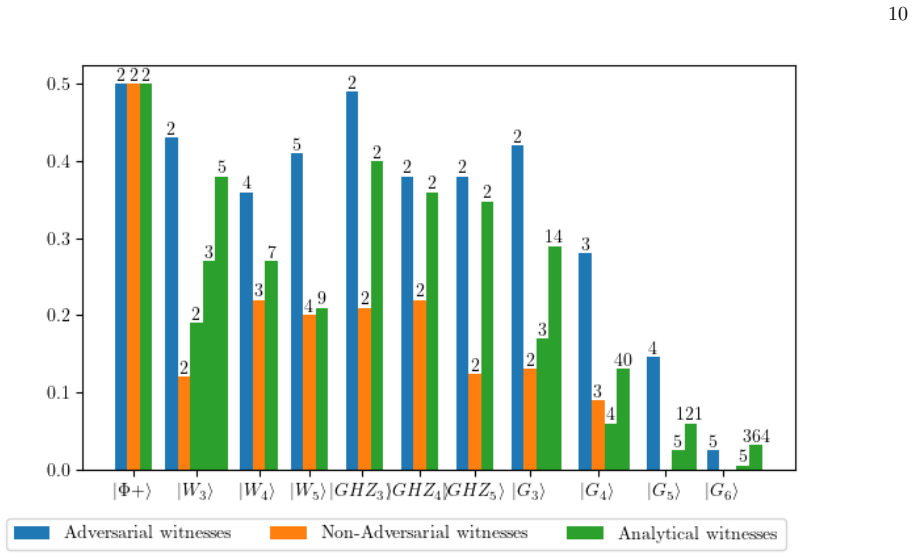
Entanglement witnesses are essential for certifying entanglement, yet constructing ones that are both noise-robust and economical in measurement settings remains challenging - particularly beyond qubits and for non-stabilizer ("magic") states. We present a machine-learning method that, given a target state and a user-specified number of measurement settings, generates an entanglement witness optimized for noise tolerance in the neighborhood of that state, requiring only local measurements. The approach is fully general, applying to multipartite qubit and qudit systems alike, including non-stabilizer states. For N qudits of dimension d, we train on the fully-separable eigenstates of each qudit's SU(d) generators to find a prototype witness, then tune the witness's bias term via gradient descent to maximize noise tolerance. Adversarial training further strengthens the witnesses, delivering greater noise tolerance with even fewer settings; critically, under this scheme the required training-set size becomes independent of system size. We package the entire pipeline as an automated script that, in every case we tested, produces witnesses surpassing all existing methods in noise tolerance and/or number of measurement settings. We demonstrate the method on Bell, GHZ, W, and hypergraph states, along with a range of qudit states, spanning 2-6 qubits, bipartite qudits up to d=10, and tripartite qutrits. Our witnesses achieve perfect accuracy across both physical experimental test states and large numerical sets of separable mixed states-including 30 million test states for a 3-qubit W-state witness and 10 million for a 4-qubit hypergraph-state witness-and we experimentally confirm the noise tolerance of Bell- and hypergraph state witnesses on both photonic and superconducting platforms, respectively.
Figures


Figures from the paper (6 more)


Reference graph
Works this paper leans on
-
[1]
We use the eigenstates of generalized Pauli operators
Generate separable training data. We use the eigenstates of generalized Pauli operators
-
[2]
The training algorithm is described in section III
Train prototype witnessW 0. The training algorithm is described in section III
-
[3]
This optimization is described in section IV
Optimize to find most misclassified separable stateρ s for the prototype witness. This optimization is described in section IV
-
[4]
Useρ s to produce corrected witnessW 1 asW 1 ← W0 −T r(ρsW0)IwhereIis the identity operator for the system. III. TRAINING MEASUREMENTS In this section, we first introduce a witness model by an ansatz of local measurements, and then train the model using an non-adversarial algorithm to produce the prototype witness. A. Witness Construction In general, quan...
work page 2000
-
[5]
Initialize trainable TensorFlow variables. 2. whileLoss variance≥Tori≤Pdo (a) Assemble Hermitian measurement matricesHfrom trainable variables. (b) Assemble inferred measurementsJfrom measurement matrices. (c) Assemble witnessW 0 from all measurement matrices and trainable coefficients. (d) Add bias term to witness, create prototype witnessW 0. (e) Comput...
-
[6]
Each matrixLrepresents systems of up to N/2 qudits
Create trainable pure state density matricesLwith nonnegative real diagonal elements. Each matrixLrepresents systems of up to N/2 qudits
-
[7]
Compute all swaps of qudits for all bipartitions of the system. 3.whileLoss variance≥tori≤pdo (a) Assemble separable stateρfrom pairs of pure state density matricesL, across all permutations of all bipartitions of the system, computing permutations with the swaps. (b) Compute expectation valueT r(ρW 0). (c) Use automatic differentiation to update each var...
work page 2000
-
[8]
I. Ali-Khan, C. J. Broadbent, and J. C. Howell, Large-alphabet quantum key distribution using energy-time entangled bipartite states, Phys. Rev. Lett.98, 060503 (2007)
work page 2007
Show all 64 references
-
[9]
Zhong, H
T. Zhong, H. Zhou, R. D. Horansky, C. Lee, V. B. Verma, A. E. Lita, A. Restelli, J. C. Bienfang, R. P. Mirin, T. Gerrits, and et al., Photon-efficient quantum key distribution using time–energy entanglement with high-dimensional encoding, New Journal of Physics17, 022002 (2015)
2015
-
[10]
L. Chen, J. Lei, and J. Romero, Quantum digital spiral imaging, Light: Science Applications3, 10.1038/lsa.2014.34 (2014)
2014 doi
-
[11]
J. M. Lukens, H.-H. Lu, B. Qi, P. Lougovski, A. M. Weiner, and B. P. Williams, All-optical frequency hopping and broadcasting in wavelength-multiplexed channels, in Conference on Lasers and Electro-Optics (Optica Publishing Group,
-
[12]
Thomas, L
P. Thomas, L. Ruscio, O. Morin, and G. Rempe, Efficient generation of entangled multiphoton graph states from a single atom, Nature608, 677 (2022)
2022
-
[13]
M. Kues, C. Reimer, P. Roztocki, L. R. Cort´ es, S. Sciara, B. Wetzel, Y. Zhang, A. Cino, S. T. Chu, B. E. Little, and et al., On-chip generation of high-dimensional entangled quantum states and their coherent control, Nature546, 622–626 (2017)
2017
-
[14]
Imany, O
P. Imany, O. D. Odele, J. A. Jaramillo-Villegas, D. E. Leaird, and A. M. Weiner, Characterization of coherent quantum frequency combs using electro-optic phase modulation, Phys. Rev. A97, 013813 (2018)
2018
-
[15]
W. K. Wootters, Entanglement of formation of an arbitrary state of two qubits, Phys. Rev. Lett.80, 2245 (1998)
1998
-
[16]
Vedral, The role of relative entropy in quantum information theory, Rev
V. Vedral, The role of relative entropy in quantum information theory, Rev. Mod. Phys.74, 197 (2002)
2002
-
[17]
M. B. Plenio and S. Virmani, An introduction to entanglement measures, arXiv preprint quant-ph/0504163 (2005)
2005 arXiv
-
[18]
Ac ´ ın, D
A. Ac ´ ın, D. Bruß, M. Lewenstein, and A. Sanpera, Classification of mixed three-qubit states, Physical Review Letters87, 040401 (2001)
2001
-
[19]
Jungnitsch, T
B. Jungnitsch, T. Moroder, and O. G¨ uhne, Taming multiparticle entanglement, Phys. Rev. Lett.106, 190502 (2011)
2011
-
[20]
Wei and P
T.-C. Wei and P. M. Goldbart, Geometric measure of entanglement and applications to bipartite and multipartite quantum states, Physical Review A68, 042307 (2003)
2003
-
[21]
Xie and J
S. Xie and J. H. Eberly, Triangle measure of tripartite entanglement, Physical Review Letters127, 040403 (2021)
2021
-
[22]
Coffman, J
V. Coffman, J. Kundu, and W. K. Wootters, Distributed entanglement, Physical Review A61, 052306 (2000)
2000
-
[23]
Ma and M.-H
Y.-C. Ma and M.-H. Yung, Transforming bell’s inequalities into state classifiers with machine learning, npj Quantum Information4, 10.1038/s41534-018-0081-3 (2018)
2018 doi
-
[24]
S. Lu, S. Huang, K. Li, J. Li, J. Chen, D. Lu, Z. Ji, Y. Shen, D. Zhou, and B. Zeng, Separability-entanglement classifier via machine learning, Phys. Rev. A98, 012315 (2018)
2018
-
[25]
Sanavio, E
C. Sanavio, E. Tignone, and E. Ercolessi, Entanglement classification via witness operators generated by support vector machine, The European Physical Journal Plus138, 936 (2023)
2023
-
[26]
Koutn` y, L
D. Koutn` y, L. Gin´ es, M. Mocza la-Dusanowska, S. H¨ ofling, C. Schneider, A. Predojevi´ c, and M. Jeˇ zek, Deep learning of quantum entanglement from incomplete measurements, Science Advances9, eadd7131 (2023), https://www.science.org/doi/pdf/10.1126/sciadv.add7131
2023 doi
-
[27]
Huang, L
Y. Huang, L. Che, C. Wei, F. Xu, X. Nie, J. Li, D. Lu, and T. Xin, Direct entanglement detection of quantum systems using machine learning, npj Quantum Information11, 29 (2025)
2025
-
[28]
Poulin, A
D. Poulin, A. Qarry, R. D. Somma, and F. Verstraete, Quantum simulation of time-dependent hamiltonians and the convenient illusion of hilbert space, Phys. Rev. Lett.106, 170501 (2011)
2011
-
[29]
Seong and J
J. Seong and J. Bae, Detecting entanglement-generating circuits in cloud-based quantum computing, Intelligent Computing 2, 0051 (2023), https://spj.science.org/doi/pdf/10.34133/icomputing.0051
2023 doi
-
[30]
A. C. Greenwood, L. T. Wu, E. Y. Zhu, B. T. Kirby, and L. Qian, Machine-learning-derived entanglement witnesses, Phys. Rev. Appl.19, 034058 (2023)
2023
-
[31]
G¨ uhne and G
O. G¨ uhne and G. T´ oth, Entanglement detection, Physics Reports474, 1–75 (2009)
2009
-
[32]
T´ oth and O
G. T´ oth and O. G¨ uhne, Entanglement detection in the stabilizer formalism, Phys. Rev. A72, 022340 (2005)
2005
-
[33]
M. Ghio, D. Malpetti, M. Rossi, D. Bruß, and C. Macchiavello, Multipartite entanglement detection for hypergraph states, Journal of Physics A: Mathematical and Theoretical51, 045302 (2017). 19
2017
-
[34]
Sciara, C
S. Sciara, C. Reimer, M. Kues, P. Roztocki, A. Cino, D. J. Moss, L. Caspani, W. J. Munro, and R. Morandotti, Universal n-partited-level pure-state entanglement witness based on realistic measurement settings, Phys. Rev. Lett.122, 120501 (2019)
2019
-
[35]
Szczepaniak, O
J. Szczepaniak, O. Makuta, and R. Augusiak, Entanglement witnesses for stabilizer states and subspaces beyond qubits, Reports on Progress in Physics88, 117602 (2025)
2025
-
[36]
Verstraete, J
F. Verstraete, J. Dehaene, B. De Moor, and H. Verschelde, Four qubits can be entangled in nine different ways, Phys. Rev. A65, 052112 (2002)
2002
-
[37]
A. R. Rosebush, A. C. B. Greenwood, B. T. Kirby, and L. Qian, An exponential reduction in training data sizes for machine learning derived entanglement witnesses, Machine Learning: Science and Technology 10.1088/2632-2153/ad7457 (2024)
2024 doi
-
[38]
R. T. Thew, K. Nemoto, A. G. White, and W. J. Munro, Qudit quantum-state tomography, Phys. Rev. A66, 012303 (2002)
2002
-
[39]
Campbell and Y
C. Campbell and Y. Ying, Support vector machines for classification, in Learning with Support Vector Machines (Springer International Publishing, Cham, 2011) pp. 1–25
2011
-
[40]
X. Yang, Q. Song, and A. Cao, Weighted support vector machine for data classification, in Proceedings. 2005 IEEE International Joint Conference on Neural Networks, 2005., Vol. 2 (2005) pp. 859–864 vol. 2
2005
-
[41]
Iranmehr, H
A. Iranmehr, H. Masnadi-Shirazi, and N. Vasconcelos, Cost-sensitive support vector machines, Neurocomputing343, 50 (2019), learning in the Presence of Class Imbalance and Concept Drift
2019
-
[42]
Vedral and M
V. Vedral and M. B. Plenio, Entanglement measures and purification procedures, Phys. Rev. A57, 1619 (1998)
1998
-
[43]
Horodecki, P
R. Horodecki, P. Horodecki, M. Horodecki, and K. Horodecki, Quantum entanglement, Rev. Mod. Phys.81, 865 (2009)
2009
-
[44]
G. H. Golub, G. H. Golub, L. C. F. van, and V. L. C. F., Matrix computations (Johns Hopkins University Press, 2013)
2013
-
[45]
Goodfellow, J
I. Goodfellow, J. Pouget-Abadie, M. Mirza, B. Xu, D. Warde-Farley, S. Ozair, A. Courville, and Y. Bengio, Generative adversarial networks, Commun. ACM63, 139–144 (2020)
2020
-
[46]
A. O. Pittenger and M. H. Rubin, Note on separability of the werner states in arbitrary dimensions1this work was supported in part by the national security agency.1, Optics Communications179, 447 (2000)
2000
-
[47]
Huang, X
J. Huang, X. Li, X. Chen, C. Zhai, Y. Zheng, Y. Chi, Y. Li, Q. He, Q. Gong, and J. Wang, Demonstration of hypergraph- state quantum information processing, Nature Communications15, 10.1038/s41467-024-46830-7 (2024)
2024 doi
-
[48]
Zyczkowski and M
K. Zyczkowski and M. Kus, Random unitary matrices, Journal of Physics A: Mathematical and General27, 4235 (1994)
1994
-
[49]
Bourennane, M
M. Bourennane, M. Eibl, C. Kurtsiefer, S. Gaertner, H. Weinfurter, O. G¨ uhne, P. Hyllus, D. Bruß, M. Lewenstein, and A. Sanpera, Experimental detection of multipartite entanglement using witness operators, Phys. Rev. Lett.92, 087902 (2004)
2004
-
[50]
E. Y. Zhu, Z. Tang, L. Qian, L. G. Helt, M. Liscidini, J. E. Sipe, C. Corbari, A. Canagasabey, M. Ibsen, and P. G. Kazansky, Direct generation of polarization-entangled photon pairs in a poled fiber, Phys. Rev. Lett.108, 213902 (2012)
2012
-
[51]
J.-S. Kim, L. S. Bishop, A. D. C´ orcoles, S. Merkel, J. A. Smolin, and S. Sheldon, Hardware-efficient random circuits to classify noise in a multiqubit system, Phys. Rev. A104, 022609 (2021)
2021
-
[52]
Stehlik, D
J. Stehlik, D. M. Zajac, D. L. Underwood, T. Phung, J. Blair, S. Carnevale, D. Klaus, G. A. Keefe, A. Carniol, M. Kumph, M. Steffen, and O. E. Dial, Tunable coupling architecture for fixed-frequency transmon superconducting qubits, Phys. Rev. Lett.127, 080505 (2021)
2021
-
[53]
Kanazawa, D
N. Kanazawa, D. J. Egger, Y. Ben-Haim, H. Zhang, W. E. Shanks, G. Aleksandrowicz, and C. J. Wood, Qiskit experiments: A python package to characterize and calibrate quantum computers, Journal of Open Source Software8, 5329 (2023)
2023
-
[54]
Gabriel, B
A. Gabriel, B. C. Hiesmayr, and M. Huber, Criterion for k-separability in mixed multipartite systems, arXiv preprint arXiv:1002.2953 (2010)
2010 arXiv
-
[55]
R. A. Horn and C. R. Johnson, Matrix analysis (Cambridge university press, 2012)
2012
-
[56]
Banaszek, G
K. Banaszek, G. M. D’Ariano, M. G. A. Paris, and M. F. Sacchi, Maximum-likelihood estimation of the density matrix, Phys. Rev. A61, 010304(R) (1999)
1999
-
[57]
Ahmed, C
S. Ahmed, C. S´ anchez Mu˜ noz, F. Nori, and A. F. Kockum, Quantum state tomography with conditional generative adversarial networks, Phys. Rev. Lett.127, 140502 (2021)
2021
-
[58]
X. Zhu, C. Zhang, Z. An, and B. Zeng, Unified framework for calculating convex roof resource measures, npj Quantum Information11, 56 (2025)
2025
-
[59]
De las Cuevas, T
G. De las Cuevas, T. Drescher, and T. Netzer, Separability for mixed states with operator schmidt rank two, Quantum3, 203 (2019)
2019
-
[60]
F. L. Pedrotti and L. S. Pedrotti, Introduction to optics (Prentice-Hall, 1987)
1987
-
[61]
Gerrard and J
A. Gerrard and J. M. Burch, Introduction to matrix methods in optics Anthony Gerrard; James M. Burch (Wiley, 1996)
1996
-
[62]
Fano, Remarks on the classical and quantum-mechanical treatment of partial polarization∗, J
U. Fano, Remarks on the classical and quantum-mechanical treatment of partial polarization∗, J. Opt. Soc. Am.39, 859 (1949). Appendix A: Optimizer Parameterization
1949
-
[63]
To parameterize a biseparable state, we iterate over up to half the number of qubits 20 and divide the system at each step
Generatingswaps To represent all possible separable mixed states, we only need to consider biseparable states, as they encompass all k-separable states [11, 47]. To parameterize a biseparable state, we iterate over up to half the number of qubits 20 and divide the system at ea...
-
[64]
coverage
Minimum Number of Mixed States Necessary to Span the Biseparable Set In this appendix, we consider the “coverage” of our parameterization of the set of biseparable states, described in the main text of this work. We argue that a necessary butnot sufficientcondition for paramet...
Reviewed August 11, 2026 · model on record in the stance chip above.
Discussion (0). Continue with ORCID to comment.