REVIEW 5 major objections 4 minor 22 references
Counterfactual Benchmarking and Training for Factuality Consistency and Order-Robust Grounded Reasoning in LLMs over Heterogeneous Knowledge
T0 review · 5 major / 4 minor · reviewed 2026-08-12 · deepseek-v4-flash
Pith's one-line read A counterfactual benchmark across tables, texts, and knowledge graphs shows LLMs' final answers often outrun their reasoning chains, and a new latent-fusion training method narrows that gap by 4.29% in chain accuracy while cutting…
desk verdict TKFQA is a genuinely useful new benchmark and ORLF is clever, but the experimental reporting has gaps (underspecified RCA, no significance tests, unresolved TKB input question) that make the headline gains provisional. read the letter →
The pith
A machine-rendered reading of the paper's core claim, the machinery that carries it, and where it could break.
The reading
What carries the argument
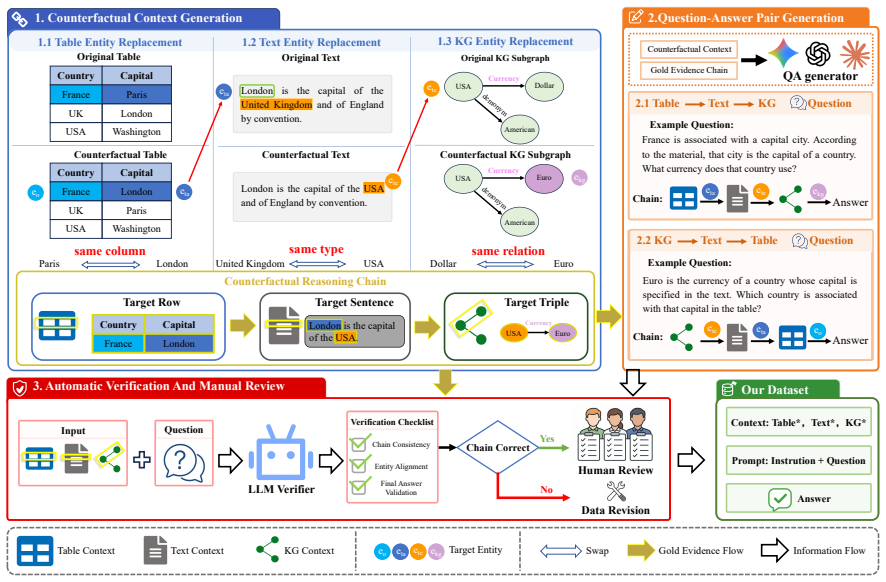
The load-bearing mechanism is the counterfactual reasoning chain $\tilde{C}=\langle \tilde{T}, \tilde{P}, \tilde{G}\rangle_{(e_o,e_{ta},e_{te},e_{kg})}$ that links the three knowledge modalities through replaced entities, making memorized knowledge useless and turning the task into a topological multi-hop traversal. On the training side, ORLF's engine is the combination of three interventions on the backbone's attention: context-wise position encoding (CPE) resets position IDs inside each context so order permutations are less disruptive; a latent-bridge attention mask (LBAM) allows trainable latent vectors $z_c$ to attend across contexts while ordinary tokens stay within their own context; and topological knowledge bias (TKB) injects a learned per-layer, per-head bias composed of inter-knowledge path distance, directional relation, and a Magnetic Laplacian spectral-geometry term. Together they let the model preserve knowledge-specific bias and encode cross-context topology without touching the frozen backbone weights.
What would settle it
Re-annotate a random sample of TKFQA's 10,130 QA pairs with independent human annotators blind to the original labels, recording rejection rates and inter-annotator agreement on chain correctness; if a substantial fraction of gold chains are judged invalid or ambiguous, the benchmark's claims about state-of-the-art weakness and ORLF's improvements collapse. Alternatively, recompute Reasoning-Chain Accuracy with exact entity-sequence matching instead of LLM-based similarity to see whether the 4.29% gain survives.
Extended reading notes
Core claim
The central claim is that factual consistency and order robustness in multi-hop grounded reasoning are separable, measurable, and trainable: a model can be made to internalize the topological structure of heterogeneous knowledge contexts rather than treating them as an unordered bag of tokens. TKFQA operationalizes this by annotating each QA pair with a counterfactual chain through a table, a text, and a knowledge graph, and scoring models on exact match, reasoning-chain accuracy, and the standard deviation of both metrics across all six context orderings. ORLF is the paper's answer: it inserts knowledge-specific trainable latent vectors into the input sequence, resets positional indices within each context (CPE), lets latent vectors bridge attention across contexts while confining original tokens to their own context (LBAM), and adds a learned bias encoding inter-context distance, direction, and spectral geometry (TKB). The result, across Qwen3-8B, GLM-4-9B, Llama-3.1-8B, and Mistral-7B, is consistent improvement over training-free and LoRA baselines on both accuracy and stability.
Load-bearing premise
The gold reasoning chains and answers in TKFQA are correct and uniquely derivable; the construction pipeline relies on LLM verification and manual review without reporting inter-annotator agreement or rejection rates, so if a non-negligible fraction of chains are invalid or ambiguous, both the diagnosis of state-of-the-art weakness and ORLF's measured gains lose their foundation.
Editorial extensions
If this is right
- If TKFQA is a fair test, then current state-of-the-art LLMs cannot be trusted to produce faithful reasoning when grounding in heterogeneous sources; answer accuracy overstates reasoning quality.
- If ORLF's improvements generalize, parameter-efficient fine-tuning with structure-aware attention can make open-weight LLMs substantially more reliable for retrieval-augmented and knowledge-grounded applications without closed-source API access.
- Reasoning-chain accuracy, not just final-answer EM, should become a standard reporting metric for grounded QA, since final answers can be right for the wrong reasons.
- Input-order robustness should be reported as O. Std. across context permutations; the paper shows this variance is large and reducible.
Reading between the lines
- A natural extension is to replace relations rather than entities along the counterfactual chain, which would test whether models track the structure of the knowledge graph, not just the identity of nodes.
- Because ORLF requires access to the internal attention mechanism and positional encoding, the method cannot transfer to API-only models; distillation or order-calibration prompting would be the only route for closed-source systems, a consequence the authors state as a limitation but do not explore.
- The reported gains could be stress-tested by evaluating on random orderings beyond the six permutations or with interleaved context blocks, which would separate genuine order-robustness from template-level serialization effects.
- The counterfactual construction could be ported to other modalities (images, audio, code) to build adversarial benchmarks that prevent models from falling back on parametric knowledge.
Signed reviews
Editorial analysis
A structured set of objections, weighed in public.
Referee Report
Summary. The paper introduces TKFQA, a 10,130-example benchmark for multi-hop grounded question answering over heterogeneous knowledge contexts (tables, text, and knowledge graphs), where each example is built from an explicit counterfactual reasoning chain. The benchmark evaluates answer correctness, reasoning-chain accuracy, and robustness to the input order of the three knowledge contexts. The authors evaluate 14 open- and closed-source LLMs and report that state-of-the-art models achieve limited reasoning-chain accuracy and are sensitive to input-order permutations. They then propose ORLF, a training framework that adds knowledge-specific latent vectors, context-wise position encoding, a latent-bridge attention mask, and a topological knowledge bias, and report that ORLF improves average Exact Match by 2.15% and Reasoning-Chain Accuracy by 4.29% over baselines across four LLM backbones while reducing order-induced standard deviation. The paper includes ablation studies, a sensitivity analysis of the latent sequence length, and a public code/data release.
Significance. If the central claims hold, TKFQA would be a useful benchmark for factuality consistency and order robustness in multi-hop grounded reasoning, and ORLF would be a credible parameter-efficient method for improving both accuracy and robustness. The benchmark construction is thoughtful: the counterfactual chains are designed to force grounding in the provided contexts rather than parametric knowledge, and the evaluation across six input-order permutations is a genuine strength. The paper also ships its code and data, which is valuable for reproducibility. However, the current manuscript leaves a load-bearing implementation question open: the topological knowledge bias in Section 4.2 depends on quantities that are properties of the gold counterfactual chain, and the paper does not state how these quantities are obtained at inference time. In addition, the Reasoning-Chain Accuracy metric is not precisely defined, and the experimental section lacks significance tests and a clear model-selection protocol. These issues do not necessarily invalidate the contributions, but they must be resolved before the quantitative claims can be accepted.
major comments (5)
- [Section 4.2, Eqs. (7)-(8)] The topological knowledge bias TKB is defined as b(u,v) = b_IKPD(u,v) + b_IKD(u,v) + b_SG(u,v), where b_IKPD is a learned function of Dhops(u,v), the 'number of hops between different knowledge contexts,' and b_IKD is a learned function of I(u,v), an indicator of whether knowledge context u is directed to v. In TKFQA, Dhops and I(u,v) are properties of the constructed counterfactual chain (e.g., Table→Text→KG) and are example-specific. The manuscript never explains how the model computes Dhops or I(u,v) from the input at inference time, when the gold chain is not available to the model. If the implementation reads these values from the annotated counterfactual chain for test examples, ORLF is given the gold reasoning structure during inference, which the baselines do not receive; this would inflate the reported EM/RCA gains and order-robustness reductions. The large performance drop when TKB is removed (Table 5) is consistent with TKB carrying substantial information, so the source of that information must be clarified. The Limitations section does not mention this dependency. Please state explicitly how Dhops and I(u,v) are computed at inference time, and if they are derived from the input, provide the exact procedure; if they are taken from test annotations, the reported results are not valid as presented.
- [Section 3, Evaluation Metrics] Reasoning-Chain Accuracy (RCA) is defined only as the similarity between the generated chain and the provided counterfactual reasoning chain, 'with a focus on entity-level consistency between the two chains.' No exact scoring rule is given: it is not specified whether matching is exact or partial, how entity aliases and surface forms are normalized, how steps are aligned, or how a chain with the correct final answer but an incorrect intermediate entity is scored. Since RCA is a central metric in Tables 2-5 and in the abstract's headline improvement of 4.29%, the metric must be specified precisely enough to be independently computed from the released data. Please provide the exact algorithm, including any string normalization and step-alignment procedure, and report agreement with human judgments on a sample.
- [Section 5 and Appendix B.3] The experimental protocol does not separate hyperparameter selection from test evaluation. The sensitivity analysis in Appendix B.3 varies the latent sequence length m and then states that m=16 is used in all main experiments, but the manuscript does not say which split (train, validation, or test) was used for this selection. If the test split was used to choose m or any other hyperparameter, the reported numbers are optimistically biased. Additionally, all experiments are repeated only three times and no significance tests, confidence intervals, or per-seed spreads are reported; with differences on the order of 0.1-2 percentage points (e.g., Table 4), it is unclear whether the reported improvements over TXH and PMFT are statistically reliable. Please report the model-selection procedure and add significance testing or confidence intervals for the main comparisons.
- [Table 4, Mistral-7B row] Section 5.3 states that ORLF 'outperforms all baselines across different LLM backbones,' but Table 4 shows that on Mistral-7B, TXH achieves an Avg. EM of 96.17 while ORLF achieves 96.00. The average improvement of 2.15% in Avg. EM masks per-backbone and per-metric exceptions. Please qualify the claim to reflect the per-backbone results, and report the full comparison table in the main text rather than only in the appendix.
- [Section 3 and Appendix A.2.2] The gold reasoning chains and answers in TKFQA are produced by an LLM-based pipeline with automatic verification and manual review, but the manuscript reports no inter-annotator agreement, no rejection rates for the automatic verification steps, and no error analysis of the manual review. Because the benchmark's validity rests on the premise that each counterfactual chain is correct and uniquely derivable, the absence of these quality statistics leaves open the possibility that a non-negligible fraction of chains are invalid or ambiguous. If so, both the conclusion that state-of-the-art LLMs are weak at reasoning-chain accuracy and the measured improvements of ORLF would be affected. Please report the verification statistics, a sample of manual-review disagreements, and any chain-validity checks.
minor comments (4)
- [Tables 3 and 4] Several numeric entries lack separating spaces or commas, e.g., '87.8992.3383.67' in Table 3 and '84.6684.87 83.9085.44 86.64 85.570.85' in Table 2; these should be formatted consistently for readability.
- [Section 3, Evaluation Metrics] The definition of Order Standard Deviation should state explicitly that it is computed across the six input-order permutations for a single metric (EM or RCA) and should clarify whether the values in Tables 2 and 4 are standard deviations of per-example scores or of averaged scores over the three seeds; the current wording is ambiguous.
- [Tables 4 and 5] O. Std. values of 0.00 for EM on Llama-3.1-8B and Mistral-7B with ORLF are printed to two decimals and may be rounding artifacts; report these values with more precision or note explicitly that they are zero after rounding.
- [Appendix E.4] The ReAct prompt in Figure 12 tells the model that 'the known reasoning dependency is Table -> Text -> Knowledge Graph,' which gives this training-free baseline prior knowledge of the gold topology. This should be discussed as a potential advantage for ReAct and, ideally, controlled by also evaluating ReAct without that hint.
Circularity Check
TKB's cross-context topology bias is parameterized by Dhops/I that are only defined on the gold counterfactual chain; the paper never specifies how these values are computed from the model input at inference, so part of the reported gains may be forced by gold-structure label leakage rather than by learned order-robust reasoning.
-
other
[Section 4.2, 'Topological Knowledge Bias', Eqs. (7)-(9); cf. Eq. (1) and Section 3.]
"In TKFQA, for example, heterogeneous knowledge contexts are constructed from counterfactual reasoning chains, thereby naturally forming cross-structure topological relations, such as Table→Text→KG. ... b(ℓ,h)IKPD(u, v) = f(ℓ,h)IKPD(Dhops(u, v);θ) (8) ... I(u, v) is an indicator function that specifies whether knowledge context u is directed to knowledge context v."
The topology bias added to attention scores is a learned function of Dhops and I, which the paper defines solely via the counterfactual reasoning chain used to construct each QA pair. The model input defined in Eq. (1) is X=E((q,a), Cω), i.e., only serialized table/text/KG contexts plus question and answer; no chain-distance or chain-direction field is part of the input. No inference-time computation of Dhops/I from X is given. If the released implementation reads these values from the gold chain for test examples, then ORLF receives the order-invariant reasoning structure during inference, which the baselines do not; the resulting EM/RCA improvements and the reported O. Std. reductions are then partly fitted to the evaluation target rather than derived from the input.
full rationale
The benchmark evaluation itself is a genuine held-out test: the QA pairs, gold answers, and gold chains are not used to fit ORLF's parameters beyond standard training on the training split, and EM/RCA are compared against held-out annotations. No load-bearing self-citation chain is present; the authors' prior works are cited only as related work. The central circularity risk is the TKB term. The equations are explicit that b_IKPD and b_IKD are functions of Dhops and I, and the text explains those quantities through the counterfactual chains, while the input formalization omits them. That is a concrete derivational gap, and if filled from test annotations it would inflate the headline gains by giving the model the gold chain topology at inference. Because the paper does not state how the released code obtains Dhops/I at test time, the attack cannot be fully confirmed from the text; therefore this is scored as a moderate, unresolved circularity/leakage risk rather than a fully established self-definitional reduction.
Assumptions & free parameters
free parameters (5)
- Latent sequence length m =
16
- LoRA rank r =
16
- LoRA scaling alpha =
32
- ORLF-specific learning rate =
5e-4
- Decoding temperature =
0.7
assumptions (5)
- domain assumption Counterfactual reasoning chains in TKFQA are valid and the gold answer is uniquely derivable.
- domain assumption RCA as entity-level matching is a valid measure of reasoning-chain correctness.
- domain assumption The six context-order permutations are the relevant input-order variations.
- domain assumption RoPE with context-wise position encoding effectively removes order sensitivity.
- ad hoc to paper The topology (e.g., Table->Text->KG) is known at training time.
Cite this review
Pith. "Pith review of Counterfactual Benchmarking and Training for Factuality Consistency and Order-Robust Grounded Reasoning in LLMs over Heterogeneous Knowledge." pith.science (2026). https://pith.science/paper/KVG2R2BR
@misc{pith2026260807838,
  author       = {Pith},
  title        = {Pith review of: Counterfactual Benchmarking and Training for Factuality Consistency and Order-Robust Grounded Reasoning in LLMs over Heterogeneous Knowledge},
  year         = {2026},
  howpublished = {\url{https://pith.science/paper/KVG2R2BR}},
  note         = {Machine review of arXiv:2608.07838}
}
read the original abstract
Large language models (LLMs) have increasingly supported response generation grounded in user-provided knowledge spanning heterogeneous structures. However, existing benchmarks provide limited assessment of whether LLMs can faithfully perform multi-hop reasoning chains across such knowledge contexts while remaining robust to variations in their input order. We introduce TKFQA, a factuality consistency benchmark comprising 10,130 question-answering (QA) pairs grounded in tables, texts, and knowledge graphs (KGs). Each example is constructed from an explicit counterfactual reasoning chain, enabling the joint evaluation of answer correctness, reasoning-chain accuracy, and robustness to different input-order. An extensive evaluation of 14 open- and closed-source LLMs reveals that state-of-the-art models exhibit limited reasoning-chain accuracy and remain sensitive to variations in the input order of heterogeneous knowledge contexts. To address these limitations, we propose ORLF, an LLM-agnostic training framework that models cross-context topological relations through knowledge-specific latent vectors. ORLF integrates context-wise position encoding, a latent-bridge attention mask, and topological knowledge bias to preserve knowledge-specific bias and encode topological semantics. Experiments across four LLM backbones show that ORLF outperforms competitive training-free and LoRA-based baselines, improving average Exact Match and Reasoning-Chain Accuracy by 2.15% and 4.29%, respectively, while reducing order-induced performance standard deviation by 0.04% to 3.01%.
Figures


Figures from the paper (9 more)


Reference graph
Works this paper leans on
-
[1]
Chain Consistency, which assesses the logi- cal coherence of the constructed reasoning chain across tables, text, and KGs; 2) Entity Alignment, which verifies that the replaced entities are cor- rectly aligned across heterogeneous sources and belong to the intended semantic categories; and 3) Final Answer Validation, which checks whether the final answer ...
-
[2]
Use the text sentence to identify the hidden bridged entity connected to the table entity
-
[3]
Use the KG triple of the bridged entity to answer the final question. Important: - The real entity names are provided below only so you can understand the reasoning chain. - The generated question must NOT explicitly reveal the hidden table entity, hidden bridged entity, or final answer. - Use the original context only to understand the link. - Use the ma...
-
[4]
Use table clues to identify the hidden table entity
-
[5]
The question must not explicitly contain any of the following hidden entities: - Table entity: "{table_entity}" - Bridged entity / KG head: "{text_entity}" / "{kg_head}" - KG tail / answer: "{kg_tail}"
-
[6]
You may use the real entity names internally to understand the reasoning chain, but you must not copy them into the question
-
[7]
The question must follow the reasoning direction: Table -> Text -> KG
-
[8]
The question must ask for the KG Tail
Show all 22 references
-
[9]
{kg_tail}
The answer must be copied exactly from the KG Tail: "{kg_tail}"
-
[10]
Do not paraphrase, translate, normalize, or add extra words to the answer
-
[11]
{kg_rel}
Paraphrase the KG relation "{kg_rel}" into natural conversational English
-
[12]
Use KG qualifiers only if they make the final question more precise and do not reveal any hidden entity
-
[13]
Use the masked context to phrase the question
-
[14]
the first person mentioned
If the text contains a list of multiple people/items, uniquely identify the hidden bridged entity by its exact position or role in the sentence. Examples: "the first person mentioned", "the second item listed", "the museum whose entrance is obscured"
-
[15]
Do not use external knowledge
-
[16]
Do not add facts that are not present in the table row, text sentence, KG relation, or KG qualifiers
-
[19]
Write the question in 2 or 3 clear sentences
-
[20]
question
Output strictly in this JSON format: {{ "question": "Your generated question here", "answer": "{kg_tail}" }}""" Figure 9: Prompt template for Table-to-Text-to-KG question generation in TKFQA (continued). [Text/Table/KG,Table->Text->KG] [Instruction]: You are given three inform...
-
[21]
You must answer based on the provided reality
NO PRIOR KNOWLEDGE: You MUST NOT use your internal prior knowledge, real-world facts, or external search. You must answer based on the provided reality
-
[22]
target_entity
For each reasoning step, set "target_entity" to the entity resolved from that context, copied exactly as it appears in the provided context. OUTPUT FORMAT: Your response must be STRICTLY in JSON format matching the exact structure below:{ "reasoning_chain": [{ "step": 1, "sour...
-
[2025]
Albert Q
The FACTS grounding leaderboard: Bench- marking LLMs’ ability to ground responses to long- form input.arXiv preprint arXiv:2501.03200. Albert Q. Jiang, Alexandre Sablayrolles, Arthur Men- sch, et al. 2023. Mistral 7B.arXiv preprint arXiv:2310.06825. Yigeng Jiang, Tingjun Su, T...
2023 arXiv
-
[2026]
InFindings of the Association for Computational Lin- guistics: ACL 2026, pages 38819–38857, San Diego, California, United States
From tasks to teams: A risk-first evaluation framework for multi-agent LLM systems in finance. InFindings of the Association for Computational Lin- guistics: ACL 2026, pages 38819–38857, San Diego, California, United States. Association for Computa- tional Linguistics. Yew Ken...
2026 arXiv
Reviewed August 12, 2026 · model on record in the stance chip above.
Discussion (0). Continue with ORCID to comment.