REVIEW 3 major objections 5 minor 51 references
Sub-Rayleigh Imaging of Unequal-Intensity Sources: Near-Quantum-Limit Multiparameter Estimation
T0 review · 3 major / 5 minor · reviewed 2026-08-12 · deepseek-v4-flash
Pith's one-line read A phase-sensitive SPLICE measurement estimates both the separation and relative intensity of two unresolved, unequal-intensity sources with RMSE about 50 percent above the quantum limit and up to sixfold better than direct imaging.
desk verdict First SPLICE experiment for two-parameter estimation, but the 'near-quantum-limit' q claim is undermined by a parasitic crosstalk that the authors themselves document. read the letter →
The pith
A machine-rendered reading of the paper's core claim, the machinery that carries it, and where it could break.
The reading
What carries the argument
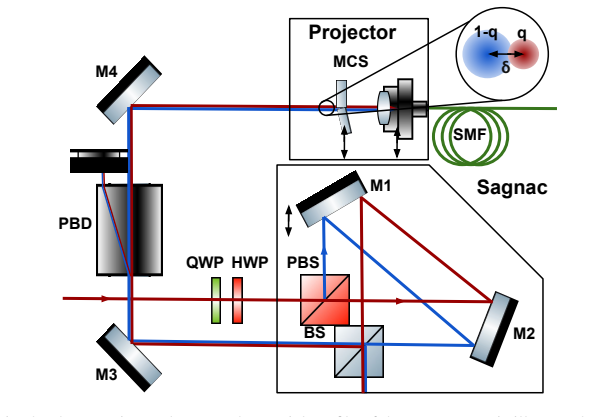
The load-bearing object is the SPLICE mode projector, whose transverse profile is a Gaussian centered at fiber position $f$ with a sign flip at phase-shifter edge $g$: $\phi(x) = \mathrm{sgn}(x-g)\, e^{-(x-f)^2/(4\sigma^2)}/(2\pi\sigma^2)^{1/4}$. Two such projectors, with $(g,f) = (\pm\sigma, \pm 2\sigma)$, approximate the ideal interferometric Hermite-Gauss modes $(HG_1 \pm HG_2)/\sqrt{2}$; the paper shows their detection probabilities equal the ideal ones up to a factor $4/(\pi e)$, so the scheme extracts about 46 percent of the total quantum Fisher information. The argument is carried by the Fisher information matrix of these two-outcome projectors and by a calibration model, Eq. (31), that fits seven coefficients $\epsilon_0, \epsilon_1, c_2, c_3, c_{40}, c_{41}, c_{42}$ to account for cross-talk from the $HG_0$ mode and other imperfections. The same matrix gives the comparison to direct imaging and the cross-talk ceiling $\sqrt{3/(2e\pi^2 \epsilon)} \approx 7.5$ on the achievable advantage.
What would settle it
Repeat the RMSE measurement at $\delta/\sigma \approx 0.1$ and $q \approx 0.1$ with the two beams' incidence angles matched so that $\epsilon_1 \approx 0$ (removing the $q$-dependent background in Eq. (30)); if the separation RMSE no longer beats direct imaging by the predicted factor, or if the $q$ RMSE jumps above the quantum bound, the advantage was carried by parasitic crosstalk rather than by the SPLICE projection itself.
Extended reading notes
Core claim
The central claim is that the two-parameter estimation problem for a Gaussian point-spread function is solved, to within a factor $4/(\pi e) \approx 0.46$ of the ideal information, by two SPLICE projectors: an edge phase shift at $x = \pm\sigma$ followed by a single-mode fiber at $x = \pm 2\sigma$. With those projectors the photon probabilities are $P_{\phi\pm} = q(1-q)\delta^2/(2\pi e \sigma^2) \pm q(1-q)(1-2q)\delta^3/(2\pi e \sigma^3) + O(\delta^4)$, mirroring the ideal interferometric Hermite-Gauss probabilities. In experiment, using roughly 320,000 single-photon detections per estimate and a seven-coefficient polynomial calibration model, the separation and relative-intensity RMSEs track the SPLICE Cramér-Rao bound, which lies below the direct-imaging bound; the reported RMSE is about 50 percent above the quantum limit and up to sixfold below direct imaging. The paper further reports that the $q$-dependent cross-talk term $\epsilon_1 q$, arising from slightly different beam incidence angles, is exploited by the least-squares estimator and makes the experimental $q$ RMSE appear better than the quantum bound at small separations, while the separation advantage at $\delta/\sigma > 0.2$ is attributed to SPLICE itself.
Load-bearing premise
The near-quantum-limit RMSE depends on a seven-coefficient polynomial response model, Eq. (31), fit to calibration trials; if the detector's true response, particularly the $q$-dependent cross-talk term $\epsilon_1$, is not stable between calibration and use, the reported advantage over direct imaging and the comparison to the quantum limit will not transfer to another apparatus.
Editorial extensions
If this is right
- At the tested separations ($\delta/\sigma$ down to about 0.02–0.1) and brightness ratios ($q$ from 0.1 to 0.5), the reported RMSE for both parameters roughly follows the SPLICE bound and beats the direct-imaging bound.
- For an intensity imbalance of 100:1, the predicted RMSE reduction over direct imaging is about 60 times; for $10^8$:1, about $6\times 10^4$, if crosstalk is low.
- Improving the projector extinction ratio from $10^3$ to $10^6$ would raise the maximum advantage from about 7.5 to about 40.
- For equal-intensity sources, SPLICE still works, but its Cramér-Rao bound is $2/(\pi e)$ times the quantum limit because the projectors are optimized for unequal intensities.
Reading between the lines
- The paper treats $\epsilon_1 q$ as a nuisance, yet shows it improves $q$ estimation at small separations; a controlled version of this $q$-dependent background could be engineered as an extra information channel, a testable modification the paper does not pursue.
- Because the advantage ceiling is set by $\epsilon$, swapping the cover slips for a higher-extinction mode sorter is a direct way to test the predicted scaling: if the RMSE reduction does not approach about 40 at $\epsilon \approx 10^{-6}$, the crosstalk model would need revision.
- The paper assumes a known center of mass; a natural extension is a third parameter (the centroid), where the same Fisher-matrix machinery would need additional projectors, and the ratio-symmetric structure of the probabilities suggests how they should be placed.
Editorial analysis
A structured set of objections, weighed in public.
Referee Report
Summary. The manuscript reports an extension of the SPLICE technique to simultaneous estimation of the separation δ and relative intensity q of two incoherent, unequal-intensity sources. After deriving quantum and classical Cramér-Rao bounds for Gaussian point-spread functions, the authors implement two phase-shifted fiber-mode projectors approximating the iHG basis and perform a single-photon experiment with 810 nm light. A polynomial response model with seven fitted coefficients per projector (Eq. 31) is calibrated on random halves of the data and tested on the remaining halves. The paper reports RMSE within about 50% of the quantum limit and up to a sixfold improvement over direct imaging, with the advantage growing for smaller separations and larger intensity imbalances.
Significance. If the central claims survive scrutiny, the work provides a comparatively simple experimental route to near-quantum-limited multiparameter estimation for unbalanced sources, with concrete relevance to exoplanet imaging and microscopy. Strengths include held-out random-partition evaluation, Monte Carlo simulations for the biased regime, and explicit modeling of crosstalk. The demonstration that a fiber collimator and phase shifter can jointly estimate δ and q is interesting and experimentally valuable. The main caveat is that the relative-intensity claim is currently entangled with a fitted parasitic background, and the direct-imaging comparison does not include that same background.
major comments (3)
- [Section 4, Eq. (30)] The q RMSE claim is not established as a near-quantum-limit result. The paper reports experimental RMSE for q below the ideal QCRB at small separations and attributes this to the ε1 q background in Eq. (30). Since the QCRB in Eqs. (11)-(12) is a lower bound for unbiased estimators on the ideal two-Gaussian-source state, an RMSE below it implies either a different physical state (e.g., the different incidence angles mentioned in the text) or a biased estimator; in either case the comparison is outside its valid regime. The fitted ε1 is part of the same calibration procedure, so the apparent q precision is carried by an apparatus degree of freedom rather than by the SPLICE projection. The paper's defense at δ/σ>0.2 is formulated for the separation estimator, not for q, and no analogous regime separation is shown for q. Please re-analyze the q data with the parasitic background modeled explicitly, or restrict the quantum-limit claim to δ and to simulations.
- [Section 4, DI Monte Carlo simulation] The claimed sixfold improvement over direct imaging may be inflated by an asymmetry in the comparison. The DI simulation uses the ideal intensity profile of Eq. (23) and does not include the incidence-angle mismatch or the q-dependent crosstalk that the SPLICE experiment enjoys through ε1 in Eq. (30). Thus the comparison partly credits SPLICE with information that comes from an uncontrolled, fitted background rather than from the SPLICE measurement principle. A fair comparison would include the same crosstalk and calibration model in the DI simulation, or compare against an actual DI measurement on the same apparatus, before concluding that SPLICE itself provides the sixfold improvement.
- [Section 4, Eq. (31)] The calibration model contains fourteen free parameters (seven per projector) fitted to ten calibration trials per setting, but only the χ² values (1.46 and 1.93) are reported. The stability of the fitted coefficients, especially ε1, is load-bearing because ε1 is exactly the term that produces the sub-QCRB q RMSE. Please report the fitted coefficients with uncertainties and correlations, and show that the held-out RMSE is robust to the random-partition procedure, e.g., by reporting the spread across the 20 partitions or a bootstrap analysis.
minor comments (5)
- [Section 2.1, after Eq. (11)] The balanced-source limit is written as (Q^{-1})_{δδ}=4σ²; it should include the factor 1/N from Eq. (11). This typo appears in a central bound and should be corrected.
- [Section 2.2] The projector positions g=±σ and f=±2σ are said to be optimal by reference to thesis [51]; since this optimality underpins the comparison with the QCRB, a derivation or a peer-reviewed reference would make the paper more self-contained.
- [Section 2.2, Eq. (18)] The definition of M and the per-photon normalization of J should be stated explicitly; currently N only appears later in Eqs. (20)-(21), which makes the formula easy to misread.
- [Section 5] The phrase 'an root mean squared error' should be 'a root-mean-square error'; the abstract and text use 'root mean squared error' inconsistently.
- [Data Availability] The statement that data are not publicly available will hinder verification; for a metrology experiment, releasing the raw count data and fitted coefficients would materially strengthen reproducibility.
Circularity Check
No significant circularity; the multiparameter estimates are cross-validated on held-out trials. A minor same-group citation for projector optimality is not load-bearing, and the fitted ε1 background complicates the q-vs-QCRB comparison but does not make the estimation circular.
-
other
[Section 2.2 (SPLICE projectors, after Eq. 19)]
"The optimal pair of projectors φ±(x) that minimize the uncertainty of δ and q is implemented by setting the MCS position g=±σ and the fiber collimator position f=±2σ, where the center of mass is defined as the origin. Although these two projectors can be thought of as approximations of the modes (HG1(x)±HG2(x))/√2, they are not optimized to maximize similarity, they are optimized to minimize uncertainty [51]."
The projector placement is asserted to be optimal by citing Ref. [51], a same-group PhD thesis, without deriving the optimality in this paper. This is a self-citation, but it is not load-bearing: the SPLICE CRBs (Eqs. 20-21) and the comparison to the external QCRB (Eqs. 11-12) are computed for these explicit projectors, not derived from the optimality claim. The optimality assertion only supports the qualitative 'as closely as possible' language, so it does not reduce any quantitative result to a prior work of the same authors.
full rationale
The central derivation is self-contained against external benchmarks. The QCRB in Eqs. (11)-(12) is taken from Ref. [35] (Řeháček et al.), which is not authored by the present group. The SPLICE CRBs in Eqs. (20)-(21) are derived in the paper from the explicit projector model of Eq. (17), not imported from the prior SPLICE papers. The calibration model Eq. (31) has seven free parameters fitted to half of the trials, but the target parameters δ and q are estimated on the remaining held-out trials using repeated random partitions; therefore the reported RMSE is a genuine prediction, not a renamed fit. The fitted ε1 q background term does allow q to be estimated better than the ideal QCRB at small separations, and the paper explicitly acknowledges this parasitic effect in Section 4; this is a correctness/benchmarking concern rather than a circular reduction. The claimed sixfold advantage over direct imaging may be optimistic because the DI simulations lack the incidence-angle difference that creates ε1, but that again affects the fairness of the comparison, not the logical circularity of the derivation. The only self-citation identified is the projector-optimality citation to Ref. [51], which is minor and non-load-bearing. Overall, the paper's experimental estimates are cross-validated, and its theoretical limits are externally anchored, so no significant circularity is present.
Assumptions & free parameters
free parameters (14)
- epsilon_0+ (HG0 crosstalk, phi+ projector) =
2.4e-3
- epsilon_1+ (q-dependent background, phi+) =
-1e-3
- epsilon_0- (HG0 crosstalk, phi- projector) =
1e-3
- epsilon_1- (q-dependent background, phi-) =
-2.1e-4
- c2+ (delta^2 correction, phi+) =
not reported
- c3+ (delta^3 correction, phi+) =
not reported
- c40+ (delta^4 coefficient, phi+) =
not reported
- c41+ (q times delta^4 coefficient, phi+) =
not reported
- c42+ (q^2 times delta^4 coefficient, phi+) =
not reported
- c2- (delta^2 correction, phi-) =
not reported
- c3- (delta^3 correction, phi-) =
not reported
- c40- (delta^4 coefficient, phi-) =
not reported
- c41- (q times delta^4 coefficient, phi-) =
not reported
- c42- (q^2 times delta^4 coefficient, phi-) =
not reported
assumptions (5)
- domain assumption Each source PSF is Gaussian, Eq 4.
- domain assumption The field is an incoherent mixture of single-photon states, Eq 2.
- domain assumption The center of mass is known.
- domain assumption The SPLICE projector is modeled as sign(x-g) times a Gaussian fiber mode, Eq 17.
- standard math Cramér-Rao bounds assume asymptotically unbiased estimators.
Cite this review
Pith. "Pith review of Sub-Rayleigh Imaging of Unequal-Intensity Sources: Near-Quantum-Limit Multiparameter Estimation." pith.science (2026). https://pith.science/paper/ZD3P4JDV
@misc{pith2026260807868,
  author       = {Pith},
  title        = {Pith review of: Sub-Rayleigh Imaging of Unequal-Intensity Sources: Near-Quantum-Limit Multiparameter Estimation},
  year         = {2026},
  howpublished = {\url{https://pith.science/paper/ZD3P4JDV}},
  note         = {Machine review of arXiv:2608.07868}
}
abstract
In optical imaging, diffraction strongly degrades the performance of conventional intensity-based estimation once the separation between two sources is below the Rayleigh-Abbe limit. Recent developments showed that this limitation can be surpassed using spatial-mode demultiplexing (SPADE), and this was demonstrated in several experiments for two equal-intensity spots of unknown separation. When there are multiple unknown parameters, as in the case of several unequal sources with unknown intensities and unknown separation, cross-talk among the parameters makes the multi-parameter estimation problem significantly more challenging. In this paper, we adapt super-resolved position localization by inversion of coherence along an edge (SPLICE) to estimate both the separation and relative intensity of two incoherent sources simultaneously. We demonstrate a clear advantage over direct imaging (DI), achieving a root mean squared error (RMSE) approximately $50 \%$ larger than the quantum limit and a sixfold improvement over DI within the range of parameters we tested. This improvement can be even greater for smaller separations and larger intensity imbalances when crosstalk is suppressed.
Figures


Figures from the paper (3 more)


Reference graph
Works this paper leans on
-
[1]
Xxxi.investigationsinoptics,withspecialreferencetothespectroscope,
Rayleigh,“Xxxi.investigationsinoptics,withspecialreferencetothespectroscope,”TheLondon,Edinburgh,Dublin Philos. Mag. J. Sci.8, 261–274 (1879)
-
[2]
Beiträge zur theorie des mikroskops und der mikroskopischen wahrnehmung,
E. Abbe, “Beiträge zur theorie des mikroskops und der mikroskopischen wahrnehmung,” Arch. für mikroskopische Anat.9, 413–468 (1873)
-
[3]
The relation of aperture and power in the microscope (continued)
Abbe, “The relation of aperture and power in the microscope (continued).” J. Royal Microsc. Soc.2, 460–473 (1882)
-
[4]
Quantum theory of superresolution for two incoherent optical point sources,
M. Tsang, R. Nair, and X.-M. Lu, “Quantum theory of superresolution for two incoherent optical point sources,” Phys. Rev. X6, 031033 (2016)
2016
-
[5]
Quantum parameter estimation in the laboratory,
H. Ferretti, “Quantum parameter estimation in the laboratory,” Ph.D. thesis, University of Toronto (Canada) (2022)
work page 2022
-
[6]
Telescope costs and cost reduction,
T. Schmidt-Kaler and P. Rucks, “Telescope costs and cost reduction,” inOptical Telescopes of Today and Tomorrow, vol. 2871 (SPIE, 1997), pp. 635–640
work page 1997
-
[7]
Breaking the diffraction resolution limit by stimulated emission: stimulated-emission- depletion fluorescence microscopy,
S. W. Hell and J. Wichmann, “Breaking the diffraction resolution limit by stimulated emission: stimulated-emission- depletion fluorescence microscopy,” Opt. letters19, 780–782 (1994)
1994
-
[8]
Imaging intracellular fluorescent proteins at nanometer resolution,
E. Betzig, G. H. Patterson, R. Sougrat,et al., “Imaging intracellular fluorescent proteins at nanometer resolution,” science313, 1642–1645 (2006)
work page 2006
Show all 51 references
-
[9]
Ultra-high resolution imaging by fluorescence photoactivation localization microscopy,
S. T. Hess, T. P. Girirajan, and M. D. Mason, “Ultra-high resolution imaging by fluorescence photoactivation localization microscopy,” Biophys. journal91, 4258–4272 (2006)
2006
-
[10]
Theuniversalscalinglawsthatdeterminetheachievableresolutionindifferentschemes for super-resolution imaging,
P.R.HemmerandT.Zapata,“Theuniversalscalinglawsthatdeterminetheachievableresolutionindifferentschemes for super-resolution imaging,” J. Opt.14, 083002 (2012)
2012
-
[11]
Quantum-enhanced measurements: beating the standard quantum limit,
V. Giovannetti, S. Lloyd, and L. Maccone, “Quantum-enhanced measurements: beating the standard quantum limit,” Science306, 1330–1336 (2004)
2004
-
[12]
Overcoming the rayleigh criterion limit with optical vortices,
F. Tamburini, G. Anzolin, G. Umbriaco,et al., “Overcoming the rayleigh criterion limit with optical vortices,” Phys. Rev. Lett.97, 163903 (2006)
2006
-
[13]
Quantum imaging beyond the diffraction limit by optical centroid measurements,
M. Tsang, “Quantum imaging beyond the diffraction limit by optical centroid measurements,” Phys. Rev. Lett.102, 253601 (2009)
2009
-
[14]
Scalable spatial superresolution using entangled photons,
L. A. Rozema, J. D. Bateman, D. H. Mahler,et al., “Scalable spatial superresolution using entangled photons,” Phys. review letters112, 223602 (2014)
2014
-
[15]
Sub-rayleigh-diffraction-bound quantum imaging,
V. Giovannetti, S. Lloyd, L. Maccone, and J. H. Shapiro, “Sub-rayleigh-diffraction-bound quantum imaging,” Phys. Rev. A79, 013827 (2009)
2009
-
[16]
Quantum spatial superresolution by optical centroid measurements,
H. Shin, K. W. C. Chan, H. J. Chang, and R. W. Boyd, “Quantum spatial superresolution by optical centroid measurements,” Phys. review letters107, 083603 (2011)
2011
-
[17]
Superresolution microscopy with quantum emitters,
O. Schwartz, J. M. Levitt, R. Tenne,et al., “Superresolution microscopy with quantum emitters,” Nano letters13, 5832–5836 (2013)
2013
-
[18]
Ultimate precision bound of quantum and subwavelength imaging,
C. Lupo and S. Pirandola, “Ultimate precision bound of quantum and subwavelength imaging,” Phys. review letters 117, 190802 (2016)
2016
-
[19]
Optimal measurements for resolution beyond the rayleigh limit,
J. Rehacek, M. Paúr, B. Stoklasa,et al., “Optimal measurements for resolution beyond the rayleigh limit,” Opt. letters 42, 231–234 (2017)
2017
-
[20]
Overcoming resolution limits with quantum sensing,
T. Gefen, A. Rotem, and A. Retzker, “Overcoming resolution limits with quantum sensing,” Nat. communications10, 4992 (2019)
2019
-
[21]
Achieving the ultimate optical resolution,
M. Paúr, B. Stoklasa, Z. Hradil,et al., “Achieving the ultimate optical resolution,” Optica3, 1144–1147 (2016)
2016
-
[22]
Far-field linear optical superresolution via heterodyne detection in a higher-order local oscillator mode,
F. Yang, A. Tashchilina, E. S. Moiseev,et al., “Far-field linear optical superresolution via heterodyne detection in a higher-order local oscillator mode,” Optica3, 1148–1152 (2016)
2016
-
[23]
Fault-tolerantandfinite-errorlocalizationforpointemitterswithinthediffraction limit,
Z.S.Tang, K.Durak,andA.Ling,“Fault-tolerantandfinite-errorlocalizationforpointemitterswithinthediffraction limit,” Opt. express24, 22004–22012 (2016)
2016
-
[24]
Beating rayleigh’s curse by imaging using phase information,
W.-K. Tham, H. Ferretti, and A. M. Steinberg, “Beating rayleigh’s curse by imaging using phase information,” Phys. review letters118, 070801 (2017)
2017
-
[25]
Quantum-limited time-frequency estimation through mode-selective photon measurement,
J. M. Donohue, V. Ansari, J. Řeháček,et al., “Quantum-limited time-frequency estimation through mode-selective photon measurement,” Phys. review letters121, 090501 (2018)
2018
-
[26]
Quantum-limited estimation of the axial separation of two incoherent point sources,
Y. Zhou, J. Yang, J. D. Hassett,et al., “Quantum-limited estimation of the axial separation of two incoherent point sources,” Optica6, 534–541 (2019)
2019
-
[27]
Super interferometric range resolution,
J. C. Howell, A. N. Jordan, B. Šoda, and A. Kempf, “Super interferometric range resolution,” Phys. Rev. Lett.131, 053803 (2023)
2023
-
[28]
Passive superresolution imaging of incoherent objects,
J. Frank, A. Duplinskiy, K. Bearne, and A. Lvovsky, “Passive superresolution imaging of incoherent objects,” Optica 10, 1147–1152 (2023)
2023
-
[29]
Ultra-sensitive separation estimation of optical sources,
C. Rouvière, D. Barral, A. Grateau,et al., “Ultra-sensitive separation estimation of optical sources,” Optica11, 166–170 (2024)
2024
-
[30]
Subdiffraction incoherent optical imaging via spatial-mode demultiplexing,
M. Tsang, “Subdiffraction incoherent optical imaging via spatial-mode demultiplexing,” New J. Phys.19, 023054 (2017)
2017
-
[31]
W. A. Traub and B. R. Oppenheimer,Direct imaging of exoplanets(University of Arizona Press, Tucson, 2010)
2010
-
[32]
Quantum hypothesis testing for exoplanet detection,
Z. Huang and C. Lupo, “Quantum hypothesis testing for exoplanet detection,” Phys. Rev. Lett.127, 130502 (2021)
2021
-
[33]
Achieving quantum limits of exoplanet detection and localization,
N. Deshler, S. Haffert, and A. Ashok, “Achieving quantum limits of exoplanet detection and localization,” arXiv preprint arXiv:2403.17988 (2024)
2024 arXiv
-
[34]
Towards real-time contrast control for direct exoplanet imaging with adaptive optics,
V. M. Radhakrishnan, C. U. Keller, and N. J. Doelman, “Towards real-time contrast control for direct exoplanet imaging with adaptive optics,” Opt. Commun.574, 131046 (2025)
2025
-
[35]
Multiparameter quantum metrology of incoherent point sources: Towards realistic superresolution,
J. Řehaček, Z. Hradil, B. Stoklasa,et al., “Multiparameter quantum metrology of incoherent point sources: Towards realistic superresolution,” Phys. Rev. A96, 062107 (2017)
2017
-
[36]
Realistic sub-rayleigh imaging with phase-sensitive measurements,
K. A. Bonsma-Fisher, W.-K. Tham, H. Ferretti, and A. M. Steinberg, “Realistic sub-rayleigh imaging with phase-sensitive measurements,” New J. Phys.21, 093010 (2019)
2019
-
[37]
Optimal measurements for quantum multiparameter estimation with general states,
J. Yang, S. Pang, Y. Zhou, and A. N. Jordan, “Optimal measurements for quantum multiparameter estimation with general states,” Phys. Rev. A100, 032104 (2019)
2019
-
[38]
Quantumlimitedsuper-resolutionofanunequal-brightnesssourcepairinthreedimensions,
S.Prasad,“Quantumlimitedsuper-resolutionofanunequal-brightnesssourcepairinthreedimensions,”Phys.Scripta 95, 054004 (2020)
2020
-
[39]
Optical super-resolution for two unequally bright point sources based on the fractional hilbert transform,
J. Xin, Y. Li, and X.-M. Lu, “Optical super-resolution for two unequally bright point sources based on the fractional hilbert transform,” Phys. Rev. A103, 052604 (2021)
2021
-
[40]
Breaking rayleigh’s curse for two unbalanced single-photon emitters using bless technique,
K. Katamadze, B. Bantysh, A. Chernyavskiy,et al., “Breaking rayleigh’s curse for two unbalanced single-photon emitters using bless technique,” Tech. rep., Optica Open (2023)
2023
-
[41]
Spatial-mode demultiplexing for enhanced intensity and distance measurement,
L. Santamaria, D. Pallotti, M. S. de Cumis,et al., “Spatial-mode demultiplexing for enhanced intensity and distance measurement,” Opt. Express31, 33930–33944 (2023)
2023
-
[42]
Single-photon sub-rayleigh precision measurements of a pair of incoherent sources of unequal intensity,
L. Santamaria, F. Sgobba, and C. Lupo, “Single-photon sub-rayleigh precision measurements of a pair of incoherent sources of unequal intensity,” Opt. Quantum2, 46–56 (2024)
2024
-
[43]
Achieving the ultimate quantum timing resolution,
V. Ansari, B. Brecht, J. Gil-Lopez,et al., “Achieving the ultimate quantum timing resolution,” PRX Quantum2, 010301 (2021)
2021
-
[44]
Spatial mode demultiplexing for super-resolved source parameter estimation,
J. S. Wallis, D. R. Gozzard, A. M. Frost,et al., “Spatial mode demultiplexing for super-resolved source parameter estimation,” Opt. Express33, 34651–34662 (2025)
2025
-
[45]
Multiparameter estimation for the superresolution of two incoherent sources,
A. Grateau, A. Boeschoten, T. Favin-Lévêque,et al., “Multiparameter estimation for the superresolution of two incoherent sources,” arXiv preprint arXiv:2601.14876 (2026)
2026
-
[46]
Information and the accuracy attainable in the estimation of statistical parameters,
C. R. Raoet al., “Information and the accuracy attainable in the estimation of statistical parameters,” Bull. Calcutta Math. Soc37, 81–91 (1945)
1945
-
[47]
A tutorial on fisher information,
A. Ly, M. Marsman, J. Verhagen,et al., “A tutorial on fisher information,” J. Math. Psychol.80, 40–55 (2017)
2017
-
[48]
Quantum detection and estimation theory,
C. W. Helstrom, “Quantum detection and estimation theory,” J. Stat. Phys.1, 231–252 (1969)
1969
-
[49]
Quantum fisher information matrix and multiparameter estimation,
J. Liu, H. Yuan, X.-M. Lu, and X. Wang, “Quantum fisher information matrix and multiparameter estimation,” J. Phys. A: Math. Theor.53, 023001 (2019)
2019
-
[50]
Minimum mean-squared error of estimates in quantum statistics,
C. W. Helstrom, “Minimum mean-squared error of estimates in quantum statistics,” Phys. letters A25, 101–102 (1967)
1967
-
[51]
W.-K. E. Tham,Quantum Homomorphic Encryption: Implementation and Applications(University of Toronto (Canada), 2020)
2020
Reviewed August 12, 2026 · model on record in the stance chip above.
Discussion (0). Continue with ORCID to comment.