REVIEW 3 major objections 5 minor 22 references
A Two-level Radial-velocity Zero-point Calibration for LAMOST MRS with Gaia and APOGEE and a Value-added RV Catalogue
T0 review · 3 major / 5 minor · reviewed 2026-08-12 · deepseek-v4-flash
Pith's one-line read LAMOST MRS radial velocities can be made roughly twice as precise by subtracting two nested zero-point layers, and the paper releases a corrected catalogue of 11,129,477 blue-arm spectra.
desk verdict A solid, reusable calibration product for LAMOST MRS; the headline 2x precision gain is partly in-sample, but the independent DR19 check and public data make this well worth publishing. read the letter →
The pith
A machine-rendered reading of the paper's core claim, the machinery that carries it, and where it could break.
The reading
What carries the argument
The load-bearing mechanism is a two-level zero-point calibration applied to residuals defined as RVZP = RV_LASP0 − RV_reference. At level one each unit (exposure, plan, spectrograph) collects residuals relative to both external catalogues, assigns inverse-variance weights with a 0.5 km/s floor on the LASP uncertainty, clips outliers, and takes the weighted median to define the spectrograph–exposure zero point; the same recipe is repeated on the first-level-corrected velocities inside (spectrograph, fiber, time-tag) units at level two. Low-evidence units inherit a grouped baseline (year×spectrograph for level one; time-part×25-fiber bundle for level two), so every spectrum receives a correction while the fit remains stable. What makes the hierarchy necessary is the observed structure: the zero-point maps vary coherently with season and spectrograph at the km/s level, then show residual fiber-scale patches and bundle discontinuities after the first level is removed.
What would settle it
Compare the corrected LAMOST velocities for stars with S/N~50–60 to a high-precision reference catalogue built on an independent wavelength and technique, such as high-resolution optical echelle spectra calibrated without Gaia/APOGEE zero-point assumptions. If the reference-residual scatter does not drop to roughly 0.5 km/s, or if the residuals show magnitude- or colour-dependent offsets, then the two-level corrections would be absorbing shared reference systematics rather than instrument zero points.
Extended reading notes
Core claim
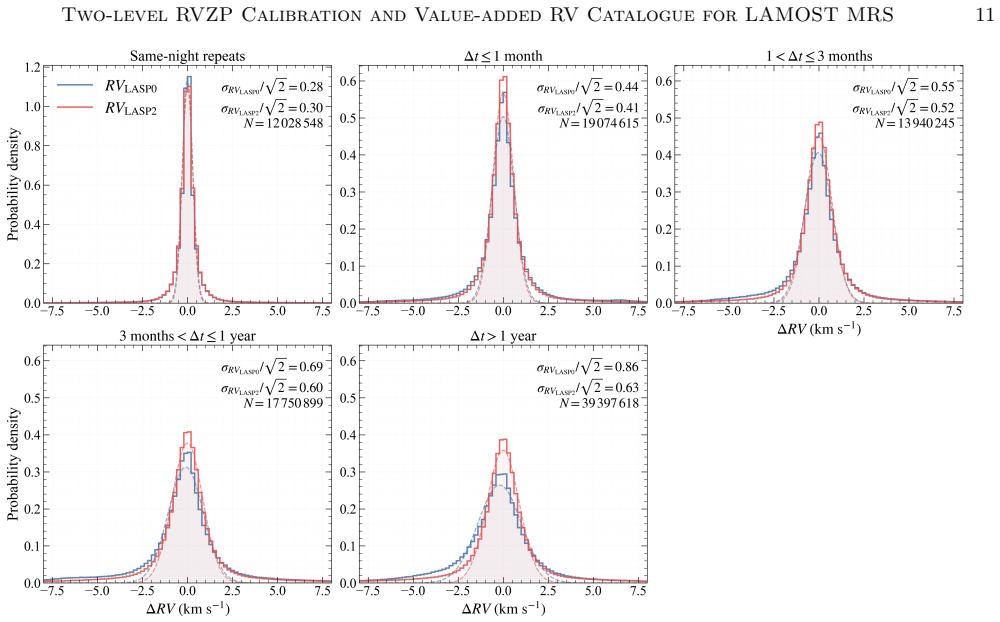
The paper's central claim is that the MRS radial-velocity zero point is a two-level empirical object rather than a single constant: a spectrograph–exposure term in (lmjm, planid, spid) units captures offsets shared within an exposure, and a fiber–time term in (spid, fiberid, time_tag) units captures the residual fiber-dependent, slowly varying structure. Both are estimated by weighted-median residuals against Gaia DR3 magnitude–colour-corrected RVs and APOGEE DR17 RVs, with outlier clipping and a grouped fallback for sparsely sampled units. After both corrections, internal cross-night single-observation precision at S/N 50–60 improves from 0.60 to 0.48 km/s, scatter against APOGEE DR17 falls from 1.09 to 0.52 km/s, and the improvement grows with the time between visits, reaching 0.63 km/s for baselines longer than a year versus 0.86 km/s before. An out-of-sample check against APOGEE DR19 reduces the same high-S/N scatter to 0.64 km/s, indicating the correction generalizes beyond its training references.
Load-bearing premise
The correction assumes the external references themselves are zero-point-clean: if Gaia's magnitude–colour-corrected RVs and APOGEE DR17 share a common zero-point error or a magnitude/colour/time-dependent residual, that error is copied into every LAMOST velocity.
Editorial extensions
If this is right
- Corrected LAMOST MRS RVs become roughly twice as precise for high-S/N spectra and are consistent across exposures, spectrographs, fibers, and epochs, enabling cleaner multi-epoch kinematics and time-domain variability studies.
- The released catalogue supplies rv_lasp2 for 11,129,477 blue-arm spectra (8,158,271 single-exposure and 2,971,206 coadded), giving a uniform velocity baseline where none existed before.
- Long-baseline repeated observations gain the most: the single-observation precision for visits separated by more than a year improves from about 0.86 to 0.63 km/s.
- The correction transfers to an independent blue- and red-arm cross-correlation pipeline without re-tuning, and at S/N≥10 produces the same qualitative gains, implying the zero-point structure is instrumental rather than a quirk of one velocity pipeline.
- An independent APOGEE DR19 validation shows the corrected scatter remains the smallest in every S/N bin, confirming the gain is not just a re-fit to the calibration references.
Reading between the lines
- Because both external references are anchored to a common system, a future Gaia RV re-release with corrected zero points could require re-running the same hierarchy rather than reusing the published catalogue unchanged; this is a testable recalibration path, not a claim the paper makes.
- The unresolved ~0.2 km/s gap between same-night and cross-night precision suggests that intermediate-timescale systematics (possibly wavelength-dependent residuals or the coarse three-segment-per-year time tagging) survive the two levels; a finer temporal grid or a wavelength-resolved layer would be a natural next experiment.
- The same hierarchical recipe could be transplanted to other multi-fiber, multi-epoch surveys with access to high-precision external RVs, with the same two-level unit structure adapted to their observing geometry.
- Because the correction is derived per measurement unit rather than per star, it should also apply to non-stellar or low-S/N spectra in the application sample after the same reference anchors are matched, though the gain there will be smaller because noise dominates.
Signed reviews
Editorial analysis
A structured set of objections, weighed in public.
Referee Report
Summary. The paper presents an empirical two-level zero-point calibration for LAMOST DR12 v1.1 MRS blue-arm radial velocities. The first level subtracts weighted-median residuals against Gaia DR3 magnitude-colour-corrected and APOGEE DR17 RVs within (lmjm, planid, spid) spectrograph-exposure units; the second level does the same within (spid, fiberid, time_tag) units after the first-level correction, with grouped fallbacks for units with too few references. The authors validate the method on same-night and cross-night repeats, on residuals against both external references, on an independently derived blue/red-arm cross-correlation pipeline, and on APOGEE DR19. They release a value-added catalogue of 11,129,477 corrected blue-arm spectra and public calibration code.
Significance. If the reported gains hold, the paper materially improves the scientific usability of LAMOST MRS velocities: high-S/N scatter against the calibration reference drops from about 1.1 to 0.52 km/s, cross-night repeatability improves from 0.60 to 0.48 km/s, and the public catalogue and reproducible pipeline lower the barrier for time-domain and kinematic studies. The method is internally consistent, with a clean separation between calibration and application samples, a weighted-median estimator that is robust to binaries and variables, and an explicit fallback for sparse units. The strongest independent evidence is the cross-night repeat test, which does not rely on the external references, together with the transfer of the framework to the cross-correlation pipeline. The main weakness is that the headline precision gain is measured against a calibration reference, so the out-of-sample DR19 result should be the basis for the catalogue's claimed external precision.
major comments (3)
- [Abstract; §5.1; §7] The headline claim of a roughly 2x improvement in RV precision is based on the APOGEE DR17 comparison (1.09 -> 0.52 km/s in the S/N=50-60 bin), but DR17 is one of the two references used to derive the zero points in Sections 3.2 and 3.3. Scatter on the calibration sample can be reduced by construction, especially for the 117,428 spectrograph-exposure and 55,451 fiber-time units with only 20 and 17 reference contributions. The out-of-sample DR19 test in Section 5.3 gives 1.07 -> 0.64 km/s, i.e., an improvement of about 1.7x, not 2.1x. The abstract, Section 5.1, and the conclusions should lead with the DR19-based gain or explicitly state that the 0.52 km/s figure is relative to the calibration reference.
- [§5.4, Eq. (3)] Equation (3) assigns empirical uncertainties from the scatter of corrected LAMOST RVs relative to APOGEE DR17, the same reference that defines the correction. Because the independent DR19 comparison shows a larger scatter (0.64 vs 0.52 km/s at high S/N), the rv_lasp2_err column in the released catalogue likely understates the external precision by roughly 20%. The uncertainty calibration should be repeated on the DR19 sample, or a reference-frame systematic term should be added and documented in the catalogue description.
- [§5.3] The DR19 test is a useful check that the correction is not a pure re-fit of the DR17 residuals, but the text overstates its independence. DR19 is an updated APOGEE/SDSS reduction and therefore shares the APOGEE instrument and reference frame with DR17; moreover, the Gaia DR3 corrected RVs used in Section 2.2 are themselves tied to the APOGEE system. The sentence claiming the DR19 sample is 'not overlapping with the APOGEE DR17 set' should be clarified or removed, and the paper should state that the absolute zero-point frame is not independently verified. A comparison to a genuinely independent reference would be needed to test for common-mode reference systematics.
minor comments (5)
- [§2.1/§3.2] The calibration sample is described as excluding likely variables, binaries, and other problematic targets, but the actual exclusion criteria and masks are not specified; please state them or explicitly defer to the sigma-clipping procedure.
- [§3.2] The justification for not deduplicating the Gaia/APOGEE overlap is plausible, but a one-line sensitivity test without the overlapping residuals would make the claimed ~17% influence quantitative.
- [§3] The key tuning parameters (0.5 km/s LASP error floor, n>=20 and n>=17 thresholds, time-tag segmentation, and clipping parameters) are not subjected to a robustness test; a short sensitivity run would show whether the DR19 0.64 km/s result is stable under reasonable variations.
- [§5.2] The external-scatter comparisons for the cross-correlation pipeline are not independent of the reference set because the two-level correction is re-derived using the same Gaia/DR17 residuals; please state that only the cross-night repeat test is fully reference-free.
- [§2.2] The reference 'Collaboration et al. 2016' should be formatted as 'Gaia Collaboration et al. 2016'.
Circularity Check
Headline ~2x precision gain is measured against APOGEE DR17, one of the two calibration references; the independent DR19 test yields 0.64 km/s (~1.7x), so the abstract's headline metric is partly in-sample, though the method has real out-of-sample support.
-
fitted input called prediction
[Section 5.1 (also abstract and Section 7, item 3)]
"Relative to APOGEE DR17, the scatter decreases from 1.09 km s−1 to 0.76 km s−1 and to 0.52 km s−1. Thus, in this representative high-S/N APOGEE DR17 comparison, the final corrected R V scatter is roughly halved relative to the original LASP0 value, implying a∼2×improvement in R V precision."
APOGEE DR17 is one of the two references used to estimate the zero points: in Section 3.2, residuals are defined as RV_LASP0 − RV_APOGEE_DR17, and the unit-level RVZP is the weighted median of those same residuals; the correction subtracts this fitted unit-level median. Therefore the residual scatter of the corrected RVs relative to the same APOGEE DR17 sample is an in-sample statistic: removing per-unit medians fitted to those residuals necessarily shrinks the pooled scatter, particularly for units with only about 20 reference stars.
full rationale
The two-level correction is an empirical calibration, so using Gaia/APOGEE DR17 to derive zero points is not circular per se. The only circular element is the presentation of the APOGEE DR17 residual scatter in Section 5.1 (and the abstract's '~2× improvement') as evidence of achieved precision: DR17 residuals are the very data from which the unit-level weighted medians are estimated, so the 1.09→0.52 km/s reduction is partly a mathematical consequence of the estimator rather than an external validation. The paper mitigates this by (i) labeling Section 5.1 'training references', (ii) providing an independent APOGEE DR19 test (1.07→0.64 km/s, ~1.7×) that is not used in calibration, and (iii) reporting cross-night repeat tests that do not depend on any external reference. The cited prior work (Zhang et al. 2021, 2026) is contextual and not load-bearing for the mathematical derivation. The catalogue release and the independent DR19 improvement mean the central method has real content; however, the headline 2× figure should be read as an in-sample comparison, with the out-of-sample gain closer to 1.7×.
Assumptions & free parameters
free parameters (5)
- sigma_LASP error floor =
0.5 km/s
- Minimum reference contributions per unit =
20 (level 1), 17 (level 2)
- Time-tag segmentation =
P1=Sep-Nov, P2=Dec-Feb, P3=Mar-Jun
- Zero-level grouping =
year x spectrograph (level 1); time part x 25-fiber bundle (level 2)
- Sigma-clipping thresholds =
not stated in text; in code
assumptions (5)
- domain assumption External reference RVs (Gaia DR3 magnitude-colour-corrected and APOGEE DR17) are on a common zero-point system accurate at the ~0.1-0.5 km/s level for the stars used.
- domain assumption Within each (lmjm, planid, spid) unit the RV zero point is constant across fibers and across the exposure.
- domain assumption Within each (spid, fiberid, time_tag) unit the residual zero point is constant over the 3-4 month time segment.
- domain assumption The Gaia and APOGEE reference samples can be combined without deduplication without biasing the weighted median.
- domain assumption The calibration sample's exclusion of binaries, variables, and problematic targets is sufficient to avoid contamination of unit-level medians.
Cite this review
Pith. "Pith review of A Two-level Radial-velocity Zero-point Calibration for LAMOST MRS with Gaia and APOGEE and a Value-added RV Catalogue." pith.science (2026). https://pith.science/paper/57FHNPRK
@misc{pith2026260807962,
  author       = {Pith},
  title        = {Pith review of: A Two-level Radial-velocity Zero-point Calibration for LAMOST MRS with Gaia and APOGEE and a Value-added RV Catalogue},
  year         = {2026},
  howpublished = {\url{https://pith.science/paper/57FHNPRK}},
  note         = {Machine review of arXiv:2608.07962}
}
read the original abstract
The LAMOST Medium-Resolution Survey (MRS) provides a large stellar spectroscopic data set for Galactic kinematics and time-domain radial-velocity (RV) studies. However, the multi-spectrograph, multi-exposure, multi-fiber observing strategy can imprint RV zero-point (RVZP) systematics that vary across instrumental and temporal hierarchies. We construct a two-level empirical RVZP correction to LAMOST DR12 MRS using Gaia DR3 magnitude-colour-corrected RVs and APOGEE DR17 RVs as external references: a spectrograph-exposure correction in (lmjm, planid, spid) units, followed by a fiber-time correction in (spid, fiberid, time_tag) units. Within each unit, RVZPs are estimated from Gaia and APOGEE residuals using a weighted-median estimator, and are subtracted from the pipeline RVs to obtain corrected velocities. For high-S/N spectra, the scatter relative to APOGEE DR17 decreases from ~1.1 km/s to ~0.52 km/s after the full two-level correction, implying a ~2x improvement in RV precision. We release a value-added catalogue of two-level-corrected RVs for 11,129,477 blue-arm spectra, including 8,158,271 single-exposure spectra and 2,971,206 coadded spectra, enabling consistent RV analyses across exposures, spectrographs, fibers, and time.
Figures


Figures from the paper (5 more)




Reference graph
Works this paper leans on
-
[1]
2023, A&A, 674, A7, doi: 10.1051/0004-6361/202243685
Blomme, R., Fr´ emat, Y., Sartoretti, P., et al. 2023, A&A, 674, A7, doi: 10.1051/0004-6361/202243685
-
[2]
2016, Astronomy & Astrophysics, 595, A1, doi: 10.1051/0004-6361/201629272
Collaboration, G., et al. 2016, Astronomy & Astrophysics, 595, A1, doi: 10.1051/0004-6361/201629272
-
[3]
2018, Astronomy & Astrophysics, 616, A5, doi: 10.1051/0004-6361/201832763
Cropper, M., Katz, D., Sartoretti, P., et al. 2018, Astronomy & Astrophysics, 616, A5, doi: 10.1051/0004-6361/201832763
-
[4]
2012, Research in Astronomy and Astrophysics, 12, 1197, doi: 10.1088/1674-4527/12/9/003
Cui, X.-Q., Zhao, Y.-H., Chu, Y.-Q., et al. 2012, Research in Astronomy and Astrophysics, 12, 1197, doi: 10.1088/1674-4527/12/9/003
-
[5]
Deng, L.-C., Newberg, H. J., Liu, C., et al. 2012, Research in Astronomy and Astrophysics, 12, 735, doi: 10.1088/1674-4527/12/7/003
-
[6]
2025, The Astrophysical Journal Supplement Series, 278, 46, doi: 10.3847/1538-4365/adced1
Guo, S., Kovalev, M., Li, J., et al. 2025, The Astrophysical Journal Supplement Series, 278, 46, doi: 10.3847/1538-4365/adced1
-
[7]
2026, The Astrophysical Journal, 1000, 168, doi: 10.3847/1538-4357/ae4aa6
Guo, Y., Li, K., Tang, Y., et al. 2026, The Astrophysical Journal, 1000, 168, doi: 10.3847/1538-4357/ae4aa6
-
[8]
2025, Monthly Notices of the Royal Astronomical Society, 544, 1361, doi: 10.1093/mnras/staf1669
He, T., Li, J., Zhang, X., et al. 2025, Monthly Notices of the Royal Astronomical Society, 544, 1361, doi: 10.1093/mnras/staf1669
Show all 22 references
-
[9]
2023, A&A, 674, A5, doi: 10.1051/0004-6361/202244220
Katz, D., Sartoretti, P., Guerrier, A., et al. 2023, A&A, 674, A5, doi: 10.1051/0004-6361/202244220
2023 doi
-
[10]
2024, Monthly Notices of the Royal Astronomical Society, 527, 521, doi: 10.1093/mnras/stad3222
Kovalev, M., Zhou, Z., Chen, X., & Han, Z. 2024, Monthly Notices of the Royal Astronomical Society, 527, 521, doi: 10.1093/mnras/stad3222
2024 doi
-
[11]
2026, The Astrophysical Journal Supplement Series, 284, 65, doi: 10.3847/1538-4365/ae657c
Li, K., Gao, X., Wang, S.-R., & Wang, L.-H. 2026, The Astrophysical Journal Supplement Series, 284, 65, doi: 10.3847/1538-4365/ae657c
2026 doi
- [12]
-
[13]
2013, Proceedings of the International Astronomical Union, 9, 310, doi: 10.1017/S1743921313006510
Liu, X.-W., Yuan, H.-B., Huo, Z.-Y., et al. 2013, Proceedings of the International Astronomical Union, 9, 310, doi: 10.1017/S1743921313006510
2013 doi
-
[14]
R., Schiavon, R
Majewski, S. R., Schiavon, R. P., Frinchaboy, P. M., et al. 2017, The Astronomical Journal, 154, 94, doi: 10.3847/1538-3881/aa784d
2017 doi
- [15]
-
[16]
G., Prusti, T., et al
Vallenari, A., Brown, A. G., Prusti, T., et al. 2023, Astronomy & Astrophysics, 674, A1, doi: 10.1051/0004-6361/202243940 16Zhang & Yuan Figure A1.Same as Figure 2, but for the coadded spectra
2023 doi
-
[17]
2019, The Astrophysical Journal Supplement Series, 244, 27, doi: 10.3847/1538-4365/ab3cc0
Wang, R., Luo, A.-L., Chen, J.-J., et al. 2019, The Astrophysical Journal Supplement Series, 244, 27, doi: 10.3847/1538-4365/ab3cc0
2019 doi
-
[18]
2011, Research in Astronomy and Astrophysics, 11, 924, doi: 10.1088/1674-4527/11/8/006
Wu, Y., Luo, A.-L., Li, H.-N., et al. 2011, Research in Astronomy and Astrophysics, 11, 924, doi: 10.1088/1674-4527/11/8/006
2011 doi
-
[19]
2021, The Astrophysical Journal Supplement Series, 256, 14, doi: 10.3847/1538-4365/ac0834
Zhang, B., Li, J., Yang, F., et al. 2021, The Astrophysical Journal Supplement Series, 256, 14, doi: 10.3847/1538-4365/ac0834
2021 doi
-
[20]
2025, The Astrophysical Journal, 992, 142, doi: 10.3847/1538-4357/ae0620
Zhang, B., Gao, Y.-D., Li, C.-Q., et al. 2025, The Astrophysical Journal, 992, 142, doi: 10.3847/1538-4357/ae0620
2025 doi
- [21]
-
[22]
Zhao, G., Zhao, Y.-H., Chu, Y.-Q., Jing, Y.-P., & Deng, L.-C. 2012, Research in Astronomy and Astrophysics, 12, 723, doi: 10.1088/1674-4527/12/7/002 Two-level R VZP Calibration and V alue-added R V Catalogue for LAMOST MRS17 Figure A2.Same as Figure 4, but for the coadded spec...
2012 doi
Reviewed August 12, 2026 · model on record in the stance chip above.
Discussion (0). Continue with ORCID to comment.