REVIEW 5 major objections 4 minor 93 references
Thought-Level Beam Search for Reasoning
T0 review · 5 major / 4 minor · reviewed 2026-08-15 · deepseek-v4-flash
Pith's one-line read Gambit reframes test-time reasoning as a fixed-budget, thought-level beam search that recycles compute from weak traces onto promising prefixes, and it claims strict dominance over both parallel sampling and pruning-only scaling on the…
desk verdict Thought-level beam search is a real contribution, but the paper's central attribution claim is undercut by a score-weighting confound. read the letter →
The pith
A machine-rendered reading of the paper's core claim, the machinery that carries it, and where it could break.
The reading
What carries the argument
The carrying mechanism is thought-level beam search with zero-sum tournaments. Traces are segmented into thoughts at double-newline boundaries; every $\Delta=200$ tokens, active traces are ranked by the running average score $\bar{s}_i=\frac{1}{n}\sum_j f_\theta(h_{i,j})$ of a lightweight two-layer MLP reading last-layer hidden states, the bottom $K=16$ traces are pruned, and the top $K$ are branched into new children via prefix-cache reuse of the parent's cached attention state. A warmup threshold of $w=12{,}000$ tokens keeps immature traces out of the branching pool, and a decoupled scheduler/tree view prevents memory-pressure evictions from collapsing the search onto a single greedy branch. Completed traces contribute to a score-weighted majority vote.
What would settle it
On AIME-25 at N=256, run Gambit with the same hyperparameters but a permutation-randomized scorer, shuffling the computed scores across active traces at each tournament round; if this randomized version matches the reported accuracy and token count, then score-guided allocation is not what produces the gains, and the paper's central mechanism would be refuted.
Extended reading notes
Core claim
The paper's central claim is that subtractive pruning underperforms not because prefix scores are weak, but because it never spends the compute it frees: killing a low-quality trace without replacing it shrinks the voting pool and leaves hardware idle. Gambit pairs every prune with a branch, removing the K lowest-scoring traces and spawning K children from the K highest-scoring prefixes, with children inheriting the parent's cached prefix. This keeps the number of active traces at exactly capacity C and, the paper argues, mechanically shifts the ensemble distribution toward correct answers. The discovery is that the topology of test-time compute allocation—recycle-and-branch rather than sample-and-discard—is what produces the reported accuracy and token-efficiency gains across three model families and five benchmarks.
Load-bearing premise
The load-bearing premise is that, once a reasoning trace passes roughly 12,000 tokens of warmup, a cheap hidden-state scorer ranks partial traces by their chance of ending in the correct answer well enough that pruning the bottom and branching the top actually concentrates compute on better futures.
Editorial extensions
If this is right
- Under a fixed GPU budget, independent parallel sampling is not the best use of test-time compute; a search that reallocates tokens among partial traces can raise accuracy without raising the token bill.
- Pruning-only early-exit strategies leave a predictable accuracy ceiling because they shrink the voting pool; branching refills it, so gains from a good prefix-scorer are amplified rather than wasted.
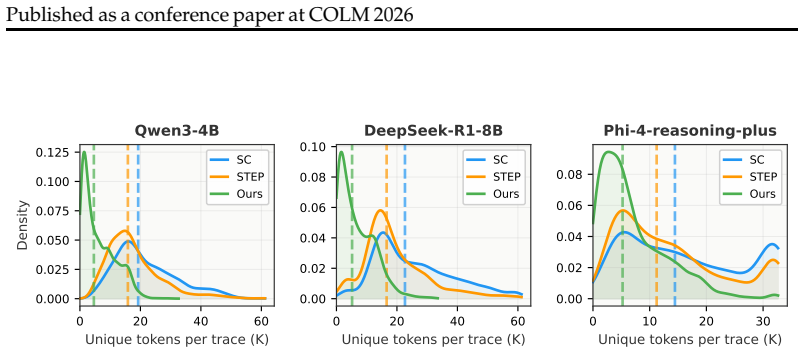
- Token savings up to 68.5% with roughly comparable wall-clock latency mean the practical cost of scaling reasoning can fall sharply on long-horizon math and science problems.
- Because Gambit uses the same scorer as STEP, the accuracy gap isolates the value of the search topology itself rather than a better reward signal.
- The method is scorer-agnostic, so future improvements in process reward models or hidden-state probes should directly translate into larger accuracy gains under the same tournament structure.
Reading between the lines
- Editorial inference: the magnitude of Gambit's gains should track the reliability of the prefix scorer; the paper's own Figure 9 shows pairwise ranking accuracy that starts near random and rises only toward 0.6-0.65, so datasets where correct and incorrect reasoning share long plausible prefixes should be where the method shines, and datasets where divergence happens before the 12K warmup should b
- Editorial inference: a natural stress test is to feed the tournament a deliberately bad scorer, for example permuting the scores across active traces at each round; if Gambit's accuracy and token savings persist, the branching mechanics alone, rather than the fidelity of the guidance signal, would be doing the work.
- Editorial inference: because Gambit is scorer-agnostic, stronger process reward models or learned value functions could be plugged in directly, likely converting better signals into larger accuracy gains than pruning-only pipelines could obtain.
Signed reviews
Editorial analysis
A structured set of objections, weighed in public.
Referee Report
Summary. The paper proposes Gambit, a thought-level beam search algorithm for test-time reasoning. Gambit maintains a fixed-capacity pool of C active traces; every Δ steps it ranks traces by the average of an off-the-shelf hidden-state MLP scorer (the STEP scorer), prunes the bottom K traces, and branches from the top K traces via prefix-cache reuse, enforcing a zero-sum memory invariant. A decoupled scheduler/tree view introduces "ghost traces" to prevent memory-pressure evictions from collapsing the beam. The paper reports accuracy, token consumption, and latency across Qwen3-4B, DeepSeek-R1-8B, and Phi-4 on AIME-25/26, HMMT-24/25, and GPQA-Diamond, and claims that Gambit strictly dominates SC, Slim-SC, DeepConf, and STEP in accuracy and efficiency, with up to +6.7% absolute accuracy gains, >2× trace throughput, and up to 68.5% token reduction.
Significance. If the central claims held, this would be a useful contribution: it reformulates test-time scaling as hardware-constrained beam search, introduces a clean zero-sum prune-and-branch invariant, and demonstrates a system-level implementation with negligible overhead, a released codebase, and a detailed qualitative trace analysis. The comparison against STEP using the identical MLP scorer is a good experimental design choice for isolating the search topology. However, the paper's strongest claims are currently not established: the accuracy comparison is confounded by score-weighted aggregation, hyperparameters are selected on a benchmark that also appears in the main table, and no uncertainty quantification is provided. These are fixable with additional ablations and reporting, so the work is worthy of a major revision.
major comments (5)
- [§5.1–5.2] The claim that accuracy differences are "strictly attributable to the underlying search topology" (§5.2) is not supported, because Gambit uses score-weighted majority voting while the baselines do not. Section 5.1 states that Gambit aggregates final answers via a score-weighted majority vote with a position-weighted penalty; SC, Slim-SC, DeepConf, and STEP are described as unweighted or pruning-based aggregations. Since the reported gains are small in absolute terms (e.g., +3.3% on AIME-25 is roughly one question out of 30), the observed improvements could be driven by the weighting scheme rather than by active reallocation. Please add an ablation of Gambit with unweighted majority voting, and/or a baseline (STEP or SC) that uses the same score-weighted vote, and report both accuracy and efficiency for these variants.
- [§A.4 and Table 1] The hyperparameter selection procedure uses the test set. Figure 10 in Section A.4 selects K=16, Δ=200, w=12K, and r=0.9 on AIME-25 with DeepSeek-R1-0528-Qwen3-8B, and the same model/benchmark combination appears in the main results of Table 1 (DeepSeek-R1-8B, AIME-25, accuracy 85.8). Because the ablation is performed on a benchmark included in the main evaluation, the reported accuracy for that configuration is optimistically biased. Please select hyperparameters on a held-out validation set (or a separate benchmark) and show that the selected configuration also performs well on all reported benchmarks, or alternatively report all ablated configurations on all benchmarks.
- [Table 1 and Table 4] The paper asserts that Gambit "strictly dominates" existing baselines, but the data do not support strict dominance on both accuracy and efficiency axes. There are no error bars or significance tests in Table 1, and several differences are within one or two questions on 30-question sets. Moreover, Table 4 shows cases where Gambit is not the best in latency or token consumption: for DeepSeek-R1-8B on AIME-25, Gambit consumes 4,211K tokens versus DeepConf's 3,753K and STEP's 3,711K; on HMMT-25 its latency is 2,169s versus STEP's 1,715s; and for Phi-4, Gambit is slower than STEP on every benchmark (e.g., 1,480s vs 1,155s on AIME-25). Please either soften the dominance claim to a targeted comparison (e.g., accuracy at a fixed number of completed traces, token reductions relative to SC) or provide a formal dominance analysis with confidence intervals.
- [§4.1 and §5.1] The algorithm as specified is incomplete. Algorithm 1 defines scoring, pruning, branching, and ghost-trace eviction, but it does not define the hard floor δ=0.1 that Section 5.1 introduces and Section A.4 refers to as a "hard-floor threshold scan." Similarly, the "position-weighted penalty" used in the final score-weighted majority vote is mentioned in Section 5.1 but never formally defined in the algorithm or equations. These are load-bearing hyperparameters for reproducibility. Please add formal definitions and pseudocode for the hard floor and the aggregation penalty.
- [Figure 9 and §A.2] The motivation for Gambit depends on the scorer's ability to rank partial traces, but Figure 9 shows that the off-the-shelf MLP's pairwise ranking accuracy is near or below random early in generation (approximately 0.50–0.65 depending on step fraction). The paper interprets this as motivation for the warmup threshold, which is reasonable, but it does not consider a calibration or selection-risk analysis: if the ranking signal is weak or miscalibrated, Gambit could underperform parallel sampling. Please add an experiment varying scorer quality (e.g., the causal scorer versus the MLP, or a deliberately noisy scorer) and report accuracy as a function of warmup threshold and scorer quality, to support the claim that the method is robust to the scorer signal.
minor comments (4)
- [§A.5] The tree statistics in the runtime example are internally inconsistent: 256 root traces plus 1,339 branches gives 1,595 nodes, but the text reports 1,083 pruned and 256 completed traces, which sums to 1,339, leaving 256 nodes unaccounted for in the stated counts. Please reconcile these numbers.
- [§4.1 and §5.1] The check interval Δ is described as "steps" in Algorithm 1 and Section A.4 but as tokens in Section 5.1 ("check interval Δ=200 tokens"). Please use one consistent unit throughout the paper.
- [§4.1] The text says a "temperature multiplier" can be applied to branched children, but no value is specified in Section 5.1 or the ablations. Please state the value used in the main experiments.
- [Figure 6] The claimed "more than 2× higher throughput" is based on a single benchmark (AIME-26) with no error bars across repeated runs; please report variance or additional benchmarks to support the generality of the throughput claim.
Circularity Check
No significant circularity: the main comparisons are empirical and the scorer input is shared with the STEP baseline; the principal caveat is an attribution confound (score-weighted final voting), not a definitional reduction.
full rationale
The paper is an empirical systems comparison rather than a derivation from first principles, and I find no step in which a claimed prediction reduces by construction to its inputs. The central control is genuine: Gambit's main evaluation uses "the exact same off-the-shelf 2-layer MLP scorer from STEP" (Section 5.1), so the scoring input is held fixed between Gambit and its closest pruning baseline; the tournament operations (Eq. 2 and Eq. 3) and zero-sum capacity invariant are algorithmic structure, not a restatement of the scorer. The Appendix's custom sequence scorer is trained with a last-step binary cross-entropy on correctness labels (Eq. 7, Appendix A.1); this is standard supervised signal extraction, and the paper does not state that the training traces come from the evaluation benchmarks, so no leakage is established. The hyperparameter ablation in Appendix A.4 is run on AIME-25, which also appears in Table 1; this is a mild selection-on-test concern for that one cell, but the chosen configuration is not the optimum in Figure 10 (e.g., w=8K appears to give 90.0 vs. the selected w=12K's 85.8), and the same constant hyperparameters are applied to all other benchmarks and models, so the main dominance claims are not forced by the fit. The more serious issue is attribution, not circularity: Section 5.2 asserts "any variance in accuracy or efficiency is strictly attributable to the underlying search topology," but Gambit's final aggregation is a score-weighted majority vote (Algorithm 1) while the baselines are described as unweighted or similarity-based; no ablation isolates the weighting. That is an uncontrolled confound and a correctness risk, but it is not an equation-level equivalence or a fitted parameter renamed as a prediction. The only self-citation (DeepConf, Fu et al. 2025, coauthored by Jiawei Zhao) is used as a baseline and in related work, not as load-bearing evidence, so it does not raise the circularity score.
Assumptions & free parameters
free parameters (8)
- Capacity C =
256
- Swap size K =
16
- Check interval delta =
200 tokens
- Warmup threshold w =
12,000 tokens
- Memory usage ratio r =
0.9
- Hard floor delta =
0.1
- Temperature multiplier
- Position-weighted penalty
assumptions (5)
- domain assumption Hidden-state scores predict which partial traces will lead to correct final answers
- domain assumption Successful and failed trajectories share promising prefixes early in generation
- domain assumption KV-cache prefix sharing keeps memory footprint constant and lets branches inherit parents without recomputation
- domain assumption A fixed pool of C active traces is the right hardware abstraction for a single GPU
- domain assumption Answer extraction and scoring are unbiased across methods
invented entities (1)
-
Ghost trace
Cite this review
Pith. "Pith review of Thought-Level Beam Search for Reasoning." pith.science (2026). https://pith.science/paper/KAGSCWG7
@misc{pith2026260808020,
  author       = {Pith},
  title        = {Pith review of: Thought-Level Beam Search for Reasoning},
  year         = {2026},
  howpublished = {\url{https://pith.science/paper/KAGSCWG7}},
  note         = {Machine review of arXiv:2608.08020}
}
abstract
Test-time compute scaling is a primary driver of performance in large reasoning models (LRMs), but extreme inefficiency bounds current approaches, shifting the critical question from \emph{how much} compute to spend, to \emph{where} to allocate it. We formalize test-time reasoning as a constrained compute allocation problem over partial trajectories. Under a fixed hardware budget, existing paradigms fail to actively allocate the compute to the most promising partial progress: traditional parallel sampling treats traces independently and induces severe memory bottlenecks, while subtractive pruning starves hardware and fails to actively and sufficiently shift the output distribution. To overcome this dichotomy, we introduce Gambit, an inference algorithm that executes \emph{thought-level beam search}. By periodically pruning unpromising trajectories and immediately branching from high-quality prefixes, Gambit dynamically concentrates compute onto the most promising reasoning traces via a light-weight scorer probing hidden states while maintaining continuous high hardware utilization. Extensive evaluations across multiple models and benchmarks demonstrate that Gambit strictly dominates existing baselines. Under identical hardware constraints, our method yields up to a +6.7\% absolute accuracy gain on HMMT-24 and +3.3\% on AIME-25 over pruning baselines, delivers $>2\times$ higher throughput on trace completion, and reduces total token consumption by up to 68.5\% relative to standard parallel sampling.
Figures


Figures from the paper (7 more)




Reference graph
Works this paper leans on
-
[1]
2025 , eprint=
Phi-4-reasoning Technical Report , author=. 2025 , eprint=
2025
-
[2]
2023 , eprint=
Reasoning with Language Model is Planning with World Model , author=. 2023 , eprint=
2023
-
[3]
2022 , eprint=
Teaching Models to Express Their Uncertainty in Words , author=. 2022 , eprint=
2022
-
[4]
2022 , eprint=
Language Models (Mostly) Know What They Know , author=. 2022 , eprint=
2022
-
[5]
2024 , eprint=
Monte Carlo Tree Search Boosts Reasoning via Iterative Preference Learning , author=. 2024 , eprint=
2024
-
[6]
2023 , eprint=
Tree of Thoughts: Deliberate Problem Solving with Large Language Models , author=. 2023 , eprint=
2023
-
[7]
2025 , eprint=
Gemma 3 Technical Report , author=. 2025 , eprint=
2025
-
[8]
2018 , eprint=
Diverse Beam Search: Decoding Diverse Solutions from Neural Sequence Models , author=. 2018 , eprint=
2018
Show all 93 references
-
[9]
2014 , eprint=
Sequence to Sequence Learning with Neural Networks , author=. 2014 , eprint=
2014
-
[10]
, year =
Lowerre, Bruce T. , year =. The
-
[11]
2023 , eprint=
RoFormer: Enhanced Transformer with Rotary Position Embedding , author=. 2023 , eprint=
2023
-
[12]
2020 , eprint=
GLU Variants Improve Transformer , author=. 2020 , eprint=
2020
-
[13]
2025 , eprint=
Speculative Thinking: Enhancing Small-Model Reasoning with Large Model Guidance at Inference Time , author=. 2025 , eprint=
2025
-
[14]
The Thirty-ninth Annual Conference on Neural Information Processing Systems , year=
SpecReason: Fast and Accurate Inference-Time Compute via Speculative Reasoning , author=. The Thirty-ninth Annual Conference on Neural Information Processing Systems , year=
-
[15]
2024 , eprint=
Math-Shepherd: Verify and Reinforce LLMs Step-by-step without Human Annotations , author=. 2024 , eprint=
2024
-
[16]
2022 , eprint=
Solving math word problems with process- and outcome-based feedback , author=. 2022 , eprint=
2022
-
[17]
2023 , eprint=
Faith and Fate: Limits of Transformers on Compositionality , author=. 2023 , eprint=
2023
-
[18]
2023 , eprint=
Let's Verify Step by Step , author=. 2023 , eprint=
2023
-
[19]
Proceedings of the 41st International Conference on Machine Learning , articleno =
Liu, Sheng and Ye, Haotian and Xing, Lei and Zou, James , title =. Proceedings of the 41st International Conference on Machine Learning , articleno =. 2024 , publisher =
2024
-
[20]
The 4th Workshop on Mathematical Reasoning and AI at NeurIPS'24 , year=
Enhancing Language Model Reasoning via Weighted Reasoning in Self-Consistency , author=. The 4th Workshop on Mathematical Reasoning and AI at NeurIPS'24 , year=
-
[21]
2025 , eprint=
Reasoning Models Know When They're Right: Probing Hidden States for Self-Verification , author=. 2025 , eprint=
2025
-
[22]
2025 , eprint=
Mind the Confidence Gap: Overconfidence, Calibration, and Distractor Effects in Large Language Models , author=. 2025 , eprint=
2025
-
[23]
2026 , eprint=
Large Language Model Reasoning Failures , author=. 2026 , eprint=
2026
-
[24]
2025 , eprint=
Learning to Reason Across Parallel Samples for LLM Reasoning , author=. 2025 , eprint=
2025
-
[25]
The Thirteenth International Conference on Learning Representations , year=
Learning Harmonized Representations for Speculative Sampling , author=. The Thirteenth International Conference on Learning Representations , year=
-
[26]
2024 , eprint=
Medusa: Simple LLM Inference Acceleration Framework with Multiple Decoding Heads , author=. 2024 , eprint=
2024
-
[27]
NVIDIA GB300 Grace Blackwell Superchip Architecture , year =
-
[28]
2023 , eprint=
Large Language Models are Zero-Shot Reasoners , author=. 2023 , eprint=
2023
-
[29]
2025 , eprint=
s1: Simple test-time scaling , author=. 2025 , eprint=
2025
-
[30]
2025 , eprint=
Scalable Best-of-N Selection for Large Language Models via Self-Certainty , author=. 2025 , eprint=
2025
-
[32]
2023 , eprint=
Self-Consistency Improves Chain of Thought Reasoning in Language Models , author=. 2023 , eprint=
2023
-
[33]
2025 , eprint=
Deep Think with Confidence , author=. 2025 , eprint=
2025
-
[34]
2026 , eprint=
Hidden States as Early Signals: Step-level Trace Evaluation and Pruning for Efficient Test-Time Scaling , author=. 2026 , eprint=
2026
-
[35]
2023 , eprint=
Efficient Memory Management for Large Language Model Serving with PagedAttention , author=. 2023 , eprint=
2023
-
[36]
2024 , eprint=
SGLang: Efficient Execution of Structured Language Model Programs , author=. 2024 , eprint=
2024
-
[37]
2025 , url =
Introducing Claude 4 , author =. 2025 , url =
2025
-
[38]
2025 , month =
Introducing GPT-5 , author =. 2025 , month =
2025
-
[39]
Introducing gpt-oss , year =
-
[40]
2025 , eprint=
Evaluating Step-by-step Reasoning Traces: A Survey , author=. 2025 , eprint=
2025
-
[41]
Open Reasoning Tasks: LLM Reasoning Tasks Collection , author =
-
[42]
2025 , eprint=
Efficient Inference for Large Reasoning Models: A Survey , author=. 2025 , eprint=
2025
-
[43]
2025 , eprint=
SeerAttention-R: Sparse Attention Adaptation for Long Reasoning , author=. 2025 , eprint=
2025
-
[44]
HMMT Problems Archive (2012--2023) , year =
2012
-
[45]
Archive of February 2024 , year =
2024
-
[46]
Archive of February 2025 , year =
2025
-
[47]
2025 , howpublished =
AIME Problems and Solutions , author =. 2025 , howpublished =
2025
-
[48]
2024 , eprint=
TidalDecode: Fast and Accurate LLM Decoding with Position Persistent Sparse Attention , author=. 2024 , eprint=
2024
-
[49]
2023 , eprint=
GPQA: A Graduate-Level Google-Proof Q&A Benchmark , author=. 2023 , eprint=
2023
-
[50]
2025 , howpublished =
Gemini 3 Pro , author =. 2025 , howpublished =
2025
-
[51]
2025 , eprint=
Qwen3 Technical Report , author=. 2025 , eprint=
2025
-
[52]
2025 , eprint=
DeepSeek-R1: Incentivizing Reasoning Capability in LLMs via Reinforcement Learning , author=. 2025 , eprint=
2025
-
[53]
2025 , month =
OpenAI , title =. 2025 , month =
2025
-
[54]
2023 , eprint=
Attention Is All You Need , author=. 2023 , eprint=
2023
-
[55]
Langley , title =
P. Langley , title =. Proceedings of the 17th International Conference on Machine Learning (ICML 2000) , address =. 2000 , pages =
2000
-
[56]
T. M. Mitchell. The Need for Biases in Learning Generalizations. 1980
1980
-
[57]
2023 , eprint=
Chain-of-Thought Prompting Elicits Reasoning in Large Language Models , author=. 2023 , eprint=
2023
-
[58]
2023 , eprint=
LLaMA: Open and Efficient Foundation Language Models , author=. 2023 , eprint=
2023
-
[59]
Phi-4-reasoning technical report, 2025
Marah Abdin, Sahaj Agarwal, Ahmed Awadallah, Vidhisha Balachandran, Harkirat Behl, Lingjiao Chen, Gustavo de Rosa, Suriya Gunasekar, Mojan Javaheripi, Neel Joshi, Piero Kauffmann, Yash Lara, Caio César Teodoro Mendes, Arindam Mitra, Besmira Nushi, Dimitris Papailiopoulos, Olli...
2025 arXiv
-
[60]
Introducing claude 4, 2025
Anthropic . Introducing claude 4, 2025. URL https://www.anthropic.com/news/claude-4. Announcement of Claude Opus 4 and Claude Sonnet 4 models
2025
-
[61]
Aime problems and solutions
AoPS. Aime problems and solutions. https://artofproblemsolving.com/wiki/index.php/AIME_Problems_and_Solutions, 2025. Accessed: 2025-07-14
2025
-
[62]
Deepseek-r1: Incentivizing reasoning capability in llms via reinforcement learning, 2025
DeepSeek-AI. Deepseek-r1: Incentivizing reasoning capability in llms via reinforcement learning, 2025. URL https://arxiv.org/abs/2501.12948
2025 arXiv
-
[63]
Hwang, Soumya Sanyal, Sean Welleck, Xiang Ren, Allyson Ettinger, Zaid Harchaoui, and Yejin Choi
Nouha Dziri, Ximing Lu, Melanie Sclar, Xiang Lorraine Li, Liwei Jiang, Bill Yuchen Lin, Peter West, Chandra Bhagavatula, Ronan Le Bras, Jena D. Hwang, Soumya Sanyal, Sean Welleck, Xiang Ren, Allyson Ettinger, Zaid Harchaoui, and Yejin Choi. Faith and fate: Limits of transforme...
2023 arXiv
-
[64]
Deep think with confidence, 2025
Yichao Fu, Xuewei Wang, Yuandong Tian, and Jiawei Zhao. Deep think with confidence, 2025. URL https://arxiv.org/abs/2508.15260
2025 arXiv
-
[65]
Reasoning with language model is planning with world model, 2023
Shibo Hao, Yi Gu, Haodi Ma, Joshua Jiahua Hong, Zhen Wang, Daisy Zhe Wang, and Zhiting Hu. Reasoning with language model is planning with world model, 2023. URL https://arxiv.org/abs/2305.14992
2023 arXiv
-
[66]
Archive of february 2024
HMMT . Archive of february 2024. HMMT Official Archive, 2024. Accessed: 2026
2024
-
[67]
Archive of february 2025
HMMT . Archive of february 2025. HMMT Official Archive, 2025. Accessed: 2026
2025
-
[68]
Slim- SC : Thought pruning for efficient scaling with self-consistency
Colin Hong, Xu Guo, Anand Chaanan Singh, Esha Choukse, and Dmitrii Ustiugov. Slim- SC : Thought pruning for efficient scaling with self-consistency. In Christos Christodoulopoulos, Tanmoy Chakraborty, Carolyn Rose, and Violet Peng (eds.), Proceedings of the 2025 Conference on ...
2025 doi
-
[69]
Language models (mostly) know what they know, 2022
Saurav Kadavath, Tom Conerly, Amanda Askell, Tom Henighan, Dawn Drain, Ethan Perez, Nicholas Schiefer, Zac Hatfield-Dodds, Nova DasSarma, Eli Tran-Johnson, Scott Johnston, Sheer El-Showk, Andy Jones, Nelson Elhage, Tristan Hume, Anna Chen, Yuntao Bai, Sam Bowman, Stanislav For...
2022 arXiv
-
[70]
Large language models are zero-shot reasoners, 2023
Takeshi Kojima, Shixiang Shane Gu, Machel Reid, Yutaka Matsuo, and Yusuke Iwasawa. Large language models are zero-shot reasoners, 2023. URL https://arxiv.org/abs/2205.11916
2023 arXiv
-
[71]
Gonzalez, Hao Zhang, and Ion Stoica
Woosuk Kwon, Zhuohan Li, Siyuan Zhuang, Ying Sheng, Lianmin Zheng, Cody Hao Yu, Joseph E. Gonzalez, Hao Zhang, and Ion Stoica. Efficient memory management for large language model serving with pagedattention, 2023. URL https://arxiv.org/abs/2309.06180
2023 arXiv
-
[72]
Evaluating step-by-step reasoning traces: A survey, 2025
Jinu Lee and Julia Hockenmaier. Evaluating step-by-step reasoning traces: A survey, 2025. URL https://arxiv.org/abs/2502.12289
2025
-
[73]
Hidden states as early signals: Step-level trace evaluation and pruning for efficient test-time scaling, 2026
Zhixiang Liang, Beichen Huang, Zheng Wang, and Minjia Zhang. Hidden states as early signals: Step-level trace evaluation and pruning for efficient test-time scaling, 2026. URL https://arxiv.org/abs/2601.09093
2026 arXiv
-
[74]
Let's verify step by step, 2023
Hunter Lightman, Vineet Kosaraju, Yura Burda, Harri Edwards, Bowen Baker, Teddy Lee, Jan Leike, John Schulman, Ilya Sutskever, and Karl Cobbe. Let's verify step by step, 2023. URL https://arxiv.org/abs/2305.20050
2023 arXiv
-
[75]
Teaching models to express their uncertainty in words, 2022
Stephanie Lin, Jacob Hilton, and Owain Evans. Teaching models to express their uncertainty in words, 2022. URL https://arxiv.org/abs/2205.14334
2022 arXiv
-
[76]
Bruce T. Lowerre. The HARPY Speech Recognition System . PhD thesis, Carnegie-Mellon University, Pittsburgh, PA, March 1976. Department of Computer Science. DTIC Accession Number: ADA035146
1976
-
[77]
s1: Simple test-time scaling, 2025
Niklas Muennighoff, Zitong Yang, Weijia Shi, Xiang Lisa Li, Li Fei-Fei, Hannaneh Hajishirzi, Luke Zettlemoyer, Percy Liang, Emmanuel Candès, and Tatsunori Hashimoto. s1: Simple test-time scaling, 2025. URL https://arxiv.org/abs/2501.19393
2025 arXiv
-
[78]
Introducing gpt-5, aug 2025 a
OpenAI . Introducing gpt-5, aug 2025 a . URL https://openai.com/index/introducing-gpt-5/. Announcement of GPT-5, OpenAI's smartest AI system with built-in reasoning
2025
-
[79]
Introducing gpt-oss, 2025 b
OpenAI . Introducing gpt-oss, 2025 b . URL https://openai.com/index/introducing-gpt-oss/
2025
-
[80]
Specreason: Fast and accurate inference-time compute via speculative reasoning
Rui Pan, Yinwei Dai, Zhihao Zhang, Gabriele Oliaro, Zhihao Jia, and Ravi Netravali. Specreason: Fast and accurate inference-time compute via speculative reasoning. In The Thirty-ninth Annual Conference on Neural Information Processing Systems, 2025. URL https://openreview.net/...
2025
-
[81]
David Rein, Betty Li Hou, Asa Cooper Stickland, Jackson Petty, Richard Yuanzhe Pang, Julien Dirani, Julian Michael, and Samuel R. Bowman. Gpqa: A graduate-level google-proof q&a benchmark, 2023. URL https://arxiv.org/abs/2311.12022
2023 arXiv
-
[82]
Glu variants improve transformer, 2020
Noam Shazeer. Glu variants improve transformer, 2020. URL https://arxiv.org/abs/2002.05202
2020 arXiv
-
[83]
Large language model reasoning failures, 2026
Peiyang Song, Pengrui Han, and Noah Goodman. Large language model reasoning failures, 2026. URL https://arxiv.org/abs/2602.06176
2026
-
[84]
Roformer: Enhanced transformer with rotary position embedding, 2023
Jianlin Su, Yu Lu, Shengfeng Pan, Ahmed Murtadha, Bo Wen, and Yunfeng Liu. Roformer: Enhanced transformer with rotary position embedding, 2023. URL https://arxiv.org/abs/2104.09864
2023 arXiv
-
[85]
Ilya Sutskever, Oriol Vinyals, and Quoc V. Le. Sequence to sequence learning with neural networks, 2014. URL https://arxiv.org/abs/1409.3215
2014 arXiv
-
[86]
Gemma Team, Aishwarya Kamath, Johan Ferret, Shreya Pathak, Nino Vieillard, Ramona Merhej, Sarah Perrin, Tatiana Matejovicova, Alexandre Ramé, Morgane Rivière, Louis Rouillard, Thomas Mesnard, Geoffrey Cideron, Jean bastien Grill, Sabela Ramos, Edouard Yvinec, Michelle Casbon, ...
2025 arXiv
-
[87]
Qwen3 technical report, 2025
Qwen Team. Qwen3 technical report, 2025. URL https://arxiv.org/abs/2505.09388
2025 arXiv
-
[88]
Solving math word problems with process- and outcome-based feedback, 2022
Jonathan Uesato, Nate Kushman, Ramana Kumar, Francis Song, Noah Siegel, Lisa Wang, Antonia Creswell, Geoffrey Irving, and Irina Higgins. Solving math word problems with process- and outcome-based feedback, 2022. URL https://arxiv.org/abs/2211.14275
2022 arXiv
-
[89]
Peiyi Wang, Lei Li, Zhihong Shao, R. X. Xu, Damai Dai, Yifei Li, Deli Chen, Y. Wu, and Zhifang Sui. Math-shepherd: Verify and reinforce llms step-by-step without human annotations, 2024. URL https://arxiv.org/abs/2312.08935
2024 arXiv
-
[90]
Self-consistency improves chain of thought reasoning in language models, 2023
Xuezhi Wang, Jason Wei, Dale Schuurmans, Quoc Le, Ed Chi, Sharan Narang, Aakanksha Chowdhery, and Denny Zhou. Self-consistency improves chain of thought reasoning in language models, 2023. URL https://arxiv.org/abs/2203.11171
2023 arXiv
-
[91]
Chain-of-thought prompting elicits reasoning in large language models, 2023
Jason Wei, Xuezhi Wang, Dale Schuurmans, Maarten Bosma, Brian Ichter, Fei Xia, Ed Chi, Quoc Le, and Denny Zhou. Chain-of-thought prompting elicits reasoning in large language models, 2023. URL https://arxiv.org/abs/2201.11903
2023 arXiv
-
[92]
Lillicrap, Kenji Kawaguchi, and Michael Shieh
Yuxi Xie, Anirudh Goyal, Wenyue Zheng, Min-Yen Kan, Timothy P. Lillicrap, Kenji Kawaguchi, and Michael Shieh. Monte carlo tree search boosts reasoning via iterative preference learning, 2024. URL https://arxiv.org/abs/2405.00451
2024 arXiv
-
[93]
Griffiths, Yuan Cao, and Karthik Narasimhan
Shunyu Yao, Dian Yu, Jeffrey Zhao, Izhak Shafran, Thomas L. Griffiths, Yuan Cao, and Karthik Narasimhan. Tree of thoughts: Deliberate problem solving with large language models, 2023. URL https://arxiv.org/abs/2305.10601
2023 arXiv
-
[94]
Gonzalez, Clark Barrett, and Ying Sheng
Lianmin Zheng, Liangsheng Yin, Zhiqiang Xie, Chuyue Sun, Jeff Huang, Cody Hao Yu, Shiyi Cao, Christos Kozyrakis, Ion Stoica, Joseph E. Gonzalez, Clark Barrett, and Ying Sheng. Sglang: Efficient execution of structured language model programs, 2024. URL https://arxiv.org/abs/2312.07104
2024 arXiv
Reviewed August 15, 2026 · model on record in the stance chip above.
Discussion (0). Continue with ORCID to comment.