REVIEW 3 major objections 4 minor 53 references
PhysX-CoT: Structured Physical Reasoning from a Single Image to Simulation-Ready 3D Assets
T0 review · 3 major / 4 minor · reviewed 2026-08-12 · deepseek-v4-flash
Pith's one-line read Casting single-image asset generation as an explicit, machine-parseable chain of part-level physical states, separately supervised and rewarded, makes the intermediate reasoning functional and improves the resulting simulation-ready 3D…
desk verdict A well-controlled ablation study with a plausible method; trust the internal controls, but don't accept the physical claims until PhysXNet annotation quality and the missing artifacts are provided. read the letter →
The pith
A machine-rendered reading of the paper's core claim, the machinery that carries it, and where it could break.
The reading
What carries the argument
The central object is the structured physical chain-of-thought: an ordered, machine-parseable trajectory $S=(K, C, \{s_k\})$ of part-level states that is simultaneously a supervised target, a conditioning signal for per-part geometry, and a reward target. Three pieces make it work. First, the state schema $s_k=(B^{2D}_k, B^{3D}_k, R_k, H_k, M_k)$ turns part decomposition, grounding, relations, coarse geometry, and surface cues into checkable variables. Second, position-factorized local geometry separates each part's 3D box (where) from its local run-length-encoded code (shape), so placement and shape are each supervised and rewarded independently. Third, CoT-aligned GRPO assigns a sequence reward through a parser and verifier that enforce parse validity, grounding, geometry, placement, and physical consistency, giving the model a scalar signal for process quality rather than only final-asset quality.
What would settle it
An experiment that would settle it is to retrain PhysX-CoT on a held-out subset where the PhysXNet part annotations are replaced by human-verified ground-truth states: if the Chamfer-distance, F-score, and scale advantages over PhysX-Anything disappear or shrink to the prompt-only level, the automatic labels, not the structured reasoning itself, were carrying the result. A cheaper check is to measure inter-annotator agreement on those part labels: low agreement on boxes or joint relations would indicate the supervision signal is not a stable target.
Extended reading notes
Core claim
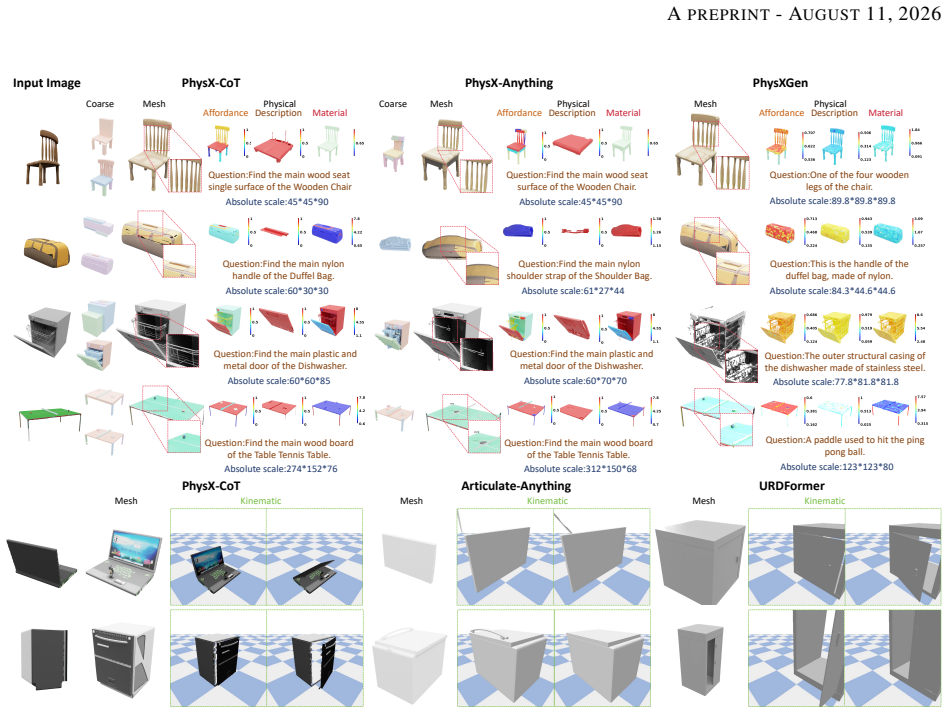
The central discovery is that supervised ordering of physical states and position-factorized geometry compound. PhysX-CoT represents the VLM output as a structured physical chain-of-thought $S=(K, C, \{s_k\})$, where each $s_k$ bundles a 2D box, an axis-aligned 3D box, inter-part relations, a coarse-geometry prior, and surface cues, together with an object-level description $P$ of scale, material, affordance, and kinematics. Geometry is factorized so that a 3D box carries placement and a local run-length-encoded code carries shape, cutting geometry tokens by roughly 58%; a CoT-aligned GRPO stage then scores candidates with process rewards for parse validity, grounding, local geometry, placement, and physical consistency. Under a unified protocol that retrains all learned baselines on the same backbone, data, and frozen decoder, the full model reaches Chamfer distance 0.041, F-score 0.480, absolute-scale error 6.57%, a kinematic score of 0.73, and 94.1% parse validity in Unreal Engine 5, outperforming the closest full-task baseline. Oracle, perturbation, and state-order controls indicate the ordered chain itself is functional: oracle states raise the kinematic score to 0.92, shuffling states drops 3D IoU to 0.542, and a never-rewarded pre-decoding CoT score correlates with asset quality at Spearman $\rho=0.455$.
Load-bearing premise
The load-bearing premise is that the automatic PhysXNet part annotations — part labels, projected and voxel boxes, and joint relations — used to build the supervised states and the reward targets are correct and complete enough to count as ground truth for physical reasoning; if those labels are noisy, the state supervision is partly training the model to reproduce that noise.
Editorial extensions
If this is right
- Correctly ordered, separately supervised intermediate states can replace implicit reasoning in image-to-asset pipelines; in the paper's ablation, prompt-only chain-of-thought barely changes results, while supervised states do.
- The where-shape factorization transfers to any part-based generation: compact local codes consume roughly 58% fewer geometry tokens and make inference about 30% faster, so more budget can be spent on more parts or higher resolution.
- Process-level rewards tied to parse validity, grounding, geometry, placement, and physical consistency generalize to other structured generation tasks with verifiable intermediate outputs.
- Assets generated this way are usable in real simulators: in the paper's Unreal Engine 5 benchmark, the full model reaches 94.1% parse validity, 96.8% collision validity, and 92.0% joint validity, so robot policy rollouts can start from image-described assets.
Reading between the lines
- Our inference, not a paper claim: if the active ingredient is verifiable state-level supervision, other generation domains with strong intermediate structure — scene graphs to layouts, code to physical simulations, CAD from sketches — should show similar gains from rewarding their intermediate state rather than only the final output.
- Our inference, not a paper claim: because both supervision and rewards come from PhysXNet's automatic part annotations, a human-agreement study on those labels would directly test how much of the gain is genuine structure versus learning label noise; retraining with human-verified states on a subset would settle it.
- Our inference, not a paper claim: the state-order degradation (shuffling and reversing the chain lowers quality) suggests the autoregressive ordering itself is an inductive bias; learning the optimal state order per object, rather than fixing one schema, is a testable next step.
- Our inference, not a paper claim: oracle 3D boxes cut scale error to 4.12%, so an end-to-end refinement that couples predicted boxes with the decoder's coarse voxels might close the remaining gap without a new architecture.
Signed reviews
Editorial analysis
A structured set of objections, weighed in public.
Referee Report
Summary. The paper proposes PhysX-CoT, a vision-language-model-based system that recasts single-image generation of simulation-ready 3D assets as an explicit, ordered, machine-parseable chain of part-level physical states (decomposition, 2D/3D grounding, relations, coarse geometry, surface cues), together with object-level physical attributes. The method factorizes geometry so that a 3D box carries placement and a local-frame RLE code carries shape, and it trains the VLM with supervised fine-tuning followed by CoT-aligned GRPO that rewards parse validity, grounding, geometry, placement, and physical consistency. The decoder is frozen and inherited from PhysX-Anything. Under a unified protocol that retrains all learned baselines on the same backbone, data, and decoder, the paper reports that PhysX-CoT improves over the closest full-task baseline on geometry (CD 0.041, F-score 0.480), scale error (6.57%), and physical-attribute metrics, with oracle, perturbation, state-order, and reward-term ablations supporting the claim that the ordered states are functionally used, and with Unreal Engine 5 execution showing high parse/collision/joint validity.
Significance. If correct, the result is significant because it provides a concrete, verifiable intermediate representation for image-to-asset generation, and it demonstrates that process-level supervision and reward over structured physical states can improve final assets. The paper is also carefully controlled: all learned baselines are retrained under a unified protocol; prompt-only CoT is separated from supervised CoT; oracle and perturbation interventions are used; state-order and token-matched variants are tested; and reward terms are ablated one at a time. These checks make the central claim internally consistent and falsifiable. The main risks are the reliance on automatic PhysXNet annotations as ground truth and the absence of the appendix, both of which affect the ability to audit the claim that the states are functional rather than cosmetic.
major comments (3)
- [Section 3.2 and Section 4.4] The ground-truth CoT states are derived from PhysXNet automatic part annotations, projection/voxel boxes, and joint relations, with no human-agreement or error analysis reported. These same annotations serve as SFT targets (Eq. 5), reward targets (Eq. 7), oracle states (Section 4.4), and the evaluation ground truth in Table 4. If these labels contain systematic errors, the model is trained and rewarded to reproduce those errors, and oracle gains could reflect matching the annotation pipeline rather than physical correctness. The paper should provide annotation-quality evidence, such as human agreement on a subset or per-field error rates, and show that UE5 validity is not simply a consequence of satisfying the auto labels. This is load-bearing for the claim that the ordered states are functional.
- [Section 3.4 and Table 4] The supervision, reward, and state-accuracy evaluation share the same coordinate definitions and label source; the paper states in Section 3.4 that 'supervision and rewards share one coordinate definition.' Table 4 therefore measures agreement with the training labels, not with physical truth. The oracle and perturbation controls are useful, but they also use those labels as the oracle. The authors should explicitly acknowledge this non-independence and add at least one evaluation against an independent label source, for example a human-annotated subset for part boxes and joint axes, or a label-noise robustness analysis.
- [Sections 3.2, 3.3, 3.4, and 4.1] The manuscript repeatedly defers crucial details to an appendix that is not provided: full field definitions of the CoT schema, the exact local index map and parser validity rules, the reward formulas, the UE5 protocol, and the annotation procedure for open-ended fields. Without this material, the central claim cannot be fully audited. The authors must include the appendix or otherwise make these details available for review; as submitted, the paper is not self-contained.
minor comments (4)
- [Section 4.1] The Kinematic metric is VLM-judged with Cohen's kappa=0.79 on a human-annotated subset; the paper should state whether this kappa is considered sufficient and whether the same human subset is used for the reported kinematic scores.
- [Section 4.4] The pre-decoding CoT linkage correlation (Spearman rho=0.455) is reported without confidence intervals or significance testing; please add them.
- [Section 4.3 and Table 3] The parse-validity numbers in Table 3 (96.4%) and the UE5 parse validity (94.1%) appear to come from different protocols; please clarify the relationship and avoid potential confusion.
- [General] The running header 'APREPRINT- AUGUST11, 2026' appears malformed, and there are minor formatting inconsistencies in the reference list; please proofread the manuscript.
Circularity Check
No significant circularity: the CoT states are trained, conditioned, and evaluated on held-out PhysXNet annotations, with oracle/perturbation and UE5 checks providing independent evidence.
full rationale
PhysX-CoT's derivation chain is self-contained rather than circular. The structured CoT states are defined by the PhysXNet-derived schema (Eq. 3), supervised from part annotations, projection/voxel boxes, and joint relations, used to condition local geometry, and rewarded through GRPO; all rewards use training-split annotations only, and evaluation is on unseen object IDs, so state-accuracy metrics in Table 4 are standard held-out supervised evaluation rather than a fit renamed as prediction. The oracle and perturbation controls in Section 4.4 intervene on the states themselves and show downstream asset quality changes, which tests the causal role of the representation; the pre-decoding CoT score is explicitly not used as a reward or final metric, and the UE5 benchmark provides an external physical-validity check. The paper reuses PhysXNet and PhysX-Anything as prior external work, not as self-citations, and the authors of the cited prior work do not overlap with the present authors. The reliance on PhysXNet auto-labels for supervision is a data-quality assumption, not a construction that equates a prediction to its input; no equation in the paper reduces the claimed result to a fitted parameter or to a self-citation chain.
Assumptions & free parameters
free parameters (5)
- GRPO hyperparameters beta and epsilon =
beta=0.02, epsilon=0.2
- Number of GRPO candidates N =
4
- Reward weights lambda_m =
not disclosed
- Surface F-score tau =
0.01 on normalized mesh
- CD sample count and normalization =
10,000 points, object-scale-normalized, no ICP
assumptions (3)
- domain assumption Part annotations, projection/voxel boxes, and joint relations from PhysXNet are correct and complete enough to supervise the structured CoT states.
- domain assumption The frozen decoder plus coarse voxel representation is an adequate target representation and the chosen proxy for 'simulation-ready'.
- standard math The ELO SFT objective is sufficient for structured-state learning.
invented entities (2)
-
Structured Physical CoT schema S=(K,C,{s_k}) with states B2D, B3D, R, H, M
independent evidence
-
Position-factorized local RLE geometry with local index space
Cite this review
Pith. "Pith review of PhysX-CoT: Structured Physical Reasoning from a Single Image to Simulation-Ready 3D Assets." pith.science (2026). https://pith.science/paper/OYH2SK6P
@misc{pith2026260808053,
  author       = {Pith},
  title        = {Pith review of: PhysX-CoT: Structured Physical Reasoning from a Single Image to Simulation-Ready 3D Assets},
  year         = {2026},
  howpublished = {\url{https://pith.science/paper/OYH2SK6P}},
  note         = {Machine review of arXiv:2608.08053}
}
read the original abstract
Simulation-ready 3D assets are central to robotics and embodied AI. Generating them from a single image is usually framed as a vision-language model that emits a serialized asset for a decoder to turn into geometry and physical fields, leaving the image-to-3D reasoning implicit. We argue the limiting factor is this output-centric view: part placement and local shape are entangled in one global-coordinate token stream, and the intermediate physical states are never exposed for supervision, conditioning, or verification. PhysX-CoT instead casts single-image asset generation as an explicit structured physical reasoning process, an ordered and machine-parseable trajectory of part-level states covering decomposition, 2D and 3D grounding, relations, coarse geometry, and surface cues that we separately supervise, use to condition geometry, and treat as reward targets. Geometry is factorized so that 3D boxes carry placement and local codes carry shape, and CoT-aligned GRPO optimizes parse validity, grounding, geometry, placement, and physical consistency. Under a unified protocol that retrains all learned baselines on the same backbone, data, and frozen decoder, PhysX-CoT outperforms the closest full-task baseline across geometry, scale, and physical-attribute metrics. Oracle, token-matched, and state-order controls show the explicit states are functional rather than cosmetic, and in Unreal Engine~5 the generated assets parse, collide, and articulate at high validity.
Figures


Figures from the paper (2 more)


Reference graph
Works this paper leans on
-
[1]
PhysX-3D: Physical-grounded 3d asset generation
Ziang Cao, Zhaoxi Chen, Liang Pan, and Ziwei Liu. PhysX-3D: Physical-grounded 3d asset generation. In Advances in Neural Information Processing Systems (NeurIPS), volume 38, 2025
work page 2025
-
[2]
PhysX-Anything: Simulation-ready physical 3d assets from single image
Ziang Cao, Fangzhou Hong, Zhaoxi Chen, Liang Pan, and Ziwei Liu. PhysX-Anything: Simulation-ready physical 3d assets from single image. InProceedings of the IEEE/CVF Conference on Computer Vision and Pattern Recognition (CVPR), June 2026
work page 2026
-
[3]
Ziang Cao, Yinghao Liu, Haitian Li, Runmao Yao, Fangzhou Hong, Zhaoxi Chen, Liang Pan, and Ziwei Liu. PhysX-Omni: Unified simulation-ready physical 3D generation for rigid, deformable, and articulated objects. arXiv preprint arXiv:2605.21572, 2026. 9 APREPRINT- AUGUST11, 2026
arXiv 2026
-
[4]
Boyuan Chen, Zhuo Xu, Sean Kirmani, Brian Ichter, Danny Driess, Pete Florence, Dorsa Sadigh, Leonidas Guibas, and Fei Xia. SpatialVLM: Endowing vision-language models with spatial reasoning capabilities.arXiv preprint arXiv:2401.12168, 2024
arXiv 2024
-
[5]
PointLLM-R: Enhancing 3D Point Cloud Reasoning via Chain-of-Thought
Chaoqi Chen, Qile Xu, Wenjun Zhou, and Hui Huang. PointLLM-R: Enhancing 3d point cloud reasoning via chain-of-thought.arXiv preprint arXiv:2605.22013, 2026
work page Pith review arXiv 2026
-
[6]
Minghao Chen, Roman Shapovalov, Iro Laina, Tom Monnier, Jianyuan Wang, David Novotny, and Andrea Vedaldi. PartGen: Part-level 3D generation and reconstruction with multi-view diffusion models.arXiv preprint arXiv:2412.18608, 2024
arXiv 2024
-
[7]
MeshXL: Neural coordinate field for generative 3d foundation models
Sijin Chen, Xin Chen, Anqi Pang, Xianfang Zeng, Wei Cheng, Yijun Fu, Fukun Yin, Yanru Wang, Zhibin Wang, Chi Zhang, Jingyi Yu, Gang Yu, Bin Fu, and Tao Chen. MeshXL: Neural coordinate field for generative 3d foundation models. InAdvances in Neural Information Processing Systems (NeurIPS), 2024
work page 2024
-
[8]
Yiwen Chen, Tong He, Di Huang, Weicai Ye, Sijin Chen, Jiaxiang Tang, Xin Chen, Zhongang Cai, Lei Yang, Gang Yu, Guosheng Lin, and Chi Zhang. Meshanything: Artist-created mesh generation with autoregressive transformers.arXiv preprint arXiv:2406.10163, 2024
arXiv 2024
Show all 53 references
-
[9]
URDFormer: A pipeline for constructing articulated simulation environments from real-world images.arXiv preprint arXiv:2405.11656, 2024
Zoey Chen, Aaron Walsman, Marius Memmel, Kaichun Mo, Alex Fang, Karthikeya Vemuri, Alan Wu, Dieter Fox, and Abhishek Gupta. URDFormer: A pipeline for constructing articulated simulation environments from real-world images.arXiv preprint arXiv:2405.11656, 2024
2024 arXiv
-
[10]
SpatialRGPT: Grounded spatial reasoning in vision language models
An-Chieh Cheng, Hongxu Yin, Yang Fu, Qiushan Guo, Ruihan Yang, Jan Kautz, Xiaolong Wang, and Sifei Liu. SpatialRGPT: Grounded spatial reasoning in vision language models. InAdvances in Neural Information Processing Systems (NeurIPS), 2024
2024
-
[11]
MeshLLM: Empowering large language models to progressively understand and generate 3d mesh
Shuangkang Fang, I-Chao Shen, Yufeng Wang, Yi-Hsuan Tsai, Yi Yang, Shuchang Zhou, Wenrui Ding, Takeo Igarashi, and Ming-Hsuan Yang. MeshLLM: Empowering large language models to progressively understand and generate 3d mesh. InProceedings of the IEEE/CVF International Conferenc...
2025
-
[12]
Seed3D 1.0: From images to high-fidelity simulation-ready 3d assets.arXiv preprint arXiv:2510.19944, 2025
Jiashi Feng, Xiu Li, Jing Lin, et al. Seed3D 1.0: From images to high-fidelity simulation-ready 3d assets.arXiv preprint arXiv:2510.19944, 2025
2025
-
[13]
LayoutGPT: Compositional visual planning and generation with large language models
Weixi Feng, Wanrong Zhu, Tsu-jui Fu, Varun Jampani, Arjun Akula, Xuehai He, Sugato Basu, Xin Eric Wang, and William Yang Wang. LayoutGPT: Compositional visual planning and generation with large language models. InAdvances in Neural Information Processing Systems (NeurIPS), 2023
2023
-
[14]
GET3D: A generative model of high quality 3d textured shapes learned from images
Jun Gao, Tianchang Shen, Zian Wang, Wenzheng Chen, Kangxue Yin, Daiqing Li, Or Litany, Zan Gojcic, and Sanja Fidler. GET3D: A generative model of high quality 3d textured shapes learned from images. InAdvances in Neural Information Processing Systems (NeurIPS), 2022
2022
-
[15]
Tenenbaum, Kaiming He, and Wojciech Matusik
Minghao Guo, Bohan Wang, Pingchuan Ma, Tianyuan Zhang, Crystal Elaine Owens, Chuang Gan, Joshua B. Tenenbaum, Kaiming He, and Wojciech Matusik. Physically compatible 3d object modeling from a single image. arXiv preprint arXiv:2405.20510, 2024
2024 arXiv
-
[16]
LRM: Large reconstruction model for single image to 3d
Yicong Hong, Kai Zhang, Jiuxiang Gu, Sai Bi, Yang Zhou, Difan Liu, Feng Liu, Kalyan Sunkavalli, Trung Bui, and Hao Tan. LRM: Large reconstruction model for single image to 3d. InInternational Conference on Learning Representations (ICLR), 2024
2024
-
[17]
3d-llm: Injecting the 3d world into large language models.arXiv preprint arXiv:2307.12981, 2023
Yining Hong, Haoyu Zhen, Peihao Chen, Shuhong Zheng, Yilun Du, Zhenfang Chen, and Chuang Gan. 3d-llm: Injecting the 3d world into large language models.arXiv preprint arXiv:2307.12981, 2023
2023 arXiv
-
[18]
AniGen: Unified s3 fields for animatable 3D asset generation.arXiv preprint arXiv:2604.08746, 2026
Yi-Hua Huang, Zi-Xin Zou, Yuting He, Chirui Chang, Cheng-Feng Pu, Ziyi Yang, Yuan-Chen Guo, Yan-Pei Cao, and Xiaojuan Qi. AniGen: Unified s3 fields for animatable 3D asset generation.arXiv preprint arXiv:2604.08746, 2026
2026 arXiv
-
[19]
3d gaussian splatting for real-time radiance field rendering.ACM Transactions on Graphics, 42(4), 2023
Bernhard Kerbl, Georgios Kopanas, Thomas Leimkühler, and George Drettakis. 3d gaussian splatting for real-time radiance field rendering.ACM Transactions on Graphics, 42(4), 2023
2023
-
[20]
Articulate-anything: Automatic modeling of articulated objects via a vision- language foundation model.arXiv preprint arXiv:2410.13882, 2024
Long Le, Jason Xie, William Liang, Hung-Ju Wang, Yue Yang, Yecheng Jason Ma, Kyle Vedder, Arjun Krishna, Dinesh Jayaraman, and Eric Eaton. Articulate-anything: Automatic modeling of articulated objects via a vision- language foundation model.arXiv preprint arXiv:2410.13882, 2024
-
[21]
PARTICULATE: Feed-forward 3d object articulation.arXiv preprint arXiv:2512.11798, 2025
Ruining Li, Yuxin Yao, Chuanxia Zheng, Christian Rupprecht, Joan Lasenby, Shangzhe Wu, and Andrea Vedaldi. PARTICULATE: Feed-forward 3d object articulation.arXiv preprint arXiv:2512.11798, 2025
2025
-
[22]
URDF- Anything: Constructing articulated objects with 3d multimodal language model.arXiv preprint arXiv:2511.00940, 2025
Zhe Li, Xiang Bai, Jieyu Zhang, Zhuangzhe Wu, Che Xu, Ying Li, Chengkai Hou, and Shanghang Zhang. URDF- Anything: Constructing articulated objects with 3d multimodal language model.arXiv preprint arXiv:2511.00940, 2025. 10 APREPRINT- AUGUST11, 2026
2025
-
[23]
Let’s verify step by step.arXiv preprint arXiv:2305.20050, 2023
Hunter Lightman, Vineet Kosaraju, Yura Burda, Harri Edwards, Bowen Baker, Teddy Lee, Jan Leike, John Schulman, Ilya Sutskever, and Karl Cobbe. Let’s verify step by step.arXiv preprint arXiv:2305.20050, 2023
2023 arXiv
-
[24]
Magic3D: High-resolution text-to-3d content creation
Chen-Hsuan Lin, Jun Gao, Luming Tang, Towaki Takikawa, Xiaohui Zeng, Xun Huang, Karsten Kreis, Sanja Fidler, Ming-Yu Liu, and Tsung-Yi Lin. Magic3D: High-resolution text-to-3d content creation. InIEEE/CVF Conference on Computer Vision and Pattern Recognition (CVPR), 2023
2023
-
[25]
Chang, Manolis Savva, and Ali Mahdavi-Amiri
Jiayi Liu, Denys Iliash, Angel X. Chang, Manolis Savva, and Ali Mahdavi-Amiri. SINGAPO: Single image controlled generation of articulated parts in objects.arXiv preprint arXiv:2410.16499, 2024
2024 arXiv
-
[26]
One-2-3-45: Any single image to 3d mesh in 45 seconds without per-shape optimization.arXiv preprint arXiv:2306.16928, 2023
Minghua Liu, Chao Xu, Haian Jin, Linghao Chen, Mukund Varma T, Zexiang Xu, and Hao Su. One-2-3-45: Any single image to 3d mesh in 45 seconds without per-shape optimization.arXiv preprint arXiv:2306.16928, 2023
2023 arXiv
-
[27]
Zero-1-to-3: Zero-shot one image to 3d object
Ruoshi Liu, Rundi Wu, Basile Van Hoorick, Pavel Tokmakov, Sergey Zakharov, and Carl V ondrick. Zero-1-to-3: Zero-shot one image to 3d object. InIEEE/CVF International Conference on Computer Vision (ICCV), 2023
2023
-
[28]
Wonder3d: Single image to 3d using cross-domain diffusion
Xiaoxiao Long, Yuan-Chen Guo, Cheng Lin, Yuan Liu, Zhiyang Dou, Lingjie Liu, Yuexin Ma, Song-Hai Zhang, Marc Habermann, Christian Theobalt, and Wenping Wang. Wonder3d: Single image to 3d using cross-domain diffusion. InIEEE/CVF Conference on Computer Vision and Pattern Recogni...
2024
-
[29]
REST3D: Reconstructing physically stable 3d scenes from a single image.arXiv preprint arXiv:2605.30338, 2026
Xiaoxuan Ma, Jiashun Wang, Nicolás Ugrinovic, Yehonathan Litman, and Kris Kitani. REST3D: Reconstructing physically stable 3d scenes from a single image.arXiv preprint arXiv:2605.30338, 2026
2026 arXiv
-
[30]
Occupancy networks: Learning 3d reconstruction in function space
Lars Mescheder, Michael Oechsle, Michael Niemeyer, Sebastian Nowozin, and Andreas Geiger. Occupancy networks: Learning 3d reconstruction in function space. InIEEE/CVF Conference on Computer Vision and Pattern Recognition (CVPR), 2019
2019
-
[31]
Srinivasan, Matthew Tancik, Jonathan T
Ben Mildenhall, Pratul P. Srinivasan, Matthew Tancik, Jonathan T. Barron, Ravi Ramamoorthi, and Ren Ng. NeRF: Representing scenes as neural radiance fields for view synthesis. InEuropean Conference on Computer Vision (ECCV), 2020
2020
-
[32]
Barron, and Ben Mildenhall
Ben Poole, Ajay Jain, Jonathan T. Barron, and Ben Mildenhall. Dreamfusion: Text-to-3d using 2d diffusion. In International Conference on Learning Representations (ICLR), 2023
2023
-
[33]
GPT4Point: A unified framework for point-language understanding and generation
Zhangyang Qi, Ye Fang, Zeyi Sun, Xiaoyang Wu, Tong Wu, Jiaqi Wang, Dahua Lin, and Hengshuang Zhao. GPT4Point: A unified framework for point-language understanding and generation. InIEEE/CVF Conference on Computer Vision and Pattern Recognition (CVPR), 2024
2024
-
[34]
Zhihong Shao, Peiyi Wang, Qihao Zhu, Runxin Xu, Junxiao Song, Xiao Bi, Haowei Zhang, Mingchuan Zhang, Y . K. Li, Y . Wu, and Daya Guo. DeepSeekMath: Pushing the limits of mathematical reasoning in open language models.arXiv preprint arXiv:2402.03300, 2024
2024 arXiv
-
[35]
MVDream: Multi-view diffusion for 3d generation
Yichun Shi, Peng Wang, Jianglong Ye, Mai Long, Kejie Li, and Xiao Yang. MVDream: Multi-view diffusion for 3d generation. InInternational Conference on Learning Representations (ICLR), 2024
2024
-
[36]
MeshGPT: Generating triangle meshes with decoder-only transformers
Yawar Siddiqui, Antonio Alliegro, Alexey Artemov, Tatiana Tommasi, Daniele Sirigatti, Vladislav Rosov, Angela Dai, and Matthias Nießner. MeshGPT: Generating triangle meshes with decoder-only transformers. InIEEE/CVF Conference on Computer Vision and Pattern Recognition (CVPR), 2024
2024
-
[37]
ViperGPT: Visual inference via python execution for reasoning
Dídac Surís, Sachit Menon, and Carl V ondrick. ViperGPT: Visual inference via python execution for reasoning. InIEEE/CVF International Conference on Computer Vision (ICCV), 2023
2023
-
[38]
LGM: Large multi-view gaussian model for high-resolution 3d content creation
Jiaxiang Tang, Zhaoxi Chen, Xiaokang Chen, Tengfei Wang, Gang Zeng, and Ziwei Liu. LGM: Large multi-view gaussian model for high-resolution 3d content creation. InEuropean Conference on Computer Vision (ECCV), 2024
2024
-
[39]
EmbodiedGen: Towards a generative 3D world engine for embodied intelligence.arXiv preprint arXiv:2506.10600, 2025
Xinjie Wang, Liu Liu, Yu Cao, Ruiqi Wu, Wenkang Qin, Dehui Wang, Wei Sui, and Zhizhong Su. EmbodiedGen: Towards a generative 3D world engine for embodied intelligence.arXiv preprint arXiv:2506.10600, 2025
2025 arXiv
-
[40]
SimuScene: Training and benchmarking code generation to simulate physical scenarios.arXiv preprint arXiv:2602.10840, 2026
Yanan Wang, Renxi Wang, Yongxin Wang, Xuezhi Liang, Fajri Koto, Timothy Baldwin, Xiaodan Liang, and Haonan Li. SimuScene: Training and benchmarking code generation to simulate physical scenarios.arXiv preprint arXiv:2602.10840, 2026
2026
-
[41]
LLaMA-Mesh: Unifying 3d mesh generation with language models.arXiv preprint arXiv:2411.09595, 2024
Zhengyi Wang, Jonathan Lorraine, Yikai Wang, Hang Su, Jun Zhu, Sanja Fidler, and Xiaohui Zeng. LLaMA-Mesh: Unifying 3d mesh generation with language models.arXiv preprint arXiv:2411.09595, 2024
2024 arXiv
-
[42]
Prolificdreamer: High- fidelity and diverse text-to-3d generation with variational score distillation
Zhengyi Wang, Cheng Lu, Yikai Wang, Fan Bao, Chongxuan Li, Hang Su, and Jun Zhu. Prolificdreamer: High- fidelity and diverse text-to-3d generation with variational score distillation. InAdvances in Neural Information Processing Systems (NeurIPS), 2023
2023
-
[43]
Le, and Denny Zhou
Jason Wei, Xuezhi Wang, Dale Schuurmans, Maarten Bosma, Brian Ichter, Fei Xia, Ed Chi, Quoc V . Le, and Denny Zhou. Chain-of-thought prompting elicits reasoning in large language models. InAdvances in Neural Information Processing Systems (NeurIPS), 2022. 11 APREPRINT- AUGUST11, 2026
2022
-
[44]
Freeman, and Joshua B
Jiajun Wu, Chengkai Zhang, Tianfan Xue, William T. Freeman, and Joshua B. Tenenbaum. Learning a probabilistic latent space of object shapes via 3d generative-adversarial modeling. InAdvances in Neural Information Processing Systems, 2016
2016
-
[45]
Chang, Leonidas J
Fanbo Xiang, Yuzhe Qin, Kaichun Mo, Yikuan Xia, Hao Zhu, Fangchen Liu, Minghua Liu, Hanxiao Jiang, Yifu Yuan, He Wang, Li Yi, Angel X. Chang, Leonidas J. Guibas, and Hao Su. SAPIEN: A simulated part-based interactive environment. InIEEE/CVF Conference on Computer Vision and Pa...
2020
-
[46]
Structured 3d latents for scalable and versatile 3d generation.arXiv preprint arXiv:2412.01506, 2024
Jianfeng Xiang, Zelong Lv, Sicheng Xu, Yu Deng, Ruicheng Wang, Bowen Zhang, Dong Chen, Xin Tong, and Jiaolong Yang. Structured 3d latents for scalable and versatile 3d generation.arXiv preprint arXiv:2412.01506, 2024
2024 arXiv
-
[47]
Instantmesh: Effi- cient 3d mesh generation from a single image with sparse-view large reconstruction models.arXiv preprint arXiv:2404.07191, 2024
Jiale Xu, Weihao Cheng, Yiming Gao, Xintao Wang, Shenghua Gao, and Ying Shan. Instantmesh: Effi- cient 3d mesh generation from a single image with sparse-view large reconstruction models.arXiv preprint arXiv:2404.07191, 2024
2024 arXiv
-
[48]
PointLLM: Empowering large language models to understand point clouds
Runsen Xu, Xiaolong Wang, Tai Wang, Yilun Chen, Jiangmiao Pang, and Dahua Lin. PointLLM: Empowering large language models to understand point clouds. InEuropean Conference on Computer Vision (ECCV), 2024
2024
-
[49]
PhyCAGE: Physically plausible compositional 3d asset generation from a single image.arXiv preprint arXiv:2411.18548, 2024
Han Yan, Mingrui Zhang, Yang Li, Chao Ma, and Pan Ji. PhyCAGE: Physically plausible compositional 3d asset generation from a single image.arXiv preprint arXiv:2411.18548, 2024
2024 arXiv
-
[50]
PhysForge: Generating physics-grounded 3d assets for interactive virtual world
Yunhan Yang, Chunshi Wang, Junliang Ye, Yang Li, Zanxin Chen, Zehuan Huang, Yao Mu, Zhuo Chen, Chunchao Guo, and Xihui Liu. PhysForge: Generating physics-grounded 3d assets for interactive virtual world. In Proceedings of the International Conference on Machine Learning (ICML), 2026
2026
-
[51]
ShapeLLM-Omni: A native multimodal llm for 3d generation and understanding.arXiv preprint arXiv:2506.01853, 2025
Junliang Ye, Zhengyi Wang, Ruowen Zhao, Shenghao Xie, and Jun Zhu. ShapeLLM-Omni: A native multimodal llm for 3d generation and understanding.arXiv preprint arXiv:2506.01853, 2025
2025 arXiv
-
[52]
SIMART: Decomposing monolithic meshes into sim-ready articulated assets via MLLM.arXiv preprint arXiv:2603.23386, 2026
Chuanrui Zhang, Minghan Qin, Yuang Wang, Baifeng Xie, Hang Li, and Ziwei Wang. SIMART: Decomposing monolithic meshes into sim-ready articulated assets via MLLM.arXiv preprint arXiv:2603.23386, 2026
2026
-
[53]
Multimodal chain-of-thought reasoning in language models.arXiv preprint arXiv:2302.00923, 2023
Zhuosheng Zhang, Aston Zhang, Mu Li, Hai Zhao, George Karypis, and Alex Smola. Multimodal chain-of-thought reasoning in language models.arXiv preprint arXiv:2302.00923, 2023. 12
2023 arXiv
Reviewed August 12, 2026 · model on record in the stance chip above.
Discussion (0). Continue with ORCID to comment.