REVIEW 4 major objections 5 minor 54 references
EvBS: Event-guided Blur Synthesis for Domain-adaptive Motion Deblurring
T0 review · 4 major / 5 minor · reviewed 2026-08-12 · deepseek-v4-flash
Pith's one-line read By using events to decouple motion from visual content, EvBS synthesizes diverse blurry training pairs that push pre-trained deblurring models to perform better on unseen real-world domains.
desk verdict A genuinely novel event-based mechanism for transferring motion across patches, with consistent empirical gains, but the evaluation protocol blurs the line between adaptation and memorization because the same frames serve as both training and test data. read the letter →
The pith
A machine-rendered reading of the paper's core claim, the machinery that carries it, and where it could break.
The reading
What carries the argument
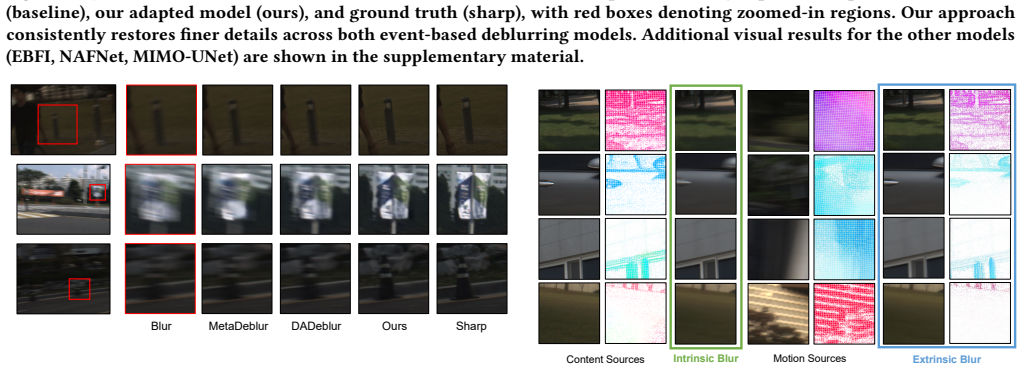
The central object is the event-guided blur-conditioning pipeline. A Dual Source Extractor (DSE) locates pseudo-sharp content patches (low event count and low predicted blur) and coherent-motion blur patches (high blur score with direction-consistent flow), using a blur score map that combines an event count map with a retrained blur magnitude estimator. A Blur Conditioning Module (BCM) then builds conditions through two generators: the Intrinsic-blur Condition Generator (InCG), which forms conditions from the content patch's own event-derived flows plus a Flow-Enhanced Deviation Accumulation (FEDA) representation, and the Extrinsic-blur Condition Generator (ExCG), which transfers motion by filtering on angular difference between content and motion orientation, then warping events via Algorithm 1. These conditions drive a conditional diffusion reblurring model (a modified ID-Blau) to synthesize blurred images, whose original sharp content serves as supervision for fine-tuning the deblurrer.
What would settle it
Construct a synthetic target domain with known ground-truth flow, for example scenes rendered with ESIM under scripted motion, and run EvBS's extrinsic transfer. If the flow of the synthesized blur does not match the intended motion source's flow beyond the orientation threshold, the decoupling claim fails. A simpler behavioral test is a scene with only uniform global camera motion, where every patch has the same flow and extrinsic transfer adds no diversity: if EvBS still improves over intrinsic-only fine-tuning there, the benefit must come from something other than motion diversity.
Extended reading notes
Core claim
EvBS establishes that events supply a motion-content decoupling that RGB frames cannot, and that this decoupling directly unlocks combinatorial blur synthesis. The central discovery is that you can take a pseudo-sharp content source and a separate motion source from the same target domain and, by warping the content source's events along an offset field computed from the motion source's global flow minus the content source's local flow, produce a training pair whose blur follows the transferred motion. The authors verify the transfer qualitatively by showing the synthesized flow follows the motion source rather than the content source, and quantitatively by ablating random offsets, which drop PSNR below the no-adaptation baseline. Consequently, fine-tuning on these synthetic pairs improves both event-based models (EFNet, MAENet, EBFI) and frame-only models (NAFNet, MIMO-UNet), with the largest gains around 2.6 dB PSNR on the HighREV benchmarks.
Load-bearing premise
The whole pipeline assumes that the detected content sources are genuinely sharp enough to serve as clean supervision and that the event stream is precisely aligned with those frames; the paper itself notes that residual blur in selected patches adds label noise (Sec 4.3) and that sensor misalignment degrades performance (Supplementary Sec E).
Editorial extensions
If this is right
- Fine-tuning with EvBS pairs improves five pre-trained deblurring models on EVRB, REVD, and HighREV variants, with average PSNR gains of roughly 2.2 to 2.6 dB while also improving SSIM and LPIPS.
- Extrinsic blur synthesis alone contributes about as much as intrinsic synthesis (28.14 vs 28.03 dB on REVD with MAENet), and combining both gives the best result (28.64 dB), showing that motion diversity is the driver of adaptation.
- The method transfers to frame-only architectures even though it is designed around events, making it a general adaptation add-on rather than an event-specific one.
- The FEDA representation beats both flow-only and plain deviation accumulation for blur synthesis quality and for downstream adaptation performance.
- Random motion offsets during transfer drop PSNR below the no-adaptation baseline (24.58 vs 25.41 dB), confirming that motion-aware transfer, not arbitrary augmentation, is what helps.
Reading between the lines
- A natural extension is that the same motion-content decoupling could serve domain adaptation for other motion-sensitive tasks, such as event-based optical flow or detection under motion blur, because it supplies dense flow and dynamics supervision without ground truth.
- The orientation filter range of 15 to 30 degrees suggests a sweet spot between redundancy and realism; on data with mostly unidirectional camera motion the extrinsic pathway may add little diversity, so gains should be larger on scenes with mixed object and ego motion, which is testable by splitting target datasets by motion direction.
- Because the pipeline relies on a patch being pseudo-sharp, it inherits a ceiling: if a target scene has no truly still regions, supervision quality drops; an adaptive threshold or multi-frame sharp fusion could push this ceiling higher.
- The reported offline cost (ExCG at 428.8 seconds versus InCG at 61.5 seconds on EVRB) implies an InCG-only lightweight variant is practical, and a deployment could gate ExCG on whether the scene shows diverse motion directions.
Signed reviews
Editorial analysis
A structured set of objections, weighed in public.
Referee Report
Summary. The paper proposes EvBS, an event-guided blur synthesis framework for domain-adaptive motion deblurring. Given test-domain frames and event streams, a Dual Source Extractor identifies pseudo-sharp content patches and motion-consistent blur patches. A Blur Conditioning Module constructs intrinsic-blur conditions (using the content patch's own event-derived motion) and extrinsic-blur conditions (warping a separate motion source's flow onto the content patch via Algorithm 1), which guide a modified diffusion-based blurring model (ID-Blau) to synthesize blurry/sharp training pairs. Pre-trained event-based and frame-based deblurring models are then fine-tuned on these pairs with the content patches as supervision. The authors report consistent PSNR/SSIM/LPIPS gains across EVRB, REVD, HighREV-3/7/11 for five backbones, and compare favorably to prior domain-adaptive deblurring methods.
Significance. The core idea of using events to explicitly decouple motion from visual content for blur synthesis is novel and addresses a real limitation of RGB-based synthesis methods, which can only re-apply a motion pattern to its original patch. If the evaluation protocol is sound, the method would be a useful contribution to domain-adaptive deblurring, with the additional advantage of natively supporting event-based deblurring models. The paper is well-structured, includes ablations of the main components (Table 3, Fig. 9), a computational cost analysis (Table S1), and an honest limitations section (Supplementary Sec E). However, the evaluation protocol as described does not separate the frames used for adaptation from those used for evaluation, which directly threatens the central claim of improving performance on 'unseen' target domains; hyperparameters are also tuned on REVD, one of the benchmark datasets.
major comments (4)
- [Section 4.2 / Fig. 2] The adaptation procedure uses the target-domain test data itself to build the training set: the Dual Source Extractor draws content and motion sources from the test frames, the blurring model synthesizes pairs from those exact patches, and the pre-trained model is fine-tuned on those pairs and then evaluated on the same datasets (Tables 1 and 2). No scene-level or frame-level split between adaptation and evaluation data is described. The reported gains could therefore reflect transductive overfitting to the evaluation frames rather than generalization to unseen target-domain data. Please adapt on a disjoint subset (e.g., a training split of each target dataset) and evaluate on a held-out split, and report both transductive and disjoint results to quantify this effect.
- [Section 4.3 / Fig. 9] Key hyperparameters (patch ratio r, extrinsic pair count n, orientation thresholds) are ablated on REVD, and REVD is also included in the main results in Tables 1 and 2. Tuning hyperparameters on a benchmark and then reporting that same benchmark as a result introduces optimistic bias and does not establish that the chosen values generalize to other datasets. Please fix hyperparameters using a separate validation set (e.g., a held-out split of REVD or a different dataset) and then evaluate on all benchmarks, or report the sensitivity of the main results to these choices across datasets.
- [Tables 1 and 2] All quantitative results are reported as single runs without standard deviations or significance tests. Given that fine-tuning is stochastic and that source selection and extrinsic-pair selection involve sampling-like procedures, the consistency of the claimed gains cannot be assessed. Please report mean and standard deviation over at least three random seeds, and where feasible a paired significance test for the main comparisons (baseline vs. w/ Ours, and Ours vs. DADeblur).
- [Supplementary Sec E / Section 4.3] The paper acknowledges that residual blur in selected content patches introduces label noise and that event–image misalignment degrades performance, but these risks are not quantified. Because every synthesized pair inherits the quality of the pseudo-sharp content source, please add an analysis showing how the final deblurring performance varies with the level of residual blur in content sources (e.g., by varying r beyond the single ablation in Fig. 9a) and include a sensitivity study under simulated event–image misalignment.
minor comments (5)
- [Section 4.2] The reference to 'Fig. ??' in the qualitative-results paragraph is unresolved; it should point to Fig. 7.
- [Section 4.2] The caption 'Qualtitative Results' is a typo; it should read 'Qualitative Results'.
- [Table 3] The 'Random' row is not described in the text; please state how the random offset field T^k was sampled (distribution, scale) and whether the reported 24.58 dB is an average over multiple random draws.
- [Section 3.2, Eq. (5)] The average orientation vector in Eq. (5) is computed by averaging the per-pixel horizontal and vertical components without magnitude weighting, while Eq. (6) uses a magnitude-weighted mean for the global motion vector; please clarify this distinction in the text, as it may affect the orientation-similarity check used in ExCG.
- [Section 4.2] The phrase 'average gains of 2.24 dB on EVRB, 2.35 dB on REVD' is ambiguous; please specify whether the average is over all five backbones and clarify in the text.
Circularity Check
No derivation-level circularity; the only fitted-input issue is hyperparameter selection on REVD, which partially inflates that one benchmark.
-
fitted input called prediction
[Sec. 4.3 (Ablation Studies, Fig. 9) and Sec. 4.1 (Implementation Details), applied in Table 1 (REVD column).]
"We conduct ablation studies on the REVD [13] using MAENet [36]. ... Key hyperparameters (ablated in Sec. 4.3) include the source selection ratio r=0.15, the number of extrinsic pairs n=2, and orientation angle thresholds [τ_low, τ_high]=[15°, 30°]."
The REVD row in Table 1 is presented as an adaptation result on a benchmark, but the hyperparameters used to produce it (r, n, and [τ_low, τ_high]) were selected by maximizing PSNR on the same REVD set in Fig. 9. Therefore the MAENet 'w/ Ours' REVD value of 28.64 dB is not an independent prediction of generalization; it is partly a fitted optimum. This is a fitted-input-called-prediction pattern for that one benchmark. The other benchmarks (EVRB, HighREV-3/7/11) are not the tuning set, so the central method retains independent evidence; the issue is limited to the REVD column and to the claim that all reported gains are on 'unseen' test sets.
full rationale
The paper is an empirical synthesis pipeline rather than a formal derivation, so there is no equation that reduces to itself. The blur-conditioning model D_psi and the Blur Magnitude Estimator are trained on GoPro with synthetic events, not on the target test sets, and the evaluation benchmarks are external. There are no self-citations carrying a load-bearing argument, no imported uniqueness theorems, and no ansatz disguised as an external result. The main protocol-level concern is that fine-tuning and evaluation use the same target-domain frames: the Dual Source Extractor draws content and motion sources from the test frames, the synthesized pairs are used to fine-tune the pre-trained model, and Table 1 then reports results on those same datasets. This is a transductive-evaluation limitation that weakens the 'unseen testing datasets' generality claim, but it is inherent to test-time domain adaptation and is disclosed in the method description, so I do not count it as circularity by construction. The clearly identified fitting issue is the ablation-driven selection of r, n, and orientation thresholds on REVD followed by reporting REVD as one of the main benchmarks; this makes the REVD gains partially fitted rather than independent. The paper's own stated limitations (residual blur in selected patches adds label noise; sensor misalignment degrades performance) are acknowledged and do not hide a derivation-level circularity. Overall the central contribution remains independently testable on other benchmarks, so the circularity score is low.
Assumptions & free parameters
free parameters (10)
- Blur score weights α and β =
α=β=0.5
- Initial patch threshold τ =
0.05
- Source selection ratio r =
0.15
- Number of extrinsic pairs n =
2
- Orientation angle thresholds τ_low, τ_high =
15°, 30°
- MS Selector similarity threshold τ =
0.9
- Patch size and stride =
256x256, stride 64
- NMS IoU threshold =
0.3
- Fine-tuning epochs and learning rate =
10 epochs, 1e-5 to 1e-7 cosine
- FEDA linear magnitude weighting =
linear
assumptions (6)
- domain assumption Event-based image formation model
- domain assumption Pseudo-sharp patches from low blur score regions are valid sharp ground truth
- domain assumption Event-based optical flow from E-RAFT is accurate enough for flow aggregation and event warping
- domain assumption The diffusion reblurring model ID-Blau, retrained on GoPro, generalizes to target-domain blur synthesis
- domain assumption Event-image pairs are well aligned
- ad hoc to paper Motion transfer is valid only when average orientations differ within [τ_low, τ_high]
invented entities (2)
-
FEDA event representation
-
Motion transfer via event warping (Algorithm 1)
Cite this review
Pith. "Pith review of EvBS: Event-guided Blur Synthesis for Domain-adaptive Motion Deblurring." pith.science (2026). https://pith.science/paper/XIMYMYCJ
@misc{pith2026260808066,
  author       = {Pith},
  title        = {Pith review of: EvBS: Event-guided Blur Synthesis for Domain-adaptive Motion Deblurring},
  year         = {2026},
  howpublished = {\url{https://pith.science/paper/XIMYMYCJ}},
  note         = {Machine review of arXiv:2608.08066}
}
read the original abstract
Motion deblurring has achieved remarkable progress with deep learning, yet pre-trained deblurring models often suffer from performance degradation in real-world scenarios due to the domain shift between training and testing distributions. To remedy this, we propose EvBS, an event-guided blur synthesis framework that generates diverse training pairs for calibrating pre-trained models to the target domain. While existing methods are constrained by the inherent entanglement between motion and visual content, our method leverages the high temporal resolution of event cameras to effectively decouple them. This enables us to utilize not only the intrinsic motion that is inherent to the given content but also extrinsic motion transferred from different sources within the target domain, thereby facilitating effective adaptation via fine-tuning. Specifically, EvBS comprises two complementary strategies: Intrinsic-Blur Synthesis, which blurs sharp contents with their own motion patterns, and Extrinsic-Blur Synthesis, which transfers motion from blurry patches to distinct sharp content. This approach generates a diverse set of training pairs that break the inherent constraints of naturally coupled motion and content, resulting in enhanced domain-adaptive deblurring performance. Extensive experiments on multiple benchmarks demonstrate that EvBS effectively enhances the robustness of existing deblurring models on unseen testing datasets.
Figures


Figures from the paper (5 more)




Reference graph
Works this paper leans on
-
[1]
Liangyu Chen, Xiaojie Chu, Xiangyu Zhang, and Jian Sun. 2022. Simple baselines for image restoration. InEuropean conference on computer vision (ECCV). 17–33
work page 2022
-
[2]
Zheng Chen, Yulun Zhang, Ding Liu, Jinjin Gu, Linghe Kong, Xin Yuan, et al
-
[3]
Zhixiang Chi, Yang Wang, Yuanhao Yu, and Jin Tang. 2021. Test-time fast adap- tation for dynamic scene deblurring via meta-auxiliary learning. InProceedings of the IEEE/CVF conference on computer vision and pattern recognition (CVPR)
work page 2021
-
[4]
Sung-Jin Cho, Seo-Won Ji, Jun-Pyo Hong, Seung-Won Jung, and Sung-Jea Ko
-
[5]
Guillermo Gallego, Tobi Delbrück, Garrick Orchard, Chiara Bartolozzi, Brian Taba, Andrea Censi, Stefan Leutenegger, Andrew J Davison, Jörg Conradt, Kostas Daniilidis, et al. 2020. Event-based vision: A survey.IEEE Transactions on Pattern Analysis and Machine Intelligence (TPAMI)(2020)
work page 2020
-
[6]
Xin Gao, Tianheng Qiu, Xinyu Zhang, Hanlin Bai, Kang Liu, Xuan Huang, Hu Wei, Guoying Zhang, and Huaping Liu. 2024. Efficient multi-scale network with learnable discrete wavelet transform for blind motion deblurring. InProceedings of the IEEE/CVF Conference on Computer Vision and Pattern Recognition (CVPR)
work page 2024
-
[7]
Mathias Gehrig, Mario Millhäusler, Daniel Gehrig, and Davide Scaramuzza. 2021. E-raft: Dense optical flow from event cameras. In2021 International Conference on 3D Vision (3DV)
work page 2021
-
[8]
Jin-Ting He, Fu-Jen Tsai, Jia-Hao Wu, Yan-Tsung Peng, Chung-Chi Tsai, Chia- Wen Lin, and Yen-Yu Lin. 2024. Domain-adaptive video deblurring via test-time blurring. InEuropean Conference on Computer Vision (ECCV)
work page 2024
Show all 54 references
-
[9]
Lukas Hoyer, Dengxin Dai, Haoran Wang, and Luc Van Gool. 2023. MIC: Masked image consistency for context-enhanced domain adaptation. InProceedings of the IEEE/CVF conference on computer vision and pattern recognition (CVPR)
2023
-
[10]
Justin Johnson, Alexandre Alahi, and Li Fei-Fei. 2016. Perceptual losses for real- time style transfer and super-resolution. InEuropean Conference on Computer Vision (ECCV)
2016
-
[11]
Mikhail Kennerley, Jian-Gang Wang, Bharadwaj Veeravalli, and Robby T Tan
-
[12]
Taewoo Kim, Hoonhee Cho, and Kuk-Jin Yoon. 2024. Cmta: Cross-modal temporal alignment for event-guided video deblurring. InEuropean Conference on Computer Vision (ECCV)
2024
-
[13]
Taewoo Kim, Hoonhee Cho, and Kuk-Jin Yoon. 2024. Frequency-aware event- based video deblurring for real-world motion blur. InProceedings of the IEEE/CVF Conference on Computer Vision and Pattern Recognition (CVPR)
2024
-
[14]
Taewoo Kim, Jeongmin Lee, Lin Wang, and Kuk-Jin Yoon. 2022. Event-guided de- blurring of unknown exposure time videos. InEuropean Conference on Computer Vision (ECCV)
2022
-
[15]
Youngho Kim, Hoonhee Cho, and Kuk-Jin Yoon. 2025. From Sharp to Blur: Unsupervised Domain Adaptation for 2D Human Pose Estimation Under Extreme Motion Blur Using Event Cameras. InProceedings of the IEEE/CVF International Conference on Computer Vision
2025
-
[16]
Ye-Chan Kim, SeungJu Cha, Si-Woo Kim, Taewhan Kim, and Dong-Jin Kim. 2025. Sida: Synthetic image driven zero-shot domain adaptation. InProceedings of the 33rd ACM International Conference on Multimedia (ACM MM)
2025
-
[17]
Diederik Kinga, Jimmy Ba Adam, et al. 2015. A method for stochastic optimization. InInternational conference on learning representations (ICLR)
2015
-
[18]
Wuyang Li, Xinyu Liu, and Yixuan Yuan. 2022. Sigma: Semantic-complete graph matching for domain adaptive object detection. InProceedings of the IEEE/CVF conference on computer vision and pattern recognition (CVPR)
2022
-
[19]
Yu-Jhe Li, Xiaoliang Dai, Chih-Yao Ma, Yen-Cheng Liu, Kan Chen, Bichen Wu, Zijian He, Kris Kitani, and Peter Vajda. 2022. Cross-domain adaptive teacher for object detection. InProceedings of the IEEE/CVF conference on computer vision and pattern recognition (CVPR)
2022
-
[20]
Patrick Lichtsteiner, Christoph Posch, and Tobi Delbruck. 2008. A 128×128 120 dB 15𝜇𝑠 latency asynchronous temporal contrast vision sensor.IEEE journal of solid-state circuits(2008)
2008
-
[21]
Po Sheng Liu, Fu Jen Tsai, Yan Tsung Peng, Chung Chi Tsai, Chia Wen Lin, and Yen Yu Lin. 2022. Meta Transferring for Deblurring. InBritish Machine Vision Conference Proceedings (BMVC)
2022
-
[22]
Ilya Loshchilov and Frank Hutter. 2016. Sgdr: Stochastic gradient descent with warm restarts.arXiv preprint arXiv:1608.03983(2016)
2016 arXiv
-
[23]
Yuwu Lu, Haoyu Huang, Biqing Zeng, Zhihui Lai, and Xuelong Li. 2024. Multi- source and multi-target domain adaptation based on dynamic generator with attention.IEEE Transactions on Multimedia (TMM)(2024)
2024
-
[24]
Claudio Michaelis, Benjamin Mitzkus, Robert Geirhos, Evgenia Rusak, Oliver Bringmann, Alexander S Ecker, Matthias Bethge, and Wieland Brendel. 2019. Benchmarking robustness in object detection: Autonomous driving when winter is coming.arXiv preprint arXiv:1907.07484(2019)
2019 arXiv
-
[25]
Seungjun Nah, Tae Hyun Kim, and Kyoung Mu Lee. 2017. Deep multi-scale convolutional neural network for dynamic scene deblurring. InIEEE Conference on Computer Vision and Pattern Recognition (CVPR)
2017
-
[26]
Seungjun Nah, Sanghyun Son, Jaerin Lee, and Kyoung Mu Lee. 2022. Clean images are hard to reblur: exploiting the ill-posed inverse task for dynamic scene deblurring. InInternational Conference on Learning Representations (ICLR)
2022
-
[27]
Liyuan Pan, Cedric Scheerlinck, Xin Yu, Richard Hartley, Miaomiao Liu, and Yuchao Dai. 2019. Bringing a blurry frame alive at high frame-rate with an event camera. InIEEE/CVF Conference on Computer Vision and Pattern Recognition (CVPR)
2019
-
[28]
Bang-Dang Pham, Phong Tran, Anh Tran, Cuong Pham, Rang Nguyen, and Minh Hoai. 2024. Blur2blur: Blur conversion for unsupervised image deblurring on unknown domains. InProceedings of the IEEE/CVF Conference on Computer Vision and Pattern Recognition (CVPR)
2024
-
[29]
Henri Rebecq, Daniel Gehrig, and Davide Scaramuzza. 2018. ESIM: an open event camera simulator. InConference on Robot Learning (CoRL)
2018
-
[30]
Mengwei Ren, Mauricio Delbracio, Hossein Talebi, Guido Gerig, and Peyman Milanfar. 2023. Multiscale structure guided diffusion for image deblurring. In Proceedings of the IEEE/CVF International Conference on Computer Vision (ICCV)
2023
-
[31]
Jaesung Rim, Geonung Kim, Jungeon Kim, Junyong Lee, Seungyong Lee, and Sunghyun Cho. 2022. Realistic blur synthesis for learning image deblurring. In European Conference on Computer Vision (ECCV)
2022
-
[32]
Jaesung Rim, Haeyun Lee, Jucheol Won, and Sunghyun Cho. 2020. Real-world blur dataset for learning and benchmarking deblurring algorithms. InEuropean conference on computer vision (ECCV). 184–201
2020
-
[33]
Maitreya Suin, Kuldeep Purohit, and AN Rajagopalan. 2020. Spatially-attentive patch-hierarchical network for adaptive motion deblurring. InProceedings of the IEEE/CVF conference on computer vision and pattern recognition (CVPR)
2020
-
[34]
Lei Sun, Christos Sakaridis, Jingyun Liang, Qi Jiang, Kailun Yang, Peng Sun, Yaozu Ye, Kaiwei Wang, and Luc Van Gool. 2022. Event-based fusion for motion deblurring with cross-modal attention. InEuropean Conference on Computer Vision (ECCV)
2022
-
[35]
Lei Sun, Christos Sakaridis, Jingyun Liang, Peng Sun, Jiezhang Cao, Kai Zhang, Qi Jiang, Kaiwei Wang, and Luc Van Gool. 2023. Event-Based Frame Interpolation with Ad-hoc Deblurring. InIEEE/CVF Conference on Computer Vision and Pattern Recognition (CVPR)
2023
-
[36]
Zhijing Sun, Xueyang Fu, Longzhuo Huang, Aiping Liu, and Zheng-Jun Zha
-
[37]
Fu-Jen Tsai, Yan-Tsung Peng, Yen-Yu Lin, Chung-Chi Tsai, and Chia-Wen Lin
-
[38]
Fu-Jen Tsai, Yan-Tsung Peng, Chung-Chi Tsai, Yen-Yu Lin, and Chia-Wen Lin
-
[39]
Zhou Wang, Alan C Bovik, Hamid R Sheikh, and Eero P Simoncelli. 2004. Image quality assessment: from error visibility to structural similarity.IEEE Transactions on Image Processing (TIP)(2004)
2004
-
[40]
InEuropean Conference on Computer Vision (ECCV)
Motion aware event representation-driven image deblurring. InEuropean Conference on Computer Vision (ECCV). Springer
-
[41]
Jia-Hao Wu, Fu-Jen Tsai, Yan-Tsung Peng, Chung-Chi Tsai, Chia-Wen Lin, and Yen-Yu Lin. 2024. Id-blau: Image deblurring by implicit diffusion-based reblurring augmentation. InProceedings of the IEEE/CVF Conference on Computer Vision and Pattern Recognition (CVPR)
2024
-
[42]
Xiangyu Xu, Li Siyao, Wenxiu Sun, Qian Yin, and Ming-Hsuan Yang. 2019. Qua- dratic video interpolation.Advances in Neural Information Processing Systems (NeurIPS)(2019)
2019
-
[43]
Wen Yang, Jinjian Wu, Leida Li, Weisheng Dong, and Guangming Shi. 2023. Event- based motion deblurring with modality-aware decomposition and recomposition. InProceedings of the 31st ACM International Conference on Multimedia (ACM MM)
2023
-
[44]
IEEE Transactions on Image Processing (TIP)(2022)
BANet: A blur-aware attention network for dynamic scene deblurring. IEEE Transactions on Image Processing (TIP)(2022)
2022
-
[45]
Richard Zhang, Phillip Isola, Alexei A Efros, Eli Shechtman, and Oliver Wang
-
[46]
Wenming Weng, Yueyi Zhang, and Zhiwei Xiong. 2023. Event-Based Blurry Frame Interpolation Under Blind Exposure. InIEEE/CVF Conference on Computer Vision and Pattern Recognition (CVPR)
2023
-
[50]
Kaihao Zhang, Wenqi Ren, Wenhan Luo, Wei-Sheng Lai, Björn Stenger, Ming- Hsuan Yang, and Hongdong Li. 2022. Deep image deblurring: A survey.Interna- tional Journal of Computer Vision (IJCV)(2022)
2022
-
[53]
Jiankun Zhu, Sicheng Zhao, Lulu Tian, Jing Jiang, Xi Chen, and Hongxun Yao
-
[2018]
In IEEE/CVF Conference on Computer Vision and Pattern Recognition (CVPR)
The unreasonable effectiveness of deep features as a perceptual metric. In IEEE/CVF Conference on Computer Vision and Pattern Recognition (CVPR)
-
[2021]
InIEEE/CVF International Conference on Computer Vision (ICCV)
Rethinking coarse-to-fine approach in single image deblurring. InIEEE/CVF International Conference on Computer Vision (ICCV). 4641–4650
-
[2022]
InEuropean conference on computer vision (ECCV)
Stripformer: Strip transformer for fast image deblurring. InEuropean conference on computer vision (ECCV)
-
[2023]
Advances in neural information processing systems (NeurIPS)(2023)
Hierarchical integration diffusion model for realistic image deblurring. Advances in neural information processing systems (NeurIPS)(2023)
2023
-
[2024]
In Proceedings of the IEEE/CVF Conference on Computer Vision and Pattern Recognition (CVPR)
Cat: Exploiting inter-class dynamics for domain adaptive object detection. In Proceedings of the IEEE/CVF Conference on Computer Vision and Pattern Recognition (CVPR)
-
[2025]
InProceedings of the 33rd ACM International Conference on Multimedia (ACM MM)
Emotion in a Bottle: Information Bottleneck Guided Disentanglement for Emotion Domain Adaptation. InProceedings of the 33rd ACM International Conference on Multimedia (ACM MM). EvBS: Event-guided Blur Synthesis for Domain-adaptive Motion Deblurring MM ’26, November 10–14, 2026...
2026
Reviewed August 12, 2026 · model on record in the stance chip above.
Discussion (0). Continue with ORCID to comment.