REVIEW 2 major objections 4 minor
Effect of Abstractions and Prompting Strategies on LLM-Guided High-Performance Optimizations
T0 review · 2 major / 4 minor · reviewed 2026-08-12 · deepseek-v4-flash
Pith's one-line read Direct C with specific hints outperformed Halide, Exo, and Noarr for LLM-guided optimization.
desk verdict A useful, honest head-to-head of direct C vs three DSLs for LLM-guided optimization; the main ranking likely holds, but the loose validation tolerance and missing statistics undercut the precise numbers. read the letter →
The pith
A machine-rendered reading of the paper's core claim, the machinery that carries it, and where it could break.
The reading
What carries the argument
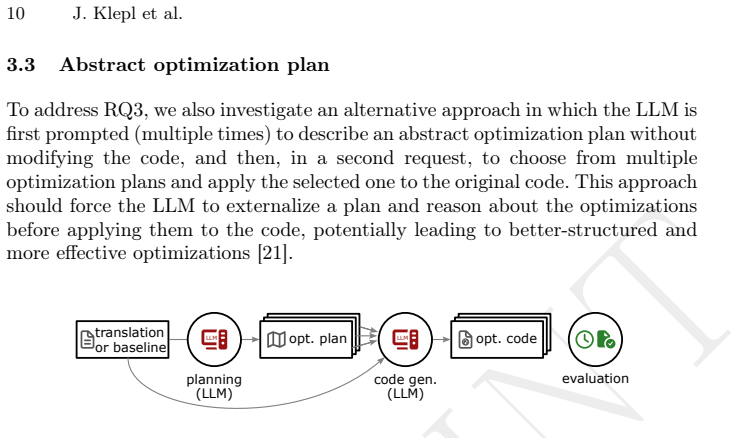
The engine of the comparison is a fixed-cost best-of-five protocol: for each of 26 PolyBench kernels, the LLM gets five independent tries per configuration; translations into a DSL are selected by closeness to the original C's runtime on SMALL, MEDIUM, and LARGE inputs, and optimized candidates are validated by output matching against the baseline C within an absolute tolerance of $10^{-2}$ and a relative tolerance of $2\times10^{-7}$ on all tested input sizes. The four prompting strategies are the naïve request, the all-hints request listing the four optimization categories, the choose-hints variant that asks the model to pick suitable hints, and the from-plan pipeline that first produces an externalized abstract schedule in the spirit of Halide/Exo separation and then implements it. The all-hints direct-C cell is the configuration that carries the paper's main conclusion.
What would settle it
Run the same all-hints direct-C protocol on the 26 PolyBench kernels, but validate every candidate against many randomly generated inputs whose dimensions are non-divisible and whose values are non-symmetric, in addition to the suite's fixed inputs. If a substantial share of candidates that pass the paper's tolerance fail on the random inputs, or if the speedup ranking between direct C and the three DSL representations flips, the central claim is contradicted.
Extended reading notes
Core claim
The paper claims that, in its evaluated setting, the best-performing and most often valid configuration is plain C plus an all-hints prompt: the model is told to improve cache locality, use limited temporary buffers, reduce arithmetic work, and parallelize, while preserving semantics. None of the three DSL workflows beats this on measured speedup at EXTRALARGE sizes, and direct C has the highest validity rate regardless of prompting approach. The from-plan workflow, which forces the model to first write an abstract schedule and then follow it, produces no performance benefit over direct optimization and lowers the validity rate for Exo. The paper takes this as evidence that existing optimization abstractions restrict the LLM more than they protect it, and that the model's own adaptive reasoning—guided by explicit hints but not coerced into a fixed plan—is what drives performance.
Load-bearing premise
The load-bearing premise is that matching the original outputs within an absolute tolerance of $10^{-2}$ and a relative tolerance of $2\times10^{-7}$ on PolyBench's non-symmetric inputs makes it unlikely that semantically wrong code passes validation; if that tolerance is too loose, the reported validity rates and the speedups built only from valid candidates overstate correctness.
Editorial extensions
If this is right
- Prompt specificity is the dominant lever: giving the LLM concrete optimization directions consistently outperforms a generic optimize-this request, so prompt design should be treated as a first-class component of LLM optimization tools.
- Current DSL abstractions do not pay for themselves in a non-iterative workflow: they neither raise validity nor unlock better speedups, and the translation step can lose performance before optimization begins.
- Forcing an explicit plan step is not a reliable way to improve reasoning; the paper's data indicate it can hurt, so future prompting schemes should test plan externalization before adopting it.
- A cheap, non-iterative best-of-five strategy with direct C reaches the same order of magnitude as an iterative agentic scheduler on several benchmarks (for example 103× on 3MM), implying that iteration cost is not the only route to high speedups.
- Validity is mostly a function of representation: direct C has the highest validity rate, Exo approaches it after five attempts, and Noarr stays slightly lower, giving a concrete target for verifiability research.
Reading between the lines
- Inference: the paper deliberately excludes compiler/runtime feedback loops; with feedback, DSL-based approaches might close the gap because iterative repair can correct translation errors, so the direct-C advantage should not be assumed to carry over to agentic settings.
- Inference: the from-plan result suggests a testable design principle—let the model choose its own reasoning depth—which could be probed by varying how much of the plan is forced and where in the pipeline it is inserted.
- Inference: the validation logic is an assumption, not a proof; stress-testing it with adversarial or randomized inputs could change which candidates count as valid and, with it, the speedup aggregates.
- Inference: if the ranking generalizes to other LLMs and benchmark suites, the productive direction for verifiable LLM optimization is validating the LLM's free-form C output, rather than constraining the LLM to existing DSL templates.
Signed reviews
Editorial analysis
A structured set of objections, weighed in public.
Referee Report
Summary. The paper reports a large empirical comparison of LLM-guided code optimization workflows on the PolyBench suite. The workflows differ along two axes: the code representation to which the LLM applies optimizations (direct C, or a translation into Halide, Exo, or Noarr) and the prompting strategy (naive, all-hints, choose-hints, or from-plan). Using GPT-5.1 in a non-iterative setting with five independent attempts per condition, the authors report that direct C generation with specific optimization hints achieves the best geometric-mean speedups and the highest validity rates, that the from-plan approach does not help, and that the DSL abstractions do not provide clear benefits in this setting. The paper includes a replication package and excludes the four benchmarks used for prompt development from the evaluation.
Significance. If the result holds, it is practically significant: it challenges the assumption that established optimization DSLs are the right interface for LLM-guided optimization and suggests that prompt specificity matters more than the representation. The study has notable strengths: a relatively large corpus of 2,080 optimization attempts, four different prompting approaches, three frameworks plus direct C, automated validation, and a public replication package with prompts, code, and results. The main risk is that the validation tolerance (Section 3.4) is loose enough to admit semantically incorrect code as valid; because invalid outputs are excluded from all performance aggregates and the C baseline is used as a fallback, a non-negligible false-positive rate would overstate both the validity-rate comparisons and the best-of-k speedups. The paper itself flags this as a limitation but does not quantify the false-negative risk.
major comments (2)
- [Section 3.4] The validation tolerance is load-bearing and is not sufficiently justified. The paper declares a generated implementation valid if its output matches the baseline within an absolute tolerance of 1e-2 and a relative tolerance of 2e-7 for all tested input sizes. For double-precision kernels whose outputs are O(1), a missing boundary term, an off-by-one loop bound, or a slightly wrong scaling can produce errors below 1e-2, and the argument that non-symmetric inputs and non-divisible sizes make such cases "unlikely" is unquantified. The 91 numerical-mismatch failures demonstrate that the tolerance catches some errors, but they do not measure false negatives. Since Section 4.2 builds all performance aggregates from valid candidates only and uses the C baseline as a fallback, an inflated validity rate could directly inflate the reported speedups. Please provide evidence that the tolerance is discriminating, for example by running the same validation on intentionally mutated or perturbed versions of the benchmarks, or by re-running the evaluation with a stricter tolerance and reporting whether the conclusions are stable.
- [Section 4.2, Figure 4] The central quantitative claims are reported without any measure of uncertainty. Execution times are averaged over three runs after two warm-ups, but the paper reports no confidence intervals, standard deviations, or significance tests for the geometric-mean speedups or for the validity-probability curves. The aggregation in Figure 4 uses best-of-k speedups with the C baseline as a fallback, and the validity denominator includes all attempts; these are reasonable choices, but the headline differences between all-hints direct C and the framework-based approaches could be driven by a few outliers or by measurement noise. Please report per-benchmark results, inter-run variance, and either paired tests or bootstrap confidence intervals to establish that the observed ordering is not a chance artifact of the specific 26-benchmark sample.
minor comments (4)
- [Section 3.1] The translation selection step chooses the candidate whose measured performance most closely matches the original C code; with only three timing runs, this selection can be noisy. It would be helpful to state whether the selection was stable across repeated runs or to use a more robust criterion.
- [Section 4.3] The comparison to Merouani et al. is not apples-to-apples: the baselines differ (original PolyBench C versus a Tiramisu re-implementation), the number of LLM invocations differs (5 versus up to 150), and the hardware and model versions are not identical. The sentence claiming results of "similar order of magnitude" should be softened or accompanied by a direct re-benchmarking under the same baseline.
- [Section 3.4] The assertion that PolyBench inputs are "intentionally designed with non-symmetric input data and dimension sizes non-divisible by common tiling factors" is a factual claim about the benchmark suite; please provide a citation or a concrete example in the replication package to substantiate it.
- [Section 4.2] The failure-category tags are described as diagnostic and non-disjoint, but the counts (454 compilation errors, 276 runtime errors, 91 numerical mismatches, 10 timeouts) are presented without the overlap information. Reporting the number of attempts that fail in multiple categories would clarify the failure analysis.
Circularity Check
No significant circularity: the core claim is an empirical benchmark comparison, not a derivation that reduces to its inputs.
full rationale
The paper's central result is a measured comparison of LLM-generated direct C code versus LLM-generated Exo, Halide, and Noarr pipelines on PolyBench, evaluated by execution time and an output-matching validation criterion. No equation in the paper predicts a performance number from a fitted parameter; no fitted value is renamed as a prediction; and no uniqueness theorem is invoked to force a choice. The validation criterion in Section 3.4 is an explicit operational definition of 'valid' for this study, and the exclusion of invalid candidates from performance aggregates is a stated evaluation protocol rather than a construction that guarantees the reported ranking. The concern that the tolerance (absolute 1e-2, relative 2e-7) may admit false positives is a correctness or measurement-threat issue, not circularity. The self-citations (Noarr [18] and the authors' prior CUDA optimizer work [7]) are used to describe the studied DSL and to motivate prompt engineering; neither is load-bearing for the conclusion. If anything, the authors' own Noarr framework performs worse in their comparison, so the result is not an artifact of self-citation. Prompt-development benchmarks were excluded from the reported evaluation, and the external comparison to Merouani et al. rests on published numbers rather than on this paper's fitted values. The central claim is self-contained with respect to the measured data.
Assumptions & free parameters
free parameters (5)
- Validation tolerance =
absolute 1e-2, relative 2e-7
- Execution timeout =
8 minutes
- Optimization hint set =
Cache, Structure, Arithmetic, Parallelism
- Translation selection metric =
geometric mean closeness to C
- Attempt budget =
5 independent requests
assumptions (3)
- domain assumption PolyBench output matching within tolerance on non-symmetric inputs implies semantic equivalence with low false-positive risk
- domain assumption GPT-5.1 snapshot is a representative state-of-the-art LLM for code optimization
- domain assumption Wall-clock timing with two warm-up runs and three measured runs is stable enough for the reported comparisons
Cite this review
Pith. "Pith review of Effect of Abstractions and Prompting Strategies on LLM-Guided High-Performance Optimizations." pith.science (2026). https://pith.science/paper/VLD4RKIH
@misc{pith2026260808085,
  author       = {Pith},
  title        = {Pith review of: Effect of Abstractions and Prompting Strategies on LLM-Guided High-Performance Optimizations},
  year         = {2026},
  howpublished = {\url{https://pith.science/paper/VLD4RKIH}},
  note         = {Machine review of arXiv:2608.08085}
}
read the original abstract
Code performance optimization is a vital aspect of modern software development, as it enables faster response times and reduced resource usage. These optimizations require a deep understanding of low-level hardware details and the intricacies of parallel processing, making them challenging even for experienced developers. With the advent of Large Language Models (LLMs), which are increasingly capable of generating and understanding code, there is growing interest in incorporating these models into automated code optimization processes. Traditionally, this automation involves transcribing the source code into a domain-specific representation that can be auto-tuned using grid search or machine learning algorithms, while adhering to strict rules and a limited set of feasible transformations to ensure verifiability. LLMs incorporate high-level code semantics and can thus perform transformations that go beyond verifiable automated optimizations. This paper investigates whether the traditional abstractions used in automated code optimization improve the performance and correctness of LLM-guided optimizations of parallel HPC applications. We evaluate this using the PolyBench benchmark suite and demonstrate that, in our evaluated setting, LLMs provided with specific optimization goals achieve better measured performance and validity rates when generating C code compared to creating computation pipelines and optimization schedules with established frameworks, suggesting that future development should explore alternative approaches for verifiable LLM-guided code optimization.
Figures


Figures from the paper (1 more)

Reviewed August 12, 2026 · model on record in the stance chip above.
Discussion (0). Continue with ORCID to comment.