REVIEW 4 major objections 6 minor 18 references
Staying True to the Origin: Continuous Image Stylization with Smooth Transitions
T0 review · 4 major / 6 minor · reviewed 2026-08-12 · deepseek-v4-flash
Pith's one-line read Five discretely trained strengths yield smooth continuous stylization
desk verdict A practical and genuinely new control scheme for diffusion-based style transfer, but the unvalidated anchor axis keeps it from being fully convincing. read the letter →
The pith
A machine-rendered reading of the paper's core claim, the machinery that carries it, and where it could break.
The reading
What carries the argument
The machinery is the strength-aware low-rank affine projector combined with B-spline interpolation in parameter space. Given a frozen LoRA adapter with matrices $A$ and $B$, a queried strength $s$ scales the low-rank features ($\hat{s}\odot Ax$ with $\hat{s}=s\mathbf{1}_r$), and a learned full-rank-in-low-dimension matrix $L$ mixes across rank dimensions with bias $b$, producing $\tilde{x}(s)=Wx+B(L(\hat{s}\odot Ax)+b)$. A set of such projectors is learned at five anchor strengths, and at inference the projectors are treated as B-spline control points and interpolated in the low-rank parameter space via the Cox–de Boor recursion. This keeps interpolation in a low-dimensional, semantically meaningful space, which the paper argues is why transitions stay content-preserving and smooth.
What would settle it
Evaluate the released model on a fresh set of content-style pairs, query 50 evenly spaced strengths, and compute c-FID and s-FID per pair; if any pair shows a reversal between adjacent strengths—increasing c-FID or decreasing s-FID with $s$—the monotonicity claim would be falsified. A simpler check: ask human raters to order the five anchor outputs by perceived stylization strength without labels; if a substantial share of pairs are not consistently ordered, the anchor dataset premise fails.
Extended reading notes
Core claim
The central discovery is that stylization strength can be parameterized as an explicit, continuous control variable rather than left to implicit mechanisms like guidance scales or LoRA scaling factors. The method trains a base LoRA adapter for endpoint stylization and then learns, for each discrete anchor strength, a small affine projector $(L_i, b_i)$ that acts on the low-rank features of the frozen adapter. During inference, B-spline interpolation over these projectors — not over images or over the full model weights — constructs a runtime projector for any queried strength. The authors report that this yields strong stylization while preserving content semantics, and that the transition path is smooth and monotonic in both content preservation (c-FID) and style matching (s-FID).
Load-bearing premise
The automatically generated five stylization anchors per content-style pair are assumed to be ordered from weakest to strongest stylization while keeping the content's layout unchanged; if varying the trade-off weight instead shifts content structure or produces out-of-order outputs, the learned projectors won't represent a meaningful strength axis and the continuous slider claim collapses.
Editorial extensions
If this is right
- A user can query any strength $s\in[0,1]$ and get a stylized image without retraining or extra optimization, because the runtime projector is constructed purely by B-spline interpolation of the learned anchors.
- The stylization control is explicit and interpretable: raising $s$ monotonically raises style matching (lower s-FID) while relaxing content preservation (higher c-FID), as shown in the reported curves.
- The same frozen base model and endpoint adapter serve both moderate and strong stylization, so one checkpoint covers the whole transition range.
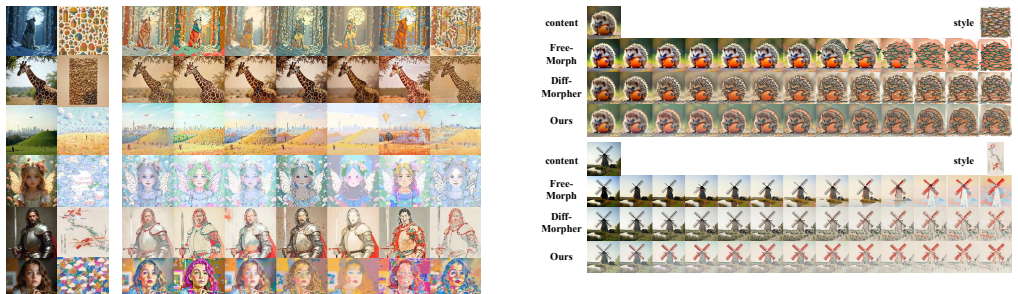
- The transition path is smoother than guidance-scale or LoRA-scaling control, as measured by PPL and SPL, and preserves content structure even at low strengths.
Reading between the lines
- A natural next test is whether the same low-rank projector interpolation yields smooth continuous control for other adapter-based editing axes, such as semantic attribute strength or identity blending, not just stylization.
- The dependence of the trade-off curve's shape on spline degree ($k=3$ vs $k=4$) suggests that the transition profile could be tuned by choosing the spline, giving practitioners a free knob beyond the strength slider.
- Because the anchors are synthetic outputs of another model, one could probe the method's robustness by replacing them with human-curated ordered stylizations; if monotonicity survives, the parameter-space path itself, not the anchor data, would be the source of smoothness.
- Querying strengths outside the trained anchor range, such as $s=0.05$ or $s=1.2$, would test how well the not-a-knot spline extrapolates in the low-rank projector manifold, an operating regime the paper does not examine.
Signed reviews
Editorial analysis
A structured set of objections, weighed in public.
Referee Report
Summary. The paper proposes a two-stage training framework for continuous image stylization using a diffusion-transformer editing model (QwenImage as default backbone). Stage 1 fine-tunes a LoRA adapter at full strength s=1.0 to establish a strong stylization endpoint. Stage 2 freezes the base model and the endpoint adapter, and trains lightweight anchor projectors (L_i, b_i) at five discrete strengths s ∈ {0.2, 0.4, 0.6, 0.8, 1.0} under a flow-matching objective. At inference, these anchor projectors are treated as B-spline control points and interpolated in the low-rank parameter space to construct a runtime projector for any queried strength s ∈ [0,1]. The paper claims that this yields strong stylization with content preservation, smooth and monotonic transitions, and interpretable strength control, supported by quantitative metrics (ArtFID 220.79, PPL 0.4959, SPL 4.7162), a user study, and numerous qualitative comparisons against stylization and morphing baselines.
Significance. If the reported results hold, this is a practically valuable contribution: a single fine-tuned model can provide continuous, monotonic stylization-strength control via lightweight low-rank projectors and spline interpolation, rather than requiring separate adapters or unreliable guidance-scale/LoRA-scaling heuristics. The paper also introduces a new SPL metric and includes extensive ablations and a user study, which are strengths. However, the central claim rests on the validity of automatically generated stylization anchors as a genuine, monotonically ordered strength axis; this premise is not verified in the manuscript, and several details needed for reproduction (LoRA rank, exact anchor-generation procedure) are missing. The reported monotonicity is measured on the trained model, not on the anchors, and all numbers are point estimates without confidence intervals.
major comments (4)
- [Anchor Style Transfer Dataset] The five stylization anchors per content–style pair are generated by 'varying only the content–style trade-off weight' at s ∈ {0.2, 0.4, 0.6, 0.8, 1.0}, but the paper never specifies the model or the exact weight values, and it never verifies that these anchors are monotonically ordered in stylization intensity or that the trade-off weight alters only style strength without also changing content layout or semantics. Stage 2 trains the projectors Δθ_i to reproduce these anchors (Eq. 4, Algorithm 2), and Eq. 6 interpolates them, so the entire continuous-control claim is inherited from this unvalidated axis. Figure 8 reports monotonic c-FID/s-FID only for the trained model at k=3 and k=4, which cannot validate the anchors themselves. The authors should provide a detailed description of the anchor-generation procedure and per-anchor quantitative verification (e.g., c-FID, s-FID, LPIPS, style loss at each anchor on a held-out set, with confidence intervals) to establish monotonicity and content preservation at the anchor level.
- [Additional Analysis on Strength Control, Figure 8] The default spline degree k=3 is selected 'because it provides a more gradual and balanced control response' on the same evaluation curves used to report the main results. This is test-set tuning: the reported advantages of k=3 over other degrees in Table 4 are not an independent evaluation of the design choice. The authors should either select k on a separate validation split or report results for all degrees without a selection step, and state the selection procedure explicitly in the main text.
- [Stylization Strength Affine Module and Implementation Details] The LoRA rank r and the bias b dimension are never reported. Eq. (3) defines L ∈ R^{r×r} and b ∈ R^r, but no value of r is given anywhere in the main text or the supplementary material, and the content–style trade-off weight schedule used to generate the anchors is not described. These details are necessary to reproduce the method and to assess whether the interpolation in 'low-rank space' is meaningfully low-rank. The authors should report r, the total number of trainable parameters, and the exact anchor-generation procedure.
- [Tables 1–4 and Figure 8] All quantitative comparisons are reported as point estimates without confidence intervals, error bars, or significance tests. Several differences are very small (e.g., s-FID 165.67 for QwenImage+Ours vs. 165.74 for QwenImage in Table 1; SPL 4.7162 for k=3 vs. 4.6132 for k=2 in Table 4), so it is unclear whether the claimed improvements and the monotonicity in Figure 8 are statistically reliable. At minimum, the authors should report confidence intervals over seeds or bootstrap resamples for the main metrics, and ideally a significance test for the central monotonicity claim.
minor comments (6)
- [Anchor Style Transfer Dataset] The citation for 'Style30k' is given as (Li et al. 2024), but the cited reference is the StyleTokenizer paper; please provide the correct reference for the Style30k dataset or clarify the relationship.
- [Ablation: Eq. (9)] The notation for b_2 in Eq. (9) and the surrounding text is confusing: the text defines 'b_2 := b_{ω2} ⊙ Ax + b', but the equation uses b_2 inside parentheses in a way that seems inconsistent with that definition. Please clarify.
- [Figure 3] Figure 3 is difficult to parse: the caption labels 'Left (a)', 'Right (b)', 'Right (c)', while the main text refers to panels (a), (b), (c) in a different order. Please reorganize the figure or caption to match the text.
- [Metrics] The definition of perceptual path length (PPL) as a sum of LPIPS distances between adjacent images is reasonable, but it could be confused with the standard PPL metric from GAN literature; please make the formula explicit (e.g., PPL = Σ_i LPIPS(I_i, I_{i-1})) when it is first introduced.
- [General formatting] The submitted text contains many missing spaces between words (e.g., 'preservingthecontentsemantics'), likely due to PDF extraction, but the author-supplied version should be checked for such formatting errors.
- [User Study] The user-preference share for stylization quality is 25.33%, which the text correctly describes as a plurality rather than a majority; consider adding a brief discussion of what this implies for the claim of perceived superiority over the other five methods.
Circularity Check
No significant circularity: the continuous-control claim rests on empirical interpolation results, not on a fitted constant or a load-bearing self-citation.
full rationale
The paper's derivation chain is supervised but not circular. Stage 1 trains an endpoint adapter at strength s=1.0; stage 2 freezes that adapter and trains anchor projectors at five discrete strengths using a synthetically generated anchor dataset; inference then constructs a B-spline interpolant over the learned projectors (Eqs. 3-6). The central claim, continuous strength control at unqueried s, is an interpolation prediction that is not statistically forced: the B-spline passes through the trained anchor projectors, but the behavior at intermediate strengths is measured, not derived from a fitted constant. The monotone c-FID/s-FID curves in Figure 8 are empirical evaluations of the trained system, and the paper explicitly frames them as verification 'beyond the discrete anchors used for training.' The synthetic anchor generation by varying a content-style trade-off weight is an external data-construction premise; the paper does not claim to derive the monotonicity from that premise, and any concern that the anchors may not be perceptually ordered is a data-quality caveat, not a circular reduction. The only self-citation (StyleSSP, first author Rui Xu) appears as a baseline and related-work context, not as load-bearing justification. No equation is shown to reduce to its own input, and no fitted parameter is renamed as a prediction. The method is also compared against external baselines and user studies, so the evaluation is self-contained.
Assumptions & free parameters
free parameters (3)
- Anchor strength values {0.2, 0.4, 0.6, 0.8, 1.0} =
0.2, 0.4, 0.6, 0.8, 1.0
- B-spline degree k =
3
- LoRA rank r =
not reported
assumptions (4)
- standard math Flow-matching objective (Eq. 1) and Cox-de Boor recursion (Eq. 5) are accepted as background math.
- domain assumption A LoRA adapter inserted into Q/K/V and MLP projections of a DiT editing model can capture style transfer while preserving content.
- ad hoc to paper Automatically generated stylization anchors obtained by varying a content-style trade-off weight define a valid, monotonically ordered stylization strength axis.
- domain assumption Interpolating low-rank projector parameters with a B-spline yields perceptually smooth and monotonic transitions in output images.
Cite this review
Pith. "Pith review of Staying True to the Origin: Continuous Image Stylization with Smooth Transitions." pith.science (2026). https://pith.science/paper/EK6DFAOQ
@misc{pith2026260808125,
  author       = {Pith},
  title        = {Pith review of: Staying True to the Origin: Continuous Image Stylization with Smooth Transitions},
  year         = {2026},
  howpublished = {\url{https://pith.science/paper/EK6DFAOQ}},
  note         = {Machine review of arXiv:2608.08125}
}
read the original abstract
Recent advances in generative models have achieved remarkable performance in text- and image-conditioned editing. However, preserving the content of a given image while referencing style patterns from another remains challenging, often leading to uncontrollable stylization results. In this paper, we approach image stylization from the perspective of continuous control, aiming to enable modern Diffusion Transformer (DiT)-based multi-reference editing models to (1) faithfully preserve the semantic structure of the content image, (2) render strong stylization effects, and (3) smoothly transition between the two. To this end, we propose a simple yet effective two-stage training strategy along with a style-strength-aware spline formulation. Specifically, in the first stage, the model is trained to produce strongly stylized outputs while preserving the content semantics as much as possible. In the second stage, with the base model frozen, we learn a set of anchor projectors that map various stylization strengths into the model parameter space. During inference, by performing style-strength-aware spline interpolation in a low-rank space, our method enables continuous control over stylization strength, even though the model is trained with only a few discrete strength levels. Extensive experiments demonstrate that our method supports precise and continuous manipulation of stylization strength while generating high-fidelity results with modern DiT models. Project page: https://reychiaro.github.io/StyleController.
Figures


Figures from the paper (7 more)


Reference graph
Works this paper leans on
-
[3]
Gemini 2.5: Pushing the fron- tier with advanced reasoning, multimodality, long context, and next generation agentic capabilities.arXiv preprint arXiv:2507.06261. Dehghani,M.;Mustafa,B.;Djolonga,J.;Heek,J.;Minderer, M.;Caron,M.;Steiner,A.;Puigcerver,J.;Geirhos,R.;Alab- dulmohsin,I.M.;etal.2023. Patchn’Pack:NaViT,aVision TransformerforAnyAspectRatioandReso...
arXiv 2023
-
[7]
Analyzingandimprovingtheimagequal- ity of stylegan
Karras, T.; Laine, S.; Aittala, M.; Hellsten, J.; Lehtinen, J.; andAila,T.2020. Analyzingandimprovingtheimagequal- ity of stylegan. InProceedings of the IEEE/CVF conference on computer vision and pattern recognition, 8110–8119. Kolkin, N.; Salavon, J.; and Shakhnarovich, G
work page 2020
-
[8]
FLUX. 1 Kontext: Flow Matching for In- ContextImageGenerationandEditinginLatentSpace.arXiv preprint arXiv:2506.15742. Li, W.; Fang, M.; Zou, C.; Gong, B.; Zheng, R.; Wang, M.; Chen, J.; and Yang, M
-
[10]
arXiv preprint arXiv:2209.03003
Flow straight and fast: Learning to generate and transfer data with rectified flow. arXiv preprint arXiv:2209.03003. Mishchenko, K.; and Defazio, A
-
[11]
Prodigy: An ex- peditiously adaptive parameter-free learner.arXiv preprint arXiv:2306.06101. Oquab, M.; Darcet, T.; Moutakanni, T.; Vo, H.; Szafraniec, M.; Khalidov, V.; Fernandez, P.; Haziza, D.; Massa, F.; El- Nouby, A.; et al
-
[12]
Dinov2: Learning robust visual fea- tureswithoutsupervision.arXivpreprintarXiv:2304.07193. Radford, A.; Kim, J. W.; Hallacy, C.; Ramesh, A.; Goh, G.; Agarwal, S.; Sastry, G.; Askell, A.; Mishkin, P.; Clark, J.; et al
-
[14]
Tan, Z.; Liu, S.; Yang, X.; Xue, Q.; and Wang, X
Omniconsistency: Learning style-agnostic consistency from paired stylization data.arXiv preprint arXiv:2505.18445. Tan, Z.; Liu, S.; Yang, X.; Xue, Q.; and Wang, X
-
[15]
InProceedings of the IEEE/CVF International Conference on Computer Vision, 14940–14950
Ominicontrol: Minimal and universal control for diffusion transformer. InProceedings of the IEEE/CVF International Conference on Computer Vision, 14940–14950. Vaswani,A.;Shazeer,N.;Parmar,N.;Uszkoreit,J.;Jones,L.; Gomez,A.N.;Kaiser,Ł.;andPolosukhin,I.2017. Attention is all you need.Advances in neural information processing systems,
work page 2017
Show all 18 references
-
[16]
Interpolating between Images with Diffusion Models. InICML. Wang,H.;Spinelli,M.;Wang,Q.;Bai,X.;Qin,Z.;andChen, A.2024a.Instantstyle:Freelunchtowardsstyle-preservingin text-to-image generation.arXiv preprint arXiv:2404.02733. Wang, H.; Xing, P.; Huang, R.; Ai, H.; Wang, Q.; and...
-
[17]
InDAGMGermanConference on Pattern Recognition, 560–576
Artfid: Quantitative eval- uationofneuralstyletransfer. InDAGMGermanConference on Pattern Recognition, 560–576. Springer. Wu,C.;Li,J.;Zhou,J.;Lin,J.;Gao,K.;Yan,K.;Yin,S.-m.; Bai,S.;Xu,X.;Chen,Y.;etal.2025. Qwen-imagetechnical report.arXiv preprint arXiv:2508.02324. Xing,P.;Wan...
2025 arXiv
-
[18]
Multi-lora composition for image generation.arXiv preprint arXiv:2402.16843
-
[2020]
Ho,J.;andSalimans,T.2022
Denoising diffusion probabilistic models.Advances in neural information pro- cessing systems, 33: 6840–6851. Ho,J.;andSalimans,T.2022. Classifier-freediffusionguid- ance.arXiv preprint arXiv:2207.12598. Hu,E.J.;Shen,Y.;Wallis,P.;Allen-Zhu,Z.;Li,Y.;Wang,S.; Wang, L.; Chen, W.; et al
2022 arXiv
-
[2021]
InInternational conference on machine learning, 8748–8763
Learning transferable visual models from natural language supervision. InInternational conference on machine learning, 8748–8763. PmLR. Seedream, T.; Chen, Y.; Gao, Y.; Gong, L.; Guo, M.; Guo, Q.;Guo,Z.;Hou,X.;Huang,W.;Huang,Y.;etal.2025. See- dream 4.0: Toward next-generation...
2025 arXiv
-
[2022]
Liu, C.; Shah, V.; Cui, A.; and Lazebnik, S
Flow matching for generative modeling.arXiv preprint arXiv:2210.02747. Liu, C.; Shah, V.; Cui, A.; and Lazebnik, S
-
[2023]
Cao, Y.; Si, C.; Wang, J.; and Liu, Z
Gpt-4 technical report.arXiv preprint arXiv:2303.08774. Cao, Y.; Si, C.; Wang, J.; and Liu, Z
-
[2024]
InForty-first international conference on machine learning
Scalingrectifiedflowtransformersforhigh-resolution image synthesis. InForty-first international conference on machine learning. Gatys,L.A.;Ecker,A.S.;andBethge,M.2016. Imagestyle transfer using convolutional neural networks. InProceed- ings of the IEEE conference on computer v...
2016
-
[2025]
InProceedings of the IEEE/CVF International Con- ference on Computer Vision, 18111–18120
Freemorph: Tuning-free generalized image morphing with diffusion model. InProceedings of the IEEE/CVF International Con- ference on Computer Vision, 18111–18120. Chen,B.;Zhao,B.;Xie,H.;Cai,Y.;Li,Q.;andMao,X.2025. Consislora:Enhancingcontentandstyleconsistencyforlora- based sty...
2025 arXiv
-
[7528]
Ganstrainedbyatwotime-scaleupdate ruleconvergetoalocalnashequilibrium.Advancesinneural information processing systems,
Heusel, M.; Ramsauer, H.; Unterthiner, T.; Nessler, B.; and Hochreiter,S.2017. Ganstrainedbyatwotime-scaleupdate ruleconvergetoalocalnashequilibrium.Advancesinneural information processing systems,
2017
Reviewed August 12, 2026 · model on record in the stance chip above.
Discussion (0). Continue with ORCID to comment.