REVIEW 3 major objections 4 minor 40 references
BAP-MOS: Bandit-Based Adaptive Prompting for Boundary-Sensitive Multi-Organ Segmentation
T0 review · 3 major / 4 minor · reviewed 2026-08-12 · deepseek-v4-flash
Pith's one-line read BAP-MOS claims that choosing prompts per organ with a bandit during decoder-only fine-tuning cuts boundary errors by roughly 48% in multi-organ ultrasound segmentation.
desk verdict The adaptive-prompting idea is interesting and the motivation is real, but the reported gains are not evidence for a deployable method: test-time prompts appear to come from ground-truth masks, and no inference-time prompt source is described. read the letter →
The pith
A machine-rendered reading of the paper's core claim, the machinery that carries it, and where it could break.
The reading
What carries the argument
The central object is the per-organ UCB-Tuned prompt selector running on a decision-block schedule, with an organ-scaled negative-prompt ring. The ring radius $r_o = \max\left(r_{\min}, \left\lfloor \alpha \sqrt{A_o} \right\rfloor\right)$ places negative points just outside each organ, and the bounded reward $R_o = 1 - \left[0.3(1-\mathrm{Dice}_o) + 0.5 \frac{\min(\mathrm{MSD}_o, \tau)}{\tau} + 0.2 \frac{\min(\mathrm{HD95}_o, 3\tau)}{3\tau}\right]$ clips boundary distances so the bandit's variance cap applies. This machinery lets the model adapt which prompt guides each organ during fine-tuning while the image and prompt encoders stay frozen.
What would settle it
Run the same benchmark with test prompts generated by a mask-free automatic prompt generator (e.g., a detector or saliency method) instead of ground-truth masks, and check whether the HD95 and MSD gains over fixed-prompt baselines persist; if they vanish, the reported improvement depends on oracle masking at test time.
Extended reading notes
Core claim
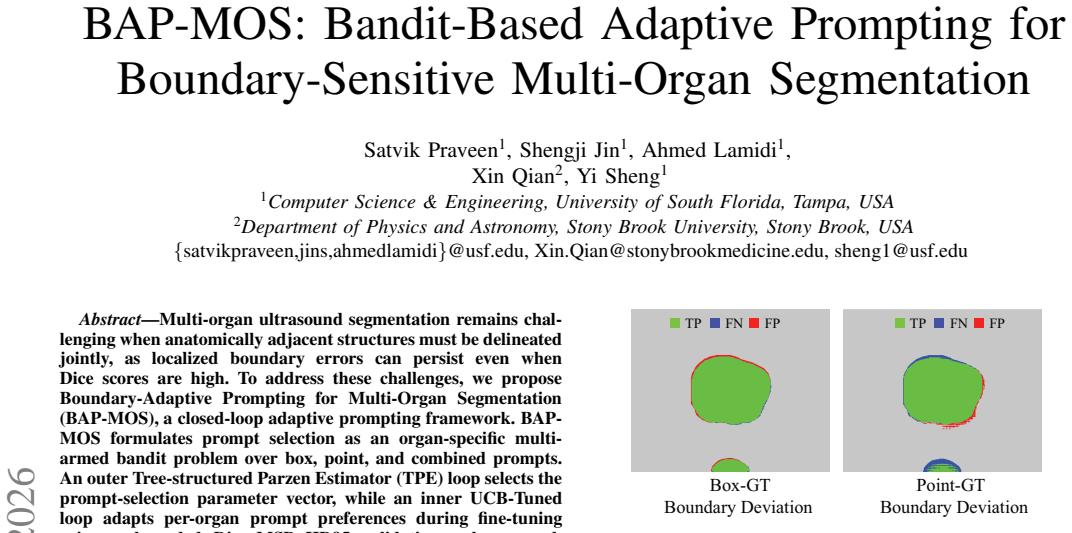
BAP-MOS treats prompt selection as an organ-specific sequential decision problem. An inner UCB-Tuned loop chooses among box, point, and combined prompts for each organ, holding the choice fixed for $K$ training batches and updating reward statistics from a bounded Dice–MSD–HD95 validation probe; an outer Tree-structured Parzen Estimator searches over prompt-geometry and reward parameters. The key reported findings are that fixed prompt schedules produce up to 98% variation in HD95 while Dice moves only 2.5%, and that the adaptive selector converges to a stable preference for box and combined prompts while improving boundary metrics over all fixed baselines.
Load-bearing premise
The load-bearing premise is that ground-truth masks are available to construct the box, point, and combined prompt coordinates used during evaluation; the paper states this for training but never specifies an inference-time prompt source.
Editorial extensions
If this is right
- Decoder-only fine-tuning plus bandit prompt choice meets or beats full-model fine-tuning at a fraction of the parameter cost.
- HD95 and MSD can vary by roughly 95–98% across fixed prompt schedules even when Dice changes by only 2.5%, so overlap-only evaluation is insufficient for promptable ultrasound segmentation.
- Per-organ prompt preferences are learnable and stable: the selector converges to box/combined dominance, suggesting that a well-chosen fixed schedule may recover much of the gain.
- The framework is backbone-agnostic: adapting MedSAM with BAP-MOS closes most of the gap to SAM on the TRUS benchmark, and the same approach shows improvement on an external pelvic-floor ultrasound corpus.
Reading between the lines
- Because the paper never specifies an inference-time prompt source, a natural extension is to pair BAP-MOS with an automatic prompt predictor; the reported gains may shrink if prompt coordinates are noisier than ground truth.
- A fair evaluation would include an oracle-prompt upper bound and a mask-free-prompt lower bound to separate the benefit of adaptation from the benefit of knowing the mask.
- The bandit-over-prompt structure could transfer to other promptable foundation models and modalities where boundary metrics matter, such as CT or MRI multi-organ segmentation, with a reward re-weighted toward the clinically relevant distance.
Editorial analysis
A structured set of objections, weighed in public.
Referee Report
Summary. The paper proposes BAP-MOS, a framework that adaptively selects per-organ prompt types (box, point, or combined) for promptable segmentation backbones such as SAM and MedSAM. A Tree-structured Parzen Estimator (TPE) outer loop tunes prompt-selection parameters and a UCB-Tuned inner loop adapts prompt choices during decoder-only fine-tuning. The authors introduce an organ-scaled negative-point ring and a bounded Dice--MSD--HD95 composite reward. Evaluation on a pooled TRUS benchmark reports Dice 0.982, HD95 0.482, and MSD 0.204, with a large improvement over conventional baselines, and an additional external PFUS1 result is reported. The central claim is that adaptive prompt allocation improves boundary-sensitive multi-organ ultrasound segmentation without modifying the foundation-model backbone.
Significance. If the method were fully specified and evaluated as an automatic segmentation approach, the per-organ bandit formulation and the boundary-sensitive reward would be a useful contribution to promptable medical image segmentation. The paper has several strengths: it clearly identifies a boundary-quality failure mode that Dice misses; it keeps the image and prompt encoders frozen, limiting trainable parameters; it evaluates on an external dataset; and it reports code availability. However, the central contribution as currently stated is not supported because the test-time prompt source is never described and the published protocol allows prompts to be derived from ground-truth masks. The PFUS1 external validation also lacks a fixed-prompt baseline, so the adaptive mechanism is not isolated. The ideas are promising, but the main evaluation needs substantial rework before the claims can be accepted.
major comments (3)
- [IV-B-2, V-B] The manuscript never specifies how prompts are generated for the held-out test sets. Section IV-B-2 states that ground-truth masks are used only to construct prompt coordinates (Eqs. 5 and 6), and no inference-time prompt generator is described. If the same protocol was applied to the test slices in Table III, the reported Dice/HD95/MSD are produced with oracle prompts derived from ground truth. In that case BAP-MOS is not a standalone segmentation method, and the comparison with U-Net and nnU-Net, which receive no prompts, is not a valid automatic-segmentation comparison. The authors must either describe and evaluate an image-based prompt generator at test time, or explicitly reframe the method as interactive promptable segmentation and compare with fixed-prompt MedSAM/SAM under the same user-provided prompt protocol.
- [Table III] The external PFUS1 row reports BAP-MOS (MedSAM) with Dice 0.849, HD95 10.062, and MSD 5.034 against an FPN baseline that reports Dice only (0.710). No fixed-prompt MedSAM or fixed-prompt SAM result on PFUS1 is provided, so the claim that adaptive prompt allocation transfers to the external domain is not isolated; the gain could come from decoder fine-tuning or from the oracle-prompt protocol rather than from adaptive selection. Add fixed-prompt baselines on PFUS1 with the same prompt source as BAP-MOS.
- [IV-A, Eq. (8)] The outer TPE objective (Eq. 2) minimizes validation MSD and the inner reward (Eq. 8) is a weighted combination of Dice, MSD, and HD95, which are also the final evaluation metrics in Table III. Selecting hyperparameters and prompt-selection policies on validation versions of the same metrics can inflate the reported improvements relative to baselines whose hyperparameters are not tuned on those metrics. The authors should report the sensitivity of the results across independent validation splits and state the hyperparameter-tuning protocol used for U-Net, nnU-Net, SAM, and MedSAM baselines.
minor comments (4)
- [IV-A] The sentence 'The parameter W specifies the sliding reward-memory length to track non-stationary distributions to track non-stationary distributions' repeats the phrase 'to track non-stationary distributions' and should be corrected.
- [IV-B-2] There is a typo in 'V alid measurements' near Eq. (8); it should read 'Valid measurements'.
- [Fig. 3] The plot legend uses 'BAPMOS_SAM' and 'BAPMOS_MEDSAM' without hyphens; these should be made consistent with the notation 'BAP-MOS (SAM)' used in the text and tables.
- [Table III] The rows 'SAM' and 'MedSAM' in Table III should be explicitly labeled as fixed-prompt baselines, matching the abstract and the experimental design, so the reader can identify the exact comparison protocol.
Circularity Check
Headline boundary gains appear to be oracle-prompted: test-time prompts are never specified, while the only prompt construction uses ground-truth masks, so the reported HD95/MSD reductions over prompt-free baselines are not attributable to the adaptive policy.
-
self definitional
[Section IV-B 'Prompt Geometry' (Eqs. 5–6); evaluation in Section V-B]
"Ground-truth masks are used only to construct prompt coordinates; they are not passed as dense mask prompts to the encoder."
BAP-MOS's prompt coordinates are defined from the ground-truth organ mask M_o (Eq. 5 uses A_o = Σ M_o to set the ring radius, and Eq. 6 samples negative points from dilate(M_o) \ M_o). The paper never describes an inference-time prompt generator, and Section V-B reports test Dice/HD95/MSD without stating how test prompts are obtained. If, as the only specified construction implies, test prompts are GT-derived, then the reported boundary metrics are produced with oracle prompt locations taken from the same labels used for scoring. The comparison against U-Net and nnU-Net, which receive only images, is therefore not a test of a deployable automatic segmentation method, and the claimed ~48% HD95 and ~45% MSD reductions are not attributable to the adaptive bandit policy alone.
full rationale
The clearest circularity is the evaluation loop: the prompt geometry is built from the target masks, and no alternative test-time prompt source is supplied, so the headline comparison against prompt-free baselines is confounded by oracle prompt information. The TPE/UCB loops do optimize the same Dice/MSD/HD95 quantities later reported, but that is not by itself circular because the 70/15/15 split keeps test folds separate and Eq. 2 is a validation objective used for model selection. Independent, non-circular content does exist: Table II shows fixed prompt schedules produce large boundary-metric spreads, and Table IV compares TPE against random/heuristic/greedy search under a fixed protocol. However, without a stated inference-time prompt source, the central claim that adaptive prompt allocation yields deployable boundary-sensitive multi-organ segmentation is not established by the reported test numbers; the test evaluation appears to reduce to GT-derived prompt coordinates. No load-bearing self-citation chain or imported uniqueness theorem was found.
Assumptions & free parameters
free parameters (7)
- tau (reward clipping scale) =
26
- alpha (ring radius scale) =
0.108
- rmin (minimum ring radius) =
10
- W (sliding reward memory length) =
50
- K (decision-block size) =
70
- Reward weights in Eq. 8 =
0.3, 0.5, 0.2
- alpha(t) loss schedule in Eq. 7 =
unspecified
assumptions (6)
- standard math The UCB-Tuned variance cap of 0.25 is valid for rewards bounded in [0,1].
- standard math TPE with 100 trials and 20 fixed startup trials yields a near-optimal prompt-selection vector.
- domain assumption MSD and HD95 computed on a small validation probe are reliable signals of boundary quality during training.
- ad hoc to paper The organ-scaled negative ring with radius alpha times sqrt(area) is an effective background-suppression geometry.
- domain assumption Ground-truth masks are available for prompt construction during training and validation, and no separate test-time prompt generator is needed.
- domain assumption The learned per-organ prompt preferences transfer across seeds and cohorts.
Cite this review
Pith. "Pith review of BAP-MOS: Bandit-Based Adaptive Prompting for Boundary-Sensitive Multi-Organ Segmentation." pith.science (2026). https://pith.science/paper/I4I2GSGV
@misc{pith2026260808191,
  author       = {Pith},
  title        = {Pith review of: BAP-MOS: Bandit-Based Adaptive Prompting for Boundary-Sensitive Multi-Organ Segmentation},
  year         = {2026},
  howpublished = {\url{https://pith.science/paper/I4I2GSGV}},
  note         = {Machine review of arXiv:2608.08191}
}
read the original abstract
Multi-organ ultrasound segmentation remains challenging when anatomically adjacent structures must be delineated jointly, as localized boundary errors can persist even when Dice scores are high. To address these challenges, we propose Boundary-Adaptive Prompting for Multi-Organ Segmentation (BAP-MOS), a closed-loop adaptive prompting framework. BAP-MOS formulates prompt selection as an organ-specific multi-armed bandit problem over box, point, and combined prompts. An outer Tree-structured Parzen Estimator (TPE) loop selects the prompt-selection parameter vector, while an inner UCB-Tuned loop adapts per-organ prompt preferences during fine-tuning using a bounded Dice--MSD--HD95 validation-probe reward. The framework further introduces an organ-scaled negative prompt ring to adapt sparse prompt geometry across anatomical scales, while keeping the image and prompt encoders frozen and updating only the mask decoder. We evaluate BAP-MOS on pooled prostate-region TRUS cohorts against U-Net, nnU-Net, MedSAM, fixed-prompt SAM/MedSAM, and adaptive policy variants. On this benchmark, BAP-MOS achieves Dice 0.982, HD95 0.482, and MSD 0.204, reducing HD95 by approximately 48% and MSD by 45% relative to the strongest conventional baseline. To verify the generalization ability of the framework, we tested it on the external PFUS1 pelvic-floor ultrasound corpus using MedSAM and its adaptive strategy variants, and the results were good. These results support adaptive prompt allocation as an effective mechanism for improving boundary-sensitive multi-organ ultrasound segmentation without modifying the foundation-model backbone. Source Code is available at: https://github.com/SatvikPraveen/BAP-MOS
Figures


Figures from the paper (2 more)


Reference graph
Works this paper leans on
-
[1]
Ultrasound image segment ation: a survey,
J. A. Noble and D. Boukerroui, “Ultrasound image segment ation: a survey,” IEEE Transactions on medical imaging , vol. 25, no. 8, pp. 987– 1010, 2006
work page 2006
-
[2]
Male pelvic multi-organ segmentation on transrectal ultrasound using anchor-free mask cnn,
Y . Lei et al. , “Male pelvic multi-organ segmentation on transrectal ultrasound using anchor-free mask cnn,” Medical Physics, vol. 48, no. 6, pp. 3055–3064, 2021
work page 2021
-
[3]
X. Y ang et al. , “Deep-learning-based multi-organ auto-segmentation on 3d transrectal ultrasound for ultrasound-guided prostate brachytherapy,” International Journal of Radiation Oncology, Biology, Phy sics, vol. 111, no. 3, p. e119, 2021
work page 2021
-
[4]
Pfus1: Premier pelvic floor ultrasound segmenta- tion dataset. a resource for advancing research
D. Sol´ ıs-Mart´ ınet al., “Pfus1: Premier pelvic floor ultrasound segmenta- tion dataset. a resource for advancing research.” Data in Brief, p. 112346, 2025
work page 2025
-
[5]
Metrics for evaluating 3d medi cal image segmentation: analysis, selection, and tool,
A. A. Taha and A. Hanbury, “Metrics for evaluating 3d medi cal image segmentation: analysis, selection, and tool,” BMC medical imaging , vol. 15, no. 1, p. 29, 2015
work page 2015
-
[6]
Family of boundary overlap metrics for the evaluation of medical image segmentation,
V . Y eghiazaryan and I. V oiculescu, “Family of boundary overlap metrics for the evaluation of medical image segmentation,” Journal of Medical Imaging, vol. 5, no. 1, p. 015006, 2018
work page 2018
-
[7]
Gec-estro acrop prostate brachytherapy guidelines,
A. Henry et al. , “Gec-estro acrop prostate brachytherapy guidelines,” Radiotherapy and Oncology , vol. 167, pp. 244–251, 2022
work page 2022
-
[8]
O. Ronneberger, P . Fischer, and T. Brox, “U-net,” in MICCAI. Springer, 2015, pp. 234–241
work page 2015
Show all 40 references
-
[9]
Milletari, N
F. Milletari, N. Navab, and S.-A. Ahmadi, “V -net,” in 2016 fourth 3DV . Ieee, 2016, pp. 565–571
2016
-
[10]
nnu-net,
F. Isensee et al., “nnu-net,” Nature methods, vol. 18, no. 2, pp. 203–211, 2021
2021
-
[11]
Boundary loss for highly unbalanced segmentation,
H. Kervadec et al., “Boundary loss for highly unbalanced segmentation,” in International conference on medical imaging with deep lear ning. PMLR, 2019, pp. 285–296
2019
-
[12]
Reducing the hausdorff d istance in medical image segmentation with convolutional neural netw orks,
D. Karimi and S. E. Salcudean, “Reducing the hausdorff d istance in medical image segmentation with convolutional neural netw orks,” IEEE Transactions on medical imaging , vol. 39, no. 2, pp. 499–513, 2019
2019
-
[13]
Segment anything,
A. Kirillov et al. , “Segment anything,” in Proceedings of ICCV , 2023, pp. 4015–4026
2023
-
[14]
Segment anything model for medical image analysis: an experimental study,
M. A. Mazurowski et al. , “Segment anything model for medical image analysis: an experimental study,” Medical Image Analysis , vol. 89, p. 102918, 2023
2023
-
[15]
Sam in medical images: Accuracy in 12 datasets,
S. He et al. , “Sam in medical images: Accuracy in 12 datasets,” arXiv preprint arXiv:2304.09324, 2023
2023 arXiv
-
[16]
Finite-time analysis of the multiarmed bandit problem,
P . Auer, N. Cesa-Bianchi, and P . Fischer, “Finite-time analysis of the multiarmed bandit problem,” Machine learning, vol. 47, no. 2, pp. 235– 256, 2002
2002
-
[17]
Segment anything in medical images,
J. Ma et al. , “Segment anything in medical images,” Nature communi- cations, vol. 15, no. 1, p. 654, 2024
2024
-
[18]
Towards more precise automatic analysis: a systematic review of deep learning-based multi-organ segmentation,
X. Liu et al. , “Towards more precise automatic analysis: a systematic review of deep learning-based multi-organ segmentation,” BioMedical Engineering OnLine , vol. 23, no. 1, p. 52, 2024
2024
-
[19]
Hfa-unet,
Y . Li et al. , “Hfa-unet,” Knowledge-Based Systems , p. 114245, 2025
2025
-
[20]
Microsegnet,
H. Jiang et al. , “Microsegnet,” Computerized Medical Imaging and Graphics, vol. 112, p. 102326, 2024
2024
-
[21]
U-net benign prostatic hyperplasia-trained deep learni ng model for prostate ultrasound image segmentation in prosta te cancer,
P . Jiao et al. , “U-net benign prostatic hyperplasia-trained deep learni ng model for prostate ultrasound image segmentation in prosta te cancer,” Quantitative Imaging in Medicine and Surgery , vol. 15, no. 6, pp. 5424– 5435, 2025
2025
-
[22]
Automated segmentation and measurement of the female pelvic floor from the mid-sagittal plane of 3d ultr asound volumes,
Z. Szentimrey et al. , “Automated segmentation and measurement of the female pelvic floor from the mid-sagittal plane of 3d ultr asound volumes,” Medical Physics , vol. 50, no. 10, pp. 6215–6227, 2023
2023
-
[23]
Measures of the amount of ecologic associat ion between species,
L. R. Dice, “Measures of the amount of ecologic associat ion between species,” Ecology, 1945
1945
-
[24]
Comparison and evaluation of methods for liver segmentation from ct datasets,
T. Heimann et al. , “Comparison and evaluation of methods for liver segmentation from ct datasets,” IEEE transactions on medical imaging , vol. 28, no. 8, pp. 1251–1265, 2009
2009
-
[25]
Comparing images using the hausdorff distance,
D. P . Huttenlocher, G. A. Klanderman, and W. J. Rucklidg e, “Comparing images using the hausdorff distance,” IEEE Transactions on pattern analysis and machine intelligence , vol. 15, no. 9, pp. 850–863, 2002
2002
-
[26]
Weakmedsam,
H. Wang et al., “Weakmedsam,” IEEE Transactions on Medical Imaging, 2025
2025
-
[27]
Acea-net: Weakly supervised prostate 3d mri image segmentation via advanced prompt points,
J. Zou et al. , “Acea-net: Weakly supervised prostate 3d mri image segmentation via advanced prompt points,” IEEE Journal of Biomedical and Health Informatics , 2025
2025
-
[28]
Sam2rad,
A. S. Wahd et al., “Sam2rad,” Computers in Biology and Medicine , vol. 187, p. 109725, 2025
2025
-
[29]
Autoprosam: Automated prompting sam for 3d multi-organ segmentation,
C. Li et al., “Autoprosam: Automated prompting sam for 3d multi-organ segmentation,” in Proceedings of the Winter Conference on Applications of Computer Vision , 2025, pp. 3570–3580
2025
-
[30]
Alignsam,
D. Huang et al. , “Alignsam,” in Proceedings of CVPR , 2024, pp. 3205– 3215
2024
-
[31]
Plug-and-play ppo,
X. Liu et al. , “Plug-and-play ppo,” in Proceedings of CVPR , 2025, pp. 4332–4342
2025
-
[32]
Temporally-extended prompts optimization for sam in interactive medical image segmentation,
C. Shen et al. , “Temporally-extended prompts optimization for sam in interactive medical image segmentation,” in 2023 BIBM . IEEE, 2023, pp. 3550–3557
2023
-
[33]
Optimizing efficiency and effectiveness in sequential prompt strategy for sam using reinforcement learning,
Y . Huang et al. , “Optimizing efficiency and effectiveness in sequential prompt strategy for sam using reinforcement learning,” in International Conference on Medical Image Computing and Computer-Assist ed Inter- vention. Springer, 2024, pp. 478–488
2024
-
[34]
On upper-confidence bound policies for switching bandit problems,
A. Garivier and E. Moulines, “On upper-confidence bound policies for switching bandit problems,” in International conference on algorithmic learning theory . Springer, 2011, pp. 174–188
2011
-
[35]
Batched bandit problems,
V . Perchet et al. , “Batched bandit problems,” The Annals of Statistics , pp. 660–681, 2016
2016
-
[36]
Feature detection with automatic scale selection,
T. Lindeberg, “Feature detection with automatic scale selection,” Inter- national journal of computer vision , vol. 30, no. 2, pp. 79–116, 1998
1998
-
[37]
Applicability of deep learning to dynamically identify the different organs of the pelvic floor in the midsa gittal plane,
J. A. Garc´ ıa-Mejido et al., “Applicability of deep learning to dynamically identify the different organs of the pelvic floor in the midsa gittal plane,” International urogynecology journal , vol. 35, no. 12, pp. 2285–2293, 2024
2024
-
[38]
Algorithms for hyper-parameter optimization,
J. Bergstra et al. , “Algorithms for hyper-parameter optimization,” Ad- vances in neural information processing systems , vol. 24, 2011
2011
-
[39]
Random search for hyper-par ameter opti- mization
J. Bergstra and Y . Bengio, “Random search for hyper-par ameter opti- mization.” Journal of machine learning research , vol. 13, no. 2, 2012
2012
-
[40]
Coordinate descent algorithms,
S. J. Wright, “Coordinate descent algorithms,” Mathematical program- ming, vol. 151, no. 1, pp. 3–34, 2015
2015
Reviewed August 12, 2026 · model on record in the stance chip above.
Discussion (0). Continue with ORCID to comment.