REVIEW 3 major objections 3 minor 31 references
SuperLocalMemory 4.0: The Governed Memory Operating System for AI Agents
T0 review · 3 major / 3 minor · reviewed 2026-08-12 · deepseek-v4-flash
Pith's one-line read This paper claims that a local-first memory layer for AI agents can enforce a governing write-time invariant — one authenticated actor, one profile generation, one policy decision, one durable receipt, one verifiable completion state —…
desk verdict Scrupulously honest agent-memory engineering with a load-bearing gap: the headline write-path invariant is supported by component tests plus code inspection, not by any end-to-end HTTP-level test, but the paper itself says so. read the letter →
The pith
A machine-rendered reading of the paper's core claim, the machinery that carries it, and where it could break.
The reading
What carries the argument
The carrying mechanism is the V4 reliability spine: generation-fenced admission (a process-local, TTL-bounded map from (profile_id, idempotency_key) to a generation epoch that rejects stale writes with WriteCoordinatorError before any projection write), verifiable memory transactions (a transactional obligation ledger with per-projection owners — Bm25Owner, TemporalOwner, VectorOwner — implementing apply/verify/compensate/erase/prove_erased, with SHA-256 checksums), a hash-checkable CompletionManifest (COMPLETE when every obligation is terminal-success, DEGRADED when at least one failed after compensation, FAILED when the canonical write failed; sealed with installation-key HMAC-SHA256 on current schemas), and cross-store verified erasure with live physical re-queries and tamper-evident receipts. This bundle turns an ordinary remember call into an auditable, bounded transaction across heterogeneous local stores.
What would settle it
Run the same eleven scenarios against the real HTTP daemon with the full end-to-end path — HTTP auth, ActorContext, journal, generation fence, projection owners, obligation ledger, completion manifest, and the ANN index — and require 200/200 per scenario; any stale-epoch write that reaches a projection owner, or any ERASE after which an ANN or other registered projection footprint remains, would falsify the invariant as stated.
Extended reading notes
Core claim
The central claim is that a memory layer for AI agents can make reliability a physical-store property rather than an application-layer hope: the central systems contribution is a hash-verifiable projection-obligation and completion-manifest protocol across heterogeneous local stores under scoped admission. On every canonical write through the HTTP/remember route and internal ingestion, the runtime atomically commits the canonical fact, a durable receipt, and projection obligations for three registered owners (BM25, temporal, vector); each owner then proves its own apply/verify/compensate/erase, and a hash-checkable CompletionManifest reports COMPLETE, DEGRADED, or FAILED from canonical presence and obligation evidence. A generation fence rejects stale writes from a superseded profile epoch before any projection owner runs, and erasure returns all_erased=True only after each owner's live re-query confirms absence. The paper presents this as the enforced design of the write path and the target architecture for all surfaces, not a property already enforced on every transport, and it reports 2,200 of 2,200 deterministic repetitions upholding the scoped component properties.
Load-bearing premise
The load-bearing premise is that component-level, in-process fault-injection results generalize to the real runtime: the paper states that no single scenario exercises the full end-to-end path and that transport, multi-process, mesh, and long-lived deployment fault-injection are future work.
Editorial extensions
If this is right
- If the invariant holds, every canonical write can be audited by its manifest: a DEGRADED state records exactly which projection owner failed, and no degraded write is ever promoted to COMPLETE.
- A deleted-and-recreated profile cannot be contaminated by a replayed stale write, because the generation fence rejects the stale epoch before any projection owner executes.
- A right-to-erasure request with all_erased=True means each registered owner re-queried its physical tables and found no residue at finalize time; partial residue forces all_erased=False.
- Governed writes cost about 1.7 ms at the median and 2.7 ms at p99 more than ungoverned writes in-process, so the governance envelope is cheap enough to leave enabled.
Reading between the lines
- A decisive next test would run the same fault-injection scenarios over the real HTTP daemon with a separate process, since the paper's own scope note says no single scenario exercises the full end-to-end path; the invariant's strongest form depends on those untested transport and multi-process paths behaving like the in-process harness.
- Because the completion-manifest layer is physical-store projection consistency, it could plausibly sit beneath belief-level or logical-state transaction layers for agent memory, composing into a stack of transaction types rather than a single transaction winning.
- Because the erasure evidence currently covers embedding metadata rather than the ANN index itself, a direct check of whether ANN entries survive an ERASE operation would extend the erasure claim to the vector projection's full footprint.
- The carried-forward retrieval results come from the prior V3 architecture and do not testify to V4 retrieval quality; an end-to-end V4 benchmark against the same long-conversation tasks would show whether the reliability spine changes retrieval behavior in practice.
Editorial analysis
A structured set of objections, weighed in public.
Referee Report
Summary. SuperLocalMemory 4.0 is a local-first memory runtime for AI agents that combines multi-channel retrieval, governance, temporal memory, mesh coordination, and a new reliability spine consisting of generation-fenced admission, a transactional obligation ledger with per-projection owners, a hash-checkable completion manifest, and cross-store verified erasure. The governing invariant—one authenticated actor, one profile generation, one policy decision, one durable receipt, one verifiable completion state—is presented as enforced on the canonical HTTP/remember route and internal ingestion, with other transport surfaces adopting the gateway incrementally. The paper reports eleven deterministic fault-injection and mechanism scenarios, each repeated 200 times (2,200/2,200 held), together with in-process performance measurements of the governed write envelope (1.687 ms p50 / 2.728 ms p99 overhead) and carried-forward V3 LoCoMo retrieval results explicitly scoped as not a new V4 benchmark.
Significance. The manuscript is a serious engineering-systems contribution. Its main technical content—a projection-obligation ledger, per-owner verify/apply/compensate/erase protocol, and a hash-sealed completion manifest with an honest DEGRADED state—is a concrete, plausible design for making agent-memory write paths auditable and verifiable. The evaluation practices are a strength: the fault-injection tests are bracketed with positive controls, the repetitions are correctly framed as deterministic flakiness checks rather than statistical samples, the harness is released with a single runner, and the paper repeatedly states what it did not exercise. The authors are unusually candid about the component-level scope of the evidence. However, the headline claim is that the admission invariant is 'enforced' on the HTTP/remember write path, and no integrated test exercises that path end-to-end; the evidence is composition of separately tested components plus code inspection. This is a scope-to-claim gap rather than an internal contradiction, and it is load-bearing because the invariant on the primary write path is the paper's central systems claim.
major comments (3)
- [§10.1, VDI 7.3, §11] The central claim that the admission invariant is enforced on the HTTP/remember primary write path is not directly measured. Section 10.1 states: "No single scenario exercises the full end-to-end path (HTTP auth→ActorContext→journal→fence→owners→obligation ledger→manifest→ANN); transport, multi-process, mesh, and long-lived deployment fault-injection are future work." VDI 7.3 similarly establishes the HTTP RBAC middleware by code inspection and lists an end-to-end unauthorized/authorized HTTP probe as future work. Because every experiment in Table 3 drives production modules in-process, an integration defect in the FastAPI handler—for example, failing to derive ActorContext from the session, or capturing the fence epoch at the wrong point relative to journal.prepare—would not be detected by any of the 11 scenarios. The honest scope disclosure does not by itself close the gap between "enforced design of the write path" and "component-level tests pass." The minimal remedy is an end-to-end HTTP-level test of the full chain, including an unauthorized/authorized probe, or an explicit reframing of the invariant as a target architecture rather than an enforced property.
- [§10.1 (exp1, exp2b), VDI 7.4, §6.3] The "cross-store verified erasure" guarantee is incomplete for the vector projection. The abstract and Contribution C4 present erasure over the three registered projection owners, including VectorOwner, but Section 10.1 states that the sqlite-vec ANN index is not loadable in the harness environment and that exp1's vector erasure is scoped to the embedding_metadata SQL table. exp2b repeats that the VectorOwner runs in embedding_metadata metadata mode with the ANN index out of scope. The live physical re-query proof in VDI 7.4 therefore covers the metadata table, not the actual vector index. If deployed configurations treat the ANN index as part of the vector projection, an all_erased=True receipt could be truthful for embedding_metadata while leaving the ANN index intact. This needs to be addressed by either including the ANN index in the experiment or narrowing the invariant itself to "vector metadata erasure," not just the experiment disclosure.
- [§10.2] The governed write-envelope overhead is presented in the abstract as "per governed write" and "control-plane overheads of 1.687 ms at p50 and 2.728 ms at p99," but Section 10.2 makes clear that the measurement is in-process, excludes HTTP transport and request parsing, runs on a temporary filesystem, and is a floor number. This is disclosed in the body, yet the abstract wording could be misread as an end-to-end cost. Because the overhead figure is one of the paper's headline numbers, the abstract should carry the same qualifier (e.g., "in-process, excluding HTTP transport"), and a loopback-HTTP side measurement, even if small and informal, would anchor the floor and help readers judge deployment cost.
minor comments (3)
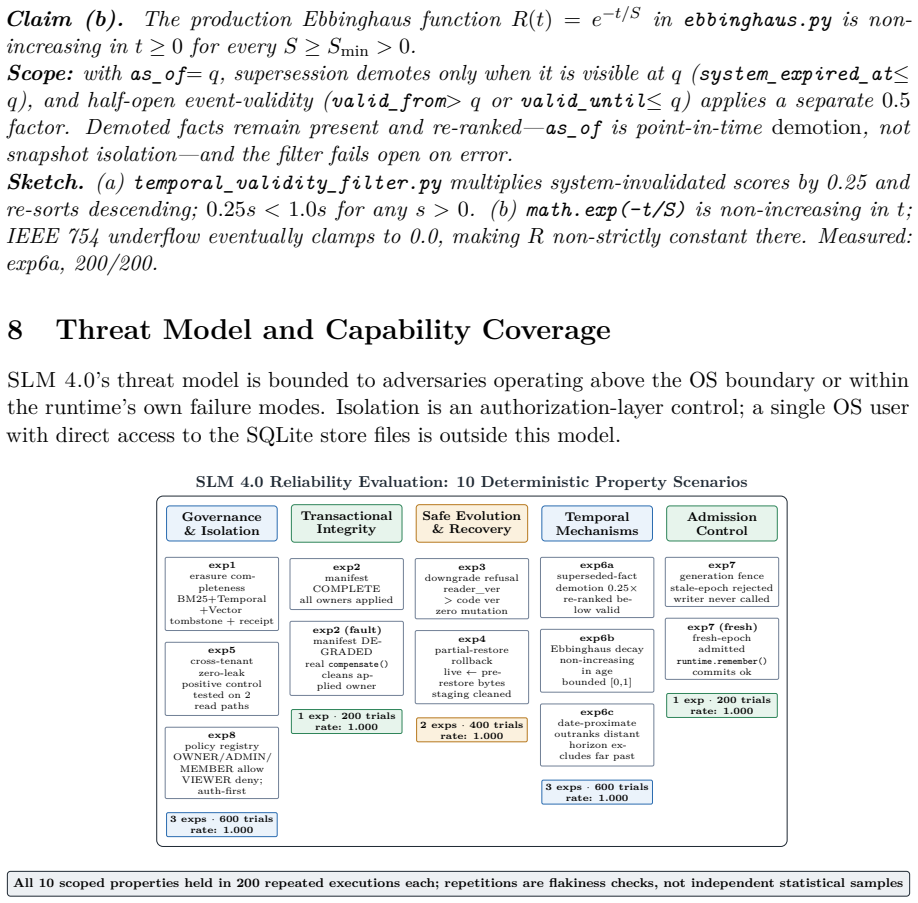
- [Figure 11 (page 23)] The figure title says "10 Deterministic Property Scenarios" and the caption says "All 10 scoped properties held," but Section 10.1 and Table 3 report eleven scenarios and 2,200 repetitions; exp2b is missing from the overview figure. This count discrepancy should be fixed, and exp2b should appear in the taxonomy because it is the primary real-owner evidence.
- [§11, Availability section] The reproducibility statement is slightly inconsistent: Section 11 notes that retained result artifacts record package version and platform but not a source commit or wheel hash, while the Availability section says the exact audited build is pinned at release. For a paper whose evidence is deterministic repetitions, pinning the source SHA and wheel hash of the evidence bundle would make the released records more auditable.
- [Figure 2 caption] The caption contains a typo: "skill evolution pipeline in SLM 4.04.0" should read "SLM 4.0."
Circularity Check
No significant circularity: the reliability claims are tested against the shipped code itself, with disclosed scope limits; prior-work self-citations are not load-bearing.
full rationale
SuperLocalMemory 4.0's central claims concern the behavior of its own write path and transaction spine (generation fence, obligation ledger, completion manifest, erasure receipts). These are evaluated by direct fault-injection against the installed package: Section 10 states 'Each experiment imports the installed superlocalmemory package and drives production code paths' and explicitly brackets the claims as 'scoped component and mechanism measurements.' The Section 7 invariants are labelled 'Verified Design Invariants' established 'by an implementation trace and measured directly—not a formal theorem deduced from axioms,' so the tests check the shipped artifact rather than an independent prediction. No fitted parameter is renamed as a prediction: the governed-write overhead (1.687 ms p50 / 2.728 ms p99) is measured against an ungoverned baseline, not fitted, and the monotonicity checks verify a stated mathematical function rather than deriving a new empirical result. Prior self-citations (V3 LoCoMo retrieval, information-geometric substrate, Living Brain lifecycle) are explicitly carried forward and not used to support the new reliability-spine claims; the paper states the V3 LoCoMo evidence is 'protocol-scoped, not a new V4 benchmark.' The main limitation—'No single scenario exercises the full end-to-end path (HTTP auth→ActorContext→journal→fence→owners→obligation ledger→manifest→ANN)'—is a scope-to-claim gap about evidence coverage, not a circular derivation: it does not show any claim is equivalent by construction to its input. Accordingly no circular step is identified.
Assumptions & free parameters
free parameters (3)
- Ebbinghaus decay constant S (per-fact or global) =
not explicitly given in paper
- RRF fusion constant k =
15
- Demotion score factors =
0.25 for superseded facts, 0.5 for half-open validity
assumptions (4)
- domain assumption Deterministic repetitions of component tests are evidence for reliability of the scoped mechanisms
- domain assumption In-process measurements with a fresh temporary filesystem bound the real-world governed write overhead
- domain assumption Authorization-layer isolation is an acceptable security boundary
- standard math HMAC-SHA256 unforgeability holds with installation-key secrecy
invented entities (3)
-
Projection obligation ledger and CompletionManifest
-
Generation fence epoch map
-
Ebbinghaus recency model with memory decay
Cite this review
Pith. "Pith review of SuperLocalMemory 4.0: The Governed Memory Operating System for AI Agents." pith.science (2026). https://pith.science/paper/RYIC7ZA3
@misc{pith2026260808253,
  author       = {Pith},
  title        = {Pith review of: SuperLocalMemory 4.0: The Governed Memory Operating System for AI Agents},
  year         = {2026},
  howpublished = {\url{https://pith.science/paper/RYIC7ZA3}},
  note         = {Machine review of arXiv:2608.08253}
}
read the original abstract
AI agents are becoming shared infrastructure, yet durable memory is commonly assembled from separate retrieval, governance, and operational components. We present SuperLocalMemory 4.0, a governed, local-first memory operating system for AI agents. The system combines dense semantic, BM25 lexical, temporal, Hopfield-associative, and spreading-activation retrieval through reciprocal-rank fusion; a governed learning and behaviour layer; bi-temporal recall; multi-scope personal, shared, and global memory; role-based access control; GDPR-oriented export and verified erasure; audit trails; and a deployment-context EU AI Act checklist. V4 introduces a reliability spine for its primary write path: generation-fenced admission, a policy registry, verifiable memory transactions with per-projection apply, verify, compensate, and erase owners, and hash-checkable completion manifests. The runtime is available through CLI, MCP, an HTTP daemon, a dashboard, editor integration, and framework adapters, and supports fully local, local-with-on-device-model, and provider-assisted modes. We evaluate eleven fault-injection and mechanism scenarios, each repeated 200 times. The released evidence bundle reports 2,200 of 2,200 deterministic repetitions upholding their scoped component properties. The governed write envelope measured 3.522 ms at p50 and 5.297 ms at p99, versus 1.835 ms and 2.569 ms for the ungoverned baseline, corresponding to in-process control-plane overheads of 1.687 ms at p50 and 2.728 ms at p99. These are scoped component and mechanism measurements, not an end-to-end multi-process or external retrieval-accuracy benchmark. The paper consolidates prior SuperLocalMemory work on privacy-preserving multi-agent memory, information-geometric retrieval, and the V3.3 Living Brain lifecycle.
Figures


Figures from the paper (11 more)



Reference graph
Works this paper leans on
-
[1]
P. Chhikara, D. Khant, S. Aryan, T. Singh, and D. Yadav. Mem0: Building Production- Ready AI Agents with Scalable Long-Term Memory, 2025. arXiv:2504.19413
arXiv 2025
-
[2]
H. Cui et al. MemTxn: A Transaction Boundary for Source-Supported Updates and Complete-State Recovery in Agent Memory, 2026. arXiv:2607.27834. 33
work page Pith review arXiv 2026
-
[3]
J. Fang et al. LightMem: Lightweight and Efficient Memory-Augmented Generation, 2026. ICLR 2026. arXiv:2510.18866
arXiv 2026
-
[4]
Jianyang Gao and Cheng Long. RaBitQ: Quantizing High-Dimensional Vectors with a Theoretical Error Bound for Approximate Nearest Neighbor Search. InProc. ACM SIGMOD International Conference on Management of Data, 2024
work page 2024
-
[5]
B. J. Gutiérrez, Y. Shu, Y. Gu, M. Yasunaga, and Y. Su. HippoRAG: Neurobiolog- ically Inspired Long-Term Memory for Large Language Models, 2024. NeurIPS 2024. arXiv:2405.14831
arXiv 2024
-
[6]
B. J. Gutiérrez, Y. Shu, W. Qi, S. Zhou, and Y. Su. From RAG to Memory: Non- Parametric Continual Learning for Large Language Models (HippoRAG 2), 2025. ICML
work page 2025
-
[7]
Polar- Quant: Quantizing KV Caches with Polar Transformation, 2025
Insu Han, Praneeth Kacham, Amin Karbasi, Vahab Mirrokni, and Amir Zandieh. Polar- Quant: Quantizing KV Caches with Polar Transformation, 2025
work page 2025
-
[8]
MemoryArena: Benchmarking Agent Memory in Interdependent Multi- Session Agentic Tasks, 2026
Zexue He et al. MemoryArena: Benchmarking Agent Memory in Interdependent Multi- Session Agentic Tasks, 2026
work page 2026
Show all 31 references
-
[9]
J. Kang, M. Ji, Z. Zhao, and T. Bai. Memory OS of AI Agent, 2025. arXiv:2506.06326
2025 arXiv
-
[10]
Letta.https://github.com/letta-ai/letta
Letta AI. Letta.https://github.com/letta-ai/letta
-
[11]
Li et al
X. Li et al. MemTX: Transactional Belief Commit for Stateful Agent Memory, 2026. arXiv:2607.23929
2026 arXiv
- [12]
-
[13]
Maharana et al
A. Maharana et al. Evaluating Very Long-Term Conversational Memory of LLM Agents,
-
[14]
R. C. Malo and T. Qiu. PROJECTMEM: A Local-First, Event-Sourced Memory and Judgment Layer for AI Coding Agents, 2026. arXiv:2606.12329
2026 arXiv
-
[15]
Margalit, N
Y. Margalit, N. Cohen-Inger, E. Avram, R. Taig, and O. Margalit. Governed Shared Memory for Multi-Agent LLM Systems (the MemClaw service and the ArgusFleet governance harness), 2026. arXiv:2606.24535
2026 arXiv
-
[16]
Introducing the token-efficient memory algorithm
Mem0. Introducing the token-efficient memory algorithm. https://mem0.ai/blog/ mem0-the-token-efficient-memory-algorithm, 2026. Vendor technical report describ- ing single-pass extraction, entity linking, multi-signal retrieval, and vendor-reported April 2026 benchmark results;...
2026
-
[17]
Mem0 (incl
Mem0 AI. Mem0 (incl. the OpenMemory local MCP server).https://github.com/mem0ai/ mem0
-
[18]
Packer et al
C. Packer et al. MemGPT: Towards LLMs as Operating Systems, 2023. arXiv:2310.08560
2023 arXiv
-
[19]
V. Pratap. SuperLocalMemory: Trust and Behavioral Foundations for Privacy-Preserving Agent Memory (v2), 2026. arXiv:2603.02240
2026
-
[20]
V. Pratap. SuperLocalMemory V3.3: The Living Brain, 2026. arXiv:2604.04514. Harvard ADS: 2026arXiv260404514P
2026 arXiv
-
[21]
V. Pratap. SuperLocalMemory (v3), 2026. arXiv:2603.14588. 34
2026
-
[22]
Rasmussen, P
P. Rasmussen, P. Paliychuk, T. Beauvais, J. Ryan, and D. Chalef. Zep: A Temporal Knowledge Graph Architecture for Agent Memory, 2025. arXiv:2501.13956
2025 arXiv
-
[23]
Supermemory — memory API for the AI era (container-tag multi-tenancy; SOC 2 Type 2 / HIPAA / GDPR; Docker self-host).https://supermemory.ai, 2026
Supermemory. Supermemory — memory API for the AI era (container-tag multi-tenancy; SOC 2 Type 2 / HIPAA / GDPR; Docker self-host).https://supermemory.ai, 2026
2026
-
[24]
H. Taheri. Governed Memory: A Production Architecture for Multi-Agent Workflows, 2026. arXiv:2603.17787
2026
-
[25]
Wang and X
Y. Wang and X. Chen. MIRIX: Multi-Agent Memory System for LLM-Based Agents, 2025. arXiv:2507.07957
2025 arXiv
-
[26]
Wu et al
D. Wu et al. LongMemEval: Benchmarking Chat Assistants on Long-Term Interactive Memory, 2025. ICLR 2025. arXiv:2410.10813
2025 arXiv
-
[27]
Yang et al
N. Yang et al. SF-AMS: Strategic Forgetting for Structured Memory in LLM Agents, 2026. arXiv:2607.22562
2026 arXiv
-
[28]
QJL: 1-Bit Quantized JL Transform for KV Cache Quantization with Zero Overhead, 2024
Amir Zandieh, Majid Daliri, and Insu Han. QJL: 1-Bit Quantized JL Transform for KV Cache Quantization with Zero Overhead, 2024
2024
-
[29]
TurboQuant: Online Vector Quantization with Near-optimal Distortion Rate, 2025
Amir Zandieh, Majid Daliri, Majid Hadian, and Vahab Mirrokni. TurboQuant: Online Vector Quantization with Near-optimal Distortion Rate, 2025
2025
-
[30]
Graphiti.https://github.com/getzep/graphiti
Zep AI. Graphiti.https://github.com/getzep/graphiti
-
[31]
Zhang et al
J. Zhang et al. Beyond Similarity: Trustworthy Memory Search for Personal AI Agents (MemGate), 2026. arXiv:2606.06054. 35
2026 arXiv
Reviewed August 12, 2026 · model on record in the stance chip above.
Discussion (0). Continue with ORCID to comment.