REVIEW 4 major objections 5 minor 236 references
Machine Learning for Specialized QKD Aspects: A Survey of Adaptive Protocols, Free-Space Links, 6G Integration, and Steerability-Aware Security
T0 review · 4 major / 5 minor · reviewed 2026-08-12 · deepseek-v4-flash
Pith's one-line read This survey claims that machine learning, reinforcement learning, and quantum machine learning improve five specialized QKD areas, and that their lowest-risk, most reliable role is improving estimates or decisions that sit beside or above…
desk verdict Useful five-theme map and risk-tier framing, but the reported quantitative gains need a provenance pass before the survey's stronger conclusions can be trusted. read the letter →
The pith
A machine-rendered reading of the paper's core claim, the machinery that carries it, and where it could break.
The reading
What carries the argument
The organizing machinery is the five-theme taxonomy plus a three-tier placement rule that classifies every learned component by its relation to the security proof: above the proof for protocol selection, routing, resource allocation, and key assignment; beside the proof for phase, polarization, channel, and key-rate estimators that feed a proven rate formula; and inside the proof for learned detectors and steerability claims that would certify secrecy. The survey's argument runs on this placement rule, treating the same random-forest or neural-network tool as safe in the first two tiers and dangerous in the third unless its output is a certified conservative lower bound. The five themes are adaptive protocol and parameter support; free-space, satellite, UAV, and HAP-assisted QKD; QKD for IoT, 6G, and quantum-secured federated learning; QML-assisted QKD functions; and steerability-aware one-sided device-independent security.
What would settle it
Take the highest-profile classification claims, the protocol-selection accuracy above 98% and the steerable-weight regression near 0.96, and re-run them with leave-one-link-out or leave-one-device-out splitting on the original simulated data; if accuracy drops to near chance or well below the reported figures, the survey's picture of where ML helps most would be substantially overstated.
Extended reading notes
Core claim
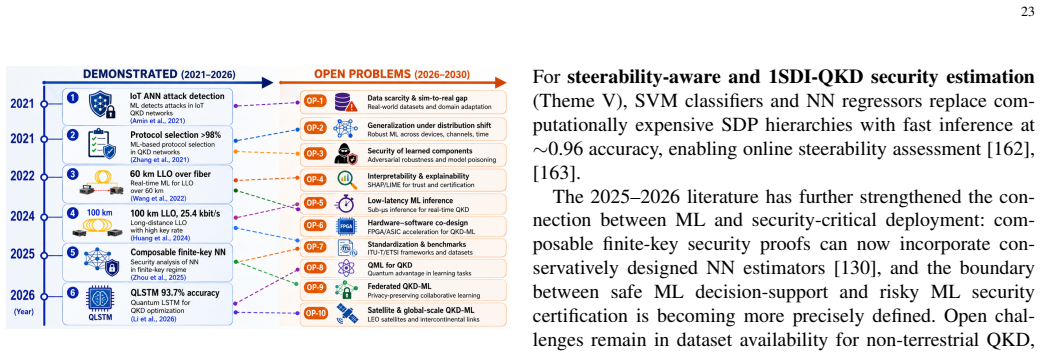
The paper's central claim is a stratification of ML's role in specialized QKD. In five thematic areas it identifies a consistent pattern: learned components deliver large speedups and high classification or regression accuracy, including protocol-selection accuracy above 98%, a five-class QLSTM attack-detection accuracy near 93.7%, Strehl-ratio prediction with mean absolute percentage error in the low single digits, steerable-weight regression accuracy near 0.96, and ML-assisted carrier recovery that extends local-local-oscillator CV-QKD to 100 km, when they act as surrogates or estimators feeding a proven rate formula or as optimizers above the proof. The same evidence is read as a warning: learned attack detectors, key-rate predictions, or steerability estimates used directly in a secrecy claim are high-risk unless they are built with provably conservative bounds, as the paper reads the composable excess-noise estimator as showing. The conclusion is that the clearest and lowest-risk wins sit beside or above the proof, not inside it.
Load-bearing premise
The survey's conclusions depend on the reported quantitative gains in the primary literature being accurate and representative, even though most of them come from simulation-only evaluations with no link-wise train/test splitting and several are the authors' own prior works.
Editorial extensions
If this is right
- New QKD deployments can treat learned protocol selectors and RL schedulers as deployable efficiency layers today, because errors in those roles cost throughput, not secrecy.
- Physical-layer learned estimators, such as ML phase recovery and SOP prediction, can extend reach and availability without weakening security, making them the most immediate candidates for field integration.
- Learned components that claim to detect attacks or certify steerability should be used only as monitors, or with provably conservative bounds, until certification requirements are met.
- Future research should prioritize open non-terrestrial datasets, link-wise evaluation splits, and composable conservative estimators over further accuracy chasing.
- QML's role in QKD remains speculative: no hardware-validated advantage over classical ML exists, so the safest reading is to treat QML as a monitoring and optimization layer.
Reading between the lines
- A direct consequence the authors leave implicit is that the near-ceiling accuracy reported for protocol selection and steerability classification is likely inflated by simulation-only, non-link-split evaluation; re-running with proper splits would probably lower the scores while preserving the ranking of the three tiers.
- The same placement rule could be exported to adjacent problems such as post-quantum cryptography migration or classical optical-network control, wherever a learned estimator feeds a certified margin.
- A concrete next experiment suggested by the survey's own roadmap is an integrated pipeline that jointly trains phase recovery, reconciliation decoding, and parameter optimization toward composable secret bits per second, which the paper lists as an open problem without demonstrating it.
Editorial analysis
A structured set of objections, weighed in public.
Referee Report
Summary. This survey reviews machine learning (ML), reinforcement learning (RL), and quantum machine learning (QML) applied to specialized and emerging QKD scenarios beyond conventional point-to-point fiber links, organized into five thematic pillars: adaptive protocol and parameter support; free-space, satellite, UAV, and HAP-assisted QKD; QKD for IoT, 6G, and quantum-secured federated learning; QML-assisted QKD functions; and steerability-aware, one-sided-device-independent QKD security estimation. For each theme it provides a problem/conventional-solution/ML-solution structure, per-theme and cross-theme comparison tables, and consolidated quantitative gains. It also proposes a three-tier risk classification (above-proof, beside-proof, inside-proof) for placing learned components relative to QKD security proofs, and identifies open challenges including dataset scarcity, generalization, interpretability, and trustworthy QML. The paper's central claim is that learning delivers its clearest, lowest-risk wins when it improves an estimate or decision supporting adaptive, non-terrestrial, or application-driven QKD without touching the security proof directly.
Significance. If the survey's conclusions are reliable, it provides a valuable and much-needed map of where ML/RL/QML can be safely and effectively deployed in specialized QKD settings, distinguishing low-risk decision support from security-critical certification. Its strengths include a clean five-theme taxonomy, a consistent per-theme structure, a useful Tier I/II/III security-placement framework, and an unusually honest evaluation-quality critique in Section XIII and Table XX that acknowledges most surveyed results are simulation-only and lack link-wise splitting or uncertainty reporting. The paper also explicitly identifies open problems (OP-1 to OP-10) and argues for open datasets and standardized benchmarks, which are constructive contributions to the community. However, the quantitative evidence underpinning the central claim is presented largely at face value from heterogeneous sources, several of which are the authors' own prior works, and at least one reported result is internally inconsistent; this currently limits the confidence with which the survey's synthesized conclusions can be accepted as a reliable guide.
major comments (4)
- [Section VIII-C and Table XIV vs reference [159]] The QLSTM result is reported inconsistently: Section VIII-C, Table XIV, and Section XI-D state '93.7% accuracy over five attack types' citing the IET version [114], while the arXiv version [159] of the same work is annotated in the reference list as 94.7% accuracy over four attack types. Because this number is used as a headline quantitative gain for Theme IV and feeds directly into the paper's conclusion about QML-assisted attack detection, the inconsistency is load-bearing and must be reconciled or explicitly flagged as an unresolved discrepancy before the survey's quantitative claims can be considered reliable.
- [Section XIII vs Sections X-XI] The paper identifies in Section XIII common evaluation pitfalls—leakage-free splitting, class imbalance, uncertainty and calibration—and Table XX scores representative works as mostly simulation-only, without link-wise splitting, without uncertainty reporting, and without field validation. Yet Sections X and XI present the same headline gains (e.g., >98% protocol-selection accuracy, 93.7% QLSTM detection, ~0.96 steerability regression, orders-of-magnitude speedups) at face value, without screening or qualifying them against these criteria. The survey should apply its own evaluation-quality criteria when reporting each headline gain, or clearly state that these numbers are unvalidated literature claims, so that the risk-tier conclusions are not built on unsecured quantitative ground.
- [Section XI-A (CV-QKD reach comparison)] The claim that ML-assisted LLO phase recovery gave 'a roughly fourfold improvement in distance over the 25 km commercial baseline' compares the 100 km result of [108] with 25 km systems from [164], [165] that differ in many hardware aspects beyond the use of ML. This improvement is not attributable specifically to the learned component, and the comparison conflates technological progress over roughly fifteen years with the ML contribution. The statement should be reworded to report the demonstrated reach of [108] and [126] without attributing the distance gain to ML unless a controlled comparison exists.
- [Reference list and Table XVI] A substantial number of the headline rows in Table XVI and the consolidated tables come from the authors' own works (e.g., [37], [38], [39], [51], [52], [53], [54], [55], [56]), and their independence is not assessed or discussed. Since the survey's central synthesis claims that specific ML roles are 'ready to deploy,' the manuscript should include a provenance or self-citation disclosure, ideally marking which quantitative entries are from the authors' own papers versus independently replicated results, and discuss any potential bias in the conclusions that rely on those entries.
minor comments (5)
- [Reference list] The reference list contains nonstandard annotations such as 'vERIFIED' and 'CONFIRM authors' (e.g., [33], [108], [114], [122], [142], [149], [159], [189]). These appear to be internal verification notes and should be removed or converted into a standard editorial footnote, as they are not part of a formal reference entry.
- [Section V-C and Section VII-A] OptiQKD appears twice with the same arXiv identifier: as [118] in Section V-C and as [120] in Section VII-A, with slightly different descriptions. The duplicate reference should be merged and cited consistently.
- [Section XI-B] The sentence 'the hybrid QLSTM raises the bar to ~93.7% over a harder five-class problem spanning unknown attack types' is unclear because the QLSTM result concerns five known attack classes, not necessarily unknown attack types; please clarify the relationship to the DBSCAN-based unknown-attack detection reported in [157].
- [Section II-E] Equation (1) writes the asymptotic secret fraction with 'r' while the surrounding text and Eq. (2) use 'R' for the key rate; unify the notation for readability.
- [Section VII-B, Eq. (5)] The key-assignment optimization problem in Eq. (5) would benefit from a brief definition of the utility function u_k and the path set P_k, which are introduced only implicitly in the surrounding text.
Circularity Check
The paper is a literature compilation, not a derivation; no surveyed prediction reduces to its own inputs by construction, and the self-citations are evidence items rather than load-bearing proof elements.
full rationale
This is a survey, so the normal derivation-chain circularity tests do not directly apply. The five-theme taxonomy is a stipulated organizational scheme (Section I-B), not a quantity derived from data, and the central risk-tier conclusion (Sections XI-E and XV) is a qualitative synthesis of literature-reported gains rather than a number computed in this paper. No equation in the paper is fitted to a subset of data and then renamed a prediction. The self-cited works [37]-[39], [51]-[56] are reported as primary sources for HAP/FSO and IoT attack-detection results; although they are concentrated in Themes II and IV, the survey does not invoke a uniqueness theorem or an ansatz from those works to force its conclusions, so the self-citations are not load-bearing in the circularity sense. The paper's own Table XX and Section XIII disclose that most headline results are simulation-only and lack link-wise splitting and uncertainty reporting; the unreconciled QLSTM accuracy figures (93.7% in [114] vs 94.7% in [159]) are an internal-consistency and reproducibility defect, not a circular reduction. Because the paper's claims are not forced by construction or by a self-citation chain, no circular step can be exhibited; the score reflects only minor self-citation density and evidence-provenance concerns.
Assumptions & free parameters
assumptions (3)
- standard math The QKD security proofs for BB84, MDI, TF, CV, and 1SDI-QKD are valid as cited (e.g., Shor-Preskill, Renner, Leverrier, Branciard et al.).
- domain assumption The reported performance metrics in the surveyed papers accurately reflect the methods' true performance in the stated settings.
- ad hoc to paper The five-theme taxonomy and the Tier I/II/III security-placement classification are useful and sufficiently exhaustive organizing schemes for the surveyed literature.
Cite this review
Pith. "Pith review of Machine Learning for Specialized QKD Aspects: A Survey of Adaptive Protocols, Free-Space Links, 6G Integration, and Steerability-Aware Security." pith.science (2026). https://pith.science/paper/A2EVPE6T
@misc{pith2026260808280,
  author       = {Pith},
  title        = {Pith review of: Machine Learning for Specialized QKD Aspects: A Survey of Adaptive Protocols, Free-Space Links, 6G Integration, and Steerability-Aware Security},
  year         = {2026},
  howpublished = {\url{https://pith.science/paper/A2EVPE6T}},
  note         = {Machine review of arXiv:2608.08280}
}
read the original abstract
Quantum Key Distribution (QKD) provides information-theoretic security grounded in the laws of quantum mechanics, yet practical deployment increasingly extends beyond conventional point-to-point fiber links. Several rapidly emerging QKD directions are often studied separately, including adaptive protocol and parameter support; free-space, satellite, UAV, and high-altitude platform (HAP) channels; integration with IoT and 6G networks; quantum-secured federated learning; Quantum Machine Learning (QML) assisted decision support; and steerability-aware estimation for one-sided device-independent QKD. This survey examines how Machine Learning (ML), Reinforcement Learning (RL), and QML address these specialized scenarios and organizes the literature into five thematic pillars: (I) adaptive protocol and parameter support; (II) free-space, satellite, UAV, and HAP-assisted QKD; (III) QKD for IoT, 6G, and quantum-secured federated learning; (IV) QML-assisted QKD functions; and (V) steerability-aware and one-sided device-independent QKD security estimation. For each theme, we follow a consistent problem, conventional solution, and ML/RL/QML solution structure and summarize reported gains using metrics such as accuracy, mean absolute percentage error, QBER reduction, and secret key rate improvement. We further provide thematic and cross-theme comparison tables and identify open challenges, including dataset scarcity, transferability across weather and mobility conditions, interpretability, trustworthy QML, and the boundary between ML-based decision support and security certification. This survey serves as a focused reference for adaptive, non-terrestrial, and application-integrated QKD systems.
Figures


Figures from the paper (4 more)


Reference graph
Works this paper leans on
-
[114]
Resisting quantum key distribution attacks using quantum machine learning,
A. Al-Kuwariet al., “Resisting quantum key distribution attacks using quantum machine learning,”IET Quantum Communication, 2026, vERIFIED – published IET 2026; Hybrid QLSTM; 93.7% accuracy after 50 epochs; surpasses LSTM and CNN baselines
2026
-
[159]
Resisting quantum key distribution attacks using quantum machine learning,
A. Al-Kuwariet al., “Resisting quantum key distribution attacks using quantum machine learning,”arXiv preprint arXiv:2509.14282, 2025, vERIFIED – Hybrid QLSTM; 94.7% accuracy over intercept- resend, PNS, Trojan-Horse, detector-blinding attacks; decoy-state BB84 dataset. 27
-
[108]
Long-distance continuous-variable quantum key distribution over 100 km fiber with local local oscillator,
Y . Pan, H. Wang, Y . Shao, Y . Pi, Y . Li, B. Liu, W. Huang, and B. Xu, “Long-distance continuous-variable quantum key distribution over 100 km fiber with local local oscillator,”Sci. Adv., vol. 10, no. 26, p. eadi9474, 2024, vERIFIED venue/result – ML carrier recovery, 25.4 kbit/s, 15.4 dB. CONFIRM authors
2024
-
[164]
Quantum key distribution over 25 km with an all-fiber continuous-variable system,
J. Lodewycket al., “Quantum key distribution over 25 km with an all-fiber continuous-variable system,”Phys. Rev. A, vol. 76, no. 4, p. 042305, 2007
2007
-
[165]
Field test of a continuous-variable quantum key distribution prototype,
S. Fossier, E. Diamanti, T. Debuisschert, A. Villing, R. Tualle-Brouri, and P. Grangier, “Field test of a continuous-variable quantum key distribution prototype,”New J. Phys., vol. 11, p. 045023, 2009
2009
-
[126]
Continuous-Variable Quantum Key Distribution Over 60 km Optical Fiber With Real Local Oscillator
A. A. E. Hajomer, H. Mani, N. Jain, H.-M. Chin, U. L. Andersen, and T. Gehring, “Continuous-variable quantum key distribution over 60 km optical fiber with real local oscillator,” inProc. Eur. Conf. Opt. Commun. (ECOC), 2022, vERIFIED – ML phase-noise compensation, LLO; arXiv:2205.15161
work page Pith review arXiv 2022
-
[37]
Quantum leaps in the sky: Composable XOR-relay QKD over HAPs for next-gen 6G networks,
H. A. Al-Mohammed and E. Yaacoub, “Quantum leaps in the sky: Composable XOR-relay QKD over HAPs for next-gen 6G networks,” in2025 IEEE 11th World Forum on Internet of Things (WF-IoT), 2025, pp. 1–6
2025
-
[38]
Advancing secure communications in high- mobility environments: Integrating quantum key distribution, free space optics, and high-altitude platforms for enhanced iot networks,
H. A. Al-Mohammed, “Advancing secure communications in high- mobility environments: Integrating quantum key distribution, free space optics, and high-altitude platforms for enhanced iot networks,” Ph.D. dissertation, Qatar University, 2026
2026
-
[39]
On the tradeoffs of FSO communications in UA V networks under varying weather conditions,
H. Al-Mohammed, K. Abualsaud, and E. Yaacoub, “On the tradeoffs of FSO communications in UA V networks under varying weather conditions,” in2024 International Telecommunications Conference (ITC-Egypt), 2024, pp. 8–13
2024
-
[51]
Detecting attackers during quantum key distribution in IoT networks using neural networks,
H. A. Al-Mohammed, A. Al-Ali, E. Yaacoub, K. Abualsaud, and T. Khattab, “Detecting attackers during quantum key distribution in IoT networks using neural networks,” in2021 IEEE Globecom Workshops (GC Wkshps), 2021, pp. 1–6
2021
-
[52]
Machine learning techniques for detecting attackers during quantum key distribution in IoT networks with application to railway scenarios,
H. A. Al-Mohammed, A. Al-Ali, E. Yaacoub, U. Qidwai, K. Abualsaud et al., “Machine learning techniques for detecting attackers during quantum key distribution in IoT networks with application to railway scenarios,”IEEE Access, vol. 9, pp. 136 994–137 004, 2021
2021
-
[53]
Towards scalable quantum key distribution: A machine learning-based cascade protocol approach,
H. A. Al-Mohammed, S. Al-Kuwari, H. Kuniyil, and A. Farouk, “Towards scalable quantum key distribution: A machine learning-based cascade protocol approach,”arXiv preprint arXiv:2409.08038, 2024
arXiv 2024
-
[54]
Using quantum key distribution with free space optics to secure communications in high-speed trains,
H. A. Al-Mohammed, E. Yaacoub, K. Abualsaud, and S. A. Al- Maadeed, “Using quantum key distribution with free space optics to secure communications in high-speed trains,”IEEE Access, vol. 12, pp. 43 560–43 574, 2024
2024
-
[55]
FSO communica- tion system for high-speed trains under varying visibility conditions,
H. A. Al-Mohammed, M. Al-Ali, and E. Yaacoub, “FSO communica- tion system for high-speed trains under varying visibility conditions,” Vehicular Communications, vol. 43, p. 100634, 2023
2023
-
[56]
Free space optics communi- cation for ultra-high-speed train running in evacuated tube,
H. A. Al-Mohammed and E. Yaacoub, “Free space optics communi- cation for ultra-high-speed train running in evacuated tube,”Applied Sciences, vol. 12, no. 17, p. 8545, 2022
2022
Show all 236 references
-
[1]
A method for obtaining dig- ital signatures and public-key cryptosystems,
R. L. Rivest, A. Shamir, and L. Adleman, “A method for obtaining dig- ital signatures and public-key cryptosystems,”Commun. ACM, vol. 21, no. 2, pp. 120–126, 1978
1978
-
[2]
New directions in cryptography,
W. Diffie and M. E. Hellman, “New directions in cryptography,”IEEE Trans. Inf. Theory, vol. 22, no. 6, pp. 644–654, 1976
1976
-
[3]
Algorithms for quantum computation: Discrete logarithms and factoring,
P. W. Shor, “Algorithms for quantum computation: Discrete logarithms and factoring,” inProc. 35th Annu. Symp. Found. Comput. Sci. (FOCS), 1994, pp. 124–134
1994
-
[4]
A fast quantum mechanical algorithm for database search,
L. K. Grover, “A fast quantum mechanical algorithm for database search,” inProc. 28th Annu. ACM Symp. Theory Comput. (STOC), 1996, pp. 212–219
1996
-
[5]
Quantum supremacy using a programmable supercon- ducting processor,
F. Aruteet al., “Quantum supremacy using a programmable supercon- ducting processor,”Nature, vol. 574, pp. 505–510, 2019
2019
-
[6]
Quantum computing in the NISQ era and beyond,
J. Preskill, “Quantum computing in the NISQ era and beyond,” Quantum, vol. 2, p. 79, 2018
2018
-
[7]
Post-quantum cryptography,
D. J. Bernstein and T. Lange, “Post-quantum cryptography,”Nature, vol. 549, pp. 188–194, 2017
2017
-
[8]
Quantum cryptography: Public key distribution and coin tossing,
C. H. Bennett and G. Brassard, “Quantum cryptography: Public key distribution and coin tossing,” inProc. IEEE Int. Conf. Comput., Syst. Signal Process., Bangalore, India, 1984, pp. 175–179
1984
-
[9]
Quantum cryptography based on Bell’s theorem,
A. K. Ekert, “Quantum cryptography based on Bell’s theorem,”Phys. Rev. Lett., vol. 67, no. 6, pp. 661–663, 1991
1991
-
[10]
Quantum cryptog- raphy,
N. Gisin, G. Ribordy, W. Tittel, and H. Zbinden, “Quantum cryptog- raphy,”Rev. Mod. Phys., vol. 74, no. 1, pp. 145–195, 2002
2002
-
[11]
Quantum key distribution with high loss: Toward global secure communication,
W.-Y . Hwang, “Quantum key distribution with high loss: Toward global secure communication,”Phys. Rev. Lett., vol. 91, no. 5, p. 057901, 2003
2003
-
[12]
Decoy state quantum key distribution,
H.-K. Lo, X. Ma, and K. Chen, “Decoy state quantum key distribution,” Phys. Rev. Lett., vol. 94, no. 23, p. 230504, 2005
2005
-
[13]
Beating the photon-number-splitting attack in practical quantum cryptography,
X.-B. Wang, “Beating the photon-number-splitting attack in practical quantum cryptography,”Phys. Rev. Lett., vol. 94, no. 23, p. 230503, 2005
2005
-
[14]
Measurement-device-independent quantum key distribution,
H.-K. Lo, M. Curty, and B. Qi, “Measurement-device-independent quantum key distribution,”Phys. Rev. Lett., vol. 108, no. 13, p. 130503, 2012
2012
-
[15]
Overcoming the rate-distance limit of quantum key distribution without quantum repeaters,
M. Lucamarini, Z. L. Yuan, J. F. Dynes, and A. J. Shields, “Overcoming the rate-distance limit of quantum key distribution without quantum repeaters,”Nature, vol. 557, pp. 400–403, 2018
2018
-
[16]
Continuous variable quantum cryptog- raphy using coherent states,
F. Grosshans and P. Grangier, “Continuous variable quantum cryptog- raphy using coherent states,”Phys. Rev. Lett., vol. 88, no. 5, p. 057902, 2002
2002
-
[17]
Gaussian quantum information,
C. Weedbrook, S. Pirandola, R. García-Patrón, N. J. Cerf, T. C. Ralph, J. H. Shapiro, and S. Lloyd, “Gaussian quantum information,”Rev. Mod. Phys., vol. 84, no. 2, pp. 621–669, 2012
2012
-
[18]
Simple proof of security of the BB84 quantum key distribution protocol,
P. W. Shor and J. Preskill, “Simple proof of security of the BB84 quantum key distribution protocol,”Phys. Rev. Lett., vol. 85, no. 2, pp. 441–444, 2000. 24
2000
-
[19]
Unconditional security in quantum cryptography,
D. Mayers, “Unconditional security in quantum cryptography,”J. ACM, vol. 48, no. 3, pp. 351–406, 2001
2001
-
[20]
Security of quantum key distribution,
R. Renner, “Security of quantum key distribution,”Int. J. Quantum Inf., vol. 6, no. 1, pp. 1–127, 2008
2008
-
[21]
The security of practical quantum key distribution,
V . Scarani, H. Bechmann-Pasquinucci, N. J. Cerf, M. Dušek, N. Lütkenhaus, and M. Peev, “The security of practical quantum key distribution,”Rev. Mod. Phys., vol. 81, no. 3, pp. 1301–1350, 2009
2009
-
[22]
The SECOQC quantum key distribution network in Vienna,
M. Peevet al., “The SECOQC quantum key distribution network in Vienna,”New J. Phys., vol. 11, p. 075001, 2009
2009
-
[23]
Field test of quantum key distribution in the Tokyo QKD network,
M. Sasakiet al., “Field test of quantum key distribution in the Tokyo QKD network,”Opt. Express, vol. 19, no. 11, pp. 10 387–10 409, 2011
2011
-
[24]
Secure quantum key distribution over 421 km of optical fiber,
A. Boaronet al., “Secure quantum key distribution over 421 km of optical fiber,”Phys. Rev. Lett., vol. 121, no. 19, p. 190502, 2018
2018
-
[25]
Satellite-to-ground quantum key distribution,
S.-K. Liaoet al., “Satellite-to-ground quantum key distribution,”Na- ture, vol. 549, pp. 43–47, 2017
2017
-
[26]
Entanglement-based secure quantum cryptography over 1,120 kilometres,
J. Yinet al., “Entanglement-based secure quantum cryptography over 1,120 kilometres,”Nature, vol. 582, pp. 501–505, 2020
2020
-
[27]
An integrated space-to-ground quantum communi- cation network over 4,600 kilometres,
Y .-A. Chenet al., “An integrated space-to-ground quantum communi- cation network over 4,600 kilometres,”Nature, vol. 589, pp. 214–219, 2021
2021
-
[28]
Secure quantum key distribution,
H.-K. Lo, M. Curty, and K. Tamaki, “Secure quantum key distribution,” Nat. Photonics, vol. 8, pp. 595–604, 2014
2014
-
[29]
Secure quantum key distribution with realistic devices,
F. Xu, X. Ma, Q. Zhang, H.-K. Lo, and J.-W. Pan, “Secure quantum key distribution with realistic devices,”Rev. Mod. Phys., vol. 92, no. 2, p. 025002, 2020
2020
-
[30]
Advances in quantum cryptography,
S. Pirandolaet al., “Advances in quantum cryptography,”Adv. Opt. Photon., vol. 12, no. 4, pp. 1012–1236, 2020
2020
-
[31]
Machine learning techniques for enhancing quantum key distribution,
A. Al-Kuwari, S. Alqrinawi, L. Al-Amir, A. Mollazehi, and S. Al- Kuwari, “Machine learning techniques for enhancing quantum key distribution,”arXiv preprint arXiv:2603.07384, 2026
2026
-
[32]
A survey of machine learning assisted continuous-variable quantum key distribution,
N. K. Long, R. Malaney, and K. J. Grant, “A survey of machine learning assisted continuous-variable quantum key distribution,”Information, vol. 14, no. 10, p. 553, 2023
2023
-
[33]
Machine learning for optimal parameter prediction in quantum key distribution,
W. Wang and H.-K. Lo, “Machine learning for optimal parameter prediction in quantum key distribution,”Phys. Rev. A, vol. 100, no. 6, p. 062334, 2019, vERIFIED – NN parameter prediction for MDI/BB84/TF-QKD
2019
-
[34]
Optical resolution through a randomly inhomogeneous medium for very long and very short exposures,
D. L. Fried, “Optical resolution through a randomly inhomogeneous medium for very long and very short exposures,”J. Opt. Soc. Am., vol. 56, no. 10, pp. 1372–1379, 1966
1966
-
[35]
L. C. Andrews and R. L. Phillips,Laser Beam Propagation Through Random Media, 2nd ed. SPIE Press, 2005
2005
-
[36]
Toward global quantum communication: Beam wandering preserves nonclassicality,
D. Vasylyev, A. A. Semenov, and W. V ogel, “Toward global quantum communication: Beam wandering preserves nonclassicality,”Phys. Rev. Lett., vol. 108, no. 22, p. 220501, 2012
2012
-
[40]
On the use of quantum communications for securing IoT devices in the 6G era,
H. A. Al-Mohammed and E. Yaacoub, “On the use of quantum communications for securing IoT devices in the 6G era,” in2021 IEEE International Conference on Communications Workshops (ICC Workshops), 2021
2021
-
[41]
Quantum key distribution with application to IoT security,
H. A. Al-Mohammed, “Quantum key distribution with application to IoT security,” Master’s thesis, Qatar University, 2021
2021
-
[42]
Federated learning in quantum computing for privacy-preserving and distributed quan- tum model training,
P. chander Mashetty, S. Chittipothu, N. V . Gangabathula, S. Ganga- bathula, P. K. Gutta, and N. A. S. Rajalakshmi, “Federated learning in quantum computing for privacy-preserving and distributed quan- tum model training,” in2025 6th International Conference on Data Intelligen...
2025
-
[43]
One-sided device-independent quantum key distribution: Security, feasibility, and the connection with steering,
C. Branciard, E. G. Cavalcanti, S. P. Walborn, V . Scarani, and H. M. Wiseman, “One-sided device-independent quantum key distribution: Security, feasibility, and the connection with steering,”Phys. Rev. A, vol. 85, no. 1, p. 010301, 2012
2012
-
[44]
Steering, entangle- ment, nonlocality, and the Einstein–Podolsky–Rosen paradox,
H. M. Wiseman, S. J. Jones, and A. C. Doherty, “Steering, entangle- ment, nonlocality, and the Einstein–Podolsky–Rosen paradox,”Phys. Rev. Lett., vol. 98, no. 14, p. 140402, 2007
2007
-
[45]
Deep learning,
Y . LeCun, Y . Bengio, and G. Hinton, “Deep learning,”Nature, vol. 521, pp. 436–444, 2015
2015
-
[46]
Machine learning: Trends, perspec- tives, and prospects,
M. I. Jordan and T. M. Mitchell, “Machine learning: Trends, perspec- tives, and prospects,”Science, vol. 349, no. 6245, pp. 255–260, 2015
2015
-
[47]
An optical communica- tion’s perspective on machine learning and its applications,
F. N. Khan, Q. Fan, C. Lu, and A. P. T. Lau, “An optical communica- tion’s perspective on machine learning and its applications,”J. Lightw. Technol., vol. 37, no. 2, pp. 493–516, 2019
2019
-
[48]
An overview on application of machine learning techniques in optical networks,
F. Musumeciet al., “An overview on application of machine learning techniques in optical networks,”IEEE Commun. Surveys Tuts., vol. 21, no. 2, pp. 1383–1408, 2019
2019
-
[49]
An introduction to deep learning for the physical layer,
T. O’Shea and J. Hoydis, “An introduction to deep learning for the physical layer,”IEEE Trans. Cogn. Commun. Netw., vol. 3, no. 4, pp. 563–575, 2017
2017
-
[50]
Machine learning under the spotlight,
D. Zibar, H. Wymeersch, and I. Lyubomirsky, “Machine learning under the spotlight,”Nat. Photonics, vol. 11, pp. 749–751, 2017
2017
-
[57]
Random forests,
L. Breiman, “Random forests,”Mach. Learn., vol. 45, no. 1, pp. 5–32, 2001
2001
-
[58]
Support-vector networks,
C. Cortes and V . Vapnik, “Support-vector networks,”Mach. Learn., vol. 20, no. 3, pp. 273–297, 1995
1995
-
[59]
XGBoost: A scalable tree boosting system,
T. Chen and C. Guestrin, “XGBoost: A scalable tree boosting system,” inProc. ACM SIGKDD Int. Conf. Knowl. Discov. Data Min., 2016, pp. 785–794
2016
-
[60]
LightGBM: A highly efficient gradient boosting decision tree,
G. Ke, Q. Meng, T. Finley, T. Wang, W. Chen, W. Ma, Q. Ye, and T.-Y . Liu, “LightGBM: A highly efficient gradient boosting decision tree,” inAdv. Neural Inf. Process. Syst. (NeurIPS), 2017, pp. 3146–3154
2017
-
[61]
ImageNet classification with deep convolutional neural networks,
A. Krizhevsky, I. Sutskever, and G. E. Hinton, “ImageNet classification with deep convolutional neural networks,” inAdv. Neural Inf. Process. Syst. (NeurIPS), 2012, pp. 1097–1105
2012
-
[62]
Long short-term memory,
S. Hochreiter and J. Schmidhuber, “Long short-term memory,”Neural Comput., vol. 9, no. 8, pp. 1735–1780, 1997
1997
-
[63]
A new approach to linear filtering and prediction problems,
R. E. Kalman, “A new approach to linear filtering and prediction problems,”J. Basic Eng., vol. 82, no. 1, pp. 35–45, 1960
1960
-
[64]
A new extension of the Kalman filter to nonlinear systems,
S. J. Julier and J. K. Uhlmann, “A new extension of the Kalman filter to nonlinear systems,” inProc. SPIE – Signal Process., Sensor Fusion, Target Recognit., vol. 3068, 1997, pp. 182–193
1997
-
[65]
Isolation forest,
F. T. Liu, K. M. Ting, and Z.-H. Zhou, “Isolation forest,” inProc. IEEE Int. Conf. Data Min. (ICDM), 2008, pp. 413–422
2008
-
[66]
A density-based algorithm for discovering clusters in large spatial databases with noise,
M. Ester, H.-P. Kriegel, J. Sander, and X. Xu, “A density-based algorithm for discovering clusters in large spatial databases with noise,” inProc. ACM SIGKDD Int. Conf. Knowl. Discov. Data Min., 1996, pp. 226–231
1996
-
[67]
R. S. Sutton and A. G. Barto,Reinforcement Learning: An Introduction, 2nd ed. MIT Press, 2018
2018
-
[68]
Human-level control through deep reinforcement learning,
V . Mnihet al., “Human-level control through deep reinforcement learning,”Nature, vol. 518, pp. 529–533, 2015
2015
-
[69]
Quantum machine learning,
J. Biamonte, P. Wittek, N. Pancotti, P. Rebentrost, N. Wiebe, and S. Lloyd, “Quantum machine learning,”Nature, vol. 549, pp. 195–202, 2017
2017
-
[70]
An introduction to quantum machine learning,
M. Schuld, I. Sinayskiy, and F. Petruccione, “An introduction to quantum machine learning,”Contemp. Phys., vol. 56, no. 2, pp. 172– 185, 2015
2015
-
[71]
Supervised learning with quantum- enhanced feature spaces,
V . Havlí ˇcek, A. D. Córcoles, K. Temme, A. W. Harrow, A. Kandala, J. M. Chow, and J. M. Gambetta, “Supervised learning with quantum- enhanced feature spaces,”Nature, vol. 567, pp. 209–212, 2019. 25
2019
-
[72]
Machine learning and artificial intelli- gence in the quantum domain,
V . Dunjko and H. J. Briegel, “Machine learning and artificial intelli- gence in the quantum domain,”Rep. Prog. Phys., vol. 81, no. 7, p. 074001, 2018
2018
-
[73]
From provable to practical: A problem-driven survey of classical and machine-learning defenses for DV/CV quantum key distribution,
H. A. Al-Mohammed and A. S. Al-Ali, “From provable to practical: A problem-driven survey of classical and machine-learning defenses for DV/CV quantum key distribution,”arXiv preprint arXiv:2605.27497, 2026
2026 arXiv
-
[74]
Quantum key distribution: A networking perspective,
M. Mehic, M. Niemiec, S. Rass, J. Ma, M. Peev, A. Aguado, E. Hugues-Salas, and M. V oznak, “Quantum key distribution: A networking perspective,”ACM Comput. Surv., vol. 53, no. 5, pp. 1– 41, 2020
2020
-
[75]
The evolution of quantum key distribution networks: On the road to the Qinternet,
Y . Cao, Y . Zhao, Q. Wang, J. Zhang, S. X. Ng, and L. Hanzo, “The evolution of quantum key distribution networks: On the road to the Qinternet,”IEEE Commun. Surveys Tuts., vol. 24, no. 2, pp. 839–894, 2022
2022
-
[76]
Challenges and opportunities in quantum machine learning,
M. Cerezo, G. Verdon, H.-Y . Huang, L. Cincio, and P. J. Coles, “Challenges and opportunities in quantum machine learning,”Nat. Comput. Sci., vol. 2, pp. 567–576, 2022
2022
-
[77]
Automatically identifying imperfections and attacks in practical quan- tum key distribution systems via machine learning,
J. Xu, X. Ma, J. Liu, C. Zhang, H. Li, X. Zhou, and Q. Wang, “Automatically identifying imperfections and attacks in practical quan- tum key distribution systems via machine learning,”Science China Information Sciences, vol. 67, no. 10, p. 202501, 2024
2024
-
[78]
Quantum key distribution through quantum machine learning: A research review,
K. Purohit and A. K. Vyas, “Quantum key distribution through quantum machine learning: A research review,”Frontiers in Quantum Science and Technology, vol. 4, p. 1575498, 2025
2025
-
[79]
Quantum cryptography with finite re- sources,
V . Scarani and R. Renner, “Quantum cryptography with finite re- sources,”Phys. Rev. Lett., vol. 100, no. 20, p. 200501, 2008
2008
-
[80]
Tight finite- key analysis for quantum cryptography,
M. Tomamichel, C. C. W. Lim, N. Gisin, and R. Renner, “Tight finite- key analysis for quantum cryptography,”Nat. Commun., vol. 3, p. 634, 2012
2012
-
[81]
Measurement-device-independent quantum key dis- tribution over a 404 km optical fiber,
H.-L. Yinet al., “Measurement-device-independent quantum key dis- tribution over a 404 km optical fiber,”Phys. Rev. Lett., vol. 117, no. 19, p. 190501, 2016
2016
-
[82]
Quantum key distribution without detector vulnerabilities using optically seeded lasers,
L. C. Comandaret al., “Quantum key distribution without detector vulnerabilities using optically seeded lasers,”Nat. Photonics, vol. 10, pp. 312–315, 2016
2016
-
[83]
Fundamental rate-loss tradeoff for optical quantum key distribution,
M. Takeoka, S. Guha, and M. M. Wilde, “Fundamental rate-loss tradeoff for optical quantum key distribution,”Nat. Commun., vol. 5, p. 5235, 2014
2014
-
[84]
Fundamental limits of repeaterless quantum communications,
S. Pirandola, R. Laurenza, C. Ottaviani, and L. Banchi, “Fundamental limits of repeaterless quantum communications,”Nat. Commun., vol. 8, p. 15043, 2017
2017
-
[85]
Sending-or-not-sending with independent lasers: Secure twin-field qkd over 509 km,
J.-P. Chenet al., “Sending-or-not-sending with independent lasers: Secure twin-field qkd over 509 km,”Phys. Rev. Lett., vol. 124, no. 7, p. 070501, 2020
2020
-
[86]
Experimental twin-field quantum key distribution through sending or not sending,
Y . Liuet al., “Experimental twin-field quantum key distribution through sending or not sending,”Phys. Rev. Lett., vol. 123, no. 10, p. 100505, 2019
2019
-
[87]
Implementation of quantum key distribution sur- passing the linear rate-transmittance bound,
X.-T. Fanget al., “Implementation of quantum key distribution sur- passing the linear rate-transmittance bound,”Nat. Photonics, vol. 14, pp. 422–425, 2020
2020
-
[88]
600-km repeater-like quantum communications with dual-band stabilization,
M. Pittalugaet al., “600-km repeater-like quantum communications with dual-band stabilization,”Nat. Photonics, vol. 15, pp. 530–535, 2021
2021
-
[89]
Experimental coherent one-way quantum key distribution with simplicity and practical security,
X.-Y . Cao, X.-R. Sun, M.-Y . Li, Y .-S. Lu, H.-L. Yin, and Z.-B. Chen, “Experimental coherent one-way quantum key distribution with simplicity and practical security,”Science Advances, vol. 12, no. 1, p. eaec2776, 2026
2026
-
[90]
Continuous variable quantum cryptography,
T. C. Ralph, “Continuous variable quantum cryptography,”Phys. Rev. A, vol. 61, no. 1, p. 010303, 1999
1999
-
[91]
Quantum key distribution using gaussian-modulated coherent states,
F. Grosshans, G. Van Assche, J. Wenger, R. Brouri, N. J. Cerf, and P. Grangier, “Quantum key distribution using gaussian-modulated coherent states,”Nature, vol. 421, pp. 238–241, 2003
2003
-
[92]
Continuous- variable quantum key distribution with gaussian modulation—the the- ory of practical implementations,
F. Laudenbach, C. Pacher, C.-H. F. Fung, A. Poppe, M. Peev, B. Schrenk, M. Hentschel, P. Walther, and H. Hübel, “Continuous- variable quantum key distribution with gaussian modulation—the the- ory of practical implementations,”Adv. Quantum Technol., vol. 1, no. 1, p. 1800011, 2018
2018
-
[93]
Generat- ing the local oscillator “locally
B. Qi, P. Lougovski, R. Pooser, W. Grice, and M. Bobrek, “Generat- ing the local oscillator “locally” in continuous-variable quantum key distribution,”Phys. Rev. X, vol. 5, no. 4, p. 041009, 2015
2015
-
[94]
Self-referenced continuous-variable quantum key distribution protocol,
D. B. S. Sohet al., “Self-referenced continuous-variable quantum key distribution protocol,”Phys. Rev. X, vol. 5, no. 4, p. 041010, 2015
2015
-
[95]
Finite-size analysis of a continuous-variable quantum key distribution,
A. Leverrier, F. Grosshans, and P. Grangier, “Finite-size analysis of a continuous-variable quantum key distribution,”Phys. Rev. A, vol. 81, no. 6, p. 062343, 2010
2010
-
[96]
Composable security proof for continuous-variable quan- tum key distribution with coherent states,
A. Leverrier, “Composable security proof for continuous-variable quan- tum key distribution with coherent states,”Phys. Rev. Lett., vol. 114, no. 7, p. 070501, 2015
2015
-
[97]
Hacking commercial quantum cryptography systems by tailored bright illumination,
L. Lydersen, C. Wiechers, C. Wittmann, D. Elser, J. Skaar, and V . Makarov, “Hacking commercial quantum cryptography systems by tailored bright illumination,”Nat. Photonics, vol. 4, pp. 686–689, 2010
2010
-
[98]
Device calibration impacts security of quantum key distribution,
N. Jain, C. Wittmann, L. Lydersen, C. Wiechers, D. Elser, C. Mar- quardt, V . Makarov, and G. Leuchs, “Device calibration impacts security of quantum key distribution,”Phys. Rev. Lett., vol. 107, no. 11, p. 110501, 2011
2011
-
[99]
Quantum hacking of a cv-qkd system using a wavelength attack,
J.-Z. Huang, C. Weedbrook, Z.-Q. Yin, S. Wang, H.-W. Li, W. Chen, G.-C. Guo, and Z.-F. Han, “Quantum hacking of a cv-qkd system using a wavelength attack,”Phys. Rev. A, vol. 87, no. 6, p. 062329, 2013
2013
-
[100]
Quantum hacking: Saturation attack on practical cv-qkd,
H. Qin, R. Kumar, and R. Alléaume, “Quantum hacking: Saturation attack on practical cv-qkd,”Phys. Rev. A, vol. 94, no. 1, p. 012325, 2016
2016
-
[101]
Device-independent security of quantum cryptography against collec- tive attacks,
A. Acín, N. Brunner, N. Gisin, S. Massar, S. Pironio, and V . Scarani, “Device-independent security of quantum cryptography against collec- tive attacks,”Phys. Rev. Lett., vol. 98, no. 23, p. 230501, 2007
2007
-
[102]
Quantum steering,
R. Uola, A. C. S. Costa, H. C. Nguyen, and O. Gühne, “Quantum steering,”Rev. Mod. Phys., vol. 92, no. 1, p. 015001, 2020
2020
-
[103]
Atmospheric quantum channels with weak and strong turbulence,
D. Vasylyev, A. A. Semenov, and W. V ogel, “Atmospheric quantum channels with weak and strong turbulence,”Phys. Rev. Lett., vol. 117, no. 9, p. 090501, 2016
2016
-
[104]
Experimental demonstration of long-distance continuous- variable quantum key distribution,
P. Jouguet, S. Kunz-Jacques, A. Leverrier, P. Grangier, and E. Dia- manti, “Experimental demonstration of long-distance continuous- variable quantum key distribution,”Nat. Photonics, vol. 7, pp. 378–381, 2013
2013
-
[105]
Experimental quantum key distribution beyond the repeaterless secret key capacity,
M. Minderet al., “Experimental quantum key distribution beyond the repeaterless secret key capacity,”Nat. Photonics, vol. 13, pp. 334–338, 2019
2019
-
[106]
Beating the fundamental rate-distance limit in a proof- of-principle quantum key distribution system,
S. Wanget al., “Beating the fundamental rate-distance limit in a proof- of-principle quantum key distribution system,”Phys. Rev. X, vol. 9, no. 2, p. 021046, 2019
2019
-
[107]
Long-distance continuous-variable quantum key distribution over 202.81 km of fiber,
Y . Zhanget al., “Long-distance continuous-variable quantum key distribution over 202.81 km of fiber,”Phys. Rev. Lett., vol. 125, no. 1, p. 010502, 2020
2020
-
[109]
Deep residual learning for image recognition,
K. He, X. Zhang, S. Ren, and J. Sun, “Deep residual learning for image recognition,” inProc. IEEE Conf. Comput. Vis. Pattern Recognit. (CVPR), 2016, pp. 770–778
2016
-
[110]
Learning phrase representations using RNN encoder- decoder for statistical machine translation,
K. Choet al., “Learning phrase representations using RNN encoder- decoder for statistical machine translation,” inProc. Conf. Empirical Methods Nat. Lang. Process. (EMNLP), 2014, pp. 1724–1734
2014
-
[111]
Quantum machine learning in feature hilbert spaces,
M. Schuld and N. Killoran, “Quantum machine learning in feature hilbert spaces,”Phys. Rev. Lett., vol. 122, no. 4, p. 040504, 2019
2019
-
[112]
Quantum support vector machine for big data classification,
P. Rebentrost, M. Mohseni, and S. Lloyd, “Quantum support vector machine for big data classification,”Phys. Rev. Lett., vol. 113, no. 13, p. 130503, 2014
2014
-
[113]
Quantum algorithms for supervised and unsupervised machine learning,
S. Lloyd, M. Mohseni, and P. Rebentrost, “Quantum algorithms for supervised and unsupervised machine learning,”arXiv preprint arXiv:1307.0411, 2013
2013 arXiv
-
[115]
Quantum key distribution as a quantum machine learning task,
T. Decker, M. Gallezot, S. F. Kerstan, A. Paesano, A. Ginter, and W. Wormsbecher, “Quantum key distribution as a quantum machine learning task,”npj Quantum Information, vol. 11, p. 140, 2025, vERIFIED – QML optimizes eavesdropping attacks; QCL finds optimal individual attack o...
2025
-
[116]
How beyond-5g and 6g makes iiot and the smart grid green—a survey,
P. Varga, Á. I. Jászberényi, D. Pásztor, B. Nagy, M. Nasar, and D. Raisz, “How beyond-5g and 6g makes iiot and the smart grid green—a survey,”Sensors, vol. 25, no. 13, p. 4222, 2025
2025
-
[117]
Deep neural network based reconciliation for cv-qkd,
J. Xie, L. Zhang, Y . Wang, and D. Huang, “Deep neural network based reconciliation for cv-qkd,”Photonics, vol. 9, no. 2, p. 110, 2022
2022
-
[119]
Design of an integrated model using deep reinforcement learning and variational autoencoders for enhanced quantum security,
H. Shingne, D. Chikmurge, P. Parkhi, and P. Agrawal, “Design of an integrated model using deep reinforcement learning and variational autoencoders for enhanced quantum security,”MethodsX, vol. 14, p. 26 103445, 2025, vERIFIED – DRL+V AE; 15–20% SKR gain, 30–40% QBER reduction ...
2025
-
[120]
OptiQKD: A machine learning-optimized framework for real-time parameter tuning in quan- tum key distribution,
N. Mohamed, J. Kaldari, and S. Al-Kuwari, “OptiQKD: A machine learning-optimized framework for real-time parameter tuning in quan- tum key distribution,”arXiv preprint arXiv:2603.04192, 2026
2026 arXiv
-
[121]
Implementation of machine learning in quantum key distributions,
S. Ren, Y . Wang, and X. Su, “Implementation of machine learning in quantum key distributions,”IEEE Commun. Lett., vol. 25, no. 3, pp. 940–944, 2021
2021
-
[122]
Quantum key distribution protocol selector based on machine learning for next-generation networks,
J. S. Nayanaet al., “Quantum key distribution protocol selector based on machine learning for next-generation networks,”Sustainability (MDPI), vol. 14, no. 23, p. 15901, 2022, vERIFIED existence/venue – RF selector, BB84/MDI/TF. CONFIRM authors
2022
-
[123]
Imple- mentation of machine learning in quantum key distributions,
Z.-A. Ren, Y .-P. Chen, J.-Y . Liu, H.-J. Ding, and Q. Wang, “Imple- mentation of machine learning in quantum key distributions,”IEEE Communications Letters, vol. 25, no. 3, pp. 940–944, 2020
2020
-
[124]
Key-sifting algorithms for continuous-variable quantum key distribution,
D. Jin, Y . Guo, Y . Wang, Y . Li, and D. Huang, “Key-sifting algorithms for continuous-variable quantum key distribution,”Physical Review A, vol. 104, no. 1, p. 012616, 2021
2021
-
[125]
Wiener,Extrapolation, Interpolation, and Smoothing of Stationary Time Series
N. Wiener,Extrapolation, Interpolation, and Smoothing of Stationary Time Series. MIT Press, 1949, vERIFIED – classical Wiener filter baseline
1949
-
[127]
Unscented kalman filter- aided carrier recovery in continuous variable quantum key distribution with direct reconciliation,
D. Qi, J. Ma, X. Wang, S. Yu, and Y . Lu, “Unscented kalman filter- aided carrier recovery in continuous variable quantum key distribution with direct reconciliation,” in5th International Conference on Laser, Optics, and Optoelectronic Technology (LOPET 2025), vol. 13694. SPIE...
2025
-
[128]
Digital signal processing from classical coherent systems to continuous-variable qkd: A review of cross-domain techniques, appli- cations, and challenges,
D. J. G. de Sousa, C. d. S. M. Alves, V . L. da Silva, and N. A. F. Neto, “Digital signal processing from classical coherent systems to continuous-variable qkd: A review of cross-domain techniques, appli- cations, and challenges,”arXiv preprint arXiv:2509.20141, 2025
2025
-
[129]
Machine learning based joint polarization and phase compensation for cv-qkd,
H.-M. Chin, A. A. Hajomer, N. Jain, U. L. Andersen, and T. Gehring, “Machine learning based joint polarization and phase compensation for cv-qkd,” inOptical Fiber Communication Conference. Optica Publishing Group, 2023, pp. Th3J–2
2023
-
[130]
Neural network for excess noise estimation in continuous-variable quantum key distribution under composable finite-size security,
L. Q. Galvão, D. J. G. De Sousa, M. A. Dias, and N. A. Ferreira Neto, “Neural network for excess noise estimation in continuous-variable quantum key distribution under composable finite-size security,”Quan- tum Science and Technology, vol. 11, no. 2, p. 025007, 2026
2026
-
[131]
Cost-effective ml-powered polarization-encoded quantum key distribution,
M. Ahmadian, M. Ruiz, J. Comellas, and L. Velasco, “Cost-effective ml-powered polarization-encoded quantum key distribution,”Journal of Lightwave Technology, vol. 40, no. 13, pp. 4119–4128, 2022
2022
-
[132]
Fibre polarisation state compensation in entanglement-based quantum key distribution,
Y . Shi, H. S. Poh, A. Ling, and C. Kurtsiefer, “Fibre polarisation state compensation in entanglement-based quantum key distribution,”Optics Express, vol. 29, no. 23, pp. 37 075–37 080, 2021
2021
-
[133]
Progress in satellite quantum key distribution,
R. Bedington, J. M. Arrazola, and A. Ling, “Progress in satellite quantum key distribution,”npj Quantum Inf., vol. 3, p. 30, 2017
2017
-
[134]
Advances in space quantum communications,
J. S. Sidhuet al., “Advances in space quantum communications,”IET Quantum Commun., vol. 2, no. 4, pp. 182–217, 2021
2021
-
[135]
Fading channel estimation for free-space continuous-variable secure quantum commu- nication,
L. Ruppert, C. Peuntinger, B. Heim, K. Günthner, V . C. Usenko, D. Elser, G. Leuchs, R. Filip, and C. Marquardt, “Fading channel estimation for free-space continuous-variable secure quantum commu- nication,”New J. Phys., vol. 21, p. 123036, 2019
2019
-
[136]
Integrating machine learning techniques in quantum communication to characterize the quantum channel,
Y . Ismail, I. Sinayskiy, and F. Petruccione, “Integrating machine learning techniques in quantum communication to characterize the quantum channel,”Journal of the Optical Society of America B, vol. 36, no. 3, pp. B116–B121, 2019
2019
-
[137]
Predicting atmospheric turbulence for secure quantum communications in free space,
T. Jaouni, L. Scarfe, F. Bouchard, M. Krenn, K. Heshami, F. Di Colan- drea, and E. Karimi, “Predicting atmospheric turbulence for secure quantum communications in free space,”Optics Express, vol. 33, no. 5, pp. 10 759–10 776, 2025
2025
-
[138]
Phase compensation for continuous variable quantum key distribution based on convolu- tional neural network,
Z. Xing, X. Li, X. Ruan, Y . Luo, and H. Zhang, “Phase compensation for continuous variable quantum key distribution based on convolu- tional neural network,”Photonics, vol. 9, no. 7, p. 463, 2022
2022
-
[139]
Performance evaluation and security analysis of uav-based fso/cv-qkd system employing dp-qpsk/cd,
N. Alshaer and T. Ismail, “Performance evaluation and security analysis of uav-based fso/cv-qkd system employing dp-qpsk/cd,”IEEE Photon- ics Journal, vol. 14, no. 3, pp. 1–11, 2022
2022
-
[140]
On-chip high-dimensional entan- gled photon sources,
T. Kaur, D. Peace, and J. Romero, “On-chip high-dimensional entan- gled photon sources,”Journal of Optics, vol. 27, no. 2, p. 023001, 2025
2025
-
[141]
Advancing classical and quantum communication systems with machine learning,
D. Zibar, U. Moura, H.-M. Chin, A. R. Brusin, N. Jain, F. Da Ros, S. Kleis, C. Schaeffer, T. Gehring, U. L. Andersenet al., “Advancing classical and quantum communication systems with machine learning,” inOptical Fiber Communication Conference. Optica Publishing Group, 2020, pp. W1K–1
2020
-
[142]
System design and realisation towards optimising secure key bits in free space QKD,
P. Chandravanshiet al., “System design and realisation towards optimising secure key bits in free space QKD,”arXiv preprint arXiv:2508.10458, 2025, vERIFIED existence August 2025 – free- space QKD optimisation under device imperfections. CONFIRM au- thors
2025 arXiv
-
[143]
Metaverse unbound: A survey on synergistic integration between semantic communication, 6G, and edge learning,
M. Z. Aloudat, A. Aboumadi, A. Soliman, H. Al-Mohammed, M. Al- Aliet al., “Metaverse unbound: A survey on synergistic integration between semantic communication, 6G, and edge learning,”IEEE Access, 2025
2025
-
[144]
Edge-fog enhanced post-quantum network security: Applications, challenges and solutions
S. Y . Moon, B. H. Jo, A. E. Azzaoui, S. K. Singh, and J. H. Park, “Edge-fog enhanced post-quantum network security: Applications, challenges and solutions.”Computers, Materials & Continua, vol. 84, no. 1, 2025
2025
-
[145]
Quantum machine learning for 6G communication networks: State-of-the-art and vision for the future,
S. J. Nawaz, S. K. Sharma, S. Wyne, M. N. Patwary, and M. Asaduz- zaman, “Quantum machine learning for 6G communication networks: State-of-the-art and vision for the future,”IEEE Access, vol. 7, pp. 46 317–46 350, 2019
2019
-
[146]
Quantum-enabled 6G wireless networks: Opportunities and challenges,
C. Wang and A. Rahman, “Quantum-enabled 6G wireless networks: Opportunities and challenges,”IEEE Wireless Commun., vol. 29, no. 1, pp. 58–69, 2022
2022
-
[147]
Quantum radar: A brief analytical study,
H. A. Al-Mohammed, “Quantum radar: A brief analytical study,” in 2020 16th International Computer Engineering Conference (ICENCO), 2020
2020
-
[148]
Quantum computer architecture from non-conventional physical simulation up to encryption cracking, machine learning application, and more,
H. A. Al-Mohammed, M. S. Al-Ali, and M. Alkaeed, “Quantum computer architecture from non-conventional physical simulation up to encryption cracking, machine learning application, and more,” in 2020 16th International Computer Engineering Conference (ICENCO), 2020
2020
-
[149]
Deep reinforcement learning- driven optimization of end-to-end key provision in QKD systems,
Y . Seok, J. B. Kim, Y . H. Hanet al., “Deep reinforcement learning- driven optimization of end-to-end key provision in QKD systems,” Journal of Network and Systems Management, vol. 33, p. 30, 2025, vERIFIED – RL with graph attention network + LSTM; improves session key availa...
2025
-
[150]
QNN-QRL: Quantum neural network integrated with quantum reinforcement learning for quantum key distri- bution,
B. K. Behera, A. Farouket al., “QNN-QRL: Quantum neural network integrated with quantum reinforcement learning for quantum key distri- bution,”arXiv preprint arXiv:2501.18188, 2025, vERIFIED – QRL-V .1 and QRL-V .2; QNN-BB84 and QNN-B92; evaluated with accuracy, F1, ROC; noise...
2025
-
[151]
Multi-tenant provisioning for quantum key distribution networks with heuristics and reinforcement learning: A comparative study,
Y . Cao, Y . Zhao, J. Li, R. Lin, J. Zhang, and J. Chen, “Multi-tenant provisioning for quantum key distribution networks with heuristics and reinforcement learning: A comparative study,”IEEE Transactions on Network and Service Management, vol. 17, no. 2, pp. 946–957, 2020
2020
-
[152]
Q-ma3dqn: Quantum-secured scheduling for contact- constrained decentralized satellite federated learning via multi-agent quantum-dueling double deep q-networks,
B. K. Behera, S. M. Alhammad, A. A. Khalifa, S. Mumtaz, and H. Abulkasim, “Q-ma3dqn: Quantum-secured scheduling for contact- constrained decentralized satellite federated learning via multi-agent quantum-dueling double deep q-networks,”IEEE Internet of Things Journal, 2026
2026
-
[153]
Adaptive resource allocation in quantum key distribution (qkd) for federated learning,
R. Kaewpuang, M. Xu, D. Niyato, H. Yu, Z. Xiong, and X. S. Shen, “Adaptive resource allocation in quantum key distribution (qkd) for federated learning,” in2023 International Conference on Computing, Networking and Communications (ICNC). IEEE, 2023, pp. 71–76
2023
-
[154]
Noise-suppressing channel allocation in dynamic dwdm-qkd networks using lightgbm,
J. Niu, Y . Sun, Y . Zhang, and Y . Ji, “Noise-suppressing channel allocation in dynamic dwdm-qkd networks using lightgbm,”Optics Express, vol. 27, no. 22, pp. 31 741–31 756, 2019
2019
-
[155]
Quantum-classical coexistence in multi-band optical networks: a noise analysis of qkd,
P. Mehdizadeh, M. R. Dibaj, H. Beyranvand, and F. Arpanaei, “Quantum-classical coexistence in multi-band optical networks: a noise analysis of qkd,”IEEE Communications Letters, vol. 28, no. 3, pp. 488–492, 2024
2024
-
[156]
Noise prediction based on machine learning in quantum secured swdm b5g fronthaul networks,
C. Wang, Y . Sun, W. Kong, and Y . Gao, “Noise prediction based on machine learning in quantum secured swdm b5g fronthaul networks,” in2022 IEEE 22nd International Conference on Communication Tech- nology (ICCT). IEEE, 2022, pp. 1426–1431
2022
-
[157]
Detecting practical quantum attacks for continuous-variable quantum key distribution using density-based spatial clustering of applications with noise,
Q. Liao, Z. Wang, H. Liu, Y . Mao, and X. Fu, “Detecting practical quantum attacks for continuous-variable quantum key distribution using density-based spatial clustering of applications with noise,”Physical Review A, vol. 106, no. 2, p. 022607, 2022
2022
-
[158]
The impact of key lengths on QKD security: An ML study,
H. A. Al-Mohammed, A. S. Al-Ali, E. Yaacoub, and K. Abualsaud, “The impact of key lengths on QKD security: An ML study,” in Quantum Computing and Cryptography in Future Computers, 2024, pp. 231–250
2024
-
[160]
Can quantum-mechanical description of physical reality be considered complete?
A. Einstein, B. Podolsky, and N. Rosen, “Can quantum-mechanical description of physical reality be considered complete?”Phys. Rev., vol. 47, no. 10, pp. 777–780, 1935
1935
-
[161]
Quantum steering: A review with focus on semidefinite programming,
D. Cavalcanti and P. Skrzypczyk, “Quantum steering: A review with focus on semidefinite programming,”Rep. Prog. Phys., vol. 80, no. 2, p. 024001, 2017
2017
-
[162]
Secure one-sided device- independent quantum key distribution under collective attacks with enhanced robustness: P. roy et al
P. Roy, S. Bera, and A. Majumdar, “Secure one-sided device- independent quantum key distribution under collective attacks with enhanced robustness: P. roy et al.”Quantum Information Processing, vol. 25, no. 2, p. 46, 2026
2026
-
[163]
Machine learning on quantifying quantum steerability,
Y .-Q. Zhang, L.-J. Yang, Q.-L. He, and L. Chen, “Machine learning on quantifying quantum steerability,”Quantum Information Processing, vol. 19, no. 8, p. 263, 2020
2020
-
[166]
A unified approach to interpreting model predictions,
S. M. Lundberg and S.-I. Lee, “A unified approach to interpreting model predictions,” inAdv. Neural Inf. Process. Syst. (NeurIPS), 2017, pp. 4765–4774
2017
-
[167]
“why should i trust you?
M. T. Ribeiro, S. Singh, and C. Guestrin, ““why should i trust you?”: Explaining the predictions of any classifier,” inProc. ACM SIGKDD Int. Conf. Knowl. Discov. Data Min., 2016, pp. 1135–1144
2016
-
[168]
Highlight on cryptocurrencies mining with CPUs and GPUs and their benefits based on their characteristics,
M. K. Alkaeed, Z. Alamro, M. S. Al-Ali, H. A. Al-Mohammed, and K. M. Khan, “Highlight on cryptocurrencies mining with CPUs and GPUs and their benefits based on their characteristics,” in2020 IEEE 10th International Conference on System Engineering and Technology (ICSET), 2020
2020
-
[169]
New way to generating and simulation QKD,
H. A. Al-Mohammed and E. Yaacoub, “New way to generating and simulation QKD,” inProceedings of Sixth International Congress on Information and Communication Technology (ICICT), 2021
2021
-
[170]
QKD protocol for securing the communication with real-life application scenarios,
H. A. Al-Mohammed, E. Yaacoub, and K. Abualsaud, “QKD protocol for securing the communication with real-life application scenarios,” inQuantum Computing and Cryptography in Future Computers, 2024, pp. 209–230
2024
-
[171]
From 5g to 6g: A survey on security, privacy, and standardization pathways,
M. Yang, Y . Qu, T. Ranbaduge, C. Thapa, N. H. Sultan, M. Ding, H. Suzuki, W. Ni, S. Abuadbba, D. Smithet al., “From 5g to 6g: A survey on security, privacy, and standardization pathways,”ACM Computing Surveys, vol. 58, no. 8, pp. 1–38, 2026
2026
-
[172]
Communication theory of secrecy systems,
C. E. Shannon, “Communication theory of secrecy systems,”Bell Syst. Tech. J., vol. 28, no. 4, pp. 656–715, 1949
1949
-
[173]
M. A. Nielsen and I. L. Chuang,Quantum Computation and Quantum Information. Cambridge Univ. Press, 2010
2010
-
[174]
Teleporting an unknown quantum state via dual classical and Einstein–Podolsky–Rosen channels,
C. H. Bennett, G. Brassard, C. Crépeau, R. Jozsa, A. Peres, and W. K. Wootters, “Teleporting an unknown quantum state via dual classical and Einstein–Podolsky–Rosen channels,”Phys. Rev. Lett., vol. 70, no. 13, pp. 1895–1899, 1993
1993
-
[175]
Quantum cryptography using any two nonorthogonal states,
C. H. Bennett, “Quantum cryptography using any two nonorthogonal states,”Phys. Rev. Lett., vol. 68, no. 21, pp. 3121–3124, 1992
1992
-
[176]
Optimal eavesdropping in quantum cryptography with six states,
D. Bruß, “Optimal eavesdropping in quantum cryptography with six states,”Phys. Rev. Lett., vol. 81, no. 14, pp. 3018–3021, 1998
1998
-
[177]
Quantum cryptography protocols robust against photon number splitting attacks,
V . Scarani, A. Acín, G. Ribordy, and N. Gisin, “Quantum cryptography protocols robust against photon number splitting attacks,”Phys. Rev. Lett., vol. 92, no. 5, p. 057901, 2004
2004
-
[178]
Differential phase shift quantum key distribution,
K. Inoue, E. Waks, and Y . Yamamoto, “Differential phase shift quantum key distribution,”Phys. Rev. Lett., vol. 89, no. 3, p. 037902, 2002
2002
-
[179]
Fast and simple one-way quantum key distribution,
D. Stucki, N. Brunner, N. Gisin, V . Scarani, and H. Zbinden, “Fast and simple one-way quantum key distribution,”Appl. Phys. Lett., vol. 87, no. 19, p. 194108, 2005
2005
-
[180]
Distributing secret keys with quantum continuous variables,
E. Diamanti and A. Leverrier, “Distributing secret keys with quantum continuous variables,”Entropy, vol. 17, no. 9, pp. 6072–6092, 2015
2015
-
[181]
Quantum communication,
N. Gisin and R. Thew, “Quantum communication,”Nat. Photonics, vol. 1, pp. 165–171, 2007
2007
-
[182]
Quantum repeaters: The role of imperfect local operations in quantum communication,
H.-J. Briegel, W. Dür, J. I. Cirac, and P. Zoller, “Quantum repeaters: The role of imperfect local operations in quantum communication,” Phys. Rev. Lett., vol. 81, no. 26, pp. 5932–5935, 1998
1998
-
[183]
Long-distance quantum communication with atomic ensembles and linear optics,
L.-M. Duan, M. D. Lukin, J. I. Cirac, and P. Zoller, “Long-distance quantum communication with atomic ensembles and linear optics,” Nature, vol. 414, pp. 413–418, 2001
2001
-
[184]
Quantum repeaters based on atomic ensembles and linear optics,
N. Sangouard, C. Simon, H. de Riedmatten, and N. Gisin, “Quantum repeaters based on atomic ensembles and linear optics,”Rev. Mod. Phys., vol. 83, no. 1, pp. 33–80, 2011
2011
-
[185]
The quantum internet,
H. J. Kimble, “The quantum internet,”Nature, vol. 453, pp. 1023–1030, 2008
2008
-
[186]
Quantum internet: A vision for the road ahead,
S. Wehner, D. Elkouss, and R. Hanson, “Quantum internet: A vision for the road ahead,”Science, vol. 362, no. 6412, p. eaam9288, 2018
2018
-
[187]
A survey on quantum channel capacities,
L. Gyongyosi, S. Imre, and H. V . Nguyen, “A survey on quantum channel capacities,”IEEE Commun. Surveys Tuts., vol. 20, no. 2, pp. 1149–1205, 2018
2018
-
[188]
Current status of the DARPA quantum network,
C. Elliott, A. Colvin, D. Pearson, O. Pikalo, J. Schlafer, and H. Yeh, “Current status of the DARPA quantum network,”Proc. SPIE, vol. 5815, pp. 138–149, 2005
2005
-
[189]
Recent progress in quantum key distribution network deployments and standards,
M. Stanley, Y . Gui, D. Unnikrishnan, S. R. G. Hall, and I. Fatadin, “Recent progress in quantum key distribution network deployments and standards,”J. Phys. Conf. Ser., 2022, vERIFIED existence – QKDN deployment/standards. CONFIRM details
2022
-
[190]
Satellite-based entanglement distribution over 1200 kilometers,
J. Yinet al., “Satellite-based entanglement distribution over 1200 kilometers,”Science, vol. 356, no. 6343, pp. 1140–1144, 2017
2017
-
[191]
Experimental demonstration of free- space decoy-state qkd over 144 km,
T. Schmitt-Manderbachet al., “Experimental demonstration of free- space decoy-state qkd over 144 km,”Phys. Rev. Lett., vol. 98, no. 1, p. 010504, 2007
2007
-
[192]
Entanglement-based quantum communication over 144 km,
R. Ursinet al., “Entanglement-based quantum communication over 144 km,”Nat. Phys., vol. 3, pp. 481–486, 2007
2007
-
[193]
Bagging predictors,
L. Breiman, “Bagging predictors,”Mach. Learn., vol. 24, no. 2, pp. 123–140, 1996
1996
-
[194]
A decision-theoretic generalization of on-line learning and an application to boosting,
Y . Freund and R. E. Schapire, “A decision-theoretic generalization of on-line learning and an application to boosting,”J. Comput. Syst. Sci., vol. 55, no. 1, pp. 119–139, 1997
1997
-
[195]
Nearest neighbor pattern classification,
T. Cover and P. Hart, “Nearest neighbor pattern classification,”IEEE Trans. Inf. Theory, vol. 13, no. 1, pp. 21–27, 1967
1967
-
[196]
Breiman, J
L. Breiman, J. Friedman, R. Olshen, and C. Stone,Classification and Regression Trees. Wadsworth, 1984
1984
-
[197]
Attention is all you need,
A. Vaswaniet al., “Attention is all you need,” inAdv. Neural Inf. Process. Syst. (NeurIPS), 2017, pp. 5998–6008
2017
-
[198]
Goodfellow, Y
I. Goodfellow, Y . Bengio, and A. Courville,Deep Learning. MIT Press, 2016
2016
-
[199]
Generative adversarial nets,
I. Goodfellowet al., “Generative adversarial nets,” inAdv. Neural Inf. Process. Syst. (NeurIPS), 2014, pp. 2672–2680
2014
-
[200]
Learning repre- sentations by back-propagating errors,
D. E. Rumelhart, G. E. Hinton, and R. J. Williams, “Learning repre- sentations by back-propagating errors,”Nature, vol. 323, pp. 533–536, 1986
1986
-
[201]
Greedy function approximation: A gradient boosting machine,
J. H. Friedman, “Greedy function approximation: A gradient boosting machine,”Ann. Stat., vol. 29, no. 5, pp. 1189–1232, 2001
2001
-
[202]
Stacked generalization,
D. H. Wolpert, “Stacked generalization,”Neural Netw., vol. 5, no. 2, pp. 241–259, 1992
1992
-
[203]
Scikit-learn: Machine learning in Python,
F. Pedregosaet al., “Scikit-learn: Machine learning in Python,”J. Mach. Learn. Res., vol. 12, pp. 2825–2830, 2011
2011
-
[204]
C. M. Bishop,Pattern Recognition and Machine Learning. Springer, 2006
2006
-
[205]
Artificial intelligence in optical communica- tions: From machine learning to deep learning,
D. Wang and M. Zhang, “Artificial intelligence in optical communica- tions: From machine learning to deep learning,”Front. Commun. Netw., 2021, vERIFIED existence – ML/DL in optical comms. CONFIRM details
2021
-
[206]
Ensemble learning for failure prediction of underwater continuous variable quantum key distribution with discrete modulations,
Z. Li, H. Zhang, Q. Liao, Y . Mao, and Y . Guo, “Ensemble learning for failure prediction of underwater continuous variable quantum key distribution with discrete modulations,”Physics Letters A, vol. 419, p. 127694, 2021
2021
-
[207]
Quantum key distribution in next- generation networks: a survey of space-based, aerial, and sdn-enabled frameworks for secure communication: D. aljebry, a. barnawi,
D. Aljebry and A. Barnawi, “Quantum key distribution in next- generation networks: a survey of space-based, aerial, and sdn-enabled frameworks for secure communication: D. aljebry, a. barnawi,”Quan- tum Information Processing, vol. 25, no. 6, p. 201, 2026
2026
-
[208]
Quantum communication with rlp quantum resistant cryptography in industrial manufacturing,
B. Senapati and B. S. Rawal, “Quantum communication with rlp quantum resistant cryptography in industrial manufacturing,”Cyber Security and Applications, vol. 1, p. 100019, 2023
2023
-
[209]
Quantum key distribution for op- tical satellite communications: An engineering-oriented review,
A. Popescu and A.-M. Badescu, “Quantum key distribution for op- tical satellite communications: An engineering-oriented review,”IEEE Access, 2026
2026
-
[210]
Short-block polar coding based cv-qkd reconciliation,
D. Wang, “Short-block polar coding based cv-qkd reconciliation,” Ph.D. dissertation, University of Southampton, 2026
2026
-
[211]
Experimental quantum cryptography,
C. H. Bennett, F. Bessette, G. Brassard, L. Salvail, and J. Smolin, “Experimental quantum cryptography,”J. Cryptol., vol. 5, no. 1, pp. 3–28, 1992
1992
-
[212]
“plug and play
A. Müller, T. Herzog, B. Huttner, W. Tittel, H. Zbinden, and N. Gisin, ““plug and play” systems for quantum cryptography,”Appl. Phys. Lett., vol. 70, no. 7, pp. 793–795, 1997
1997
-
[213]
Quantum key distribution over 122 km of standard telecom fiber,
C. Gobby, Z. L. Yuan, and A. J. Shields, “Quantum key distribution over 122 km of standard telecom fiber,”Appl. Phys. Lett., vol. 84, no. 19, pp. 3762–3764, 2004
2004
-
[214]
Practical challenges in quantum key distribution,
E. Diamanti, H.-K. Lo, B. Qi, and Z. Yuan, “Practical challenges in quantum key distribution,”npj Quantum Inf., vol. 2, p. 16025, 2016. 28
2016
-
[215]
Measurement-device-independent quantum key distri- bution over 200 km,
Y . Yinet al., “Measurement-device-independent quantum key distri- bution over 200 km,”Phys. Rev. Lett., vol. 113, no. 19, p. 190501, 2014
2014
-
[216]
Continuous-variable quantum key distribution system over 50 km commercial fiber,
Y . Zhanget al., “Continuous-variable quantum key distribution system over 50 km commercial fiber,”Quantum Sci. Technol., vol. 4, no. 3, p. 035006, 2019
2019
-
[217]
Ground-to-satellite quantum teleportation,
J.-G. Renet al., “Ground-to-satellite quantum teleportation,”Nature, vol. 549, pp. 70–73, 2017
2017
-
[218]
Satellite-relayed intercontinental quantum network,
S.-K. Liaoet al., “Satellite-relayed intercontinental quantum network,” Phys. Rev. Lett., vol. 120, no. 3, p. 030501, 2018
2018
-
[219]
Quantum random number generators,
M. Herrero-Collantes and J. C. Garcia-Escartin, “Quantum random number generators,”Rev. Mod. Phys., vol. 89, no. 1, p. 015004, 2017
2017
-
[220]
Quan- tum entanglement,
R. Horodecki, P. Horodecki, M. Horodecki, and K. Horodecki, “Quan- tum entanglement,”Rev. Mod. Phys., vol. 81, no. 2, pp. 865–942, 2009
2009
-
[221]
Bell nonlocality,
N. Brunner, D. Cavalcanti, S. Pironio, V . Scarani, and S. Wehner, “Bell nonlocality,”Rev. Mod. Phys., vol. 86, no. 2, pp. 419–478, 2014
2014
-
[222]
Adam: A method for stochastic optimization,
D. P. Kingma and J. Ba, “Adam: A method for stochastic optimization,” inProc. Int. Conf. Learn. Represent. (ICLR), 2015
2015
-
[223]
Dropout: A simple way to prevent neural networks from overfitting,
N. Srivastava, G. Hinton, A. Krizhevsky, I. Sutskever, and R. Salakhut- dinov, “Dropout: A simple way to prevent neural networks from overfitting,”J. Mach. Learn. Res., vol. 15, pp. 1929–1958, 2014
1929
-
[224]
TensorFlow: A system for large-scale machine learning,
M. Abadiet al., “TensorFlow: A system for large-scale machine learning,” inProc. USENIX Symp. Oper. Syst. Des. Implement. (OSDI), 2016, pp. 265–283
2016
-
[225]
Quantum computing: A taxonomy, systematic review and future directions,
S. S. Gillet al., “Quantum computing: A taxonomy, systematic review and future directions,”Softw. Pract. Exp., vol. 52, no. 1, pp. 66–114, 2022
2022
-
[226]
Commercial applications of quantum computing,
F. Bova, A. Goldfarb, and R. G. Melko, “Commercial applications of quantum computing,”EPJ Quantum Technol., vol. 8, p. 2, 2021
2021
-
[227]
Quantum computing circuits and devices,
T. S. Humble, H. Thapliyal, E. Munoz-Coreas, F. A. Mohiyaddin, and R. S. Bennink, “Quantum computing circuits and devices,”IEEE Des. Test, vol. 36, no. 3, pp. 69–94, 2019
2019
-
[228]
Long-distance quantum key distribution in optical fibre,
P. A. Hiskettet al., “Long-distance quantum key distribution in optical fibre,”New J. Phys., vol. 8, p. 193, 2006
2006
-
[229]
Satellite-to-ground continuous variable quantum key distribution: The gaussian and discrete modulated protocols in low earth orbit,
M. T. Sayat, B. Shajilal, S. P. Kish, S. M. Assad, T. Symul, P. K. Lam, N. J. Rattenbury, and J. E. Cater, “Satellite-to-ground continuous variable quantum key distribution: The gaussian and discrete modulated protocols in low earth orbit,”IEEE Transactions on Communications, ...
2024
-
[230]
Quantum machine learning: What quantum computing means to data mining,
P. Wittek, “Quantum machine learning: What quantum computing means to data mining,”Academic Press, 2014
2014
-
[231]
Machine learning and quantum computing for 5g/6g communication networks-a survey,
M. Suriya, “Machine learning and quantum computing for 5g/6g communication networks-a survey,”International Journal of Intelligent Networks, vol. 3, pp. 197–203, 2022
2022
-
[232]
A survey of quantum internet protocols from a layered perspective,
Y . Li, H. Zhang, C. Zhang, T. Huang, and F. R. Yu, “A survey of quantum internet protocols from a layered perspective,”IEEE Communications Surveys & Tutorials, vol. 26, no. 3, pp. 1606–1634, 2024
2024
-
[233]
Entanglement of gaussian states and the applicability to quantum key distribution over fading channels,
V . C. Usenko, B. Heim, C. Peuntinger, C. Wittmann, C. Marquardt, G. Leuchs, and R. Filip, “Entanglement of gaussian states and the applicability to quantum key distribution over fading channels,”New J. Phys., vol. 14, p. 093048, 2012
2012
-
[234]
Long-distance continuous-variable quantum key distribution with a gaussian modu- lation,
P. Jouguet, S. Kunz-Jacques, and A. Leverrier, “Long-distance continuous-variable quantum key distribution with a gaussian modu- lation,”Phys. Rev. A, vol. 84, no. 6, p. 062317, 2011
2011
-
[235]
Experimental study on the Gaussian-modulated coherent-state quantum key distribution over standard telecom fiber,
B. Qi, L.-L. Huang, L. Qian, and H.-K. Lo, “Experimental study on the Gaussian-modulated coherent-state quantum key distribution over standard telecom fiber,”Phys. Rev. A, vol. 76, no. 5, p. 052323, 2007
2007
-
[236]
Continuous- variable quantum cryptography using two-way quantum communica- tion,
S. Pirandola, S. Mancini, S. Lloyd, and S. L. Braunstein, “Continuous- variable quantum cryptography using two-way quantum communica- tion,”Nat. Phys., vol. 4, pp. 726–730, 2008
2008
-
[237]
A survey on continuous variable quantum key distribution for secure data transmission: Toward the future of secured quantum-networks,
M. Motaharifar, M. Hasani, and H. Kaatuzian, “A survey on continuous variable quantum key distribution for secure data transmission: Toward the future of secured quantum-networks,”Quantum Information & Computation, vol. 25, no. 2025, pp. 175–194, 2025
2025
Reviewed August 12, 2026 · model on record in the stance chip above.
Discussion (0). Continue with ORCID to comment.