REVIEW 3 major objections 5 minor 71 references
Randomness Certification and Trade-offs in the Prepare-and-Broadcast Scenario
T0 review · 3 major / 5 minor · reviewed 2026-08-12 · deepseek-v4-flash
Pith's one-line read A prepare-and-broadcast witness certifies exactly two bits of joint randomness at its maximal quantum value.
desk verdict Two-bit certificate is genuinely new and mostly proven, but the abstract drops the finite-dimensional/classical-adversary caveats and the CHSH benchmark is not apples-to-apples. read the letter →
The pith
A machine-rendered reading of the paper's core claim, the machinery that carries it, and where it could break.
The reading
What carries the argument
The carrying object is the prepare-and-broadcast witness $W_{\mathrm{PAB}}$ of Eq. (11), a linear combination of two-receiver correlators conditioned on three preparation inputs, whose classical bound is 6 and quantum maximum is $W_Q=8+2\sqrt{2}$. The proof splits the witness into three preparation blocks with individual bounds $4$, $4$, and $2\sqrt{2}$, so maximal violation saturates each block. Saturation becomes algebraic relations among the dilated observables, and a block decomposition of each receiver's pair of reflections, combined with the rank-two constraint imposed by the qubit message, forces the two local anticommutators to vanish on the generation state. The adversary's guessing probability is bounded by a support-function envelope built from independent semidefinite moment relaxations of the adversarial branches, and the witness's 16-element relabeling symmetry transports the two-bit certificate to a four-input orbit.
What would settle it
A prepare-and-broadcast behavior attainable with a qubit message and finite-dimensional tensor-product receivers that attains $W_{\mathrm{PAB}}=8+2\sqrt{2}$ yet has a non-uniform output distribution at $(1,0,0)$, or an adversarial decomposition of such a behavior with guessing probability above $1/4$, would falsify Theorem 2. Concretely, an experimenter could aim to reach the maximal witness value while checking the generation-input statistics for any bias.
Extended reading notes
Core claim
On the paper's own terms, the central discovery is Theorem 2: for the prepare-and-broadcast witness $W_{\mathrm{PAB}}$ of Eq. (11), at the maximal quantum value $W_Q = 8+2\sqrt{2}$, the guessing probability of a classical adversary at the generation input $s^*=(1,0,0)$ is exactly $G=1/4$, so the certified joint min-entropy is exactly $H_{\min}=2$ bits. The proof shows that at maximal violation every nonzero-weight adversarial branch produces the uniform distribution on the output pair at $s^*$, using an exact dilation to projective form, saturation of the three independent preparation blocks, and a rank-two rigidity argument. The two-bit certificate holds on a four-input orbit of the witness's symmetry group, while other inputs certify at most one bit. A separate trade-off result states that the broadcast 2-to-1 quantum random access code scores satisfy $(P_B-1/2)^2+(P_C-1/2)^2=1/8$, the same boundary as optimal asymmetric phase-covariant cloning, so a quantum advantage on one marginal excludes it on the other.
Load-bearing premise
The two-bit certificate assumes the adversary's strategies are qubit prepare-and-broadcast behaviors with finite-dimensional tensor-product receiver spaces and only classical side information; if an eavesdropper instead holds a quantum system correlated with the preparations, or if infinite-dimensional commuting measurements are allowed, the exact two-bit guarantee is not proven.
Editorial extensions
If this is right
- If the central claim is correct, a prepare-and-broadcast experiment that achieves the maximal witness value can be turned into a semi-device-independent random number generator producing exactly two bits of certified joint randomness per round with only a qubit-dimension assumption.
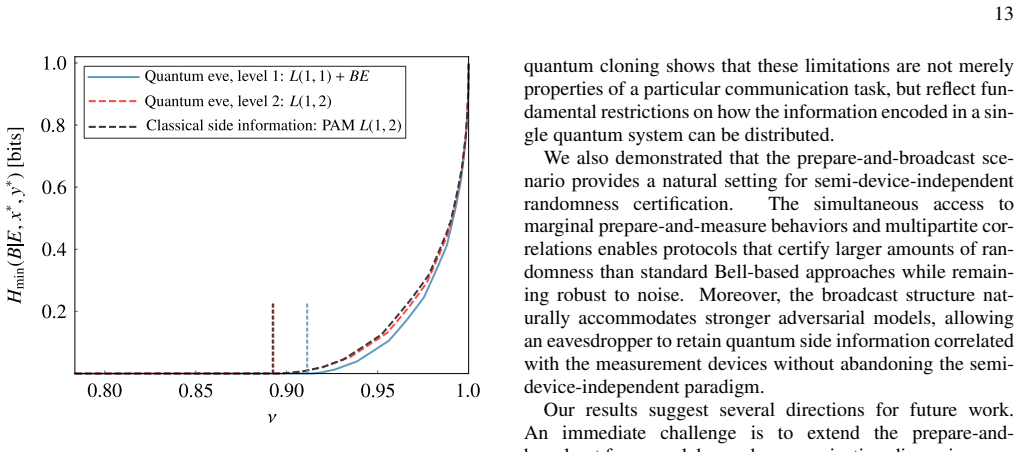
- The PAB certificate beats CHSH-based certification both in entropy (two bits versus about 1.23 bits) and in noise tolerance, becoming nontrivial at visibility below the CHSH locality threshold.
- The QRAC trade-off means a broadcast quantum random access code cannot give both receivers a quantum advantage: if one receiver beats the classical 3/4 success probability, the other necessarily drops below it, with the boundary given by optimal asymmetric phase-covariant cloning.
- PAM and Bell violations can coexist in the same broadcast realization, but only up to a threshold; beyond it the marginal PAM witness prevents a conditioned CHSH violation.
- Retaining the full observed behavior rather than a single witness value strictly improves the certified randomness, so data-processing choices matter for the certificate.
Reading between the lines
- Because the generation slice at maximal violation is Bell local, the two-bit certificate is driven by the qubit-dimension constraint rather than by nonlocality; a testable extension is to look for other dimension witnesses, outside the broadcast setting, that certify two uniform output bits without any Bell violation.
- The exact equality with the asymmetric phase-covariant cloning boundary suggests the same broadcast trade-off may hold for other quantum communication tasks whose optimal encodings are equatorial, and that more than two receivers would be governed by multipartite cloning bounds rather than pairwise monogamy alone.
- The rigidity proof is tied to finite-dimensional tensor-product receivers and classical side information; if the eavesdropper holds a purification of the preparations, the two-bit guarantee is open, so a natural next step is to decide whether a quantum-adversary version of Theorem 2 holds.
- Experimentally, the witness's generation correlator is absent from $W_{\mathrm{PAB}}$, so the uniform output at the maximal value is enforced indirectly; this suggests noise-robustness tests could be designed around the input orbit $O_B$ rather than the single setting $(1,0,0)$.
Editorial analysis
A structured set of objections, weighed in public.
Referee Report
Summary. The paper develops the prepare-and-broadcast (PAB) scenario, in which a qubit prepared by Alice is broadcast to two receivers, Bob and Charlie. It reports numerical trade-offs between marginal prepare-and-measure witnesses, conditioned Bell violations, and quantum random access code scores, connects the QRAC boundary to asymmetric phase-covariant cloning, and introduces a semi-device-independent randomness certification framework based on PAB witnesses. The central formal result is Theorem 2: for the witness W_PAB of Eq. (11), at its maximal quantum value W_Q = 8 + 2√2, the guessing probability of a classical adversary (Definition 1) at generation input s* = (1,0,0) is exactly 1/4, so the certified joint min-entropy is exactly two bits. The paper also presents SDP-based robustness curves, a numerical CHSH comparison, and a preliminary quantum-side-information analysis in a marginal S3 scenario. The proof of Theorem 2 in Appendix C is detailed and, within the stated assumptions, appears coherent; I found no obvious gap in the algebraic steps.
Significance. If taken together with its stated assumptions, the two-bit rigidity result is a valuable contribution to semi-device-independent randomness certification: it shows that a broadcast scenario with a dimension-bounded message can certify the full two bits of a binary pair at an exact analytic endpoint, with a public GitHub code repository and conservative SDP envelopes for the noisy regime. The trade-off connection to phase-covariant cloning is also interesting and well motivated. However, the advertised significance is currently inflated: Theorem 2 applies only to a classical adversary with finite-dimensional tensor-product receiver spaces, and the quantum-adversary case is explicitly left open in Remark 14. The headline comparison with the CHSH-based limit therefore compares different adversarial and dimension assumptions. These issues are fixable by qualification, but they are load-bearing for the paper's central claim as presented.
major comments (3)
- [Abstract; §IV C, Theorem 2; Remarks 8 and 14] The headline claim is narrower than stated. Theorem 2 proves G(BC|Λ,s*;W_Q)=1/4 only for the classical-adversary model of Definition 1, in which every branch has a qubit message and finite-dimensional tensor-product receiver Hilbert spaces, and in which Eve holds no purification of the preparations. The proof is load-bearing on finite-dimensionality: Proposition 7 uses Jordan's lemma and the rank-two transfer on finite-dimensional receiver factors, and the paper itself states in Remark 8 that the tensor form of the commuting algebras becomes an extra assumption in infinite dimensions; Remark 14 states that security against a quantum adversary holding a purification remains open. The abstract nonetheless states 'the maximal quantum violation certifies two bits of joint randomness' without either caveat. Please qualify the abstract, the introduction, and Section V, and state before Theorem 2 that this is a finite-dimensional, classical-side-information result.
- [§IV C, Fig. 6, Eqs. (35)–(37)] The comparison with CHSH is not apples-to-apples. The 'approximately 1.23 bits' CHSH limit is obtained with a dimension-unbounded NPA relaxation, as the text itself states, and the PAB certificates use the qubit-bounded L(1,2) relaxation against classical side information. The paper acknowledges this in the paragraph around Eqs. (35)–(37) by calling the two families 'two separately optimized white-noise benchmarks,' but the abstract and introduction present 'exceeding the limit achievable from the CHSH inequality' as an unqualified advantage. This comparison should either be performed under the same adversarial and dimension assumptions, or explicitly labeled in the abstract and conclusions as a comparison between different models. Otherwise the central significance claim overstates the result.
- [§III, Eq. (15) and Appendix B] The marginal QRAC trade-off boundary (P_B − 1/2)^2 + (P_C − 1/2)^2 = 1/8 is presented as if it were a derived result: the text says the two bounds 'agree within numerical precision and give Eq. (15)' and later that the cloning boundary 'maps exactly to Eq. (15).' In fact, Eq. (15) is a numerical boundary obtained by matching a nonconvex lower-bound search to an SDP upper bound at the L(1,2) level, as Appendix B makes clear. The cloning interpretation is a heuristic explanation rather than a proof of optimality. Please state explicitly in Section III that Eq. (15) is certified only at the relaxation level used and is not an analytically proven trade-off. This does not affect Theorem 2, but it is part of the paper's first advertised contribution.
minor comments (5)
- [§IV C opening paragraph] The text refers to 'the broadcast witness W^{(2)}_{CC}', but the witness of Eq. (11) is called W_PAB throughout the paper. Please either define W^{(2)}_{CC} or correct this notation.
- [§II, Eq. (11) and Ref. [29]/[34]] Equation (11) is said to be derived in Ref. [34], which is the companion numerical code repository, while later text says the witness W_PAB was introduced in Ref. [29]. Please clarify the provenance of the witness and cite the original framework for the inequality, with the code repository cited only as code.
- [Appendix B and Figures 4–6, 8] The numerical certificates rely on 'agreement within numerical precision' and on conservative SDP envelopes, but no solver tolerance or stopping criterion is reported. Please state the numerical accuracy used for the SDPs and for the reported endpoint values, so that the robustness claims can be reproduced.
- [Eq. (C16)] The bound in Eq. (C16) is explicitly an upper estimate and is not attainable because the three signs in the generation distribution cannot be chosen independently. This is fine, but it would help to add one sentence clarifying that the subsequent endpoint conclusion uses only the case where all defect terms vanish, so the looseness of the intermediate bound is irrelevant to Theorem 2.
- [Figure 2 caption] The caption distinguishes green filled circles as explicit-strategy lower bounds and red open circles as SDP upper bounds, but the pale-blue 'certified' regions are not described as outer or inner approximations. Please specify in the caption which regions are inner (lower-bound) and which are outer (relaxation) so readers can interpret the unshaded gaps correctly.
Circularity Check
No significant circularity: the two-bit certificate is proven by an exact rigidity argument within the paper's explicitly stated model, and the witness's origin in the authors' prior work is not load-bearing.
full rationale
The central derivation chain (Theorem 2, Appendix C) is self-contained. The witness W_PAB is an explicit linear functional (Eq. (11)), and the paper proves the quantum bound W_Q = 8+2√2 internally in Lemma 5, including an explicit attaining strategy; the theorem therefore does not import its endpoint from prior work. At maximal violation, the block-deficit argument forces saturation of each preparation block, Lemma 6 bounds the generation moments by anticommutator defects, and Proposition 7 uses Jordan's lemma and a rank-two transfer to force those defects to vanish, with Lemma 9 extending the result to mixed preparations. Every step is an exact derivation from the stated qubit-message, finite-dimensional tensor-product model, and the numerical SDP certificates in Sec. IV are explicitly conservative upper bounds rather than fitted predictions. The witness is said to be introduced in the authors' prior work [29] and derived in their numerical code [34], but this is a normal citation of an input object: the quantum bound and rigidity are re-proven in this paper, so the self-citation is not load-bearing. The finite-dimensional tensor-product assumption (Remark 8) and the restriction to classical side information (Remark 14) are explicitly acknowledged scope limitations; they make the abstract's unqualified phrasing less general than the theorem, but they do not make the derivation circular. No equation is defined in terms of the quantity it is said to predict, and no fitted parameter is renamed as a prediction.
Assumptions & free parameters
assumptions (4)
- domain assumption The communicated system is a qubit (d=2) and the broadcasting device is an arbitrary quantum channel; the receivers perform arbitrary local POVMs on finite-dimensional tensor-product Hilbert spaces.
- domain assumption Eve's side information is a classical random variable Lambda that selects a PAB branch p_lambda in Q_br, independent of the inputs (Definition 1, Sec. IV A).
- standard math Every PAB behavior admits a projective isometric dilation with commuting measurements on separate tensor factors (Stinespring and Naimark, Lemma 4).
- standard math Jordan's lemma holds for pairs of reflections on finite-dimensional Hilbert spaces, giving joint invariant subspaces of dimension at most two (Appendix C, Prop 7).
Cite this review
Pith. "Pith review of Randomness Certification and Trade-offs in the Prepare-and-Broadcast Scenario." pith.science (2026). https://pith.science/paper/FN5USF6W
@misc{pith2026260808329,
  author       = {Pith},
  title        = {Pith review of: Randomness Certification and Trade-offs in the Prepare-and-Broadcast Scenario},
  year         = {2026},
  howpublished = {\url{https://pith.science/paper/FN5USF6W}},
  note         = {Machine review of arXiv:2608.08329}
}
read the original abstract
We investigate the prepare-and-broadcast scenario, a multipartite extension of dimension-constrained prepare-and-measure experiments in which a quantum system is distributed to multiple receivers. We derive fundamental trade-offs between prepare-and-measure witnesses, Bell nonlocality, and quantum random access code performance. We further develop a semi-device-independent randomness certification framework based on prepare-and-broadcast witnesses, showing that the maximal quantum violation certifies two bits of joint randomness, exceeding the limit achievable from the CHSH inequality while remaining robust to noise. Finally, we show that the prepare-and-broadcast scenario naturally accommodates stronger adversarial models in which the eavesdropper retains a quantum system correlated with the measurement device, providing a natural framework for semi-device-independent randomness certification against quantum side information.
Figures


Figures from the paper (5 more)


Reference graph
Works this paper leans on
- [7]
-
[1]
V . Scarani, S. Iblisdir, N. Gisin, and A. Ac´ın, Quantum cloning, Rev. Mod. Phys.77, 1225 (2005)
work page 2005
-
[2]
Design e arquiteturas de Protocolos CV-QKD
Throughout this subsection, the generation input is fixed to (x ⋆,y⋆)=(2,1) for two reasons: all inputs choices lead to the same results forS 4, and (x⋆,y⋆)=(2,1) is the optimal input at which the qubit realization attainingS Q 3 produces an unbiased outcome, so that one full bit is in princi- ple available. We compare two uses of the observed data, one i...
-
[3]
H. Fan, Y .-N. Wang, L. Jing, J.-D. Yue, H.-D. Shi, Y .-L. Zhang, and L.-Z. Mu, Quantum cloning machines and the applications, Physics Reports544, 241 (2014)
work page 2014
-
[4]
J. B. Brask, N. Brunner, J. Pauwels, D. Rusca, and A. Tavakoli, Quantum correlations in prepare-and-measure sce- narios and their semi-device-independent applications (2026), arXiv:2603.23604 [quant-ph]
arXiv 2026
-
[5]
Gallego, N
R. Gallego, N. Brunner, C. Hadley, and A. Ac ´ın, Device- independent tests of classical and quantum dimensions, Phys. Rev. Lett.105, 230501 (2010)
2010
-
[6]
A. Tavakoli, A. Hameedi, B. Marques, and M. Bourennane, Quantum random access codes using singled-level systems, Phys. Rev. Lett.114, 170502 (2015)
work page 2015
-
[8]
D. Poderini, S. Brito, R. Nery, F. Sciarrino, and R. Chaves, Cri- teria for nonclassicality in the prepare-and-measure scenario, Phys. Rev. Res.2, 043106 (2020)
work page 2020
Show all 71 references
-
[9]
Ambainis, A
A. Ambainis, A. Nayak, A. Ta-Shma, and U. Vazirani, Dense quantum coding and quantum finite automata, J. ACM49, 496–511 (2002)
2002
-
[10]
Nayak, Optimal lower bounds for quantum automata and random access codes, 40th Annual Symposium on Foundations of Computer Science (Cat
A. Nayak, Optimal lower bounds for quantum automata and random access codes, 40th Annual Symposium on Foundations of Computer Science (Cat. No.99CB37039) , 369 (1999)
1999
-
[11]
Ambainis, D
A. Ambainis, D. Leung, L. Mancinska, and M. Ozols, Quan- tum random access codes with shared randomness (2009), arXiv:0810.2937 [quant-ph]
2009 arXiv
-
[12]
Pawłowski and M
M. Pawłowski and M. ˙Zukowski, Entanglement-assisted ran- dom access codes, Phys. Rev. A81, 042326 (2010)
2010
-
[13]
Tavakoli, A
A. Tavakoli, A. A. Abbott, M.-O. Renou, N. Gisin, and N. Brun- ner, Semi-device-independent characterization of multipartite entanglement of states and measurements, Phys. Rev. A98, 052333 (2018)
2018
-
[14]
Moreno, R
G. Moreno, R. Nery, C. de Gois, R. Rabelo, and R. Chaves, Semi-device-independent certification of entanglement in su- perdense coding, Phys. Rev. A103, 022426 (2021)
2021
-
[15]
Pauwels, A
J. Pauwels, A. Tavakoli, E. Woodhead, and S. Pironio, Entan- glement in prepare-and-measure scenarios: many questions, a few answers, New J. Phys24, 063015 (2022)
2022
-
[16]
Vieira, C
C. Vieira, C. de Gois, L. Pollyceno, and R. Rabelo, Interplays between classical and quantum entanglement-assisted commu- nication scenarios, New J. Phys25, 113004 (2023)
2023
-
[17]
Zamora, R
S. Zamora, R. A. Mac ˆedo, T. S. Sarubi, M. Alves, D. Poderini, and R. Chaves, Semi-device-independent nonstabilizerness cer- tification in the prepare-and-measure scenario, Phys. Rev. A 112, 042410 (2025)
2025
-
[18]
Pawłowski, T
M. Pawłowski, T. Paterek, D. Kaszlikowski, V . Scarani, A. Win- ter, and M. ˙Zukowski, Information causality as a physical prin- ciple, Nature461, 1101 (2009)
2009
-
[19]
Pawłowski and N
M. Pawłowski and N. Brunner, Semi-device-independent se- curity of one-way quantum key distribution, Phys. Rev. A84, 010302(R) (2011)
2011
-
[20]
H.-W. Li, M. Pawłowski, Z.-Q. Yin, G.-C. Guo, and Z.-F. Han, Semi-device-independent randomness certification usingn→1 quantum random access codes, Phys. Rev. A85, 052308 (2012)
2012
-
[21]
E. Woodhead,Imperfections and self testing in prepare-and- measure quantum key distribution, Phd thesis, Universit ´e li- bre de Bruxelles, Facult ´e des Sciences – Physique, Bruxelles (2014)
2014
-
[22]
Lunghi, J
T. Lunghi, J. B. Brask, C. C. W. Lim, Q. Lavigne, J. Bowles, A. Martin, H. Zbinden, and N. Brunner, Self-testing quantum random number generator, Phys. Rev. Lett.114, 150501 (2015)
2015
-
[23]
Passaro, D
E. Passaro, D. Cavalcanti, P. Skrzypczyk, and A. Ac´ın, Optimal randomness certification in the quantum steering and prepare- and-measure scenarios, New J. Phys17, 113010 (2015)
2015
-
[24]
Chaves, C
R. Chaves, C. Majenz, and D. Gross, Information-theoretic im- plications of quantum causal structures, Nat. Commun6, 5766 (2015)
2015
-
[25]
Tavakoli, J
A. Tavakoli, J. Pauwels, E. Woodhead, and S. Pironio, Correla- tions in entanglement-assisted prepare-and-measure scenarios, PRX Quantum2, 040357 (2021)
2021
-
[26]
Alves, V
M. Alves, V . L. Sena, S. Zamora, T. S. Sarubi, A. de Oliveira Ju- nior, A. B. Tacla, and R. Chaves, Semi-device-independent ran- domness certification on discretized continuous-variable plat- forms, Phys. Rev. A113, 042418 (2026)
2026
-
[27]
Y . Wang, I. W. Primaatmaja, E. Lavie, A. Varvitsiotis, and C. C. W. Lim, Characterising the correlations of prepare-and- measure quantum networks, npj Quantum Information5, 17 (2019)
2019
-
[28]
Ioannou, P
M. Ioannou, P. Sekatski, A. A. Abbott, D. Rosset, J.-D. Ban- cal, and N. Brunner, Receiver-device-independent quantum key distribution protocols, New J. Phys24, 063006 (2022)
2022
-
[29]
Y . Jia, F. Guo, Y . Wang, H. Dong, and F. Gao, Characterizing the set of quantum correlations in prepare-and-measure quan- tum multichain-shaped networks, Phys. Rev. A111, 022439 (2025)
2025
-
[30]
T. S. Sarubi, M. Alves, S. Zamora, V . F. Alves, A. de Oliveira Junior, and R. Chaves, The prepare and broadcast scenario (2026), arXiv:2606.28632 [quant-ph]
2026 arXiv
-
[31]
D. Bruß, M. Cinchetti, G. Mauro D’Ariano, and C. Macchi- avello, Phase-covariant quantum cloning, Phys. Rev. A62, 012302 (2000)
2000
-
[32]
G. M. D’Ariano and C. Macchiavello, Optimal phase-covariant cloning for qubits and qutrits, Phys. Rev. A67, 042306 (2003)
2003
-
[33]
Pironio, A
S. Pironio, A. Ac ´ın, S. Massar, A. Boyer de la Giroday, D. N. Matsukevich, P. Maunz, S. Olmschenk, D. Hayes, L. Luo, T. A. Manning, and C. Monroe, Random numbers certified by Bell’s theorem, Nature464, 1021 (2010)
2010
-
[34]
Ac ´ın, S
A. Ac ´ın, S. Massar, and S. Pironio, Randomness versus nonlo- cality and entanglement, Phys. Rev. Lett108, 100402 (2012)
2012
-
[35]
Sarubi, Randomness-certification-and-trade-offs-in-the- prepare-and-broadcast – numerical codes (2025)
T. Sarubi, Randomness-certification-and-trade-offs-in-the- prepare-and-broadcast – numerical codes (2025)
2025
-
[36]
J. F. Clauser, M. A. Horne, A. Shimony, and R. A. Holt, Pro- posed experiment to test local hidden-variable theories, Phys. Rev. Lett.23, 880 (1969)
1969
-
[37]
Brukner, M
ˇC. Brukner, M. ˙Zukowski, J.-W. Pan, and A. Zeilinger, Bell’s inequalities and quantum communication complexity, Phys. Rev. Lett92, 127901 (2004)
2004
-
[38]
Mohan, A
K. Mohan, A. Tavakoli, and N. Brunner, Sequential random access codes and self-testing of quantum measurement instru- ments, New J. Phys21, 083034 (2019)
2019
-
[39]
Rezakhani, S
A. Rezakhani, S. Siadatnejad, and A. Ghaderi, Separability in asymmetric phase-covariant cloning, Phys. Lett. A336, 278 (2005)
2005
-
[40]
H. Chen, X. Zhou, D. Suter, and J. Du, Experimental realization of1→2asymmetric phase-covariant quantum cloning, Phys. Rev. A75, 012317 (2007)
2007
-
[41]
Navascu ´es, S
M. Navascu ´es, S. Pironio, and A. Ac ´ın, Bounding the set of quantum correlations, Phys. Rev. Lett.98, 010401 (2007). 15
2007
-
[42]
Navascu ´es, S
M. Navascu ´es, S. Pironio, and A. Ac ´ın, A convergent hierar- chy of semidefinite programs characterizing the set of quantum correlations, New Journal of Physics10, 073013 (2008)
2008
-
[43]
Navascu ´es and T
M. Navascu ´es and T. V ´ertesi, Bounding the set of finite di- mensional quantum correlations, Phys. Rev. Lett.115, 020501 (2015)
2015
-
[44]
Ac ´ın, S
A. Ac ´ın, S. Pironio, T. V ´ertesi, and P. Wittek, Optimal ran- domness certification from one entangled bit, Phys. Rev. A93, 040102(R) (2016)
2016
-
[45]
Wooltorton, P
L. Wooltorton, P. Brown, and R. Colbeck, Tight analytic bound on the trade-offbetween device-independent randomness and nonlocality, Phys. Rev. Lett.129, 150403 (2022)
2022
-
[46]
Nieto-Silleras, S
O. Nieto-Silleras, S. Pironio, and J. Silman, Using complete measurement statistics for optimal device-independent random- ness evaluation, New Journal of Physics16, 013035 (2014)
2014
-
[47]
Bancal, L
J.-D. Bancal, L. Sheridan, and V . Scarani, More randomness from the same data, New J. Phys.16, 033011 (2014)
2014
-
[48]
W. F. Stinespring, Positive functions onC ∗-algebras, Proceed- ings of the American Mathematical Society6, 211 (1955)
1955
-
[49]
M. A. Naimark, Spectral functions of a symmetric operator, Izvestiya Akademii Nauk SSSR, Seriya Matematicheskaya4, 277 (1940)
1940
-
[50]
ˇSupi´c and J
I. ˇSupi´c and J. Bowles, Self-testing of quantum systems: A re- view, Quantum4, 337 (2020)
2020
-
[51]
Van Himbeeck, E
T. Van Himbeeck, E. Woodhead, N. J. Cerf, R. Garc ´ıa-Patr´on, and S. Pironio, Semi-device-independent framework based on natural physical assumptions, Quantum1, 33 (2017)
2017
-
[52]
Pauwels, S
J. Pauwels, S. Pironio, E. Woodhead, and A. Tavakoli, Almost qudits in the prepare-and-measure scenario, Phys. Rev. Lett. 129, 250504 (2022)
2022
-
[53]
Tavakoli, Semi-device-independent framework based on restricted distrust in prepare-and-measure experiments, Phys
A. Tavakoli, Semi-device-independent framework based on restricted distrust in prepare-and-measure experiments, Phys. Rev. Lett.126, 210503 (2021)
2021
-
[54]
Chaves, J
R. Chaves, J. B. Brask, and N. Brunner, Device-independent tests of entropy, Phys. Rev. Lett.115, 110501 (2015)
2015
-
[55]
Tavakoli, E
A. Tavakoli, E. Zambrini Cruzeiro, J. Bohr Brask, N. Gisin, and N. Brunner, Informationally restricted quantum correla- tions, Quantum4, 332 (2020)
2020
-
[56]
Boyd and L
S. Boyd and L. Vandenberghe,Convex Optimization(Cam- bridge University Press, 2004)
2004
-
[57]
Jordan, Essai sur la g ˆeomˆetrie `andimensions, Bulletin de la Soci´et´e Math´ematique de France3, 103 (1875)
C. Jordan, Essai sur la g ˆeomˆetrie `andimensions, Bulletin de la Soci´et´e Math´ematique de France3, 103 (1875)
-
[58]
Masanes, Asymptotic violation of Bell inequalities and dis- tillability, Phys
L. Masanes, Asymptotic violation of Bell inequalities and dis- tillability, Phys. Rev. Lett97, 050503 (2006), arXiv:quant- ph/0512153 [quant-ph]. Appendix A: Proof of Eqs.(6)-(8) In this appendix we show that a set of four preparations ρ={ρ 0,ρ 1,ρ 2,ρ 3}satisfies every relabe...
2006
-
[59]
Trade-offcurves LetG 1 andG 2 be two linear scores of the broadcast behav- ior and let RQ =conv G1[p],G 2[p] :p∈Q br (B1) be the set of attainable pairs, convex because the devices may share classical randomness. Instead of fixing a target value of one coordinate and maximizin...
-
[60]
max g∈GBC Fg(τ)−τw # ,(B10) which, combined with the inclusion of the physical set in its moment relaxation, yields the certified chain G(BC|Λ,s;w)≤G q,t(BC|Λ,s;w) ≤inf τ≥0
Randomness envelopes We now apply the construction to the guessing-probability curves of Sec. IV, stating it for the joint randomness of the broadcast pair, the marginal case following by restriction. Solving the coupled branch program of Eq. (23) pointwise certifies the guess...
-
[61]
Exact dilation to the projective isometric form Lemma 4(exact dilation).Every p∈Q br admits a represen- tation p(b,c|x,y,z)=tr Vρ xV† ΠB b|y ΠC c|z⊗1 R ,(C3) with qubit statesρ x, an isometry V:C 2→H B⊗H C⊗H R be- tween finite-dimensional spaces, and projective measurements wh...
-
[62]
Block bounds, attainability, and saturation Lemma 5(bounds, attainability, saturation).In the represen- tation(C3)with receivers of arbitrary finite dimension, the three blocks obey W [0]≤4, W [1]≤4, and W [2]≤2 √ 2, so that WPAB ≤W Q, and the value W Q is attained by an ex- p...
-
[63]
Moreover, if the preparations are pure and WPAB =W Q, then B0C0|ϕ0⟩=|ϕ 0⟩,B 1C1|ϕ0⟩=|ϕ 0⟩,(C7) B0C1|ϕ1⟩=|ϕ 1⟩,B 1C0|ϕ1⟩=−|ϕ 1⟩,(C8) {B0,B 1}|ϕ2⟩=0,{C 0,C 1}|ϕ2⟩=0.(C9) Proof.We first establish the three block bounds. EachB yCz is a product of two commuting Hermitian involution...
-
[64]
The bound is attained onC 2⊗C 2 byB 0 =C 0 =Z,B 1 = C1 =X(acting on the respective factors) and |ϕ0⟩= 1√ 2 |00⟩+|11⟩ , |ϕ1⟩= 1 2 |00⟩+|01⟩−|10⟩+|11⟩ , |ϕ2⟩= |ϕ0⟩−|ϕ 1⟩ q 2− √ 2
The three blocks involve three different preparations, so each expectation is bounded separately and WPAB≤8+2 √ 2. The bound is attained onC 2⊗C 2 byB 0 =C 0 =Z,B 1 = C1 =X(acting on the respective factors) and |ϕ0⟩= 1√ 2 |00⟩+|11⟩ , |ϕ1⟩= 1 2 |00⟩+|01⟩−|10⟩+|11⟩ , |ϕ2⟩= |ϕ0⟩−...
-
[65]
Then⟨B 0C0⟩[0] +⟨B 1C1⟩[0] =2 with each term in [−1,1] forces both to equal 1; for a Hermi- tian involutionMand a unit vector with⟨M⟩=1, the spectral splitM=M +−M− gives∥M−ϕ∥=0 andM|ϕ⟩=|ϕ⟩, which proves (C7), and the signs in (11) give (C8). For (C9), set u= 1√ 2(C0 +C 1) andv...
-
[66]
The next lemma ties all three to two anticommutator defects, so that their simultaneous vanishing forces a uniform generation distribution
Generation moments and the guessing bound The distribution ats ∗ involves the three moments⟨B 0⟩[1], ⟨C0⟩[1], and⟨B 0C0⟩[1], none of which appears inW PAB. The next lemma ties all three to two anticommutator defects, so that their simultaneous vanishing forces a uniform genera...
-
[67]
Insert- ing (C15) into (C6) and maximizing each sign yields (C16)
The sameRwith X=B 0C0, together with∥B 1C0ϕ1∥=1, gives the third bound; 20 andS=B 0C1 withσ= +1,X=C 0 gives the second. Insert- ing (C15) into (C6) and maximizing each sign yields (C16). The bound (C16) is an upper estimate and is not claimed at- tainable, since the three sign...
-
[68]
In particular∆ B = ∆C =0and p(b,c|s ∗)= 1 4
Exact rigidity at the endpoint Proposition 7(endpoint rigidity).In the representation(C3) with pure preparations, W PAB =W Q implies P bad|ϕ0⟩= Pbad|ϕ1⟩=0, where P bad projects onto the joint Jordan blocks on which the two local anticommutators do not both vanish. In particula...
-
[69]
HenceW PAB[p]=W Q forcesWPAB[pλ]=W Q on every branch of nonzero weight
Proof of Theorem 2 For a classical adversary, the independenceq(λ|x,y,z)= q(λ) makesW PAB affine over the adversarial decomposition, and each branch obeysWPAB[pλ]≤W Q by the block bounds of Lemma 5. HenceW PAB[p]=W Q forcesWPAB[pλ]=W Q on every branch of nonzero weight. Dilati...
-
[70]
Symmetry and the four-input orbit The witness (11) is the coefficient tensorγ xyz on the cor- relators⟨B yCz⟩[x], withγ 000 =γ 011 =γ 101 =2,γ 110 =−2, γ200 =γ 201 =γ 211 =−1,γ 210 =1, and all other entries zero; no single-party terms appear. A relabeling of the experiment is ...
-
[71]
Decoupling of the channel environment at the endpoint Lemma 12(environment decoupling).In the representation (C3)with pure preparations and WPAB =W Q, the conditional state of the Stinespring environmentH R given the outputs at s∗ is outcome-independent: writingρ (b,c) R for t...
Reviewed August 12, 2026 · model on record in the stance chip above.
Discussion (0). Continue with ORCID to comment.