REVIEW 3 major objections 3 minor 137 references
A Shared Observation Shields Collective Fluctuations while Preserving Local Independence
T0 review · 3 major / 3 minor · reviewed 2026-08-12 · deepseek-v4-flash
Pith's one-line read Conditioning a population on its own record imposes a centered-square penalty and a nonpositive shield; measured heterogeneity is the excess over a negative baseline.
desk verdict Clean mathematical core and a nice conceptual point, but the advertised chi_4 baseline is a scope gap the paper itself acknowledges. read the letter →
The pith
A machine-rendered reading of the paper's core claim, the machinery that carries it, and where it could break.
The reading
What carries the argument
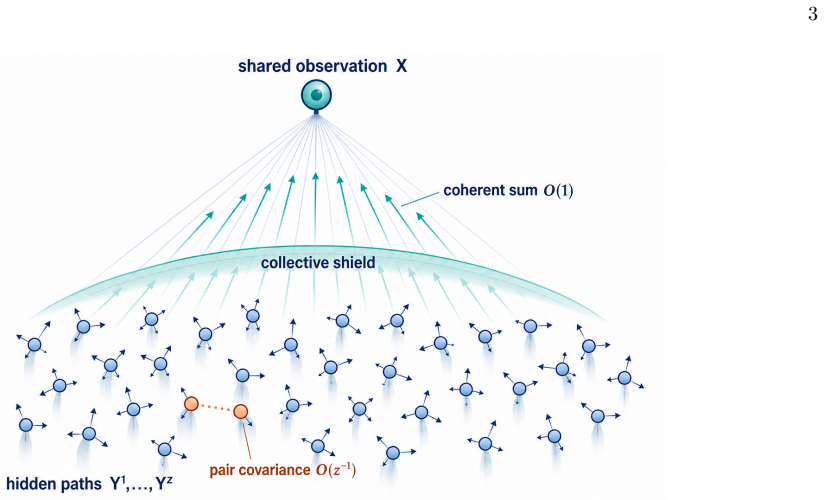
The load-bearing object is the conditional posterior of Eq. (2), a single centered-square penalty produced by the Girsanov transformation: it is rank-one, acts only along the collective direction the record can see, and carries the minus sign that makes the correction a suppression. Diagonalizing the one-path covariance operator $C$ turns the fixed-history collective covariance into $D = aC(aI+C)^{-1}$, so $D - C = -C^2(aI+C)^{-1} \preceq 0$, the operator inequality the paper names the Schur shield; each eigenmode of variance $c$ is suppressed by the factor $a/(a+c)$, weakly visible modes barely change, and strongly visible modes saturate at the observation-noise scale. A leave-two-out expansion produces the $O(z^{-1})$ pair covariance of Eq. (6) with mutual information $O(z^{-2})$, the resummation of those weak pair terms yields the parameter-free negative correction of Eq. (8), and the law of total variance splits the measured cross-correlation into the negative mean shield $-E\delta_X$ and the positive propensity variance $\mathrm{Var}(h_z(X))$, giving the sign threshold of Eq. (11).
What would settle it
In the exactly solvable Ornstein–Uhlenbeck model of Eq. (12), measure the fixed-history cross-covariance of two hidden paths and check the predicted closed form $\mathrm{Cov}[y_i(t), y_j(s)\,|\,x] = -(\sigma^2/z)[e^{-\lambda|t-s|} - (\lambda/\alpha)e^{-\alpha|t-s|}]$: a positive or order-one value at fixed history would falsify the Schur-shield claim. In any conditioned ensemble, the three quantities in Eq. (11) must satisfy $z\,\mathrm{Cov}(u_1,u_2) = \mathrm{Var}(h_z(X)) - E\delta_X$, so a systematic violation would expose residual interactions beyond the single centered-square penalty.
Extended reading notes
Core claim
The central discovery is a closed-form conditional posterior for a population that drives its own observation: with the record $X$ fixed, the density of the $z$ hidden trajectories with respect to the independent reference law is $dP_x^z / dQ^{\otimes z}_x = (1/Z_z(x)) \exp[-(1/(2az)) \sum_i (G_x(Y^i) - m_x)^2]$, Eq. (2), obtained by a Girsanov change of measure. From this single centered square the paper derives the fixed-history collective covariance $D = aC(aI+C)^{-1}$ and the Schur shield $D - C = -C^2(aI+C)^{-1} \preceq 0$, Eqs. (4)-(5); the $O(z^{-1})$ pair covariance and the resummed order-one correction $-\langle b_u, (aI+C)^{-1} b_u \rangle$, Eqs. (6)-(8); and, in the fluctuating-history ensemble, the identity $z\,\mathrm{Cov}(u_1,u_2) = \mathrm{Var}(h_z(X)) - E\delta_X$, Eq. (11), which sets the sign of measured cross-particle correlation by competition between the negative shield and the positive propensity variance. The paper's physical conclusion is that measured dynamical heterogeneity contains a conditioning-only component that is computable and nonpositive, so the genuine cooperative signal is the excess of the measured $\chi_4$ over this negative baseline, not over zero.
Load-bearing premise
The theorem assumes that, once the observed history is fixed, the $z$ hidden trajectories are independent apart from one collective drift term, so every pair correlation entering a measured $\chi_4$ is attributed to the observation itself rather than to direct neighbor-neighbor interactions or correlations between different tagged populations.
Editorial extensions
If this is right
- Any four-point susceptibility computed from trajectories that generated the record it summarizes inherits a computable, nonpositive conditioning-only baseline; genuine dynamical correlations are the excess over that baseline, and comparing with zero underestimates them by exactly the mean shield $E\delta_X$.
- Pair independence does not bound the collective response: fixed labels decouple as $O(z^{-1})$ while the resummed susceptibility keeps an order-one correction, so small mutual information of order $O(z^{-2})$ cannot rule out a coherent collective effect.
- The sign of a measured cross-particle correlation is protocol-dependent: experiments that fix the macroscopic history weight the negative shield, while experiments that mix histories add the positive propensity variance, so two protocols can report opposite signs while agreeing on the underlying dynamics.
- Tuning the output-noise variance $a$ gives a direct experimental handle: output-visible collective modes are suppressed by the factor $a/(a+c)$ while orthogonal observables are unaffected, and the exactly solvable model shows that equal-time and time-integrated responses differ, so no single static coupling reproduces both.
- The exact theorem covers one tagged population; carrying the baseline to the bulk $\chi_4$, which compares fluctuations across different tagged stars, requires controlling cross-population correlations and is stated by the paper as a concrete open problem.
Reading between the lines
- A reporting standard follows that the paper sketches but does not name: laboratories and simulations that store many histories could report the fixed-history shield and the between-history propensity variance separately, and Eq. (11) then decides the sign of genuine cooperativity without any new experiment.
- The rank-one structure suggests a diagnostic that extends beyond glasses: for any collective observable built from the trajectories it describes, sweeping the measurement noise should suppress only the component overlapping the recorded mode, cleanly separating observation-induced shielding from intrinsic correlations in crowded-media probes, coarse-grained order parameters, or pooled neural recor
- Because the reference law assumes hidden paths are independent given the record, the identity of Eq. (11) can be run in reverse: a systematic violation of $z\,\mathrm{Cov}(u_1,u_2) = \mathrm{Var}(h_z(X)) - E\delta_X$ in an interacting system would quantify the direct neighbor-neighbor and cross-population correlations that the observation-only construction omits.
Editorial analysis
A structured set of objections, weighed in public.
Referee Report
Summary. The paper analyzes how conditioning on a shared, endogenously generated observation affects the collective fluctuations of a population of hidden stochastic paths. In the finite-population model of Sec. II, the author derives, via a Girsanov transformation, a closed-form conditional posterior (Eq. (2)) in which the many-body effect is a single centered-square penalty along the record-visible collective direction. From this, Eq. (4)-(5) give the fixed-history collective covariance and the nonpositive 'Schur shield' correction. Section III derives pair-level independence with O(z^{-1}) covariance and O(z^{-2}) mutual information while showing that the resummed collective correction is order one. Section IV lets the observed history fluctuate and obtains the law-of-total-variance decomposition Eq. (11), separating a negative fixed-history shield from a positive propensity-variance term. Section V evaluates the construction exactly in a Gaussian model, and Sec. VI proposes a measurement workflow and a baseline interpretation for dynamical heterogeneity: measured chi_4 should be read as genuine cooperative signal plus a nonpositive conditioning-only baseline.
Significance. If the advertised scope were fully established, the paper would provide a useful exact reference calculation for observation-induced collective effects in a broad class of stochastic systems, and it would sharpen the interpretation of four-point susceptibility measurements in glassy liquids. The mathematical core is attractive: Eq. (2) is a clean and seemingly correct Girsanov result under the stated boundedness and Lipschitz assumptions, Eq. (5) is an algebraic identity, the operator formulas are parameter-free, and the Gaussian calibration in Sec. V and Appendix E gives an explicit falsifiable prediction for the equal-time versus time-integrated response. The paper is also refreshingly honest about some limitations, explicitly flagging the lack of uniformity on growing time windows and the open bulk-chi_4 extension. However, the load-bearing steps leading from the exact theorem to the advertised physical baseline currently rest on an unproven remainder estimate and on a scope extension that the paper itself declares open; these gaps need to be closed before the central physical claim is fully supported.
major comments (3)
- [Appendix B, Eq. (6)] The leave-two-out expansion in Eq. (B2) is presented as a sketch: the O_{L1}(z^{-3/2}) remainder is asserted but no explicit bound is derived, and no uniformity over the observables u and v is stated. Since Sec. II promises that 'all remainders quoted below are nonasymptotic and dimension free,' this is a missing load-bearing justification for the O(z^{-1}) covariance formula and for the resummation leading to Eq. (8). Please supply explicit remainder estimates, or explicitly downgrade the finite-z statements to formal asymptotics.
- [Sec. VI versus Abstract, Eq. (11)] The baseline subtraction in Eq. (11) is derived for a single tagged population under the independent-neighbor reference law of Sec. II and Appendix A. Section VI correctly states that carrying the theorem to bulk chi_4, which compares fluctuations across different tagged stars, requires controlling cross-population correlations and remains an open problem. The Abstract nevertheless says that 'a comparison that existing simulation data can already perform' is available. This is a scope mismatch: without a specified cross-population extension or an explicit matching of Eq. (11) to a particular bulk chi_4 protocol, existing simulation data cannot be used to test the advertised baseline. Please restrict the claim to the tagged-population susceptibility or provide the missing extension/protocol.
- [Sec. VI, Appendix F] The physical conclusion that the genuine cooperative signal is the measured value minus the negative baseline relies on Eq. (11) being applicable to real glassy systems, but the manuscript contains no simulation or data analysis check. Appendix F is a proposed workflow, not a validation. Given the Abstract's claim that existing simulation data can already perform the comparison, I would expect at least one concrete demonstration (for example, a reanalysis of isoconfigurational-ensemble simulations, or a numerical test of Eqs. (10)-(11) on a model glass former). Absent that, the manuscript should clearly state that the baseline interpretation is an application proposal rather than an established empirical result.
minor comments (3)
- [Sec. IV, first paragraph] In the sentence 'Let X denote the sigma algebra generated by the observed history,' the symbol X is reused for both the path and the sigma algebra; this is understandable but worth disambiguating, for instance by writing sigma(X).
- [Eq. (13)] The conditional covariance in Eq. (13) is stated for the complete stationary x history; the notation Cov[yi(t), yj(s)|x] could be misread as conditioning on the initial value. Please write explicitly 'conditional on the full sample path X = x' at that point.
- [Fig. 2 caption] The caption says 'One shared output constrains a whole population' but the figure itself is schematic; please state explicitly that the diagram is illustrative and not a plot of a computed quantity, to avoid confusion with the quantitative panels.
Circularity Check
No significant circularity: the central derivation is a self-contained exact conditioning identity with no fitted inputs, and the chi4 baseline is an exact decomposition with explicitly stated scope limits.
full rationale
The paper's derivation chain is self-contained and non-circular. Equation (2) is obtained by a Girsanov change of measure applied to the explicit model of Section II and Appendix A, with all assumptions stated (bounded f, Lipschitz coefficients, fixed window). The Schur shield D = aC(aI+C)^(-1) and the inequality D - C <= 0 in Eqs. (4)-(5) follow from Gaussian operator algebra, not from any fitted parameter. Equations (6) and (8) are leave-two-out expansions and exact resummations with stated remainders. Equation (11) is an identity from the law of total variance applied to exchangeable labels, and the proposed baseline subtraction (measured zCov plus E delta_X) is a rearrangement of that identity, not a statistical fit disguised as a prediction. The paper explicitly flags its scope limits: Section II notes the nonasymptotic constants are not uniform on windows growing with relaxation time, Section V repeats that a mixing estimate would be needed for such windows, and Section VI states that carrying the theorem to bulk chi4 is an open problem requiring control of cross-population correlations. These are honest scope statements, not circular reasoning. The only self-citations (Refs. 21-24) are historical context for time-domain optical spectroscopy and play no load-bearing role in the derivation. No fitted parameter is later renamed as a prediction, and no uniqueness claim is imported from the authors' prior work to force a choice. Thus there is no circular step by the standards of this review.
Assumptions & free parameters
assumptions (4)
- standard math Girsanov theorem and Novikov condition for the change of measure from reference to endogenous dynamics
- domain assumption Hidden paths Y^1,...,Y^z are independent given the observed history X under the reference law, and exchangeable
- domain assumption The record sees only the additive, z^{-1/2}-normalized collective drift f(X_t, Y^i_t), and the full path X over [0,T] is observed
- domain assumption A measured four-point susceptibility or dynamic propensity can be matched to this conditional ensemble with matching history, normalization, and fixed variables
Cite this review
Pith. "Pith review of A Shared Observation Shields Collective Fluctuations while Preserving Local Independence." pith.science (2026). https://pith.science/paper/5UHLWSRL
@misc{pith2026260808358,
  author       = {Pith},
  title        = {Pith review of: A Shared Observation Shields Collective Fluctuations while Preserving Local Independence},
  year         = {2026},
  howpublished = {\url{https://pith.science/paper/5UHLWSRL}},
  note         = {Machine review of arXiv:2608.08358}
}
abstract
As a liquid approaches its glass transition, its dynamics turns heterogeneous: mobile and immobile regions coexist, and the four-point susceptibility $\chi_4$ that quantifies this heterogeneity grows sharply. Interpreting that growth is subtle, because the collective signals experiments record, such as a tagged particle's trajectory, an overlap function, or a mean field, are generated by the same particles they describe. Here we compute exactly what conditioning on such a shared record does to the population that produced it, for a broad class of stochastically observed systems; the guiding example is a tagged particle and the cage of $z$ neighbors that drives its force history. Using a Girsanov path transformation, we prove that the conditioning multiplies the independent joint law of the $z$ trajectories by exactly one term: a centered-square penalty along the single collective direction the record can see. Any fixed pair of particles stays nearly independent, with covariance falling as $O(z^{-1})$ and mutual information as $O(z^{-2})$, the property known as propagation of chaos, yet the $z(z-1)$ weak pair correlations add coherently into a finite suppression of collective fluctuations, the Schur shield $D - C = -C^2(aI + C)^{-1} \preceq 0$. An exactly solvable Brownian model calibrates the construction. The physical consequence is a calculable baseline for dynamical heterogeneity: conditioning itself contributes a computable, nonpositive amount to the susceptibility of a conditioned ensemble, so the genuine cooperative signal is the excess of the measured $\chi_4$ over this baseline rather than over zero, a comparison that existing simulation data can already perform.
Figures


Reference graph
Works this paper leans on
-
[1]
author author C. A. \ Angell ,\ https://doi.org/10.1126/science.267.5206.1924 journal journal Science \ volume 267 ,\ pages 1924 ( year 1995 ) NoStop
arXiv 1924
-
[2]
author author M. D. \ Ediger ,\ https://doi.org/10.1146/annurev.physchem.51.1.99 journal journal Annual Review of Physical Chemistry \ volume 51 ,\ pages 99 ( year 2000 ) NoStop
-
[3]
author author P. G. \ Debenedetti \ and\ author F. H. \ Stillinger ,\ https://doi.org/10.1038/35065704 journal journal Nature \ volume 410 ,\ pages 259 ( year 2001 ) NoStop
doi:10.1038/35065704 2001
-
[4]
author author L. Berthier \ and\ author G. Biroli ,\ https://doi.org/10.1103/RevModPhys.83.587 journal journal Reviews of Modern Physics \ volume 83 ,\ pages 587 ( year 2011 ) NoStop
-
[5]
author author L. Berthier , author G. Biroli , author J.-P. \ Bouchaud , author L. Cipelletti , author D. El Masri , author D. L'H \^o te , author F. Ladieu ,\ and\ author M. Pierno ,\ https://doi.org/10.1126/science.1120714 journal journal Science \ volume 310 ,\ pages 1797 ( year 2005 ) NoStop
-
[6]
author author A. Widmer-Cooper , author P. Harrowell ,\ and\ author H. Fynewever ,\ https://doi.org/10.1103/PhysRevLett.93.135701 journal journal Phys. Rev. Lett. \ volume 93 ,\ pages 135701 ( year 2004 ) NoStop
-
[8]
author author H. Tong \ and\ author H. Tanaka ,\ https://doi.org/10.1103/PhysRevX.8.011041 journal journal Phys. Rev. X \ volume 8 ,\ pages 011041 ( year 2018 ) NoStop
-
[9]
author author G. Ben Arous \ and\ author O. Zeitouni ,\ https://doi.org/10.1016/S0246-0203(99)80006-5 journal journal Ann. Inst. H. Poincar \'e Probab. Statist. \ volume 35 ,\ pages 85 ( year 1999 ) NoStop
Show all 137 references
-
[12]
Kac ,\ in\ @noop booktitle Proceedings of the Third Berkeley Symposium on Mathematical Statistics and Probability ,\ Vol
author author M. Kac ,\ in\ @noop booktitle Proceedings of the Third Berkeley Symposium on Mathematical Statistics and Probability ,\ Vol. volume 3 \ ( publisher University of California Press ,\ address Berkeley ,\ year 1956 )\ pp.\ pages 171--197 NoStop
1956
-
[13]
author author H. P. \ McKean ,\ in\ @noop booktitle Stochastic Differential Equations (Lecture Series in Differential Equations, Session 7) \ ( publisher Catholic University ,\ address Washington, D.C. ,\ year 1967 )\ pp.\ pages 41--57 NoStop
1967
-
[14]
author author R. S. \ Ellis \ and\ author C. M. \ Newman ,\ https://doi.org/10.1007/BF00533049 journal journal Z. Wahrscheinlichkeitstheorie verw. Gebiete \ volume 44 ,\ pages 117 ( year 1978 ) NoStop
1978 doi
-
[15]
Bolthausen ,\ https://doi.org/10.1007/BF00699109 journal journal Z
author author E. Bolthausen ,\ https://doi.org/10.1007/BF00699109 journal journal Z. Wahrscheinlichkeitstheorie verw. Gebiete \ volume 72 ,\ pages 305 ( year 1986 ) NoStop
1986 doi
-
[16]
Kusuoka \ and\ author S
author author S. Kusuoka \ and\ author S. Liang ,\ https://doi.org/10.1007/PL00008727 journal journal Probab. Theory Relat. Fields \ volume 116 ,\ pages 221 ( year 2000 ) NoStop
-
[17]
Bally \ and\ author E
author author V. Bally \ and\ author E. L \"o cherbach ,\ @noop journal journal arXiv preprint \ ( year 2026 ) ,\ https://arxiv.org/abs/2606.23433 arXiv:2606.23433 NoStop
2026 arXiv
-
[19]
Bapst , author T
author author V. Bapst , author T. Keck , author A. Grabska-Barwi \'n ska , author C. Donner , author E. D. \ Cubuk , author S. S. \ Schoenholz , author A. Obika , author A. W. R. \ Nelson , author T. Back , author D. Hassabis ,\ and\ author P. Kohli ,\ https://doi.org/10.1038...
-
[21]
Cang , author J
author author H. Cang , author J. Li , author V. N. \ Novikov ,\ and\ author M. D. \ Fayer ,\ https://doi.org/10.1063/1.1568338 journal journal The Journal of Chemical Physics \ volume 118 ,\ pages 9303 ( year 2003 a ) NoStop
2003 doi
-
[22]
Cang , author J
author author H. Cang , author J. Li ,\ and\ author M. D. \ Fayer ,\ https://doi.org/10.1016/S0009-2614(02)01542-7 journal journal Chemical Physics Letters \ volume 366 ,\ pages 82 ( year 2002 ) NoStop
2002 doi
-
[23]
Cang , author J
author author H. Cang , author J. Li , author H. C. \ Andersen ,\ and\ author M. D. \ Fayer ,\ https://doi.org/10.1063/1.2000235 journal journal The Journal of Chemical Physics \ volume 123 ,\ pages 064508 ( year 2005 ) NoStop
2005 doi
-
[24]
Cang , author J
author author H. Cang , author J. Li , author V. N. \ Novikov ,\ and\ author M. D. \ Fayer ,\ https://doi.org/10.1063/1.1618215 journal journal The Journal of Chemical Physics \ volume 119 ,\ pages 10421 ( year 2003 b ) NoStop
2003 doi
-
[25]
Mori ,\ https://doi.org/10.1143/PTP.33.423 journal journal Prog
author author H. Mori ,\ https://doi.org/10.1143/PTP.33.423 journal journal Prog. Theor. Phys. \ volume 33 ,\ pages 423 ( year 1965 ) NoStop
1965 doi
-
[26]
Zwanzig ,\ https://doi.org/10.1063/1.1731409 journal journal J
author author R. Zwanzig ,\ https://doi.org/10.1063/1.1731409 journal journal J. Chem. Phys. \ volume 33 ,\ pages 1338 ( year 1960 ) NoStop
1960 doi
-
[27]
author author W. G \"o tze ,\ https://doi.org/10.1093/acprof:oso/9780199235346.001.0001 title Complex Dynamics of Glass-Forming Liquids: A Mode-Coupling Theory \ ( publisher Oxford University Press ,\ address Oxford ,\ year 2009 ) NoStop
-
[28]
author author L. M. C. \ Janssen ,\ https://doi.org/10.3389/fphy.2018.00097 journal journal Frontiers in Physics \ volume 6 ,\ pages 97 ( year 2018 ) NoStop
2018
-
[29]
van Zon \ and\ author J
author author R. van Zon \ and\ author J. Schofield ,\ @noop journal journal Phys. Rev. E \ volume 65 ,\ pages 011106 ( year 2002 ) ,\ https://arxiv.org/abs/cond-mat/0108029 arXiv:cond-mat/0108029 NoStop
2002 arXiv
-
[31]
Mayer , author K
author author P. Mayer , author K. Miyazaki ,\ and\ author D. R. \ Reichman ,\ https://doi.org/10.1103/PhysRevLett.97.095702 journal journal Phys. Rev. Lett. \ volume 97 ,\ pages 095702 ( year 2006 ) NoStop
2006 doi
-
[32]
author author L. M. C. \ Janssen , author P. Mayer ,\ and\ author D. R. \ Reichman ,\ https://doi.org/10.1088/1742-5468/2016/05/054049 journal journal J. Stat. Mech. \ ,\ pages 054049 ( year 2016 ) ,\ https://arxiv.org/abs/1510.07636 arXiv:1510.07636 NoStop
2016 arXiv
-
[38]
author author I. V. \ Girsanov ,\ https://doi.org/10.1137/1105027 journal journal Theory Probab. Appl. \ volume 5 ,\ pages 285 ( year 1960 ) NoStop
1960 doi
-
[43]
No \'e \ and\ author F
author author F. No \'e \ and\ author F. N \"u ske ,\ https://doi.org/10.1137/110858616 journal journal Multiscale Model. Simul. \ volume 11 ,\ pages 635 ( year 2013 ) NoStop
2013 doi
-
[44]
Janssen, Liesbeth M. C. and Mayer, Peter and Reichman, David R. , title =. J. Stat. Mech. , year =. doi:10.1088/1742-5468/2016/05/054049 , eprint =
2016 doi
-
[45]
and Luo, Chengjie and Ciarella, Simone and Janssen, Liesbeth M
Debets, Vincent E. and Luo, Chengjie and Ciarella, Simone and Janssen, Liesbeth M. C. , title =. Phys. Rev. E , volume =. 2021 , doi =. 2108.06829 , archivePrefix =
2021 arXiv
-
[46]
Maimbourg, Thibaud and Kurchan, Jorge and Zamponi, Francesco , title =. Phys. Rev. Lett. , volume =. 2016 , doi =. 1507.03421 , archivePrefix =
2016 arXiv
-
[47]
Kurchan, Jorge and Maimbourg, Thibaud and Zamponi, Francesco , title =. J. Stat. Mech. , pages =. 2016 , doi =. 1512.02186 , archivePrefix =
2016 arXiv
-
[48]
arXiv preprint , year =
Deng, Yu and Hani, Zaher and Ma, Xiao , title =. arXiv preprint , year =. 2408.07818 , archivePrefix =
-
[49]
Europhys
Szamel, Grzegorz , title =. Europhys. Lett. , volume =. 2010 , doi =. 1004.3526 , archivePrefix =
2010 arXiv
-
[50]
Franz, Silvio and Jacquin, Hugo and Parisi, Giorgio and Urbani, Pierfrancesco and Zamponi, Francesco , title =. Proc. Natl. Acad. Sci. USA , volume =. 2012 , doi =. 1206.2482 , archivePrefix =
2012 arXiv
-
[51]
arXiv preprint , year =
Nikolaev, Paul , title =. arXiv preprint , year =. 2407.01217 , archivePrefix =
-
[52]
arXiv preprint , year =
Li, Lei and Wang, Yuelin and Wang, Yuliang , title =. arXiv preprint , year =. 2312.00339 , archivePrefix =
-
[53]
Electron
Lacker, Daniel , title =. Electron. J. Probab. , volume =. 2022 , doi =. 2105.03238 , archivePrefix =
2022 arXiv
-
[54]
Lacker, Daniel , title =. Probab. Math. Phys. , volume =. 2023 , doi =. 2105.02983 , archivePrefix =
2023 arXiv
-
[55]
Propagation of chaos and residual dependence in
Jalowy, Jonas and Kabluchko, Zakhar and L. Propagation of chaos and residual dependence in. Math. Phys. Anal. Geom. , volume =. 2025 , doi =. 2410.08004 , archivePrefix =
2025 arXiv
-
[56]
Increasing propagation of chaos for mean field models , journal =
Ben Arous, G. Increasing propagation of chaos for mean field models , journal =. 1999 , doi =
1999
-
[57]
and Newman, Charles M
Ellis, Richard S. and Newman, Charles M. , title =. Z. Wahrscheinlichkeitstheorie verw. Gebiete , volume =. 1978 , doi =
1978
-
[58]
Bolthausen, Erwin , title =. Z. Wahrscheinlichkeitstheorie verw. Gebiete , volume =. 1986 , doi =
1986
-
[59]
Kusuoka, Shigeo and Liang, Song , title =. Probab. Theory Relat. Fields , volume =. 2000 , doi =
2000
-
[60]
Albeverio, Sergio and Liang, Song , title =. Ann. Probab. , volume =. 2005 , doi =. math/0503601 , archivePrefix =
2005 arXiv
-
[61]
Latz, Arnulf , title =. J. Phys.: Condens. Matter , volume =. 2000 , doi =. cond-mat/9911025 , archivePrefix =
2000 arXiv
-
[62]
Europhys
Biroli, Giulio and Bouchaud, Jean-Philippe , title =. Europhys. Lett. , volume =. 2004 , doi =. cond-mat/0401260 , archivePrefix =
2004 arXiv
-
[63]
, title =
Biroli, Giulio and Bouchaud, Jean-Philippe and Miyazaki, Kunimasa and Reichman, David R. , title =. Phys. Rev. Lett. , volume =. 2006 , doi =. cond-mat/0605733 , archivePrefix =
2006 arXiv
-
[64]
, title =
Berthier, Ludovic and Biroli, Giulio and Bouchaud, Jean-Philippe and Kob, Walter and Miyazaki, Kunimasa and Reichman, David R. , title =. J. Chem. Phys. , volume =. 2007 , doi =. cond-mat/0609656 , archivePrefix =
2007 arXiv
-
[65]
Mori, Hazime , title =. Prog. Theor. Phys. , volume =. 1965 , doi =
1965
-
[66]
Zwanzig, Robert , title =. J. Chem. Phys. , volume =. 1960 , doi =
1960
-
[67]
van Zon, Ramses and Schofield, Jeremy , title =. Phys. Rev. E , volume =. 2002 , eprint =
2002
-
[68]
Luo, Chengjie and Janssen, Liesbeth M. C. , title =. J. Chem. Phys. , volume =. 2020 , doi =. 1909.00428 , archivePrefix =
2020 arXiv
-
[69]
Ikeda, Atsushi and Miyazaki, Kunimasa , title =. Phys. Rev. Lett. , volume =. 2010 , doi =. 1003.5472 , archivePrefix =
2010 arXiv
-
[70]
arXiv preprint , year =
Zhu, Yuanran , title =. arXiv preprint , year =. 2109.01990 , archivePrefix =
-
[71]
Widder, Christoph and Zimmer, Johannes and Schilling, Tanja , title =. J. Phys. A , year =. doi:10.1088/1751-8121/ae02cc , eprint =
-
[72]
arXiv preprint , year =
Widder, Christoph , title =. arXiv preprint , year =. 2607.25855 , archivePrefix =
-
[73]
Emergence of common noise: quantitative conditional propagation of chaos , journal =
Bally, Vlad and L. Emergence of common noise: quantitative conditional propagation of chaos , journal =. 2026 , eprint =
2026
-
[74]
Laudicina, Corentin C. L. and Janssen, Liesbeth M. C. and Szamel, Grzegorz , title =. Phys. Rev. Lett. , year =. doi:10.1103/8lw2-352q , eprint =
-
[75]
Ikeda, Harukuni and Ikeda, Atsushi , title =. J. Stat. Mech. , pages =. 2016 , doi =. 1603.06314 , archivePrefix =
2016 arXiv
-
[76]
Parisi, Giorgio and Rizzo, Tommaso , title =. Phys. Rev. E , volume =. 2013 , doi =. 1205.3360 , archivePrefix =
2013 arXiv
-
[77]
, title =
Widmer-Cooper, Asaph and Harrowell, Peter and Fynewever, H. , title =. Phys. Rev. Lett. , volume =. 2004 , doi =
2004
-
[78]
Tong, Hua and Tanaka, Hajime , title =. Phys. Rev. X , volume =. 2018 , doi =
2018
-
[79]
, title =
Berthier, Ludovic and Jack, Robert L. , title =. Phys. Rev. E , volume =. 2007 , doi =. 0706.1044 , archivePrefix =
2007 arXiv
-
[80]
Unveiling the Predictive Power of Static Structure in Glassy Systems , journal =
Bapst, Victor and Keck, Thomas and Grabska-Barwi. Unveiling the Predictive Power of Static Structure in Glassy Systems , journal =. 2020 , doi =
2020
-
[81]
Rotation-Equivariant Graph Neural Networks for Learning Glassy Liquids Representations , journal =
Pezzicoli, Francesco Saverio and Charpiat, Guillaume and Landes, Fran. Rotation-Equivariant Graph Neural Networks for Learning Glassy Liquids Representations , journal =. 2024 , doi =. 2211.03226 , archivePrefix =
2024 arXiv
-
[82]
A Variational Approach to Modeling Slow Processes in Stochastic Dynamical Systems , journal =
No. A Variational Approach to Modeling Slow Processes in Stochastic Dynamical Systems , journal =. 2013 , doi =
2013
-
[83]
Field Theoretic Formulation of a Mode-Coupling Equation for Colloids , journal =
Jacquin, Hugo and van Wijland, Fr. Field Theoretic Formulation of a Mode-Coupling Equation for Colloids , journal =. 2011 , doi =. 1103.5242 , archivePrefix =
2011 arXiv
-
[84]
Kipnis, Claude and Varadhan, S. R. S. , title =. Commun. Math. Phys. , volume =. 1986 , doi =
1986
-
[85]
Franosch, T. and G. Structure and Structure Relaxation , journal =. 1998 , doi =. cond-mat/9807017 , archivePrefix =
1998 arXiv
-
[86]
and Voigtmann, Th
Franosch, T. and Voigtmann, Th. , title =. J. Stat. Phys. , volume =. 2002 , doi =. cond-mat/0202238 , archivePrefix =
2002 arXiv
-
[87]
Szamel, Grzegorz , title =. Prog. Theor. Exp. Phys. , volume =. 2013 , doi =. 1209.6622 , archivePrefix =
2013 arXiv
-
[88]
Kurchan, Jorge and Parisi, Giorgio and Urbani, Pierfrancesco and Zamponi, Francesco , title =. J. Phys. Chem. B , volume =. 2013 , doi =. 1303.1028 , archivePrefix =
2013 arXiv
-
[89]
Arita, Chikashi and Krapivsky, P. L. and Mallick, Kirone , title =. Phys. Rev. E , volume =. 2017 , doi =. 1611.07719 , archivePrefix =
2017 arXiv
-
[90]
arXiv preprint , year =
Dechant, Andreas , title =. arXiv preprint , year =. 2306.00417 , archivePrefix =
-
[91]
Wu, Jianlan and Cao, Jianshu , title =. Phys. Rev. Lett. , volume =. 2005 , doi =
2005
-
[92]
Wu, Jianlan and Cao, Jianshu , title =. J. Phys. Chem. B , volume =. 2004 , doi =
2004
-
[93]
Anderson, W. N., Jr. and Duffin, R. J. , title =. J. Math. Anal. Appl. , volume =. 1969 , doi =
1969
-
[94]
Kubo, Fumio and Ando, Tsuyoshi , title =. Math. Ann. , volume =. 1980 , doi =
1980
-
[95]
Iannazzo, Bruno , title =. Numer. Linear Algebra Appl. , volume =. 2016 , doi =
2016
-
[96]
Szamel, Grzegorz , title =. J. Chem. Phys. , volume =. 2007 , doi =. 0705.3645 , archivePrefix =
2007 arXiv
-
[97]
Pihlajamaa, Ilian and Janssen, Liesbeth M. C. , title =. Phys. Rev. Research , volume =. 2024 , doi =. 2408.11579 , archivePrefix =
2024 arXiv
-
[98]
and Laudicina, Corentin C
Pihlajamaa, Ilian and Debets, Vincent E. and Laudicina, Corentin C. L. and Janssen, Liesbeth M. C. , title =. SciPost Phys. , volume =. 2023 , doi =. 2307.03443 , archivePrefix =
2023 arXiv
-
[99]
Physica A , volume =
Kawasaki, Kyozi , title =. Physica A , volume =. 1995 , doi =
1995
-
[100]
Classical and Quantum Dynamics in Condensed Phase Simulations , editor =
Kapral, Raymond and Consta, Styliani and McWhirter, Liam , title =. Classical and Quantum Dynamics in Condensed Phase Simulations , editor =. 1998 , doi =
1998
-
[101]
arXiv:2512.10256 , year =
Lang, Quanjun and Lu, Jianfeng , title =. arXiv:2512.10256 , year =. 2512.10256 , archivePrefix =
-
[102]
Lang, Simon and Schilling, Rolf and Krakoviack, Vincent and Franosch, Thomas , title =. Phys. Rev. E , volume =. 2012 , doi =. 1208.1929 , archivePrefix =
2012 arXiv
-
[103]
and Ciarella, Simone and
Biezemans, Rutger A. and Ciarella, Simone and. Glassy dynamics from generalized mode-coupling theory: existence and uniqueness of solutions for hierarchically coupled integro-differential equations , journal =. 2020 , doi =. 2006.04476 , archivePrefix =
2020 arXiv
-
[104]
Liu, Wei and Su, Yu and Wang, Yao and Dou, Wenjie , title =. Phys. Rev. Lett. , volume =. 2025 , doi =. 2407.01923 , archivePrefix =
2025 arXiv
-
[105]
Forrester, P. J. and Jancovici, B. , title =. Physica A , volume =. 1997 , doi =
1997
-
[106]
Banchio, Adolfo J. and N. Collective diffusion, self-diffusion and freezing criteria of colloidal suspensions , journal =. 2000 , doi =
2000
-
[107]
Ackerson, B. J. , title =. The Journal of Chemical Physics , volume =. 1976 , doi =
1976
-
[108]
Physical Review E , volume =
Yeomans-Reyna, Laura and Medina-Noyola, Magdaleno , title =. Physical Review E , volume =. 2000 , doi =
2000
-
[109]
Physica A , volume =
Cichocki, Bogdan and Hess, Walter , title =. Physica A , volume =. 1987 , doi =
1987
-
[110]
Vaccarino, Francesco , title =. Ann. Inst. Fourier , volume =. 2005 , doi =
2005
-
[111]
, title =
Mayer, Peter and Miyazaki, Kunimasa and Reichman, David R. , title =. Phys. Rev. Lett. , volume =. 2006 , doi =
2006
-
[112]
Monotonicity, Bounds and Acceleration of Block
Zimmerling, J. Monotonicity, Bounds and Acceleration of Block. Journal of Scientific Computing , volume =. 2025 , doi =. 2407.21505 , archivePrefix =
2025 arXiv
-
[113]
Shohat, James Alexander and Tamarkin, Jacob David , title =
-
[114]
, title =
Benzi, Michele and Golub, Gene H. , title =. BIT Numerical Mathematics , volume =. 1999 , doi =
1999
-
[115]
BIT Numerical Mathematics , volume =
Frommer, Andreas and Schweitzer, Marcel , title =. BIT Numerical Mathematics , volume =. 2016 , doi =
2016
-
[116]
Proceedings of the 33rd International Conference on Machine Learning , series =
Li, Chengtao and Sra, Suvrit and Jegelka, Stefanie , title =. Proceedings of the 33rd International Conference on Machine Learning , series =. 2016 , eprint =
2016
-
[117]
and Stiefel, Eduard , title =
Hestenes, Magnus R. and Stiefel, Eduard , title =. Journal of Research of the National Bureau of Standards , volume =. 1952 , doi =
1952
-
[118]
BIT Numerical Mathematics , volume =
Massei, Stefano and Robol, Leonardo , title =. BIT Numerical Mathematics , volume =. 2021 , doi =. 1908.02032 , archivePrefix =
2021 arXiv
-
[119]
Ilhan, Beybin and Mugele, Frieder and Duits, Michael H. G. , title =. Journal of Colloid and Interface Science , volume =. 2022 , doi =. 2012.11729 , archivePrefix =
2022 arXiv
-
[120]
Physical Review Letters , volume =
Liang, Jian and Feng, Xuan and Zheng, Ning and Wang, Huaguang and Ni, Ran and Zhang, Zexin , title =. Physical Review Letters , volume =. 2025 , doi =. 2407.11479 , archivePrefix =
2025 arXiv
-
[121]
Ranganath , title =
Nayak, P. Ranganath , title =. Journal of Lubrication Technology , volume =. 1971 , doi =
1971
-
[122]
Effective Boundary Condition at a Rough Surface Starting from a Slip Condition , journal =
Dalibard, Anne-Laure and G. Effective Boundary Condition at a Rough Surface Starting from a Slip Condition , journal =. 2011 , doi =. 1008.5030 , archivePrefix =
2011 arXiv
-
[123]
Arendt, Wolfgang and ter Elst, A. F. M. , title =. J. Differential Equations , volume =. 2011 , doi =. 1005.0875 , archivePrefix =
2011 arXiv
-
[124]
arXiv preprint , year =
Li, Liping , title =. arXiv preprint , year =. 2202.10914 , archivePrefix =
-
[125]
, title =
Grebenkov, Denis S. , title =. Phys. Rev. E , volume =. 2019 , doi =
2019
-
[126]
Burdzy, Krzysztof and Chen, Zhen-Qing and Pal, Soumik , title =. Ann. Appl. Probab. , volume =. 2011 , doi =
2011
-
[127]
Ericok, O. B. and Ganesan, K. and Mason, J. K. , title =. Phys. Rev. E , volume =. 2021 , doi =. 2106.10315 , archivePrefix =
2021 arXiv
-
[128]
Acta Math
Huang, Lu-Jing and Mao, Yong-Hua and Wang, Tao , title =. Acta Math. Sin. Engl. Ser. , volume =. 2023 , doi =. 2106.00324 , archivePrefix =
2023 arXiv
-
[129]
Beta relaxation in supercooled liquids , journal =
G. Beta relaxation in supercooled liquids , journal =. 1991 , doi =
1991
-
[130]
Physical Review X , volume =
Rusciano, Francesco and Pastore, Raffaele and Greco, Francesco and Kob, Walter , title =. Physical Review X , volume =. 2026 , doi =
2026
-
[131]
Janssen, Liesbeth M. C. and Mayer, Peter and Reichman, David R. , title =. Journal of Statistical Mechanics: Theory and Experiment , pages =. 2016 , doi =
2016
-
[132]
Angell, C. A. , title =. Science , volume =. 1995 , doi =
1995
-
[133]
and Stillinger, Frank H
Debenedetti, Pablo G. and Stillinger, Frank H. , title =. Nature , volume =. 2001 , doi =
2001
-
[134]
Reviews of Modern Physics , volume =
Berthier, Ludovic and Biroli, Giulio , title =. Reviews of Modern Physics , volume =. 2011 , doi =
2011
-
[135]
Pusey, P. N. and van Megen, W. , title =. Nature , volume =. 1986 , doi =
1986
-
[136]
, title =
Kob, Walter and Andersen, Hans C. , title =. Physical Review E , volume =. 1995 , doi =
1995
-
[137]
and Underwood, S
van Megen, W. and Underwood, S. M. , title =. Physical Review E , volume =. 1994 , doi =
1994
-
[138]
Relaxation Processes in Supercooled Liquids , journal =
G. Relaxation Processes in Supercooled Liquids , journal =. 1992 , doi =
1992
-
[139]
, title =
Anderson, Philip W. , title =. Science , volume =
-
[140]
Bengtzelius, U. and G. Dynamics of Supercooled Liquids and the Glass Transition , journal =. 1984 , doi =
1984
-
[141]
, title =
Leutheusser, E. , title =. Physical Review A , volume =. 1984 , doi =
1984
-
[142]
and Underwood, S
van Megen, W. and Underwood, S. M. , title =. Physical Review Letters , volume =. 1993 , doi =
1993
-
[143]
Complex Dynamics of Glass-Forming Liquids: A Mode-Coupling Theory , publisher =
G. Complex Dynamics of Glass-Forming Liquids: A Mode-Coupling Theory , publisher =. 2009 , doi =
2009
-
[144]
Janssen, Liesbeth M. C. , title =. Frontiers in Physics , volume =. 2018 , doi =
2018
-
[145]
, title =
Ediger, Mark D. , title =. Annual Review of Physical Chemistry , volume =. 2000 , doi =
2000
-
[146]
and Biroli, G
Berthier, L. and Biroli, G. and Bouchaud, J.-P. and Cipelletti, L. and El Masri, D. and L'H. Direct Experimental Evidence of a Growing Length Scale Accompanying the Glass Transition , journal =. 2005 , doi =
2005
-
[147]
Proceedings of the Third Berkeley Symposium on Mathematical Statistics and Probability , volume =
Kac, Mark , title =. Proceedings of the Third Berkeley Symposium on Mathematical Statistics and Probability , volume =
-
[148]
, title =
McKean, Henry P. , title =. Stochastic Differential Equations (Lecture Series in Differential Equations, Session 7) , pages =
-
[149]
, title =
Girsanov, Igor V. , title =. Theory Probab. Appl. , volume =. 1960 , doi =
1960
-
[150]
and Fayer, Michael D
Cang, Hu and Li, Jie and Andersen, Hans C. and Fayer, Michael D. , title =. The Journal of Chemical Physics , volume =. 2005 , doi =
2005
-
[151]
Cang, Hu and Li, Jie and Novikov, V. N. and Fayer, Michael D. , title =. The Journal of Chemical Physics , volume =. 2003 , doi =
2003
-
[152]
, title =
Cang, Hu and Li, Jie and Fayer, Michael D. , title =. Chemical Physics Letters , volume =. 2002 , doi =
2002
Reviewed August 12, 2026 · model on record in the stance chip above.
Discussion (0). Continue with ORCID to comment.