REVIEW 4 major objections 4 minor 36 references
FreCast: Refining Radar Echo Intensity via Phase-Preserving Amplitude Residual Diffusion for Precipitation Nowcasting
T0 review · 4 major / 4 minor · reviewed 2026-08-14 · deepseek-v4-flash
Pith's one-line read FreCast corrects radar echo intensity biases by diffusing only the amplitude spectrum while freezing the predicted phase, improving nowcasting skill on three datasets.
desk verdict FreCast reports genuine gains in radar nowcasting, but the phase-preservation mechanism it claims is not what the final pipeline actually implements—the paper's own ablation shows the learned, non-phase-preserving reconstruction path drives the improvement. read the letter →
The pith
A machine-rendered reading of the paper's core claim, the machinery that carries it, and where it could break.
The reading
What carries the argument
The central object is the two-dimensional Fourier decomposition of each radar frame into amplitude spectrum $A$ and phase spectrum $\Phi$, together with the phase-preserving recombination rule of Eq. (24). The amplitude spectrum is treated as the carrier of echo-intensity (energy) information, while the phase spectrum is treated as the carrier of spatial structure; the phase is therefore frozen during refinement. The mechanism is AmpResidualDM, a conditional diffusion model that generates the normalized amplitude-spectrum residual $\Delta A^n$ under a condition built from baseline amplitude and low-frequency phase, plus the backbone components (AmpliNet, PhaseNet, ImagePriorNet, ImageSpectrumCorrector, MixerNet, SpatialRefiner) that produce and reconstruct the baseline. This design confines stochastic correction to intensity-related spectral energy and prevents the structural drift that the paper attributes to pixel-domain residual generation.
What would settle it
Split the SEVIR test set by backbone phase error (for example, amplitude-weighted mean absolute phase difference or image-domain displacement between the backbone prediction and ground truth) and check whether FreCast's CSI and FSS gains over its backbone shrink or reverse on the high-phase-error subset while remaining positive on the low-phase-error subset; a more direct test is to shift the predicted phase by a few pixels and verify whether the amplitude-only correction's advantage disappears.
Extended reading notes
Core claim
FreCast's central claim is that echo-intensity bias can be corrected in the Fourier amplitude domain while the phase spectrum of the first-stage forecast is kept fixed. For a future frame with transform $Z_{t+\ell}=A_{t+\ell}\odot\exp(i\Phi_{t+\ell})$, the backbone produces baseline amplitude $\bar{A}^n_{t+\ell}$ and phase $\bar{\Phi}_{t+\ell}$; the diffusion target is the normalized amplitude residual $\Delta A^n_{t+\ell}=A^{gt,n}_{t+\ell}-\bar{A}^n_{t+\ell}$, conditioned on baseline amplitude and low-frequency phase. At inference the sampled residual is added to the baseline amplitude and recombined with the unchanged phase, $\tilde{Z}_{t+\ell}=\tilde{A}_{t+\ell}\odot\exp(i\bar{\Phi}_{t+\ell})$ (Eq. 24), then transformed back to the image domain. The paper reports that this amplitude-only, phase-preserving correction yields the best CSI, HSS, and FSS on all three datasets, higher POD at weak-to-strong thresholds, lower FAR than pixel-domain diffusion baselines, and better preservation of rainband continuity.
Load-bearing premise
The backbone's predicted phase spectrum is accurate enough that freezing it during refinement does not introduce significant structural errors.
Editorial extensions
If this is right
- On SEVIR, MeteoNet, and Shanghai, FreCast achieves the best CSI, HSS, and FSS among the compared deterministic and probabilistic nowcasters, with the largest gains appearing at medium and high echo-intensity thresholds.
- Because refinement is confined to amplitude, adding the diffusion stage does not require re-predicting spatial structure; the deterministic backbone's rainband continuity is preserved while strong-echo underestimation is reduced.
- Compared with pixel-domain residual diffusion (DiffCast), phase preservation lowers FAR and improves CSI, indicating that spectral residual modeling offers a more constrained correction target.
- The CSI lead-time curves remain highest or near-highest as lead time grows, suggesting the benefit is not limited to short-range extrapolation.
- Ablations show that the image-prior correction and the joint diffusion-backbone reconstruction are complementary: removing either weakens event detection or spatial neighborhood consistency.
Reading between the lines
- The same phase-preserving amplitude-residual recipe could be applied on top of any deterministic nowcaster by Fourier-transforming its output; the paper's comparison with DiffCast suggests this would beat pixel-domain residual diffusion, but that specific transfer is not tested here.
- The amplitude/phase split is a proxy, so events with rapid convective initiation or severe displacement—where phase changes abruptly—are the natural stress test; if gains vanish there, the method's effective domain is advection-dominated precipitation.
- A testable extension is to condition the residual diffusion on phase-confidence maps, so regions with unreliable phase receive smaller amplitude corrections; this could incrementally move toward the joint amplitude-phase correction the paper names as future work.
Signed reviews
Editorial analysis
A structured set of objections, weighed in public.
Referee Report
Summary. The paper proposes FreCast, a two-stage precipitation nowcasting framework. Stage one is a deterministic spectral backbone that predicts future amplitude and phase spectra, applies an image-prior spectral correction, and reconstructs a baseline forecast through MixerNet and SpatialRefiner. Stage two trains a conditional diffusion model on the normalized amplitude-spectrum residual relative to the raw baseline amplitude, recombines the sampled corrected amplitude with the baseline phase in Eq. (24), and sends the resulting spectrum through the same reconstruction and spatial-refinement path. Experiments on SEVIR, MeteoNet, and Shanghai report that FreCast achieves the best CSI, HSS, and FSS among the compared methods, with ablations that examine the diffusion residual, ImagePrior, and joint reconstruction. The paper attributes the gains to phase-preserving, structure-constrained intensity refinement.
Significance. If the mechanism were as stated, the paper would make a useful contribution by showing a frequency-domain residual-diffusion design that improves operational skill metrics while reducing false alarms relative to pixel-domain diffusion. The manuscript has clear strengths: the two-stage training objectives are explicitly specified, the diffusion objective is standard and well-defined, the residual target is a direct regression quantity, and the evaluation spans three datasets with operational meteorological metrics and component ablations. However, the central mechanistic claim of phase preservation is not enforced in the final output path, and the paper's own ablation indicates that the phase-preserving direct reconstruction path is much worse than the full model. The empirical claim is also weakened by single-run results without variance estimates. These issues are load-bearing because they concern what the method actually does and whether the reported improvements are statistically distinguishable.
major comments (4)
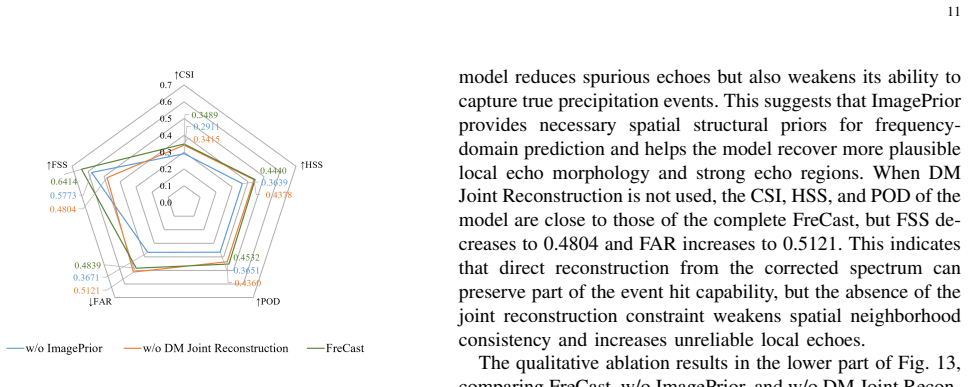
- [IV-C3, Eq. (24), Eqs. (13)-(14), V-C3] The phase-preservation claim is not enforced for the final forecast: after Eq. (24) recombines the corrected amplitude with the baseline phase, the spectrum is passed through MixerNet and SpatialRefiner (Eqs. (13)-(14)), which are learned nonlinear operators, and neither L_det nor L_diff constrains the Fourier phase of their output. The final prediction is therefore not guaranteed to retain the baseline phase, so the statement that freezing the phase anchors spatial structure is unsupported by the architecture. The paper's own 'w/o DM Joint Reconstruction' ablation in Section V-C3 confirms the difficulty: direct reconstruction from the corrected spectrum, which is the phase-preserving path, gives FSS 0.4804 and FAR 0.5121 versus 0.6414 and 0.4839 for the full model, indicating that the spatial-consistency gain is produced by the non-phase-preserving joint reconstruction modules rather than by the amplitude-residual diffusion. Please either rephrase the contribution as phase-conditioned amplitude refinement with a revised attribution, or add an experiment that preserves phase through the reconstruction path and demonstrates the claimed structural anchoring.
- [V-A, Tables II-III] All quantitative results are reported from a single training run, with no error bars, standard deviations, or seed variance. The improvements over the strongest deterministic baseline are modest in several cases (e.g., SEVIR CSI 0.3489 versus AlphaPre 0.3350; MeteoNet HSS 0.5701 versus AlphaPre 0.5624), so without repeated-seed statistics the central empirical claim of consistent improvement is not statistically grounded. Please report mean and variance over at least three seeds, or otherwise justify that the observed differences exceed run-to-run noise.
- [II-D, V-B] DuoCast and CasCast are explicitly identified in the related work as the most closely related probabilistic decoupled approaches, yet neither appears in the baseline comparison of Table III. Given that DuoCast in particular operates on a low-/high-frequency probabilistic decomposition, its absence leaves the 'best on all three datasets' claim relative to an incomplete comparison set. Please add these baselines or state a concrete reason for their exclusion.
- [IV-C1, Eq. (17), Eqs. (11)-(14)] The diffusion target is defined against the raw spectral prediction bar A^n in Eq. (17), while the deterministic forecast hat Y^0 that is supposed to be refined is reconstructed from the image-prior-corrected spectra hat A^0 and hat Phi^0 through Eqs. (11)-(14). As written, the amplitude residual is therefore not the residual of the actual first-stage forecast, and the connection between the diffused quantity and the 'intensity biases in the first-stage prediction' claimed in the abstract is not established. Please define the residual with respect to the actual backbone output spectrum, or justify why the raw spectral baseline is the correct quantity to correct.
minor comments (4)
- [VI] In the conclusion, 'However, Its effectiveness' should be 'However, its effectiveness'.
- [V-C3] The description of the 'w/o DM Joint Reconstruction' variant is ambiguous: it first says the sampled residual is combined with the backbone amplitude and phase, which is exactly Eq. (24), and then says the prediction is 'directly reconstructed' from the corrected spectrum; please clarify explicitly whether MixerNet and SpatialRefiner are bypassed in this ablation.
- [Table II] The table header with arrows and metric names (MAE, SSIM, LPIPS, PSNR) is difficult to parse; please make the direction of better performance explicit for each column, for example by repeating the arrows in the caption or using separate rows.
- [Fig. 11] The caption contains instructional text about the reversed POD axis; please rewrite it as a description of the figure rather than an instruction to the reader.
Circularity Check
No significant circularity: the amplitude residual is a supervised regression target defined from ground-truth spectra, and all claims are evaluated on held-out test splits; the phase-preservation concern is an attribution issue, not a definitional loop.
full rationale
FreCast's derivation is self-contained and empirically grounded. The deterministic backbone produces a spectral baseline, and the second stage defines the amplitude residual target as the difference between the normalized ground-truth amplitude spectrum and the baseline amplitude spectrum (Eq. 17), trains a conditional diffusion model to generate that residual (Eqs. 19-21), and evaluates the resulting forecasts on held-out test splits of SEVIR, MeteoNet, and Shanghai using standard skill metrics. No model parameter is fitted to the test set, and no predicted quantity is defined in terms of the model's own output. The cited prior works (AlphaPre, DiffCast, DuoCast, FACL, Oppenheim-Lim) are external and are used as motivation or comparison, not as a self-citation chain that forces the design. The skeptic's concern about phase preservation is a mechanistic attribution issue, not circularity: the paper's own 'w/o DM Joint Reconstruction' ablation (FSS 0.4804 vs 0.6414) suggests that the spatial-consistency gain comes largely from MixerNet/SpatialRefiner rather than from the phase-preserving recombination of Eq. 24, but this is an empirical-architecture critique, not an equivalence between the prediction and its inputs. Accordingly, no circular step is present and the circularity score is 0.
Assumptions & free parameters
free parameters (4)
- Loss weights λA, λΦ, λP =
0.01, 0.02, 0.02
- SpatialRefiner residual scale λs
- Low-frequency phase truncation Tk
- Diffusion noise schedule and sampling steps
assumptions (4)
- domain assumption Amplitude and phase spectra are proxy representations of echo intensity and spatial structure, respectively.
- domain assumption The baseline phase can be frozen during refinement without significant structural degradation.
- domain assumption Forecast error can be decomposed into independent location and intensity components.
- domain assumption Holdout test splits of SEVIR, MeteoNet, and Shanghai Radar are valid benchmarks for operational skill.
Cite this review
Pith. "Pith review of FreCast: Refining Radar Echo Intensity via Phase-Preserving Amplitude Residual Diffusion for Precipitation Nowcasting." pith.science (2026). https://pith.science/paper/YS4HQN3F
@misc{pith2026260808436,
  author       = {Pith},
  title        = {Pith review of: FreCast: Refining Radar Echo Intensity via Phase-Preserving Amplitude Residual Diffusion for Precipitation Nowcasting},
  year         = {2026},
  howpublished = {\url{https://pith.science/paper/YS4HQN3F}},
  note         = {Machine review of arXiv:2608.08436}
}
read the original abstract
Precipitation nowcasting predicts the spatiotemporal evolution of future radar echoes from historical radar echo sequences, thereby estimating the occurrence, development, and movement of precipitation over the near term. In recent years, deep learning has become an important approach to precipitation nowcasting. Although state-of-the-art models can generally capture the overall spatial distribution of future precipitation, their predictions still exhibit substantial biases in radar echo intensity at individual locations. This observation motivates a more targeted strategy for reducing forecast errors. Instead of regenerating an entire radar echo sequence without spatial constraints, the predicted precipitation structure can be used to guide the refinement of echo intensities at individual locations. This structure-guided refinement directly targets echo intensity biases. Accordingly, we propose FreCast, a two-stage framework for radar echo prediction. The first stage generates an initial forecast of future radar echoes. The second stage uses the spatial structure of the initial forecast as a constraint to further correct intensity biases at individual locations in the first-stage prediction. Experiments on three datasets demonstrate that FreCast achieves consistent improvements across forecast skill metrics. Qualitative results further show that FreCast better preserves rainband continuity and intense precipitation structures at longer lead times.
Figures


Figures from the paper (9 more)


Reference graph
Works this paper leans on
-
[1]
Pysteps: An open-source python library 12 for probabilistic precipitation nowcasting (v1. 0),
S. Pulkkinen, D. Nerini, A. A. P ´erez Hortal, C. Velasco-Forero, A. Seed, U. Germann, and L. Foresti, “Pysteps: An open-source python library 12 for probabilistic precipitation nowcasting (v1. 0),”Geoscientific Model Development, vol. 12, no. 10, pp. 4185–4219, 2019
work page 2019
-
[2]
A short-long term sequence learning network for precipitation nowcasting,
Z. Pan, R. Hang, Q. Liu, and X.-T. Yuan, “A short-long term sequence learning network for precipitation nowcasting,”IEEE Transactions on Geoscience and Remote Sensing, vol. 62, pp. 1–14, 2024
work page 2024
-
[3]
Skilful nowcasting of extreme precipitation with nowcastnet,
Y . Zhang, M. Long, K. Chen, L. Xing, R. Jin, M. I. Jordan, and J. Wang, “Skilful nowcasting of extreme precipitation with nowcastnet,”Nature, vol. 619, no. 7970, pp. 526–532, 2023
2023
-
[4]
Use of nwp for nowcasting convective precipitation: Recent progress and challenges,
J. Sun, M. Xue, J. W. Wilson, I. Zawadzki, S. P. Ballard, J. Onvlee- Hooimeyer, P. Joe, D. M. Barker, P.-W. Li, B. Goldinget al., “Use of nwp for nowcasting convective precipitation: Recent progress and challenges,”Bulletin of the American Meteorological Society, vol. 95, no. 3, pp. 409–426, 2014
work page 2014
-
[5]
The value of precipitation forecasts to anticipate floods,
T. Busker, B. van den Hurk, H. de Moel, and J. C. Aerts, “The value of precipitation forecasts to anticipate floods,”Bulletin of the American Meteorological Society, vol. 106, no. 3, pp. E473–E491, 2025
work page 2025
-
[6]
H.-J. Wang, R. Merz, and S. Basso, “Constructing a geography of heavy- tailed flood distributions: insights from common streamflow dynamics,” Hydrology and Earth System Sciences Discussions, vol. 2024, pp. 1–33, 2024
work page 2024
-
[7]
Convective precipita- tion nowcasting using u-net model,
L. Han, H. Liang, H. Chen, W. Zhang, and Y . Ge, “Convective precipita- tion nowcasting using u-net model,”IEEE Transactions on Geoscience and Remote Sensing, vol. 60, pp. 1–8, 2021
2021
-
[8]
Skilful precipitation nowcasting using deep generative models of radar,
S. Ravuri, K. Lenc, M. Willson, D. Kangin, R. Lam, P. Mirowski, M. Fitzsimons, M. Athanassiadou, S. Kashem, S. Madgeet al., “Skilful precipitation nowcasting using deep generative models of radar,”Nature, vol. 597, no. 7878, pp. 672–677, 2021
2021
Show all 36 references
-
[9]
Precipitation nowcasting diffusion model based on fluid dynamics and multisource data,
D. Li, K. Deng, D. Zhang, H. Leng, Y . Liu, K. Ren, and J. Song, “Precipitation nowcasting diffusion model based on fluid dynamics and multisource data,”IEEE Transactions on Geoscience and Remote Sensing, vol. 63, pp. 1–24, 2025
2025
-
[10]
Applications of radar-based nowcasting techniques for mesoscale weather forecasting in hong kong,
P. Li and E. S. Lai, “Applications of radar-based nowcasting techniques for mesoscale weather forecasting in hong kong,”Meteorological Ap- plications, vol. 11, no. 3, pp. 253–264, 2004
2004
-
[11]
Towards the blending of nwp with nowcast—operation experience in b08fdp,
W. K. Wong, L. H. Yeung, Y . C. Wang, and M. Chen, “Towards the blending of nwp with nowcast—operation experience in b08fdp,” in WMO Symposium on Nowcasting, vol. 30, 2009, p. 24
2009
-
[12]
Tempee: Temporal– spatial parallel transformer for radar echo extrapolation beyond au- toregression,
S. Chen, T. Shu, H. Zhao, G. Zhong, and X. Chen, “Tempee: Temporal– spatial parallel transformer for radar echo extrapolation beyond au- toregression,”IEEE Transactions on Geoscience and Remote Sensing, vol. 61, pp. 1–14, 2023
2023
-
[13]
Remnet: Recurrent evolution memory-aware network for accurate long-term weather radar echo extrapolation,
J. Jing, Q. Li, L. Ma, L. Chen, and L. Ding, “Remnet: Recurrent evolution memory-aware network for accurate long-term weather radar echo extrapolation,”IEEE Transactions on Geoscience and Remote Sensing, vol. 60, pp. 1–13, 2022
2022
-
[14]
Convolutional lstm network: A machine learning approach for precipitation nowcasting,
X. Shi, Z. Chen, H. Wang, D.-Y . Yeung, W.-K. Wong, and W.-c. Woo, “Convolutional lstm network: A machine learning approach for precipitation nowcasting,”Advances in neural information processing systems, vol. 28, 2015
2015
-
[15]
A hybrid approach to physical and deep learning models for radar-based precipitation nowcasting,
H.-J. Kim, S.-S. Yoon, Y . H. Gu, S. H. Kim, Y .-D. Choi, and H.-H. Kwon, “A hybrid approach to physical and deep learning models for radar-based precipitation nowcasting,”IEEE Transactions on Geoscience and Remote Sensing, 2025
2025
-
[16]
Earthformer: Exploring space-time transformers for earth system fore- casting,
Z. Gao, X. Shi, H. Wang, Y . Zhu, Y . B. Wang, M. Li, and D.-Y . Yeung, “Earthformer: Exploring space-time transformers for earth system fore- casting,”Advances in Neural Information Processing Systems, vol. 35, pp. 25 390–25 403, 2022
2022
-
[17]
Motion-guided global–local aggregation transformer network for precipitation nowcast- ing,
X. Dong, Z. Zhao, Y . Wang, J. Wang, and C. Hu, “Motion-guided global–local aggregation transformer network for precipitation nowcast- ing,”IEEE Transactions on Geoscience and Remote Sensing, vol. 60, pp. 1–16, 2022
2022
-
[18]
Prediff: Precipitation nowcasting with latent diffusion models,
Z. Gao, X. Shi, B. Han, H. Wang, X. Jin, D. Maddix, Y . Zhu, M. Li, and Y . B. Wang, “Prediff: Precipitation nowcasting with latent diffusion models,”Advances in Neural Information Processing Systems, vol. 36, pp. 78 621–78 656, 2023
2023
-
[19]
Experimental study on generative adversarial network for precipitation nowcasting,
C. Luo, X. Li, Y . Ye, S. Feng, and M. K. Ng, “Experimental study on generative adversarial network for precipitation nowcasting,”IEEE Transactions on Geoscience and Remote Sensing, vol. 60, pp. 1–20, 2022
2022
-
[20]
Duocast: Duo-probabilistic diffusion for precipitation nowcast- ing,
P. Wen, M. He, P. Filippi, N. Zhao, F. Zhang, T. F. Bishop, Z. Wang, and K. Hu, “Duocast: Duo-probabilistic diffusion for precipitation nowcast- ing,” inProceedings of the AAAI Conference on Artificial Intelligence, vol. 40, no. 46, 2026, pp. 39 442–39 450
2026
-
[21]
Alphapre: Amplitude-phase disentanglement model for precipitation nowcasting,
K. Lin, B. Zhang, D. Yu, W. Feng, S. Chen, F. Gao, X. Li, and Y . Ye, “Alphapre: Amplitude-phase disentanglement model for precipitation nowcasting,” inProceedings of the Computer Vision and Pattern Recog- nition Conference, 2025, pp. 17 841–17 850
2025
-
[22]
Sevir: A storm event imagery dataset for deep learning applications in radar and satellite meteorology,
M. Veillette, S. Samsi, and C. Mattioli, “Sevir: A storm event imagery dataset for deep learning applications in radar and satellite meteorology,” Advances in neural information processing systems, vol. 33, pp. 22 009– 22 019, 2020
2020
-
[23]
Diffcast: A unified framework via residual diffusion for precipitation nowcasting,
D. Yu, X. Li, Y . Ye, B. Zhang, C. Luo, K. Dai, R. Wang, and X. Chen, “Diffcast: A unified framework via residual diffusion for precipitation nowcasting,” inProceedings of the IEEE/CVF Conference on Computer Vision and Pattern Recognition, 2024, pp. 27 758–27 767
2024
-
[24]
Cascast: Skillful high-resolution precipitation nowcasting via cascaded modelling,
J. Gong, L. Bai, P. Ye, W. Xu, N. Liu, J. Dai, X. Yang, and W. Ouyang, “Cascast: Skillful high-resolution precipitation nowcasting via cascaded modelling,”arXiv preprint arXiv:2402.04290, 2024
2024 arXiv
-
[25]
The importance of phase in signals,
A. V . Oppenheim and J. S. Lim, “The importance of phase in signals,” Proceedings of the IEEE, vol. 69, no. 5, pp. 529–541, 2005
2005
-
[26]
Fourier amplitude and correlation loss: Beyond using l2 loss for skillful precipitation nowcasting,
C.-W. Yan, S. Q. Foo, V . H. Trinh, D.-Y . Yeung, K.-H. Wong, and W.- K. Wong, “Fourier amplitude and correlation loss: Beyond using l2 loss for skillful precipitation nowcasting,”Advances in Neural Information Processing Systems, vol. 37, pp. 100 007–100 041, 2024
2024
-
[27]
Predrnn: Recurrent neural networks for predictive learning using spatiotemporal lstms,
Y . Wang, M. Long, J. Wang, Z. Gao, and P. S. Yu, “Predrnn: Recurrent neural networks for predictive learning using spatiotemporal lstms,” Advances in neural information processing systems, vol. 30, 2017
2017
-
[28]
Memory in memory: A predictive neural network for learning higher-order non-stationarity from spatiotemporal dynamics,
Y . Wang, J. Zhang, H. Zhu, M. Long, J. Wang, and P. S. Yu, “Memory in memory: A predictive neural network for learning higher-order non-stationarity from spatiotemporal dynamics,” inProceedings of the IEEE/CVF conference on computer vision and pattern recognition, 2019, pp. 9154–9162
2019
-
[29]
Predrnn++: Towards a resolution of the deep-in-time dilemma in spatiotemporal predictive learning,
Y . Wang, Z. Gao, M. Long, J. Wang, and P. S. Yu, “Predrnn++: Towards a resolution of the deep-in-time dilemma in spatiotemporal predictive learning,” inInternational conference on machine learning. PMLR, 2018, pp. 5123–5132
2018
-
[30]
Mau: A motion-aware unit for video prediction and beyond,
Z. Chang, X. Zhang, S. Wang, S. Ma, Y . Ye, X. Xinguang, and W. Gao, “Mau: A motion-aware unit for video prediction and beyond,”Advances in Neural Information Processing Systems, vol. 34, pp. 26 950–26 962, 2021
2021
-
[31]
Simvp: Simpler yet better video prediction,
Z. Gao, C. Tan, L. Wu, and S. Z. Li, “Simvp: Simpler yet better video prediction,” inProceedings of the IEEE/CVF conference on computer vision and pattern recognition, 2022, pp. 3170–3180
2022
-
[32]
Temporal attention unit: Towards efficient spatiotemporal predictive learning,
C. Tan, Z. Gao, L. Wu, Y . Xu, J. Xia, S. Li, and S. Z. Li, “Temporal attention unit: Towards efficient spatiotemporal predictive learning,” inProceedings of the IEEE/CVF conference on computer vision and pattern recognition, 2023, pp. 18 770–18 782
2023
-
[33]
Rainformer: Features extraction balanced network for radar-based precipitation nowcasting,
C. Bai, F. Sun, J. Zhang, Y . Song, and S. Chen, “Rainformer: Features extraction balanced network for radar-based precipitation nowcasting,” IEEE Geoscience and Remote Sensing Letters, vol. 19, pp. 1–5, 2022
2022
-
[34]
Meteonet, an open reference weather dataset by meteo-france. 2020,
G. Larvor, L. Berthomier, V . Chabot, B. Le Pape, B. Pradel, and L. Perez, “Meteonet, an open reference weather dataset by meteo-france. 2020,” URL https://www. kaggle. com/datasets/katerpillar/meteonet, 2020
2020
-
[35]
A deep learning-based method- ology for precipitation nowcasting with radar,
L. Chen, Y . Cao, L. Ma, and J. Zhang, “A deep learning-based method- ology for precipitation nowcasting with radar,”Earth and Space Science, vol. 7, no. 2, p. e2019EA000812, 2020
2020
-
[36]
Disentangling physical dynamics from unknown factors for unsupervised video prediction,
V . L. Guen and N. Thome, “Disentangling physical dynamics from unknown factors for unsupervised video prediction,” inProceedings of the IEEE/CVF conference on computer vision and pattern recognition, 2020, pp. 11 474–11 484
2020
Reviewed August 14, 2026 · model on record in the stance chip above.
Discussion (0). Continue with ORCID to comment.