REVIEW 3 major objections 5 minor 27 references
Rethinking Higher Education: From Fixed Curricula to Learnity Graphs
T0 review · 3 major / 5 minor · reviewed 2026-08-14 · deepseek-v4-flash
Pith's one-line read The paper argues that lifelong learning is best represented as a 'learnity graph'—an evolving network of knowledge, skills, experience, and artifacts.
desk verdict A well-written position paper that honestly frames a graph-based lifelong learning idea but leaves the central node/edge semantics undefined; worth one round of peer review as a framework paper. read the letter →
The pith
A machine-rendered reading of the paper's core claim, the machinery that carries it, and where it could break.
The reading
What carries the argument
The central object is the learnity graph. A learnity is a minimal meaningful unit of learning—knowledge, skill, experience, or artifact—and the graph's nodes are learnities while its edges are relationships such as prerequisite, composition, specialization, and interdisciplinary integration. The argument is carried by the claim that this one structured representation can absorb what curricula, transcripts, portfolios, and CVs capture separately: academic foundations appear as knowledge learnities, professional growth as experience learnities, and evidence as artifact learnities. To keep the graph usable, the paper proposes layers for developmental depth, subgraphs for context, and AI-based navigation and recommendation as the mechanism for searching and extending the graph.
What would settle it
Give two annotators the same transcript, portfolio, and work history and ask each to build a learnity graph. If the graphs agree on core nodes and edges only at chance levels, or if the graphs do not predict performance on a novel interdisciplinary task better than a conventional transcript, the central claim that learnity graphs capture real developmental structure is not supported.
Extended reading notes
Core claim
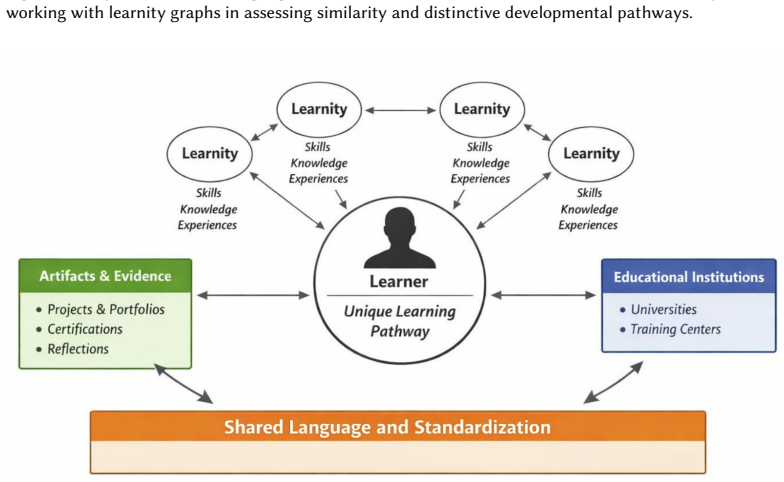
The paper's central discovery is a representational proposal: model learning as a graph whose nodes are learnities—minimal meaningful learning entities that capture a capability, concept, experience, or demonstrated competence—and whose edges are typed relationships including prerequisite, composition, specialization, and interdisciplinary integration. The graph is intended to be a lifelong structure that holds academic foundations, professional experience, and concrete artifacts in one place, with layers and subgraphs providing orthogonal views of depth and context. Because the graph stores actual evidence and connections rather than a fixed course sequence, the authors argue it reflects the unique developmental path of each learner and allows comparison across learners by node overlap, relationship types, depth of dependencies, and artifacts. The proposal is conceptual; the paper supports it with illustrative graphs and points to a prototype infrastructure.
Load-bearing premise
The framework's load-bearing premise is that a person's learning can be cleanly decomposed into discrete learnities with meaningful relationships, so that the graph is a faithful record of competence and development rather than an arbitrary labeling. The paper says in Section 4 that criteria for node distinctness are critical but does not supply them.
Editorial extensions
If this is right
- New fields could emerge as dense clusters of learnities inside a shared graph, letting institutions update offerings without launching new degree programs.
- A learner's development across academic, professional, and personal settings could live in one evolving graph that functions as a living record, complementing or replacing a CV.
- Comparisons between learners would shift from comparing credential titles to comparing graph structure and evidence: which learnities overlap, how they are connected, and what artifacts support them.
- AI-based advisors could turn personalized guidance into graph navigation, suggesting the next learnity to add based on the learner's current structure and goals.
- Cross-institutional recognition would require shared conventions for defining learnities and relationships, with enough flexibility to avoid recreating rigid curricula.
Reading between the lines
- Editorial inference: if node definitions can be made reproducible, credit hours and course grades might lose their role as the primary currency of education, replaced by evidenced learnities.
- Editorial inference: the framework's value could be tested by whether two trained annotators build similar graphs from the same evidence; low agreement would reduce it to a metaphor.
- Editorial inference: a learnity graph could double as a personal knowledge graph, providing a natural interface for AI tutors that recommend not just content but also experiences and projects.
- Editorial inference: the same graph representation could be applied to teams or organizations, modeling collective competence as a shared learnity graph across individuals.
Editorial analysis
A structured set of objections, weighed in public.
Referee Report
Summary. The paper proposes replacing the fixed-curriculum model of higher education with a flexible, lifelong learning framework centered on 'learnity graphs.' A learnity is defined as a minimal meaningful unit of knowledge, competency, or experience, and a learnity graph is a network of such units connected by relationship edges such as prerequisites, composition, and interdisciplinary links. The authors argue that such graphs can integrate academic, professional, and personal learning, support AI-driven personalization and recommendation, and eventually complement or replace CVs and static degree records. The paper is explicitly conceptual: it presents definitions, illustrative figures, and design considerations, and acknowledges in Sections 4 and 5 that node granularity, standardization, and full implementation remain open problems. It also points to a prototype website as an initial realization.
Significance. If the framework could be made operational, a unified representation of learning spanning academic, professional, and personal contexts would be genuinely valuable: it would enable cross-institutional lifelong records, more granular comparison of learners, and personalized learning-pathway recommendation. The paper is honest in scope—it claims to introduce a concept, not to validate it empirically—and it explicitly lists unresolved design questions. It also provides a public prototype, which is a concrete step beyond pure speculation. However, the central construct, the learnity, is currently under-specified to the point that cross-learner comparison and recommendation—two of the promised benefits—are not yet well-defined. The significance is therefore conditional on the resolution of node identity and edge semantics.
major comments (3)
- [Section 3 and Section 4] The load-bearing concept of a 'learnity' is defined only as a 'minimal meaningful unit,' with no operational criterion for minimality. Section 4 concedes that 'clear criteria are therefore required for creating, aggregating, and validating learnities within the graph,' but no such criteria are supplied. Because the entire framework—including Figure 4's node-overlap comparison and any graph-based recommendation—depends on a stable notion of what counts as one node, the proposed representation is not yet operational. The paper should either provide concrete criteria (e.g., based on evidence thresholds, competency taxonomies, or annotation protocols) or substantially narrow its claims to those that do not require cross-learner node identity.
- [Section 3, 'Learnities are connected through relationships' and Section 4, 'Types of Relationships'] The edge semantics are under-defined. The paper lists prerequisite, compositional, interdisciplinary, and specialization links, but does not specify their formal properties: whether they are directed or undirected, transitive, composable, or whether path existence has a pedagogical interpretation. Without these properties, concepts such as 'identifying unique pathways' and 'forecasting potential learning trajectories' are not well-defined, and graph algorithms cannot be applied in a principled way. The authors should specify an edge ontology or else clearly delimit which claims require only informal graph language.
- [Figure 4 and Section 5] The cross-learner comparison example relies on 'overlap of nodes,' which presupposes that two learners' graphs use the same node vocabulary. Since no standardization or alignment mechanism is given—and Section 5 only calls for standardization as a future need—the comparison is annotator-dependent: the same capability could be one node, several nodes, or a subgraph depending on how a learner or evaluator decomposes it. This undermines the claim that learnity graphs can 'complement or replace conventional CVs' and enable fair assessment of similarity and distinctive developmental paths. The paper should either propose a method for establishing node equivalence across learners or explicitly limit comparison to within-learner development.
minor comments (5)
- [Article header and references] The ACM Reference Format block states a publication year of 2018 while the manuscript is dated 2026; this inconsistency should be corrected.
- [Figure 3 caption] 'a real estate lawyer' should be 'a real-estate lawyer' (or 'real estate lawyer' as a compound modifier) for grammatical precision.
- [Throughout] Several citations to arXiv preprints are formatted without full venue details; for a journal submission, these should be expanded or updated where published versions exist.
- [Section 5] The prototype URL is mentioned but no description of its implementation, data model, or limitations is given. A brief description of what the prototype actually demonstrates would help readers assess the claimed 'initial infrastructure.'
- [Section 6] The concluding list of open questions (validation, legitimacy, grading avoidance, algorithmic control) is useful, but it would be strengthened by an explicit statement of which of these the authors consider blocking for basic feasibility versus which are deployment-level concerns.
Circularity Check
No circularity: the paper is a self-contained conceptual proposal with no derivations, fitted parameters, or load-bearing self-citation chain.
full rationale
The paper introduces learnity graphs as a conceptual framework and explicitly leaves implementation, validation, and standardization to future work. There is no derived quantitative claim, no fitted parameter that is later renamed as a prediction, and no equation whose output is identical to its input by construction. The term 'learnity' is defined as 'a minimal meaningful unit' without a formal criterion for minimality, and Section 4 openly states that 'Clear criteria are therefore required for creating, aggregating, and validating learnities within the graph' without supplying them. That under-specification is a correctness or operationalization risk, not circularity, because the paper does not claim to have derived a prediction from the undefined term. The only self-citation is reference [14] (Harel and Koren) for graph-drawing methods, which is an external algorithmic result invoked for readability of visualizations and is not load-bearing for the conceptual claim. No uniqueness theorem, fitted input, or ansatz is smuggled in through self-citation. The framework's value is asserted as a representation proposal, not derived from its own terminology, so there is no circular step to flag.
Assumptions & free parameters
assumptions (4)
- domain assumption Learning can be represented as a network of discrete, meaningful units called learnities.
- domain assumption Graph visualization techniques can make learnity graphs interpretable.
- domain assumption AI can provide effective personalized recommendations and navigation over learning graphs.
- domain assumption Self-Determination Theory supports that flexible, personalized architectures increase engagement.
invented entities (1)
-
learnity
Cite this review
Pith. "Pith review of Rethinking Higher Education: From Fixed Curricula to Learnity Graphs." pith.science (2026). https://pith.science/paper/FO4F5A4R
@misc{pith2026260808543,
  author       = {Pith},
  title        = {Pith review of: Rethinking Higher Education: From Fixed Curricula to Learnity Graphs},
  year         = {2026},
  howpublished = {\url{https://pith.science/paper/FO4F5A4R}},
  note         = {Machine review of arXiv:2608.08543}
}
read the original abstract
Higher education stands at a turning point. In an era where knowledge is increasingly accessible and which is, more often than not, mediated by advanced Artificial Intelligence (AI), the value of traditional curricula models warrants reconsideration. This does not imply that one should replace thorough academic studies. Universities remain essential in providing foundational knowledge, theoretical depth and conceptual grounding. The challenge is to extend these educational facets with learning environments that foster creativity, interdisciplinary integration, hands-on experience, and especially long-term development. In this paper, we introduce a lifelong learning framework that integrates academic, professional, and personal learning, centered on a new concept that we term learnity graphs, a structured representation of learning as interconnected units of knowledge, skills, experience, and actual artifacts, coupled with a method for presenting, and leveraging it.
Figures


Figures from the paper (4 more)



Reference graph
Works this paper leans on
-
[1]
Hasan Abu-Rasheed, Christian Weber, and Madjid Fathi. 2024. Knowledge Graphs as Context Sources for LLM-Based Explanations of Learning Recommendations. arXiv:2403.03008 https://arxiv.org/abs/2403.03008
arXiv 2024
-
[2]
2009.Computer Science Curricula 2008: An Interim Revision of CS 2001
ACM/IEEE-CS Joint Task Force on Computing Curricula. 2009.Computer Science Curricula 2008: An Interim Revision of CS 2001. Association for Computing Machinery and IEEE Computer Society. doi:10.1145/1595453
-
[3]
2020.Computing Curricula 2020: Paradigms for Global Computing Education
ACM/IEEE-CS Joint Task Force on Computing Curricula. 2020.Computing Curricula 2020: Paradigms for Global Computing Education. Association for Computing Machinery. doi:10.1145/3467967
doi:10.1145/3467967 2020
-
[4]
2004.Learning for an Unknown Future
Ronald Barnett. 2004.Learning for an Unknown Future. Routledge
work page 2004
-
[5]
Helen C. Barrett. 2007. Researching Electronic Portfolios and Learner Engagement.Journal of Adolescent & Adult Literacy50, 6 (2007), 436–449. doi:10.1598/JAAL.50.6.2
- [6]
-
[7]
2011.Vocational Education: Purposes, Traditions and Prospects
Stephen Billett. 2011.Vocational Education: Purposes, Traditions and Prospects. Springer
work page 2011
-
[8]
Hélène de Burgh-Woodman and Ali Yakhlef. 2012. The Epistemological Foundations of Consumer Culture Theory: A Critical Analysis.Marketing Theory12, 2 (2012), 131–150. doi:10.1177/1470593112441560
Show all 27 references
-
[9]
Deci and Richard M
Edward L. Deci and Richard M. Ryan. 2000. The What and Why of Goal Pursuits: Human Needs and the Self- Determination of Behavior.Psychological Inquiry11, 4 (2000), 227–268. doi:10.1207/S15327965PLI1104_01
2000 doi
-
[10]
Heffernan, Tanja Käser, Steven Moore, Anna N
Paul Denny, Sumit Gulwani, Neil T. Heffernan, Tanja Käser, Steven Moore, Anna N. Rafferty, and Adish Singla
-
[11]
Michael Eraut. 2004. Informal Learning in the Workplace.Studies in Continuing Education26, 2 (2004), 247–273. doi:10.1080/158037042000225245
2004 doi
-
[12]
European Ministers of Education. 1999. The Bologna Declaration of 19 June 1999. https://www.ehea.info/media.ehea. info/file/Ministerial_conferences/02/8/1999_Bologna_Declaration_English_553028.pdf
1999
-
[13]
John Field. 2006. Lifelong Learning and the New Educational Order.British Journal of Educational Technology37 (2006), 987–988. doi:10.1111/j.1467-8535.2006.00660_18.x
2006
-
[14]
David Harel and Yehuda Koren. 2002. A Fast Multi-Scale Method for Drawing Large Graphs.Journal of Graph Algorithms and Applications6, 3 (2002), 179–202
2002
-
[15]
2019.Artificial Intelligence in Education: Promise and Implications for Teaching and Learning
Wayne Holmes, Maya Bialik, and Charles Fadel. 2019.Artificial Intelligence in Education: Promise and Implications for Teaching and Learning. Center for Curriculum Redesign
2019
-
[16]
2016.Intelligence Unleashed: An Argument for AI in Education
Rose Luckin, Wayne Holmes, Mark Griffiths, and Laurie Forcier. 2016.Intelligence Unleashed: An Argument for AI in Education. Pearson
2016
-
[17]
Martin Mulder. 2017. Competence Theory and Research: A Synthesis. InCompetence-Based Vocational and Professional Education: Bridging the Worlds of Work and Education, Martin Mulder (Ed.). Springer, Cham, Switzerland, 1071–1106. doi:10.1007/978-3-319-41713-4_50
2017 doi
-
[18]
2022.The Future of Undergraduate Computer Science Education
National Academies of Sciences, Engineering, and Medicine. 2022.The Future of Undergraduate Computer Science Education. The National Academies Press. doi:10.17226/26308
2022 doi
-
[19]
Noy and Deborah L
Natasha F. Noy and Deborah L. McGuinness. 2001.Ontology Development 101: A Guide to Creating Your First Ontology. Technical Report KSL-01-05. Stanford Knowledge Systems Laboratory
2001
-
[20]
Roy D. Pea. 1993. Practices of Distributed Intelligence and Designs for Education. InDistributed Cognitions: Psychological and Educational Considerations, Gavriel Salomon (Ed.). Cambridge University Press, 47–87
1993
-
[21]
Valentina Presutti et al. 2025. Opportunities for Knowledge Graphs in the AI Landscape.Data & Knowledge Engineering 155 (2025). doi:10.1016/j.websem.2025.100867
2025
- [22]
-
[23]
Ryan and Edward L
Richard M. Ryan and Edward L. Deci. 2017.Self-Determination Theory: Basic Psychological Needs in Motivation, Development, and Wellness. Guilford Press, New York, NY
2017
-
[24]
2013.Handbook of Graph Drawing and Visualization
Roberto Tamassia (Ed.). 2013.Handbook of Graph Drawing and Visualization. CRC Press
2013
-
[25]
Leesa Wheelahan. 2015. Not Just Skills: What a Focus on Knowledge Means for Vocational Education.Journal of Curriculum Studies47, 6 (2015), 750–762. doi:10.1080/00220272.2015.1089942
2015
-
[26]
Graesser
Hu Xu, Tong Wang, and Arthur C. Graesser. 2025. Generative AI in Education: From Foundational Insights to the Socratic Playground for Learning. arXiv:2501.06682 https://arxiv.org/abs/2501.06682 J. ACM, Vol. 37, No. 4, Article 111. Publication date: August 2018
2025 arXiv
-
[2024]
arXiv:2402.01580 https: //arxiv.org/abs/2402.01580
Generative AI for Education (GAIED): Advances, Opportunities, and Challenges. arXiv:2402.01580 https: //arxiv.org/abs/2402.01580
Reviewed August 14, 2026 · model on record in the stance chip above.
Discussion (0). Continue with ORCID to comment.