REVIEW 3 major objections 5 minor 27 references
Business Arena: Benchmarking LLM Agents in a Realistic Marketplace
T0 review · 3 major / 5 minor · reviewed 2026-08-14 · deepseek-v4-flash
Pith's one-line read Business Arena claims to measure business intelligence in a realistic simulated marketplace, and finds the best LLM agents still fall far behind expert strategies.
desk verdict A serious benchmark for end-to-end business agents with solid internal reliability, but the realism claim is undercut by an engineered demand signal and the lack of released artifacts; worth engaging and sending to peer review. read the letter →
The pith
A machine-rendered reading of the paper's core claim, the machinery that carries it, and where it could break.
The reading
What carries the argument
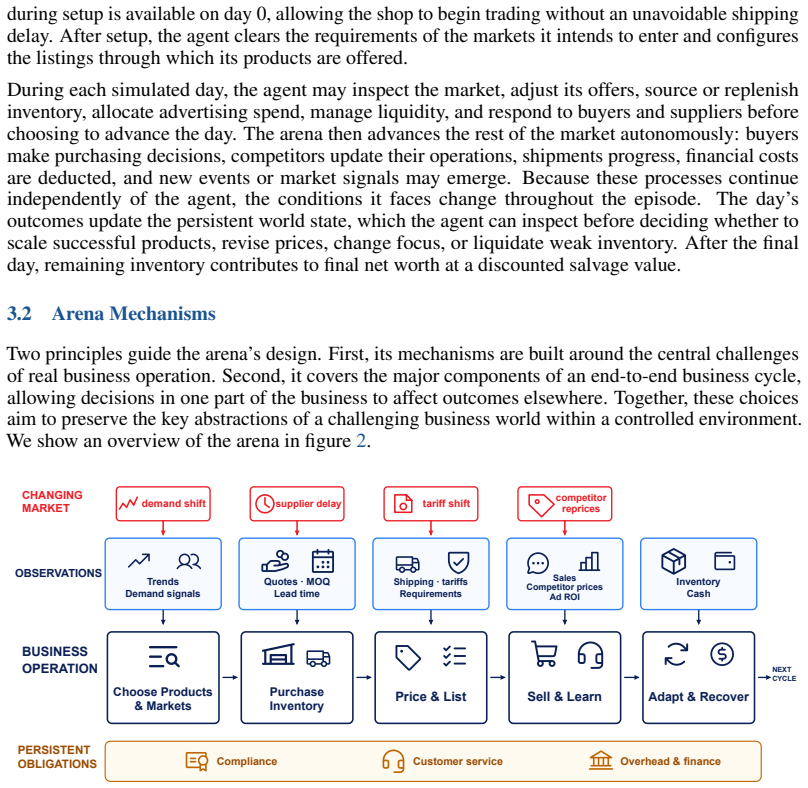
The load-bearing object is the arena itself: a 30-day, data-grounded marketplace simulator with hidden state, scripted competitor archetypes, a financial ledger, compliance gates, and a save-fork-load stateful evaluation harness. Around this core, the diagnostic stack—an expert-designed strategy reserve that estimates available opportunity, skill-level metrics that expose operating styles, action-level attribution that traces gains and losses to decisions, and mechanism ablations that test intended behavior against neglect and misuse—is what turns a single profit number into evidence about business capability. The four design mechanisms of noisy evidence, delayed consequences, a changing market, and persistent obligations are what make the scores interpretable as business intelligence rather than as routine workflow completion.
What would settle it
Run the same benchmark with the raw, unprocessed Google Trends series substituted for the post-processed signal: if evidence-guided policies no longer beat the blind baseline by tens of thousands of dollars in final net worth, the claim that scores reflect genuine business intelligence rather than an engineered signal would be undercut.
Extended reading notes
Core claim
Business Arena places one LLM-operated shop inside a simulated cross-border B2B marketplace with 965 supplier offers across 135 SKUs, more than 60 tools, a persistent workspace, and scripted competitor sellers, over a 30-day episode. The central discovery is that the environment separates models sharply: mean final net worth across 15 frontier models ranges from $188,488 to $20,856, a $9.0\times$ gap, and 51% of runs finish below the $80,000 starting capital. The strongest expert-designed strategy reaches $436,195 in the same world, more than twice the best model mean, showing available opportunity the agents are not yet capturing. Mechanism ablations over portfolio selection, market events, pricing, tariffs, and customer service show that evidence-guided behavior beats both neglect and misuse, which the paper takes as evidence that higher arena scores reflect genuine business intelligence rather than simulator-specific shortcuts.
Load-bearing premise
The claim that higher arena scores reflect genuine business intelligence depends on hand-set simulator parameters and on a post-processed Google Trends signal that is deliberately correlated with hidden demand; if that signal were not so clean, evidence-guided agents might not outperform blind ones, and the measured capability gap could shrink.
Editorial extensions
If this is right
- Frontier LLM agents are not yet reliable enough for autonomous business operation: 51% of runs lose money, and only four of fifteen models preserve starting capital in every trial.
- The best model mean ($188,488) trails the best expert-designed strategy ($436,195) by more than a factor of two, indicating substantial headroom in end-to-end business operation.
- Mechanism ablations show that evidence-guided behavior outperforms both neglect and misuse across five tested mechanisms, supporting the interpretation that higher scores reflect genuine business intelligence.
- Skill-level metrics reveal stable operating styles—premium sellers, volume wholesalers, customer-service specialists—that a single final score hides, making targeted diagnosis and training-data construction possible.
- Stateful save-fork-load evaluation enables test-time compute scaling: five-day trace search beat daily search and independent runs under the same rollout budget, evidence that the arena's feedback is genuinely delayed.
Reading between the lines
- Beyond the paper, a natural stress test is to replace the post-processed Google Trends signal with raw, unprocessed public data; because Appendix C reveals the signal is engineered to correlate with hidden demand, the measured capability gap may shrink under real-world noise.
- Beyond the paper, the action-level attribution chains could be used directly as dense credit assignment for reinforcement learning, converting each sourcing, pricing, and recovery action into a reward signal.
- Beyond the paper, a normalized opportunity-capture score—model final net worth divided by the best expert-strategy final net worth—would make the benchmark comparable across different world seeds and future arena versions.
- Beyond the paper, the arena currently tests one business setting (cross-border B2B sourcing), so the generality of the business-intelligence claim to retail, services, or manufacturing remains an open question.
Editorial analysis
A structured set of objections, weighed in public.
Referee Report
Summary. Business Arena is a simulated cross-border B2B marketplace in which an LLM agent operates a shop over 30 simulated days, with supplier data grounded in Alibaba.com and demand, tariffs, and events calibrated from public sources. The paper evaluates 15 frontier models across 10 runs each, reporting a 9.0x spread in mean final net worth, with 51% of runs losing money, and compares model performance to a library of expert-designed strategies. It contributes diagnostic skill-level metrics, action-level attribution, stateful checkpointing, and nine mechanism ablations. The central claims are that the arena preserves the challenges of real business and that higher arena scores reflect genuine business intelligence rather than shortcuts, leaving large headroom between frontier LLM agents and expert strategies.
Significance. If the realism claim were fully supported, this would be a valuable benchmark for long-horizon, open-ended agent evaluation: it combines noisy evidence, delayed feedback, non-stationarity, and persistent obligations in one testbed, and the evaluation methodology is careful. The reliability analysis (ICC = 0.944 for ten-run means; split-half rho = 0.898) and the nine mechanism ablations with negative controls are strengths, as are the stateful save-fork-load pipeline and action-level attribution. However, the external validity of the demand signal and the reference-strategy headroom estimate are not yet established; the within-benchmark evidence is strong, but the realistic and trustworthy claim remains conditional.
major comments (3)
- [Appendix C and Appendix G, Table 1] The demand signal is post-processed to correlate with oracle demand: Appendix C states 'We conduct minor post-processing of google trends data so that the results is correlated with oracle demand,' and Appendix G reports a pooled correlation of 0.972 with 93.3% country-category identification. This engineered correlation means the evidence-guided sourcing advantage of +$63.6k in Table 1 is measured under a public signal nearly as informative as the hidden demand state. The manuscript does not report the raw Google Trends correlation before post-processing, nor does it provide a noise model, temporal lag structure, or category-specific degradation. Because real public demand signals are substantially noisier and time-lagged, the measured capability gap and the claimed headroom could shrink or reorder if the signal were cleaned to a realistic noise level. The authors should add a raw-correlation baseline, a sensitivity analysis across noise levels, or validation against out-of-sample real demand series before claiming that the arena preserves the noisy-evidence challenge. This issue is load-bearing for the Section 6.5 conclusion that higher scores reflect genuine business intelligence.
- [Section 6.5 and Appendix J] The expert-designed strategies, including the Bayesian export compounder reaching $436,195, are authored by the same team with full knowledge of the arena's mechanisms and NPC behavior. Although they operate only on agent-visible information, this reference standard may encode privileged knowledge of which mechanisms matter, making the substantial-headroom conclusion partly internal to the authors' design. The paper should test the robustness of the headroom estimate, for example by using independently authored strategies or by varying NPC population and world seeds and showing that the expert advantage is stable. Without such evidence, the conclusion that frontier models fall substantially behind human-designed strategies is not independently validated.
- [Section 6.5 and Appendix G] The mechanism ablations compare hand-coded intended policies against hand-coded neglect and misuse variants; they demonstrate that the arena rewards the intended mechanisms, but they do not directly establish that the observed LLM leaderboard differences are caused by those mechanisms. The paper states that 'these ablations support interpreting higher Business Arena scores as evidence of stronger business intelligence,' yet the policies that earn higher scores in the ablations are not the LLM agents. To bridge this gap, the authors should explicitly acknowledge this limitation and, where possible, correlate model-level scores with the corresponding skill-level metrics (e.g., demand-inference accuracy or pricing precision) to show that the same mechanisms drive both the ablation ladder and the model ranking.
minor comments (5)
- [Appendix C] The sentence 'We conduct minor post-processing of google trends data so that the results is correlated with oracle demand' contains a grammatical error; 'results is' should be 'results are'.
- [Section 4 and Appendix J] The word 'capitol' appears in 'capitol commitments' (Section 4) and 'redeploy capitol' (Appendix J); both should be 'capital'.
- [Appendix D] The text mentions '10 baselines (one per archetype, used for alpha computation)' but never defines what alpha is; please specify this quantity or remove the reference.
- [Appendix M] The sentence 'The contrast shows the what we expect from models' is ungrammatical and should be rephrased, for example to 'The contrast shows what we expect from models.'
- [References] Reference [4] is listed as 'arXiv preprint, 2026' without author names; please complete the citation so readers can locate the work.
Circularity Check
Demand-signal ablation is self-definitional: Google Trends is post-processed to correlate with oracle demand (pooled ρ=0.972), so the evidence-guided advantage is guaranteed by construction rather than an empirical property of real public signals.
-
fitted input called prediction
[Appendix C ('Realistically-grounded Demand'); relied on in Section 6.5 Table 1 and Appendix G demand-inference ablation]
"We conduct minor post-processing of google trends data so that the results is correlated with oracle demand, thus testing the agent's ability to do numerical analysis to estimate demand trends."
By construction, the agent-visible Google Trends signal is post-processed to correlate with the hidden oracle demand it is supposed to infer. The demand-inference ablation then reports pooled ρ=0.972 for 'public evidence' and a $63.6k advantage for evidence-guided sourcing over blind bulk buying (Sec. 6.5, App. G). That correlation is the design target of the post-processing, not an empirical property of real public data. No raw-correlation baseline, noise model, or lag structure is reported, so the ablation only verifies the arena's internal consistency.
full rationale
The derivation is mostly self-contained: 15 frontier models run in an isolated sandbox with a protected information boundary; the leaderboard means, ICC reliability, split-half rank correlation, and action-level attribution are computed from recorded interactions, not from fitted parameters. The expert-designed strategies are internal baselines, not predictions, and no load-bearing self-citation chain appears. The one genuinely circular element is the demand-signal construction. Appendix C states that Google Trends data are post-processed so that the results correlate with oracle demand; Appendix G then reports that the public evidence recovers the hidden demand ranking at ρ=0.972 and that evidence-guided sourcing beats blind policies by $63.6k. Because the signal was engineered to be nearly as informative as the oracle, the demand-inference ablation is a tautology with respect to the realism claim: it demonstrates that a signal designed to reveal hidden demand helps agents, but says nothing about whether real-world public signals are that informative. The paper does not provide a raw-signal baseline or noise model that would support transfer to noisier real markets. This affects the 'realistic and trustworthy testbed' conclusion (Section 6.5) but not the internal model ordering or the skill-level/attribution analyses, so the overall circularity is partial rather than total. Score 4 reflects one load-bearing manufactured input in an otherwise independent evaluation.
Assumptions & free parameters
free parameters (6)
- Daily fixed overhead =
$200/day
- Final settlement discounts =
0.97 escrow, 0.97 receivables, 0.85 inventory
- Compliance fine schedule =
max($500, 0.15 × order value) × min(k,5)
- Google Trends post-processing correlation =
correlated with oracle demand (ρ=0.972)
- NPC population distribution =
micro 45%, small 30%, mid 18%, large 5%, enterprise 2%
- Festival demand caps =
capped category-specific changes
assumptions (4)
- domain assumption The arena's mechanisms are a valid operationalization of real business challenges
- ad hoc to paper Post-processed Google Trends signal is a legitimate public demand signal
- ad hoc to paper Expert-designed strategies represent the available opportunity in the arena
- standard math Standard reliability statistics (ICC, split-half) are applicable to these score distributions
invented entities (2)
-
Hidden oracle demand state
-
NPC seller archetypes
Cite this review
Pith. "Pith review of Business Arena: Benchmarking LLM Agents in a Realistic Marketplace." pith.science (2026). https://pith.science/paper/3TDWXRW7
@misc{pith2026260808621,
  author       = {Pith},
  title        = {Pith review of: Business Arena: Benchmarking LLM Agents in a Realistic Marketplace},
  year         = {2026},
  howpublished = {\url{https://pith.science/paper/3TDWXRW7}},
  note         = {Machine review of arXiv:2608.08621}
}
read the original abstract
Running a business is a challenging form of intelligent work. Operators must infer opportunities from partial signals, commit capital under uncertainty, adapt to delayed outcomes in a changing market, and satisfy regulatory obligations before trading legally. Frontier LLM agents can increasingly complete complex workflows, yet business-related capabilities are rarely evaluated in existing agent benchmarks. We introduce \textbf{Business Arena}, a controlled environment where an AI agent runs a cross-border shop, buying from suppliers and selling to buyers over a long horizon. We ground the arena in real Alibaba.com sourcing data and market conditions calibrated from authoritative sources. Delayed and coupled consequences make individual business decisions difficult to judge, but their combined outcome is measurable through profit. Because profit alone cannot explain why an agent succeeds or fails, we compare agents with human-designed strategies to estimate available opportunity, use skill-level metrics to reveal underlying strengths and weaknesses, and trace realized gains and losses to the actions that produced them. We use mechanism ablations to establish that strong results reflect genuine business intelligence rather than neglect or simulator-specific shortcuts. We evaluate 15 frontier models and find a ninefold difference in mean final net worth. Even the best model falls behind human-designed strategies, indicating that business operation remains challenging for LLM agents. Skill-level analysis reveals operating styles, from margin-focused premium sellers to high-turnover wholesalers and customer-service specialists, while action-level attribution identifies the sourcing, pricing, and recovery decisions that create or destroy value. Together, Business Arena takes a first step toward a realistic and trustworthy testbed for evaluating end-to-end business agents.
Figures


Figures from the paper (16 more)





Reference graph
Works this paper leans on
-
[1]
DMTCP: transparent checkpointing for cluster computa- tions and the desktop
Jason Ansel, Kapil Arya, and Gene Cooperman. DMTCP: transparent checkpointing for cluster computa- tions and the desktop. In2009 IEEE International Symposium on Parallel and Distributed Processing, 1–12. 2009. doi:10.1109/IPDPS.2009.5161063
arXiv 2009
-
[2]
Axel Backlund and Lukas Petersson. Vending-bench: a benchmark for long-term coherence of autonomous agents.arXiv preprint arXiv:2502.15840, 2025
arXiv 2025
-
[3]
CEO-Bench: can agents play the long game?arXiv preprint arXiv:2606.18543, 2026
Haozhe Chen, Karthik Narasimhan, and Zhuang Liu. CEO-Bench: can agents play the long game?arXiv preprint arXiv:2606.18543, 2026
arXiv 2026
-
[4]
SWE-Marathon: long-horizon software engineering tasks for LLM agents.arXiv preprint, 2026
Aditya Desai and others. SWE-Marathon: long-horizon software engineering tasks for LLM agents.arXiv preprint, 2026
work page 2026
-
[5]
Yunpeng Dong, Jingkai He, Yuze Hou, Dong Du, Zhonghu Xu, Si Yu, Yubin Xia, and Haibo Chen. DeltaBox: scaling stateful AI agents with millisecond-level sandbox checkpoint/rollback.arXiv preprint arXiv:2605.22781, 2026
arXiv 2026
-
[6]
Muyu He, Adit Jain, Anand Kumar, Vincent Tu, Soumyadeep Bakshi, Sachin Patro, and Nazneen Rajani. YC-Bench: benchmarking AI agents for long-term planning and consistent execution.arXiv preprint arXiv:2604.01212, 2026
arXiv 2026
-
[7]
SWE-bench: can language models resolve real-world GitHub issues? InICLR
Carlos E Jimenez, John Yang, Alexander Wettig, Shunyu Yao, Kexin Pei, Ofir Press, and Karthik Narasimhan. SWE-bench: can language models resolve real-world GitHub issues? InICLR. 2024
work page 2024
-
[8]
The role of management games and simulations in education and research
Bernard Keys and Joseph Wolfe. The role of management games and simulations in education and research. Journal of Management, 16(2):307–336, 1990
work page 1990
Show all 27 references
-
[9]
Shrout and Joseph L
Patrick E. Shrout and Joseph L. Fleiss. Intraclass correlations: uses in assessing rater reliability.Psycho- logical Bulletin, 86(2):420–428, 1979. doi:10.1037/0033-2909.86.2.420
1979 doi
-
[10]
Herbert A. Simon. A behavioral model of rational choice.The Quarterly Journal of Economics, 69(1):99– 118, 1955
1955
-
[11]
John D. Sterman. Modeling managerial behavior: misperceptions of feedback in a dynamic decision making experiment.Management Science, 35(3):321–339, 1989
1989
-
[12]
Teece, Gary Pisano, and Amy Shuen
David J. Teece, Gary Pisano, and Amy Shuen. Dynamic capabilities and strategic management.Strategic Management Journal, 18(7):509–533, 1997
1997
-
[13]
Agent-based computational economics: a constructive approach to economic theory
Leigh Tesfatsion. Agent-based computational economics: a constructive approach to economic theory. In Handbook of Computational Economics, volume 2, pages 831–880. Elsevier, 2006
2006
-
[14]
ShoppingBench: a real-world intent-grounded shopping benchmark for LLM-based agents.AAAI, 2024
Yinuo Wang, Chuanfeng Xiao, and others. ShoppingBench: a real-world intent-grounded shopping benchmark for LLM-based agents.AAAI, 2024
2024
-
[15]
Crab: a semantics-aware check- point/restore runtime for agent sandboxes.arXiv preprint arXiv:2604.28138, 2026
Tianyuan Wu, Chaokun Chang, Lunxi Cao, Wei Gao, and Wei Wang. Crab: a semantics-aware check- point/restore runtime for agent sandboxes.arXiv preprint arXiv:2604.28138, 2026
2026 arXiv
-
[16]
τ-bench: a benchmark for tool-agent- user interaction in real-world domains
Shunyu Yao, Noah Shinn, Pedram Razavi, and Karthik Narasimhan. τ-bench: a benchmark for tool-agent- user interaction in real-world domains. InICLR. 2025
2025
-
[17]
WebArena: a realistic web environment for building autonomous agents
Shuyan Zhou, Frank F Xu, Hao Zhu, Xuhui Zhou, Robert Lo, Abishek Sridhar, Xianyi Cheng, Tianyue Ou, Yonatan Bisk, Daniel Fried, Uri Alon, and Graham Neubig. WebArena: a realistic web environment for building autonomous agents. InICLR. 2024
2024
-
[18]
The 2024 holiday season set new records for ecommerce
Adobe Digital Insights. The 2024 holiday season set new records for ecommerce. 2025. URL: https: //business.adobe.com/uk/blog/2024-holiday-season-set-new-records-for-ecommerce
2024
-
[19]
Holiday commerce data and shopping trends
Criteo. Holiday commerce data and shopping trends. URL:https://www.criteo.com/insights/
-
[20]
Turnover and volume of sales in wholesale and retail trade: monthly data
Eurostat. Turnover and volume of sales in wholesale and retail trade: monthly data. Dataset sts_trtu_m. URL:https://ec.europa.eu/eurostat/databrowser/view/sts_trtu_m/default/table
-
[21]
Federal Reserve Bank of St. Louis. Fred api: economic data observations. URL:https://fred.stlou isfed.org/docs/api/fred/
-
[22]
Google trends
Google. Google trends. URL:https://trends.google.com/. 15
-
[23]
European holiday spending outlook
Mastercard Economics Institute. European holiday spending outlook. 2024. URL: https://www.mast ercard.com/news/europe/en/newsroom/press-releases/en/2024/european-shoppers-set -to-celebrate-with-spending-on-fashion-gadgets-and-travel-this-festive-season/
2024
-
[24]
Total retail sales of consumer goods
National Bureau of Statistics of China. Total retail sales of consumer goods. URL: https://www.stats. gov.cn/english/PressRelease/
-
[25]
Holiday data and consumer trends
National Retail Federation. Holiday data and consumer trends. URL: https://nrf.com/research-i nsights/holiday-data-and-trends
-
[26]
Census Bureau
U.S. Census Bureau. Monthly retail trade survey. URL: https://www.census.gov/retail/mrts/a bout_the_surveys.html
-
[27]
World integrated trade solution: bilateral tariff technical note
World Bank. World integrated trade solution: bilateral tariff technical note. WITS Trade and Tariff Database. Tariff data sourced from UNCTAD TRAINS and WTO IDB. URL: https://wits.worldba nk.org/Bilateral-Tariff-Technical-Note.html. 16 A Agent Runtime and Interface Autonomous ...
Reviewed August 14, 2026 · model on record in the stance chip above.
Discussion (0). Continue with ORCID to comment.