REVIEW 5 major objections 6 minor 66 references
The James Webb Space Telescope Absolute Flux Calibration. VI. Near-Infrared Camera Imaging and Coronagraphy
T0 review · 5 major / 6 minor · reviewed 2026-08-14 · deepseek-v4-flash
Pith's one-line read This paper delivers the updated absolute flux-calibration factors for every NIRCam imaging mode, converting DN/s to MJy/sr with scatter typically below 2%, and shows the instrument response drifts by less than 0.4% per year.
desk verdict A thorough, honest calibration delivery whose <2% scatter is real but measures internal consistency, not absolute accuracy; the single-star and substituted modes are clearly labeled and the paper deserves a serious referee. read the letter →
The pith
A machine-rendered reading of the paper's core claim, the machinery that carries it, and where it could break.
The reading
What carries the argument
The load-bearing object is the calibration factor C defined by C = Fν / (Nap Acor Scor Ωpix), the ratio of the stellar model flux density Fν to the measured count rate Nap in a finite aperture, corrected for aperture losses Acor, subarray offsets Scor, and the average pixel solid angle Ωpix. Measuring C for each filter, detector, mask, and subarray, then averaging across standard stars, is what turns every NIRCam image into physical surface-brightness units. The CALSPEC2 stellar models supply the flux reference, STPSF supplies the aperture corrections, and the full-frame-versus-subarray comparison supplies the subarray offsets; together these convert the raw DN/s measurements into the PHOTMJSR keyword values that the pipeline applies.
What would settle it
Obtain a high-signal NIRSpec spectrum of LDS 749B (or one of the excluded WDFS white dwarfs) and compare it directly to its CALSPEC2 model; if the model is the problem, the spectral mismatch will match the 2-5% photometric offset, while if the spectrum matches the model, the offset must originate in the NIRCam photometric chain. Alternatively, recompute the delivered factors using an independent stellar-atmosphere model grid and check whether the fifteen retained stars still agree within 1%.
Extended reading notes
Core claim
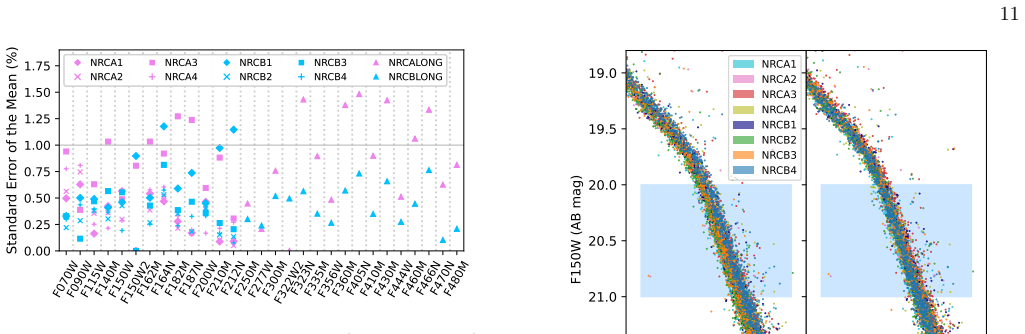
The central discovery is a measured PHOTMJSR calibration factor for each of the 29 NIRCam imaging filters on all ten detectors, all five coronagraphic masks (including dual-channel pairings), both weak lenses (WLP4 and WLP8) used in time-series modes, and every science subarray, delivered as pmap 1490 in March 2026. The factors are derived by comparing CALSPEC2 model spectra to aperture photometry, corrected for aperture losses with STPSF simulations, for subarray-to-full-frame count-rate differences, and for detector-to-detector offsets measured from LMC and 47 Tuc mosaics. The scatter in the factor is below 2% in most filter+detector[+mask] combinations and below 1% in about half; no trends appear with count rate or well depth. Four white dwarfs (LDS 749B and three WDFS stars) are excluded from the averages because their model predictions disagree at the 2-5% level, and the paper attributes these disagreements to the CALSPEC2 models rather than to the photometric chain. This is the first on-sky calibration for the weak lenses and for secondary coronagraphy channels, and the delivered factors change by less than 4% from the previous delivery for most combinations.
Load-bearing premise
The entire delivered scale inherits the accuracy of the CALSPEC2 model spectra for the fifteen stars kept in the averages; if those models carry a common bias, every PHOTMJSR value is biased by the same amount and the sub-2% scatter measures internal consistency rather than absolute accuracy.
Editorial extensions
If this is right
- All NIRCam imaging, time-series imaging, and coronagraphic data processed with pmap 1490 share one absolute flux scale; calibrated images carry the PHOTMJSR keyword that converts DN/s to MJy/sr, and the delivered table gives the associated zeropoints.
- Subarray-dependent factors remove count-rate offsets up to about 1%, so observations taken in different subarrays or with different readout patterns can be compared directly.
- Weak-lens and dual-channel coronagraph modes now have an on-sky calibration for the first time, with scatter below 1.5% for setups measured with at least three stars.
- NIRCam's response drift (under 0.4% per year in the short-wavelength channel and under 0.1% in the long-wavelength channel) is smaller than the calibration uncertainty, so no time-dependent correction is delivered yet, but future deliveries will add one as more epochs accumulate.
- Detector-to-detector offsets measured in eight filters are folded into the reference files; residual offsets from LMC and 47 Tuc images are typically below 1% but reach 4-5% in a few cases, and a Cycle 5 program will measure offsets in all remaining filters.
Reading between the lines
- If the delivered factors are right at the percent level, the 2-5% discrepancies seen for LDS 749B and WDFS2317 are model-atmosphere failures rather than instrument problems; an independent spectrum of those stars would settle which side is wrong.
- The detector-offset pattern, with NRCA3 and NRCB4 showing the largest offsets in the four measured SW filters, suggests those two detectors may be the main source of residual scatter in the unmeasured filters; a 47 Tuc observation in an unmeasured filter would test this directly.
- Because the faint white dwarfs were added specifically for full-frame calibration, a future model-grid update could convert those excluded stars into independent cross-checks without new observations, simply by recomputing the factors with corrected models.
- The weak-lens flat fields are still ground-based and known to differ from sky flats by 6-8%; once sky-based weak-lens flats are delivered, the WLP4/WLP8 factors may shift by more than their current scatter, so those factors should be re-derived before relying on them for time-series science.
Editorial analysis
A structured set of objections, weighed in public.
Referee Report
Summary. This paper reports the updated absolute flux calibration of the JWST Near-Infrared Camera (NIRCam) imaging, time-series imaging, and coronagraphic modes. The calibration factor PHOTMJSR, converting DN/s/pixel to MJy/sr, is derived by comparing aperture photometry of 19 standard stars (A dwarfs, solar analogs, hot stars, and faint white dwarfs) with predicted fluxes from CALSPEC2 synthetic spectra, using STPSF aperture corrections and measured subarray-to-full-frame offsets. The authors deliver factors for all 29 imaging filters, 5 coronagraph masks, both weak lenses, and the coronagraph target-acquisition subarrays, with separate values by detector and subarray; the factors were installed in CRDS pmap 1490 in 2026 March. They report calibration scatter <2% for most imaging modes (<1% for about half), residual detector offsets typically <1% but up to 5%, subarray-dependent corrections up to ~1%, and slow responsivity declines <0.4%/yr. The paper provides the first on-sky calibration of WLP4/WLP8 and of dual-channel coronagraph configurations, and includes reproducibility checks against LMC and 47 Tuc fields.
Significance. If the delivered factors are accurate, this paper defines the reference flux scale for essentially all NIRCam imaging science from 2026 March onward, including time-series and coronagraphy. The analysis is a direct measurement (Eq. 1) rather than a fit to a desired outcome, uses 3.5 years and 19 stars, and ships the reduction code and an electronic table of factors, which is exemplary for an operational calibration paper. The independent LMC/47 Tuc comparison and the repeatability monitoring are valuable validation steps. The main limitation is that the quoted scatter measures internal agreement among stars retained after sigma-clipping, so it does not bound common-mode systematics in the CALSPEC2 model SEDs or in shared photometric chain elements; this is normal for JWST calibration, but it means the headline 'absolute accuracy' should be presented with an explicit model-error term, and the several single-star modes warrant prominent qualification.
major comments (5)
- [§2.3.5, §3.1.1] The delivered PHOTMJSR_ERR and the paper's <2% scatter are internal statistical quantities, not absolute accuracy bounds. Four stars (LDS 749B and the three WDFS white dwarfs) are excluded from the averages because they deviate from the mean; this is a post-hoc selection, and while the NIRISS result supports the model interpretation for LDS 749B, no independent check is cited for WDFS2317, whose ~5% long-wavelength deviation could signal a flat-field or aperture-correction error common to the photometric chain. Please add to Section 3.1.1 and Table 6 an explicit statement and, where possible, a numeric systematic error floor representing CALSPEC2 model uncertainty, so that users do not mistake the reported scatter for total uncertainty.
- [§3.2.1, Table 6] The final WLP4/WLP8 calibration factors for Module A rest on a single star (P330E) after the SUB320 data are excluded, and the WLP8 Module B factors add only J1743045 and G 191-B2B. With N_stars=1, PHOTMJSR_STD and PHOTMJSR_SEM are zero by construction, so Table 6 gives no uncertainty for a mode the abstract lists as 'calibrated.' The text should state that these factors are provisional and carry a systematic uncertainty that cannot be estimated from this dataset, and should flag N_stars=1 entries in the electronic table.
- [§3.3, §4.1.1] Dual-channel coronagraphy is calibrated in far fewer configurations than the abstract suggests: the secondary-channel combinations are based on P330E alone (plus J1743045 for 210R), the LWB+SW filter combinations are not measured and are delivered using SWB factors substituted, and for FULL-frame coronagraphy the pipeline applies one factor averaged over the round or bar masks (up to ~3% deviation). These substitutions and averages are recorded in the text, but they do not appear in Table 6 in a way that users can identify. Please add a column or flag that marks substituted/averaged entries and include the substitution uncertainty in PHOTMJSR_ERR.
- [§3.1.2, Table 5] Detector-to-detector offsets are measured in only 8 filters and applied to those filters only, while offsets up to 0.055 mag (5.5%) are found for NRCA3 in F070W. For the remaining 21 imaging filters the delivered single per-detector factors contain unknown inter-detector errors; the text itself speculates that NRCA3 and NRCB4 may show the largest offsets in every filter. Please either derive correction factors for all filters or propagate an inter-detector uncertainty floor for the unmeasured filters in the delivered reference file.
- [§3.4.1] Residual subarray offsets on NRCB1, especially between SUB160P and SUB160, reach ~3%, and because the final factors are averaged with SUB160 dominating, the paper warns that Time Series Imaging with standard filters on NRCB1 may be discrepant by up to ~2%. This residual is not included in the delivered error budget for those modes. Since Imaging Time Series is one of the modes being calibrated, please quantify the effect on the NRCB1 standard-imaging PHOTMJSR values and add it to the stated uncertainties, or correct for the residual before delivery.
minor comments (6)
- [Table A2] In the Cycle 1 weak lens imaging row, the date '2002 Aug 20' should read '2022 Aug 20'.
- [Table 3] The note under Table 3 contains a typo: 'Ths inverse' should be 'The inverse'.
- [§2.3.5] Equation (1) defines N_ap as 'the flux density measured in a finite aperture (DN s^-1 pix^-1)'; this is a count rate, not a flux density, so please adjust the wording.
- [Figure 5] The caption contains an erroneous line break in 'subar- rays'; please repair the hyphenation.
- [§4.3] The equation for the Vega-Sirius zeropoint should state explicitly whether C is the full-frame or subarray-corrected calibration factor; clarifying this will avoid ambiguity for users applying Eq. (3).
- [§4.1.2] The limitation that the pipeline cannot distinguish coronagraph masks in FULL-frame observations is important for users; please add a prominent note in the abstract or Section 1 that mask-specific FULL-frame values must be applied manually.
Circularity Check
No significant circularity; PHOTMJSR is a direct ratio to external CALSPEC2 models, with a mild post-hoc exclusion caveat.
-
other
[Section 2.3.5 (Eq. 1) and Section 3.1.1]
"Then we combine the targets together into a final calibration factor, giving each target equal weight and excluding stars with measurements outside 2.5 σ. ... We exclude all three faint white dwarfs and LDS 749B from the average calibration factor for all filters/detectors, but include them on the plots for comparison."
The final PHOTMJSR factor is the sigma-clipped weighted mean of standard-star ratios (Eq. 1), and Sec. 3.1.1 removes the four stars that deviate 2–5% from that mean before averaging. The reported scatter (<2%, and <1% for about half the modes) is therefore computed from the same retained stars that define the factor; it measures internal consistency of the selected sample, not an independent absolute-accuracy check. This is a mild selection effect, not a forced fit: the absolute scale is still anchored to external CALSPEC2 model spectra, and the excluded stars are disclosed rather than predicted. It does not invalidate the central calibration, but the precision claim should not be read as external validation.
full rationale
The core derivation is self-contained against external benchmarks, not circular. Equation 1 defines each calibration factor as C = F_nu / (N_ap A_cor S_cor Omega_pix), a direct aperture-photometry ratio of CALSPEC2 model flux to measured DN/s, with aperture corrections from independent STPSF simulations and subarray offsets from dedicated full-frame/subarray transfer observations. The delivered PHOTMJSR values are thus measured ratios to external model spectra, not outputs of a fitted model. The subarray, detector-offset, and repeatability checks use separate datasets (programs 4452/6630/8882, LMC/47 Tuc, programs 1539/4499/6607/7671) and are not used to force the factors. The only self-referential element is the sigma-clipped combination and the explicit exclusion of LDS 749B and the three WDFS white dwarfs (Secs. 2.3.5 and 3.1.1): the average and the quoted scatter are defined over the stars that pass the 2.5-sigma cut. This is standard robust averaging and is openly disclosed; the four excluded stars are not claimed as predictions, and the absolute scale remains anchored to the external CALSPEC2 system. The paper also flags residual subarray offsets up to ~2% (Sec. 3.4.1), sparse standard-star coverage for weak lenses and coronagraphy (Sec. 5), and missing factors (Sec. 4.1.1); these limit precision but do not create circularity. Self-citations (Sunnquist et al. 2022/2024, Boyer et al. 2022, Boyer 2026, Bajaj 2024) are used for software, flat-field context, and visualization, and are not load-bearing for the central factor derivation. Overall circularity score: 2, reflecting only the mild self-consistency caveat.
Assumptions & free parameters
free parameters (2)
- sigma-clipping thresholds =
2.5 sigma (target combination), 2.5 and 3 sigma (subarray averages)
- excluded standard stars =
LDS 749B, WDFS0122-30, WDFS0458-56, WDFS2317-29 excluded from all calibrations; G191-B2B and J1743045 excluded from…
assumptions (5)
- domain assumption CALSPEC2 model spectra are accurate for the retained standard stars
- domain assumption STPSF simulated PSFs accurately predict encircled energy and aperture corrections
- domain assumption Filter throughputs (Synphot v7.0) and pixel area maps are correct
- ad hoc to paper Residual subarray offsets are caused by flat-field errors, not by the subarray correction itself
- domain assumption Dark subtraction errors are negligible for long exposures
Cite this review
Pith. "Pith review of The James Webb Space Telescope Absolute Flux Calibration. VI. Near-Infrared Camera Imaging and Coronagraphy." pith.science (2026). https://pith.science/paper/MWMKA3ZW
@misc{pith2026260808717,
  author       = {Pith},
  title        = {Pith review of: The James Webb Space Telescope Absolute Flux Calibration. VI. Near-Infrared Camera Imaging and Coronagraphy},
  year         = {2026},
  howpublished = {\url{https://pith.science/paper/MWMKA3ZW}},
  note         = {Machine review of arXiv:2608.08717}
}
read the original abstract
We present an updated flux calibration for all imaging modes of the Near-Infrared Camera on JWST that converts instrumental units to physical surface brightness units of MJy sr^-1. This calibration includes observations of 19 flux standard stars spanning 3.5 years, with a mix of A dwarfs, solar analogs, and hot stars. All 5 coronagraphic setups, all 29 filters, and both weak lenses are calibrated. This is the first on-sky calibration for the weak lenses used in Time Series observations and for secondary coronagraphic configurations (long wavelength masks paired with short wavelength filters, and vice versa). We also assess count-rate differences between subarrays and the full frame, finding differences of up to ~1%. These differences are incorporated into the calibration factors. We find that the scatter in the calibration factor is typically <2%, with about half of the filter+detector[+mask] combinations reaching <1% scatter. There are no trends with detector effects such as the count rate and well depth. Images in a handful of filters of the Large Magellanic Cloud and globular cluster 47 Tuc show that residual detector-to-detector offsets are typically small (<1%), but can be as high as 4-5%. The NIRCam detectors are found to be quite stable, with possible count-rate decreases of <0.4% per year, which is within the calibration uncertainties. These new calibration factors were incorporated into the JWST pipeline in 2026 March.
Figures


Figures from the paper (13 more)




Reference graph
Works this paper leans on
-
[2]
2022, in American Astronomical Society Meeting Abstracts, Vol
Anderson , J. 2022, in American Astronomical Society Meeting Abstracts, Vol. 240, American Astronomical Society Meeting \#240, 206.01
work page 2022
-
[3]
Astropy Collaboration , Robitaille , T. P., Tollerud , E. J., et al. 2013, title Astropy: A community Python package for astronomy , , 558, A33, 10.1051/0004-6361/201322068
-
[4]
Astropy Collaboration , Price-Whelan , A. M., Sip o cz , B. M., et al. 2018, title The Astropy Project: Building an Open-science Project and Status of the v2.0 Core Package , , 156, 123, 10.3847/1538-3881/aabc4f
-
[5]
Astropy Collaboration , Price-Whelan , A. M., Lim , P. L., et al. 2022, title The Astropy Project: Sustaining and Growing a Community-oriented Open-source Project and the Latest Major Release (v5.0) of the Core Package , , 935, 167, 10.3847/1538-4357/ac7c74
-
[6]
Axelrod , T., Saha , A., Matheson , T., et al. 2023, title All-sky Faint DA White Dwarf Spectrophotometric Standards for Astrophysical Observatories: The Complete Sample , , 951, 78, 10.3847/1538-4357/acd333
-
[7]
2024, title One-Pass-Fitting , , version 0.2 https://github.com/Vb2341/One-Pass-Fitting
Bajaj , V. 2024, title One-Pass-Fitting , , version 0.2 https://github.com/Vb2341/One-Pass-Fitting
work page 2024
-
[8]
O., Kammerer , J., Pueyo , L., et al
Balmer , W. O., Kammerer , J., Pueyo , L., et al. 2025, title JWST-TST High Contrast: Living on the Wedge, or, NIRCam Bar Coronagraphy Reveals CO _ 2 in the HR 8799 and 51 Eri Exoplanets' Atmospheres , , 169, 209, 10.3847/1538-3881/adb1c6
-
[9]
Bohlin , R. C., Gordon , K. D., & Tremblay , P. E. 2014, title Techniques and Review of Absolute Flux Calibration from the Ultraviolet to the Mid-Infrared , , 126, 711, 10.1086/677655
doi:10.1086/677655 2014
Show all 66 references
-
[10]
C., Krick , J
Bohlin , R. C., Krick , J. E., Gordon , K. D., & Hubeny , I. 2022, title How Do Spitzer IRAC Fluxes Compare to HST CALSPEC? , , 164, 10, 10.3847/1538-3881/ac6fe1
2022 doi
-
[12]
L., Anderson , J., Gennaro , M., et al
Boyer , M. L., Anderson , J., Gennaro , M., et al. 2022, title The JWST Resolved Stellar Populations Early Release Science Program. I. NIRCam Flux Calibration , Research Notes of the American Astronomical Society, 6, 191, 10.3847/2515-5172/ac923a
2022 doi
-
[15]
P., Mather , J
Gardner , J. P., Mather , J. C., Abbott , R., et al. 2023, title The James Webb Space Telescope Mission , , 135, 068001, 10.1088/1538-3873/acd1b5
2023 doi
-
[16]
H., Leisenring , J., Kammerer , J., et al
Girard , J. H., Leisenring , J., Kammerer , J., et al. 2022, in Society of Photo-Optical Instrumentation Engineers (SPIE) Conference Series, Vol. 12180, Space Telescopes and Instrumentation 2022: Optical, Infrared, and Millimeter Wave, ed. L. E. Coyle , S. Matsuura , & M. D. P...
2022 doi
-
[17]
D., Bohlin , R., Sloan , G
Gordon , K. D., Bohlin , R., Sloan , G. C., et al. 2022, title The James Webb Space Telescope Absolute Flux Calibration. I. Program Design and Calibrator Stars , , 163, 267, 10.3847/1538-3881/ac66dc
2022 doi
-
[18]
D., Sloan , G
Gordon , K. D., Sloan , G. C., Garcia Marin , M., et al. 2025, title The James Webb Space Telescope Absolute Flux Calibration. II. Mid-infrared Instrument Imaging and Coronagraphy , , 169, 6, 10.3847/1538-3881/ad8cd4
2025 doi
-
[19]
Z., Llop-Sayson , J., Lew , B
Greenbaum , A. Z., Llop-Sayson , J., Lew , B. W. P., et al. 2023, title First Observations of the Brown Dwarf HD 19467 B with JWST , , 945, 126, 10.3847/1538-4357/acb68b
2023 doi
-
[20]
2016--2026, title JWST User Documentation (JDox)
JWST User Documentation, . 2016--2026, title JWST User Documentation (JDox). Baltimore, MD: Space Telescope Science Institute , , https://jwst-docs.stsci.edu https://jwst-docs.stsci.edu
2016
-
[21]
2011, title Scikit-learn: Machine Learning in P ython, Journal of Machine Learning Research, 12, 2825
Pedregosa, F., Varoquaux, G., Gramfort, A., et al. 2011, title Scikit-learn: Machine Learning in P ython, Journal of Machine Learning Research, 12, 2825
2011
-
[24]
H., Su , K., Sloan , G
Rieke , G. H., Su , K., Sloan , G. C., & Schlawin , E. 2022, title Infrared Absolute Calibration. I. Comparison of Sirius with Fainter Calibration Stars , , 163, 45, 10.3847/1538-3881/ac3b5d
2022 doi
-
[26]
J., Kelly , D
Rieke , M. J., Kelly , D. M., Misselt , K., et al. 2023, title Performance of NIRCam on JWST in Flight , , 135, 028001, 10.1088/1538-3873/acac53
2023 doi
-
[27]
2023, title The Science Performance of JWST as Characterized in Commissioning , , 135, 048001, 10.1088/1538-3873/acb293
Rigby , J., Perrin , M., McElwain , M., et al. 2023, title The Science Performance of JWST as Characterized in Commissioning , , 135, 048001, 10.1088/1538-3873/acb293
2023 doi
-
[28]
2018, title synphot: Synthetic photometry using Astropy , , Astrophysics Source Code Library, record ascl:1811.001 1811.001
STScI Development Team . 2018, title synphot: Synthetic photometry using Astropy , , Astrophysics Source Code Library, record ascl:1811.001 1811.001
2018
-
[29]
2024, title Improved NIRCam Flat Field Reference Files for Cycle 1 , , Tech
Sunnquist , B., Boyer , M., Brooks , B., et al. 2024, title Improved NIRCam Flat Field Reference Files for Cycle 1 , , Tech. Rep. Technical Report JWST-STScI-008607, STScI
2024
-
[30]
2022, title NIRCam Commissioning Results NRC-10-Flat Fields, Scattered Light, and Backgrounds , , Tech
Sunnquist , B., Willmer , C., Brooks , B., et al. 2022, title NIRCam Commissioning Results NRC-10-Flat Fields, Scattered Light, and Backgrounds , , Tech. Rep. Technical Report JWST-STScI-008304, STScI
2022
-
[31]
E., et al
Virtanen, P., Gommers, R., Oliphant, T. E., et al. 2020, title SciPy 1.0: Fundamental Algorithms for Scientific Computing in Python , Nature Methods, 17, 261, 10.1038/s41592-019-0686-2
2020 doi
-
[33]
Baltimore, MD: Space Telescope Science Institute
JWST User Documentation (JDox). Baltimore, MD: Space Telescope Science Institute. 2016--2026 , month = jan, adsurl =
2016
-
[34]
NIRCam Commissioning Results NRC-10-Flat Fields, Scattered Light, and Backgrounds
-
[35]
, keywords =
How Do Spitzer IRAC Fluxes Compare to HST CALSPEC?. , keywords =. doi:10.3847/1538-3881/ac6fe1 , archivePrefix =. 2205.08322 , primaryClass =
-
[36]
American Astronomical Society Meeting \#240 , year = 2022, series =
hst1pass: One-Pass PSF Photometry for HST Detectors. American Astronomical Society Meeting \#240 , year = 2022, series =
2022
-
[37]
Space Telescopes and Instrumentation 2022: Optical, Infrared, and Millimeter Wave , year = 2022, editor =
Phasing the Webb Telescope. Space Telescopes and Instrumentation 2022: Optical, Infrared, and Millimeter Wave , year = 2022, editor =. doi:10.1117/12.2633474 , adsurl =
2022 doi
-
[38]
, keywords =
Performance of NIRCam on JWST in Flight. , keywords =. doi:10.1088/1538-3873/acac53 , archivePrefix =. 2212.12069 , primaryClass =
-
[39]
, keywords =
The Science Performance of JWST as Characterized in Commissioning. , keywords =. doi:10.1088/1538-3873/acb293 , archivePrefix =. 2207.05632 , primaryClass =
-
[40]
, keywords =
The James Webb Space Telescope Mission. , keywords =. doi:10.1088/1538-3873/acd1b5 , archivePrefix =. 2304.04869 , primaryClass =
-
[41]
The James Webb Space Telescope Absolute Flux Calibration. V. Near-Infrared Camera Wide Field Slitless Spectroscopy. arXiv e-prints , keywords =. doi:10.48550/arXiv.2602.13918 , archivePrefix =. 2602.13918 , primaryClass =
-
[42]
The James Webb Space Telescope Absolute Flux Calibration. IV. Near-Infrared Imager and Slitless Spectrograph Imaging. , keywords =. doi:10.3847/1538-3881/adea77 , adsurl =
-
[43]
synphot: Synthetic photometry using Astropy
-
[44]
doi:10.5281/zenodo.8436689 , version =
JWST Calibration Pipeline. doi:10.5281/zenodo.8436689 , version =
-
[45]
doi:10.5281/zenodo.21677181 , version =
JWST/NIRCam Flux calibration for Imaging, Coronagraphy, and Time Series. doi:10.5281/zenodo.21677181 , version =
-
[46]
, keywords =
First Observations of the Brown Dwarf HD 19467 B with JWST. , keywords =. doi:10.3847/1538-4357/acb68b , archivePrefix =. 2301.11455 , primaryClass =
-
[47]
, keywords =
JWST-TST High Contrast: Living on the Wedge, or, NIRCam Bar Coronagraphy Reveals CO _ 2 in the HR 8799 and 51 Eri Exoplanets' Atmospheres. , keywords =. doi:10.3847/1538-3881/adb1c6 , archivePrefix =. 2503.13608 , primaryClass =
-
[48]
The JWST Resolved Stellar Populations Early Release Science Program. I. NIRCam Flux Calibration. Research Notes of the American Astronomical Society , keywords =. doi:10.3847/2515-5172/ac923a , archivePrefix =. 2209.03348 , primaryClass =
-
[49]
, keywords =
All-sky Faint DA White Dwarf Spectrophotometric Standards for Astrophysical Observatories: The Complete Sample. , keywords =. doi:10.3847/1538-4357/acd333 , archivePrefix =. 2305.07563 , primaryClass =
-
[50]
The James Webb Space Telescope Absolute Flux Calibration. II. Mid-infrared Instrument Imaging and Coronagraphy. , keywords =. doi:10.3847/1538-3881/ad8cd4 , archivePrefix =. 2409.10443 , primaryClass =
-
[51]
Infrared Absolute Calibration. I. Comparison of Sirius with Fainter Calibration Stars. , keywords =. doi:10.3847/1538-3881/ac3b5d , archivePrefix =. 2111.10444 , primaryClass =
-
[52]
Observatory Operations: Strategies, Processes, and Systems VI , year = 2016, editor =
Pandeia: a multi-mission exposure time calculator for JWST and WFIRST. Observatory Operations: Strategies, Processes, and Systems VI , year = 2016, editor =. doi:10.1117/12.2231768 , archivePrefix =. 1707.02202 , primaryClass =
2016 arXiv
-
[53]
Update of the STIS CTE Correction Formula for Stellar Spectra
-
[54]
, keywords =
Techniques and Review of Absolute Flux Calibration from the Ultraviolet to the Mid-Infrared. , keywords =. doi:10.1086/677655 , archivePrefix =. 1406.1707 , primaryClass =
-
[55]
Space Telescopes and Instrumentation 2014: Optical, Infrared, and Millimeter Wave , year = 2014, editor =
Updated point spread function simulations for JWST with WebbPSF. Space Telescopes and Instrumentation 2014: Optical, Infrared, and Millimeter Wave , year = 2014, editor =. doi:10.1117/12.2056689 , adsurl =
2014 doi
-
[56]
astropy/photutils: 1.8.0 , month = may, year = 2023, publisher =
Larry Bradley and Brigitta Sip. astropy/photutils: 1.8.0 , month = may, year = 2023, publisher =. doi:10.5281/zenodo.7946442 , url =
2023 doi
-
[57]
The James Webb Space Telescope Absolute Flux Calibration. I. Program Design and Calibrator Stars. , keywords =. doi:10.3847/1538-3881/ac66dc , archivePrefix =. 2204.06500 , primaryClass =
-
[58]
and Haberland, Matt and Reddy, Tyler and Cournapeau, David and Burovski, Evgeni and Peterson, Pearu and Weckesser, Warren and Bright, Jonathan and
Virtanen, Pauli and Gommers, Ralf and Oliphant, Travis E. and Haberland, Matt and Reddy, Tyler and Cournapeau, David and Burovski, Evgeni and Peterson, Pearu and Weckesser, Warren and Bright, Jonathan and. Nature Methods , year =
-
[59]
doi:10.5281/zenodo.6672538 , url =
Brammer, Gabriel and Victoria Strait and Jasleen Matharu and Ivelina Momcheva , title =. doi:10.5281/zenodo.6672538 , url =
-
[60]
Astrometric Catalog for JWST Focal Plane Geometric Calibration
-
[61]
, keywords =
The Initial Mass Function in the Coma Berenices Dwarf Galaxy from Deep Near-infrared HST Observations. , keywords =. doi:10.3847/1538-4357/aaceff , archivePrefix =. 1806.08380 , primaryClass =
-
[62]
Calibration of ACS/WFC Absolute Scale and Rotation for Use in creation of a JWST Astrometric Reference Field
-
[63]
Space Telescopes and Instrumentation 2012: Optical, Infrared, and Millimeter Wave , year = 2012, editor =
The JWST Fine Guidance Sensor (FGS) and Near-Infrared Imager and Slitless Spectrograph (NIRISS). Space Telescopes and Instrumentation 2012: Optical, Infrared, and Millimeter Wave , year = 2012, editor =. doi:10.1117/12.926578 , adsurl =
2012 doi
-
[64]
Cryogenic Optical Systems and Instruments XI , year = 2005, editor =
Overview of James Webb Space Telescope and NIRCam's Role. Cryogenic Optical Systems and Instruments XI , year = 2005, editor =. doi:10.1117/12.615554 , adsurl =
2005 doi
-
[65]
Improved NIRCam Flat Field Reference Files for Cycle 1
-
[66]
arXiv , Author =:1307.6212 , Journal =
doi:10.1051/0004-6361/201322068 , Eid =. arXiv , Author =:1307.6212 , Journal =
-
[67]
, keywords =
The Astropy Project: Building an Open-science Project and Status of the v2.0 Core Package. , keywords =. doi:10.3847/1538-3881/aabc4f , archivePrefix =. 1801.02634 , primaryClass =
-
[68]
, keywords =
The Astropy Project: Sustaining and Growing a Community-oriented Open-source Project and the Latest Major Release (v5.0) of the Core Package. , keywords =. doi:10.3847/1538-4357/ac7c74 , archivePrefix =. 2206.14220 , primaryClass =
-
[69]
, keywords =
Stellar Cluster Fiducial Sequences with the Advanced Camera for Surveys. , keywords =. doi:10.1086/444542 , archivePrefix =. astro-ph/0506672 , primaryClass =
-
[70]
A detailed photometric and spectroscopic study of the very metal-poor Draco II satellite
Pristine dwarf galaxy survey - I. A detailed photometric and spectroscopic study of the very metal-poor Draco II satellite. , keywords =. doi:10.1093/mnras/sty1986 , archivePrefix =. 1807.10655 , primaryClass =
-
[71]
, keywords =
Accurate distances to Galactic globular clusters through a combination of Gaia EDR3, HST, and literature data. , keywords =. doi:10.1093/mnras/stab1474 , archivePrefix =. 2105.09526 , primaryClass =
-
[72]
, keywords =
Intrinsic iron spread and a new metallicity scale for globular clusters. , keywords =. doi:10.1051/0004-6361/200913003 , archivePrefix =. 0910.0675 , primaryClass =
-
[73]
and Varoquaux, G
Pedregosa, F. and Varoquaux, G. and Gramfort, A. and Michel, V. and Thirion, B. and Grisel, O. and Blondel, M. and Prettenhofer, P. and Weiss, R. and Dubourg, V. and Vanderplas, J. and Passos, A. and Cournapeau, D. and Brucher, M. and Perrot, M. and Duchesnay, E. , journal=. S...
-
[74]
Space Telescopes and Instrumentation 2022: Optical, Infrared, and Millimeter Wave , year = 2022, editor =
JWST/NIRCam coronagraphy: commissioning and first on-sky results. Space Telescopes and Instrumentation 2022: Optical, Infrared, and Millimeter Wave , year = 2022, editor =. doi:10.1117/12.2629636 , archivePrefix =. 2208.00998 , primaryClass =
2022 arXiv
Reviewed August 14, 2026 · model on record in the stance chip above.
Discussion (0). Continue with ORCID to comment.