REVIEW 3 major objections 5 minor 58 references
ELICITED: EHR-grounded Longitudinal Interactive Conversations for Information-seeking Triage Evaluation and Decision-making
T0 review · 3 major / 5 minor · reviewed 2026-08-14 · deepseek-v4-flash
Pith's one-line read EHR2Dial-Triage is a benchmark that makes the evidence-gathering process of emergency triage auditable by linking every accepted patient disclosure to the EHR event that supports it and the first turn at which it appears.
desk verdict A useful new benchmark for conversational triage with genuinely new event–turn lineage, but the exact-tracing claim rests on an unvalidated verifier; worth reviewing and fixing. read the letter →
The pith
A machine-rendered reading of the paper's core claim, the machinery that carries it, and where it could break.
The reading
What carries the argument
The load-bearing object is the event-turn lineage ledger. Each accepted disclosure is reduced to a normalized atomic fact; the ledger records its fact identifier, supporting EHR source, round index, and speaker role, and the dialogue-visible state accumulates as $Z_{i,t}=Z_{i,t-1}\cup\Delta Z_{i,t}$. The information partition $C_i/P_i$ and the ten-round budget then turn this ledger into metrics: fact coverage, history and medication coverage, fixed-reader entropy, question yield, and grounding precision. This is what allows the benchmark to measure not only whether a model asked useful questions, but exactly which record-supported facts entered the conversation, when, and from which role.
What would settle it
Run the verifier on a set of real triage conversations recorded in an emergency department (with patient consent) and have clinicians annotate each disclosure's supporting EHR event and first relevant turn; if agreement between the verifier's lineage and clinicians' annotations is low, or if substituting real transcripts for the simulated patient responses changes fact-coverage and entropy trajectories materially, the acquisition metrics would not measure what they claim.
Extended reading notes
Core claim
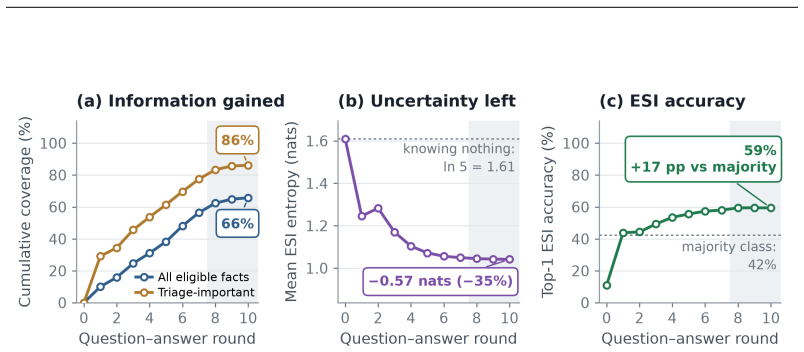
The paper claims that EHR2Dial-Triage turns conversational triage into an auditable evidence-acquisition process. Each encounter is partitioned into clinician-visible information $C_i$, patient-reportable information $P_i$, and future-hidden evaluation-only information. Two role-specific language models alternate under asymmetric access: the clinician conditions on $C_i$ and the dialogue history, the patient on $P_i$ and a non-clinical persona, and a verifier maps each accepted disclosure to a normalized atomic fact, its supporting EHR source, and the first accepted speaker turn. Over a frozen corpus of 4,041 conversations, the paper reports that patient facts are disclosed progressively (reaching 86% of triage-important facts by round ten), that cumulative disclosures reduce an ESI reader's entropy and raise recorded-ESI accuracy from a 42% majority baseline to 59% top-1, and that different models lead on information acquisition versus final ESI prediction versus grounded communication. The authors' central conclusion is that conversational triage should be evaluated as a multi-stage process of acquisition, reasoning, and communication, not by final acuity alone.
Load-bearing premise
The benchmark's core metrics rest on the assumption that its simulated patients answer like real patients and that its verifier maps utterances to EHR facts correctly, and the paper states that its validation is internal and does not establish clinical validity or deployment readiness.
Editorial extensions
If this is right
- Clinician models can be compared on what they ask and elicit, not only on the acuity label they output, because every acquired fact carries a source and a turn.
- The same completed dialogue can be used to separate the ability to gather evidence from the ability to use it: a fixed ESI reader converts acquired facts into an acuity distribution, while a separate evaluation tests prediction and closing generation on identical transcripts.
- Temporal partitioning lets researchers check whether a system respects what could have been known at triage time, using future-hidden events to detect post-triage leakage.
- Safety analyses can quantify under-triage severity and confidence calibration, such as how often a model assigns ESI 4 or 5 to an encounter recorded as ESI 1 or 2 and whether reported confidence drops when it does.
- Because only facts originating in $P_i$ get acquisition credit, the metrics reward eliciting patient-reportable evidence rather than restating clinician-visible arrival data.
Reading between the lines
- The event-turn ledger could be reused as training signal for question-asking policies, since it attributes each new fact to the clinician turn that preceded it, making credit assignment for information gain explicit.
- With the same ledger, one could run counterfactual analyses the paper does not report, such as holding the dialogue fixed but delaying a fact's first turn to ask whether the ESI reader's distribution or confidence would change materially.
- The temporal-boundary design could transfer to other time-critical clinical decisions, such as admission or sepsis screening, where the core question is how quickly and from which sources evidence must be acquired.
- If the framework were run on real transcribed triage conversations with expert annotation of source events, the acquisition metrics could be calibrated against human behavior; the paper does not provide such validation.
Signed reviews
Editorial analysis
A structured set of objections, weighed in public.
Referee Report
Summary. The paper introduces EHR2Dial-Triage, a framework and benchmark for emergency-department triage conversations grounded in MIMIC-IV-ED. Each encounter is partitioned into clinician-visible information C_i, patient-reportable information P_i, and future/evaluation-only information; two role-specific LLMs generate alternating dialogues under these asymmetric information constraints. A verifier maps accepted disclosures to normalized atomic facts, links each fact to its supporting EHR event, and records the first accepted turn, producing what the paper calls event–turn lineage. The paper validates internal properties (role-consistent realization, bounded interaction scale, progressive disclosure, predictive relevance of disclosed facts) and then evaluates LLMs on two tasks: information elicitation as triage clinician, and dialogue-based ESI prediction with patient-facing closing generation, including an under-triage and confidence safety analysis.
Significance. If the event–turn lineage is reliable, EHR2Dial-Triage fills a genuine gap: it is a reusable, temporally partitioned conversational triage benchmark that allows exact, machine-readable tracing of when triage-relevant evidence enters a dialogue, and it separates information acquisition from downstream prediction and communication. Strengths include the released generator and frozen corpus, the explicit role/time information boundaries, the careful acknowledgment in Section 4 that the internal analyses are not clinical validation, and the clinically meaningful safety analysis of confidence under severe under-triage. The main significance is conditional: the benchmark's signature claim of auditable lineage depends on a verifier whose accuracy is not reported, so the contribution cannot yet be fully assessed.
major comments (3)
- [§3.3, Eq. (6)] The central claim of exact, machine-readable event–turn lineage depends entirely on the verifier described in Section 3.3, but the paper reports no precision/recall for fact extraction, no accuracy for source-event linking, no inter-annotator agreement against human annotation, and no audit of partial-support cases where an utterance contains both supported and unsupported details. All downstream quantities—FACTCOV, HistoryMedCov, reader-entropy trajectories, QYield, and the grounding metrics in Appendix C.3—are computed from the verifier's ledger. If the verifier systematically over-accepts near-matches or attributes a disclosure to the wrong source event, the benchmark's central contribution would not measure what it claims. Please add a verifier evaluation on a human-annotated sample covering fact extraction, event linking, first-accepted-turn assignment, and partial support, and report error rates; a sensitivity analysis showing how coverage and entropy change under simulated verifier errors would further establish robustness.
- [§4 opening; §5.2] The paper explicitly states in Section 4 that the internal analyses 'do not establish clinical validity or readiness for deployment.' That scoping is appropriate, but patient-simulator realism is load-bearing for the information-acquisition metrics in Experiment I: if the patient model does not approximate how real patients disclose triage-relevant information, then question-yield and coverage comparisons are difficult to interpret as measures of clinical information seeking. The manuscript currently offers no comparison against real triage conversations, recorded triage notes, or clinician judgment. I am not asking for deployment-level validation, but a small clinician or human-annotation study, or an explicit quantitative comparison to real triage documentation, would substantially strengthen the claim that the benchmark studies triage information acquisition rather than only simulated-patient behavior.
- [§4.3 vs Table 3 (§5.2)] The reader-entropy numbers in Section 4.3 and Table 3 appear inconsistent. Section 4.3 reports mean predictive entropy decreasing from 1.61 nats initially to approximately 1.04 nats at Round 10, while Table 3 reports Entropy@10 between 0.69 and 0.76 nats for what is described as the same fixed, patient-disjoint multinomial logistic-regression reader. If the readers, cohorts, or feature representations differ between the two analyses, the text must state this; if they are the same, there is a numerical error in one of the computations. This discrepancy matters because Figure 4 is the primary evidence that progressively disclosed information is predictive of the recorded ESI label.
minor comments (5)
- [Appendix A] Several headings in the case study are preceded by the literal artifact '/clipboard-lis' (e.g., before 'Information revealed in the conversation' and 'Turn-wise accumulated grounded state'); this appears to be a copy-paste artifact and should be removed.
- [Appendix C.1] Question yield (QYield) is defined in Equation (9) but never reported in the results section; either report it in Experiment I or remove the definition to avoid an unused metric.
- [§5.2, Figure 5] The question-target assignment procedure is described as a 'fixed target annotation procedure' but no reliability measure (e.g., annotator agreement on a sample) is reported; since question-target distributions are a main descriptive result, a small agreement check would be useful.
- [Table 3] The caption states 'Best open-weight results are bold,' but the table also contains proprietary models; clarify whether bolding is restricted to the open-weight block or applied across all models.
- [Abstract and Section 1] The phrase 'across models, and patient personas' contains an unnecessary comma; the writing is generally clear, but the paper would benefit from a final pass for such mechanical errors.
Circularity Check
No material circularity; the benchmark's internal consistency checks are labeled as such and its external evaluations are not forced by construction.
full rationale
The central construction (Eqs. 2-6) defines an information partition and an event-turn ledger; the 'lineage' is an audit record of the verifier's accepted disclosures, not a fitted prediction. ESI prediction uses recorded MIMIC-IV-ED labels as an external target, withheld from both dialogue roles, and the reader in Sections 4.3 and 5.2 is fixed and patient-disjoint, so the entropy and coverage trends are empirical rather than definitional. Section 4's role-consistency and predictive-relevance analyses are explicitly described as internal design validation: 'These analyses evaluate the internal design of the benchmark; they do not establish clinical validity or readiness for deployment.' The observed role-alignment follows from the access constraints in Eqs. 2 and 4, but the paper does not use that alignment as evidence for any external claim. No load-bearing step reduces to its input, and there is no reliance on self-citation; the unvalidated verifier and patient simulator are correctness and validation gaps, not circular reasoning.
Assumptions & free parameters
assumptions (4)
- domain assumption Recorded ESI labels in MIMIC-IV-ED are a reliable ground-truth target for triage acuity.
- domain assumption The three-way information partition (C_i, P_i, future-hidden) correctly models what is knowable at triage onset.
- domain assumption An LLM patient agent conditioned on P_i and persona eta_i is an adequate stand-in for a real patient in triage.
- domain assumption The verifier accurately maps utterances to normalized EHR facts.
Cite this review
Pith. "Pith review of ELICITED: EHR-grounded Longitudinal Interactive Conversations for Information-seeking Triage Evaluation and Decision-making." pith.science (2026). https://pith.science/paper/23MKUJEX
@misc{pith2026260809024,
  author       = {Pith},
  title        = {Pith review of: ELICITED: EHR-grounded Longitudinal Interactive Conversations for Information-seeking Triage Evaluation and Decision-making},
  year         = {2026},
  howpublished = {\url{https://pith.science/paper/23MKUJEX}},
  note         = {Machine review of arXiv:2608.09024}
}
read the original abstract
Emergency-department (ED) triage requires clinicians to rapidly identify patients who need immediate attention, determine who can safely wait, and prioritize limited clinical resources. At presentation, however, information may be limited to a chief complaint and initial vital signs. Clinically important details, including symptom onset and progression, associated symptoms, medical history, and medication use, are often obtained through focused conversation. Effective triage therefore requires clinicians to identify information gaps, ask appropriate follow-up questions, and update their assessment as new evidence becomes available. Most existing ED benchmarks evaluate acuity prediction from a fixed clinical snapshot. Although this formulation measures predictive performance after patient information has been assembled, it does not capture the interactive process through which triage-relevant evidence is elicited and interpreted. Existing medical dialogue datasets support the study of clinical communication, but dialogue statements are not always linked to temporally ordered events in the electronic health record (EHR). We introduce EHR2Dial-Triage, an agentic conversation-generation framework and benchmark grounded in MIMIC-IV-ED. The framework constructs triage conversations under explicit role-based and temporal information boundaries. Each accepted patient disclosure is linked to its supporting EHR event and the first dialogue turn at which it becomes available. EHR2Dial-Triage enables controlled evaluation of information elicitation, evidence use, five-level Emergency Severity Index prediction, and patient-facing communication across models and patient personas. It provides a structured setting for studying conversational triage as a dynamic process of clinical information acquisition, reasoning, and communication.
Figures


Figures from the paper (9 more)


Reference graph
Works this paper leans on
-
[1]
Benchmarking Emergency Department Prediction Models with Machine Learning and Public Electronic Health Records , author =. Scientific Data , volume =. 2022 , doi =
work page 2022
-
[2]
and Klauer, Kevin and Reilly, Christian , journal =
Ivanov, Oleksandr and Wolf, Lisa and Brecher, Deena and Lewis, Erica and Masek, Kevin and Montgomery, Kyla and Andrieiev, Yurii and McLaughlin, Moss and Liu, Stephen and Dunne, Robert B. and Klauer, Kevin and Reilly, Christian , journal =. Improving. 2021 , doi =
work page 2021
-
[3]
Zeng, Guangtao and Yang, Wenmian and Ju, Zeqian and Yang, Yue and Wang, Sicheng and Zhang, Ruisi and Zhou, Meng and Zeng, Jiaqi and Dong, Xiangyu and Zhang, Ruoyu and Fang, Hongchao and Zhu, Penghui and Chen, Shu and Xie, Pengtao , booktitle =. 2020 , publisher =. doi:10.18653/v1/2020.emnlp-main.743 , url =
-
[4]
A Benchmark for Automatic Medical Consultation System: Frameworks, Tasks and Datasets , author =. Bioinformatics , volume =. 2023 , doi =
work page 2023
-
[5]
Yan, Guojun and Pei, Jiahuan and Ren, Pengjie and Ren, Zhaochun and Xin, Xin and Liang, Huasheng and de Rijke, Maarten and Chen, Zhumin , booktitle =. 2022 , publisher =. doi:10.1145/3477495.3531809 , url =
arXiv 2022
-
[6]
Saley, Vishal Vivek and Saha, Goonjan and Das, Rocktim Jyoti and Raghu, Dinesh and Mausam , booktitle =. 2024 , publisher =. doi:10.18653/v1/2024.emnlp-main.936 , url =
-
[7]
Wang, Junda and Yao, Zonghai and Yang, Zhichao and Zhou, Huixue and Li, Rumeng and Wang, Xun and Xu, Yucheng and Yu, Hong , booktitle =. 2024 , publisher =. doi:10.18653/v1/2024.findings-acl.901 , url =
-
[8]
Zhou, Yang and Sheng, Zhenting and Tan, Mingrui and Song, Yuting and Zhou, Jun and Kwan, Yu Heng and Low, Lian Leng and Bai, Yang and Liu, Yong , journal =. 2026 , doi =
work page 2026
Show all 58 references
-
[9]
2025 , note =
Kyung, Daeun and Chung, Hyunseung and Bae, Seongsu and Kim, Jiho and Sohn, Jae Ho and Kim, Taerim and Kim, Soo Kyung and Choi, Edward , booktitle =. 2025 , note =
2025
-
[10]
Nature Medicine , volume =
An Evaluation Framework for Clinical Use of Large Language Models in Patient Interaction Tasks , author =. Nature Medicine , volume =. 2025 , doi =
2025
-
[11]
and Pierson, Emma and Koh, Pang Wei and Tsvetkov, Yulia , booktitle =
Li, Shuyue Stella and Balachandran, Vidhisha and Feng, Shangbin and Ilgen, Jonathan S. and Pierson, Emma and Koh, Pang Wei and Tsvetkov, Yulia , booktitle =. 2024 , doi =
2024
-
[12]
Ask Patients with Patience: Enabling
Zhu, Jiayuan and Pan, Jiazhen and Liu, Yuyuan and Liu, Fenglin and Wu, Junde , booktitle =. Ask Patients with Patience: Enabling. 2025 , publisher =. doi:10.18653/v1/2025.emnlp-main.142 , url =
2025 doi
-
[13]
Evaluating the Pre-Consultation Ability of
Seo, Jean and Kim, Gibaeg and Shin, Kihun and Lim, Seungseop and Lee, Hyunkyung and Han, Wooseok and Lee, Jongwon and Yang, Eunho , booktitle =. Evaluating the Pre-Consultation Ability of. 2026 , publisher =. doi:10.18653/v1/2026.eacl-industry.6 , url =
2026 doi
- [14]
- [15]
-
[16]
Nature , volume =
Towards Conversational Diagnostic Artificial Intelligence , author =. Nature , volume =. 2025 , doi =
2025
-
[17]
2026 , doi =
Schmidgall, Samuel and Ziaei, Rojin and Harris, Carl and Kim, Ji Woong and Reis, Eduardo Pontes and Jopling, Jeffrey and Moor, Michael , journal =. 2026 , doi =
2026
-
[18]
2025 , publisher =
Sviridov, Ivan and Miftakhova, Amina and Tereshchenko, Artemiy and Zubkova, Galina and Blinov, Pavel and Savchenko, Andrey , booktitle =. 2025 , publisher =. doi:10.18653/v1/2025.emnlp-main.1353 , url =
2025 doi
- [19]
-
[20]
Nature , volume =
Towards Autonomous Medical Artificial Intelligence Agents , author =. Nature , volume =. 2026 , doi =
2026
- [21]
-
[22]
doi:10.48550/arXiv.2603.10035 , url =
Srirag, Dipankar and Nguyen, Quoc Dung and Joshi, Aditya and Narasimhan, Padmanesan and Kanhere, Salil , year =. doi:10.48550/arXiv.2603.10035 , url =. 2603.10035 , archivePrefix =
-
[23]
2022 , publisher =
Liu, Wenge and Tang, Jianheng and Cheng, Yi and Li, Wenjie and Zheng, Yefeng and Liang, Xiaodan , booktitle =. 2022 , publisher =. doi:10.1007/978-3-031-17120-8_35 , url =
2022 doi
-
[24]
Proceedings of the 17th Conference of the European Chapter of the Association for Computational Linguistics , pages =
An Empirical Study of Clinical Note Generation from Doctor-Patient Encounters , author =. Proceedings of the 17th Conference of the European Chapter of the Association for Computational Linguistics , pages =. 2023 , publisher =. doi:10.18653/v1/2023.eacl-main.168 , url =
2023 doi
-
[25]
2023 , doi =
Yim, Wen-wai and Fu, Yujuan and Ben Abacha, Asma and Snider, Neal and Lin, Thomas and Yetisgen, Meliha , journal =. 2023 , doi =
2023
-
[26]
Advances in Neural Information Processing Systems , volume =
Fansi Tchango, Ars. Advances in Neural Information Processing Systems , volume =. 2022 , doi =
2022
-
[27]
Johnson, Alistair E. W. and Bulgarelli, Lucas and Pollard, Tom and Celi, Leo Anthony and Mark, Roger G. and Horng, Steven , title =. PhysioNet , year =. doi:10.13026/5ntk-km72 , url =
-
[28]
and Milne, Leslie W
Wuerz, Richard C. and Milne, Leslie W. and Eitel, David R. and Travers, Debbie and Gilboy, Nicki , title =. Academic Emergency Medicine , year =
-
[29]
arXiv preprint arXiv:2505.09388 , year =
Yang, An and Li, Anfeng and Yang, Baosong and Zhang, Beichen and Hui, Binyuan and Zheng, Bo and Yu, Bowen and Gao, Chang and Huang, Chengen and Lv, Chenxu and others , title =. arXiv preprint arXiv:2505.09388 , year =. doi:10.48550/arXiv.2505.09388 , url =
-
[30]
Proceedings of the 41st International ACM SIGIR Conference on Research and Development in Information Retrieval , year =
Zhu, Yaoming and Lu, Sidi and Zheng, Lei and Guo, Jiaxian and Zhang, Weinan and Wang, Jun and Yu, Yong , title =. Proceedings of the 41st International ACM SIGIR Conference on Research and Development in Information Retrieval , year =
-
[31]
and Jarvis, Scott , title =
McCarthy, Philip M. and Jarvis, Scott , title =. Behavior Research Methods , year =
-
[32]
Psychological Bulletin , year =
Cohen, Jacob , title =. Psychological Bulletin , year =
-
[33]
Proceedings of the ACL Workshop on Intrinsic and Extrinsic Evaluation Measures for Machine Translation and/or Summarization , year =
Banerjee, Satanjeev and Lavie, Alon , title =. Proceedings of the ACL Workshop on Intrinsic and Extrinsic Evaluation Measures for Machine Translation and/or Summarization , year =
-
[34]
and Artzi, Yoav , title =
Zhang, Tianyi and Kishore, Varsha and Wu, Felix and Weinberger, Kilian Q. and Artzi, Yoav , title =. International Conference on Learning Representations , year =
-
[35]
, title =
Efron, Bradley and Tibshirani, Robert J. , title =. 1993 , isbn =
1993
-
[36]
JAMA Network Open , volume =
Use of a Large Language Model to Assess Clinical Acuity of Adults in the Emergency Department , author =. JAMA Network Open , volume =. 2024 , doi =
2024
-
[37]
International Journal of Computer Assisted Radiology and Surgery , volume =
Evaluating Large Language Models on Hospital Health Data for Automated Emergency Triage , author =. International Journal of Computer Assisted Radiology and Surgery , volume =. 2025 , doi =
2025
-
[38]
2004 , month = jul, address =
Lin, Chin-Yew , booktitle =. 2004 , month = jul, address =
2004
-
[39]
2002 , month = jul, address =
Papineni, Kishore and Roukos, Salim and Ward, Todd and Zhu, Wei-Jing , booktitle =. 2002 , month = jul, address =. doi:10.3115/1073083.1073135 , url =
2002
-
[40]
Proceedings of the 2016 Conference of the North American Chapter of the Association for Computational Linguistics: Human Language Technologies , year =
A Diversity-Promoting Objective Function for Neural Conversation Models , author =. Proceedings of the 2016 Conference of the North American Chapter of the Association for Computational Linguistics: Human Language Technologies , year =. doi:10.18653/v1/N16-1014 , url =
2016 doi
-
[41]
and Warton, E
Sax, Dana R. and Warton, E. Margaret and Mark, Dustin G. and Vinson, David R. and Kene, Mamata V. and Ballard, Dustin W. and Vitale, Tina J. and McGaughey, Katherine R. and Beardsley, Aaron and Pines, Jesse M. and Reed, Mary E. and. Evaluation of Version 4 of the Emergency Sev...
2023
-
[42]
Journal of Patient Experience , volume =
Emergency Department Patient Experience: A Systematic Review of the Literature , author =. Journal of Patient Experience , volume =. 2018 , doi =
2018
-
[43]
npj Digital Medicine , volume =
A Framework to Assess Clinical Safety and Hallucination Rates of LLMs for Medical Text Summarisation , author =. npj Digital Medicine , volume =. 2025 , doi =
2025
-
[44]
Journal of Advanced Nursing , volume =
Emergency Department Triage Decision-Making by Registered Nurses: An Instrument Development Study , author =. Journal of Advanced Nursing , volume =. 2024 , doi =
2024
-
[45]
2023 , organization =
Emergency Severity Index Handbook , author =. 2023 , organization =
2023
-
[46]
Journal of Nursing Care Quality , volume =
Effects of Interruptions on Triage Process in Emergency Department: A Prospective, Observational Study , author =. Journal of Nursing Care Quality , volume =. 2018 , doi =
2018
-
[47]
and Adams, James G
Tanabe, Paula and Gimbel, Rick and Yarnold, Paul R. and Adams, James G. , journal =. The Emergency Severity Index (Version 3) 5-Level Triage System Scores Predict. 2004 , volume =
2004
-
[48]
2024 , url =
Lin, Ji and Tang, Jiaming and Tang, Haotian and Yang, Shang and Chen, Wei-Ming and Wang, Wei-Chen and Xiao, Guangxuan and Dang, Xingyu and Gan, Chuang and Han, Song , booktitle =. 2024 , url =
2024
-
[49]
2026 , howpublished =
2026
-
[50]
arXiv preprint arXiv:2508.10925 , year=
gpt-oss-120b & gpt-oss-20b model card , author=. arXiv preprint arXiv:2508.10925 , year=
-
[51]
2026 , url =
Sellergren, Andrew and Gao, Chufan and Mahvar, Fereshteh and Kohlberger, Timo and Jamil, Fayaz and Traverse, Madeleine and Tono, Alberto and Sadjad, Bashir and Yang, Lin and others , journal =. 2026 , url =
2026
-
[52]
2026 , month = jul, howpublished =
2026
-
[53]
2026 , month = jun, howpublished =
2026
- [54]
-
[55]
Journal of Biomedical Informatics , volume =
Clinical Pathway-Aware Large Language Models for Reliable and Transparent Medical Dialogue , author =. Journal of Biomedical Informatics , volume =. 2025 , doi =
2025
-
[56]
International Emergency Nursing , volume =
Patient Experience of Emergency Department Triage: An Integrative Review , author =. International Emergency Nursing , volume =. 2024 , doi =
2024
-
[57]
International Emergency Nursing , volume =
Understanding Triage Assessment of Acuity by Emergency Nurses at Initial Adult Patient Presentation: A Qualitative Systematic Review , author =. International Emergency Nursing , volume =. 2023 , doi =
2023
-
[58]
Australasian Emergency Care , volume =
Facilitators and Barriers to Triage Efficiency in Adult Emergency Departments: An Integrative Literature Review , author =. Australasian Emergency Care , volume =. 2026 , doi =
2026
Reviewed August 14, 2026 · model on record in the stance chip above.
Discussion (0). Continue with ORCID to comment.