REVIEW 4 major objections 7 minor 57 references
ROEVO: Robust Organized Edge Feature-based Visual Odometry Using RGB-D Cameras
T0 review · 4 major / 7 minor · reviewed 2026-08-11 · deepseek-v4-flash
Pith's one-line read Organized edges—ordered chains of edge pixels—let a visual odometry system track and map using only edges, outperforming point-feature and learning-based baselines in sparse-texture scenes.
desk verdict A genuinely new organized-edge representation and a complete VO built on it, with a strong empirical effort, but the ICL-NUIM truncation protocol undercuts the headline robustness claim and the fine-tracking Jacobian has a dimension slip. read the letter →
The pith
A machine-rendered reading of the paper's core claim, the machinery that carries it, and where it could break.
The reading
What carries the argument
The load-bearing object is the organized edge: a Canny edge mask is preprocessed to remove two ambiguous local pixel patterns, then traversed by an oriented breadth-first search that clusters adjacent pixels whose gradient directions differ by at most 20 degrees, recording the expansion route. Backtracking from end nodes and retaining the longest combined path turns each cluster into a single ordered sequence of pixels. This ordering is what makes edge-level association possible: normals and tangents are computed from neighboring points in the chain, strict 5-degree normal-direction agreement validates candidate correspondences, and a disjoint-set structure chains associations across keyframes into a co-visibility graph. The same ordering supports the fusion of multiple views of one spatial edge into a fitted 3D map edge, and the decoupled bundle adjustment that alternates fitting with per-pose registration.
What would settle it
Take a sequence with sharp corners or significant motion blur, extract organized edges with the paper's fixed thresholds, and count how many true scene edges fragment into multiple chains or fail to associate across viewpoints; if the fragmentation rate is high enough that the co-visibility graph inherits wrong correspondences, the reported robustness in sparse-texture scenes would collapse.
Extended reading notes
Core claim
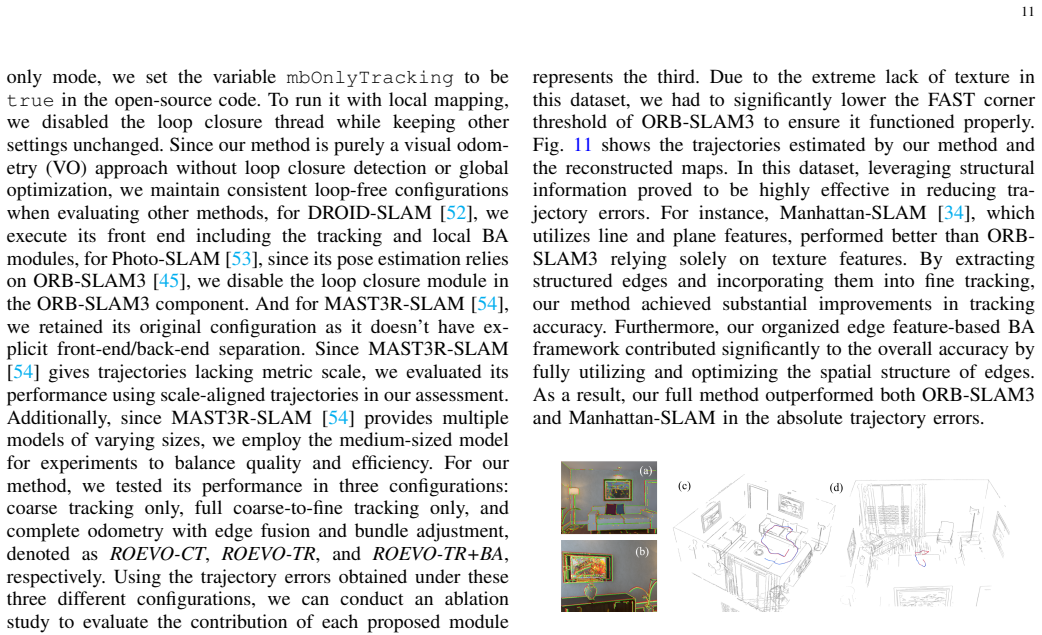
The central discovery is that representing edges as organized, sequentialized clusters rather than raw edge masks makes edge-only visual odometry viable and competitive. Each organized edge is an ordered point sequence whose textural information comes from gradient orientation and whose structural information comes from curvature along the chain. With this representation, the paper builds edge-wise residuals for 3D-2D registration, a disjoint-set co-visibility graph for multi-frame association, a shape-preserving fitting and stitching step for map edges, and a bundle adjustment that decouples into edge fitting followed by per-pose registration. On ICL-NUIM, TUM RGB-D, ETH-3D, and custom indoor and outdoor sequences, the full system achieves the best ATE rank in 13 of 24 sequences and the top-three rank in 18 of 24, while completing sparse-texture sequences where several baselines fail.
Load-bearing premise
The whole pipeline assumes that true scene edges, after Canny extraction and suppression of two ambiguous local patterns, can be unambiguously sequentialized by oriented BFS with a fixed 20-degree gradient-direction clustering threshold, and that such chains repeat across viewpoints enough for the 5-degree normal-association threshold.
Editorial extensions
If this is right
- An RGB-D VO system that uses only edges can run at roughly 35 Hz on a laptop CPU and remain accurate in sparse-texture indoor rooms.
- Sliding-window bundle adjustment over organized edges reduces rotation drift and improves local mapping quality, as shown by the relative pose error improvements from tracking-only to tracking-plus-BA configurations.
- Because organized edges encode gradient orientation, coarse tracking with a rotation-invariant patch-based photometric error beats raw Canny edges and keypoint-selection baselines in relative pose accuracy.
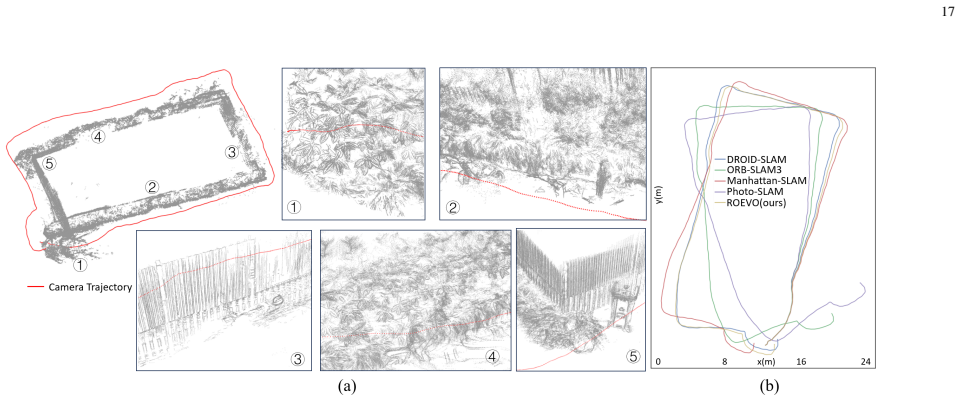
- The method completes sequences where distance-field edge methods and geometry-based pipelines fail, indicating that the representation transfers to cluttered outdoor scenes with repeated structures and dynamic shadows.
- Edge fusion filters pseudo-edges caused by dynamic disturbances, so the semi-dense reconstruction in scenes with human shadows is cleaner than the raw edge input would allow.
Reading between the lines
- Beyond the paper's experiments, the fixed 20-degree clustering threshold implies an upper bound on detectable curvature: sharp corners will fragment into several organized edges, so the stitching step in edge fusion likely carries much of the burden in man-made scenes with many right angles.
- A natural testable extension is to make the 20-degree and 5-degree thresholds adaptive to local edge curvature or gradient noise; the paper's own note that motion blur remains a weakness suggests such adaptation could widen the operating range.
- The organized-edge representation could plausibly serve as a constraint source inside a full SLAM system with loop closure, since it already produces a co-visibility graph and fused map elements that look like landmarks.
- Because the association is edge-level rather than pixel-level, the representation may transfer to monocular or stereo settings, where depth comes from triangulation instead of a depth sensor; the paper lists this as future work, not a demonstrated result.
Signed reviews
Editorial analysis
A structured set of objections, weighed in public.
Referee Report
Summary. ROEVO is an RGB-D visual odometry system that uses only edge features. Edge pixels are clustered into sequentially ordered 'organized edges' via oriented BFS, then tracked with a coarse photometric step and a fine edge-wise association step that combines geometric point-to-tangent and photometric residuals. A local mapping thread maintains a co-visibility graph via a disjoint set, fuses associated edges into 3D map edges, and performs a decoupled bundle adjustment. The system is evaluated on ICL-NUIM, TUM RGB-D, ETH-3D, and two custom datasets, with ablations for coarse tracking, repeatability, and runtime, and it reports state-of-the-art ATE on many sequences.
Significance. The organized-edge representation is a useful and well-motivated contribution: it gives edge features an ordered structure that supports edge-level association, co-visibility, and local map fusion, and the empirical study is extensive, with public code. If the reported results hold, the paper demonstrates that an edge-only VO can be competitive with point-based, direct, and learning-based methods, particularly in structure-rich but texture-sparse scenes. The main limitation is that the sparse-texture claim is weakened by the ICL-NUIM evaluation protocol, and the core optimization equations contain inconsistencies that must be corrected.
major comments (4)
- [Section VII-B.1, Table I] The ICL-NUIM protocol truncates segments that 'only capture bare walls' and excludes 'frames where pose estimation is not feasible,' then reports a frame-count-weighted average. This removes exactly the frames in which an edge-only system has no edge features to associate, so Table I cannot support the paper's headline claim of robustness in sparse-texture environments. Please report results on the full sequences, including failure counts or lost-track segments, and compare baselines on the same full inputs, or restrict the claim to segments where edges are actually observable.
- [Section V-C, Eqs. (8)-(9) and (12)-(13)] Equation (8) has a dimension mismatch: e_g is in R^2, p' is a 2D reprojected point, and the projection Jacobian in Eq. (25) is 2x6, so the left factor must be I_{2x2} - uu^T rather than I_{3x3} - ... . In Eq. (12), the Hessian terms for the photometric part omit the alpha^2 factor that follows from J_a = [J_g; alpha J_p] in Eq. (9), while Eq. (13) contains alpha^2; H and g are therefore inconsistent. These equations are central to the fine-tracking and BA implementation and need to be corrected and re-derived.
- [Section VI-C, Eqs. (17)-(19)] The transformation of joint BA into 'argmin_T (argmin_E ...)' in Eq. (18) is not an equality for general nonlinear least squares; the authors acknowledge that the subsequent use of edge fusion is approximate ('approximately preserve the minimum fitting geometric residuals'). Since the paper presents decoupled BA as a contribution, this approximation should be stated clearly, justified with a convergence or accuracy comparison against joint BA on a subset of sequences, and its error quantified. As written, the derivation implies an exactness that the method does not provide.
- [Section IV-B and Section V-C] The extraction and association depend on two fixed thresholds: 20 degrees for gradient-direction clustering in oriented BFS and 5 degrees for edge-normal association in fine tracking. No sensitivity analysis is provided, and these thresholds directly determine whether edges are sequentialized and whether correspondences survive viewpoint changes. Please add a sensitivity study (e.g., 5-40 degrees and 1-20 degrees) on at least TUM and ICL sequences, and report how often tracking is lost as the thresholds vary.
minor comments (7)
- [Section I] The first paragraph contains corrupted text: 'pose esfine time:18.6219 timates' should be cleaned up.
- [Table II] The header uses 'RMES' instead of 'RMSE', and the average columns repeat 'RMES (t)'; please correct these typos.
- [Fig. 13 caption] The caption repeats the ICL-NUIM sentence '(c) and (d) are the estimated trajectories ... lr kt2 and lr kt1' in the ETH-3D results; replace it with the actual ETH-3D sequence names.
- [Table IX] The row for ManhattanSLAM cites reference [54], but the correct reference is [34].
- [Section VII-C, Table XII] The ablation table reports a single row of RPE values without naming the sequences or indicating how the values are aggregated; add the sequence list and standard deviations.
- [Table XIII] The loop-closure error on the Plant-Fence sequence is reported on a single trajectory without ground truth; state that this is a qualitative indicator and report repeated runs if available.
- [Algorithm 1] The pseudo-code uses informal conventions such as 'set union' and 'associate list[j] != false'; define these operations or replace them with standard mathematical notation.
Circularity Check
No derivation-level circularity: the organized-edge pipeline is self-contained, and the reported tuning/truncation choices are evaluation caveats rather than fitted predictions.
full rationale
I walked the claimed derivation chain: organized edges are produced by a feed-forward Canny + oriented-BFS sequentialization (Section IV), tracking minimizes photometric and point-to-tangent residuals with formulas (1)-(13), and local mapping uses co-visibility, edge fusion, and a decoupled BA (17)-(19). None of these equations reduces to a value fitted on the test trajectories; the depth-weight parameters, the 20-degree clustering threshold, the 5-degree normal-association threshold, and the Otsu-based Canny threshold are configuration choices, not quantities being predicted, and the paper does not rename any fitted quantity as a result. The only potentially self-referential citation is Photo-SLAM [53] as an experimental baseline, and it is not load-bearing for the method. BALM [48] is an external citation for the decoupling idea. One evaluation caveat should be flagged explicitly: Section VII-B.1 truncates ICL-NUIM segments and excludes frames where 'pose estimation is not feasible,' then reports a frame-weighted mean; this weakens the sparse-texture robustness claim as an external-validity matter, but it is not a circular reduction because all baselines are evaluated on the same truncated segments and the reported errors are measured rather than derived from the exclusion rule. Overall, the central derivation is self-contained and no load-bearing step reduces to its own inputs.
Assumptions & free parameters
free parameters (7)
- Gradient-clustering angular threshold =
20 degrees
- Fine-tracking edge-normal association threshold =
5 degrees
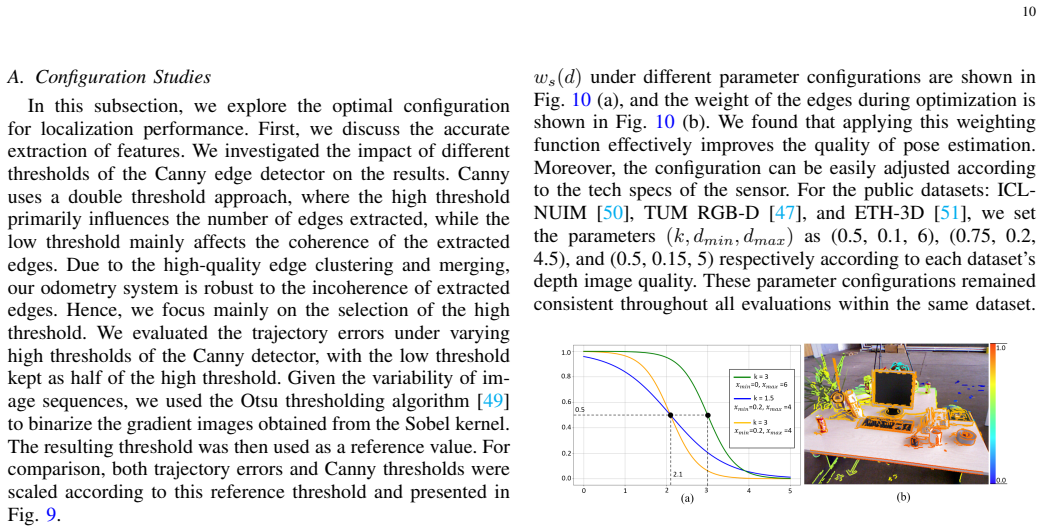
- Depth-weighting sigmoid parameters =
(0.5, 0.1, 6), (0.75, 0.2, 4.5), (0.5, 0.15, 5)
- Geometric-photometric residual balance factor alpha =
Not reported
- Keyframe insertion associability ratio =
80 percent
- Short-path exclusion length =
Not reported
- BA sliding window size =
Not reported
assumptions (5)
- domain assumption Brightness constancy holds for small patches on edges across frames.
- domain assumption True edges are locally smooth, so gradient directions along an edge stay within the fixed 20 degree clustering threshold.
- domain assumption The camera is fully calibrated and depth is aligned with color, so the projection functions in Eq. 1 are valid.
- domain assumption Edge normals of the same physical edge are repeatable enough for the 5 degree association threshold across frames.
- ad hoc to paper Centroid-based edge fusion approximates the optimal fitting result in the decoupled BA.
Cite this review
Pith. "Pith review of ROEVO: Robust Organized Edge Feature-based Visual Odometry Using RGB-D Cameras." pith.science (2026). https://pith.science/paper/OLZRSYR2
@misc{pith2026260809112,
  author       = {Pith},
  title        = {Pith review of: ROEVO: Robust Organized Edge Feature-based Visual Odometry Using RGB-D Cameras},
  year         = {2026},
  howpublished = {\url{https://pith.science/paper/OLZRSYR2}},
  note         = {Machine review of arXiv:2608.09112}
}
read the original abstract
This work presents a visual odometry (VO) system that leverages image edge features. Edges are spatially expressive cues commonly present across diverse environments, offering rich textural and structural information. However, existing edge-based VO methods often fail to fully exploit this potential. To this end, we introduce a novel feature representation termed \textit{organized edges}, which transforms disjoint edge pixels into sequentialized clusters, enabling more effective retention and utilization of the underlying textural and structural information. Another nice property of this formulation is that organized edges can perform edge-level association across multiple frames, enabling the establishment of a co-visibility graph. To achieve precise and efficient pose estimation, we propose a range of particularly designed tracking and joint optimization methods based on the characteristics of organized edges. For tracking, we formulate edge-wise rather than pixel-wise residuals to achieve robust and accurate inter-frame registration. For joint optimization, we introduce a novel shape-preserving edge-fitting method and an organized edge-based Bundle Adjustment (BA) approach, which decomposes the traditional BA problem into fitting and registration to preserve the structural integrity. Based on these novel techniques, we develop a complete VO system that exclusively employs organized edge features, achieving efficient tracking and precise local mapping. Extensive experiments demonstrate its accuracy and robustness in indoor environments, outperforming or achieving comparable performance to state-of-the-art methods. The source code is publicly available at https://github.com/liumingrui814/ROEVO
Figures


Figures from the paper (16 more)







Reference graph
Works this paper leans on
-
[1]
Direct sparse odometry,
J. Engel, V . Koltun, and D. Cremers, “Direct sparse odometry,”IEEE Transactions on Pattern Analysis and Machine Intelligence, vol. 40, no. 3, pp. 611–625, 2018
2018
-
[2]
Svo: Semidirect visual odometry for monocular and multicamera sys- tems,
C. Forster, Z. Zhang, M. Gassner, M. Werlberger, and D. Scaramuzza, “Svo: Semidirect visual odometry for monocular and multicamera sys- tems,”IEEE Transactions on Robotics, vol. 33, no. 2, pp. 249–265, 2017
work page 2017
-
[3]
Orb-slam: A versatile and accurate monocular slam system,
R. Mur-Artal, J. M. M. Montiel, and J. D. Tard ´os, “Orb-slam: A versatile and accurate monocular slam system,”IEEE Transactions on Robotics, vol. 31, no. 5, pp. 1147–1163, 2015
2015
-
[4]
Lsd-slam: Large-scale direct monocular slam,
J. Engel, T. Sch ¨ops, and D. Cremers, “Lsd-slam: Large-scale direct monocular slam,” inComputer Vision – ECCV 2014, D. Fleet, T. Pajdla, B. Schiele, and T. Tuytelaars, Eds. Cham: Springer International Publishing, 2014, pp. 834–849
2014
-
[5]
Monoslam: Real-time single camera slam,
A. J. Davison, I. D. Reid, N. D. Molton, and O. Stasse, “Monoslam: Real-time single camera slam,”IEEE Transactions on Pattern Analysis and Machine Intelligence, vol. 29, no. 6, pp. 1052–1067, 2007
work page 2007
-
[6]
Parallel tracking and mapping for small ar workspaces,
G. Klein and D. Murray, “Parallel tracking and mapping for small ar workspaces,” in2007 6th IEEE and ACM International Symposium on Mixed and Augmented Reality, 2007, pp. 225–234
work page 2007
-
[7]
Orb-slam2: An open-source slam system for monocular, stereo, and rgb-d cameras,
R. Mur-Artal and J. D. Tard ´os, “Orb-slam2: An open-source slam system for monocular, stereo, and rgb-d cameras,”IEEE Transactions on Robotics, vol. 33, no. 5, pp. 1255–1262, 2017
2017
-
[8]
Brief: Binary robust independent elementary features,
M. Calonder, V . Lepetit, C. Strecha, and P. Fua, “Brief: Binary robust independent elementary features,” inComputer Vision – ECCV 2010, K. Daniilidis, P. Maragos, and N. Paragios, Eds. Berlin, Heidelberg: Springer Berlin Heidelberg, 2010, pp. 778–792
2010
Show all 57 references
-
[9]
Orb: An efficient alternative to sift or surf,
E. Rublee, V . Rabaud, K. Konolige, and G. Bradski, “Orb: An efficient alternative to sift or surf,” in2011 International Conference on Computer Vision, 2011, pp. 2564–2571
2011
-
[10]
Pl-slam: Real-time monocular visual slam with points and lines,
A. Pumarola, A. Vakhitov, A. Agudo, A. Sanfeliu, and F. Moreno- Noguer, “Pl-slam: Real-time monocular visual slam with points and lines,” in2017 IEEE International Conference on Robotics and Au- tomation (ICRA), 2017, pp. 4503–4508
2017
-
[11]
Pl-svo: Semi- direct monocular visual odometry by combining points and line seg- ments,
R. Gomez-Ojeda, J. Briales, and J. Gonzalez-Jimenez, “Pl-svo: Semi- direct monocular visual odometry by combining points and line seg- ments,” in2016 IEEE/RSJ International Conference on Intelligent Robots and Systems (IROS), 2016, pp. 4211–4216
2016
-
[12]
Cubeslam: Monocular 3-d object slam,
S. Yang and S. Scherer, “Cubeslam: Monocular 3-d object slam,”IEEE Transactions on Robotics, vol. 35, no. 4, pp. 925–938, 2019
2019
-
[13]
Quadricslam: Dual quadrics from object detections as landmarks in object-oriented slam,
L. Nicholson, M. Milford, and N. S ¨underhauf, “Quadricslam: Dual quadrics from object detections as landmarks in object-oriented slam,” IEEE Robotics and Automation Letters, vol. 4, no. 1, pp. 1–8, 2019
2019
-
[14]
Lsd: A fast line segment detector with a false detection control,
R. Grompone von Gioi, J. Jakubowicz, J.-M. Morel, and G. Randall, “Lsd: A fast line segment detector with a false detection control,”IEEE Transactions on Pattern Analysis and Machine Intelligence, vol. 32, no. 4, pp. 722–732, 2010
2010
-
[15]
An efficient and robust line segment matching approach based on lbd descriptor and pairwise geometric consistency,
L. Zhang and R. Koch, “An efficient and robust line segment matching approach based on lbd descriptor and pairwise geometric consistency,” Journal of Visual Communication and Image Representation, vol. 24, no. 7, pp. 794–805, 2013
2013
-
[16]
Bundle adjustment — a modern synthesis,
B. Triggs, P. F. McLauchlan, R. I. Hartley, and A. W. Fitzgibbon, “Bundle adjustment — a modern synthesis,” inVision Algorithms: Theory and Practice, B. Triggs, A. Zisserman, and R. Szeliski, Eds. Berlin, Heidelberg: Springer Berlin Heidelberg, 2000, pp. 298–372
2000
-
[17]
Dense visual slam for rgb-d cameras,
C. Kerl, J. Sturm, and D. Cremers, “Dense visual slam for rgb-d cameras,” in2013 IEEE/RSJ International Conference on Intelligent Robots and Systems, 2013, pp. 2100–2106
2013
-
[18]
Pyramidal implementation of the affine lucas kanade feature tracker description of the algorithm,
J.-Y . Bouguetet al., “Pyramidal implementation of the affine lucas kanade feature tracker description of the algorithm,”Intel corporation, vol. 5, no. 1-10, p. 4, 2001
2001
-
[19]
Edplvo: Efficient direct point-line visual odometry,
L. Zhou, G. Huang, Y . Mao, S. Wang, and M. Kaess, “Edplvo: Efficient direct point-line visual odometry,” in2022 International Conference on Robotics and Automation (ICRA), 2022, pp. 7559–7565
2022
-
[20]
Canny-vo: Visual odometry with rgb-d cameras based on geometric 3-d–2-d edge alignment,
Y . Zhou, H. Li, and L. Kneip, “Canny-vo: Visual odometry with rgb-d cameras based on geometric 3-d–2-d edge alignment,”IEEE Transactions on Robotics, vol. 35, no. 1, pp. 184–199, 2019
2019
-
[21]
Reslam: A real-time robust edge- based slam system,
F. Schenk and F. Fraundorfer, “Reslam: A real-time robust edge- based slam system,” in2019 International Conference on Robotics and Automation (ICRA), 2019, pp. 154–160
2019
-
[22]
Realtime edge-based visual odometry for a monocular camera,
J. J. Tarrio and S. Pedre, “Realtime edge-based visual odometry for a monocular camera,” in2015 IEEE International Conference on Com- puter Vision (ICCV), 2015, pp. 702–710
2015
-
[23]
Edge slam: Edge points based monocular visual slam,
S. Maity, A. Saha, and B. Bhowmick, “Edge slam: Edge points based monocular visual slam,” in2017 IEEE International Conference on Computer Vision Workshops (ICCVW), 2017, pp. 2408–2417
2017
-
[24]
Multiple view geometry of general algebraic curves,
J. Y . Kaminski and A. Shashua, “Multiple view geometry of general algebraic curves,”International Journal of Computer Vision, vol. 56, no. 3, pp. 195–219, Feb 2004
2004
-
[25]
Multiview reconstruction of space curves,
Kahl and August, “Multiview reconstruction of space curves,” inPro- ceedings Ninth IEEE International Conference on Computer Vision, 2003, pp. 1017–1024 vol.2
2003
-
[26]
Optimized stereo reconstruction of free-form space curves based on a nonuniform rational b-spline model,
Y . J. Xiao and Y . F. Li, “Optimized stereo reconstruction of free-form space curves based on a nonuniform rational b-spline model,”J. Opt. Soc. Am. A, vol. 22, no. 9, pp. 1746–1762, Sep 2005
2005
-
[27]
End-to-end vectorized hd- map construction with piecewise bezier curve,
L. Qiao, W. Ding, X. Qiu, and C. Zhang, “End-to-end vectorized hd- map construction with piecewise bezier curve,” inProceedings of the IEEE/CVF Conference on Computer Vision and Pattern Recognition (CVPR), June 2023, pp. 13 218–13 228
2023
-
[28]
A computational approach to edge detection,
J. Canny, “A computational approach to edge detection,”IEEE Transac- tions on Pattern Analysis and Machine Intelligence, vol. PAMI-8, no. 6, pp. 679–698, 1986
1986
-
[29]
Xdog: An ex- tended difference-of-gaussians compendium including advanced image stylization,
H. Winnem ¨oller, J. E. Kyprianidis, and S. C. Olsen, “Xdog: An ex- tended difference-of-gaussians compendium including advanced image stylization,”Computers & Graphics, vol. 36, no. 6, pp. 740–753, 2012, 2011 Joint Symposium on Computational Aesthetics (CAe), Non- Photorealis...
2012
-
[30]
Holistically-nested edge detection,
S. Xie and Z. Tu, “Holistically-nested edge detection,” inProceedings of the IEEE International Conference on Computer Vision (ICCV), December 2015
2015
-
[31]
Manhattan- world stereo,
Y . Furukawa, B. Curless, S. M. Seitz, and R. Szeliski, “Manhattan- world stereo,” in2009 IEEE Conference on Computer Vision and Pattern Recognition, 2009, pp. 1422–1429
2009
-
[32]
Pose estimation from line correspondences: A complete analysis and a series of solutions,
C. Xu, L. Zhang, L. Cheng, and R. Koch, “Pose estimation from line correspondences: A complete analysis and a series of solutions,”IEEE Transactions on Pattern Analysis and Machine Intelligence, vol. 39, no. 6, pp. 1209–1222, 2017
2017
-
[33]
Structslam: Visual slam with building structure lines,
H. Zhou, D. Zou, L. Pei, R. Ying, P. Liu, and W. Yu, “Structslam: Visual slam with building structure lines,”IEEE Transactions on Vehicular Technology, vol. 64, no. 4, pp. 1364–1375, 2015
2015
-
[34]
Manhattanslam: Robust planar tracking and mapping leveraging mixture of manhattan frames,
R. Yunus, Y . Li, and F. Tombari, “Manhattanslam: Robust planar tracking and mapping leveraging mixture of manhattan frames,” in2021 IEEE International Conference on Robotics and Automation (ICRA), 2021, pp. 6687–6693
2021
-
[35]
2d euclidean distance transform algorithms: A comparative survey,
R. Fabbri, L. D. F. Costa, J. C. Torelli, and O. M. Bruno, “2d euclidean distance transform algorithms: A comparative survey,”ACM Computing Surveys (CSUR), vol. 40, no. 1, pp. 1–44, 2008. 20
2008
-
[36]
Edge enhanced direct visual odometry
X. Wang, W. Dong, M. Zhou, R. Li, and H. Zha, “Edge enhanced direct visual odometry.” inBMVC, 2016
2016
-
[37]
Robust edge-based visual odometry using machine-learned edges,
F. Schenk and F. Fraundorfer, “Robust edge-based visual odometry using machine-learned edges,” in2017 IEEE/RSJ International Conference on Intelligent Robots and Systems (IROS), 2017, pp. 1297–1304
2017
-
[38]
Edgevo: An efficient and accurate edge-based visual odometry,
H. Zhao, J. Shang, K. Liu, C. Chen, and F. Gu, “Edgevo: An efficient and accurate edge-based visual odometry,” in2023 IEEE International Conference on Robotics and Automation (ICRA), 2023, pp. 10 630– 10 636
2023
-
[39]
Good feature matching: Toward accurate, robust vo/vslam with low latency,
Y . Zhao and P. A. Vela, “Good feature matching: Toward accurate, robust vo/vslam with low latency,”IEEE Transactions on Robotics, vol. 36, no. 3, pp. 657–675, 2020
2020
-
[40]
Fast raster scan distance propagation on the discrete rectangular lattice,
F. Leymarie and M. Levine, “Fast raster scan distance propagation on the discrete rectangular lattice,”CVGIP: Image Understanding, vol. 55, no. 1, pp. 84–94, 1992
1992
-
[41]
Edge-based robust rgb-d visual odometry using 2-d edge divergence minimization,
C. Kim, P. Kim, S. Lee, and H. J. Kim, “Edge-based robust rgb-d visual odometry using 2-d edge divergence minimization,” in2018 IEEE/RSJ International Conference on Intelligent Robots and Systems (IROS), 2018, pp. 1–9
2018
-
[42]
Edge-based visual odometry with stereo cameras using multiple oriented quadtrees,
C. Kim, J. Kim, and H. J. Kim, “Edge-based visual odometry with stereo cameras using multiple oriented quadtrees,” in2020 IEEE/RSJ International Conference on Intelligent Robots and Systems (IROS), 2020, pp. 5917–5924
2020
-
[43]
A descriptive algorithm for sobel image edge detection,
O. R. Vincent and O. Folorunso, “A descriptive algorithm for sobel image edge detection,” 2009
2009
-
[44]
Robust odometry estimation for rgb-d cameras,
C. Kerl, J. Sturm, and D. Cremers, “Robust odometry estimation for rgb-d cameras,” in2013 IEEE International Conference on Robotics and Automation, 2013, pp. 3748–3754
2013
-
[45]
Orb-slam3: An accurate open-source library for visual, visual–inertial, and multimap slam,
C. Campos, R. Elvira, J. J. G. Rodr ´ıguez, J. M. M. Montiel, and J. D. Tard ´os, “Orb-slam3: An accurate open-source library for visual, visual–inertial, and multimap slam,”IEEE Transactions on Robotics, vol. 37, no. 6, pp. 1874–1890, 2021
2021
-
[46]
A linear-time algorithm for a special case of disjoint set union,
H. N. Gabow and R. E. Tarjan, “A linear-time algorithm for a special case of disjoint set union,”Journal of Computer and System Sciences, vol. 30, no. 2, pp. 209–221, 1985
1985
-
[47]
A benchmark for the evaluation of rgb-d slam systems,
J. Sturm, N. Engelhard, F. Endres, W. Burgard, and D. Cremers, “A benchmark for the evaluation of rgb-d slam systems,” in2012 IEEE/RSJ International Conference on Intelligent Robots and Systems, 2012, pp. 573–580
2012
-
[48]
Balm: Bundle adjustment for lidar mapping,
Z. Liu and F. Zhang, “Balm: Bundle adjustment for lidar mapping,” IEEE Robotics and Automation Letters, vol. 6, no. 2, pp. 3184–3191, 2021
2021
-
[49]
A threshold selection method from gray-level histograms,
N. Otsu, “A threshold selection method from gray-level histograms,” IEEE Transactions on Systems, Man, and Cybernetics, vol. 9, no. 1, pp. 62–66, 1979
1979
-
[50]
A benchmark for rgb-d visual odometry, 3d reconstruction and slam,
A. Handa, T. Whelan, J. McDonald, and A. J. Davison, “A benchmark for rgb-d visual odometry, 3d reconstruction and slam,” in2014 IEEE International Conference on Robotics and Automation (ICRA), 2014, pp. 1524–1531
2014
-
[51]
Bad slam: Bundle adjusted direct rgb-d slam,
T. Sch ¨ops, T. Sattler, and M. Pollefeys, “Bad slam: Bundle adjusted direct rgb-d slam,” in2019 IEEE/CVF Conference on Computer Vision and Pattern Recognition (CVPR), 2019, pp. 134–144
2019
-
[52]
Droid-slam: Deep visual slam for monocular, stereo, and rgb-d cameras,
Z. Teed and J. Deng, “Droid-slam: Deep visual slam for monocular, stereo, and rgb-d cameras,”Advances in neural information processing systems, vol. 34, pp. 16 558–16 569, 2021
2021
-
[53]
Photo-slam: Real- time simultaneous localization and photorealistic mapping for monocular stereo and rgb-d cameras,
H. Huang, L. Li, H. Cheng, and S.-K. Yeung, “Photo-slam: Real- time simultaneous localization and photorealistic mapping for monocular stereo and rgb-d cameras,” inProceedings of the IEEE/CVF Conference on Computer Vision and Pattern Recognition, 2024, pp. 21 584–21 593
2024
-
[54]
Mast3r-slam: Real- time dense slam with 3d reconstruction priors,
R. Murai, E. Dexheimer, and A. J. Davison, “Mast3r-slam: Real- time dense slam with 3d reconstruction priors,”arXiv preprint arXiv:2412.12392, 2024
2024 arXiv
-
[55]
Improved alpha-tested magnification for vector textures and special effects,
C. Green, “Improved alpha-tested magnification for vector textures and special effects,” inACM SIGGRAPH 2007 Courses, ser. SIGGRAPH ’07. New York, NY , USA: Association for Computing Machinery, 2007, p. 9–18
2007
-
[56]
A micro lie theory for state estimation in robotics,
J. Sol `a, J. Deray, and D. Atchuthan, “A micro lie theory for state estimation in robotics,”CoRR, vol. abs/1812.01537, 2018. [Online]. Available: http://arxiv.org/abs/1812.01537
2018 arXiv
-
[57]
On-manifold preintegration for real-time visual–inertial odometry,
C. Forster, L. Carlone, F. Dellaert, and D. Scaramuzza, “On-manifold preintegration for real-time visual–inertial odometry,”IEEE Transactions on Robotics, vol. 33, no. 1, pp. 1–21, 2017
2017
Reviewed August 11, 2026 · model on record in the stance chip above.
Discussion (0). Continue with ORCID to comment.