REVIEW 4 major objections 5 minor 39 references
RISE-RL: Rubric-Informed Selective Exploration for Open-Ended Reinforcement Learning
T0 review · 4 major / 5 minor · reviewed 2026-08-11 · deepseek-v4-flash
Pith's one-line read RISE-RL shows that open-ended reinforcement learning improves when the model is guided toward rubric criteria it repeatedly fails, using quality-filtered privileged trajectories and a support-weighted auxiliary loss.
desk verdict A practical rubric-guidance recipe with consistent empirical gains, but the mechanism that supposedly makes it selective is not actually isolated from plain off-policy imitation. read the letter →
The pith
A machine-rendered reading of the paper's core claim, the machinery that carries it, and where it could break.
The reading
What carries the argument
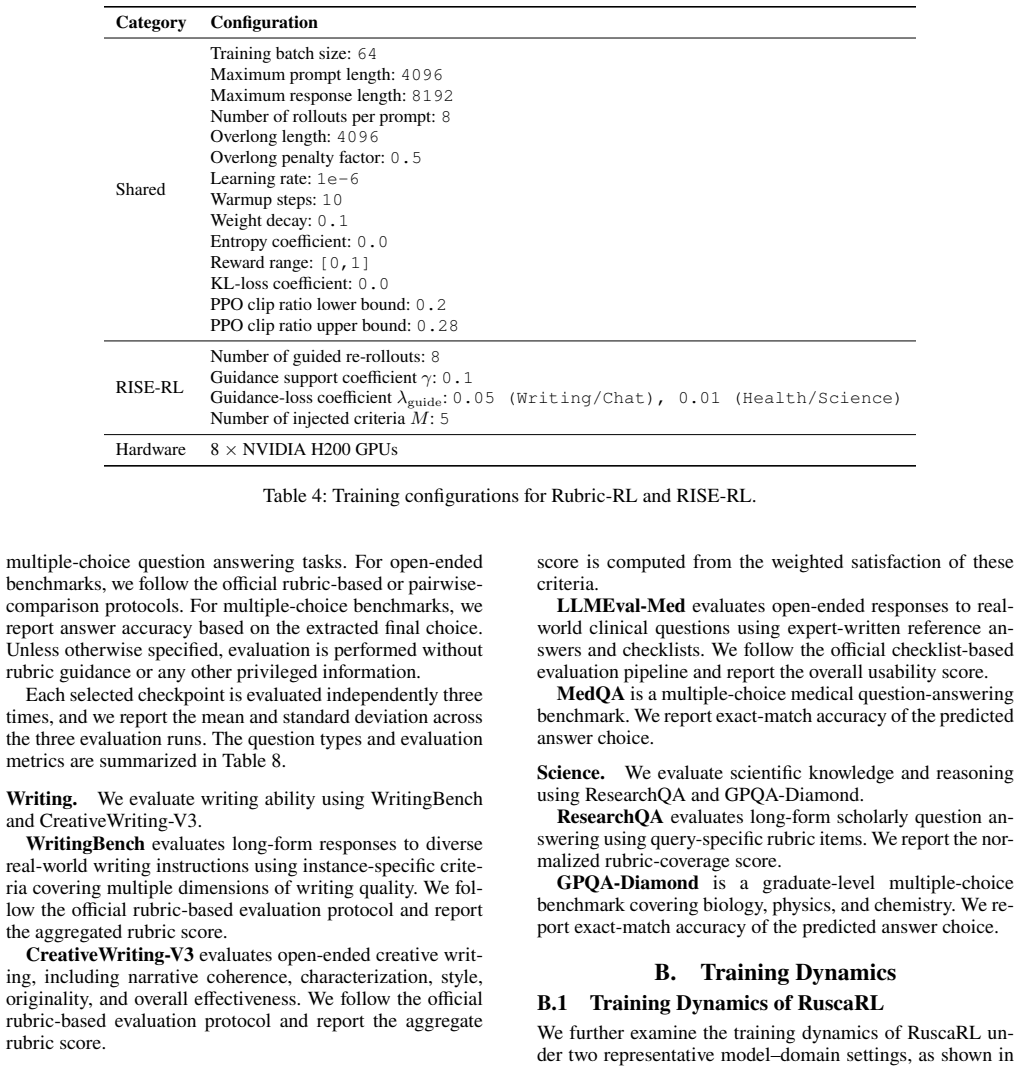
The central object is the policy support factor $\rho_{j,t} = p_{j,t}/(p_{j,t}+\gamma)$, where $p_{j,t}$ is the current policy's probability of token $t$ in a retained privileged trajectory when that trajectory is re-scored token by token under the original prompt, without the injected criteria. Because $-\log\rho_{j,t}$ grows as $p_{j,t}$ shrinks, the factor upweights exactly the tokens that appear in a high-reward guided response yet remain unlikely under the natural policy; the clipped trajectory gain $\tilde{A}_j = \operatorname{clip}(A_j^\text{ref}, 0, A_\max)$ keeps only reward-improving trajectories in $\mathcal{L}_\text{guide} = -\frac{1}{|\mathcal{O}_\text{ref}|}\sum_j \tilde{A}_j \frac{1}{|o_j|}\sum_t \log\rho_{j,t}$. This support weighting runs through a separate auxiliary objective added to the GRPO loss, so guided trajectories never enter the group-relative advantage normalization of natural rollouts, and the whole guidance branch is switched off when the privileged-versus-natural reward gap stops shrinking.
What would settle it
A direct test would look at the low-probability tokens that the support factor upweights in retained guidance trajectories: if these tokens do not disproportionately implement the injected failed criteria, such as being mostly stylistic fillers or rare idioms, then the support factor is not measuring the capability gap the paper claims and the gains would not be expected to transfer to new prompts. A sharper quantitative version would retrain with the support factor replaced by a uniform weight on all retained tokens while keeping the reward filter; if the uniform-weight variant matches RISE-RL, the paper's central mechanism is the reward filter alone, not policy support shaping.
Extended reading notes
Core claim
On the paper's own terms, the central discovery is that selectively feeding a policy its own persistent rubric failures produces rubric alignment that survives guidance-free evaluation. After a group of natural rollouts is scored criterion by criterion, RISE-RL ranks the criteria by importance-weighted failure frequency, appends the top $M$ to the prompt, samples privileged responses, and retains only those whose complete-rubric reward exceeds the average natural reward. Each retained trajectory is then re-scored token by token under the original prompt, without the injected criteria, and the resulting token probabilities feed $\rho_{j,t} = p_{j,t}/(p_{j,t}+\gamma)$, so tokens that appear in a high-reward trajectory but are weakly supported by the current policy receive larger guidance. The auxiliary loss $\mathcal{L}_\text{guide}$ maximizes these support factors scaled by the clipped reward improvement, while the natural branch runs Group Relative Policy Optimization (GRPO) as usual; guidance is removed once the privileged-versus-natural reward gap plateaus. The experiments claim that this selective, decoupled, time-limited guidance is what lets the policy internalize behaviors that unguided exploration rarely finds, including safety-relevant health criteria and rare creative modes, rather than merely imitating rubric-conditioned responses.
Load-bearing premise
The load-bearing premise is that when a filtered high-reward guided response is re-scored under the original prompt, a low token probability marks a genuine capability gap that training on that token will fix, rather than an off-distribution artifact of the privileged prompt that will not transfer once guidance is removed.
Editorial extensions
If this is right
- RISE-RL, if correct, gives a drop-in alternative to scalar rubric reward: training with criterion-level priority selection, reward filtering, and support shaping raises mean benchmark scores by 1.3 points at 4B and 3.3 points at 14B over standard Rubric-RL in the paper's evaluations.
- Open-ended rubrics and verifiable tasks are not in tension: the same health and science training improves MedQA by 3.3 points and GPQA-Diamond by 3.6 points, so rubric-guided alignment can transfer into objectively scored knowledge.
- Guidance removal is part of the benefit: persistent guidance leads to fluctuating entropy and a late-training performance drop, whereas RISE-RL keeps improving after guidance is withdrawn, suggesting a two-stage expand-then-consolidate dynamics.
- Diversity need not be sacrificed: creative-writing evaluations show a 5.8% diversity gain over the base model, while Rubric-RL degrades coherence and style, so targeted guidance can expand rather than collapse the policy distribution.
- Decoupling matters: placing the same filtered privileged trajectories inside the group-relative objective underperforms RISE-RL on both writing and health ablations, implying that keeping guided learning outside natural advantage estimation is a real component of the result.
Reading between the lines
- The authors leave implicit that the same selective-guidance loop could run with rubrics produced by the judge itself when no curated rubric dataset exists; testing RISE-RL on model-generated criteria would show whether the benefit depends on RubricHub's rubric quality.
- Because $\rho$ increases with $p$, the support factor acts as a soft inverse-probability weight; one could vary $\gamma$ per domain to see whether creative writing, where low-probability tokens are often stylistic, needs a different sensitivity than health or science.
- The guidance switch is set from a preliminary run, but the paper measures the privileged-versus-natural reward gap throughout, so an online rule that removes guidance when that gap flattens is a natural next step that would remove the need for a fixed $s_\text{switch}$.
- The transfer to MedQA and GPQA-Diamond hints that guided trajectories may serve partly as a knowledge regularizer; a probe of factual retention on held-out domain questions would test that interpretation.
Editorial analysis
A structured set of objections, weighed in public.
Referee Report
Summary. This paper proposes RISE-RL, a rubric-informed selective exploration method for open-ended reinforcement learning. The method identifies rubric criteria that are frequently failed by natural rollouts, appends the top-M such criteria to the prompt to sample privileged trajectories, filters those trajectories by whether their complete-rubric reward exceeds the mean natural reward, re-evaluates the retained trajectories under the original prompt, and weights each token by a policy-support factor rho = p/(p+gamma). The resulting auxiliary loss is optimized separately from GRPO and is removed at a training step s_switch. Experiments on Qwen3-4B and Qwen3-14B across writing, chat, health, and science report higher mean scores than Rubric-RL on all eight downstream benchmarks, with average gains of 1.3 and 3.3 points, plus ablations on the guidance coefficient, number of injected criteria, support weighting, and coupled versus decoupled optimization.
Significance. RISE-RL targets a genuine problem: scalar rubric rewards obscure which criteria are persistently missed, and unguided exploration may fail to discover rare high-reward modes. The decoupled auxiliary objective is a clean way to keep privileged trajectories out of the GRPO advantage estimator, and the training-dynamics analysis in Figure 3, the criterion-level health case in Table 12, and the full CreativeWriting-V3 criterion-level results in Table 10 are valuable evidence that targeted guidance can be internalized and then removed. The evaluation spans four domains and includes objectively scored benchmarks such as MedQA and GPQA-Diamond, which goes beyond style-level comparisons. The method is described precisely enough to be reimplementable, although no code is provided. The core weakness is that the mechanism claimed to drive the gains — policy-support weighting of low-probability tokens in Eq. (11) — is not actually validated against the off-policy distribution-shift alternative.
major comments (4)
- [Method, Eqs. (9)–(11)] Equation (9) computes p_{j,t} by teacher-forcing under the original prompt q a trajectory that was sampled under q_priv = q ⊕ C_fb. Once the privileged suffix changes an early token, every later conditional probability is evaluated on an off-policy prefix, so a low p_{j,t} conflates the cumulative distribution shift of the whole hinted continuation with the model's weak support for the specific missed criterion. Equation (11) then up-weights all low-support tokens, including lexical or stylistic artifacts of the hint. The ablation in Figure 7(b) shows only that support weighting helps relative to uniform weighting; it does not show that the low-p tokens correspond to the targeted rubric criteria. A control that weights only criterion-relevant spans, or a comparison against a version that applies the same support weights to equal-reward trajectories sampled without the hint, is needed to establish the paper's central attribution of the gains to 'policy support shaping.'
- [Table 1 and Appendix A.3] Appendix A.3 promises that 'each selected checkpoint is evaluated independently three times, and we report the mean and standard deviation across the three evaluation runs,' but Table 1 reports only means and no standard deviations. Several headline RISE-RL versus Rubric-RL differences are small, for example 20.89 versus 20.76 on Arena-Hard-v2 at 4B and 52.32 versus 52.00 on HealthBench at 4B. The claim that RISE-RL beats Rubric-RL on every benchmark is a mean-score claim, but without the promised variance information the reader cannot assess whether these differences are stable across evaluation runs or checkpoints. Please report the standard deviations, confidence intervals, or individual run values for the main table.
- [Experiments, 'Main Results'] During the guided stage, RISE-RL spends roughly twice the rollout budget of Rubric-RL (G natural rollouts plus G privileged re-rollouts), and no baseline matches this compute with unguided rollouts. The paper states that the gains are not merely from extra sampling or rubric conditioning, but the support-weighting and coupled-versus-decoupled ablations keep the extra sampling fixed. A compute-matched Rubric-RL variant, for example 2G natural rollouts per step or a second unguided re-rollout branch, is needed to rule out the trivial explanation that additional on-policy samples alone drive the improvement.
- [Decoupled Optimization and Guidance Removal] The guidance-removal step s_switch is set 'based on a preliminary run' near the onset of the plateau in the reward-gap curve, but the manuscript does not specify which domain/model the preliminary run used, how the plateau was detected, or how sensitive the final scores are to s_switch. Since the two-stage dynamics in Figure 3 and the comparison against persistent guidance are a stated contribution, the paper should report the actual s_switch values used for each domain and provide at least a small sensitivity analysis over early, chosen, and late removal.
minor comments (5)
- [Appendix A.2 and Appendix B.1] There are two empty cross-references: 'provided in Section .' appears in the RuscaRL implementation paragraph and again in the training-dynamics appendix; both should be filled in.
- [Section D.1] The privileged-prompt construction says M=5 criteria are injected, but it is not stated what happens when fewer than M criteria are violated in a given natural-rollout group; please clarify whether the hint then contains only the violated criteria or is padded in some way.
- [Table 12] The failure-count columns in Table 12 are difficult to align in the current formatting, and the stated column totals do not obviously match the row entries; please reformat the table and verify the totals.
- [Main Results, Table 1] The manuscript does not state how the 'selected checkpoint' for Table 1 was chosen, for example final training step versus best validation step; this should be specified because it affects the comparability of the reported means.
- [Figure 5 and Table 11] Figure 5 uses criterion labels such as R0 and R9 that are defined only in Table 11; the figure caption should either restate the criteria or clearly point to the table.
Circularity Check
No circular derivation: RISE-RL's benchmark gains are externally measured, and the only mild self-reference is the non-load-bearing citation to RubricHub for training data and judge reliability.
full rationale
The claimed chain is empirical rather than definitional: RISE-RL constructs privileged trajectories from rubric failures (Eqs. 4-6), filters them by complete-rubric reward (Eqs. 7-8), re-weights tokens by natural-policy support (Eqs. 9-11), and optimizes a decoupled auxiliary loss (Eq. 12). None of these equations derives downstream benchmark scores from the training signal by construction; the headline gains are measured on WritingBench, CreativeWriting-V3, Arena-Hard-v2, HealthBench, LLMEval-Med, MedQA, ResearchQA, and GPQA-Diamond, which are external to the RubricHub training corpus and are evaluated under guidance-free protocols. The questionable interpretation that low p_j,t in Eq. 9 isolates missed criteria rather than off-policy distribution shift is a correctness risk, not circularity: p_j,t is by definition the natural-policy token probability, and the paper tests the weighting mechanism in an ablation (Fig. 7b). The only mild self-reference is the citation to RubricHub (Li et al. 2026a) for the training corpus and for the claim that gpt-oss-120b agrees with human judgment; that paper shares an author (H. Ren) with the present work, but it supplies data and a judge-validation input, not the external benchmark outcomes, so it is not load-bearing. An appendix editorial defect (an empty cross-reference 'provided in Section .') is a completeness issue, not circularity.
Assumptions & free parameters
free parameters (5)
- s_switch =
not reported
- lambda_guide =
0.05 writing/chat, 0.01 health/science
- M =
5
- gamma =
0.1
- Amax =
not reported
assumptions (6)
- domain assumption The gpt-oss-120b judge provides reliable binary rubric judgments that agree with human judgment.
- ad hoc to paper Policy support factor rho = p/(p + gamma) with gamma = 0.1 is a valid measure of how weakly the natural policy supports a token.
- domain assumption Privileged prompt suffix containing up to five failed criteria does not change task semantics, and behaviors learned under it transfer to the natural prompt.
- standard math GRPO with sequence-level advantages is a suitable optimizer for open-ended rubric rewards.
- domain assumption Training on RubricHub rubrics transfers to the eight evaluation benchmarks.
- ad hoc to paper s_switch chosen on a preliminary run generalizes to all main runs.
Cite this review
Pith. "Pith review of RISE-RL: Rubric-Informed Selective Exploration for Open-Ended Reinforcement Learning." pith.science (2026). https://pith.science/paper/UH46VEJO
@misc{pith2026260809123,
  author       = {Pith},
  title        = {Pith review of: RISE-RL: Rubric-Informed Selective Exploration for Open-Ended Reinforcement Learning},
  year         = {2026},
  howpublished = {\url{https://pith.science/paper/UH46VEJO}},
  note         = {Machine review of arXiv:2608.09123}
}
abstract
Aligning Large Language Models (LLMs) for open-ended tasks is challenging because responses must satisfy multidimensional criteria without following a single correct generation trajectory. Existing rubric-based reinforcement learning (RL) methods compress fine-grained criterion-level feedback into scalar rewards, making persistent capability gaps difficult to target under limited on-policy exploration. We propose $\textbf{RISE-RL}$ (Rubric-Informed Selective Exploration), which uses repeatedly missed rubric criteria to elicit privileged trajectories that are difficult to discover through unguided exploration alone. RISE-RL retains only trajectories whose complete-rubric reward exceeds the mean reward of natural rollouts, and then re-evaluates them under the original prompt to emphasize behaviors that remain weakly supported by the natural policy. The resulting guidance signal is optimized through a separate auxiliary objective and removed once its additional benefit diminishes. Experiments with 4B and 14B models across writing, chat, health, and science show that RISE-RL achieves the highest mean score on every evaluated benchmark under guidance-free evaluation. Compared with standard Rubric-RL, it improves the average score by 1.3 points at the 4B scale and $\textbf{3.3 points at the 14B scale}$, including a $\textbf{6.0-point}$ gain on CreativeWriting-V3. It also improves creative-writing diversity and yields gains on objectively scored medical and scientific benchmarks. These results indicate that selective internalization through reward filtering and policy support shaping is effective for open-ended reinforcement learning.
Figures


Figures from the paper (4 more)



Reference graph
Works this paper leans on
-
[1]
arXiv preprint arXiv:2507.17746 , year=
Rubrics as rewards: Reinforcement learning beyond verifiable domains , author=. arXiv preprint arXiv:2507.17746 , year=
-
[2]
arXiv preprint arXiv:2604.13016 , year=
Rethinking on-policy distillation of large language models: Phenomenology, mechanism, and recipe , author=. arXiv preprint arXiv:2604.13016 , year=
-
[3]
arXiv preprint arXiv:2511.12344 , year=
Reward and Guidance through Rubrics: Promoting Exploration to Improve Multi-Domain Reasoning , author=. arXiv preprint arXiv:2511.12344 , year=
-
[4]
arXiv preprint arXiv:2505.09388 , year=
Qwen3 technical report , author=. arXiv preprint arXiv:2505.09388 , year=
-
[5]
Rubrichub: A comprehensive and highly discriminative rubric dataset via automated coarse-to-fine generation , author=. Proceedings of the 64th Annual Meeting of the Association for Computational Linguistics (Volume 1: Long Papers) , pages=
-
[6]
arXiv preprint arXiv:2601.18734 , year=
Self-Distilled Reasoner: On-Policy Self-Distillation for Large Language Models , author=. arXiv preprint arXiv:2601.18734 , year=
-
[7]
Advances in Neural Information Processing Systems , volume=
Learning to reason under off-policy guidance , author=. Advances in Neural Information Processing Systems , volume=
-
[8]
arXiv preprint arXiv:2506.03106 , year=
Critique-grpo: Advancing llm reasoning with natural language and numerical feedback , author=. arXiv preprint arXiv:2506.03106 , year=
Show all 39 references
-
[9]
arXiv preprint arXiv:2606.12507 , year=
Rubric-Guided Self-Distillation: Post-Training Without Rubric Verifiers , author=. arXiv preprint arXiv:2606.12507 , year=
-
[10]
arXiv preprint arXiv:2508.16949 , year=
Breaking the exploration bottleneck: Rubric-scaffolded reinforcement learning for general llm reasoning , author=. arXiv preprint arXiv:2508.16949 , year=
-
[11]
arXiv preprint arXiv:2402.03300 , year=
Deepseekmath: Pushing the limits of mathematical reasoning in open language models , author=. arXiv preprint arXiv:2402.03300 , year=
-
[12]
arXiv preprint arXiv:1707.06347 , year=
Proximal policy optimization algorithms , author=. arXiv preprint arXiv:1707.06347 , year=
-
[13]
Advances in Neural Information Processing Systems , volume=
Writingbench: A comprehensive benchmark for generative writing , author=. Advances in Neural Information Processing Systems , volume=
-
[14]
arXiv preprint arXiv:2505.08775 , year=
Healthbench: Evaluating large language models towards improved human health , author=. arXiv preprint arXiv:2505.08775 , year=
-
[15]
arXiv preprint arXiv:2506.04078 , year=
LLMEval-Med: a real-world clinical benchmark for medical LLMs with physician validation , author=. arXiv preprint arXiv:2506.04078 , year=
-
[16]
Applied Sciences , volume=
What disease does this patient have? a large-scale open domain question answering dataset from medical exams , author=. Applied Sciences , volume=. 2021 , publisher=
2021
-
[17]
arXiv preprint arXiv:2406.11939 , year=
From crowdsourced data to high-quality benchmarks: Arena-hard and benchbuilder pipeline , author=. arXiv preprint arXiv:2406.11939 , year=
-
[18]
Transactions of the Association for Computational Linguistics , volume=
Researchqa: Evaluating scholarly question answering at scale across 75 fields with survey-mined questions and rubrics , author=. Transactions of the Association for Computational Linguistics , volume=. 2026 , publisher=
2026
-
[19]
arXiv preprint arXiv:2311.12022 , year=
Gpqa: A graduate-level google-proof q&a benchmark , author=. arXiv preprint arXiv:2311.12022 , year=
-
[20]
Proceedings of the AAAI Conference on Artificial Intelligence , volume=
Swift: a scalable lightweight infrastructure for fine-tuning , author=. Proceedings of the AAAI Conference on Artificial Intelligence , volume=
-
[21]
Proceedings of the Twentieth European Conference on Computer Systems , pages=
Hybridflow: A flexible and efficient rlhf framework , author=. Proceedings of the Twentieth European Conference on Computer Systems , pages=
-
[22]
arXiv preprint arXiv:2504.21801 , year=
Deepseek-prover-v2: Advancing formal mathematical reasoning via reinforcement learning for subgoal decomposition , author=. arXiv preprint arXiv:2504.21801 , year=
-
[23]
arXiv preprint arXiv:2507.23726 , year=
Seed-prover: Deep and broad reasoning for automated theorem proving , author=. arXiv preprint arXiv:2507.23726 , year=
-
[24]
arXiv preprint arXiv:2603.00729 , year=
Qwen3-coder-next technical report , author=. arXiv preprint arXiv:2603.00729 , year=
-
[25]
Advances in Neural Information Processing Systems , volume=
Coderl: Mastering code generation through pretrained models and deep reinforcement learning , author=. Advances in Neural Information Processing Systems , volume=
-
[26]
Findings of the Association for Computational Linguistics: EMNLP 2023 , pages=
A confederacy of models: a comprehensive evaluation of LLMs on creative writing , author=. Findings of the Association for Computational Linguistics: EMNLP 2023 , pages=
2023
-
[27]
arXiv preprint arXiv:2304.00008 , year=
On the creativity of large language models , author=. arXiv preprint arXiv:2304.00008 , year=
-
[28]
arXiv preprint arXiv:2502.09838 , year=
Healthgpt: A medical large vision-language model for unifying comprehension and generation via heterogeneous knowledge adaptation , author=. arXiv preprint arXiv:2502.09838 , year=
-
[29]
Nature , volume=
Publisher correction: large language models encode clinical knowledge , author=. Nature , volume=
-
[30]
Nature medicine , volume=
Toward expert-level medical question answering with large language models , author=. Nature medicine , volume=. 2025 , publisher=
2025
-
[31]
arXiv preprint arXiv:2405.09939 , year=
SciQAG: A framework for auto-generated science question answering dataset with fine-grained evaluation , author=. arXiv preprint arXiv:2405.09939 , year=
-
[32]
Proceedings of the 34th ACM International Conference on Information and Knowledge Management , pages=
SQuAI: Scientific Question-Answering with Multi-Agent Retrieval-Augmented Generation , author=. Proceedings of the 34th ACM International Conference on Information and Knowledge Management , pages=
-
[33]
Proceedings of the 58th annual meeting of the association for computational linguistics: system demonstrations , pages=
Dialogpt: Large-scale generative pre-training for conversational response generation , author=. Proceedings of the 58th annual meeting of the association for computational linguistics: system demonstrations , pages=
-
[34]
Proceedings of the 16th Conference of the European Chapter of the Association for Computational Linguistics: Main Volume , pages=
Recipes for building an open-domain chatbot , author=. Proceedings of the 16th Conference of the European Chapter of the Association for Computational Linguistics: Main Volume , pages=
-
[35]
arXiv preprint arXiv:2201.08239 , year=
Lamda: Language models for dialog applications , author=. arXiv preprint arXiv:2201.08239 , year=
-
[36]
Advances in Neural Information Processing Systems , volume=
Sam-r1: Leveraging sam for reward feedback in multimodal segmentation via reinforcement learning , author=. Advances in Neural Information Processing Systems , volume=
-
[37]
arXiv preprint arXiv:2601.20802 , year=
Reinforcement Learning via Self-Distillation , author=. arXiv preprint arXiv:2601.20802 , year=
-
[38]
arXiv preprint arXiv:2605.28014 , year=
Rosd: Reflective on-policy self-distillation for language model reasoning across domains , author=. arXiv preprint arXiv:2605.28014 , year=
-
[39]
Findings of the Association for Computational Linguistics: ACL 2026 , pages=
Think outside the policy: In-context steered policy optimization , author=. Findings of the Association for Computational Linguistics: ACL 2026 , pages=
2026
Reviewed August 11, 2026 · model on record in the stance chip above.
Discussion (0). Continue with ORCID to comment.