REVIEW 3 major objections 4 minor 14 references
A further study of quandles and quandle rings
T0 review · 3 major / 4 minor · reviewed 2026-08-11 · deepseek-v4-flash
Pith's one-line read Core quandles of dihedral groups have rank 4, refuting the proposed formula rk(Core(G)) = rk(G)+1.
desk verdict Settles two open questions and gives a valid counterexample to the rank conjecture, but needs a corrected Corollary 7.2 and a filled gap in Proposition 2.2. read the letter →
The pith
A machine-rendered reading of the paper's core claim, the machinery that carries it, and where it could break.
The reading
What carries the argument
The load-bearing machinery is the explicit multiplication rule of Core(D_n): with elements written a^i b^j and operation x*y = y $x^{{-1}}$ y, the parity of n decides whether the map j ↦ 2j-i permutes residues modulo n (odd n) or only permutes them modulo n/2 (even n). That decides the number of orbits and lets the rank proof run on subquandle generation. For the ring-theoretic results, the paper works in the augmentation ideal with basis E_i = e_i - e_0, whose multiplication table (Lemma 3.5) converts idempotent equations into polynomial systems solved by Gröbner bases. For units, zero-divisors, and nilpotents it uses the extended quandle ring S = k[Q] ⊕ ke with e central, and characterises units and zero-divisors by solvability of a small linear system. The final construction uses bivariate Lagrange interpolation in (Z_{2n+1}[Q])[X,Y] to write a polynomial f whose values f(a,b) reproduce the commutative quandle operation e_{(n+1)(a+b)}.
What would settle it
For n=4, compute the four orbits of Core(D_4) under the operation x*y = y $x^{{-1}}$ y, choose one representative from each orbit, and check whether the subquandle they generate has all eight elements of D_4; if it does not, the claimed rank 4 is too small.
Extended reading notes
Core claim
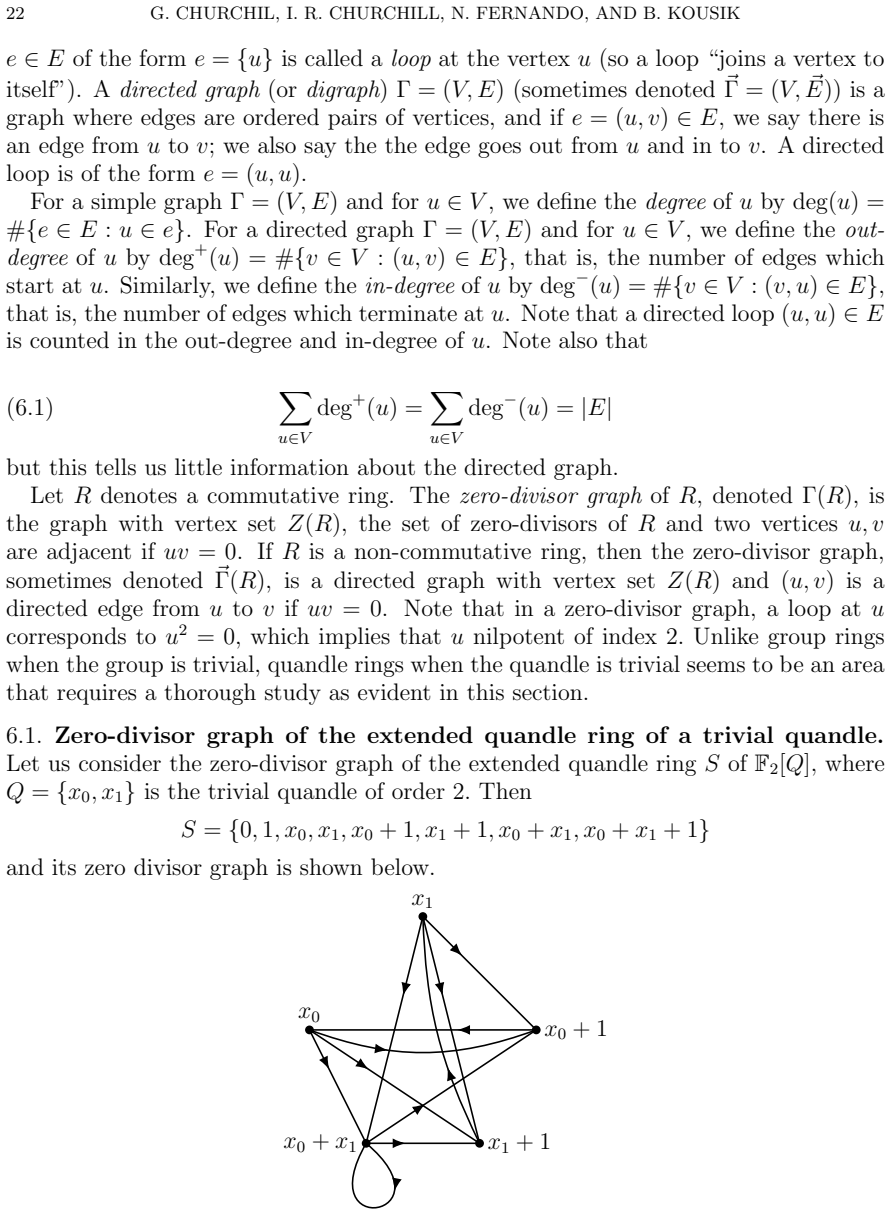
The paper's central discovery is a counterexample to a proposed rank formula. For n>2, rk(Core(D_n)) = 4 = rk(D_n)+2, so the answer to the question posed in [5]—whether rk(Core(G)) always equals rk(G)+1—is no: the core quandle can require two more generators than the group. The orbit structure, two orbits for odd n and four for even n, is what forces the extra generator. Alongside this, the paper proves that the only idempotents of augmentation 1 in Z[R_5] and Z[C_5] are the trivial basis elements, so those rings have no nontrivial idempotents of that augmentation, and it exhibits infinite-field core quandles with nontrivial idempotents, contradicting another conjecture. In the zero-divisor graphs of extended quandle rings over F_2 it finds a mirror symmetry: a vertex with in-degree i and out-degree o is paired with a vertex with in-degree o and out-degree i, and the paired elements add to a non-zero-divisor.
Load-bearing premise
For even n, the rank-4 proof assumes, without a complete derivation, that one element chosen from each of the four orbits of Core(D_n) generates the entire quandle.
Editorial extensions
If this is right
- The proposed formula rk(Core(G)) = rk(G)+1 is false for dihedral groups, so a correct general statement about core-quandle ranks must depend on more than the group's rank.
- The quandle rings Z[R_5] and Z[C_5] have no nontrivial idempotents with augmentation 1, so idempotent-based knot invariants built from these rings must use augmentation-0 elements or other coefficient rings.
- Since latin core quandles of odd-order groups have nontrivial idempotents without containing a trivial subquandle of order greater than 1, subquandle criteria cannot characterise nontrivial idempotents in quandle rings.
- Over F_2, the zero-divisor graphs of extended quandle rings of trivial and Joyce quandles obey a mirror symmetry between in-degrees and out-degrees, and mirror pairs sum to a non-zero-divisor.
- If p divides |Q| then Z_p[Q] is not semi-prime and not prime; moreover the bivariate polynomial f(X,Y) evaluates to exactly the elements of the commutative quandle on Z_{2n+1}.
Reading between the lines
- The mirror pairs in the paper all add to 1 in the extended ring, suggesting the general symmetry is the map u -> u+1; proving that for all finite fields would extend the F_2 computation to arbitrary characteristic.
- The even-n rank proof's gap suggests a direct computer test of Core(D_4) and Core(D_6) would confirm or refute the orbit-generation step, and similar orbit methods could be tried on other two-generator groups to see how widely the rank jump rk(G)+2 occurs.
- Because the polynomial systems for Z[R_5] and Z[C_5] were solved by Gröbner bases, the same pipeline can be applied to R_p and C_p for other primes to classify nontrivial idempotents systematically.
- The Lagrange interpolation result connects quandle-ring-valued polynomials with local permutation polynomials and latin squares, a direction the paper mentions only in motivation; one testable extension is whether every finite latin quandle admits such a polynomial over its quandle ring.
Editorial analysis
A structured set of objections, weighed in public.
Referee Report
Summary. The paper studies core quandles of dihedral groups and algebraic properties of quandle rings. It claims a counterexample to the conjecture rk(Core(G)) = rk(G)+1 by proving rk(Core(D_n)) = rk(D_n)+2 for n>2, determines idempotents in several quandle rings (including solving two systems left open in earlier work), analyzes units and nilpotents in extended quandle rings, introduces zero-divisor graphs for extended quandle rings and observes a mirror symmetry in their in- and out-degrees, discusses prime/semi-prime quandle rings, and constructs a bivariate polynomial over Z_{2n+1}[Q] that realizes a commutative quandle of prime order.
Significance. If the main results stand, the paper makes a useful contribution: Proposition 2.2 gives a clean counterexample to a published conjecture, and Section 4 settles two previously open systems of equations on idempotents. The zero-divisor graph computations are concrete and checkable, and the mirror symmetry observation is a genuinely new phenomenon that could spur further work. The paper is also commendably explicit: it reports Gröbner bases, multiplication tables, and degree tables rather than only existence statements. However, the rank proof has a load-bearing gap in the even case, and Section 7 contains a false corollary and an unjustified ideal computation, so the paper is not yet acceptable in its current form.
major comments (3)
- [§2, Proposition 2.2] The even-n case of the proof is incomplete at the point where the upper bound on rk(Core(D_n)) is established. After Theorem 2.1 gives four orbits, the text asserts, without derivation, that fewer than four elements cannot generate Core(D_n) and that any choice of one element from each orbit generates the whole quandle. Neither assertion is immediate from the displayed orbit analysis. A correct proof needs the invariance observation that the type (rotation/reflection) and the parity of the exponent of the left operand are preserved by the quandle operation, so no orbit can be omitted, and then a doubling argument (or an equivalent) showing that, for example, a^0 and a^t with t odd generate all rotations of both parities. The odd-n case also silently assumes that two suitably chosen rotations generate the full rotation orbit; this is true since 2 is invertible modulo odd n, but it should be stated. As written, the central rank theorem is not fully proved.
- [§7, Corollary 7.2] Corollary 7.2 is false as stated. Let Q be the trivial quandle of order 3 and take p=5. Writing S=x0+x1+x2, the trivial-quandle multiplication gives S^2=3S and more generally S^k=3^{k-1}S. Then S^3=9S≡4S, but (S^3)^2=S^6=3^5S≡3S, which is not 4S in Z_5. Hence S^3 is not an idempotent. The intended statement becomes true only with an additional hypothesis such as p|n, under which S^2=0 and the nth power is 0. The attribution 'which also appeared in [3]' should be checked against the exact statement in that reference.
- [§7, Proposition 7.1] The proof of Proposition 7.1 does not justify the assertion that the two-sided ideal generated by S=x0+...+x_{n-1} is exactly {αS : α∈Z_p}. The displayed identity verifies only products of the form S·(Σα_i x_i). For arbitrary A, the product A·S involves the row sums of the quandle multiplication table, which are not shown to be scalar multiples of S unless the quandle is Latin or has some additional balanced-row property. Consequently the square of a general element of the ideal is never computed, and the conclusion I^2=0 is not established for arbitrary quandles. The proposition may be salvageable by a different argument or by restricting the class of quandles, but the present proof is incomplete.
minor comments (4)
- [§4, C5 system after (4.4)] The rational root candidates for the displayed one-variable polynomial in β4 are the integer divisors of 6, namely ±1, ±2, ±3, ±6, not ±1, ±2, ±3, ±4. The proof should either replace the list or explicitly check the missing candidates ±6.
- [§6.1, Case 3] The line 'in-degree = 2.2^{n-1}-1' should read 2^n-1, and the notation 'x0+x1 x2' in Remark 6.2 is missing commas and likely a missing plus sign.
- [§8, Lagrange basis] In the displayed definition of L_{(X,2n)}(X), the product is written with 'i≠n−1'; it should be 'i≠2n'.
- [Throughout] There are numerous typos and inconsistent notations, including 'commutaitve', 'whcih', 'zero-divsor', 'Proporition', 'ε' versus 'ϵ', and the duplicated Propositions 1.8 and 3.3. A careful copyedit is needed.
Circularity Check
No circularity: the main results are derived by explicit computation or from external cited results; the only self-citation is background and not load-bearing.
full rationale
The derivation chain is not circular. Proposition 2.2 computes rk(Core(D_n)) from the orbit count in Theorem 2.1; the even-n generation claim is asserted rather than fully expanded, but it is a sufficiency argument that does not presuppose the rank being proved. Section 3's idempotent conclusions rest on [4, Propositions 12.11 and 12.13], authored by Bardakov, Elhamdadi, and Singh, not by the present authors; Section 4 solves systems imported from [2] by explicit Grobner basis computations. Section 5 proves unit and nilpotent characterizations from the definitions, with [7, Theorem 3.5] as an external, non-self input, and Section 6 computes zero-divisor degrees from those characterizations. Proposition 7.1 is proved directly, and Section 8 constructs its bivariate polynomial by Lagrange interpolation from the known operation, so the 'determines' claim is a construction rather than an assumed input. The sole self-citation is [10], where N. Fernando is a coauthor, cited in the introduction for background facts on power-associativity, integral domains, and Noetherianity; none of these facts is used in the later proofs, so the self-citation is not load-bearing. The omitted proof of Lemma 5.1 and the unexpanded generation step in Proposition 2.2 are expositional gaps, not circularities.
Assumptions & free parameters
assumptions (4)
- standard math Quandle axioms: x*x=x, right multiplication by each element is invertible, and the operation distributes over itself.
- domain assumption [4, Proposition 12.11]: If a quandle Q contains a subquandle of order n and n is a unit in k, then k[Q] has a nontrivial idempotent.
- domain assumption [7, Theorem 3.5]: The augmentation ideal of the quandle ring of a trivial quandle squares to zero.
- standard math Lagrange interpolation over the finite field Z_{2n+1} yields a unique bivariate polynomial taking prescribed values on F_q^2.
Cite this review
Pith. "Pith review of A further study of quandles and quandle rings." pith.science (2026). https://pith.science/paper/TVQ2OE4C
@misc{pith2026260809149,
  author       = {Pith},
  title        = {Pith review of: A further study of quandles and quandle rings},
  year         = {2026},
  howpublished = {\url{https://pith.science/paper/TVQ2OE4C}},
  note         = {Machine review of arXiv:2608.09149}
}
abstract
We investigate core quandles and idempotents in quandle rings of core quandles. We answer several questions on the rank of core quandles and nontrivial idempotents in quandle rings. We also present solutions to two questions raised in a recent paper about non-trivial idempotents in quandle rings $\mathbb{Z}[R_5]$ and $\mathbb{Z}[C_5]$, where $\mathbb{Z}$, $R_5$ and $C_5$ are the ring of integers, the dihedral quandle of order 5, and the commutative quandle of order 5, respectively. We then study units in extended quandle rings of a trivial quandle and the Joyce quandle, and nilpotent elements in extended quandles rings of a trivial quandle, where the ground ring is an integral domain. As a consequence, we show that the quandle ring and the extended quandle ring of a trivial quandle are not nil clean rings. We also explore prime rings and semi-prime rings among quandle rings. We introduce zero-divisor graphs of quandle rings and find an intriguing mirror symmetry among the in-degree and out-degree of the vertices. Moreover, we find a bivariate polynomial in the ring $(\mathbb{Z}_{2n+1}[Q])[X,Y]$ that determines the commutative quandle of order $2n+1$, where $2n+1$ is prime.
Figures


Figures from the paper (1 more)

Reference graph
Works this paper leans on
-
[4]
V. Bardakov , M. Elhamdadi , M. Singh,Yang-Baxter Equation and Related Algebraic Structures, arXiv:2506.23175
-
[3]
V. G. Bardakov , M. Elhamdadi , M. Singh,Algebra of the Yang–Baxter Equation, Skew Braces, Quandles, and Cohomology, Springer Monographs in Mathematics, Springer Singapore (2026)
work page 2026
-
[1]
D. F. Anderson, T. Asir, A. Badawi, T. T. Chelvam,Graphs from rings, Springer Cham (2021)
work page 2021
-
[2]
Idempotents and Powers of Ideals in Quandle Rings
V. Bardakov and M. Elhamdadi,Idempotents and Powers of Ideals in Quandle Rings, arXiv:2601.07057v2
-
[5]
V. G. Bardakov and D. A. Fedoseev,Products of quandles, Algebra Logic 63 (2024), no. 2, 75 – 97
work page 2024
-
[6]
V. G. Bardakav, I. B. S. Passi and M. Singh,Zero-divisors and idempotents in quandle rings, Osaka J. Math, 59:611-637, 2022
work page 2022
-
[7]
V.G. Bardakov, I. B. S. Passi and M. Singh.Quandle rings, J. Algebra Appl. 18: 1950157, 2019
work page 2019
-
[8]
M. Elhamdadi, D. Swain,State sum invariants of knots from idempotents in quandle rings. J. Knot Theory Ramifications 35, No. 5, Article ID 2550088, 20 p. (2026)
work page 2026
Show all 14 references
-
[9]
Elhamdadi, B
M. Elhamdadi, B. Nunez, M. Singh, D. Swain,Idempotents, free products and quandle coverings, Int. J. Math. 34, No. 3, Article ID 2350011, 27 p. (2023)
2023
-
[10]
Elhamdadi, N
M. Elhamdadi, N. Fernando, B. Tsvelikhovskiy,Ring theoretic aspects of quandles, J. Algebra 526, 166 – 187 (2019)
2019
-
[11]
Joyce,A classifying invariant of knots, the knot quandle
D. Joyce,A classifying invariant of knots, the knot quandle. J. Pure Appl. Algebra 23, 37 – 65 (1982)
1982
-
[12]
S. V. Matveev,Distributive groupoids in knot theory, Mat. Sb., Nov. Ser. 119(161), No. 1, 78 – 88 (1982)
1982
-
[13]
Spaggiari and M
F. Spaggiari and M. Bonatto.On core quandles, Algebra Univers: 86-28, 2025
2025
-
[14]
Wu,A Study of Knots and Quandles(2025)
Z. Wu,A Study of Knots and Quandles(2025). Math and Computer Science Honors Theses. 64. College of the Holy Cross, Worcester, Massachusetts. Department of Mathematics, SUNY Oswego, Oswego, NY 13126, USA Email address:gregory.churchill@oswego.edu Department of Mathematics, SUNY...
2025
Reviewed August 11, 2026 · model on record in the stance chip above.
Discussion (0). Continue with ORCID to comment.