REVIEW 2 major objections 4 minor 68 references
Transverse distributions of the energy-momentum tensor for a spin-$3/2$ baryon
T0 review · 2 major / 4 minor · reviewed 2026-08-11 · deepseek-v4-flash
Pith's one-line read This paper establishes a single factorization identity that carries the transverse energy-momentum distributions of a spin-3/2 baryon from the transverse Breit frame to the infinite-momentum frame, where they match the light-front results.
desk verdict A careful, largely correct extension of the EF/IMF multipole framework to spin-3/2; the main caveat is that the completeness of the ten-form-factor EMT parametrization is imported from earlier work rather than proved. read the letter →
The pith
A machine-rendered reading of the paper's core claim, the machinery that carries it, and where it could break.
The reading
What carries the argument
The load-bearing identity is Eq. (31), which factorizes the boost of the energy-momentum tensor matrix element into a $3 \times 3$ Lorentz-mixing matrix acting on the vector $(T^{00}, T^{03}, T^{33})^T$ and the Wigner rotation matrices $D^{(3/2)}(p_B,\Lambda)$ on both external states. The input is the set of seven transverse Breit-frame multipole form factors — $E_0, E_2, J_1, J_3, P_0, P_{0Q}, P_2$ — and the output at any $P_z$ is the set of six elastic-frame multipole coefficients (two monopoles, two dipoles, one quadrupole, one octupole), whose $\tau\to0$ limits are finite despite explicit inverse powers of $\tau=\,-t/(4m^2)$.
What would settle it
On the lattice, compute the complete set of $\Delta$-baryon energy-momentum tensor matrix elements at several spin projections and momentum transfers: if more than ten independent covariant form factors are needed to fit them, the parametrization of Eq. (3) is incomplete and the multipole distributions rest on a false foundation; if ten suffice, the distributions are fixed and the boost factorization can be checked by comparing its $P_z\to\infty$ limit with a direct light-front calculation.
Extended reading notes
Core claim
The central discovery is that Eq. (31) is exact: the finite-$P_z$ elastic-frame matrix elements of $T^{00}$, $T^{03}$, and $T^{33}$ are obtained from their transverse Breit-frame counterparts by applying the Lorentz boost matrix $L(\beta)$ and the spin-3/2 Wigner rotations $D^{(3/2)}(p_B,\Lambda)$, and the result expands in six transverse multipole structures. In the $P_z \to \infty$ limit the three components approach a common multipole expansion, and the leading matrix elements coincide with those computed directly from light-front Rarita–Schwinger spinors, as stated in Eq. (65).
Load-bearing premise
The ten form factors in the covariant spin-3/2 parametrization (Eq. (3)) are assumed to exhaust every allowed Lorentz structure for the on-shell matrix element; if additional structures from off-shell spin-1/2 components or contact terms exist, the seven-multipole decomposition and every distribution built from it would be incomplete.
Editorial extensions
If this is right
- In the infinite-momentum frame the three transverse distributions of energy, longitudinal momentum, and longitudinal momentum flux coincide at fixed spin projection, because their multipole form factors share a common limit (Eq. (37)).
- Longitudinally polarized spin-3/2 targets produce only azimuthally symmetric monopole profiles, while transversely polarized targets show dipole, quadrupole, and octupole angular deformations.
- The transverse integral of the longitudinal-momentum distribution grows from zero at $P_z=0$ to the baryon mass $m$ in the IMF, and the momentum-flux integral rises to $m\beta_P^2$, with the $P_z=0$ flux profile obeying the two-dimensional von Laue condition.
- Any dynamical input — model or lattice — that supplies the seven transverse Breit-frame multipole form factors determines all boosted distributions and their light-front limits, so the frame-dependence problem is reduced to computing seven functions.
- For the Skyrme-model $\Delta$, the energy density changes only weakly under boosts, its central monopole dominates, and the dipole shifts the peak of the transverse energy distribution in opposite directions at moderate and large $P_z$.
Reading between the lines
- Because the factorization is a statement about spin algebra and Lorentz kinematics, the same construction should apply to higher-spin targets such as spin-2 or spin-5/2 particles, with more multipoles but the same separation of boost mixing from Wigner rotation.
- If lattice QCD later finds the ten-form-factor parametrization insufficient, that would indicate missing off-shell spin-1/2 or contact-term contributions in the Rarita–Schwinger basis rather than a breakdown of the boost factorization itself.
- One could test the factorization directly at intermediate $P_z$ by taking any parametrization of the seven multipole form factors, evaluating the left- and right-hand sides of Eq. (31) independently, and checking whether the residual vanishes at all $P_z$ and $t$; the paper's algebraic verification suggests it does, but an independent numerical check would strengthen confidence.
Editorial analysis
A structured set of objections, weighed in public.
Referee Report
Summary. The paper develops an elastic-frame (EF) formalism for the transverse spatial distributions of the energy-momentum tensor of a spin-3/2 baryon. Starting from the ten-form-factor covariant parametrization of Ref. [39], it derives seven transverse Breit-frame multipole form factors, factorizes the finite-Pz EF matrix elements into Lorentz component mixing and spin-3/2 Wigner rotations, and expresses each T00, T03, T33 matrix element through six EF multipole structures. Fourier transforms define transverse densities of energy, longitudinal momentum, and longitudinal momentum flux for longitudinally and transversely polarized targets. The EF results are then compared with a direct light-front calculation in the infinite-momentum frame, with the Wigner rotation becoming the Melosh rotation. The formalism is applied numerically to the Delta baryon using Skyrme-model gravitational form factors.
Significance. If the central factorization is valid, this is the first systematic spin-3/2 extension of boost-dependent transverse EMT densities, connecting the Breit frame, finite-Pz elastic frames, and the light-front limit. The multipole classification is carefully built on angular-momentum selection rules, the sum rules at t=0 are checked explicitly, and the appendices contain enough algebraic detail to test the finite-Pz form factors. The light-front calculation is a genuine cross-check of the Wigner/Melosh spin-rotation kinematics, although it shares the same covariant form-factor basis as the EF calculation and therefore does not by itself validate the completeness of that basis. The numerical section is clearly presented as illustrative rather than as a quantitative extraction.
major comments (2)
- [II.A, Eq. (3)] The paper assumes that the ten covariant form factors F_{i,j}(t) in Eq. (3) exhaust all independent Lorentz structures for the symmetric EMT between on-shell spin-3/2 states. This completeness is not derived or discussed, and every subsequent result—the Breit-frame multipoles in Eq. (19), the finite-Pz factorization in Eq. (31), and the light-front comparison in Eq. (65)—inherits this assumption. Please provide a counting argument or derivation that the displayed structures are complete, or explicitly state where a completeness proof exists and summarize its content. In particular, explain why possible on-shell-equivalent off-shell spin-1/2 components of the Rarita-Schwinger field cannot introduce independent EMT structures that would alter the multipole decomposition.
- [III.D (after Eq. (31)) and V.C (Eq. (65))] The claimed independent verification of Eq. (31) is stated but not displayed, and the light-front matching in Eq. (65) is summarized without showing the spin-index mapping between the canonical basis and the LF helicity basis. Because Eq. (31) is the central load-bearing result, the direct evaluation should be outlined or placed in an appendix. At minimum, specify the relation between the canonical spin projections sigma, sigma' and the LF helicities lambda, lambda' used in Eq. (65), and state explicitly which large-Pz power is kept as 'leading' for each of T^{++}, T^{+-}, and T^{--}.
minor comments (4)
- [III.D, Eq. (31)] The notation in Eq. (31), with D matrices written on both sides of each Breit-frame matrix element, is unconventional and should be clarified by defining the spin-space multiplication order explicitly, as in Eq. (30).
- [III.A, Eq. (16)] The normalization in Eq. (16) uses gamma_P, the forward-limit boost factor defined in Eq. (15); please state explicitly that this is not the same as the t-dependent gamma appearing in Eq. (24) to avoid confusion in later formulas.
- [VI.A, Eq. (66) and Table I] The numerical input relies on the ad hoc p=6 parametrization fitted over 0<=Q^2<=1 GeV^2, but no fit quality measure is reported. Please show the fit residuals or a chi^2/dof value, and comment on how sensitive the qualitative conclusions are to the chosen tail behavior.
- [V.C, Eq. (65)] The comparison of EF and LF matrix elements should state the conversion between P^+ and P_z used to relate Eq. (62) and Eq. (38), and should specify the power counting that isolates the leading term in each LF component; without this, the reader cannot reproduce the matching.
Circularity Check
No significant circularity: the multipole factorization is algebraic, while the claimed 'independent' check of Eq. (31) is a same-input consistency check.
-
other
[Section III.D, paragraph after Eq. (31)]
"To verify Eq. (31) independently, we evaluate its left-hand side directly from the covariant EMT matrix element in Eq. (3), using the EF kinematics at finite P_z in Eqs. (13) and (14) together with the normalization in Eq. (16)."
The check is not logically independent: the right-hand side of Eq. (31) is constructed from the transverse Breit-frame matrix elements in Eq. (19), which were themselves obtained by evaluating the same covariant EMT matrix element Eq. (3). The boost relation Eq. (30) is an exact Lorentz transformation of that same covariant matrix element. Thus comparing the boosted form of Eq. (3) with a direct EF evaluation of Eq. (3) verifies algebraic and spinor consistency, but it does not provide an independent confirmation of the factorization. The word 'independently' overstates the epistemic status of the check, although the central derivation does not depend on this verification.
full rationale
The paper's central derivation is a self-contained algebraic exercise once the covariant spin-3/2 EMT parametrization in Eq. (3) is accepted. Equations (19)-(20) define the seven transverse Breit-frame multipoles as linear combinations of the ten covariant form factors; Eq. (30) is an exact Lorentz boost formula; Eq. (31) follows by applying that boost to the three EMT components T00, T03, and T33, which mix only among themselves under a longitudinal boost. The finite-Pz multipole form factors in Appendix D and the IMF limits in Eqs. (38) are then obtained by linear algebra and taking limits, not by fitting. The light-front calculation in Section V starts from the same covariant matrix element Eq. (3) and the same seven Breit-frame multipoles, so the IMF agreement in Eq. (65) is an internal consistency check of the spinor and boost conventions rather than an external benchmark. The numerical input from the Skyrme model in Ref. [39] is explicitly labelled as representative input, and the fitted pole masses are used only for illustrations; the paper does not present the resulting distributions as predictions against data. The completeness of Eq. (3) is an assumption imported from Refs. [38,39], but Ref. [38] is an external reference and the parametrization is standard in the field; this is an assumption about the physics input, not a circular derivation of the paper's new results. The only notable issue is the overstated 'independent' verification of Eq. (31), which is a same-input consistency check and is not load-bearing for the main conclusions. Self-citation to Ref. [39] is transparent and does not carry the argument.
Assumptions & free parameters
free parameters (8)
- M_{1,0} =
2.05 GeV
- M_{1,1} =
1.53 GeV
- M_{2,0} =
1.26 GeV
- M_{2,1} =
0.78 GeV
- M_{4,0} =
1.88 GeV
- M_{4,1} =
1.88 GeV
- M_{5,0} =
1.88 GeV
- p =
6
assumptions (5)
- standard math The spin-multipole basis for a spin-3/2 object terminates at rank 3 (octupole), and the six structures in Eq. (32) are complete for the EMT components considered.
- domain assumption The Belinfante energy-momentum tensor is symmetric and conserved, so the total-EMT constraints in Eq. (7) hold.
- domain assumption The covariant parametrization in Eq. (3) is complete for spin-3/2 energy-momentum tensor matrix elements.
- domain assumption The Skyrme-model gravitational form factors of Ref. [39] provide a representative input for the Delta baryon.
- ad hoc to paper The momentum-transfer dependence is parametrized as F_i,j(t)=F_i,j(0)(1+Q^2/M^2)^{-6} with pole masses fitted over 0 <= Q^2 <= 1 GeV^2.
Cite this review
Pith. "Pith review of Transverse distributions of the energy-momentum tensor for a spin-$3/2$ baryon." pith.science (2026). https://pith.science/paper/BUNAU6YK
@misc{pith2026260809242,
  author       = {Pith},
  title        = {Pith review of: Transverse distributions of the energy-momentum tensor for a spin-$3/2$ baryon},
  year         = {2026},
  howpublished = {\url{https://pith.science/paper/BUNAU6YK}},
  note         = {Machine review of arXiv:2608.09242}
}
abstract
We develop a multipole description of transverse distributions of the energy-momentum tensor for a spin-$3/2$ baryon in frames connected by a longitudinal boost. In the transverse Breit frame, the $T^{00}$, $T^{03}$, and $T^{33}$ matrix elements are expressed through seven multipole form factors for energy, angular momentum, and stress. At finite longitudinal momentum, we factorize the Lorentz mixing of these three components from the spin-$3/2$ Wigner rotations of the external states. The resulting elastic-frame matrix elements contain six transverse multipoles, whose Fourier transforms define the distributions of energy, longitudinal momentum, and longitudinal momentum flux. We also calculate $T^{++}$, $T^{+-}$, and $T^{--}$ directly with light-front Rarita-Schwinger spinors. The elastic-frame construction provides a continuous interpolation from the transverse Breit frame to the infinite-momentum frame. In this limit, the Wigner rotation becomes the Melosh rotation, and the leading elastic-frame matrix elements reproduce the corresponding light-front results. Using the $\Delta$-baryon gravitational form factors obtained in the Skyrme model as a representative numerical input, we find that the energy distribution is dominated by the energy monopole defined in the transverse Breit frame and changes only weakly under longitudinal boosts. Through boost mixing, this monopole provides the dominant contribution to the longitudinal momentum distribution and its flux at finite $P_z$. For a longitudinally polarized spin-$3/2$ target, the distributions contain only the monopole contributions, whereas those of a transversely polarized target exhibit spin-dependent quadrupole and octupole deformations and a dipole that shifts their maxima.
Figures


Figures from the paper (11 more)




Reference graph
Works this paper leans on
-
[39]
A. Freese and G. A. Miller, Phys. Rev. D103, 094023 (2021), arXiv:2102.01683 [hep-ph]
arXiv 2021
-
[1]
3 show the energy distributions fors z = 3/2 ands z = 1/2, respectively
Energy distribution The left and right panels of Fig. 3 show the energy distributions fors z = 3/2 ands z = 1/2, respectively. Their dependence onP z is modest: asP z increases, the central value atx ⊥ = 0 decreases slightly fors z = 3/2 but increases fors z = 1/2, and the curves forP z ≳5 GeV are nearly indistinguishable from the IMF limit. In the transv...
-
[2]
4 show the longitudinal momentum distributions fors z = 3/2 ands z = 1/2, respectively
Distribution of longitudinal momentum The left and right panels of Fig. 4 show the longitudinal momentum distributions fors z = 3/2 ands z = 1/2, respectively. AtP z = 0, both profiles vanish for allx ⊥. In Eq. (19b),J 1 multipliesiϵ ij3SiX j 1 , whileJ 3 multiplies the octupole operators, and the expectation values of both vanish in longitudinal spin sta...
-
[3]
5 show the longitudinal momentum flux distributions fors z = 3/2 ands z = 1/2, respectively
Distribution of longitudinal momentum flux The left and right panels of Fig. 5 show the longitudinal momentum flux distributions fors z = 3/2 ands z = 1/2, respectively. Unlike the longitudinal momentum distributions in Fig. 4, the momentum flux distributions do not vanish identically atP z = 0, owing to the nonvanishing expectation values of the1andQ 33 ...
-
[4]
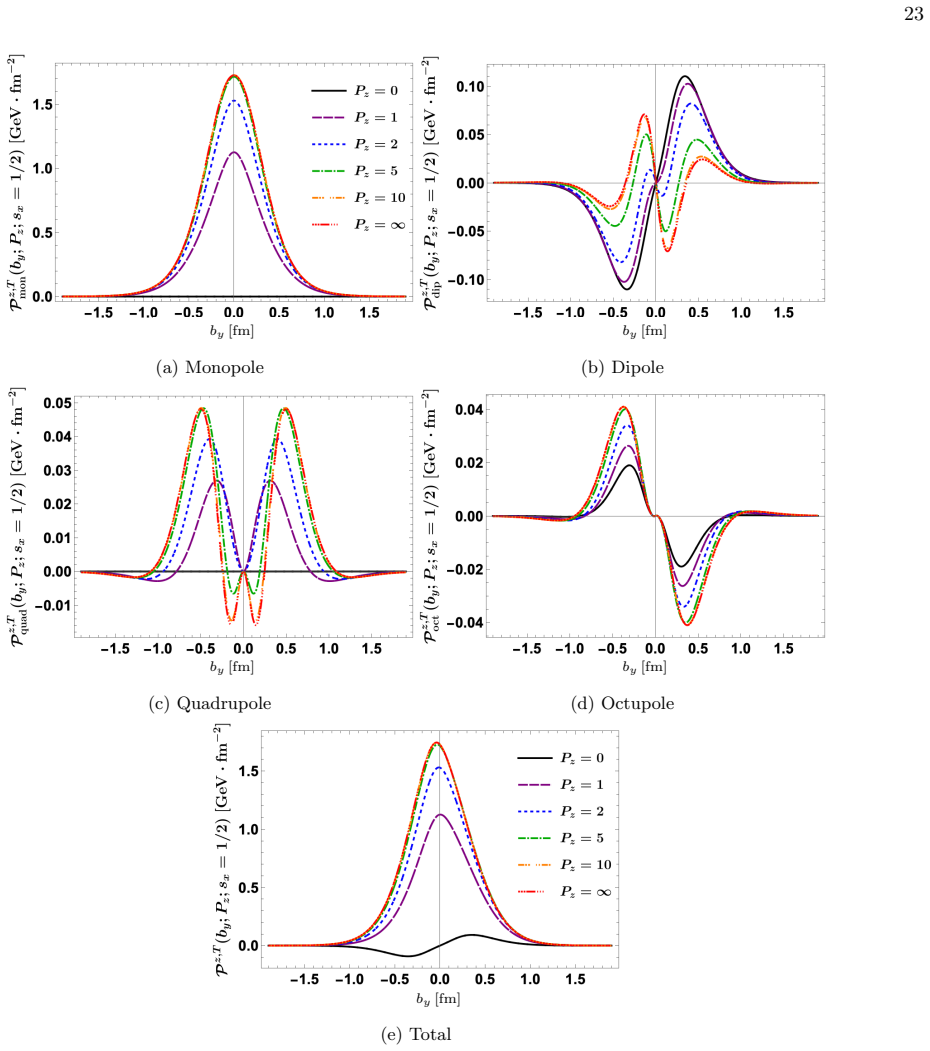
Energy distribution Figures 6 and 7 show the multipole contributions to the transversely polarized energy distributions fors x = 3/2 ands x = 1/2, respectively. In both cases, the monopole is much larger than the higher multipoles and sets the overall size of the total distribution. AtP z = 0,β=θ= 0, and the EF energy matrix element reduces to Eq. (19a), ...
-
[5]
Distribution of longitudinal momentum While the energy distributions in Figs. 6 and 7 contain the even multipoles already atP z = 0, the longitudinal momentum distributions in Figs. 8 and 9 are purely odd in the transverse Breit frame. AtP z = 0, the matrix element ofT 03 in Eq. (19b) contains only the dipole and octupole, so the profile changes sign unde...
-
[6]
Distribution of longitudinal momentum flux The longitudinal momentum flux in Figs. 10 and 11 differs from the longitudinal momentum in that it does not vanish in the transverse Breit frame. In that frame, the monopole and quadrupole produce a sign-changing profile with zero transverse integral. A longitudinal boost changes this balance in two ways: odd mu...
-
[7]
Energy distribution Figure 12 shows that the energy distribution remains positive and dominated by the central monopole over the full range ofP z. AtP z = 0, only the even multipoles contribute, and the maps are symmetric undery→ −y, i.e., under reflection about the spin (x) axis. The quadrupole deforms the inner contours in opposite ways for the two proj...
Show all 68 references
-
[8]
Distribution of longitudinal momentum Figure 13 shows the two-dimensional maps of the longitudinal momentum distributions analyzed in Figs. 8 and 9. AtP z = 0, the maps exhibit a pure dipole pattern with the positive region at +ˆy. This pattern originates from the 1S 27 struct...
-
[9]
AtP z = 0, only the even multipoles contribute, in accordance with Eq
Distribution of longitudinal momentum flux Figure 14 shows the maps of the longitudinal momentum flux. AtP z = 0, only the even multipoles contribute, in accordance with Eq. (19c). The monopole radial function changes sign inx ⊥, as required byP 0(0) =P 0Q(0) = 0, and together...
2025
-
[10]
Canonical-spin representation The canonical Rarita–Schwinger spinor for the transverse Breit frame and the EF is obtained by coupling a spin-1 polarization vector to a Dirac spinor [49]: uµ(p, σ) = X λ,s C 3 2 σ 1λ 1 2 sus(p)ϵµ λ(p), u s(p) = p m+p 0 ϕs σ·p m+p 0 ϕs .(...
-
[11]
(56) and order four-vector components as (+,−,1,2)
LF-helicity representation We use the LF coordinates of Eq. (56) and order four-vector components as (+,−,1,2). The expressions below follow the standard LF boost and phase convention [19, 20, 46]. Withp + >0, we define pR ≡p 1 +ip 2, p L ≡p 1 −ip 2, p − = m2 +p 2 ⊥ 2p+ .(A4) ...
-
[12]
Pagels, Phys
H. Pagels, Phys. Rev.144, 1250 (1966)
1966
- [13]
- [14]
-
[15]
Leader and C
E. Leader and C. Lorc´ e, Phys. Rept.541, 163 (2014), arXiv:1309.4235 [hep-ph]
2014 arXiv
-
[16]
V. D. Burkert, L. Elouadrhiri, F. X. Girod, C. Lorc´ e, P. Schweitzer, and P. E. Shanahan, Rev. Mod. Phys.95, 041002 (2023), arXiv:2303.08347 [hep-ph]
2023 arXiv
-
[17]
Goeke, M
K. Goeke, M. V. Polyakov, and M. Vanderhaeghen, Prog. Part. Nucl. Phys.47, 401 (2001), arXiv:hep-ph/0106012
2001 arXiv
- [18]
-
[19]
A. V. Belitsky and A. V. Radyushkin, Phys. Rept.418, 1 (2005), arXiv:hep-ph/0504030
2005 arXiv
-
[20]
von Laue, Annalen Phys.340, 524 (1911)
M. von Laue, Annalen Phys.340, 524 (1911)
1911
-
[21]
M. V. Polyakov, Phys. Lett. B555, 57 (2003), arXiv:hep-ph/0210165
2003 arXiv
-
[22]
M. V. Polyakov and P. Schweitzer, Int. J. Mod. Phys. A33, 1830025 (2018), arXiv:1805.06596 [hep-ph]
2018 arXiv
-
[23]
Lorc´ e, H
C. Lorc´ e, H. Moutarde, and A. P. Trawi´ nski, Eur. Phys. J. C79, 89 (2019), arXiv:1810.09837 [hep-ph]
2019 arXiv
-
[24]
Goeke, J
K. Goeke, J. Grabis, J. Ossmann, M. V. Polyakov, P. Schweitzer, A. Silva, and D. Urbano, Phys. Rev. D75, 094021 (2007), arXiv:hep-ph/0702030
2007 arXiv
-
[25]
R. L. Jaffe, Phys. Rev. D103, 016017 (2021), arXiv:2010.15887 [hep-ph]
2021 arXiv
-
[26]
Epelbaum, J
E. Epelbaum, J. Gegelia, N. Lange, U. G. Meißner, and M. V. Polyakov, Phys. Rev. Lett.129, 012001 (2022), arXiv:2201.02565 [hep-ph]
2022 arXiv
-
[27]
Lorc´ e and P
C. Lorc´ e and P. Schweitzer, Acta Phys. Polon. B56, 3 (2025), arXiv:2501.04622 [hep-ph]
2025 arXiv
-
[28]
P. A. M. Dirac, Rev. Mod. Phys.21, 392 (1949)
1949
-
[29]
J. B. Kogut and D. E. Soper, Phys. Rev. D1, 2901 (1970)
1970
-
[30]
D. E. Soper, Phys. Rev. D5, 1956 (1972)
1972
-
[31]
S. J. Brodsky, H.-C. Pauli, and S. S. Pinsky, Phys. Rept.301, 299 (1998), arXiv:hep-ph/9705477
1998 arXiv
-
[32]
Burkardt, Phys
M. Burkardt, Phys. Rev. D62, 071503 (2000), [Erratum: Phys. Rev. D 66, 119903 (2002)], arXiv:hep-ph/0005108. 35
2000 arXiv
- [33]
- [34]
-
[35]
G. A. Miller, Phys. Rev. Lett.99, 112001 (2007), arXiv:0705.2409 [nucl-th]
2007 arXiv
-
[36]
C. E. Carlson and M. Vanderhaeghen, Phys. Rev. Lett.100, 032004 (2008), arXiv:0710.0835 [hep-ph]
2008 arXiv
-
[37]
C. E. Carlson and M. Vanderhaeghen, Eur. Phys. J. A41, 1 (2009), arXiv:0807.4537 [hep-ph]
2009 arXiv
-
[38]
G. A. Miller, Ann. Rev. Nucl. Part. Sci.60, 1 (2010), arXiv:1002.0355 [nucl-th]
2010 arXiv
-
[40]
Freese and W
A. Freese and W. Cosyn, Phys. Rev. D106, 114013 (2022), arXiv:2207.10787 [hep-ph]
2022 arXiv
-
[41]
J. Y. Panteleeva and M. V. Polyakov, Phys. Rev. D104, 014008 (2021), arXiv:2102.10902 [hep-ph]
2021 arXiv
-
[42]
Kim and H.-C
J.-Y. Kim and H.-C. Kim, Phys. Rev. D104, 074019 (2021), arXiv:2105.10279 [hep-ph]
2021 arXiv
-
[43]
Lorc´ e, P
C. Lorc´ e, P. Schweitzer, and K. Tezgin, Phys. Rev. D106, 014012 (2022), arXiv:2202.01192 [hep-ph]
2022 arXiv
-
[44]
Won and C
H.-Y. Won and C. Lorc´ e, Phys. Rev. D111, 094021 (2025), arXiv:2503.07382 [hep-ph]
2025 arXiv
-
[45]
Won and C
H.-Y. Won and C. Lorc´ e, Phys. Rev. D114, 014012 (2026), arXiv:2604.07616 [hep-ph]
2026 arXiv
-
[46]
S. D. Drell and T.-M. Yan, Phys. Rev. Lett.24, 181 (1970)
1970
-
[47]
G. B. West, Phys. Rev. Lett.24, 1206 (1970)
1970
- [48]
-
[49]
Cotogno, C
S. Cotogno, C. Lorc´ e, P. Lowdon, and M. Morales, Phys. Rev. D101, 056016 (2020), arXiv:1912.08749 [hep-ph]
2020 arXiv
-
[50]
Kim and B.-D
J.-Y. Kim and B.-D. Sun, Eur. Phys. J. C81, 85 (2021), arXiv:2011.00292 [hep-ph]
2021 arXiv
-
[51]
Cosyn, S
W. Cosyn, S. Cotogno, A. Freese, and C. Lorc´ e, Eur. Phys. J. C79, 476 (2019), arXiv:1903.00408 [hep-ph]
2019 arXiv
-
[52]
M. V. Polyakov and B.-D. Sun, Phys. Rev. D100, 036003 (2019), arXiv:1903.02738 [hep-ph]
2019 arXiv
-
[53]
J. Y. Panteleeva and M. V. Polyakov, Phys. Lett. B809, 135707 (2020), arXiv:2004.02912 [hep-ph]
2020 arXiv
-
[54]
Kim, B.-D
J.-Y. Kim, B.-D. Sun, D. Fu, and H.-C. Kim, Phys. Rev. D107, 054007 (2023), arXiv:2208.01240 [hep-ph]
2023 arXiv
-
[55]
E. P. Wigner, Annals Math.40, 149 (1939)
1939
-
[56]
B. D. Keister and W. N. Polyzou, Adv. Nucl. Phys.20, 225 (1991)
1991
-
[57]
H. J. Melosh, Phys. Rev. D9, 1095 (1974)
1974
-
[58]
C. E. Carlson and C.-R. Ji, Phys. Rev. D67, 116002 (2003), arXiv:hep-ph/0301213
2003 arXiv
-
[59]
F. J. Belinfante, Physica6, 887 (1939)
1939
-
[60]
Rarita and J
W. Rarita and J. Schwinger, Phys. Rev.60, 61 (1941)
1941
-
[61]
Cotogno, C
S. Cotogno, C. Lorc´ e, and P. Lowdon, Phys. Rev. D100, 045003 (2019), arXiv:1905.11969 [hep-th]
2019 arXiv
-
[62]
Lorc´ e and P
C. Lorc´ e and P. Lowdon, Eur. Phys. J. C80, 207 (2020), arXiv:1908.02567 [hep-th]
2020 arXiv
-
[63]
D. A. Varshalovich, A. N. Moskalev, and V. K. Khersonskii,Quantum Theory of Angular Momentum: Irreducible Tensors, Spherical Harmonics, Vector Coupling Coefficients, 3nj Symbols(World Scientific Publishing Company, 1988)
1988
- [64]
-
[65]
Kim and H.-C
J.-Y. Kim and H.-C. Kim, Phys. Rev. D112, 074014 (2025), arXiv:2508.21319 [hep-ph]
2025 arXiv
-
[66]
Chen and C
Y. Chen and C. Lorc´ e, Phys. Rev. D106, 116024 (2022), arXiv:2210.02908 [hep-ph]
2022 arXiv
-
[67]
Alexandrou, T
C. Alexandrou, T. Korzec, G. Koutsou, C. Lorc´ e, J. W. Negele, V. Pascalutsa, A. Tsapalis, and M. Vanderhaeghen, Nucl. Phys. A825, 115 (2009), arXiv:0901.3457 [hep-ph]
2009 arXiv
-
[68]
D. V. Ahluwalia and M. Sawicki, Phys. Rev. D47, 5161 (1993), arXiv:nucl-th/9603019
1993 arXiv
Reviewed August 11, 2026 · model on record in the stance chip above.
Discussion (0). Continue with ORCID to comment.