REVIEW 4 major objections 6 minor 70 references
Alpha as an Efficiency Signal: Visibility-Routed RGBA Image-to-Video Generation
T0 review · 4 major / 6 minor · reviewed 2026-08-15 · deepseek-v4-flash
Pith's one-line read Joint RGBA video generation beats two-stage matting and runs 1.2x faster.
desk verdict A genuinely new visibility-routing idea for RGBA diffusion, honestly reported, but extractor-derived alpha and unmatched baselines leave the alpha-quality and FVD claims softer than the abstract suggests. read the letter →
The pith
A machine-rendered reading of the paper's core claim, the machinery that carries it, and where it could break.
The reading
What carries the argument
The load-bearing mechanism is the combination of a merged RGB-A latent and the visibility router with x0-lock. The merged latent keeps the pretrained image-to-video backbone's native 36-channel DiT input by concatenating a 16-channel RGB-alpha target latent with a 20-channel conditioning latent, so alpha costs no extra tokens or branches. The visibility router reads the clean estimate after the second evaluation through a logistic-regression probe, routes tokens predicted fully transparent, transports them along the unchanged flow-matching schedule via x0-lock, caches their K/V for attention context, and reactivates tokens that the evolving foreground boundary reaches. This lets alpha act as the efficiency signal: compute is spent where RGB can actually influence the composite.
What would settle it
Take a set of renderer-native RGBA clips with known ground-truth alpha, including semi-transparent hair, glow, and motion blur, run the paper's pipeline on them, and compare recovered alpha and single-stage outputs against ground truth: if the soft-opacity band shows large mean absolute difference or recompositing onto arbitrary backgrounds visibly fails, the extractor-supervision premise and the quality claim collapse.
Extended reading notes
Core claim
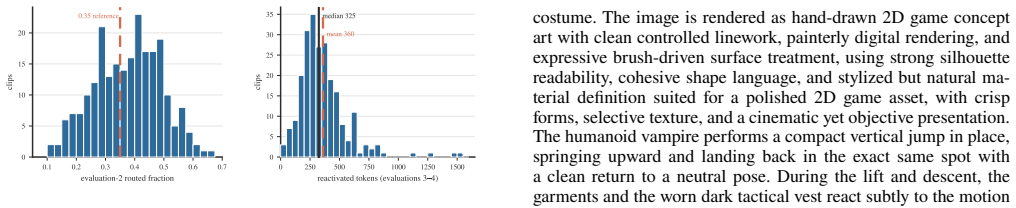
The central claim is that visibility, read from the model's own early clean estimate, is a valid and useful routing signal for RGBA diffusion inference. Because compositing satisfies $C = \alpha R + (1-\alpha)B$, RGB refinement cannot affect any composite wherever the final $\alpha$ is zero; the paper turns this analytic identity into an inference-time policy. A probe trained on dense trajectories predicts, after the second of four denoising evaluations, which tokens will be effectively transparent (maximum decoded $\alpha$ $\le 0.05$); a dilated spatiotemporal margin protects predicted foreground, uncertain clips fall back to dense inference, and routed tokens advance by x0-lock along the straight flow-matching interpolant toward their stored endpoints instead of passing through the DiT. The paper reports that this single-stage system obtains lower FVD than generate-then-matte baselines on its validation set and matches dense quality closely at 1.2x backbone speedup, with reactivation correcting most early routing errors.
Load-bearing premise
The load-bearing premise is that the extractor-derived alpha sequences are good enough to serve as supervision and evaluation ground truth; if those mattes are systematically wrong in semi-transparent regions, the dataset, the trained model, and the reported alpha metrics inherit that error.
Editorial extensions
If this is right
- A single-stage RGBA generator can achieve lower FVD than generate-then-matte pipelines on game-style assets, so the decomposition into RGB synthesis followed by matting is not obligatory for quality.
- The alpha channel gives a task-native token-importance criterion: tokens whose final alpha is zero can be skipped without directly affecting composited output, a signal generic saliency heuristics lack.
- Skipping is safe when combined with a spatial-temporal margin, local reactivation, and a dense fallback: routing errors are contained rather than propagated.
- Because the router changes neither the denoising schedule nor backbone parameters, it composes with step distillation and other acceleration techniques.
- The approach transfers beyond the game-asset training domain: on a human-video matting benchmark the routed model still matches dense quality while dense fallback and reactivation absorb the domain shift.
Reading between the lines
- If the compositing criterion is the right lens, the next natural step is continuous compute allocation by expected compositing error rather than a binary transparent/visible split, which could capture more speed on clips with glow, hair, and motion blur.
- The 35% skip is well below the dataset's roughly 63% average fully-transparent token budget; foreground-dense clips and the first-frame protection cap the realized gain, so a budget-aware router might approach the oracle bound.
- Since the merged RGB-A latent adds no token overhead, the cost of RGBA generation could approach that of ordinary RGB video; applying the router to multi-layer or multi-object RGBA generation is a direct testable extension.
- The router's probe is fit to the model's own estimate rather than external saliency; this suggests the same early-readability result may hold in other flow-matching generators, where the clean estimate is already available.
Signed reviews
Editorial analysis
A structured set of objections, weighed in public.
Referee Report
Summary. The paper proposes a single-stage reference-conditioned RGBA image-to-video generator trained on a new GameAlpha-2.4K dataset of synthetic game-asset clips whose alpha mattes are recovered by extractors and selected by staged audits. To avoid extra DiT tokens, the method uses a merged RGB-A VAE, and it introduces a visibility router that predicts final-transparent tokens from the step-2 clean estimate, skips their later DiT updates, and advances them with an x0-lock transport under a spatiotemporal margin with local reactivation. The authors report lower FVD than frozen generate-then-matte baselines, a 1.2x backbone speedup at a 35% evaluation-2 routed fraction, and small quality deltas relative to dense inference. Extensive appendices document dataset construction, routing ablations, cross-domain evaluation on VideoMatte240K, and a blinded human evaluation.
Significance. The core idea, using alpha as a task-native signal for token-level computation routing, is attractive and the analytic criterion in Eq. (6) is a genuine simplification. The x0-lock construction in Eq. (7) is an elegant way to keep routed tokens on the global noise schedule, and the paper is commendably explicit about its limitations, including the extractor-derived alpha supervision and the full-system nature of the comparisons. The dataset is a carefully documented resource for a domain, game assets, that existing RGBA datasets under-serve. However, the headline claims are currently supported only under a specific supervision contract: the alpha used for training, for MAD, and for FVD references all come from the same extractors, and the two-stage baselines are not fine-tuned on the target domain. If the authors add a renderer-ground-truth alpha check and a same-backbone fine-tuned two-stage baseline, the paper would be substantially stronger and the claims of semi-transparent quality and FVD advantage would be on much firmer ground.
major comments (4)
- [Sec. 3.1, App. A.4, Sec. 5] The alpha sequences in GameAlpha-2.4K are produced by BiRefNet, SAM3, and MatAnyone2 from synthetic RGB videos and then selected by a multimodal evaluator; these same sequences supervise the RGB-A VAE, the DiT, the transparency-probe labels, and the MAD reference, and they define the reference composites for FVD. Appendix A.4 reports that only 2.2% of pixels fall in the soft band (2/255 < alpha < 253/255), which is exactly the regime where the paper claims two-stage matting fails (Sec. 1). The paper's own limitation statement (Sec. 5) concedes that extractor-selected alpha and the small soft-band coverage mean physical alpha accuracy and recompositability are not established. This is load-bearing because the motivation, the training signal, and the evaluation metric all share the same extractor bias, so the claimed semi-transparent advantage is not yet demonstrated. I would like to see a small renderer-ground-truth subset (or a compositing check with known alpha) used for evaluation and, ideally, for a brief fine-tuning probe.
- [Sec. 4.3, Table 1] The two-stage comparison in Table 1 is a full-system comparison: the single-stage model is fine-tuned on GameAlpha-2.4K training clips, while the Wan, CogVideoX, and HunyuanVideo generators and the matting models are used off-the-shelf and frozen. Because the FVD advantage could come from domain adaptation to the GameAlpha distribution rather than from joint RGB-alpha modeling, the claim that the model obtains lower FVD than traditional two-stage pipelines is not yet isolated. The paper acknowledges this in Sec. 4.3 and App. C.6, but the abstract states the comparison without this caveat. Please add a controlled baseline: fine-tune the same Wan2.1-I2V backbone on GameAlpha-2.4K RGB-only (or with dataset alpha as an auxiliary output) and then apply the same matting postprocessors; this would directly test the joint-modeling claim.
- [Sec. 4.3, App. B.4] MAD is computed against the extractor-selected alpha sequences, and FVD is computed on checkerboard composites whose reference composites are built from the same sequences. Because the model is trained to reproduce those sequences, both metrics can reward agreement with extractor artifacts rather than with true compositing quality. The description in App. B.4 correctly notes that MAD does not by itself establish physical opacity accuracy or arbitrary-background recompositability, but this caveat is absent from the main-text results. Please report at least one independent alpha metric on a subset where alpha is known by construction (for example, rendered semi-transparent effects or hand-composited overlays with known alpha), and state clearly in Sec. 4.3 that FVD is relative to extractor-selected references.
- [Sec. 4.5, Table 3] The operating point (k_route = 2, r_s = 2) and the dense-fallback thresholds are selected on the full validation split, and the headline FVD numbers (172.3 dense vs. 174.4 routed) are reported on that same split with no confidence intervals or significance tests. The 'negligible quality degradation' claim is therefore an in-sample comparison at a self-selected operating point. A held-out split for hyperparameter selection, or bootstrap confidence intervals on the FVD difference, would make the efficiency claim robust.
minor comments (6)
- [Sec. 3.1] Section 3.1 contains a near-duplicate passage beginning 'Arbitrary backgrounds make foreground and alpha recovery underconstrained...'; please remove the repeated sentences.
- [Abstract, App. C.4] The 35% figure in the abstract is the evaluation-2 initial routed fraction, not the realized skip over evaluations 3-4; Appendix C.4 reports 31.9% realized suffix skip at the requested 0.35 tier. Please make this distinction explicit in the abstract or keep the more precise wording in the body.
- [Table 3, Fig. 13] The dense reference FVD differs between the main ablation (172.3) and Appendix C.4 (172.9); please state that these are independent runs under the same harness so the numbers do not appear inconsistent.
- [App. C.8] The human evaluation uses an enriched pool of 20 cases rather than a random sample of the validation set; please label the study as exploratory in the main text or in the appendix caption.
- [Eqs. (6)-(7), Sec. 3.3] The paper does not justify why active queries should attend to cached K/V of routed tokens whose states are advanced by x0-lock, since those cached K/V come from evaluation 2 and therefore do not reflect the transported state; a brief note on this approximation would improve clarity.
- [References] Several references carry future-dated years (e.g., 2026); please check that all citations are complete and correctly dated in the final version.
Circularity Check
No circular derivation found; efficiency claim rests on measured speedup and an analytic compositing criterion.
full rationale
The paper's derivation chain is self-contained. The visibility criterion in Eq. (6) follows from the compositing equation, and the x0-lock update in Eq. (7) is an exact algebraic transport along the flow-matching interpolant defined by the stored endpoint, not a fitted quantity. The central speedup claim is validated by comparing routed inference against dense inference of the same model under a matched protocol (Table 3), so the 1.2x backbone speedup is measured directly and does not depend on external labels. The transparency probe is fitted to the model's own dense trajectories and labeled by the model's own final alpha; this is a self-referential readout, but the paper discloses it explicitly ('The probe is a readout of the model's own evolving prediction, not an external saliency heuristic') and uses it only to select tokens for sparse computation, not to produce the reported quality metrics. The GameAlpha-2.4K alpha is extractor-selected rather than renderer ground truth, and the paper concedes this limitation: 'MAD measures agreement with that reference sequence and does not by itself establish physical opacity accuracy or arbitrary-background recompositability.' That is a data-quality and evaluation-bias limitation, not a constructional circularity: the FVD and MAD comparisons are empirical and could in principle go either way, and the cross-domain VideoMatte240K evaluation uses ground-truth alpha as an external check. No load-bearing self-citation, no imported uniqueness theorem, and no ansatz smuggled in by citation appear. The central efficiency claim is therefore independently grounded, and the disclosed limitations concern dataset supervision and external validity rather than circular reasoning.
Assumptions & free parameters
free parameters (7)
- transparency threshold eta =
0.05
- routing time k_route =
2
- spatial margin r_s =
2
- temporal margin r_t =
1
- dense fallback thresholds =
10% candidates, 15% uncertain, delta=2
- probe feature patch =
2x2x16
- DoRA rank and training epochs =
rank 32, 10 epochs
assumptions (5)
- standard math Standard alpha compositing equation C = alpha R + (1-alpha) B
- domain assumption Extractor-selected alpha from matte-friendly synthetic videos is adequate supervision for RGBA generation
- domain assumption The logistic probe trained on dense trajectories of the same model predicts final transparency at evaluation 2
- domain assumption Pretrained Wan-VAE encoder and decoder plus Wan2.1-I2V provide a valid base representation and motion prior
- standard math Flow matching formulation and the four-step LightX2V schedule are valid
Cite this review
Pith. "Pith review of Alpha as an Efficiency Signal: Visibility-Routed RGBA Image-to-Video Generation." pith.science (2026). https://pith.science/paper/7OUKZ3ZU
@misc{pith2026260809355,
  author       = {Pith},
  title        = {Pith review of: Alpha as an Efficiency Signal: Visibility-Routed RGBA Image-to-Video Generation},
  year         = {2026},
  howpublished = {\url{https://pith.science/paper/7OUKZ3ZU}},
  note         = {Machine review of arXiv:2608.09355}
}
read the original abstract
RGBA videos combine RGB appearance with an alpha channel, enabling animated assets to be applied across arbitrary backgrounds, which are heavily used in gaming industry. However, generating high-quality RGBA animations for games remains challenging for two reasons. First, most existing RGBA video datasets are dominated by photorealistic content, with limited coverage of game assets. Second, the traditional generate-then-matte pipelines estimate alpha only after RGB synthesis, so semi-transparent regions are often blurred by background, resulting in unstable matting outputs. More recently, many methods have begun to model RGB and alpha jointly, but existing approaches are mostly text-conditioned, and still have unresolved issues in efficiency and quality. To address these challenges, we introduce GameAlpha-2.4K, a 2.4K-clip game-style RGBA video dataset built with matte-friendly synthesis, multi-hypothesis alpha recovery, and compositing-based quality gates. Using this dataset, we train a reference-conditioned RGBA video generator that jointly produces RGB frames and alpha mattes in a single pass. To improve efficiency, we propose a visibility router that identifies transparent tokens in an early stage and bypasses their later DiT updates, while x_0-lock guides them along the original flow-matching schedule toward self-predicted endpoints. Our model obtains lower FVD than traditional two-stage pipelines, and the visibility router skips 35% of token evaluations in the final two DiT denoising steps, providing a 1.2x backbone speedup with negligible quality degradation compared to dense inference.
Figures


Figures from the paper (12 more)




Reference graph
Works this paper leans on
-
[1]
Communication, Simulation, and Intelligent Agents: Implications of Personal Intelligent Machines for Medical Education
Clancey, William J. Communication, Simulation, and Intelligent Agents: Implications of Personal Intelligent Machines for Medical Education. Proceedings of the Eighth International Joint Conference on Artificial Intelligence (IJCAI-83)
-
[2]
Classification Problem Solving
Clancey, William J. Classification Problem Solving. Proceedings of the Fourth National Conference on Artificial Intelligence
-
[3]
, title =
Robinson, Arthur L. , title =. 1980 , doi =. https://science.sciencemag.org/content/208/4447/1019.full.pdf , journal =
1980
-
[4]
New Ways to Make Microcircuits Smaller---Duplicate Entry
Robinson, Arthur L. New Ways to Make Microcircuits Smaller---Duplicate Entry. Science
-
[5]
Clancey and Glenn Rennels , abstract =
Diane Warner Hasling and William J. Clancey and Glenn Rennels , abstract =. Strategic explanations for a diagnostic consultation system , journal =. 1984 , issn =. doi:https://doi.org/10.1016/S0020-7373(84)80003-6 , url =
-
[6]
and Rennels, Glenn R
Hasling, Diane Warner and Clancey, William J. and Rennels, Glenn R. and Test, Thomas. Strategic Explanations in Consultation---Duplicate. The International Journal of Man-Machine Studies
-
[7]
Poligon: A System for Parallel Problem Solving
Rice, James. Poligon: A System for Parallel Problem Solving
-
[8]
Transfer of Rule-Based Expertise through a Tutorial Dialogue
Clancey, William J. Transfer of Rule-Based Expertise through a Tutorial Dialogue
Show all 70 references
-
[9]
The Engineering of Qualitative Models
Clancey, William J. The Engineering of Qualitative Models
-
[10]
2023 , eprint=
Attention Is All You Need , author=. 2023 , eprint=
2023
-
[11]
Pluto: The 'Other' Red Planet
NASA. Pluto: The 'Other' Red Planet
-
[12]
2025 , eprint=
Video Generation with Stable Transparency via Shiftable RGB-A Distribution Learner , author=. 2025 , eprint=
2025
-
[13]
2025 , eprint=
SAM 3: Segment Anything with Concepts , author=. 2025 , eprint=
2025
-
[14]
arXiv preprint arXiv:2408.00714 , url=
SAM 2: Segment Anything in Images and Videos , author=. arXiv preprint arXiv:2408.00714 , url=
-
[15]
Yang, Peiqing and Zhou, Shangchen and Hao, Kai and Tao, Qingyi , booktitle =
-
[16]
Yang, Peiqing and Zhou, Shangchen and Zhao, Jixin and Tao, Qingyi and Loy, Chen Change , booktitle =
- [17]
-
[18]
arXiv preprint arXiv:2601.14255 , year=
VideoMaMa: Mask-Guided Video Matting via Generative Prior , author=. arXiv preprint arXiv:2601.14255 , year=
-
[19]
arXiv preprint arXiv:2402.17113 , year=
Transparent image layer diffusion using latent transparency , author=. arXiv preprint arXiv:2402.17113 , year=
-
[20]
Proceedings of the Computer Vision and Pattern Recognition Conference , pages=
Transpixeler: Advancing text-to-video generation with transparency , author=. Proceedings of the Computer Vision and Pattern Recognition Conference , pages=
-
[21]
arXiv preprint arXiv:2603.17944 , year=
TransText: Alpha-as-RGB Representation for Transparent Text Animation , author=. arXiv preprint arXiv:2603.17944 , year=
-
[22]
ICASSP 2025-2025 IEEE International Conference on Acoustics, Speech and Signal Processing (ICASSP) , pages=
TransVDM: Motion-Constrained Video Diffusion Model for Transparent Video Synthesis , author=. ICASSP 2025-2025 IEEE International Conference on Acoustics, Speech and Signal Processing (ICASSP) , pages=. 2025 , organization=
2025
-
[23]
Proceedings of the IEEE/CVF Conference on Computer Vision and Pattern Recognition , pages=
Transanimate: Taming layer diffusion to generate rgba video , author=. Proceedings of the IEEE/CVF Conference on Computer Vision and Pattern Recognition , pages=
-
[24]
Proceedings of the Computer Vision and Pattern Recognition Conference , pages=
Art: Anonymous region transformer for variable multi-layer transparent image generation , author=. Proceedings of the Computer Vision and Pattern Recognition Conference , pages=
-
[25]
Proceedings of the IEEE/CVF Conference on Computer Vision and Pattern Recognition , pages=
Real-time high-resolution background matting , author=. Proceedings of the IEEE/CVF Conference on Computer Vision and Pattern Recognition , pages=
-
[26]
GitHub repository , howpublished =
LightX2V Contributors , title =. GitHub repository , howpublished =. 2025 , publisher =
2025
-
[27]
arXiv preprint arXiv:2411.19108 , year=
Timestep Embedding Tells: It's Time to Cache for Video Diffusion Model , author=. arXiv preprint arXiv:2411.19108 , year=
-
[28]
The IEEE/CVF Conference on Computer Vision and Pattern Recognition , year=
DeepCache: Accelerating Diffusion Models for Free , author=. The IEEE/CVF Conference on Computer Vision and Pattern Recognition , year=
-
[29]
Advances in Neural Information Processing Systems (NeurIPS) , year =
DynamicViT: Efficient Vision Transformers with Dynamic Token Sparsification , author=. Advances in Neural Information Processing Systems (NeurIPS) , year =
-
[30]
arXiv preprint arXiv:2207.01580 , year=
Dynamic Spatial Sparsification for Efficient Vision Transformers and Convolutional Neural Networks , author=. arXiv preprint arXiv:2207.01580 , year=
-
[31]
2025 , eprint=
Region-Adaptive Sampling for Diffusion Transformers , author=. 2025 , eprint=
2025
-
[32]
Token Merging: Your
Bolya, Daniel and Fu, Cheng-Yang and Dai, Xiaoliang and Zhang, Peizhao and Feichtenhofer, Christoph and Hoffman, Judy , booktitle=. Token Merging: Your
-
[33]
arXiv preprint arXiv:2410.05317 , year=
Accelerating Diffusion Transformers with Token-wise Feature Caching , author=. arXiv preprint arXiv:2410.05317 , year=
-
[34]
CVPR Workshop on Efficient Deep Learning for Computer Vision , year=
Token Merging for Fast Stable Diffusion , author=. CVPR Workshop on Efficient Deep Learning for Computer Vision , year=
-
[35]
arXiv preprint arXiv:2503.20314 , year=
Wan: Open and Advanced Large-Scale Video Generative Models , author=. arXiv preprint arXiv:2503.20314 , year=
-
[36]
arXiv preprint arXiv:2408.06072 , year=
CogVideoX: Text-to-Video Diffusion Models with An Expert Transformer , author=. arXiv preprint arXiv:2408.06072 , year=
-
[37]
arXiv preprint arXiv:2205.15868 , year=
CogVideo: Large-scale Pretraining for Text-to-Video Generation via Transformers , author=. arXiv preprint arXiv:2205.15868 , year=
-
[38]
2023 , eprint=
SparseCtrl: Adding Sparse Controls to Text-to-Video Diffusion Models , author=. 2023 , eprint=
2023
-
[39]
Proceedings of the IEEE/CVF International Conference on Computer Vision , pages =
VACE: All-in-One Video Creation and Editing , author =. Proceedings of the IEEE/CVF International Conference on Computer Vision , pages =
-
[40]
ACM SIGGRAPH 2024 Conference Papers , pages=
I2v-adapter: A general image-to-video adapter for diffusion models , author=. ACM SIGGRAPH 2024 Conference Papers , pages=
2024
-
[41]
International conference on machine learning , pages=
Learning transferable visual models from natural language supervision , author=. International conference on machine learning , pages=. 2021 , organization=
2021
-
[42]
Hu, Edward J and Shen, Yalu and Wallis, Phillip and Allen-Zhu, Zeyuan and Li, Yuanzhi and Wang, Shean and Wang, Lu and Chen, Weizhu , booktitle=
-
[43]
Proceedings of the IEEE/CVF International Conference on Computer Vision , pages=
Adding conditional control to text-to-image diffusion models , author=. Proceedings of the IEEE/CVF International Conference on Computer Vision , pages=
-
[44]
Advances in neural information processing systems , volume=
Denoising diffusion probabilistic models , author=. Advances in neural information processing systems , volume=
-
[45]
Proceedings of the IEEE/CVF international conference on computer vision , pages=
Scalable diffusion models with transformers , author=. Proceedings of the IEEE/CVF international conference on computer vision , pages=
-
[46]
arXiv preprint arXiv:2210.02747 , year=
Flow matching for generative modeling , author=. arXiv preprint arXiv:2210.02747 , year=
-
[47]
International Conference on Learning Representations , year=
AnimateDiff: Animate Your Personalized Text-to-Image Diffusion Models without Specific Tuning , author=. International Conference on Learning Representations , year=
-
[48]
2026 , eprint=
Seedance 2.0: Advancing Video Generation for World Complexity , author=. 2026 , eprint=
2026
-
[49]
arXiv preprint arXiv:1711.05101 , volume=
Fixing weight decay regularization in adam , author=. arXiv preprint arXiv:1711.05101 , volume=
-
[50]
arXiv preprint arXiv:2402.09353 , year=
DoRA: Weight-Decomposed Low-Rank Adaptation , author=. arXiv preprint arXiv:2402.09353 , year=
-
[51]
CAAI Artificial Intelligence Research , volume =
Bilateral Reference for High-Resolution Dichotomous Image Segmentation , author=. CAAI Artificial Intelligence Research , volume =
-
[52]
Transactions on Machine Learning Research Journal , year=
Dinov2: Learning robust visual features without supervision , author=. Transactions on Machine Learning Research Journal , year=
-
[53]
arXiv:2309.16588 , year=
Vision Transformers Need Registers , author=. arXiv:2309.16588 , year=
-
[54]
Proceedings of the Computer Vision and Pattern Recognition Conference , pages=
Dinov2 meets text: A unified framework for image-and pixel-level vision-language alignment , author=. Proceedings of the Computer Vision and Pattern Recognition Conference , pages=
-
[55]
FVD: A new metric for video generation , author=
-
[56]
arXiv preprint arXiv:2112.14683 , year=
Stylegan-v: A continuous video generator with the price, image quality and perks of stylegan2 , author=. arXiv preprint arXiv:2112.14683 , year=
-
[57]
International Conference on Learning Representations , year=
Generating Videos with Dynamics-aware Implicit Generative Adversarial Networks , author=. International Conference on Learning Representations , year=
-
[58]
Huang, Ziqi and He, Yinan and Yu, Jiashuo and Zhang, Fan and Si, Chenyang and Jiang, Yuming and Zhang, Yuanhan and Wu, Tianxing and Jin, Qingyang and Chanpaisit, Nattapol and Wang, Yaohui and Chen, Xinyuan and Wang, Limin and Lin, Dahua and Qiao, Yu and Liu, Ziwei , booktitle=
-
[59]
, author=
Perceptually Motivated Benchmark for Video Matting. , author=. BMVC , volume=
-
[60]
arXiv preprint arXiv:2412.03603 , year=
Hunyuanvideo: A systematic framework for large video generative models , author=. arXiv preprint arXiv:2412.03603 , year=
-
[61]
ACM Transactions on Graphics , volume =
UniVidX: A Unified Multimodal Framework for Versatile Video Generation via Diffusion Priors , author =. ACM Transactions on Graphics , volume =. 2026 , month = jul, doi =
2026
-
[62]
2025 , journal=
LayerFlow : A Unified Model for Layer-aware Video Generation , author=. 2025 , journal=
2025
-
[63]
2021 , eprint=
Robust High-Resolution Video Matting with Temporal Guidance , author=. 2021 , eprint=
2021
-
[64]
arXiv preprint , year=
VMFormer: End-to-End Video Matting with Transformer , author=. arXiv preprint , year=
-
[65]
2024 , eprint=
Phased Consistency Models , author=. 2024 , eprint=
2024
-
[66]
arxiv , year=
FasterCache: Training-Free Video Diffusion Model Acceleration with High Quality , author=. arxiv , year=
-
[67]
International Conference on Learning Representations , volume=
Fastercache: Training-free video diffusion model acceleration with high quality , author=. International Conference on Learning Representations , volume=
-
[68]
2023 , eprint=
UniMax: Fairer and more Effective Language Sampling for Large-Scale Multilingual Pretraining , author=. 2023 , eprint=
2023
-
[69]
2017 IEEE Conference on Computer Vision and Pattern Recognition (CVPR) , year=
Quo Vadis, Action Recognition? A New Model and the Kinetics Dataset , author=. 2017 IEEE Conference on Computer Vision and Pattern Recognition (CVPR) , year=
2017
-
[70]
Scandinavian Conference on Image Analysis , year=
Two-Frame Motion Estimation Based on Polynomial Expansion , author=. Scandinavian Conference on Image Analysis , year=
Reviewed August 15, 2026 · model on record in the stance chip above.
Discussion (0). Continue with ORCID to comment.