REVIEW 4 major objections 4 minor 61 references
Birefringent Biomineral Microcarriers Stabilise Multimodal Nanodiamond Quantum Sensing in Liquids
T0 review · 4 major / 4 minor · reviewed 2026-08-11 · deepseek-v4-flash
Pith's one-line read A vaterite–nanodiamond microcarrier stabilises multimodal quantum sensing in liquids.
desk verdict A genuinely promising hybrid-carrier platform for NV sensing in liquids, with honest limitations; the proton-transduction mechanism is underdetermined but the paper says so itself. read the letter →
The pith
A machine-rendered reading of the paper's core claim, the machinery that carries it, and where it could break.
The reading
What carries the argument
The central object is the vaterite–nanodiamond microcarrier: a 3–5 $\mu$m porous vaterite microspherulite decorated at its surface with 40-nm NV nanodiamonds, with a polyelectrolyte (PSS) layer at the junction. Its birefringence produces an optical torque in a linearly polarised 976-nm trap that biases the particle's orientation against Brownian rotation; the same anisotropy redirects surface-dipole emission, with a simulated Purcell factor near 0.30 relative to water, so collection is angularly redistributed rather than rate-enhanced. The chemical channel is carried by equations (3)–(6): a grand-canonical charge-regulation model in which proton bulk activity maps to a local surface potential $\psi_0$, occupation fractions $f_s$ follow a two-state form, and the longitudinal relaxation rate $\Gamma_{1,\mathrm{eff}}$ receives an occupation-gated fast term and an occupation-switching term, each filtered by a Lorentzian spectral window at the NV transition. The model’s key quantitative output is the constraint $\omega_0 \tau_e \approx 1$, giving $\tau_e \approx 55$ ps for a downstream relaxation-active fluctuator at 2.87 GHz.
What would settle it
A matched acid–base cycle would settle it: titrate DMEM back to the original pH with base and check whether $T_1$ returns to about 23 microseconds; if it does not, or if a matched buffer without carbonate shows the same shortening, the proton-specific charge-regulation mechanism is not the dominant cause.
Extended reading notes
Core claim
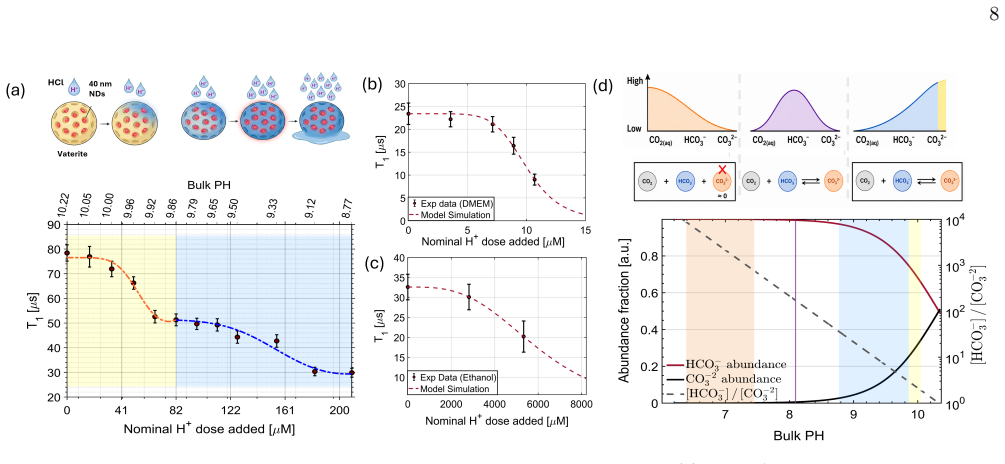
The central claim is that assembling a 40-nm nitrogen-vacancy nanodiamond layer on porous, birefringent vaterite microspherulites creates a single liquid-accessible hybrid that stabilises NV quantum sensing during optical trapping and adds a chemical-relaxometry channel. In this architecture the vaterite body provides the orienting frame, the surface-bound nanodiamonds provide the quantum transducer, and the vaterite/PSS/nanodiamond junction provides a charge-regulated proton-active interface. The evidence: ODMR contrast varies by less than 7 percent and the resonance centre shifts by about 1 MHz when the 976-nm trap is turned on at 0.8 W; Zeeman-split resonances resolve fields of 0 to 0.8 mT with a source-reported response metric of 78–144 $\mu$T/$\sqrt{\mathrm{Hz}}$; and in DMEM a 10.7 $\mu$M nominal proton-equivalent dose shortens $T_1$ from 23.4 $\pm$ 2.3 $\mu$s to 9.0 $\pm$ 1.2 $\mu$s, a 2.60 $\pm$ 0.43-fold rise in relaxation rate that is far larger than the 0.69-percentage-point occupation change allowed by the measured 0.012-unit bulk-pH shift at fixed surface potential. The authors therefore conclude that the response is amplified medium-dependent interfacial transduction, supported by a grand-canonical charge-regulation model coupling proton chemical potential to occupation statistics and interfacial switching kinetics within the NV spectral window.
Load-bearing premise
The proton-transduction interpretation of the DMEM $T_1$ shortening assumes the measured bulk-pH shift from 8.100 to 8.088 is the relevant thermodynamic drive at the diamond surface, with the surface electrical potential and other ionic activities unchanged.
Editorial extensions
If this is right
- If the platform works as claimed, a single optically trapped hybrid in liquid can simultaneously serve as a magnetic-field probe (0–0.8 mT range) and a chemical-relaxometry probe, removing the need to immobilise or isolate the sensor.
- Orientation stabilisation by the birefringent carrier should suppress Brownian-rotation noise, making reproducible ODMR and $T_1$ readings possible under 976-nm trapping.
- The DMEM result implies the sensor reports local interfacial proton activity amplified by charge regulation rather than bulk pH, allowing detection of small proton-equivalent perturbations in buffered biological media.
- The ethanol control suggests transduction gain is medium-specific, so the same carrier could be tuned by solvent or buffer composition.
- Retaining ODMR and $T_1$ under 976-nm trapping allows measurement sequences that combine trapping, microwave driving, and optical readout on one moving particle.
Reading between the lines
- If charge regulation at the vaterite interface is the operative mechanism, the carrier should respond to other species that alter surface potential or site occupation; matched-buffer and ion-substitution experiments would test whether the response is proton-specific.
- The 55-ps spectral constraint points to a downstream electronic or paramagnetic fluctuator whose population is regulated by protonation; varying ionic strength, dissolved oxygen, or paramagnetic ion concentration at fixed pH would test that channel.
- Because the carrier defines a body frame, adding independent angular tracking would convert the orientation-stabilised platform into a vector magnetometer, able to report field direction rather than a single axial projection.
- The model’s reliance on an unresolved medium-dependent mapping suggests a direct test: a solvent series with controlled water content in ethanol should monotonically tune the transduction gain if hydration and buffer capacity are the controlling variables.
Editorial analysis
A structured set of objections, weighed in public.
Referee Report
Summary. The paper assembles 40-nm NV nanodiamonds onto 3-5 µm vaterite microspherulites and characterizes the resulting hybrids in optical traps. It reports polarisation-dependent photoluminescence attributed to the birefringent carrier, retention of ODMR with less than 7% contrast variation under 976-nm trapping, Zeeman-split resonances for field sensing, and T1 shortening in DMEM under a 10.7 µM nominal proton-equivalent dose. A grand-canonical charge-regulation model is introduced to connect bulk proton chemical potential to interfacial occupation, switching kinetics, and NV longitudinal relaxation. The manuscript is unusually explicit about its limitations, stating that orientation is not independently tracked, that the sensitivity metrics are fit-derived and not noise-normalised, that the model is not globally fitted, and that selectivity for H+ over phthalate, potassium, ionic strength, or carrier dissolution is not established.
Significance. If the full multimodal claim could be supported, the platform would be a useful contribution to liquid-phase nanodiamond sensing: the combination of a birefringent, chemically active carrier with an NV quantum layer is a plausible route to orientation-stabilised, chemically responsive sensors. The paper's strengths include extensive supplementary data, raw T1 decays, clearly separated empirical fits from the thermodynamic model, and an honest discussion of what the measurements cannot establish. The empirical observations—ODMR retention, Zeeman splitting, and dose-dependent T1 changes—are internally consistent and presented with fit uncertainties. However, the central chemical-sensing claim is underdetermined by the current controls, and the sensitivity numbers in the abstract go beyond what the noise analysis supports. Because the title and abstract foreground 'proton-active' and 'proton-responsive' sensing, these gaps are load-bearing for the paper's main message.
major comments (4)
- [V (DMEM/ethanol contrast)] The nominal-dose comparison in Section V cannot separate proton activity from phthalate, potassium, ionic strength, or vaterite dissolution effects, as the text itself concedes after Eq. (6). The 0.69% bound on ideal-site occupation at fixed ψ0 rules out only a fixed-potential bulk-pH-only model; it does not test whether the 2.60±0.43-fold ΔΓ1,eff increase arises from non-proton channels. Because the abstract and Section VI present 'proton-responsive sensing' and 'proton-active thermodynamic interface' as established, this underdetermination is load-bearing for the chemical-sensing half of the central claim. Matched-buffer controls (e.g., phthalate/K+ at constant pH, ionic-strength-matched additions), an acid-base reversibility test, and post-titration morphology or Ca2+ measurements are required before the claim can be accepted as stated.
- [Eqs. (3)-(6) and Supp. C2.9] The charge-regulation model is not constrained by the data: ψ0 and the effective pKa coordinates are free, and the dashed curves in Fig. 6 are empirical Hill-like projections rather than global fits of Eqs. (3)-(6). The model is therefore consistent with the measured trends but cannot provide unique support for the 'amplified interfacial proton transduction' interpretation. The 2.60-fold Γ1,eff increase is a real measured effect, but its attribution to charge-regulated proton noise requires either independent measurement of ψ0 (or zeta potential) with ionic-strength controls, or a model comparison against a dissolution/ionic-strength channel. Without this, the phrase 'support amplified medium-dependent interfacial transduction' overstates the evidence.
- [Abstract, Section IV, Table III] The abstract reports 78-144 µT Hz^-1/2, 6.46 µM Hz^-1/2, and 6.54 mpH Hz^-1/2 as sensitivities, but Supplementary Table III states that these are source-reported fit-derived metrics for which 'independent noise normalisation is unavailable' (acquisition time, measurement variance, and particle-to-particle dispersion are missing). In addition, Fig. 4(f) gives a magnetic sensitivity of 171.7 µT/√Hz for a trapped hybrid while the text cites 78-144 µT/√Hz. These values should be labelled as response metrics, the noise-model caveat should appear wherever they are quoted, and the numerical discrepancy should be resolved.
- [III] The claim of 'orientation stabilisation' is not directly measured. Section III states that 'the particle angle was not independently tracked' and that the state is 'orientation-stabilised rather than quantitatively orientation-locked.' The polarisation-dependent PL in Fig. 3(d) demonstrates reproducible polarisation-dependent collection but does not by itself show that Brownian rotation is suppressed or that the body axis is stabilised in the trap. Since orientation stabilisation is one of the three pillars of the multimodal platform, an independent angle-tracking measurement (or at least a quantitative bound on angular diffusion) is needed to support the central claim.
minor comments (4)
- [Supp. C2.13.2] The caption of Fig. C2.13.2 says the decays are for 'ethanol' although the text and data refer to the DMEM series; this is a typo.
- [Supp. B1] In the caption of Fig. B1.2, 'Far -Fireld' should be 'Far-Field'.
- [II] The text calls the junction 'vaterite/poly(sodium 4-styrenesulfonate)(PSS)/nanodiamond'; the abstract's repeated emphasis on a 'carbonate-rich interface' should more consistently acknowledge the PSS contribution in the main text, as the Methods do.
- [V] The phrase 'concentration and pH sensitivities' in the abstract should be qualified as 'nominal-dose response metrics' to match the caveats in Supp. C2.9 and Table III.
Circularity Check
No significant circularity: the empirical claims rest on independent measurements, and the model is explicitly not fitted to the dose-response data.
full rationale
The paper's central results are experimental: ODMR contrast, Zeeman splitting, T1 relaxometry, and polarization-dependent PL are directly measured observables, not outputs of the model. The grand-canonical charge-regulation model (Eqs. 3-6) is explicitly presented as an organizing framework rather than a fitted predictive engine: 'Dashed curves are empirical regional or Hill-like projections, not global fits of equations 3-6.' The key inference against a bulk-pH-only response is a genuine null-hypothesis test: at fixed psi0 the 0.012-unit pH shift changes any ideal binary-site occupation by at most 0.69%, whereas the measured Delta_Gamma_1,eff is 2.60 +/- 0.43-fold. This is a quantitative contradiction of the null model, not a prediction equivalent to its input. The paper also explicitly disclaims the stronger mechanistic claim: 'These measurements establish a dose-dependent response in the measured particle series. They do not establish selectivity for H+ over changes in phthalate, potassium, ionic strength or carrier dissolution.' Self-citations to prior vaterite work (refs 15, 16, 18) supply material parameters for simulations and context, but the birefringence and optical response are independently measured here, and no uniqueness theorem or fitted parameter is imported from those citations. The model's underdetermination is acknowledged as a limitation ('it is not a uniquely identified microscopic fit'), which is a correctness/interpretation risk, not circularity. The empirical fits and response metrics are clearly labeled as fit-derived, so there is no fitted-input-called-prediction pattern. Overall, the derivation chain is self-contained with respect to its inputs.
Assumptions & free parameters
free parameters (6)
- DMEM Hill fit u50 =
10.0 µM nominal dose
- DMEM Hill fit m =
6.91
- Ethanol Hill fit u50 =
6.23e3 µM nominal dose
- Ethanol Hill fit m =
3.13
- NaOH/HCl regional fit parameters (Gamma0, S, K, m) =
Region 1: 0.0131, 0.0267, 186.3, 5.4; Region 2: 0.0194, 0.058, 515, 6.86
- Interfacial surface potential psi0 =
not determined (left free)
assumptions (8)
- standard math NV- ground-state spin Hamiltonian with Zeeman, strain and hyperfine terms (Eq. 1)
- domain assumption Bloch-Redfield transverse relaxation expression with angular-frequency PSD convention (Eq. 2)
- domain assumption Grand-canonical equilibrium at the solid-liquid interface (Eq. 3)
- ad hoc to paper Two-state Markov occupation switching with Lorentzian noise spectrum (Eq. 6 and Supplementary C2.7)
- domain assumption Optical torque U(theta) approximately -Delta_alpha |E|^2 cos^2(theta)/4 for a birefringent particle in a linearly polarized trap
- domain assumption FDTD continuum-sphere representation of porous vaterite spherulites
- standard math Aqueous carbonate pKa2 = 10.33 used as a bulk coordinate
- domain assumption Bulk pH measurement represents the thermodynamic drive at the NV interface
invented entities (2)
-
Fast downstream fluctuator with tau_e approximately 55 ps
-
Effective proton-active site classes (Ss/SsH) with effective pKa
Cite this review
Pith. "Pith review of Birefringent Biomineral Microcarriers Stabilise Multimodal Nanodiamond Quantum Sensing in Liquids." pith.science (2026). https://pith.science/paper/YUJPBXMB
@misc{pith2026260809434,
  author       = {Pith},
  title        = {Pith review of: Birefringent Biomineral Microcarriers Stabilise Multimodal Nanodiamond Quantum Sensing in Liquids},
  year         = {2026},
  howpublished = {\url{https://pith.science/paper/YUJPBXMB}},
  note         = {Machine review of arXiv:2608.09434}
}
read the original abstract
Mobile nanodiamond quantum sensors in liquids are limited by Brownian rotation, variable photon collection, and perturbations introduced by optical trapping. Here, we assemble 40-nm nitrogen-vacancy nanodiamonds at the surface of porous, birefringent vaterite microspherulites. This carbonate biomineral provides a polarization-addressable body frame, anisotropic emission redistribution, and a proton-active thermodynamic interface. Under 976-nm optical trapping, the hybrids retain their spin resonance and longitudinal relaxation, with the resonance contrast varying by less than 7 percent and the resonance centre shifting by approximately 1 MHz at 0.8 W. Zeeman-split resonances enable magnetic-field sensing from 0 to 0.8 mT, with a response metric of 78-144 microT per square root Hz. In buffered cell-culture medium, a 10.7 microM nominal proton-equivalent dose shortens T1 from 23.4 +/- 2.3 to 9.0 +/- 1.2 microseconds, corresponding to concentration and pH sensitivities of 6.46 microM per square root Hz and 6.54 mpH per square root Hz, respectively, in DMEM. By contrast, a 500-fold higher proton dose in ethanol produces a substantially weaker spin response, highlighting the role of the carbonate-rich interface. We develop a grand-canonical charge-regulation model coupling proton chemical potential to interfacial switching kinetics within the NV spectral window, capturing medium-dependent dynamic proton transduction. By integrating orientation stabilisation, optical manipulation, magnetic sensing, and interfacial chemical response, this carbonate-rich hybrid platform establishes a versatile approach to multimodal quantum sensing in complex biological liquids.
Figures


Figures from the paper (3 more)


Reference graph
Works this paper leans on
-
[2]
author author T. Fujisaku et al. ,\ title title pH nanosensor using electronic spins in diamond , \ 10.1021/acsnano.9b05342 journal journal ACS Nano \ volume 13 ,\ pages 11726--11732 ( year 2019 ) NoStop
-
[3]
author author A. Mzyk , author A. Sigaeva , \ and\ author R. Schirhagl ,\ title title Relaxometry with nitrogen vacancy ( NV ) centers in diamond , \ 10.1021/acs.accounts.2c00520 journal journal Accounts of Chemical Research \ volume 55 ,\ pages 3572--3580 ( year 2022 ) NoStop
-
[4]
author author Y. Romach et al. ,\ title title Spectroscopy of surface-induced noise using shallow spins in diamond , \ 10.1103/PhysRevLett.114.017601 journal journal Physical Review Letters \ volume 114 ,\ pages 017601 ( year 2015 ) NoStop
-
[5]
author author I. Benedi c i c et al. ,\ title title Spin-lattice relaxation of NV centers in nanodiamonds adsorbed on conducting and nonconducting surfaces , \ 10.1103/1s53-5wls journal journal Physical Review B \ volume 111 ,\ pages 235421 ( year 2025 ) NoStop
-
[6]
author author T. Rosskopf et al. ,\ title title Investigation of surface magnetic noise by shallow spins in diamond , \ 10.1103/PhysRevLett.112.147602 journal journal Physical Review Letters \ volume 112 ,\ pages 147602 ( year 2014 ) NoStop
-
[7]
author author G. P. \ Conangla , author A. W. \ Schell , author R. A. \ Rica , \ and\ author R. Quidant ,\ title title Motion control and optical interrogation of a levitating single nitrogen vacancy in vacuum , \ 10.1021/acs.nanolett.8b01414 journal journal Nano Letters \ volume 18 ,\ pages 3956--3961 ( year 2018 ) NoStop
-
[8]
author author T. Delord , author L. Nicolas , author L. Schwab , \ and\ author G. H\' e tet ,\ title title Electron spin resonance from NV centers in diamonds levitating in an ion trap , \ 10.1088/1367-2630/aa659c journal journal New Journal of Physics \ volume 19 ,\ pages 033031 ( year 2017 ) NoStop
-
[9]
author author L. W. \ Russell , author S. G. \ Ralph , author K. Wittick , author J.-P. \ Tetienne , author D. A. \ Simpson , \ and\ author P. J. \ Reece ,\ title title Manipulating the quantum coherence of optically trapped nanodiamonds , \ 10.1021/acsphotonics.8b00946 journal journal ACS Photonics \ volume 5 ,\ pages 4491--4496 ( year 2018 ) NoStop
Show all 61 references
-
[10]
Dervillez , author F
author author A. Dervillez , author F. Kalantarifard , author L. Troise , author A. Huck , \ and\ author K. Berg-S rensen ,\ 10.48550/arXiv.2501.07263 title Sensing with near-infrared laser trapped fluorescent nanodiamonds , \ ( year 2025 ),\ http://arxiv.org/abs/2501.07263 ar...
-
[12]
Rivi\` e re et al
author author F. Rivi\` e re et al. ,\ title title Hot Brownian motion of optically levitated nanodiamonds , \ 10.1021/acsphotonics.1c01642 journal journal ACS Photonics \ volume 9 ,\ pages 420--425 ( year 2022 ) NoStop
2022 doi
- [13]
-
[14]
Roy et al
author author S. Roy et al. ,\ title title Comparison of optical trapping wavelengths for nanoscopic diamonds containing nitrogen-vacancy centers , \ 10.1088/2399-6528/ad48d4 journal journal Journal of Physics Communications \ volume 8 ,\ pages 055001 ( year 2024 ) NoStop
-
[15]
author author R. E. \ Noskov et al. ,\ title title Golden vaterite as a mesoscopic metamaterial for biophotonic applications , \ 10.1002/adma.202008484 journal journal Advanced Materials \ volume 33 ,\ pages 2008484 ( year 2021 ) NoStop
-
[16]
Ushkov et al
author author A. Ushkov et al. ,\ title title Nanojet visualization and dark-field imaging of optically trapped vaterite capsules with endoscopic illumination , \ 10.1038/s41378-025-00951-1 journal journal Microsystems & Nanoengineering \ volume 11 ,\ pages 91 ( year 2025 ) NoStop
-
[17]
author author M. W. \ Doherty et al. ,\ title title Theory of the ground-state spin of the NV ^ - center in diamond , \ 10.1103/PhysRevB.85.205203 journal journal Physical Review B \ volume 85 ,\ pages 205203 ( year 2012 ) NoStop
2012 doi
-
[18]
author author R. E. \ Noskov , author I. I. \ Shishkin , author H. Barhom , \ and\ author P. Ginzburg ,\ title title Non- Mie optical resonances in anisotropic biomineral nanoparticles , \ 10.1039/C8NR07561A journal journal Nanoscale \ volume 10 ,\ pages 21031--21040 ( year 20...
-
[19]
Vogt , author J
author author N. Vogt , author J. Jeske , \ and\ author J. H. \ Cole ,\ title title Stochastic Bloch-Redfield theory: Quantum jumps in a solid-state environment , \ 10.1103/PhysRevB.88.174514 journal journal Physical Review B \ volume 88 ,\ pages 174514 ( year 2013 ) NoStop
-
[22]
Ashkin ,\ @noop title Optical Trapping and Manipulation of Neutral Particles Using Lasers \ ( publisher World Scientific ,\ address Singapore ,\ year 2006 ) NoStop
author author A. Ashkin ,\ @noop title Optical Trapping and Manipulation of Neutral Particles Using Lasers \ ( publisher World Scientific ,\ address Singapore ,\ year 2006 ) NoStop
2006
-
[23]
author author K. C. \ Neuman \ and\ author S. M. \ Block ,\ title title Optical trapping , \ 10.1063/1.1785844 journal journal Review of Scientific Instruments \ volume 75 ,\ pages 2787--2809 ( year 2004 ) NoStop
2004 doi
-
[24]
Lukosz ,\ title title Light emission by magnetic and electric dipoles close to a plane dielectric interface
author author W. Lukosz ,\ title title Light emission by magnetic and electric dipoles close to a plane dielectric interface. iii. radiation patterns of dipoles with arbitrary orientation , \ 10.1364/JOSA.69.001495 journal journal J. Opt. Soc. Am. \ volume 69 ,\ pages 1495--15...
-
[25]
author author V. R. \ Horowitz , author B. J. \ Alem \'a n , author D. J. \ Christle , author A. N. \ Cleland , \ and\ author D. D. \ Awschalom ,\ title title Electron spin resonance of nitrogen-vacancy centers in optically trapped nanodiamonds , \ 10.1073/pnas.1211311109 jour...
-
[26]
\ Chen et al
author author X.-D. \ Chen et al. ,\ title title High-contrast quantum imaging with time-gated fluorescence detection , \ 10.1103/PhysRevApplied.11.064024 journal journal Physical Review Applied \ volume 11 ,\ pages 064024 ( year 2019 ) NoStop
-
[27]
Boehm et al
author author F. Boehm et al. ,\ title title Temporal filtered quantum sensing with the nitrogen-vacancy center in diamond , \ 10.48550/ARXIV.2511.02369 \ ( year 2025 ),\ 10.48550/ARXIV.2511.02369 ,\ http://arxiv.org/abs/2511.02369 arXiv:2511.02369 NoStop
2025 doi
-
[28]
author author R. De Sousa ,\ title title Electron spin as a spectrometer of nuclear-spin noise and other fluctuations , \ in\ 10.1007/978-3-540-79365-6_10 booktitle Electron Spin Resonance and Related Phenomena in Low-Dimensional Structures ,\ series Topics in Applied Physics ...
-
[29]
Cheng , author Y
author author H. Cheng , author Y. Luo , author X. Luo , author C. Xue , author Y. Li , author G. Liu , author L. Chen , author Z. Chen , \ and\ author Y. Chen ,\ title title All-fiber quantum relaxometry for biochemical sensing based on diamond nv centers , \ 10.1364/OE.52540...
-
[35]
Li , author D
author author Y. Li , author D. Zheng , author Z. Liu , author H. Wang , author Y. Liu , author C. Hou , author H. Guo , author Z. Li , author Y. Sugawara , author J. Tang , author Z. Ma , \ and\ author J. Liu ,\ title title Noise suppression of nitrogen-vacancy magnetometer i...
-
[36]
Horowitz, V. R. and Alem\'. Electron spin resonance of nitrogen-vacancy centers in optically trapped nanodiamonds , journal =. 2012 , month = aug, doi =
2012
-
[37]
and others , title =
Fujisaku, T. and others , title =. ACS Nano , volume =. 2019 , month = oct, doi =
2019
-
[38]
and Sigaeva, A
Mzyk, A. and Sigaeva, A. and Schirhagl, R. , title =. Accounts of Chemical Research , volume =. 2022 , month = dec, doi =
2022
-
[39]
and others , title =
Romach, Y. and others , title =. Physical Review Letters , volume =. 2015 , month = jan, doi =
2015
-
[40]
Spin-lattice relaxation of
Benedi. Spin-lattice relaxation of. Physical Review B , volume =. 2025 , month = jun, doi =
2025
-
[41]
and others , title =
Rosskopf, T. and others , title =. Physical Review Letters , volume =. 2014 , month = apr, doi =
2014
-
[42]
Conangla, G. P. and Schell, A. W. and Rica, R. A. and Quidant, R. , title =. Nano Letters , volume =. 2018 , month = jun, doi =
2018
-
[43]
and Nicolas, L
Delord, T. and Nicolas, L. and Schwab, L. and H\'. Electron spin resonance from. New Journal of Physics , volume =. 2017 , month = mar, doi =
2017
-
[44]
Russell, L. W. and Ralph, S. G. and Wittick, K. and Tetienne, J.-P. and Simpson, D. A. and Reece, P. J. , title =. ACS Photonics , volume =. 2018 , month = nov, doi =
2018
-
[45]
and Kalantarifard, F
Dervillez, A. and Kalantarifard, F. and Troise, L. and Huck, A. and Berg-S. Sensing with near-infrared laser trapped fluorescent nanodiamonds , year =. 2501.07263 , archivePrefix =
-
[46]
and others , title =
Iyer, S. and others , title =. Physical Review Applied , volume =. 2024 , month = dec, doi =
2024
-
[47]
Rivi\`. Hot. ACS Photonics , volume =. 2022 , month = feb, doi =
2022
-
[48]
Russell, L. W. and Dossetor, E. C. and Wood, A. A. and Simpson, D. A. and Reece, P. J. , title =. 2021 , eprint =
2021
-
[49]
and others , title =
Roy, S. and others , title =. Journal of Physics Communications , volume =. 2024 , month = may, doi =
2024
-
[50]
Noskov, R. E. and others , title =. Advanced Materials , volume =. 2021 , month = jun, doi =
2021
-
[51]
and others , title =
Ushkov, A. and others , title =. Microsystems & Nanoengineering , volume =. 2025 , month = may, doi =
2025
-
[52]
Doherty, M. W. and others , title =. Physical Review B , volume =. 2012 , month = may, doi =
2012
-
[53]
Noskov, R. E. and Shishkin, I. I. and Barhom, H. and Ginzburg, P. , title =. Nanoscale , volume =. 2018 , doi =
2018
-
[54]
and Jeske, J
Vogt, N. and Jeske, J. and Cole, J. H. , title =. Physical Review B , volume =. 2013 , month = nov, doi =
2013
-
[55]
and others , title =
Li, Y. and others , title =. Micromachines , volume =. 2023 , month = sep, doi =
2023
-
[56]
McGuinness, L. P. and others , title =. Nature Nanotechnology , volume =. 2011 , month = jun, doi =
2011
-
[57]
Horowitz, V. R. and Alem. Electron spin resonance of nitrogen-vacancy centers in optically trapped nanodiamonds , journal =. 2012 , month = aug, doi =
2012
-
[58]
and others , title =
Chen, X.-D. and others , title =. Physical Review Applied , volume =. 2019 , month = jun, doi =
2019
-
[59]
and others , title =
Boehm, F. and others , title =. 2025 , eprint =
2025
-
[60]
, title =
De Sousa, R. , title =. Electron Spin Resonance and Related Phenomena in Low-Dimensional Structures , editor =. 2009 , doi =
2009
-
[61]
All-fiber quantum relaxometry for biochemical sensing based on diamond NV centers , volume =
Hongda Cheng and Yunhan Luo and Xiaoling Luo and Chen Xue and Yuxin Li and Guishi Liu and Lei Chen and Zhe Chen and Yaofei Chen , journal =. All-fiber quantum relaxometry for biochemical sensing based on diamond NV centers , volume =. 2024 , url =
2024
-
[62]
Optically-trapped-nanodiamond relaxometric detection of nanomolar paramagnetic spins in aqueous environments , author =. Phys. Rev. Appl. , volume =. 2024 , month =. doi:10.1103/PhysRevApplied.22.064076 , url =
2024 doi
-
[63]
Sensing with near-infrared laser trapped fluorescent nanodiamonds , volume=
Dervillez, Arthur and Kalantarifard, Fatemeh and Troise, Luca and Huck, Alexander and Berg-Sørensen, Kirstine , year=. Sensing with near-infrared laser trapped fluorescent nanodiamonds , volume=. doi:10.1016/j.diamond.2026.113749 , journal=
2026
-
[64]
L. P. McGuinness and Y. Yan and A. Stacey and D. A. Simpson and L. T. Hall and D. Maclaurin and S. Prawer and P. Mulvaney and J. Wrachtrup and F. Caruso and R. E. Scholten and L. C. L. Hollenberg , title =. Nature Nanotechnology , year =. doi:10.1038/nnano.2011.64 , url =
-
[65]
Classical statistical mechanics in the grand canonical ensemble , author =. Phys. Rev. E , volume =. 2021 , month =. doi:10.1103/PhysRevE.104.014117 , url =
2021 doi
-
[66]
Journal of Modern Physics , year =
Luis Felipe del Castillo and Paula Vera-Cruz , title =. Journal of Modern Physics , year =. doi:10.4236/jmp.2011.25047 , url =
2011
-
[67]
Micromachines , VOLUME =
Li, Yang and Zheng, Doudou and Liu, Zhenhua and Wang, Hui and Liu, Yankang and Hou, Chenyu and Guo, Hao and Li, Zhonghao and Sugawara, Yashuhiro and Tang, Jun and Ma, Zongmin and Liu, Jun , TITLE =. Micromachines , VOLUME =. 2023 , NUMBER =
2023
-
[68]
Ashkin, Arthur , title =
-
[69]
and Block, Steven M
Neuman, Keir C. and Block, Steven M. , title =. Review of Scientific Instruments , volume =. 2004 , doi =
2004
-
[70]
Lukosz , journal =
W. Lukosz , journal =. Light emission by magnetic and electric dipoles close to a plane dielectric interface. III. Radiation patterns of dipoles with arbitrary orientation , volume =. 1979 , url =
1979
Reviewed August 11, 2026 · model on record in the stance chip above.
Discussion (0). Continue with ORCID to comment.