REVIEW 4 major objections 4 minor 103 references
Listen, See and Track: Spatio-Temporal Audio-Visual Sound Event Reasoning for Omni-Modal Language Models
T0 review · 4 major / 4 minor · reviewed 2026-08-11 · deepseek-v4-flash
Pith's one-line read The paper argues that dynamic sound scenes require tracking each source's identity, position, and motion over time, and presents a model and benchmark that do so.
desk verdict ST-OmniQA is a well-designed benchmark for a real gap, but the headline numbers rest on an unvalidated LLM judge that also serves as the RL reward model, so treat the quantitative claims as conditional until the evaluator and artifacts are sorted out. read the letter →
The pith
A machine-rendered reading of the paper's core claim, the machinery that carries it, and where it could break.
The reading
What carries the argument
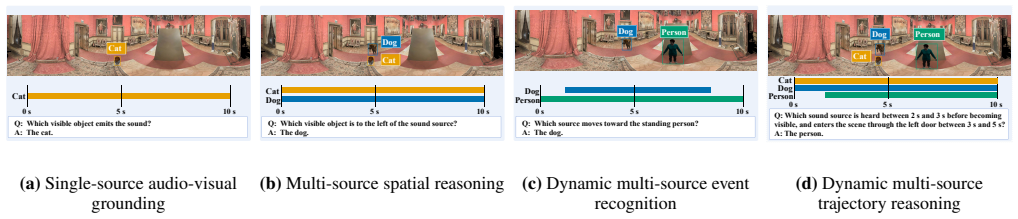
The load-bearing object is the STA-encoder's split audio representation: a single semantic token for clip-level event content and $K=40$ trajectory tokens that retain time-varying direction, distance, and activity. The input is a seven-channel FOA-derived feature tensor combining channel-wise log-Mel spectrograms with Mel-projected acoustic-intensity components, processed by an Audio Spectrogram Transformer; temporal self-attention over frequency-pooled patch features produces the ordered trajectory tokens. Their initialization loss $L_{\text{traj}}$ supervises per-bin binary activity, unit direction vectors, and log-distance, while a frozen static encoder preserves event semantics. These audio tokens are projected by a trainable connector and concatenated with video and question tokens as $C = [V_{\text{tok}}; A_{\text{tok}}; Q_{\text{tok}}]$, which lets the language model bind acoustic trajectories to visible instances. The benchmark uses the constraint $|C_A|>1$, $|C_V|>1$, $|C_{AV}|=1$ so that a Level-D answer is unique only after cross-modal binding.
What would settle it
Take a few hundred held-out ST-OmniQA answers from all four levels and have human annotators score semantic equivalence instead of the automated judge; if the human scores change the ranking or shrink the gap, the headline claim fails. As a second check, ablate the 40 trajectory tokens from the model's audio input; if Level C and Level D accuracy do not fall, the trajectory mechanism is not carrying the result.
Extended reading notes
Core claim
The central claim is that time-varying source geometry is the missing ingredient in audio-language and vision-language models, and that it can be learned and expressed through FOA-derived semantic and trajectory representations. In the benchmark, each source carries a multimodal state $S_i(t) = \{e_i, a_i(t), g_i(t), m_i(t), v_i(t), o_i, R_i(t)\}$, where $g_i(t)$ holds azimuth, elevation, and source-listener distance and $R_i(t)$ holds relations to landmarks, occluders, and other sources. ST-Omni-R1's STA-encoder turns a four-channel FOA waveform into a semantic token $s$ and $K=40$ temporally ordered trajectory tokens $\tau_1,\dots,\tau_K$, supervised during initialization by per-bin activity, unit direction, and log-distance targets; the connector inserts these into the decoder context together with video tokens. Progressive curriculum stages and reasoning-tree reinforcement learning train the model, which reaches 84.70%, 76.20%, 55.70%, and 94.70% semantic accuracy on the four levels and a 77.83% average, and outperforms the BAT baseline on the TAU-NIGENS, L3DAS22, and STARSS23 transfer sets. Semantic accuracy here means whether a generated answer conveys the same meaning as the reference.
Load-bearing premise
Every reported accuracy number is produced by a fixed automated semantic-equivalence judge with no reported human agreement, error analysis, or per-category validation; if that judge is lenient or biased toward ST-Omni-R1's answer style, the headline gap and the transfer numbers are not established.
Editorial extensions
If this is right
- General-purpose audio-visual and audio-only models that compress a clip into global event semantics will miss source-level geometry; ST-OmniQA puts this gap at 37.28% best baseline versus 77.83%.
- The learned spatial and motion token sequence transfers to real-world audio and audio-visual spatial datasets, so the representation is not tied only to the synthetic benchmark.
- Because Level-D questions are constructed so that neither modality alone determines the answer, strong performance on that level is evidence of genuine cross-modal binding rather than unimodal shortcutting.
- Progressive curriculum stages and reasoning-tree RL both add capability, with Stage II lifting the hardest scene-grounded level from 90.90% to 94.70%.
Reading between the lines
- Because the benchmark scenes are rendered from indoor 3D meshes with simulated room acoustics, real-world deployment could face a domain gap that the three transfer datasets only partially cover.
- The single automated semantic-equivalence judge makes the reported gap contingent on that judge's scoring behavior; a human-validated scoring subset would be the most direct check, and the paper does not report one.
- The trajectory-token interface could be reused outside question answering, for example as a generic audio-state module for embodied agents that must localize and follow a moving sound source; the paper does not make that claim.
- Because each question is generated from executable reasoning graphs over structured scene states, the benchmark could be extended to harder compositional or physical-reasoning questions beyond the four levels covered.
Editorial analysis
A structured set of objections, weighed in public.
Referee Report
Summary. The paper introduces ST-OmniQA, a synthetic benchmark built from 40K panoramic videos with synchronized first-order Ambisonics (FOA) audio, containing 400K question-answer pairs organized into four capability levels that cover source perception, multi-source localization, trajectory relations, and audio-visual binding. The paper also proposes ST-Omni-R1, a model that combines an STA-encoder producing one semantic token and 40 trajectory tokens with panoramic visual context, and trains it with progressive curriculum learning followed by reasoning-tree reinforcement learning. The authors report 77.83% average semantic accuracy on ST-OmniQA versus 37.28% for the best evaluated baseline, and additional transfer results on TAU-NIGENS, L3DAS22, and STARSS23.
Significance. If the results hold, the benchmark and model fill a genuine gap: treating sound sources as persistent, spatially located, moving entities that must be bound to visible instances, rather than as clip-level acoustic events. The paper's strengths include the modality-necessity constraint in Eq. (2), which reduces unimodal shortcuts; the scene-room-level split that prevents leakage; the executable reasoning graphs behind Level C/D traces; and the transfer evaluation on three public spatial-audio benchmarks. The central weakness is that all reported accuracy numbers are produced by a single unvalidated LLM judge that also participates in the reward computation during training, so the quantitative claims are not yet established. The manuscript is worth pursuing after the evaluation pipeline is independently validated and statistical variability is reported.
major comments (4)
- [Experiments, "Evaluation protocol" paragraph] All semantic-accuracy numbers in Tables 2-4 are computed by DeepSeek-v4-flash, yet no human agreement, per-category validation, or error analysis is reported. Because every headline comparison passes through this judge, the 77.83% versus 37.28% gap and the transfer numbers are properties of the judge as much as of the models. Please report human agreement on a representative sample, per-level and per-question-type accuracy, and a judge-free exact-match check for structured fields such as event class, DoA, distance, and motion state.
- [Stage II, Eq. (14) and the following sentence] The same semantic-equivalence evaluator that produces the reported accuracy is used to score free-form responses inside the RT-RL reward in Eq. (14). The model is therefore optimized directly toward the judge's notion of semantic equivalence, and any stylistic preference of the judge is amplified during training; the Level D jump from 90.90 (SFT) to 94.70 (SFT+RT-RL) in Table 4 may reflect judge alignment rather than reasoning skill. Please validate the judge independently, evaluate with a different judge or human raters, and report the agreement between RT-RL reward scores and human judgments.
- [Experiments, "Implementation details" and Tables 2-4] No seed variance, error bars, or significance tests are reported, despite small differences such as the Level C comparison of 55.70 versus 54.40 in Table 4. Please report at least three seeds with standard deviations, or bootstrap confidence intervals, for the main comparisons so that the reader can assess whether the reported gaps are statistically meaningful.
- [Experiments, "Main Results" and Tables 2-3] The baseline comparisons are not controlled: general-purpose baselines are evaluated without task-specific tuning and do not receive spatial audio, while BAT retains its own free-form prompting protocol, and on the transfer benchmarks BAT scores are near zero on several axes. The claim of superiority over the best baseline is therefore not established under a common protocol. Please add at least one spatial-audio-capable baseline under the same input and evaluation protocol, or present an explicit audio-only controlled comparison that reports both models with matched modalities.
minor comments (4)
- [References] References for Hyun-Bin et al. 2026 and Oh et al. 2026 cite the same arXiv identifier (2606.14141) but are listed as separate works; please merge or disambiguate them.
- [Experiments, footnote 1] Footnote 1 states that additional details appear in the Appendix, but no appendix is included in the manuscript; please either add the appendix or remove the pointer.
- [Experiments, general] The paper does not state whether the benchmark, evaluation prompts, or model weights will be released; given the benchmark's intended reuse, an availability statement would be valuable.
- [References] The reference for Yang, Liu, and Li 2022 contains the typo "Acouts." in the venue name; please correct it to "Acoustics".
Circularity Check
Headline semantic accuracy is judged by the same DeepSeek-v4-flash evaluator used as the free-form reward in RT-RL, closing the evaluation loop.
-
fitted input called prediction
[Section 'Stage II: Reasoning-Tree Reinforcement Learning' (Eq. 14); 'Experiments / Evaluation protocol']
"Fields with annotation-defined targets are evaluated directly against the corresponding ST-OmniQA annotations, whereas free-form responses are scored using a fixed semantic-equivalence evaluator to accommodate valid linguistic variation. ... Semantic accuracy is evaluated by DeepSeek-v4-flash (Xu et al. 2026)."
The same unvalidated DeepSeek-v4-flash semantic-equivalence evaluator appears twice: in Eq. 14 it scores free-form responses during GRPO reward computation, and in the Evaluation protocol it defines the reported semantic accuracy for all models. ST-Omni-R1's free-form answers are therefore token-level optimized (Eq. 15) to maximize exactly the scores that are later reported as its accuracy. Baselines were not optimized against this judge, so the 77.83% vs. 37.28% gap and transfer numbers partly measure how well ST-Omni-R1 has learned the judge's equivalence and stylistic preferences rather than independent semantic skill. No human agreement or judge-free validation is reported to break the loop, so the 'prediction' is a re-measurement of the training reward.
full rationale
ST-OmniQA is constructed from simulator states with deterministic queries and scene-disjoint training/test splits; training on those annotations is ordinary supervised learning, not circular. The STA-encoder derivation (Eqs. 4-10) defines features and losses from FOA physics and benchmark geometry without reusing the target metric. The transfer experiments use external real-world datasets, although their scores also pass through the same DeepSeek judge. The one load-bearing circularity-adjacent step is the identity between the free-form reward evaluator in Stage II and the semantic-accuracy evaluator in the experiments. Because the model is optimized against this judge and then judged by it, with no human agreement or independent validation, the central quantitative claim is not fully self-contained. This is an evaluation-loop confound rather than a derivation that reduces to its inputs, so the score is moderate rather than extreme.
Assumptions & free parameters
free parameters (4)
- K trajectory tokens =
40
- STA-encoder loss weights λ_sem, λ_evt =
not reported
- RT-RL reward weights λ_fmt, λ_tree, λ_ans, λ_con =
not reported
- Curriculum training schedule =
one epoch per stage at LR 1e-5, batch 128
assumptions (4)
- domain assumption SoundSpaces2.0 and Matterport3D simulations faithfully represent real-world audio-visual source binding
- domain assumption DeepSeek-v4-flash semantic accuracy is a valid proxy for human correctness
- domain assumption QA templates and executable reasoning graphs produce unique answers without answer shortcuts
- standard math Standard optimization and audio-visual background (AST, GRPO, next-token cross-entropy) is valid
Cite this review
Pith. "Pith review of Listen, See and Track: Spatio-Temporal Audio-Visual Sound Event Reasoning for Omni-Modal Language Models." pith.science (2026). https://pith.science/paper/DNZFGKYL
@misc{pith2026260809435,
  author       = {Pith},
  title        = {Pith review of: Listen, See and Track: Spatio-Temporal Audio-Visual Sound Event Reasoning for Omni-Modal Language Models},
  year         = {2026},
  howpublished = {\url{https://pith.science/paper/DNZFGKYL}},
  note         = {Machine review of arXiv:2608.09435}
}
read the original abstract
Understanding dynamic sound sources requires jointly determining what produces a sound, where the source is located, and how it moves over time. Yet existing audio-language models often represent clips as global acoustic events, while vision-language models lack the spatial audio cues needed to localize and track individual sources. To evaluate this missing capability, we introduce ST-OmniQA, a spatio-temporal audio-visual question-answering benchmark built from panoramic videos paired with synchronized first-order Ambisonics (FOA) audio of moving sound sources. It contains 40K videos and 400K question-answer pairs organized into four capability levels covering sound-event recognition, direction of arrival, source distance, motion trajectories, and temporally grounded audio-visual reasoning. Building on this benchmark, we propose ST-Omni-R1, which integrates FOA-derived semantic and trajectory representations with panoramic visual context and is trained through progressive curriculum learning and reasoning-tree reinforcement learning. ST-Omni-R1 achieves 77.83\% average semantic accuracy across the four levels, compared with 37.28\% for the best evaluated baseline. Results on three public spatial-audio benchmarks further indicate that its learned spatial and motion representations transfer beyond ST-OmniQA.
Figures

Reference graph
Works this paper leans on
-
[1]
Proceedings of the 6th Workshop on Detection and Classification of Acoustic Scenes and Events (DCASE 2021) , pages =
A Dataset of Dynamic Reverberant Sound Scenes with Directional Interferers for Sound Event Localization and Detection , author =. Proceedings of the 6th Workshop on Detection and Classification of Acoustic Scenes and Events (DCASE 2021) , pages =. 2021 , doi =
2021
-
[2]
arXiv preprint arXiv:2606.19348 , year=
Deepseek-v4: Towards highly efficient million-token context intelligence , author=. arXiv preprint arXiv:2606.19348 , year=
-
[3]
arXiv preprint arXiv:2504.18425 , year=
Kimi-audio technical report , author=. arXiv preprint arXiv:2504.18425 , year=
-
[4]
doi:10.21437/Interspeech.2021-698 , issn =
Yuan Gong and Yu-An Chung and James Glass , year =. doi:10.21437/Interspeech.2021-698 , issn =
-
[5]
Advances in neural information processing systems , volume=
STARSS23: An audio-visual dataset of spatial recordings of real scenes with spatiotemporal annotations of sound events , author=. Advances in neural information processing systems , volume=
-
[6]
arXiv preprint arXiv:2402.03300 , year=
Deepseekmath: Pushing the limits of mathematical reasoning in open language models , author=. arXiv preprint arXiv:2402.03300 , year=
-
[7]
ICASSP 2022-2022 IEEE International Conference on Acoustics, Speech and Signal Processing (ICASSP) , pages=
L3DAS22 challenge: Learning 3D audio sources in a real office environment , author=. ICASSP 2022-2022 IEEE International Conference on Acoustics, Speech and Signal Processing (ICASSP) , pages=. 2022 , organization=
2022
-
[8]
Communication, Simulation, and Intelligent Agents: Implications of Personal Intelligent Machines for Medical Education
Clancey, William J. Communication, Simulation, and Intelligent Agents: Implications of Personal Intelligent Machines for Medical Education. Proceedings of the Eighth International Joint Conference on Artificial Intelligence (IJCAI-83)
Show all 103 references
-
[9]
Classification Problem Solving
Clancey, William J. Classification Problem Solving. Proceedings of the Fourth National Conference on Artificial Intelligence
-
[10]
, title =
Robinson, Arthur L. , title =. 1980 , doi =. https://science.sciencemag.org/content/208/4447/1019.full.pdf , journal =
1980
-
[11]
New Ways to Make Microcircuits Smaller---Duplicate Entry
Robinson, Arthur L. New Ways to Make Microcircuits Smaller---Duplicate Entry. Science
-
[12]
Clancey and Glenn Rennels , abstract =
Diane Warner Hasling and William J. Clancey and Glenn Rennels , abstract =. Strategic explanations for a diagnostic consultation system , journal =. 1984 , issn =. doi:https://doi.org/10.1016/S0020-7373(84)80003-6 , url =
1984 doi
-
[13]
arXiv preprint arXiv:2406.07476 , year=
Videollama 2: Advancing spatial-temporal modeling and audio understanding in video-llms , author=. arXiv preprint arXiv:2406.07476 , year=
-
[14]
5-omni technical report , author=
Qwen2. 5-omni technical report , author=. arXiv preprint arXiv:2503.20215 , year=
-
[15]
arXiv preprint arXiv:2407.10759 , year=
Qwen2-audio technical report , author=. arXiv preprint arXiv:2407.10759 , year=
-
[16]
arXiv preprint arXiv:2511.21631 , year=
Qwen3-VL Technical Report , author=. arXiv preprint arXiv:2511.21631 , year=
-
[17]
5-vl technical report , author=
Qwen2. 5-vl technical report , author=. arXiv preprint arXiv:2502.13923 , year=
-
[18]
arXiv preprint arXiv:2306.02858 , year=
Video-llama: An instruction-tuned audio-visual language model for video understanding , author=. arXiv preprint arXiv:2306.02858 , year=
-
[19]
arXiv preprint arXiv:2303.08774 , year=
Gpt-4 technical report , author=. arXiv preprint arXiv:2303.08774 , year=
-
[20]
and Rennels, Glenn R
Hasling, Diane Warner and Clancey, William J. and Rennels, Glenn R. and Test, Thomas. Strategic Explanations in Consultation---Duplicate. The International Journal of Man-Machine Studies
-
[21]
Poligon: A System for Parallel Problem Solving
Rice, James. Poligon: A System for Parallel Problem Solving
-
[22]
Transfer of Rule-Based Expertise through a Tutorial Dialogue
Clancey, William J. Transfer of Rule-Based Expertise through a Tutorial Dialogue
-
[23]
The Engineering of Qualitative Models
Clancey, William J. The Engineering of Qualitative Models
-
[24]
2023 , eprint=
Attention Is All You Need , author=. 2023 , eprint=
2023
-
[25]
Pluto: The 'Other' Red Planet
NASA. Pluto: The 'Other' Red Planet
-
[26]
2023 , volume =
Han, Zongbo and Zhang, Changqing and Fu, Huazhu and Zhou, Joey Tianyi , journal = IEEE_J_PAMI, title =. 2023 , volume =
2023
-
[27]
2022 , volume =
Yang, Bing and Liu, Hong and Li, Xiaofei , booktitle = ICASSP, title =. 2022 , volume =
2022
-
[28]
2023 , pages =
Yabo Wang and Bing Yang and Xiaofei Li , title =. 2023 , pages =
2023
-
[29]
PILOT: Introducing Transformers for Probabilistic Sound Event Localization , author =
-
[30]
Evidential Deep Learning to Quantify Classification Uncertainty , year =
Sensoy, Murat and Kaplan, Lance and Kandemir, Melih , booktitle = NIPS, pages =. Evidential Deep Learning to Quantify Classification Uncertainty , year =
-
[31]
2023 , publisher =
Uncertainty-inspired open set learning for retinal anomaly identification , author =. 2023 , publisher =
2023
-
[32]
Tbrats: Trusted brain tumor segmentation , author =
-
[33]
2023 , volume =
Wang, Qingwang and Yin, Cheng and Song, Haochen and Shen, Tao and Gu, Yanfeng , journal = IEEE_J_GRSL, title =. 2023 , volume =
2023
-
[34]
2021 , pages =
Bao, Wentao and Yu, Qi and Kong, Yu , booktitle = ICCV, title =. 2021 , pages =
2021
-
[35]
2015 , volume =
Panayotov, Vassil and Chen, Guoguo and Povey, Daniel and Khudanpur, Sanjeev , booktitle = ICASSP, title =. 2015 , volume =
2015
-
[36]
NOISEX-92: A database and an experiment to study the effect of additive noise on speech recognition systems , journal =
Assessment for automatic speech recognition: II. NOISEX-92: A database and an experiment to study the effect of additive noise on speech recognition systems , journal =. 1993 , doi =
1993
-
[37]
2019 , volume =
Adavanne, Sharath and Politis, Archontis and Nikunen, Joonas and Virtanen, Tuomas , journal = IEEE_J_STSP, title =. 2019 , volume =
2019
-
[38]
2022 , volume =
An, Inkyu and Kwon, Youngsun and Yoon, Sung-eui , journal = IEEE_J_RO, title =. 2022 , volume =
2022
-
[39]
2023 , volume =
Richter, Julius and Welker, Simon and Lemercier, Jean-Marie and Lay, Bunlong and Gerkmann, Timo , journal = IEEE_J_ASLP, title =. 2023 , volume =
2023
-
[40]
Industrial fluid pipeline leak detection and localization based on a multiscale Mann-Whitney test and acoustic emission event tracking , journal = MSSP, volume =
Zahoor Ahmad and Tuan-Khai Nguyen and Akhand Rai and Jong-Myon Kim , keywords =. Industrial fluid pipeline leak detection and localization based on a multiscale Mann-Whitney test and acoustic emission event tracking , journal = MSSP, volume =. 2023 , doi =
2023
-
[41]
and Carter, G
Knapp, C. and Carter, G. , journal = IEEE_J_ASSP, title =. 1976 , volume =
1976
-
[42]
, journal = IEEE_J_AP, title =
Schmidt, R. , journal = IEEE_J_AP, title =. 1986 , volume =
1986
-
[43]
2010 , volume =
Raspaud, Martin and Viste, Harald and Evangelista, Gianpaolo , journal = IEEE_J_ASLP, title =. 2010 , volume =
2010
-
[44]
1968 , publisher =
A generalization of Bayesian inference , author =. 1968 , publisher =
1968
-
[45]
2018 , publisher =
Subjective Logic: A formalism for reasoning under uncertainty , author =. 2018 , publisher =
2018
-
[46]
Attention is All you Need , year =
Vaswani, Ashish and Shazeer, Noam and Parmar, Niki and Uszkoreit, Jakob and Jones, Llion and Gomez, Aidan N and Kaiser, ukasz and Polosukhin, Illia , booktitle = NIPS, pages =. Attention is All you Need , year =
-
[47]
, journal = IEEE_J_ASLP, title =
Diaz-Guerra, David and Miguel, Antonio and Beltran, Jose R. , journal = IEEE_J_ASLP, title =. 2021 , volume =
2021
-
[48]
Habets, Emanuel A. P. and Cohen, Israel and Gannot, Sharon , title =. 2008 , volume =. doi:10.1121/1.2987429 , issn =
2008 doi
-
[49]
, journal = IEEE_J_ASLP, title =
Diaz-Guerra, David and Miguel, Antonio and Beltran, Jose R. , journal = IEEE_J_ASLP, title =. 2023 , volume =
2023
-
[50]
and Evers, Christine and Schmidt, Alexander and Mellmann, Heinrich and Barfuss, Hendrik and Naylor, Patrick A
Löllmann, Heinrich W. and Evers, Christine and Schmidt, Alexander and Mellmann, Heinrich and Barfuss, Hendrik and Naylor, Patrick A. and Kellermann, Walter , booktitle = SAM, title =. 2018 , volume =
2018
-
[51]
and Moore, AlastairH
Löllmann, Heinrich W. and Moore, AlastairH. and Naylor, Patrick A. and Rafaely, Boaz and Horaud, Radu and Mazel, Alexandre and Kellermann, Walter , booktitle =. Microphone array signal processing for robot audition , year =
-
[52]
2024 , volume =
Zhu, Xin-Cheng and Zhang, Hong and Feng, Hui-Tao and Zhao, Deng-Huang and Zhang, Xiao-Jun and Tao, Zhi , journal = IEEE_J_IM, title =. 2024 , volume =
2024
-
[53]
2019 , volume =
Pak, Junhyeong and Shin, Jong Won , journal = IEEE_J_ASLP, title =. 2019 , volume =
2019
-
[54]
2020 , volume =
Varzandeh, Reza and Adiloğlu, Kamil and Doclo, Simon and Hohmann, Volker , booktitle = ICASSP, title =. 2020 , volume =
2020
-
[55]
2020 , volume =
Comanducci, Luca and Borra, Federico and Bestagini, Paolo and Antonacci, Fabio and Tubaro, Stefano and Sarti, Augusto , journal = IEEE_J_ASLP, title =. 2020 , volume =
2020
-
[56]
, journal = IEEE_J_ASLP, title =
Nguyen, Thi Ngoc Tho and Gan, Woon-Seng and Ranjan, Rishabh and Jones, Douglas L. , journal = IEEE_J_ASLP, title =. 2020 , volume =
2020
-
[57]
2020 , volume =
Comanducci, Luca and Cobos, Maximo and Antonacci, Fabio and Sarti, Augusto , booktitle = ICASSP, title =. 2020 , volume =
2020
-
[58]
arXiv preprint arXiv:2501.12948 , year=
Deepseek-r1: Incentivizing reasoning capability in llms via reinforcement learning , author=. arXiv preprint arXiv:2501.12948 , year=
-
[59]
arXiv preprint arXiv:2507.06261 , year=
Gemini 2.5: Pushing the frontier with advanced reasoning, multimodality, long context, and next generation agentic capabilities , author=. arXiv preprint arXiv:2507.06261 , year=
-
[60]
2025 , eprint=
GLM-4.1V-Thinking: Towards Versatile Multimodal Reasoning with Scalable Reinforcement Learning , author=. 2025 , eprint=
2025
-
[61]
2021 , volume =
He, Weipeng and Motlicek, Petr and Odobez, Jean-Marc , journal = IEEE_J_ASLP, title =. 2021 , volume =
2021
-
[62]
and Nguyen, Ngoc Khanh and Jones, Douglas L
Nguyen, Thi Ngoc Tho and Watcharasupat, Karn N. and Nguyen, Ngoc Khanh and Jones, Douglas L. and Gan, Woon-Seng , journal = IEEE_J_ASLP, title =. 2022 , volume =
2022
-
[63]
2021 , volume =
Cheng, Longbiao and Sun, Xingwei and Yao, Dingding and Li, Junfeng and Yan, Yonghong , journal = IEEE_J_ASLP, title =. 2021 , volume =
2021
-
[64]
2022 , volume =
SongGong, Kunkun and Wang, Wenwu and Chen, Huawei , journal = IEEE_J_ASLP, title =. 2022 , volume =
2022
-
[65]
2022 , volume =
Lee, Soo Young and Chang, Jiho and Lee, Seungchul , journal = IEEE_J_IM, title =. 2022 , volume =
2022
-
[66]
2021 , volume =
Krause, Daniel and Politis, Archontis and Kowalczyk, Konrad , booktitle = EUSIPCO, title =. 2021 , volume =
2021
-
[67]
2022 , volume =
Zhong, Tianle and Velázquez, Israel Mendoza and Ren, Yi and Meana, Héctor Manuel Pérez and Haneda, Yoichi , booktitle = ICASSP, title =. 2022 , volume =
2022
-
[68]
, title =
Neal, Radford M. , title =. 1996 , isbn =
1996
-
[69]
Dropout as a Bayesian Approximation: Representing Model Uncertainty in Deep Learning , author =
-
[70]
Nature reviews neuroscience , volume=
Multisensory integration: current issues from the perspective of the single neuron , author=. Nature reviews neuroscience , volume=. 2008 , publisher=
2008
-
[71]
Current Biology , volume=
Neural processing of auditory looming in the human brain , author=. Current Biology , volume=. 2002 , publisher=
2002
-
[72]
Current biology , volume=
The ventriloquist effect results from near-optimal bimodal integration , author=. Current biology , volume=. 2004 , publisher=
2004
-
[73]
Current Biology , volume=
When correlation implies causation in multisensory integration , author=. Current Biology , volume=. 2012 , publisher=
2012
-
[74]
Proceedings of the IEEE conference on computer vision and pattern recognition , pages=
Learning to localize sound source in visual scenes , author=. Proceedings of the IEEE conference on computer vision and pattern recognition , pages=
-
[75]
Proceedings of the European conference on computer vision (ECCV) , pages=
Audio-visual scene analysis with self-supervised multisensory features , author=. Proceedings of the European conference on computer vision (ECCV) , pages=
-
[76]
European conference on computer vision , pages=
Soundspaces: Audio-visual navigation in 3d environments , author=. European conference on computer vision , pages=. 2020 , organization=
2020
-
[77]
IEEE Transactions on Audio, Speech and Language Processing , year=
PSELDNets: Pre-trained neural networks on a large-scale synthetic dataset for sound event localization and detection , author=. IEEE Transactions on Audio, Speech and Language Processing , year=
-
[78]
arXiv preprint arXiv:2606.14141 , year=
Spatio-Temporal Audio Language Modeling for Dynamic Sound Sources , author=. arXiv preprint arXiv:2606.14141 , year=
-
[79]
arXiv preprint arXiv:2509.26140 , year=
OWL: Geometry-Aware Spatial Reasoning for Audio Large Language Models , author=. arXiv preprint arXiv:2509.26140 , year=
-
[80]
International Conference on Machine Learning , pages=
BAT: Learning to Reason about Spatial Sounds with Large Language Models , author=. International Conference on Machine Learning , pages=. 2024 , organization=
2024
-
[81]
Advances in Neural Information Processing Systems , volume=
Pengi: An audio language model for audio tasks , author=. Advances in Neural Information Processing Systems , volume=
-
[82]
International Conference on Learning Representations , volume=
Listen, think, and understand , author=. International Conference on Learning Representations , volume=
-
[83]
International Conference on Learning Representations , volume=
Salmonn: Towards generic hearing abilities for large language models , author=. International Conference on Learning Representations , volume=
-
[84]
International Conference on Machine Learning , pages=
Audio Flamingo: A Novel Audio Language Model with Few-Shot Learning and Dialogue Abilities , author=. International Conference on Machine Learning , pages=. 2024 , organization=
2024
-
[85]
Proceedings of the IEEE/CVF conference on computer vision and pattern recognition , pages=
Egocentric audio-visual object localization , author=. Proceedings of the IEEE/CVF conference on computer vision and pattern recognition , pages=
-
[86]
2026 , howpublished=
2026
-
[87]
2025 , howpublished=
2025
-
[88]
ArXiv , year=
Gemini 2.5: Pushing the Frontier with Advanced Reasoning, Multimodality, Long Context, and Next Generation Agentic Capabilities , author=. ArXiv , year=
-
[89]
ArXiv , year=
Phi-4-Mini Technical Report: Compact yet Powerful Multimodal Language Models via Mixture-of-LoRAs , author=. ArXiv , year=
-
[90]
ArXiv , year=
Qwen3-Omni Technical Report , author=. ArXiv , year=
-
[91]
Advances in Neural Information Processing Systems , volume=
Soundspaces 2.0: A simulation platform for visual-acoustic learning , author=. Advances in Neural Information Processing Systems , volume=
-
[92]
Proceedings of the IEEE/CVF conference on computer vision and pattern recognition , pages=
Mix and localize: Localizing sound sources in mixtures , author=. Proceedings of the IEEE/CVF conference on computer vision and pattern recognition , pages=
-
[93]
European Conference on Computer Vision , pages=
Localizing visual sounds the easy way , author=. European Conference on Computer Vision , pages=. 2022 , organization=
2022
-
[94]
Can Large Language Models Understand Spatial Audio? , author=. Proc. Interspeech 2024 , pages=
2024
-
[95]
arXiv preprint arXiv:2511.06606 , year=
SPUR: A Plug-and-Play Framework for Integrating Spatial Audio Understanding and Reasoning into Large Audio-Language Models , author=. arXiv preprint arXiv:2511.06606 , year=
-
[96]
IEEE Open Journal of Signal Processing , year=
Sci-Phi: A Large Language Model Spatial Audio Descriptor , author=. IEEE Open Journal of Signal Processing , year=
-
[97]
arXiv preprint arXiv:2606.10738 , year=
Spatial-Omni: Spatial Audio Understanding Integration in Multimodal LLMs via FOA Encoding , author=. arXiv preprint arXiv:2606.10738 , year=
-
[98]
arXiv preprint arXiv:2509.14666 , year=
Spatial Audio Motion Understanding and Reasoning , author=. arXiv preprint arXiv:2509.14666 , year=
-
[99]
arXiv preprint arXiv:2602.16334 , year=
Spatial audio question answering and reasoning on dynamic source movements , author=. arXiv preprint arXiv:2602.16334 , year=
-
[100]
arXiv preprint arXiv:2606.14141 , year =
Spatio-Temporal Audio Language Modeling for Dynamic Sound Sources , author =. arXiv preprint arXiv:2606.14141 , year =. doi:10.48550/arXiv.2606.14141 , url =
-
[101]
2024 , volume =
Zheng, Zhisheng and Peng, Puyuan and Ma, Ziyang and Chen, Xie and Choi, Eunsol and Harwath, David , booktitle =. 2024 , volume =
2024
-
[102]
2026 , url =
Biswas, Subrata and Khan, Mohammad Nur Hossain and Islam, Bashima , booktitle =. 2026 , url =
2026
-
[103]
2017 International Conference on 3D Vision (3DV) , pages =
Chang, Angel and Dai, Angela and Funkhouser, Thomas and Halber, Maciej and Nie. 2017 International Conference on 3D Vision (3DV) , pages =. 2017 , publisher =. doi:10.1109/3DV.2017.00081 , url =
2017
Reviewed August 11, 2026 · model on record in the stance chip above.
Discussion (0). Continue with ORCID to comment.