REVIEW 3 major objections 6 minor
Model Discovery Agent: LLM-assisted Bayesian experiment design for data-efficient discovery of mechanistic world models
T0 review · 3 major / 6 minor · reviewed 2026-08-11 · deepseek-v4-flash
Pith's one-line read A Bayesian evidence layer turns an LLM proposer into a data-efficient discoverer of mechanistic laws, beating pure LLM agents even when the true mechanism is absent from the initial pool.
desk verdict Serious, unusually honest integration of LLM proposers with SMC/VoI, but the FORCEBENCH SOTA claim is confounded by prompt and design-menu pre-specification; still deserves refereeing. read the letter →
The pith
A machine-rendered reading of the paper's core claim, the machinery that carries it, and where it could break.
The reading
What carries the argument
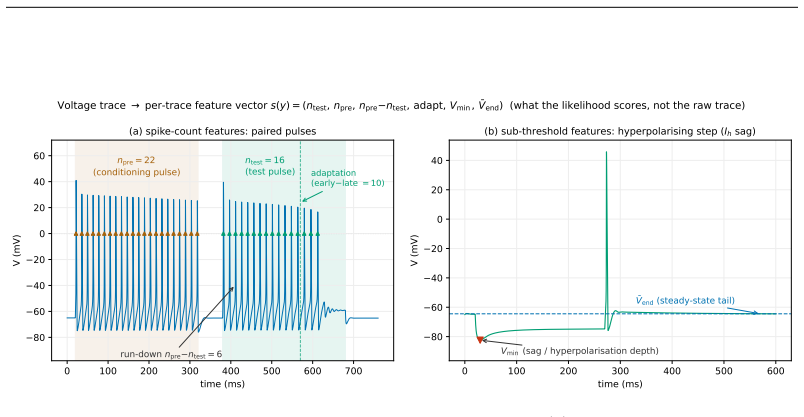
The load-bearing identity is the value-of-information reduction of Eq. (5): with Gaussian observation noise, the mutual information between the mechanism $M$ and the outcome of experiment $\xi$ is $\frac{1}{2}\ln(1 + \mathrm{Var}_{p(M|D)}[\mu(\xi)]/\sigma^2)$, a monotone function of the between-class variance of the posterior predictive mean, so optimal design reduces to choosing the intervention on which the candidate mechanisms disagree most. The paper makes this concrete with the Yukawa world, where only a probe launched past the screening length $\lambda$ splits the Bessel kernel from its power-law near-misses, and the Coulomb world, where only a charge intervention — a mechanism-level $do(a)$ — separates the true law from a curve fit that agrees with it on all unit-charge data. Around this identity sits the inference stack that feeds it: nested adaptive-tempered SMC computes each candidate's marginal likelihood (evidence) $Z_m = \int p(D|m,\theta)p(\theta|m)\,d\theta$, whose automatic Occam factor trades complexity against fit; a model-level SMC maintains the posterior over structures, with LLM proposals conditioned on the whole pool's residuals; a residual-based predictive check triggers the M-open expansion of the hypothesis space; and an ESS-adaptive rule prunes near-duplicate pools. For the stochastic neuron benchmark the likelihood is intractable, so a bootstrap particle filter inside the tempered SMC estimates it, with a learned 1-D CNN summary statistic and synthetic Gaussian likelihood as a roughly $10^4\times$ cheaper surrogate, guarded by a particle-filter spot-check that falls back to the exact filter when the cheap summary disagrees.
What would settle it
Run the Yukawa world with the design menu's longest launch kept inside the screening length ($r_0 \le \lambda$) and a proposer prompt that never mentions screened, Helmholtz, or Bessel kernels. The paper's own account predicts the true $K_1(r/\lambda)/\lambda$ law is never recovered — short-range probes leave the candidates indistinguishable and the residual check has no family to propose — so recovering the correct form under these restrictions would falsify the claimed necessity of discriminative design and supplied vocabulary.
Extended reading notes
Core claim
Stated in the paper's own terms: discovery and experiment design reinforce each other. The value-of-information objective selects the intervention on which the candidate mechanisms' predictions disagree most; the outcome identifies the mechanism the LLM proposer introduced; and the identified mechanism improves interventional forecasts, shrinking residuals and exposing subtler predictive errors that trigger the next round of hypothesis expansion. The paper demonstrates this reinforcement on FORCEBENCH (force laws: MDA passes numerically in ~93% of 8-experiment runs versus ~31% for a budget-matched pure LLM agent, and reaches the previously reported state-of-the-art accuracy with ~5x fewer experiments), on CHEMBENCH (enzyme rate laws: ~56% symbolic accuracy within ~8 experiments versus ~42% for the previous state of the art at a budget of 60), and on NEURONBENCH (a new single-neuron electrophysiology benchmark with partial observability and, in its stochastic form, an intractable likelihood, where the model-based Bayes forecaster beats in-context LLM forecasting on every world). The recovered models are mechanistic — the screened Yukawa kernel $K_1(r/\lambda)/\lambda$, the enzyme-kinetic inhibition structure, the Hodgkin–Huxley channel composition — rather than numerically accurate but mechanistically meaningless expressions, and in the M-open miss cases (e.g., a neuron world whose novel current the LLM never proposed) the residual-triggered expansion still recovers the mechanism.
Load-bearing premise
MDA's gains rest on the pre-specified experiment menu and the proposer prompt containing, at least implicitly, the one intervention and the one mechanism family that can separate the true law from its near-misses — if no probe reaches past the screening length, or the prompt never names the screened-Bessel family, the value-of-information maximizer has no discriminating experiment to choose and the residual check has no vocabulary to invoke.
Editorial extensions
If this is right
- On FORCEBENCH, MDA's ~93% numeric pass rate with 8 one-per-round experiments versus ~31% for a budget-matched LLM agent implies that the bottleneck for pure LLM discovery is inference and experiment design, not capability.
- In the M-open setting (e.g., a neuron world whose true current the LLM never proposed), residual-triggered expansion lets the agent recover mechanisms absent from the initial pool — a route to genuinely new knowledge rather than recall.
- For interventional forecasting, a model-based Bayes forecaster built on the SMC posterior dominates in-context LLM forecasting by roughly two orders of magnitude on the noisy stochastic neuron benchmark.
- Intractable-likelihood discovery is workable when the likelihood is replaced by a learned summary statistic plus synthetic likelihood, with cost-aware auto-selection of the observation model and a particle-filter spot-check as the safety anchor.
- The benchmark's LLM-judged explanation metric is unreliable — flat and non-monotonic in the number of experiments — so held-out interventional forecast error, justified by the theorem that robust interventional prediction requires a causally correct model, is the more trustworthy evaluation.
Reading between the lines
- Editorial inference: the same VoI-as-disagreement identity should transfer to any domain where an LLM can propose mechanistic simulators rather than symbolic laws — dose-response models, policy simulators, engineering control laws — because the identity only requires simulating each candidate's predicted outcome, not closed-form expressions.
- Editorial inference: the paper's base-model sweep, in which a much stronger LLM closes most of the gap and even leads on exact-form naming while scoring only ~11% numeric on Coulomb, suggests MDA's durable value is honest model selection — evidence over naming — and that 'can name the law' versus 'can compute with the law' will become the defining benchmark distinction as proposers improve.
- Editorial inference: the paper's observation that random design matches VoI on the noisy stochastic benchmark hints that the marginal value of optimal design shrinks as observation noise dominates; repeat-aware VoI — spending budget re-running the discriminating experiment — is demonstrated on neurons and should generalize to any noisy experimental domain.
- Editorial inference: the least automatic input left in the loop is the human-written prompt vocabulary (screened/Helmholtz kernels, enzyme-kinetics grammar, channel archetypes); a testable next step is to have the residual check propose that vocabulary itself, removing the last hand-engineered element from the discovery pipeline.
Editorial analysis
A structured set of objections, weighed in public.
Referee Report
Summary. The paper introduces the Model Discovery Agent (MDA), which couples an LLM-based proposer of mechanistic structures with sequential Monte Carlo (SMC) for parameter and structure posteriors, simulation-based likelihoods for intractable cases, and value-of-information (VoI) experiment design. MDA is designed to operate in the M-open regime: when the current hypothesis pool fits poorly, a predictive-check residual triggers the LLM to propose new mechanisms. The authors evaluate MDA on three benchmarks (FORCEBENCH physics, CHEMBENCH chemistry, and a new NEURONBENCH electrophysiology benchmark plus a stochastic extension), reporting substantially improved data efficiency over LLM-only baselines. The central claim is that MDAs coupling of Bayesian inference with LLM proposal yields faster held-out interventional prediction and more reliable mechanistic recovery than pure LLM agents, including in the M-open setting.
Significance. If the results hold, MDA is a valuable architecture for interactive scientific discovery, and NEURONBENCH and NEURONBENCHSTOCH are useful new benchmarks that add partial observability and stochastic dynamics to the existing evaluation landscape. The paper has several notable strengths: the VoI derivation in Eq. (5) is a standard, clearly stated Bayesian objective; the algorithms are given in sufficient pseudocode to be reproduced; the ablation study in Section D.3 and the base-model robustness study in Section C.8 are honest and informative; and the authors ship interactive apps and code for their new benchmark. However, the strongest empirical claims are currently supported by comparisons that do not fully isolate the contribution of the Bayesian machinery from prompt pre-specification, and the biology benchmark does not compare against a full LLM agent. The core idea is credible and the weaknesses are addressable, but the paper as written overstates the breadth of its M-open and SOTA claims.
major comments (3)
- [Section G.1.1, Table 5, Section C.10] The FORCEBENCH demonstration does not support the M-open discovery claim as cleanly as stated. The proposer prompt in Section G.1.1 explicitly names the screened-Poisson/Helmholtz family, including `K1(r/lam)/lam`, which is exactly the true Yukawa form, and Table 5 includes the long-range launches (r0=5,6) that Section C.10 identifies as decisive for Yukawa. Thus the correct mechanism is inside the initial hypothesis class and the decisive probe is inside the fixed design menu. The control in Section C.5 gives the LLM baseline the same menu but not the same physical vocabulary, so it does not isolate whether the data-efficiency gain comes from SMC/VoI or from prompt content. A no-hint control, in which the proposer prompt omits the true family and the menu omits the decisive probes, is needed before the paper can claim open-ended M-open discovery on FORCEBENCH.
- [Section 4.3, Fig. 4, Section G.3.2] The NEURONBENCH evaluation does not compare MDA against a full LLM agent. Figure 4 compares the Bayes-forecaster with the in-context (ICL) forecaster; the LLM baselines in Section G.3.2 are acquisition and ICL-forecasting prompts, not an agent that proposes candidate mechanisms, simulates them, and forecasts from a fitted model. The paper's general claim that MDA is more data-efficient than pure LLM agents is therefore not established for the biology benchmark. In addition, Fig. 4 shows that within the Bayes-forecaster family, VoI and LLM acquisition perform similarly, and random acquisition is sometimes close; Section F.4 states that random designs are similar to, and arguably slightly better than, VoI designs in the stochastic setting. These results should be reported as a more nuanced boundary on the VoI contribution, and a full LLM-agent baseline should be added for NEURONBENCH.
- [Section D.2, Table 9, Table 2] The CHEMBENCH SOTA claim rests on thin evidence. The main comparison uses a 36-task subset with two seeds, and the 'reported' baseline row in Table 9 is based on a different, unreleased 36-task subset using gpt-4o-mini rather than the matched proposer model, so the headline comparison against the published number is not apples-to-apples. The head-to-head 'LLM-AUTOSCILAB(us)' row is fairer, but it is still only two seeds. Furthermore, key M-open and pool-size thresholds (tau_r=0.05, tau_p=0.9 in Table 2, and the Occam penalty lambda=2.5 in Section C.4) are set per benchmark with no sensitivity analysis, so it is unclear how robust the method is to these choices. Per-seed results, confidence intervals, and a sensitivity sweep over these thresholds are needed to support the data-efficiency and M-open claims.
minor comments (6)
- [Section 4] There is a typo in 'we summarize some our our experimental results' which should read 'some of our experimental results'.
- [Section E.4] The text contains a typo: 'The summary statsitic we use' should be 'The summary statistic we use'.
- [Section E.3] The phrase 'candidate mechansims' should be 'candidate mechanisms'.
- [Section G.3.2] The caption and text refer to the 'LLM baseline' in NEURONBENCH, but the implemented baseline is an in-context forecaster; please use consistent terminology to avoid overstating the comparison.
- [Section C.8] The base model 'Fable 5' is used without a version or citation; please provide a reference or model card so that the robustness sweep can be reproduced.
- [Section F.4] The sentence 'Note only do we see that MDA is more sample efficient' has inverted word order; consider rewriting as 'Note that not only is MDA more sample efficient...'.
Circularity Check
No circular derivation: SMC evidence and VoI design are standard and evaluated on held-out interventional targets, but the FORCEBENCH 'M-open' demonstration is partially pre-specified by the proposer prompt naming the true kernel family and by a design menu containing the decisive probes.
-
self definitional
[Section G.1.1 (MDA proposer prompt) vs. Section 4.1 'Example: Yukawa world' and Section C.2, Table 5]
"Note that the language spec names screened/power-law/oscillatory families (including the K1 Yukawa form) as examples, so the proposer is given the physical vocabulary — MDA's contribution is the inference and V oI design that identify which form the data support (see App. C, Fig. 14), not blind form-discovery."
The paper defines the M-open setting as 'when the truth lies outside the current hypothesis class' and presents the Yukawa world as a discovery example, but the proposer prompt explicitly includes the true Yukawa kernel K1(r/lam)/lam among the allowed physical vocabulary. Thus the truth is inside the initial hypothesis class by construction, and the 'discovered' law is a selection from the provided vocabulary, not an M-open expansion. The design menu in Table 5 likewise pre-contains the long-range probes (r0=5,6) that Section C.10 identifies as decisive for Yukawa, so the VoI choice is a choice among pre-supplied informative options.
full rationale
The core Bayesian machinery is not circular: the SMC evidence computation (Algorithm 3) and the VoI objective (Eq. 5) are derived from standard Bayesian principles, parameter priors are stated, and held-out interventional predictive error is scored against ground-truth simulations rather than fit targets. The identified circularity-adjacent issue is confined to benchmark pre-specification: for FORCEBENCH the proposer prompt names the true family (including K1(r/lam)/lam) and the fixed 13-launch menu contains the probes that split Yukawa from its near-misses, so the headline physics demonstration reduces partly to selection from supplied vocabulary. The paper candidly admits this in G.1.1, and its menu-control (C.5) only shows the menu alone is insufficient; it does not remove the prompt-vocabulary confound. The M-open claim is nevertheless genuinely instantiated elsewhere, e.g., CHEMBENCH compound recovery and the NEURONBENCH Z-REBOUND miss where the truth is not proposed. Since no derivation step is equivalent to its own inputs and the benchmark confound is acknowledged and partially controlled, the circularity score is low.
Assumptions & free parameters
free parameters (5)
- Occam penalty lambda =
2.5
- Fixed observation noise sigma =
0.03
- M-open residual threshold tau_r =
0.18 (NEURONBENCH), 0.05 (CHEMBENCH)
- Concentration threshold tau_p =
0.9
- Feature-kernel tolerances sigma_j =
0.3, 1.2, 0.06
assumptions (5)
- domain assumption The true data-generating process is a state-space model; any non-Markovian model can be converted to Markov form by enlarging the latent state (Eq. 1, Section A.1).
- domain assumption LLM proposals are drawn from a family that contains mechanisms close enough to the truth, and the prompts enumerate the relevant mechanism families (e.g., Green's function kernels in FORCEBENCH).
- ad hoc to paper The fixed design menus contain an experiment capable of discriminating the true mechanism from near-misses (e.g., long-range probes for Yukawa, hyperpolarizing pre-pulse for NEURONBENCH).
- standard math Richens and Everitt theorem: robust interventional prediction implies causal model learning.
- standard math SMC marginal likelihood provides an automatic Occam penalty; the explicit exp(-lambda*C_m) prior is added because marginal likelihood alone overfits on near-deterministic data.
invented entities (1)
-
NEURONBENCH mystery mechanisms (Z-REBOUND, H-SAG, CA-REBOUND, D-TYPE, NA-FATIGUE, TEXTBOOK-M)
Cite this review
Pith. "Pith review of Model Discovery Agent: LLM-assisted Bayesian experiment design for data-efficient discovery of mechanistic world models." pith.science (2026). https://pith.science/paper/2S3DN5VR
@misc{pith2026260809696,
  author       = {Pith},
  title        = {Pith review of: Model Discovery Agent: LLM-assisted Bayesian experiment design for data-efficient discovery of mechanistic world models},
  year         = {2026},
  howpublished = {\url{https://pith.science/paper/2S3DN5VR}},
  note         = {Machine review of arXiv:2608.09696}
}
read the original abstract
Predicting the answer to interventional ``what if'' questions --- the outcome of an action never taken --- requires a \emph{mechanistic}, causal model, not a curve fit; and learning such a model requires \emph{experiments}, because passive data leaves its mechanisms unidentified. Experiments are expensive, so the central problem is \emph{data efficiency}. We present the Model Discovery Agent (MDA), which couples a large language model (LLM), used as a \emph{proposer} of candidate structures, with standard Bayesian machinery --- sequential Monte Carlo (SMC) for parameter and structure posteriors, simulation-based inference (SBI) for intractable likelihoods, and value-of-information (VoI) for experiment design --- to discover latent mechanistic world models from few interventions. MDA operates in the M-open setting: when the truth lies outside the current hypothesis class, a predictive check flags the inadequacy and the proposer expands the hypothesis space with a new model whose parameters are then identified by designed experiments. We show that \emph{discovery and design reinforce}: the design step identifies the mechanism the discovery step proposes, and the identified mechanism improves predictions, enabling further discoveries from the remaining unexplained residuals. On three different benchmarks --- covering physics (\DPbench, \citep{wiemann2026discoverphysics}), chemistry (\CHEMbench, \citep{kabra2026autoscilab}) and biology (\HHbench, a new partially observed single-neuron electrophysiology benchmark we create) --- we show that MDA sets a new SOTA in terms of data-efficient model learning and reliable interventional prediction ability.
Figures


Figures from the paper (29 more)




Reviewed August 11, 2026 · model on record in the stance chip above.
Discussion (0). Continue with ORCID to comment.