REVIEW 3 major objections 7 minor 23 references
Preferential Attachment as a Simpliciality-Enforcing Mechanism in Hypergraphs
T0 review · 3 major / 7 minor · reviewed 2026-08-11 · deepseek-v4-flash
Pith's one-line read The paper claims that in a generalized preferential attachment hypergraph model, the stationary hyperdegree distribution follows a power law whose exponent depends only on the ratio p of the expected number of new nodes per step to the…
desk verdict The ratio-only mean-field result is clean and worth engaging, but the paper's own simulations undercut it in the small-p regime where all its datasets sit, and the backward-stepping estimator has a load-bearing assumption. read the letter →
The pith
A machine-rendered reading of the paper's core claim, the machinery that carries it, and where it could break.
The reading
What carries the argument
The key machinery is a mean-field approximate master equation (AME) for the probability that a node has hyperdegree d_H at time t, in which random quantities are replaced by their conditional expectations and the strong law of large numbers provides deterministic limits for total node count and total hyperdegree. Solving the stationary recursion yields the closed-form gamma-function distribution and the power-law tail. Two further components carry the empirical argument: a backward-stepping procedure that reconstructs the sequence (X_t, Y_t) from any timestamped hypergraph by removing hyperedges in reverse order and counting newly isolated nodes as new arrivals, and the nonlinear preferential attachment kernel p(u) ∝ d(u)^α, whose gelation transition at α = 1 is shown to divide a simpliciality-enforcing regime from a simpliciality-destroying one.
What would settle it
Construct a synthetic timestamped hypergraph from a closed population with known node birth times (all nodes present before the first hyperedge) and run the backward-stepping procedure: if it reports p substantially above the true value of 0, or if the degree tail predicted by Theorem 1 with the fitted p fails to match the simulated tail, the empirical small-p claims and the parameter-free fitting claim are called into question.
Extended reading notes
Core claim
The central discovery is a universality result for growing hypergraphs: the stationary hyperdegree distribution of the generalized preferential attachment model is P(d_H) = Γ(d_H) Γ(1/(1−p)+1) / ((1−p) Γ(1/(1−p)+d_H+1)), which scales as $d_H^{{-γ}}$ with γ = 1/(1−p) + 1, where p = E[X_t]/E[Y_t] is the limiting ratio of expected new nodes to expected hyperedge size. The exponent depends on the two random processes only through this ratio, not on the shapes of their distributions. The paper further finds, via a nonlinear generalization, that the simplicial fraction σ_SF increases monotonically with the preferential attachment exponent α for α ≤ 1 and decreases for α > 1, with the gelation transition at α = 1 marking the boundary. Across eight empirical datasets, the fitted ratios are all very small (p ≈ 0.0005 to 0.015), situating real systems in the small-p regime where preferential attachment has the strongest potential to enforce simpliciality; the mechanism is that moderate attachment concentrates hyperedges around high-degree nodes, making their neighborhoods dense enough to satisfy downward closure, while superlinear attachment creates a dominant hub whose hyperedges lack their sub-hyperedges.
Load-bearing premise
The backward-stepping estimator assumes that a node left isolated after removing a hyperedge first appeared exactly when that hyperedge was added, which holds only for growing populations where nodes are born at their first hyperedge and not for closed populations where individuals pre-exist.
Editorial extensions
If this is right
- Any two growth rules for hypergraphs with the same ratio p produce identical stationary degree tails, so the ratio is a universal parameter for degree heterogeneity in growing higher-order networks.
- Hyperedge sizes and new-node counts can be read off directly from timestamped data, allowing the model to be fit without assuming particular distributions for X_t or Y_t.
- In the small-p regime, which includes all eight empirical datasets, preferential attachment is the dominant driver of simpliciality in sparse systems like email and legislative networks, while proximity networks owe most of their simpliciality to size and degree distributions.
- Superlinear preferential attachment actively undermines simpliciality past the gelation threshold, predicting that systems with very strong rich-get-richer dynamics should have lower simplicial fractions.
Reading between the lines
- The backward-stepping estimator treats any node that becomes isolated after removing a hyperedge as having first appeared at that step; in closed-population datasets such as proximity contact networks, where individuals pre-exist, this biases the fitted p upward, so the empirical 'small-p' conclusion may be partly an artifact of the estimation procedure.
- If the universality holds, p could serve as a one-number fingerprint for comparing higher-order growth processes across domains, and the simpliciality-enforcement curve as a function of α offers a template for classifying systems by how strongly attachment drives their simplicial structure.
- A direct testable extension would be to run the backward-stepping procedure on synthetic hypergraphs with known node birth times and closed populations; if the fitted p deviates systematically from the true value, the empirical analysis of real datasets should be re-examined with a birth-time-aware estimator.
Editorial analysis
A structured set of objections, weighed in public.
Referee Report
Summary. This manuscript proposes a generalized preferential-attachment hypergraph model in which each new hyperedge has size Y_t and contains X_t new nodes and Y_t − X_t existing nodes selected with probability proportional to hyperdegree. The authors derive, by a mean-field approximate master equation in the thermodynamic limit, that the stationary hyperdegree distribution is P(d_H) ∝ d_H^{-(1/(1-p)+1)}, with p = E[X_t]/E[Y_t], and that the exponent depends only on p, not on the shapes of the input distributions (Theorem 1, Corollary 1). They propose a backward-stepping estimator of {X_t, Y_t} from timestamped hypergraphs, fit it to eight XGI-DATA datasets (p̂ from 5e-4 to 1.5e-2), and, using a nonlinear preferential-attachment variant with exponent α, report that the simplicial fraction σ_SF increases monotonically with α up to the gelation transition at α=1 and then decreases. The paper concludes that preferential attachment is a simpliciality-enforcing mechanism. Appendices contain the AME derivation, the CCDF proof, and simulation validation (Y_t ~ Poisson(5), X_t ~ Binomial(Y_t,p)).
Significance. If Theorem 1 holds, the ratio-only universality is a clean, publishable contribution: it generalizes the Avin et al. and Wang et al. models, the recursion in Appendix A solves correctly, the gamma-function form is properly normalized (verified for test values of p and d_H), and Corollary 1's CCDF is consistent. Credit is due for shipping open code, for stating the mean-field nature of the derivation up front, and for honestly reporting in Appendix C that the simulated tail is heavier than the theoretical prediction for small p and declining in Section 6.1 to claim empirical validation against degree sequences. However, the manuscript's empirical significance is weaker than its framing: all eight datasets lie in the small-p regime where the paper's own simulations deviate from the theory, the backward-stepping estimator embeds an unflagged node-birth assumption that is violated by four of the eight datasets, and the simpliciality 'confirmation' is a fit of α to σ_SF rather than a sharp test. These are fixable framing and validation gaps rather than defects in the analytic core.
major comments (3)
- [§3.2 (Theorem 1), §6.1, Appendix C] The central universality claim is left unvalidated precisely in the regime where all the empirical data sit. Table 1 reports p̂ between 5e-4 and 1.5e-2 for all eight datasets, yet Appendix C reports that in this small-p range the simulated CCDF is systematically heavier-tailed than the prediction of Corollary 1, attributing the discrepancy to a finite-size effect that 'becomes increasingly pronounced as p→0'. No convergence proof, error bound, or scaling analysis is provided to show that the deviation vanishes in the thermodynamic limit; the mean-field gain probability differs from the exact without-replacement selection probability by a relative amount of order (Y_t−X_t)·d_H/D_t ∼ t^{-p} for the dominant nodes, so for p≈1e-3 the approach to the limit occurs only on astronomically large timescales. Section 6.1 then explicitly declines to test Theorem 1 against the empirical degree sequences. The abstract's claims that the model can be fitted to any timestamped dataset 'without parametric assumptions' and that the exponent depends only on p therefore overstate what is established; the authors should either supply a quantitative convergence analysis for the small-p regime or explicitly restrict the universality and fitting claims and present γ≈2 as an untested limiting prediction.
- [§5.2] The backward-stepping estimator asserts that a node left isolated by removing e_T 'therefore first appeared when e_T was added.' This inference is valid only for a growing process in which nodes are born at their first hyperedge and never pre-exist the observation window. Four of the eight datasets (Contact-high-school, Contact-primary-school, Hospital-Lyon, Malawi-Village) are closed-population proximity contact networks whose individuals pre-exist; a node that appears in exactly one hyperedge is then counted as a new node, which inflates X_t and biases p̂. The paper neither flags this assumption in Section 5.2 nor assesses the bias (for example, by recomputing p̂ under the opposite convention that all nodes are present from the start). Since the fitted p̂ underpins the small-p and γ≈2 statements and the 'parameter-free fitting' contribution, this assumption and a sensitivity analysis must be added.
- [§6.2, Figures 2–9] The evidence for 'preferential attachment as a simpliciality-enforcing mechanism' is presented as confirmation, but the empirical side of the argument is a fit: α is chosen so that the NLPA model reproduces the observed σ_SF, and the monotone model trend is then read as confirming the mechanism. Since σ_SF is matched by construction at the fitted α, the match itself carries limited evidential weight; what the data actually support is that the empirical σ_SF lies on the model curve in the plausible range α∈[0,1.1]. The monotone increase of σ_SF with α is a genuine, falsifiable prediction of the model, but it is not tested out-of-sample here. A sharper test would compare additional statistics at the single fitted α without further tuning (for example, σ_SF restricted to hyperedges of a given size, or degree-conditional downward closure), and the text should be rephrased so that the confirmation claim matches the strength of that test.
minor comments (7)
- [§3.2 and Appendix A, Eq. (8)] The text states that the first mean-field approximation replaces Y_t−X_t by its conditional expectation, but Eq. (8) retains the random quantity Y_t−X_t; the two-stage conditioning-and-averaging procedure should be described consistently.
- [Table 1 caption] The sentence 'Entries marked in red are to be completed' and the phrase 'for the eight datasets for which they are currently available' indicate that the manuscript is an unfinished draft; the captions should be brought in line with the presented content or the missing entries supplied.
- [§2] The definition of a simplicial complex is incomplete: 'A simplicial complex is a hypergraph with an additional structural property: for every hyperedge present' is not a complete sentence and does not state the downward-closure condition.
- [§5.2] The backward-stepping procedure requires a total order on hyperedges, but several datasets (notably 20-second-resolution contact networks) contain simultaneous hyperedges; the tie-breaking rule should be stated.
- [Appendix C] The simulation study does not report the number of time steps or the final number of nodes used; this is essential for evaluating the claimed finite-size nature of the small-p deviation.
- [Abstract and §4] The abstract locates the gelation transition 'at α>1', while Section 4 defines it at α=1; the wording should be made consistent.
- [§3.1] The model description does not specify the initial condition or what happens when Y_t−X_t exceeds the current node count |V_t|; a minimal initial configuration and a rule for the early-time regime are needed.
Circularity Check
No significant circularity: Theorem 1 is derived from model equations with explicit mean-field approximations, and the empirical sections do not present fitted quantities as predictions.
full rationale
The central analytical result, Theorem 1, is derived in Appendix A from an approximate master equation, an averaging step, a stationary limit, and an induction; the final formula is not fitted to data. The dependence on p=E[X_t]/E[Y_t] follows from the stated mean-field replacement of Y_t-X_t by its conditional expectation in Eq. (8), which is an explicit approximation rather than a definitional identity, and the theorem is not calibrated to any dataset. No empirical degree sequence is claimed as confirmation: Section 6.1 explicitly states that the authors 'do not attempt to validate Theorem 1 directly against empirical degree sequences,' and validation is instead carried out in Appendix C against simulations with controlled p. The backward-stepping estimator is an identification procedure for X_t and Y_t under a growing-process assumption; it is a data-generation assumption, not a circular reduction of the fitted ratio into a predicted quantity. The NLPA simpliciality analysis scans alpha in [0,2], generates synthetic hypergraphs, and compares the resulting sigma_SF with empirical values; choosing the alpha that matches a dataset is model fitting, while the monotone dependence of sigma_SF on alpha is a property of the simulated model, not a fitted parameter disguised as a prediction. There are no load-bearing self-citations: references to Landry et al. and XGI-DATA are external data and metric sources, and the comparison with Avin et al. is an independent benchmark. The small-p discrepancy reported in Appendix C is a correctness and finite-size validity concern about the mean-field asymptotic, not a by-construction equivalence. Accordingly, no circular step meeting the required evidence standard is present.
Assumptions & free parameters
free parameters (2)
- p = E[X_t]/E[Y_t] =
Fitted per dataset in Table 1, e.g., Email-Enron 0.0055, Contact-high-school 0.00098
- preferential exponent alpha =
Per dataset, e.g., Email-Enron about 0.4, Email-EU about 0.8, Congress-Bills about 1.1
assumptions (4)
- standard math Strong law of large numbers: |V_t|/t converges to E[X] and D_t/t converges to E[Y] almost surely
- domain assumption Mean-field approximation: replace Y_t - X_t by its expectation and treat preferential selections as independent Bernoulli draws
- domain assumption Stationarity of the degree distribution in the thermodynamic limit, with partial derivative of P with respect to t equal to o(1/t)
- domain assumption Backward-stepping assumption: a node isolated by removing the latest hyperedge is a node that first appeared at that step; nodes never pre-exist the observation window
Cite this review
Pith. "Pith review of Preferential Attachment as a Simpliciality-Enforcing Mechanism in Hypergraphs." pith.science (2026). https://pith.science/paper/K5M3PDGB
@misc{pith2026260809788,
  author       = {Pith},
  title        = {Pith review of: Preferential Attachment as a Simpliciality-Enforcing Mechanism in Hypergraphs},
  year         = {2026},
  howpublished = {\url{https://pith.science/paper/K5M3PDGB}},
  note         = {Machine review of arXiv:2608.09788}
}
abstract
Higher-order networks, represented as hypergraphs, enable direct modeling of multi-body interactions of arbitrary size. Hypergraph representations of real-world systems have been observed to exhibit high \emph{simpliciality} --- the tendency for subsets of hyperedges to also appear as hyperedges --- yet the generative mechanisms responsible for this structure are poorly understood. We introduce a generalized preferential attachment hypergraph model in which both hyperedge size $Y_t$ and the number of new nodes per step $X_t$ are drawn from arbitrary distributions, and derive analytically, using a mean-field approximate master equation approach, that the stationary hyperdegree distribution follows a power law whose exponent depends only on the ratio $p = E[X_t]/E[Y_t]$, independent of the shapes of the underlying distributions. Crucially, both $X_t$ and $Y_t$ can be estimated directly from any timestamped hypergraph dataset via a backward-stepping procedure, enabling the model to be fit without parametric assumptions. Applying a nonlinear extension of the model to eight real-world hypergraph datasets, we find that the simplicial fraction increases monotonically with the strength of preferential attachment up to the gelation transition at $\alpha > 1$, establishing preferential attachment as a simpliciality-enforcing mechanism.
Figures


Figures from the paper (7 more)


Reference graph
Works this paper leans on
-
[1]
Graph fission in an evolving voter model
Richard Durrett et al. “Graph fission in an evolving voter model”. In:Proceedings of the National Academy of Sciences109.10 (2012), pp. 3682–3687.doi: 10.1073/pnas.1200709109
-
[2]
Adaptive Networks: Coevolution of disease and topology
Vincent Marceau et al. “Adaptive Networks: Coevolution of disease and topology”. In: Physical Review E82.3 (Sept. 2010).doi: 10.1103/physreve.82.036116
-
[3]
Mahantesh Halappanavar et al.A Network-of-Networks Model for Electrical Infrastructure Networks. 2015. arXiv: 1512.01436[physics.soc-ph].url: https://arxiv.org/abs/1512. 01436
work page Pith review arXiv 2015
-
[4]
Simplicial closure and higher-order link prediction
Austin R. Benson et al. “Simplicial closure and higher-order link prediction”. In:Proceedings of the National Academy of Sciences115.48 (Nov. 2018), E11221–E11230.doi: 10.1073/ pnas.1800683115. 8 LaRuez, Rooney
work page 2018
-
[5]
https: //github.com/xgi-org/xgi-data
Nicholas Landry et al.XGI-DATA: A Data Repository for Higher-Order Networks. https: //github.com/xgi-org/xgi-data. 2023.url: https://github.com/xgi-org/xgi-data
work page 2023
-
[6]
Persistent Homology of Complex Networks
Danijela Horak, Slobodan Maletić, and Milan Rajkovic. “Persistent Homology of Complex Networks”. In:J. Stat. Mech.: Theory Experiment2009 (Nov. 2008).doi: 10.1088/1742- 5468/2009/03/P03034
doi:10.1088/1742- 2008
-
[7]
Simplicial models of social contagion
Iacopo Iacopini et al. “Simplicial models of social contagion”. In:Nature Communications 10.1 (June 2019).doi: 10.1038/s41467-019-10431-6
-
[8]
Yuanzhao Zhang, Maxime Lucas, and Federico Battiston. “Higher-order interactions shape collective dynamics differently in hypergraphs and simplicial complexes”. In:Nature Com- munications14.1 (Mar. 2023).doi: 10.1038/s41467-023-37190-9
Show all 23 references
-
[9]
Topological phase transitions in Functional Brain Networks
Fernando A. Santos et al. “Topological phase transitions in Functional Brain Networks”. In: Physical Review E100.3 (2019).doi: 10.1103/physreve.100.032414
2019 doi
-
[10]
Encapsulation structure and dynamics in hyper- graphs
Timothy LaRock and Renaud Lambiotte. “Encapsulation structure and dynamics in hyper- graphs”. In:Journal of Physics: Complexity4.4 (Nov. 2023), p. 045007.doi: 10.1088/2632- 072x/ad0b39
2023 doi
-
[11]
Hyperedgeoverlapdrivesexplosivetransitionsinsystemswithhigher- order interactions
FedericoMaliziaetal.“Hyperedgeoverlapdrivesexplosivetransitionsinsystemswithhigher- order interactions”. In:Nature Communications16.1 (Jan. 2025).doi: 10.1038/s41467-024- 55506-1
2025 doi
-
[12]
The simpliciality of higher- order networks
Nicholas W. Landry, Jean-Gabriel Young, and Nicole Eikmeier. “The simpliciality of higher- order networks”. In:EPJ Data Science13.1 (Mar. 2024).doi: 10.1140/epjds/s13688-024- 00458-1
2024 doi
-
[13]
Jordan Barrett et al.Counting simplicial pairs in hypergraphs. 2024. arXiv: 2408.11806 [cs.SI].url: https://arxiv.org/abs/2408.11806
2024 arXiv
-
[14]
Emergence of scaling in random networks
Albert-László Barabási and Réka Albert. “Emergence of scaling in random networks”. In: Science286.5439 (1999), pp. 509–512.doi: 10.1126/science.286.5439.509
1999 doi
-
[15]
Evolving hypernetwork model
Jian-Wei Wang et al. “Evolving hypernetwork model”. In:The European Physical Journal B 77.4 (Oct. 2010), pp. 493–498.doi: 10.1140/epjb/e2010-00297-8
2010 doi
-
[16]
Random preferential attachment hypergraph
Chen Avin et al. “Random preferential attachment hypergraph”. In:Proceedings of the 2019 IEEE/ACM International Conference on Advances in Social Networks Analysis and Mining. Aug. 2019, pp. 398–405.doi: 10.1145/3341161.3342867
2019
-
[17]
A local-world evolving hypernetwork model
Guang-Yong Yang and Jian-Guo Liu. “A local-world evolving hypernetwork model”. In: Chinese Physics B23.1 (Jan. 2014), p. 018901.doi: 10.1088/1674-1056/23/1/018901
2014 doi
-
[18]
Non-uniform evolving hypergraphs and weighted evolving hypergraphs
Jin-Li Guo et al. “Non-uniform evolving hypergraphs and weighted evolving hypergraphs”. In:Scientific Reports6.1 (Nov. 2016).doi: 10.1038/srep36648
2016 doi
-
[19]
Connectivity of Growing Random Networks
P. L. Krapivsky, S. Redner, and F. Leyvraz. “Connectivity of Growing Random Networks”. In:Physical Review Letters85.21 (2000), pp. 4629–4632.doi: 10.1103/PhysRevLett.85.4629
2000 doi
-
[20]
Organization of Growing Random Networks
P. L. Krapivsky and S. Redner. “Organization of Growing Random Networks”. In:Physical Review E63.6 (2001), p. 066123.doi: 10.1103/PhysRevE.63.066123
2001 doi
-
[21]
Cosimo Agostinelli, Marco Mancastroppa, and Alain Barrat.Higher-order dissimilarity mea- sures for hypergraph comparison. 2025. arXiv: 2503.16959[physics.soc-ph].url: https: //arxiv.org/abs/2503.16959
2025
-
[22]
Competition and multiscaling in evolving networks
G Bianconi and A.-L Barabási. “Competition and multiscaling in evolving networks”. In: Europhysics Letters (EPL)54.4 (May 2001), pp. 436–442.doi: 10.1209/epl/i2001-00260-6
2001 doi
-
[23]
Edge correlations and link prediction in growing hypergraphs
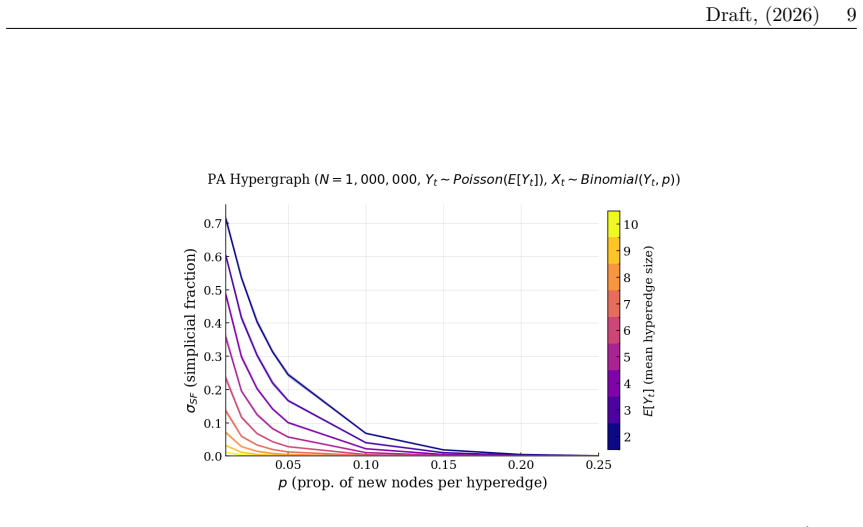
Xie He, Philip S Chodrow, and Peter J Mucha. “Edge correlations and link prediction in growing hypergraphs”. In:Physical Review E112.2 (2025), p. 024305. Draft, (2026) 9 Figure 1: Simplicial fractionσ SF of generalized preferential attachment hypergraphs (N= 1,000,000) as a fu...
2025
Reviewed August 11, 2026 · model on record in the stance chip above.
Discussion (0). Continue with ORCID to comment.