REVIEW 2 major objections 4 minor 86 references
Tunable Multiband Geometry and Fractional Phases in Higher Vortexable Systems
T0 review · 2 major / 4 minor · reviewed 2026-08-11 · deepseek-v4-flash
Pith's one-line read Tuning the interlayer tunneling angle in higher vortexable moiré bands changes only quantum geometry and, in exact diagonalization of both flat bands, drives transitions between Halperin, fractional Chern, Moore–Read, and Read–Rezayi…
desk verdict Careful two-band exact-diagonalization study of geometry-driven fractional phases in higher vortexable moiré bands, but the 'full Hilbert space' claim overstates a Hund's-rule projection that deserves a four-band check. read the letter →
The pith
A machine-rendered reading of the paper's core claim, the machinery that carries it, and where it could break.
The reading
What carries the argument
The carrying object is the higher vortexable flat-band pair: two exactly degenerate, exactly flat Chern bands on one sublattice, built from torus Landau-level functions $\psi^{\mathrm{LLL}}_k$ and $\psi^{\mathrm{LL1}}_k$ multiplied by a fixed moiré dressing factor $h(r)$. The key identity is the higher vortexable construction itself—a Chern band that has a vortexable partner and cannot be split into two individually vortexable bands—which guarantees the degenerate pair and the tunability of geometry through the block chiral operator $D_{\mathrm{hv}}$ with diagonal block $D_v$ and off-diagonal tunneling block $D_\gamma$. The parameter $\theta$ (defined through $\tan\theta\propto\gamma$) changes the relative weight of the $n=1$ and $n=0$ Landau-level components in band 2, thereby changing the quantum metric and Berry-curvature distribution while dispersion, degeneracy, and topology stay fixed. Exact diagonalization of the full two-band projected Coulomb Hamiltonian, analyzed through many-body Chern numbers, particle and hole entanglement spectra, band occupations, and C$_3$/C$_6$ quantum numbers, converts this geometric dial into the phase diagram.
What would settle it
Perform an exact diagonalization that keeps all four flat bands (or a tensor-network simulation at the same fillings) at $\nu=2/5$ and $\nu=8/5$ with the same screened Coulomb interaction: if substantial occupation appears in the other sublattice pair, or if the predicted tenfold quasidegenerate Read–Rezayi manifold with its entanglement-spectrum gap above $27{,}345$ levels does not appear, the two-band projection and the non-Abelian phase claims would be refuted.
Extended reading notes
Core claim
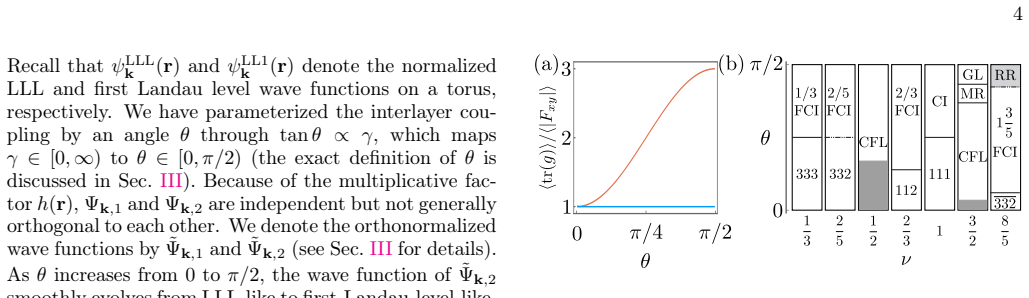
The central claim is that in a higher vortexable two-band system, the interlayer tunneling parameter $\theta$ acts as a pure quantum-geometry dial: band 2 evolves continuously from LLL-like to first-Landau-level-like while the two bands remain exactly flat, exactly degenerate, and topologically unchanged. Under screened Coulomb interaction, exact diagonalization of the full two-band Hilbert space shows that this dial alone selects the many-body ground state: small $\theta$ stabilizes Halperin-type bilayer states (111, 333, 112, 332), while large $\theta$ stabilizes single-layer-type states including a Chern insulator, Laughlin-like and Jain fractional Chern insulators, a Moore–Read state at $\nu=3/2$, and a Read–Rezayi state at $\nu=8/5$. At $\nu=2/3$ the Halperin-112 state and the $2/3$ FCI share Abelian order yet are separated by a threefold-rotation-protected level crossing near $\theta\approx0.4$; at $\nu=2/5$ the Halperin-332 state and the $2/5$ Jain FCI are adiabatically connected; and at $\nu=8/5$ a gap closing near $\theta\approx0.1$ is followed by an intermediate fivefold $1^{3/5}$ FCI that merges with five additional states to form the tenfold Read–Rezayi manifold. Compared with single-band projection, the two-band calculation shifts the optimal $\theta$ for Moore–Read and Read–Rezayi gaps to smaller values while keeping the many-body gaps of the same order as the corresponding first-Landau-level states. The paper marks the Read–Rezayi region as shaded in its phase diagram, noting that the thermodynamic-limit stability of that phase under screened Coulomb interaction remains unresolved within finite-size resolution.
Load-bearing premise
The calculation assumes that for fillings $\nu<2$, electrons stay in just the two flat bands on one sublattice (a Hund's-rule-like polarization), and this is never checked by a calculation that keeps all four flat bands.
Editorial extensions
If this is right
- At weak interlayer tunneling ($\theta\approx0$), coupled vortexable layers are predicted to host integer and fractional exciton insulators (Halperin-111 and -333) at zero magnetic field, detectable as a quenched Hall resistance in counterflow transport.
- At strong tunneling ($\theta\to\pi/2$), the same system realizes Laughlin-type, Jain $2/5$, Moore–Read, and Read–Rezayi fractional Chern insulators without a magnetic field, with many-body gaps comparable to those of the corresponding first-Landau-level states.
- Varying $\theta$ at fixed filling provides a controlled path between phases: a sharp C$_3$-protected transition at $\nu=2/3$, a smooth crossover at $\nu=2/5$, and a gap-closing route from a Halperin-332 state of holes through an intermediate fivefold phase to the Read–Rezayi state at $\nu=8/5$.
- Keeping both flat bands does not obstruct non-Abelian order: the optimal geometry for Moore–Read and Read–Rezayi states shifts to smaller $\theta$ relative to single-band projections, and the non-Abelian states survive screened Coulomb interaction.
Reading between the lines
- The paper leaves implicit that the same geometry knob could act as a reversible topological switch: because $\theta$ changes only wave functions, a gate-tunable interlayer tunneling could toggle an exciton insulator and a fractional Chern insulator without altering single-particle energetics.
- Because the two-band projection is the load-bearing approximation, a natural next calculation is four-band exact diagonalization or tensor-network simulation on the same clusters; if the other sublattice pair acquires macroscopic occupation, several phase identifications would need revision.
- The C$_3$-protected transition at $\nu=2/3$ suggests that breaking threefold rotation, for example by uniaxial strain, should convert the sharp level crossing into a smooth crossover, which is a testable consequence of the geometry-dial mechanism.
- The thin-torus proximity between the $3/5$ Jain and Read–Rezayi root patterns hints that the intermediate fivefold state at $\nu=8/5$ could be continuously connected to the Read–Rezayi manifold under suitable anisotropy; varying the cluster aspect ratio could reveal such a path.
Editorial analysis
A structured set of objections, weighed in public.
Referee Report
Summary. The paper studies a chiral moiré homobilayer model with higher vortexable flat bands, in which an interlayer tunneling parameter θ continuously changes the Bloch wave-function geometry while leaving the bands exactly flat, degenerate, and topologically unchanged. The authors perform exact diagonalization retaining two of the four degenerate flat bands, and report a cascade of many-body phases as a function of filling ν and θ: Halperin-type exciton insulators at weak tunneling, fractional Chern insulators and non-Abelian Moore–Read and Read–Rezayi states at strong tunneling, and geometry-driven transitions or crossovers between them. A central claim is that these phase changes are driven purely by quantum geometry because θ does not alter single-particle dispersion, degeneracy, or topology. The paper also compares two-band and single-band ED to show that interband mixing shifts, but does not destroy, the optimal regime for non-Abelian states.
Significance. If the central projection assumption is justified, the paper would establish a rare platform in which quantum geometry can be tuned as an independent control parameter while single-particle energetics are held fixed, and it would substantially extend the study of multiband fractional phases beyond single-band projections. The exact flat-band construction, the systematic use of many-body Chern numbers, particle/hole entanglement spectra, and generalized Pauli-principle countings are strengths, and the authors are careful to flag finite-size and thermodynamic-limit uncertainties in several places. However, the main many-body results are computed in a two-band truncated Hilbert space, and the justification for that truncation is an untested assumption. The significance of the work is therefore conditional on resolving that issue.
major comments (2)
- [Sec. III, Eq. (17)] The entire many-body analysis is performed in the two-band Hilbert space generated by Ψ_{k,1} and Ψ_{k,2}, but the single-particle Hamiltonian of Eq. (13) has four exactly degenerate flat bands at E=0: the A-sublattice pair in Eq. (16) and the B-sublattice pair Ψ_{k,3}, Ψ_{k,4} obtained by M_zT symmetry. The text states only that 'we anticipate that the same Hund's rule applies' (Sec. III) and then projects the interaction into those two bands. This is an assumption, not a derived or numerically verified property. Every ED phase in Fig. 1(b) and in Secs. IV–VI is computed in this truncated space, so the abstract's phrase 'retaining the full flat-band Hilbert space' is inaccurate. At θ=π/2 the A/B pairs are layer-polarized, so a full four-band calculation could favor bilayer-type (e.g., Halperin) states rather than the reported single-layer non-Abelian states. I request a four-band ED on the available clusters, or at minimum a sublattice-polarization check such as a Hartree–Fock analysis or a measurement of the sublattice occupation in the two-band ground states, before the phase diagram can be accepted.
- [Sec. IV.E and Appendix D.6] The Read–Rezayi identification rests on a particle entanglement spectrum that shows gaps only above 1365 and 27345 levels. For N_s=15 and N_A=4, the total two-band Hilbert space has C(30,4)=27405 states, so the upper 'gap' separates the 27345 configurations that obey the RR generalized Pauli principle from the 60 configurations that violate it; it is not an entanglement gap inside the physical subspace. The expected block gaps at 1365+6825 and at 1365+6825+11025 are not observed, and the spectrum between 1365 and 27345 appears to have no further gaps. The tenfold ground-state degeneracy is consistent with RR, but the PES counting alone does not select RR over other band-2-constrained states. Given the authors' own caveat that the stability of the RR state 'remains uncertain in the thermodynamic limit' (Fig. 1 caption), the RR label in Fig. 1(b) is not as firmly established as the other phase assignments; additional diagnostics, such as a comparison with an explicit RR trial state or quasihole counting, would be needed.
minor comments (4)
- [Sec. III, Eq. (16)] The parameter θ is used in Eq. (12) of Sec. II.B but is only defined near Eq. (16) as tanθ = ℓ_B γ/√8; the definition should be moved earlier to avoid confusion.
- [Fig. 1(b) caption] The notation '1 3/5 FCI' is explained in the text but is not self-evident in the caption; a brief parenthetical definition would improve readability.
- [Appendix F] The gate distances are quoted both in lattice units and as d=1≈0.14a and d=5≈0.69a; please state explicitly that d is measured in units of the moiré lattice constant a throughout the appendix.
- [Sec. II.B] In the sentence 'higher vortexable bands therefore provide a setting...', the capitalization is inconsistent ('higher vortexable' lower-case at sentence start); this is a minor typographical issue only.
Circularity Check
No significant circularity: the many-body phases are exact-diagonalization outputs, and the geometry-tuning knob is a stated model input rather than a fitted predictor.
full rationale
The paper's central claims are numerical outputs of exact diagonalization in a fully specified two-band model, with phases identified by matching particle/hole entanglement spectrum counting to independent Landau-level and bilayer quantum Hall benchmarks. The interlayer tunneling angle theta is defined by tan(theta) = l_B gamma / sqrt(8), and the flat-band wave functions are written explicitly, so the constancy of dispersion, degeneracy, and topology as theta varies is a demonstrated property of the model rather than a fitted assumption; the resulting phase transitions and crossovers are computed, not imposed. The Hund's-rule projection onto the two A-sublattice bands is an unvalidated approximation and a genuine correctness risk, but it is not circular because the truncated Hilbert space is fixed before diagonalization and no target phase is used to select it. Self-citations to prior work provide model parameters, magic values, and a strain-field design, but these are inputs to the calculation, and the key flat-band wave functions are re-derived in Appendix A; no prediction in the paper reduces by construction to a fitted parameter or to a self-citation chain.
Assumptions & free parameters
free parameters (2)
- moiré potential parameters (α, β, η) =
α ≈ 2.19 G², β = -0.5, η = -0.45
- gate distance d =
d = 0.27a, 0.69a, and varied up to 1.4a
assumptions (5)
- domain assumption The chiral block Hamiltonian of Eq. (13) with the higher vortexable structure describes realistic moiré systems such as strained bilayer graphene and double twisted bilayer graphene.
- domain assumption At the magic parameters (α, β, η) ≈ (2.19G², -0.5, -0.45) the model has four exactly flat bands with ideal non-Abelian quantum geometry.
- domain assumption For ν < 2, electrons occupy only the two sublattice-polarized bands on one sublattice (Hund's rule), allowing projection of the interaction into two bands.
- domain assumption The symmetric dual-gate screened Coulomb interaction V(q) = 4πU tanh(dq)/(N_s √3 q a) is the relevant interaction.
- domain assumption The strain field is designed so that the two flat bands on each sublattice have an almost constant quantum geometric tensor across the Brillouin zone.
Cite this review
Pith. "Pith review of Tunable Multiband Geometry and Fractional Phases in Higher Vortexable Systems." pith.science (2026). https://pith.science/paper/BKEGMTVM
@misc{pith2026260809911,
  author       = {Pith},
  title        = {Pith review of: Tunable Multiband Geometry and Fractional Phases in Higher Vortexable Systems},
  year         = {2026},
  howpublished = {\url{https://pith.science/paper/BKEGMTVM}},
  note         = {Machine review of arXiv:2608.09911}
}
read the original abstract
Higher vortexability is often viewed as a route to topological flat bands with higher-Landau-level-like quantum geometry. Here we emphasize a complementary perspective: it provides a tunable multiband structure in which wave function geometry can be varied continuously while the band dispersion, degeneracy, and topology remain fixed. We perform systematic exact-diagonalization studies of many-body phases in fractionally filled higher vortexable moir\'e systems, retaining the full flat-band Hilbert space rather than projecting onto a single band. The multiband treatment reveals a cascade of Abelian and non-Abelian phases at zero magnetic field, including integer and fractional exciton insulators, Abelian fractional Chern insulators, Moore-Read and Read-Rezayi states. At fixed filling, different phases are connected through transitions or crossovers driven solely by changes in wave function geometry, highlighting quantum geometry itself as a direct tuning parameter between competing topological states. At fillings associated with Moore-Read and Read-Rezayi states, our calculations show that interband mixing shifts the optimal quantum geometry regime without suppressing non-Abelian topological order under screened Coulomb interaction. Our results establish higher vortexable moir\'e bands as a tunable platform for exploring geometry-driven multiband topological phases at zero magnetic field.
Figures


Figures from the paper (14 more)


Reference graph
Works this paper leans on
-
[1]
Largeθatν= 1/3 ForN A = 2andN s = 12, the PES of theν= 1/3 ground state manifold atθ=π/2exhibits a gap above 42states, consistent with the generalized Pauli principle that no more than one electron may occupy any three consecutive orbitals; see Fig. 11
-
[2]
Smallθatν= 2/5 We identify theθ= 0.05ground state manifold as a Halperin-332state by comparing its PES, which ex- hibits two gaps above315and405states, with that of a Halperin-332state in a quantum Hall bilayer atν= 2/5; see Fig. 12. FIG.11. PESoftheν= 1/3groundstatemanifoldatθ=π/2 forN s = 12,N A = 2, andd= 0.27a; see Fig. 2(d) for the many-body spectrum...
-
[3]
Thisiden- tifies the small-θground state manifold as a Halperin-332 state of holes
Smallθatν= 8/5 The hole-PES gaps of the fivefold ground state mani- fold agree with the PES gaps of a Halperin-332state in a quantumHallbilayerat2/5filling; seeFig.13. Thisiden- tifies the small-θground state manifold as a Halperin-332 state of holes. FIG. 13. Identification atθ= 0.05andν= 8/5. (a) Hole PES of the five ground states for the15-unit-cell cl...
-
[4]
Intermediateθatν= 8/5 The hole PES of the ground state manifold atθ= 0.25 exhibits a gap above350states, which is also present in the PES of a2/5Jain state in the LLL; see Fig. 14. FIG. 14. (a) Hole PES of the five ground states atθ= 0.25 andν= 8/5for the15-unit-cell cluster withN A = 3. (b) PES of the2/5Jain state from the LLL atν= 2/5withN A = 3. Both d...
-
[5]
T. Neupert, L. Santos, C. Chamon, and C. Mudry, Phys- ical review letters106, 236804 (2011)
work page 2011
-
[6]
from the dimension of theSU(2)irreducible representa- tion carried by the ferromagnetic ground state
(b)ν= 1/3andθ= 0, normalized byN e/2 = 2. from the dimension of theSU(2)irreducible representa- tion carried by the ferromagnetic ground state. Atθ= 0, the Hamiltonian isSU(2)-symmetric, and the fully po- larized state is obtained from the completely symmet- ric combination ofN e =νN s = 12spin-1/2degrees of freedom. This symmetric product forms the total...
-
[7]
H. L. Stormer, D. C. Tsui, and A. C. Gossard, Reviews of Modern Physics71, S298 (1999)
1999
-
[8]
R. B. Laughlin, Reviews of Modern Physics71, 863 18 (1999)
work page 1999
Show all 86 references
-
[9]
Tang, J.-W
E. Tang, J.-W. Mei, and X.-G. Wen, Physical review let- ters106, 236802 (2011)
2011
-
[10]
K. Sun, Z. Gu, H. Katsura, and S. D. Sarma, Physical review letters106, 236803 (2011)
2011
-
[11]
S. A. Parameswaran, R. Roy, and S. L. Sondhi, Comptes Rendus Physique14, 816 (2013)
2013
-
[12]
Sheng, Z.-C
D. Sheng, Z.-C. Gu, K. Sun, and L. Sheng, Nature com- munications2, 389 (2011)
2011
-
[13]
Regnault and B
N. Regnault and B. A. Bernevig, Physical Review X1, 021014 (2011)
2011
-
[14]
D. Xiao, W. Zhu, Y. Ran, N. Nagaosa, and S. Okamoto, Nature communications2, 596 (2011)
2011
-
[15]
B. A. Bernevig and N. Regnault, Physical Review B—Condensed Matter and Materials Physics85, 075128 (2012)
2012
-
[16]
Y.-H. Wu, J. Jain, and K. Sun, Physical Review B—Condensed Matter and Materials Physics86, 165129 (2012)
2012
-
[17]
Z. Liu, A. Abouelkomsan, and E. J. Bergholtz, Physical Review Letters126, 026801 (2021)
2021
-
[18]
Roy, Physical Review B90, 165139 (2014)
R. Roy, Physical Review B90, 165139 (2014)
2014
-
[19]
Y.-H. Wu, J. Jain, and K. Sun, Physical Review B91, 041119 (2015)
2015
-
[20]
Repellin and T
C. Repellin and T. Senthil, Physical Review Research2, 023238 (2020)
2020
-
[21]
P. J. Ledwith, G. Tarnopolsky, E. Khalaf, and A. Vish- wanath, Physical Review Research2, 023237 (2020)
2020
-
[22]
S. H. Simon and M. S. Rudner, Physical Review B102, 165148 (2020)
2020
-
[23]
Y. Xie, A. T. Pierce, J. M. Park, D. E. Parker, E. Khalaf, P. Ledwith, Y. Cao, S. H. Lee, S. Chen, P. R. Forrester, et al., Nature600, 439 (2021)
2021
-
[24]
Mera and T
B. Mera and T. Ozawa, Physical Review B104, 115160 (2021)
2021
-
[25]
H. Li, U. Kumar, K. Sun, and S.-Z. Lin, Physical Review Research3, L032070 (2021)
2021
-
[26]
Devakul, V
T. Devakul, V. Crépel, Y. Zhang, and L. Fu, Nature com- munications12, 6730 (2021)
2021
-
[27]
P. J. Ledwith, E. Khalaf, and A. Vishwanath, Annals of Physics435, 168646 (2021)
2021
-
[28]
J. Wang, J. Cano, A. J. Millis, Z. Liu, and B. Yang, Physical Review Letters127, 246403 (2021)
2021
-
[29]
A.-K. Wu, S. Sarkar, X. Wan, K. Sun, and S.-Z. Lin, Physical Review Research6, L032063 (2024)
2024
-
[30]
J. Cai, E. Anderson, C. Wang, X. Zhang, X. Liu, W. Holtzmann, Y. Zhang, F. Fan, T. Taniguchi, K. Watanabe,et al., Nature622, 63 (2023)
2023
-
[31]
Y. Zeng, Z. Xia, K. Kang, J. Zhu, P. Knüppel, C. Vaswani, K. Watanabe, T. Taniguchi, K. F. Mak, and J. Shan, Nature622, 69 (2023)
2023
-
[32]
H. Park, J. Cai, E. Anderson, Y. Zhang, J. Zhu, X. Liu, C. Wang, W. Holtzmann, C. Hu, Z. Liu,et al., Nature 622, 74 (2023)
2023
-
[33]
F. Xu, Z. Sun, T. Jia, C. Liu, C. Xu, C. Li, Y. Gu, K. Watanabe, T. Taniguchi, B. Tong,et al., Physical Review X13, 031037 (2023)
2023
-
[34]
P. J. Ledwith, A. Vishwanath, and D. E. Parker, Physical Review B108, 205144 (2023)
2023
-
[35]
Fujimoto, D
M. Fujimoto, D. E. Parker, J. Dong, E. Khalaf, A. Vish- wanath, and P. Ledwith, Physical Review Letters134, 106502 (2025)
2025
-
[36]
Z. Lu, T. Han, Y. Yao, A. P. Reddy, J. Yang, J. Seo, K. Watanabe, T. Taniguchi, L. Fu, and L. Ju, Nature 626, 759 (2024)
2024
-
[37]
Wang, X.-W
C. Wang, X.-W. Zhang, X. Liu, Y. He, X. Xu, Y. Ran, T. Cao, and D. Xiao, Physical Review Letters132, 036501 (2024)
2024
-
[38]
J. Xie, Z. Huo, X. Lu, Z. Feng, Z. Zhang, W. Wang, Q. Yang, K. Watanabe, T. Taniguchi, K. Liu,et al., Na- ture Materials24, 1042 (2025)
2025
-
[39]
P. J. Ledwith, A. Vishwanath, and E. Khalaf, Physical Review Letters128, 176404 (2022)
2022
-
[40]
A. P. Reddy, F. Alsallom, Y. Zhang, T. Devakul, and L. Fu, Physical Review B108, 085117 (2023)
2023
-
[41]
Sarkar, X
S. Sarkar, X. Wan, S.-Z. Lin, and K. Sun, Physical Re- view Letters135, 016501 (2025)
2025
-
[42]
Z. Liu, B. Mera, M. Fujimoto, T. Ozawa, and J. Wang, Physical Review X15, 031019 (2025)
2025
-
[43]
H. Liu, Z. Liu, and E. J. Bergholtz, Physical review let- ters135, 106604 (2025)
2025
-
[44]
H. Liu, R. Perea-Causin, and E. J. Bergholtz, Nature Communications16, 1770 (2025)
2025
-
[45]
Sarkar, X
S. Sarkar, X. Wan, A.-K. Wu, S.-Z. Lin, and K. Sun, Physical Review Letters135, 216501 (2025)
2025
-
[46]
Zhang, S
Y. Zhang, S. Sarkar, X. Wan, D. E. Parker, S.-Z. Lin, and K. Sun, arXiv preprint arXiv:2510.22831 (2025)
2025
- [47]
-
[48]
Tarnopolsky, A
G. Tarnopolsky, A. J. Kruchkov, and A. Vishwanath, Physical review letters122, 106405 (2019)
2019
-
[49]
Li, A.-L
M.-R. Li, A.-L. He, and H. Yao, Physical Review Re- search4, 043151 (2022)
2022
- [50]
-
[51]
C.Le, Q.Zhang, F.Cui, X.Wu,andC.-K.Chiu,Physical Review Letters132, 246401 (2024)
2024
-
[52]
P. M. Eugenio and O. Vafek, SciPost Physics15, 081 (2023)
2023
-
[53]
E. H. Rezayi, Physical Review Letters119, 026801 (2017)
2017
-
[54]
X. Wan, S. Sarkar, S.-Z. Lin, and K. Sun, Physical Re- view Letters130, 216401 (2023)
2023
-
[55]
McCann and M
E. McCann and M. Koshino, Reports on Progress in physics76, 056503 (2013)
2013
-
[56]
X. Wan, S. Sarkar, K. Sun, and S.-Z. Lin, Physical Re- view B108, 125129 (2023)
2023
-
[57]
Chen, W.-W
F. Chen, W.-W. Luo, W. Zhu, and D. Sheng, Nature Communications16, 2115 (2025)
2025
-
[58]
C.-E. Ahn, W. Lee, K. Yananose, Y. Kim, and G. Y. Cho, Physical Review B110, L161109 (2024)
2024
-
[59]
F. D. M. Haldane, Bulletin of the American Physical So- ciety51, 633 (2006)
2006
-
[60]
N. D. Le and T. Jolicoeur, Physical Review B107, 125129 (2023)
2023
- [61]
-
[62]
Sethi, M
G. Sethi, M. Cuma, and F. Liu, Physical Review Letters 130, 186401 (2023)
2023
-
[63]
Li and F
H. Li and F. D. M. Haldane, Physical review letters101, 010504 (2008)
2008
-
[64]
F. D. M. Haldane, Physical review letters67, 937 (1991)
1991
-
[65]
Tao and D
R. Tao and D. Thouless, Physical Review B28, 1142 (1983)
1983
-
[66]
W. Zhu, S. Gong, F. Haldane, and D. Sheng, Physical review letters115, 126805 (2015)
2015
-
[67]
R. S. Mong, M. P. Zaletel, F. Pollmann, and Z. Papić, Physical Review B95, 115136 (2017). 19
2017
-
[68]
Herviou and F
L. Herviou and F. Mila, Physical Review B110, 045143 (2024)
2024
-
[69]
Wen,Quantum field theory of many-body systems: From the origin of sound to an origin of light and elec- trons(Oxford university press, 2004)
X.-G. Wen,Quantum field theory of many-body systems: From the origin of sound to an origin of light and elec- trons(Oxford university press, 2004)
2004
-
[70]
Wen and A
X.-G. Wen and A. Zee, Physical Review B46, 2290 (1992)
1992
-
[71]
H. Tang, Y. Wang, X. Ni, K. Watanabe, T. Taniguchi, P. Jarillo-Herrero, S. Fan, E. Mazur, A. Yacoby, and Y. Cao, Nature632, 1038 (2024)
2024
-
[72]
Bergholtz and A
E. Bergholtz and A. Karlhede, Physical Review B—Condensed Matter and Materials Physics77, 155308 (2008)
2008
-
[73]
Read and E
N. Read and E. Rezayi, Physical Review B59, 8084 (1999)
1999
-
[74]
Z. F. Ezawa,Quantum Hall effects: Recent theoretical and experimental developments(World Scientific Pub- lishing Company, 2013)
2013
-
[75]
Milovanović and Z
M. Milovanović and Z. Papić, Physical Review B—Condensed Matter and Materials Physics82, 035316 (2010)
2010
-
[76]
J. Dong, J. Wang, P. J. Ledwith, A. Vishwanath, and D. E. Parker, Physical Review Letters131, 136502 (2023)
2023
-
[77]
Zhang, H
Y. Zhang, H. L. Zhao, S. Huang, M. A. Hossain, and A. M. van der Zande, ACS nano18, 12377 (2024)
2024
-
[78]
Jiang, J
Y. Jiang, J. Mao, J. Duan, X. Lai, K. Watanabe, T. Taniguchi, and E. Y. Andrei, Nano letters17, 2839 (2017)
2017
-
[79]
Zhang, Y
Y. Zhang, Y. Kim, M. J. Gilbert, and N. Mason, Applied Physics Letters115(2019)
2019
-
[80]
Watanabe, T
J.Mao, S.P.Milovanović, M.Anđelković, X.Lai, Y.Cao, K. Watanabe, T. Taniguchi, L. Covaci, F. M. Peeters, A. K. Geim,et al., Nature584, 215 (2020)
2020
-
[81]
C. Cho, J. Wong, A. Taqieddin, S. Biswas, N. R. Aluru, S. Nam, and H. A. Atwater, Nano letters21, 3956 (2021)
2021
-
[82]
Zhang, M
Y. Zhang, M. A. Hossain, K. J. Hwang, P. F. Ferrari, J. Maduzia, T. Peña, S. M. Wu, E. Ertekin, and A. M. van der Zande, ACS nano18, 4205 (2024)
2024
-
[84]
J. M. Kim, M. F. Haque, E. Y. Hsieh, S. M. Nahid, I. Zarin, K.-Y. Jeong, J.-P. So, H.-G. Park, and S. Nam, Advanced Materials35, 2107362 (2023)
2023
-
[85]
Eisenstein, Annu
J. Eisenstein, Annu. Rev. Condens. Matter Phys.5, 159 (2014)
2014
-
[86]
Kharchev and A
S. Kharchev and A. Zabrodin, Journal of Geometry and Physics94, 19 (2015)
2015
-
[184]
Together they sum to 1988, the number of states below the second gap in Fig. 15(b). In both finite size systems we studied, the ground state remains consistent with Moore–Read state. FIG. 15. (a) Many-body spectrum atν= 3/2andθ= 1.21 withd= 0.27aon the12-unit-cell cluster, wit...
1988
Reviewed August 11, 2026 · model on record in the stance chip above.
Discussion (0). Continue with ORCID to comment.