REVIEW 3 major objections 5 minor 62 references
GENCO - A Unified Neural Solver Embedded in a Development Framework for Steady-State Grid Analysis
T0 review · 3 major / 5 minor · reviewed 2026-08-11 · deepseek-v4-flash
Pith's one-line read The paper claims a single neural architecture, GENCO, can solve the three core steady-state grid problems - power flow, optimal power flow, and state estimation - from one shared graph representation, returning complete AC operating…
desk verdict A well-engineered unification of PF/OPF/SE with a genuinely useful framework and the most careful runtime protocol I've seen in this literature, but the SCADA conclusion overstates what Figure 16 shows and the structural-zero residuals deserve a caveat in the abstract. read the letter →
The pith
A machine-rendered reading of the paper's core claim, the machinery that carries it, and where it could break.
The reading
What carries the argument
The load-bearing object is the iterative correction loop: a Heterogeneous Graph Transformer (HGT) layer that propagates messages between bus and generator nodes with attention conditioned on branch electrical coupling; a shared solution-decoder MLP that maps the updated embeddings to primary variables (voltage magnitudes, angles, and generator active powers); and a task-specific physics decoder that computes branch flows from the decoded voltages and analytically recovers reactive generation from the reactive power-balance equation, making the corresponding residuals structurally zero. A residual-encoder MLP then maps the per-bus power-balance residual vector into the bus embedding before the next HGT layer, so every step receives explicit physics-grounded infeasibility feedback; the training loss combines final-solution supervision with these intermediate residuals weighted by an exponentially increasing factor. Sigmoid projections enforce box constraints for OPF, and for state estimation the model predicts net nodal injections rather than decomposing generation and load.
What would settle it
Take a real or realistic grid outside the ones used in the paper (e.g., a European TSO model with one year of SCADA-derived states), fine-tune the released pretrained GENCO on the paper's 1,000-sample recipe, and compare its mean active power-balance residual against DC-PF on the same held-out set. The paper's own data-efficiency claim requires the fine-tuned model to beat DC-PF here, as it does on IEEE 118 (1.93 MW vs 2.30 MW); on real Hydro-Québec SCADA the paper's best fine-tuned result (3.36 MW) merely approaches DC-PF (2.90 MW), so any new grid that fails to clear the DC-PF bar after fine-tuning would falsify the transfer claim.
Extended reading notes
Core claim
GENCO's central claim is that power flow, optimal power flow, and state estimation can be unified in a single learnable architecture whose only task-specific parts are lightweight, non-learned physics decoders that complete the AC solution from decoded voltage states. At each of N correction steps, the model decodes voltage magnitudes and angles (plus generator active powers for OPF), analytically recovers reactive generation and branch flows from the power-flow equations, computes per-bus power-balance residuals, and feeds them back into the latent representation to drive the next correction. Recovered variables satisfy their balance equations by construction, so reactive power-balance residuals at PV and reference buses are structurally zero - the mechanism the authors credit for GENCO's low feasibility violations. On the PFDelta benchmark the model's mean power-balance residuals are below 1% of mean apparent power and far below published neural baselines; on OPFData it stays within a 0.3% optimality gap of IPOPT while lowering thermal violations relative to its strongest neural competitor; and in state estimation it beats weighted least squares under measurement noise and network-parameter errors while always returning an estimate. The paper positions GENCO between classical AC and DC solvers: DC-level throughput with AC-level output completeness.
Load-bearing premise
The load-bearing premise is that synthetic pretraining followed by a limited amount of real-world fine-tuning produces practically useful accuracy on real grids; the paper's own numbers show zero-shot transfer is poor (an 11.07 MW residual versus DC-PF's 2.30 MW on IEEE 118) and that fine-tuning on a year of real SCADA data only approaches, rather than clearly beats, the DC-PF residual (3.36 MW versus 2.90 MW).
Editorial extensions
If this is right
- A single set of weights, hyperparameters, and graph representation serves PF, OPF, and SE, so architectural and training improvements transfer across tasks instead of being re-derived from scratch for each one.
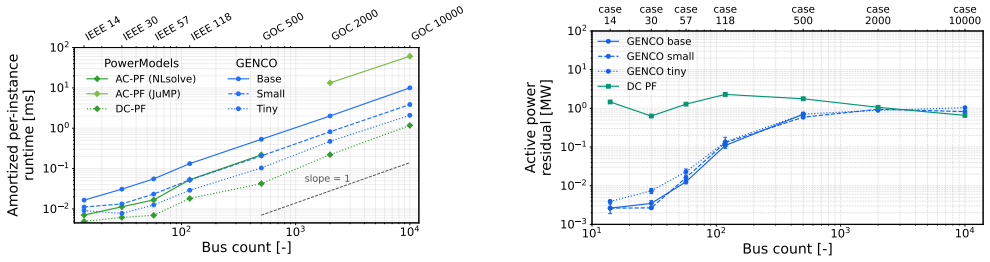
- On grids of 2,000 buses and larger, the smallest GENCO variant is about 28-29x faster than AC-PF with active power-balance residuals comparable to DC-PF, while also supplying the voltage magnitudes and reactive power that DC-PF cannot - making it a candidate replacement for DC-PF in voltage-aware screening.
- For OPF, GENCO Small is 16-85x faster than AC-OPF and 4-6x faster than DC-OPF across the tested grids, while reducing DC-OPF's optimality gap by 1.9-55x and its feasibility violations by 2.4-86x.
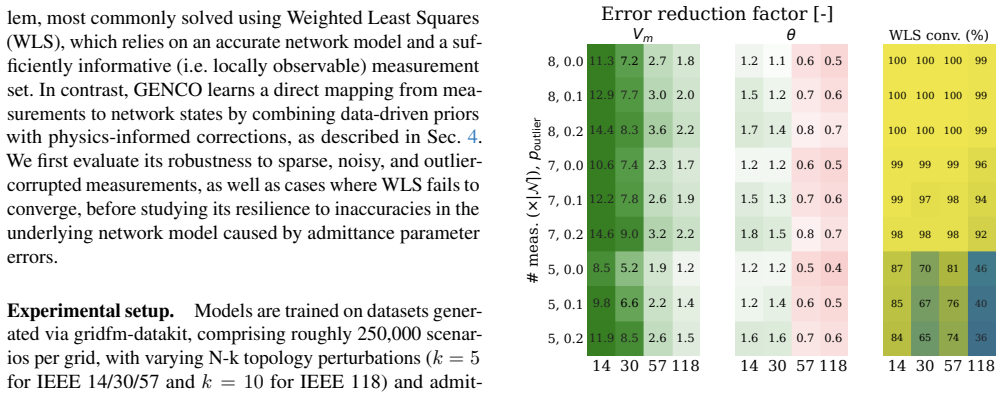
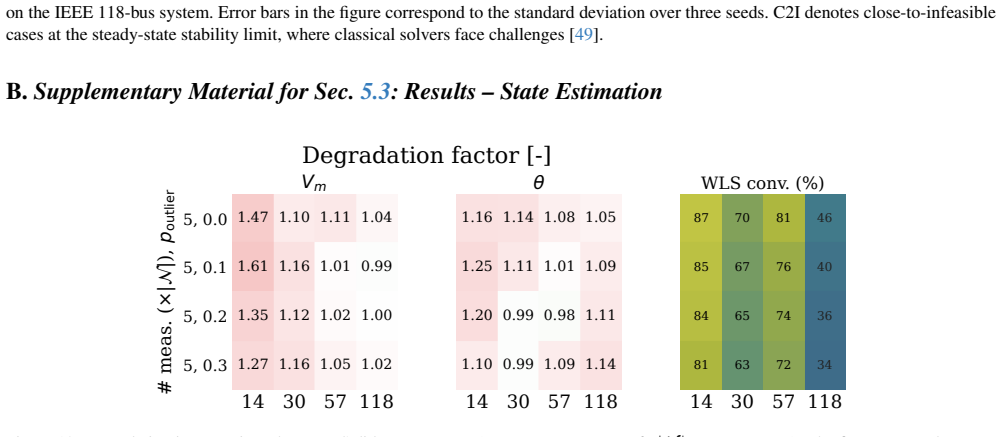
- In state estimation, GENCO never fails to return an estimate, degrading by only about 10% on measurement configurations where weighted least squares does not converge, and it can jointly denoise wrong grid parameters - a mode classical estimators do not have.
- Pretraining on many topologies lets a new grid reach DC-PF-level power-flow accuracy with about 1,000 fine-tuning samples (1.93 MW versus DC-PF's 2.30 MW on IEEE 118), where training from scratch at that data budget is worse.
Reading between the lines
- The paper's residual feedback covers only active and reactive power balance - it explicitly excludes thermal limits, branch angle differences, and reactive generation bounds from the intermediate correction signal - so the demonstrated feasibility properties live at the nodal balance level; whether the same mechanism extends to inequality constraints is the natural next experiment.
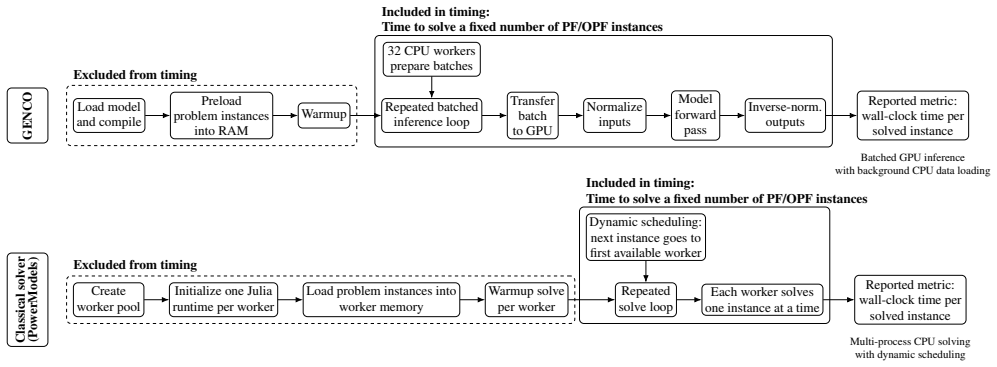
- The headline 30x and 85x speedups are batch-throughput figures measured on a fully occupied GPU against a multi-core CPU pool; for an isolated single solve the advantage would be far smaller, and the paper's own appendix shows that including disk loading erases the gain on small grids.
- If the fine-tuning recipe transfers to other real grids, the trajectory points to a genuine grid foundation model: one pretrained backbone adapted per grid with roughly a year of operational SCADA data, replacing today's practice of training separate solvers for each task and topology.
- The poor zero-shot results suggest GENCO currently encodes grid-specific operating patterns rather than universal AC physics; closing the zero-shot gap would require either substantially broader pretraining topology diversity or moving the power-flow equations into a hard architectural constraint, both of which the paper leaves open.
Signed reviews
Editorial analysis
A structured set of objections, weighed in public.
Referee Report
Summary. The paper presents GENCO, a unified neural architecture for steady-state transmission grid analysis covering power flow (PF), optimal power flow (OPF), and state estimation (SE), together with the open-source GridFM Development Framework (gridfm-datakit, gridfm-graphkit) and large synthetic datasets. The architecture uses heterogeneous graph transformers with iterative correction steps, physics-based decoders that reconstruct complete AC states, and power-balance residual feedback. The authors evaluate GENCO on the PFDelta and OPFData benchmarks, on gridfm-datakit-generated synthetic cases up to 10,000 buses, and on real Hydro-Quebec SCADA data for PF. They report substantially lower power-balance residuals than prior neural solvers, competitive or improved feasibility/optimality over DC solvers, large speedups over classical AC solvers in batched in-memory settings, robustness of SE to noisy and incomplete measurements, and data-efficient fine-tuning transfer to real grids.
Significance. If the claims held, the contribution would be significant: a single architecture handling three core steady-state tasks with near-DC-level runtime and full AC output, plus a standardized framework and public datasets, would advance reproducibility and lower development barriers in neural power-system solving. The paper is strong on artifacts: code and datasets are released, evaluation protocols are described in detail, and the runtime methodology is more careful than in most prior work. However, the manuscript overstates its real-world results and certain feasibility advantages are partly by construction, which tempers the significance until these points are corrected.
major comments (3)
- [Conclusion vs. Sec. 5.6.2 / Fig. 16] The Conclusion states that on the real-world HQ1200 grid and its SCADA-derived states GENCO achieved "improved performance compared to DC-PF," but Fig. 16 shows the opposite after fine-tuning: GENCO reaches 3.36±0.05 MW versus DC-PF's 2.90 MW on the same evaluation set. The Sec. 5.6.2 text correctly says GENCO is "approaching" DC-PF, so the Conclusion overstates the result. In addition, the zero-shot result on real SCADA is far above DC-PF (order of 10^2 MW, per Fig. 16), and Fig. 15 shows zero-shot GENCO on IEEE 118 at 11.07 MW versus 2.30 MW for DC-PF. The claim that synthetic pretraining plus limited fine-tuning "lowers the barrier to entry" is therefore not supported by the real-data evidence as presented; the discrepancy between Sec. 5.6.2 and the Conclusion is load-bearing and must be fixed.
- [Sec. 4.2.2, Eq. (11), Sec. 4.2.3, Sec. 5.2, Tab. 5] Because the physics decoder analytically recovers reactive generation at PV and REF buses from the reactive power-balance equation, the corresponding PBRes_Q components are structurally zero by construction (Sec. 4.2.2). The paper acknowledges this in Sec. 5.2, but the headline comparisons in Fig. 4 and Tab. 5 report aggregate power-balance residuals that include these identically zero components. The claim of "substantially improving feasibility" over HH-MPNN and other baselines is therefore partly manufactured by the decoder, not learned. The authors should re-analyze residuals excluding structurally zero components (e.g., report residuals only at buses where all injections are predicted) or otherwise demonstrate that the feasibility advantage does not rest solely on this construction.
- [Abstract, Sec. 5.4.2, Tab. 6, Sec. C.3] The abstract claims that for large-scale PF GENCO "matches DC-PF-level active power-balance residuals." Tab. 6 shows that on GOC 10,000 the DC-PF/GENCO residual ratio is 0.63, i.e., GENCO's residual is about 1.6× higher than DC-PF; the paper's own text says residuals are "comparable to or slightly above" at that scale. The claim should be qualified to the 2,000-bus regime where the ratio is 1.19. Relatedly, the runtime claims ("up to 30× speedups," "only 2× the runtime of DC-PF") are based on the in-memory batched protocol of Sec. 5.4.1; Tab. 10 shows that under the loading-inclusive protocol the PF speedups on small grids drop below 1 (0.3–0.6× on IEEE 14–57), so the abstract's unconditional wording overstates the operational speedup.
minor comments (5)
- [Sec. 5.2, Tab. 5 caption] The caption states that Qg violations are "structurally zero for HH-MPNN (reactive limits enforced via sigmoid activation)," but the paper does not provide the same level of structural-zero transparency for GENCO's PBRes_Q. A footnote or separate column indicating which residual components are zero by construction for each model would improve fairness of presentation.
- [Sec. 5.2, GOC 2000 entry] The sentence "HH-MPNN reaches a near-zero optimality gap (potentially due to reduced constraint satisfaction)" is speculative and not supported by the table alone; either provide evidence or rephrase as "associated with less constraint satisfaction."
- [Fig. 16] The x-axis is labeled "Training scenario count" without indicating a logarithmic scale; the tick positions 100, 1000, 10000, 15000 would be clearer with a log-scale axis label.
- [Sec. 4.2.3, Eq. (17)] The feedback injection adds MLP'_bus(PBRes_i) to the bus embedding, but the residual vector PBRes_i at buses with no measurement in SE is undefined (the paper says residuals are evaluated only at buses with measurements). It would help to specify how the feedback is masked or zero-padded in the SE case for buses without residuals.
- [Introduction, Contributions] The phrase "complete AC operating state" is used for the PF mode, but the paper does not always predict reactive power at PQ buses (it is implicitly derived from flows rather than directly predicted). The wording could be clarified to distinguish decoded from derived variables.
Circularity Check
Minor disclosed by-construction residual metric; central claims are independently benchmarked.
-
self definitional
[Sec. 4.2.2 Eq. (11); Sec. 4.2.3 Eq. (14); Sec. 5.2 OPF discussion]
"Reactive generator powers at PV and REF buses are analytically recovered from the reactive power balance equation: Q̂i_{g,j} = Q̂i_{inj,j} + Q_{d,j} − Q_{shunt,j}(V̂i) ... A key property of the model is that whenever a variable is analytically recovered from a balance equation, the corresponding residual component is structurally zero (Sec. 4.2.3)."
Substituting Eq. (11) into the residual definition Eq. (14) yields PBRes_Q,k = (Q̂g,k − Qd,k) − Q̂inj,k + Qshunt,k(V̂) = 0 at every PV/REF bus, and similarly the active residual is zero at the reference bus where P_g is recovered. Consequently, the low power-balance residuals displayed in Fig. 4 and Tab. 5 are partly guaranteed by definition of the recovered variables, not by the learned mapping. The paper explicitly discloses this ('structurally zero') and presents it as a design trade-off, so this is not hidden.
full rationale
The central GENCO claims are benchmarked against external datasets and classical solvers (PFDelta, OPFData, Newton–Raphson, IPOPT, WLS, real Hydro-Québec SCADA), so the main results do not reduce to the model's own fitted quantities. The only by-construction element is the physics decoder: reactive and reference-bus active generation are analytically recovered from the power-balance equations, making those residual components structurally zero. The paper states this explicitly and uses it to explain lower PBResQ figures, so part of the reported residual comparison is definitional rather than learned. This is disclosed, affects specific metrics only, and leaves the active-power, thermal, optimality, runtime, and state-estimation robustness results intact. No load-bearing self-citation chain or imported uniqueness theorem is present; gridfm-datakit and related self-citations are contextual and not used as the evidence for GENCO's performance.
Assumptions & free parameters
free parameters (5)
- GENCO architectural hyperparameters (H, N, Nh) =
H = 12/24/48; N and Nh not reported; 20.1M/5.0M/1.3M parameters
- Training loss weight lambda (Eq 18) =
not reported
- GENCO learned weights =
Base 20.1M, Small 5.0M, Tiny 1.3M
- SE measurement protocol parameters (sigma_V, sigma_PQ, p_mask, p_outlier) =
0.01, 0.02, 0.2, 0.1
- Admittance perturbation widths (sigma_Y, sigma_prime) =
sigma_Y in {0.1, 0.3}; sigma'_R = sigma'_X = 0.2
assumptions (6)
- standard math AC power-flow equations and the admittance-based branch flow model in Sec 4.2.2 are the correct physical model.
- domain assumption Ground-truth solutions from Newton-Raphson, IPOPT, and weighted least squares are valid references.
- domain assumption gridfm-datakit synthetic load and topology perturbation model (Eq 1 and Sec 3.1) is representative of real operating conditions.
- ad hoc to paper The in-memory batched runtime protocol (Sec 5.4.1) is the right operational scenario for utility workloads.
- domain assumption Synthetic SE measurement model (Gaussian noise, random masking without observability-aware placement) approximates real SCADA.
- ad hoc to paper Power-balance residuals are a sufficient and comparable measure of physical consistency across models.
Cite this review
Pith. "Pith review of GENCO - A Unified Neural Solver Embedded in a Development Framework for Steady-State Grid Analysis." pith.science (2026). https://pith.science/paper/ZAOWYAW5
@misc{pith2026260809921,
  author       = {Pith},
  title        = {Pith review of: GENCO - A Unified Neural Solver Embedded in a Development Framework for Steady-State Grid Analysis},
  year         = {2026},
  howpublished = {\url{https://pith.science/paper/ZAOWYAW5}},
  note         = {Machine review of arXiv:2608.09921}
}
read the original abstract
Foundation models are transforming business workflows and boosting productivity, yet they remain largely absent from engineering domains such as power system analysis, where strict physical consistency must be enforced. We present GENCO (GEometric Neural Corrective Optimizer), a unified neural solver for steady-state transmission grid analysis that handles power flow (PF), optimal power flow (OPF), and state estimation (SE) within a single architecture and shared network representation. To support advances in neural power system solvers, we introduce the open-source GridFM Development Framework, which standardizes synthetic data generation and training in a low-code environment. We also release large-scale datasets with millions of PF and OPF scenarios across diverse grid topologies to support reproducible benchmarking. We evaluate GENCO on the PFDelta and OPFData benchmarks against state-of-the-art neural solvers and classical solvers, including Newton-Raphson and IPOPT, as well as on real-world Hydro-Qu\'ebec SCADA data. For large-scale PF, GENCO recovers the full AC operating state, including voltage magnitudes and reactive power that DC-PF cannot provide, while matching DC-PF-level active power-balance residuals. It achieves up to 30x speedups over Newton-Raphson at only 2x the runtime of DC-PF. For OPF, it achieves up to 85x speedups over IPOPT while improving feasibility, optimality, and runtime over DC-OPF. For SE, GENCO is more robust than classical weighted least squares to noisy measurements and network parameter errors, and always returns a high-quality estimate even when weighted least squares fails to converge. Together, the unified architecture and development framework provide a new approach to large-scale steady-state grid analysis, lowering the barrier to entry for power system engineers and marking a step toward Grid Foundation Models.
Figures


Figures from the paper (18 more)






Reference graph
Works this paper leans on
-
[1]
Ali Abur and Antonio G´omez Exp´osito.Power System State Estimation: Theory and Implementation. CRC Press, 1st edition, 2004. 3
work page 2004
-
[2]
Antonio Alc´antara and Spyros Chatzivasileiadis. Trustworthi- ness layer for foundation models in power systems: Applica- tion to n-k contingency screening, 2026. 33
work page 2026
-
[3]
Towards general- ization of graph neural networks for ac optimal power flow
Olayiwola Arowolo and Jochen Cremer. Towards general- ization of graph neural networks for ac optimal power flow. https://arxiv.org/abs/2510.06860, 2025. 2, 3, 4, 6, 12, 13, 16
arXiv 2025
-
[4]
Christie, Carleton Coffrin, Christopher DeMarco, Ruisheng Table 9
Sogol Babaeinejadsarookolaee, Adam Birchfield, Richard D. Christie, Carleton Coffrin, Christopher DeMarco, Ruisheng Table 9. Author contributions. ContributionAuthors Conceptualization Alban Puech, Matteo Mazzonelli, Jonas Weiss, Fran c ¸ois Mirall `es, Hendrik F. Hamann, Etienne V os, Thomas Brunschwiler Experiments Alban Puech, Matteo Mazzonelli, Tamara...
work page 2021
-
[5]
Matteo Ba `u, Luca Perbellini, and Samuele Grillo. A prin- cipled framework to evaluate quality of ac-opf datasets for machine learning: Benchmarking a novel, scalable generation method, 2025. 6
work page 2025
-
[6]
Keith J. Benes, Joshua E. Porterfield, and Charles Yang. AI for Energy: Opportunities for a Modern Grid and Clean Energy Economy, 2024. 2
work page 2024
-
[7]
Bessa, Spyros Chatzivasileiadis, Ning Zhang, Chongqing Kang, and Nikos Hatziargyriou
Ricardo J. Bessa, Spyros Chatzivasileiadis, Ning Zhang, Chongqing Kang, and Nikos Hatziargyriou. Current and future applications of artificial intelligence in power systems: A critical appraisal.Journal of Modern Power Systems and Clean Energy, 14(1):23–36, 2026. 2
work page 2026
-
[8]
Julia: A fresh approach to numerical computing.SIAM review, 59(1):65–98, 2017
Jeff Bezanson, Alan Edelman, Stefan Karpinski, and Viral B Shah. Julia: A fresh approach to numerical computing.SIAM review, 59(1):65–98, 2017. 5
work page 2017
Show all 62 references
-
[9]
Deep ensemble 24 learning-based approach to real-time power system state esti- mation.International Journal of Electrical Power & Energy Systems, 129:106806, 2021
Narayan Bhusal, Raj Mani Shukla, Mukesh Gautam, Mo- hammed Benidris, and Shamik Sengupta. Deep ensemble 24 learning-based approach to real-time power system state esti- mation.International Journal of Electrical Power & Energy Systems, 129:106806, 2021. 2
2021
-
[10]
On the opportunities and risks of foundation models.arXiv preprint arXiv:2108.07258, 2021
Rishi Bommasani, Drew A Hudson, Ehsan Adeli, Russ Alt- man, Simran Arora, Sydney von Arx, Michael S Bernstein, Jeannette Bohg, Antoine Bosselut, Emma Brunskill, et al. On the opportunities and risks of foundation models.arXiv preprint arXiv:2108.07258, 2021. 2
2021 arXiv
-
[11]
Cain, Richard P
Mary B. Cain, Richard P. O’Neill, and Anya Castillo. History of the optimal power flow and formulations, 2012. 3
2012
-
[12]
Powermodels.jl: An open-source frame- work for exploring power flow formulations
Carleton Coffrin, Russell Bent, Kaarthik Sundar, Yeesian Ng, and Miles Lubin. Powermodels.jl: An open-source frame- work for exploring power flow formulations. In2018 Power Systems Computation Conference (PSCC), pages 1–8, 2018. 2, 3, 5, 15
2018
-
[13]
Cremer, Adrian Kelly, Ricardo J
Jochen L. Cremer, Adrian Kelly, Ricardo J. Bessa, Milos Subasic, Panagiotis N. Papadopoulos, Samuel Young, Amar Sagar, and Antoine Marot. A pioneering roadmap for ml- driven algorithmic advancements in electrical networks, 2024. 2
2024
-
[14]
Gehin, Kirsten Laurin-Kovitz, Bryan Morreale, Rick Stevens, and William Tumas
Claus Daniel, Jess C. Gehin, Kirsten Laurin-Kovitz, Bryan Morreale, Rick Stevens, and William Tumas. Advanced research directions on ai for energy: Report on winter 2023 workshops. https : / / www . anl . gov / ai / reference/ai-for-energy-report-2024 , 2024. 2
2023
-
[15]
On the path to 100% clean electricity
Paul Donohoo-Vallett, Nicole Ryan, and Ryan Wiser. On the path to 100% clean electricity. U.S. Department of Energy,
-
[16]
Neural net- works for power flow: Graph neural solver.Electric Power Systems Research, 189:106547, 2020
Balthazar Donon, R´emy Cl´ement, Benjamin Donnot, Antoine Marot, Isabelle Guyon, and Marc Schoenauer. Neural net- works for power flow: Graph neural solver.Electric Power Systems Research, 189:106547, 2020. 2, 3, 4, 6, 10
2020
-
[17]
Donti, David Rolnick, and J
Priya L. Donti, David Rolnick, and J. Zico Kolter. Dc3: A learning method for optimization with hard constraints, 2021. 3
2021
-
[18]
Commission regulation (eu) 2017/1485 of 2 august 2017 establishing a guideline on elec- tricity transmission system operation
European Commission. Commission regulation (eu) 2017/1485 of 2 august 2017 establishing a guideline on elec- tricity transmission system operation. Official Journal of the European Union, L 220, pp. 1–120, 2017. Article 75: Methodology for coordinating operational security ana...
2017
-
[19]
Commission regulation (eu) 2017/2195 of 23 november 2017 establishing a guideline on electricity balancing
European Commission. Commission regulation (eu) 2017/2195 of 23 november 2017 establishing a guideline on electricity balancing. Official Journal of the European Union, L 312, 28 November 2017, pp. 6–53, 2017. Accessed: 2026-07-07. 21
2017
-
[20]
CIM-based Network Model Man- agement Implementation Guide
European Network of Transmission System Operators for Electricity (ENTSO-E). CIM-based Network Model Man- agement Implementation Guide. Technical report, ENTSO-E,
-
[21]
Solon Falas, Markos Asprou, Charalambos Konstantinou, and Maria K. Michael. Physics-informed neural networks for ac- celerating power system state estimation. In2023 IEEE PES Innovative Smart Grid Technologies Europe (ISGT EUROPE), pages 1–5, 2023. 2, 3
2023
-
[22]
Foundation models for the electric power grid.Joule, 8(12):3245–3258, 2024
Hendrik F Hamann, Blazhe Gjorgiev, Thomas Brunschwiler, Leonardo SA Martins, Alban Puech, Anna Varbella, Jonas Weiss, Juan Bernabe-Moreno, Alexandre Blondin Mass ´e, Seong Lok Choi, et al. Foundation models for the electric power grid.Joule, 8(12):3245–3258, 2024. 2
2024
-
[23]
The White House. U.s. innovation to meet 2050 climate goals: Assessing initial r&d opportunities. https:// energy.mit.edu/wp- content/uploads/2023/ 02 / US - Innovation - to - Meet - 2050 - Climate - Goals.pdf, 2022. 2
2023
-
[24]
Johannes Jakubik, Sujit Roy, C. E. Phillips, Paolo Frac- caro, Denys Godwin, Bianca Zadrozny, Daniela Szwarc- man, Carlos Gomes, Gabby Nyirjesy, Blair Edwards, Daiki Kimura, Naomi Simumba, Linsong Chu, S. Karthik Mukkav- illi, Devyani Lambhate, Kamal Das, Ranjini Bangalore, Da...
2023
-
[25]
Trager Joswig-Jones, Kyri Baker, and Ahmed S. Zamzam. Opf-learn: An open-source framework for creating represen- tative ac optimal power flow datasets. In2022 IEEE Power & Energy Society Innovative Smart Grid Technologies Confer- ence (ISGT), pages 1–5, 2022. 2, 4, 5
2022
-
[26]
Juliacall, 2026
JuliaPy. Juliacall, 2026. Accessed: 2026-05-31. 5
2026
-
[27]
BELTISTOS: A robust interior point method for large-scale optimal power flow problems.Electric Power Systems Research, 212:108613, 2022
Juraj Kardoˇs, Drosos Kourounis, Olaf Schenk, and Ray Zim- merman. BELTISTOS: A robust interior point method for large-scale optimal power flow problems.Electric Power Systems Research, 212:108613, 2022. 3
2022
-
[28]
Review of machine learning techniques for optimal power flow.Applied Energy, 388, 15 June 2025
Hooman Khaloie, Mihaly Dolanyi, Jean-Franc ¸ois Toubeau, and Franc ¸ois Vall´ee. Review of machine learning techniques for optimal power flow.Applied Energy, 388, 15 June 2025. 2
2025
-
[29]
PGLearn - an open-source learning toolkit for optimal power flow, 2025
Michael Klamkin, Mathieu Tanneau, and Pascal Van Henten- ryck. PGLearn - an open-source learning toolkit for optimal power flow, 2025. 2, 4, 5
2025
-
[30]
P. J. Lagace, M. H. Vuong, and I. Kamwa. Improving power flow convergence by newton raphson with a levenberg- marquardt method. In2008 IEEE Power and Energy Society General Meeting - Conversion and Delivery of Electrical Energy in the 21st Century, pages 1–6, 2008. 3
2008
-
[31]
Lefebvre, J
S. Lefebvre, J. Prevost, J.C. Rizzi, P. Ye, B. Lambert, and H. Horisberger. Operational experience with state estimation at hydro-qu´ebec. In2008 IEEE Power and Energy Society General Meeting - Conversion and Delivery of Electrical Energy in the 21st Century, pages 1–8, 2008. 14
2008
-
[32]
Lumina: Foundation models for topology transferable acopf.https://arxiv.org/pdf/2603.04300,
Yijiang Li, Zeeshan Memon, Hongwei Jin, Stefano Fenu, Keunju Song, Sunash Sharma, Parfait Gasana, Hongseok Kim, Liang Zhao, and Kibaek Kim. Lumina: Foundation models for topology transferable acopf.https://arxiv.org/pdf/2603.04300,
-
[33]
A review of graph neural networks and their applications in power sys- tems.Journal of Modern Power Systems and Clean Energy, 10(2):345–360, 2022
Wenlong Liao, Birgitte Bak-Jensen, Jayakrishnan Radhakr- ishna Pillai, Yuelong Wang, and Yusen Wang. A review of graph neural networks and their applications in power sys- tems.Journal of Modern Power Systems and Clean Energy, 10(2):345–360, 2022. 2
2022
-
[34]
Powerflownet: Power 25 flow approximation using message passing graph neural net- works.International Journal of Electrical Power & Energy Systems, 160:110112, 2024
Nan Lin, Stavros Orfanoudakis, Nathan Ordonez Cardenas, Juan S Giraldo, and Pedro P Vergara. Powerflownet: Power 25 flow approximation using message passing graph neural net- works.International Journal of Electrical Power & Energy Systems, 160:110112, 2024. 2, 3, 4, 5, 6, 10
2024
-
[35]
Graph self-supervised learning: A survey
Yixin Liu, Ming Jin, Shirui Pan, Chuan Zhou, Yu Zheng, Feng Xia, and Philip Yu. Graph self-supervised learning: A survey. IEEE Transactions on Knowledge and Data Engineering,
-
[36]
Lopez-Garcia and Jos ´e A
Tania B. Lopez-Garcia and Jos ´e A. Dom ´ınguez-Navarro. Power flow analysis via typed graph neural networks.Engi- neering Applications of Artificial Intelligence, 117:105567,
-
[37]
Opfdata: Large-scale datasets for ac optimal power flow with topological perturbations
Sean Lovett, Miha Zgubic, Sofia Liguori, Sephora Madji- heurem, Hamish Tomlinson, Sophie Elster, Chris Apps, Sims Witherspoon, and Luis Piloto. Opfdata: Large-scale datasets for ac optimal power flow with topological perturbations. https://arxiv.org/abs/2406.07234, 2024. 2, 4,...
2024 arXiv
-
[38]
S.H. Low. Convex relaxation of optimal power flow part i: Formulations and equivalence.IEEE Transactions on Control of Network Systems, 1(1):15–27, 2014. 3
2014
-
[39]
Dokania, Mark Coates, Philip Torr, and Ser-Nam Lim
Liheng Ma, Chen Lin, Derek Lim, Adriana Romero-Soriano, Puneet K. Dokania, Mark Coates, Philip Torr, and Ser-Nam Lim. Graph inductive biases in transformers without message passing. InProceedings of the 40th International Conference on Machine Learning, pages 23321–23337. PMLR...
2023
-
[40]
S. Karthik Mukkavilli, Daniel Salles Civitarese, Johannes Schmude, Johannes Jakubik, Anne Jones, Nam Nguyen, Christopher Phillips, Sujit Roy, Shraddha Singh, Campbell Watson, Raghu Ganti, Hendrik Hamann, Udaysankar Nair, Rahul Ramachandran, and Kommy Weldemariam. Ai foun- dati...
2023
-
[41]
Fsnet: Feasibility-seeking neural network for constrained optimization with guarantees
Hoang Nguyen and Priya Donti. Fsnet: Feasibility-seeking neural network for constrained optimization with guarantees. InAdvances in Neural Information Processing Systems, pages 39670–39708. Curran Associates, Inc., 2025. 3, 4
2025
-
[42]
Omitaomu and Haoran Niu
Olufemi A. Omitaomu and Haoran Niu. Artificial intelligence techniques in smart grid: A survey.Smart Cities, 4(2):548– 568, 2021. 2
2021
-
[43]
A survey of optimal power flow methods.Journal of Theoretical and Applied Information Theory, 4(5):450–458, 2008
Kartik Pandya and Satish Joshi. A survey of optimal power flow methods.Journal of Theoretical and Applied Information Theory, 4(5):450–458, 2008. 3
2008
-
[44]
Self-supervised primal-dual learning for constrained optimization
Seonho Park and Pascal Van Hentenryck. Self-supervised primal-dual learning for constrained optimization. InPro- ceedings of the Thirty-Seventh AAAI Conference on Artificial Intelligence and Thirty-Fifth Conference on Innovative Appli- cations of Artificial Intelligence and Th...
-
[45]
An efficient and scalable algorithm for the creation of representative syn- thetic ac-opf datasets
Luca Perbellini, Matteo Ba`u, and Samuele Grillo. An efficient and scalable algorithm for the creation of representative syn- thetic ac-opf datasets. In2024 IEEE 8th Forum on Research and Technologies for Society and Industry Innovation (RTSI), pages 653–658, 2024. 5
2024
-
[46]
Canos: A fast and scalable neural ac-opf solver robust to n-1 perturbations
Luis Piloto, Sofia Liguori, Sephora Madjiheurem, Miha Zgubic, Sean Lovett, Hamish Tomlinson, Sophie Elster, Chris Apps, and Sims Witherspoon. Canos: A fast and scalable neural ac-opf solver robust to n-1 perturbations. https://arxiv.org/html/2403.17660v1, 2024. 2, 3, 4, 5, 6, 10, 16
2024 arXiv
-
[47]
Govindasamy, Mangaliso Mngomezulu, Jonas Weiss, Matteo Ba`u, Anna Varbella, Franc ¸ois Mirall`es, Kibaek Kim, Le Xie, Hendrik F
Alban Puech, Matteo Mazzonelli, Celia Cintas, Tamara R. Govindasamy, Mangaliso Mngomezulu, Jonas Weiss, Matteo Ba`u, Anna Varbella, Franc ¸ois Mirall`es, Kibaek Kim, Le Xie, Hendrik F. Hamann, Etienne V os, and Thomas Brunschwiler. gridfm-datakit-v1: A python library for scala...
2025
-
[48]
Recipe for a general, powerful, scalable graph transformer, 2023
Ladislav Ramp´aˇsek, Mikhail Galkin, Vijay Prakash Dwivedi, Anh Tuan Luu, Guy Wolf, and Dominique Beaini. Recipe for a general, powerful, scalable graph transformer, 2023. 3
2023
-
[49]
PF ∆: A benchmark dataset for power flow under load, generation, and topology variations
Ana Rivera Him, Anvita Bhagavathula, Alvaro Carbonero, and Priya Donti. PF ∆: A benchmark dataset for power flow under load, generation, and topology variations. InAdvances in Neural Information Processing Systems. Curran Associates, Inc., 2025. 2, 3, 4, 5, 6, 10, 11, 16, 28
2025
-
[50]
PSS ®E Version 34, 2026
Siemens. PSS ®E Version 34, 2026. Power system simulation software. 5, 7
2026
-
[51]
Thurner, A
L. Thurner, A. Scheidler, F. Sch¨afer, J. Menke, J. Dollichon, F. Meier, S. Meinecke, and M. Braun. pandapower — an open- source python tool for convenient modeling, analysis, and optimization of electric power systems.IEEE Transactions on Power Systems, 33(6):6510–6521, 2018. 4, 14
2018
-
[52]
Marcos Tostado-V´eliz, Hany M Hasanien, Rania A Turky, Salah Kamel, and Francisco Jurado. Solving realistic large- scale ill-conditioned power flow cases based on combination of numerical solvers.International Transactions on Electrical Energy Systems, 31(12):e13194, 2021. 3, 18
2021
-
[53]
Department of Energy, Grid Deployment Office
U.S. Department of Energy, Grid Deployment Office. The national transmission planning study. Technical report, U.S. Department of Energy, Washington, D.C., 2024. 2
2024
-
[54]
Energy Information Administration
U.S. Energy Information Administration. Hourly Actual Load by Weather Zone for ERCOT – EIA Collected from ERCOT. https://www.eia.gov/electricity/ wholesalemarkets/csv/ercot_load_act_hr_ 2025.csv, 2025. Accessed: 2025-12-10. 5
2025
-
[55]
PowerGraph: A power grid benchmark dataset for graph neural networks, 2024
Anna Varbella, Kenza Amara, Blazhe Gjorgiev, Mennatallah El-Assady, and Giovanni Sansavini. PowerGraph: A power grid benchmark dataset for graph neural networks, 2024. 2, 4, 5
2024
-
[56]
Physics-informed gnn for non-linear constrained optimiza- tion: Pinco a solver for the ac-optimal power flow, 2024
Anna Varbella, Damien Briens, Blazhe Gjorgiev, Giuseppe Alessio D’Inverno, and Giovanni Sansavini. Physics-informed gnn for non-linear constrained optimiza- tion: Pinco a solver for the ac-optimal power flow, 2024. 2
2024
-
[57]
Attention is all you need.Advances in Neural Information Processing Systems, 2017
A Vaswani. Attention is all you need.Advances in Neural Information Processing Systems, 2017. 3
2017
-
[58]
J. B. Ward and H. W. Hale. Digital computer solution of power-flow problems [includes discussion].Transactions of the American Institute of Electrical Engineers. Part III: Power Apparatus and Systems, 75(3):398–404, 1956. 3
1956
-
[59]
Zonghan Wu, Shirui Pan, Fengwen Chen, Guodong Long, Chengqi Zhang, and Philip S. Yu. A comprehensive survey on graph neural networks.IEEE Transactions on Neural Networks and Learning Systems, 32(1):4–24, 2021. 2 26
2021
-
[60]
Spina, Spencer Fowers, Baosen Zhang, and Chris White
Weiwei Yang, Andrea Britto Mattos Lima, Thiago V . Spina, Spencer Fowers, Baosen Zhang, and Chris White. Gridsfm: A foundation model for ac optimal power flow. 2026. 4, 6
2026
-
[61]
Graph neural networks: A review of methods and applications.AI Open, 1:57–81, 2020
Jie Zhou, Ganqu Cui, Shengding Hu, Zhengyan Zhang, Cheng Yang, Zhiyuan Liu, Lifeng Wang, Changcheng Li, and Maosong Sun. Graph neural networks: A review of methods and applications.AI Open, 1:57–81, 2020. 2, 3
2020
-
[62]
reduce-overhead
Ray Daniel Zimmerman, Carlos Edmundo Murillo-S´anchez, and Robert John Thomas. Matpower: Steady-state operations, planning, and analysis tools for power systems research and education.IEEE Transactions on Power Systems, 26(1):12– 19, 2011. 4, 5 27 A.Supplementary Material for ...
2011
Reviewed August 11, 2026 · model on record in the stance chip above.
Discussion (0). Continue with ORCID to comment.