REVIEW 3 major objections 6 minor 41 references
Numerical modeling of microstructure evolution in nanocrystalline alloys - grain boundary segregation, solute drag and mechanics
T0 review · 3 major / 6 minor · reviewed 2026-08-14 · deepseek-v4-flash
Pith's one-line read This paper presents a three-dimensional finite-strain phase-field framework that unifies grain-boundary segregation, solute precipitation, and mechanical loading, and shows how these effects jointly stabilize grain size in nanocrystalline…
desk verdict A plausible coupling of segregation, precipitation, and finite-strain mechanics, but the printed strong form is non-conservative and the key rescaling is vacuous; fixable, not desk-rejectable. read the letter →
The pith
A machine-rendered reading of the paper's core claim, the machinery that carries it, and where it could break.
The reading
What carries the argument
The load-bearing object is the solute-composition-dependent double-well potential W(c)=Wφ(1−c)+W_c c that multiplies the multiwell landscape g(φ) of the grain order parameters. This one function couples the three physics: it makes grain boundaries energetically favorable for solute, it makes the effective boundary mobility MφW(c) composition-dependent so a moving boundary drags an asymmetric solute profile, and in the regular-solution version it combines with the heat of mixing to drive precipitation. The second essential piece is the finite-strain elasticity term (1/2)E:C(φ):E with an orientation-averaged stiffness tensor C(φ), which adds a strain-energy driving force to the same Allen-Cahn kinetics. The paper uses the total grain-boundary energy ∫ (ε²/2)Σᵢ|∇φᵢ|² dV as its scalar measure of grain growth, since it is proportional to total boundary length at fixed boundary thickness.
What would settle it
Take a specific nanocrystalline alloy with known segregation enthalpy and boundary mobility, feed those values into the model, and compare its predicted grain-size evolution against in-situ annealing experiments. If the measured coarsening rate, stabilized grain size, or response to applied load deviates from the model's prediction in a way that cannot be fixed by adjusting the linear W(c) parameters, the assumption that segregation is captured by this double-well construction is falsified.
Extended reading notes
Core claim
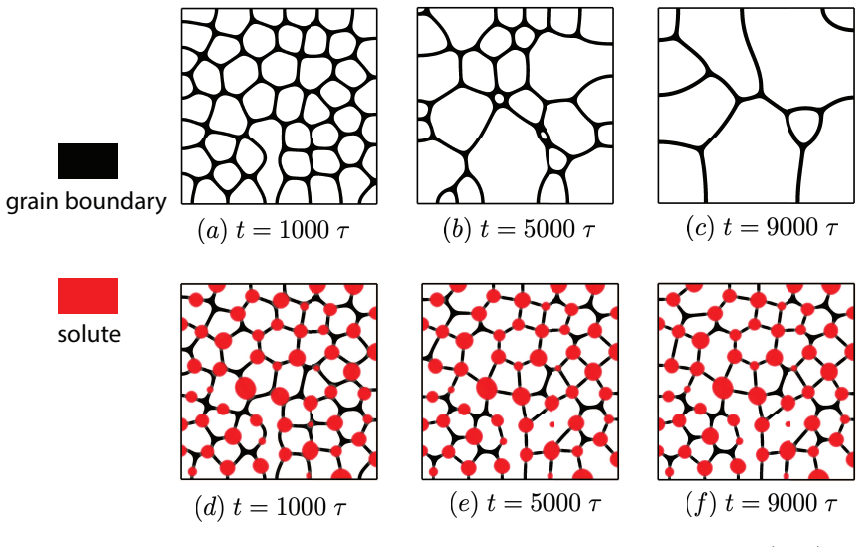
The central claim is that the coupled systems of equations—Eq. (19) for an ideal solution (grain-boundary segregation with mechanics) and Eq. (22) for a regular solution (solute precipitation with mechanics)—capture the simultaneous evolution of grain order parameters φ_i, solute concentration c, solute chemical potential μ, and displacement u in a nanocrystalline polycrystal. The coupling is carried by making the double-well barrier W(c)=Wφ(1−c)+W_c c a decreasing function of solute composition, so solute is thermodynamically pulled into the grain boundaries, and by adding the finite-strain elastic energy (1/2)E:C(φ):E to the total free energy. The demonstrations show three behaviors: segregation produces a composition-dependent drag that slows grain coarsening; precipitation at triple junctions pins those junctions and stabilizes the structure; and mechanical load accelerates grain growth through strain-energy minimization while orienting the remaining grains. The paper reads these as evidence that grain-size stabilization can be engineered through solute interactions and that mechanical deformation can modulate the stabilized microstructure.
Load-bearing premise
The load-bearing assumption is that a simple, uncalibrated linear rule—solute lowers the grain-boundary energy barrier in proportion to its local concentration, with numbers chosen for the demonstrations and constant mobilities—captures the physics of segregation and drag; if that rule is not true for a real alloy, the predicted stabilization could be an artifact.
Editorial extensions
If this is right
- Researchers can now study, in one simulation, how segregation strength, precipitation, and applied strain compete to set the stable grain size of a nanocrystalline alloy.
- The model yields a concrete criterion: when the strain-energy term exceeds the chemical grain-boundary term in the order-parameter equation, mechanical loading dominates and accelerates coarsening; when segregation lowers the barrier enough, drag dominates and suppresses it.
- The triple-junction pinning result implies that precipitate-forming solutes can keep the grain structure stable even under mechanical load, which matters for alloys that are deformed during production or used under stress.
- Because grains with low-strain-energy orientations grow preferentially under load, the framework can predict deformation-induced texture, not just grain-size stabilization.
- The three-dimensional finite-element implementation allows application to realistic polycrystalline geometries, moving beyond 2D idealizations.
Reading between the lines
- A step the paper leaves implicit is calibration: fitting W(c), Mφ, and Msol to atomistic or experimental data for a specific alloy would turn the observed qualitative trends into quantitative design predictions.
- Because the model tracks the solute chemical potential as a field, an immediate testable extension is comparing its steady-state boundary-velocity-versus-driving-force curve against the classical analytical solute-drag solution; agreement would confirm the thermodynamic basis of the drag.
- The same free-energy construction could be extended to anisotropic or temperature-dependent mobilities, which would let the framework address abnormal grain growth and texture evolution without importing a separate model.
- One could also couple the precipitation branch to explicit nucleation kinetics, since currently precipitates form by spinodal decomposition at triple junctions rather than by nucleation and growth.
Editorial analysis
A structured set of objections, weighed in public.
Referee Report
Summary. The manuscript proposes a phase-field framework for coupled grain-boundary segregation, solute drag/precipitation, and finite-strain mechanics in nanocrystalline alloys. The model is built on a free-energy functional whose double-well barrier W(c) depends linearly on solute composition, plus gradient terms for the phase fields and composition and an elastic strain-energy term. Governing equations are presented in strong form (Eqs. (19) and (22)) and weak form (Eqs. (23)-(27)), with backward-Euler time integration over C0 finite elements. Demonstrations include 2D polycrystal simulations of solute segregation/drag for different Wc values, precipitation pinning at triple junctions, load-driven grain growth under elastic anisotropy, and 3D thin-slice coupled cases. The paper claims this is the first unified treatment of these phenomena in a 3D FEM finite-strain phase-field setting.
Significance. If taken at face value, the framework is a useful contribution to computational materials science: it couples conserved and non-conserved phase-field equations with finite-strain mechanics, and the qualitative phenomena shown—solute accumulation at GBs, asymmetric solute profiles during migration, triple-junction pinning, and texture development under load—are consistent with established expectations. The explicit variational weak forms and the use of an established finite-element library are strengths that will help others reproduce the method. The main weaknesses are the lack of calibration and validation against experiments, the non-conservative strong form in Eq. (19), and several algebraic or typographical inconsistencies. None of these invalidates the overall idea, but they must be corrected before the formulation can serve as a reliable reference.
major comments (3)
- [Section 2.1, Eq. (19)] The boxed solute evolution equation ∂c/∂t = c(1−c)M_sol∇²µ is not the divergence of the flux defined in Eq. (6). Continuity (5) with J = −c(1−c)M_sol∇µ gives ∂c/∂t = ∇·[c(1−c)M_sol∇µ]. The printed strong form differs by the term M_sol∇[c(1−c)]·∇µ. With no-flux boundaries, ∫∂c/∂t = ∫c(1−c)M_sol∇²µ dV is not identically zero, so the segregation simulations in Figures 3, 4, and 8 would use a non-conservative equation if Eq. (19) were implemented literally. The weak form (23) integrates the divergence form, so either the strong form is a typo and the paper must state that the weak form is the governing PDE, or the authors must justify dropping the ∇[c(1−c)]·∇µ term and verify global mass conservation in the reported runs.
- [Section 2.1, Eq. (8)] With ~ǫ defined as ǫ/W(c), Eq. (8) is algebraically identical to Eq. (7), since −Mφ W(c)(∂g/∂φ − (ǫ/W(c))∇²φ) = −Mφ(W(c)∂g/∂φ − ǫ∇²φ). The claimed fixed-GB-width modification therefore has no effect on the equation. If a fixed diffuse-interface width is intended, the gradient-energy coefficient in the free energy must be scaled proportionally to W(c), not by ǫ/W(c). As written, this passage is misleading and should be removed or corrected.
- [Section 2, Eq. (2)] The term −ǫ∑_{i=1}^N ∇²φ_i in the evolution equation for φ_i is incorrect; the variational derivative of ∑_i (ǫ/2)|∇φ_i|² with respect to φ_i contains only ∇²φ_i, not the sum over all order parameters. The sum appears to be a typographical error, but since Eq. (2) introduces the base grain-growth model, it should be corrected to avoid ambiguity.
minor comments (6)
- [Section 5] The manuscript reports Wφ=1 and the three Wc values, but it does not provide numerical values for Mφ, M_sol, ǫ, κ, Ωmix, RT, elastic constants, applied load magnitude, time step, or mesh resolution. A parameter table is needed for reproducibility.
- [Section 2.1, after Eq. (7)] The text writes the GB thickness as δ=ǫ/W(c); for the double-well free energy, the diffuse-interface width typically scales as (ǫ/W(c))^{1/2} up to the specific well shape, so this expression should be justified or corrected.
- [Page 4 and References [26,27]] 'Fadi et. al.' should be 'Abdeljawad et al.' and 'Acta Materiallia' should be 'Acta Materialia'.
- [Figure 5 caption and Figure 10 axes] 'soute interaction' and 'precipitaiton' are typos, and the axis label 'T × 10^3 (time step)' is confusing; it should be restated as 'time step (×10^3)' or similar.
- [Reference [31]] The entry is listed as Scripta Materialia 63 (1997) 1049–1052; given the volume number, the year is likely 2010 and should be checked against the original publication.
- [Section 5.4] The '3D' example is a thin slice with 'a few elements along the thickness direction'; the authors should clarify whether the reported results are effectively 2D in-plane and discuss any through-thickness resolution effects.
Circularity Check
The only definitional identity is the redundant ~ǫ rescaling in Eq. (8); the coupled formulation and case studies are not circular.
-
self definitional
[Section 2.1, Eqs. (7)-(8), definition of the scaled interface parameter]
"As the double-well height is now a function of the solute composition, this leads to a dependency of the GB thickness on the solute composition (δ = ǫ/W(c)). To maintain a fixed GB width we introduce a new scaled parameter ˜ǫ = ǫ/W(c). With the introduction of this scaled parameter, the governing equation of grain growth in the presence of a solute distribution is given by, ∂φi/∂t = −MφiW(c)(∂g(φ)/∂φi − ~ǫ∇2φi) (8)."
Because ˜ǫ is defined as ǫ/W(c) immediately above, substituting it into Eq. (8) yields exactly the right-hand side of Eq. (7): −MφW(c)∂g/∂φ + Mφ ǫ∇²φ. The 'scaled' equation is therefore algebraically identical to the equation it is meant to modify; the claimed fixed-GB-width adjustment is a notational relabeling of the existing gradient coefficient and does not introduce a new term. This is a self-definitional identity rather than a derivation of a modified governing equation. The identity is not the source of the paper's central unification claim, and all later weak forms are consistent with the original Eq. (7), so the circularity is minor.
full rationale
The central claim is a coupled 3D finite-strain FEM phase-field formulation, and that formulation is assembled from external prior models (Grönhagen-Ågren, Abdeljawad et al., Tonks et al.) rather than from a self-citation chain; the authors' own references are background examples only and are not load-bearing. The only step in the derivation chain that reduces to its own input by construction is Eq. (8), where the definition ~ǫ=ǫ/W(c) makes the new equation identical to Eq. (7). This no-op does not undermine the coupled formulation because all subsequent weak forms use the equivalent expression. The segregation, drag, and pinning behaviors in Section 5 are model inputs rather than independent predictions: the paper states that W(c) 'has been set up as a decreasing function of solute composition' and that the free energy 'has been setup in a way' to achieve the drag. Because the paper presents these as demonstrations of the model's intended behavior and does not rename them as externally fitted predictions, they do not meet the threshold for fitted-input-called-prediction circularity. No uniqueness theorem or ansatz is imported via self-citation. For completeness, the printed strong form ∂c/∂t=c(1−c)Msol∇²μ in Eq. (19) is not the divergence form of the flux in Eq. (6) used in the weak forms in Eq. (23), but that is a consistency/reproducibility concern outside the circularity definition. The score therefore reflects a single minor definitional identity.
Assumptions & free parameters
free parameters (12)
- Wφ (double-well height, solute-free GB) =
1 (arbitrary units)
- Wc (double-well height, solute-rich GB) =
0.2, -0.1, -0.4 in parametric study
- GB mobility Mφ =
not specified
- Solute mobility Msol =
not specified
- Gradient energy coefficient ǫ =
not specified
- Composition gradient coefficient κ =
not specified
- Heat of mixing Ωmix =
not specified
- Elastic constants and anisotropy ratio =
e2 modulus twice e1; absolute values not specified
- Initial solute composition c0 =
0.3
- Temperature / RT scaling =
not specified
- Applied displacement (load level and rate) =
not specified
- Time stepping and mesh density =
128x128 elements in 2D, 'similar' in 3D; time steps not specified
assumptions (9)
- domain assumption Allen-Cahn and Cahn-Hilliard equations are valid mesoscale models for GB migration and solute diffusion.
- domain assumption Ideal and regular solution free energies describe solute thermodynamics in NC alloys.
- ad hoc to paper A linear composition-dependent double-well height W(c)=Wφ(1-c)+Wc c captures segregation energetics.
- domain assumption GB and solute mobilities are isotropic constants.
- domain assumption Elastic stiffness of a grain boundary region is the h(φ)-weighted average of grain stiffness tensors.
- domain assumption Green-Lagrange strain with a constant elasticity tensor describes finite-strain deformation of the alloy.
- domain assumption GB energy can be measured by the gradient term ∫(ǫ/2)|∇φ|² when GB width is fixed.
- domain assumption No-flux boundary conditions on solute and order parameters are appropriate for the simulated representative patch.
- domain assumption A ~60-grain 2D or 2.5D simulation with six random orientations is representative of NC polycrystal behavior.
Cite this review
Pith. "Pith review of Numerical modeling of microstructure evolution in nanocrystalline alloys - grain boundary segregation, solute drag and mechanics." pith.science (2026). https://pith.science/paper/5TJ7P3FQ
@misc{pith2026260810048,
  author       = {Pith},
  title        = {Pith review of: Numerical modeling of microstructure evolution in nanocrystalline alloys - grain boundary segregation, solute drag and mechanics},
  year         = {2026},
  howpublished = {\url{https://pith.science/paper/5TJ7P3FQ}},
  note         = {Machine review of arXiv:2608.10048}
}
read the original abstract
Nanocrystalline (NC) alloys hold much promise as structural alloys due to their superior mechanical properties over traditional coarser grained microcrystalline alloys. Strength of metallic alloys is related to the underlying grain size - as represented by the classical Hall-Petch relation. Generally, a metals strength increases with decreasing mean grain size from the micrometer scale to the nanometer scale, until about a mean size of 20 nm. Any further decrease of grain size results in decreasing strength. Thus, there is an optimal range of mean grain size for most metals about which maximum material strength can be obtained. In the context of NC alloys, stabilization of the grain size in this optimal range is one of the primary synthesis challenges. Since nm-scale mean grain sizes are desired, phenomena like GB solute segregation and solute precipitation are utilized during alloy synthesis to mitigate grain growth. Numerical modeling the phenomena of GB-solute interactions and the evolution of these stabilized GBs under mechanical load are of immense interest to the NC alloy community. To enrich the numerical modeling formulations available in this space, we present here a phase-field method based numerical framework to model GB segregation, solute precipitation and effect of external loading on NC alloys. While some of these effects have been modeled in isolation, a unified treatment of the solute and GB segregation with mechanics interactions has not be considered in the literature. We present a 3D FEM finite-strain phase-field formulation for modeling grain evolution and microstructure stabilization. Beyond the formulation, various case studies demonstrate the applicability of this framework. Further, thermodynamic and kinetic arguments are provided based on the evolution of GB energy to explain the effects of solute drag, GB pinning and mechanical deformation.
Figures


Figures from the paper (7 more)



Reference graph
Works this paper leans on
-
[1]
P. La, J. Ma, Y. T. Zhu, J. Yang, W. Liu, Q. Xue, R. Z. Valiev, Dry-sliding tribological properties of ultrafine-grained ti prepared by severe plast ic deformation, Acta materialia 53 (2005) 5167–5173
work page 2005
-
[2]
I. Szlufarska, A. Nakano, P. Vashishta, A crossover in th e mechanical response of nanocrystalline ceramics, Science 309 (2005) 911–914
work page 2005
-
[3]
M. A. Meyers, A. Mishra, D. J. Benson, Mechanical propert ies of nanocrystalline materials, Progress in materials science 51 (2006) 427–556
work page 2006
-
[4]
J. P. Hirth, The influence of grain boundaries on mechanic al properties, 1972
work page 1972
- [5]
-
[6]
Hillert, Inhibition of grain-growth by 2nd-phase par ticles, Acta Metallurgica 36 (1988) 3177–3181
M. Hillert, Inhibition of grain-growth by 2nd-phase par ticles, Acta Metallurgica 36 (1988) 3177–3181. 23
work page 1988
-
[7]
Smith, Grains, phases and interfaces - an interpretat ion of microstructure, Trans Am
C. Smith, Grains, phases and interfaces - an interpretat ion of microstructure, Trans Am. Ins. Min. Engg. 175 (1948) 15–51
work page 1948
-
[8]
G. Hassold, H. E. D. Srolovitz, Effects of particle-size o n inhibited grain-growth, Scr. Metall. 24 (1990) 101–107
work page 1990
Show all 41 references
-
[9]
Kirchheim, Grain coarsening inhibited by solute segr egation, Acta Materialia 50 (2002) 413–419
R. Kirchheim, Grain coarsening inhibited by solute segr egation, Acta Materialia 50 (2002) 413–419
2002
-
[10]
Kirchheim, Reducing grain boundary, dislocation li ne and vacancyformation energies by solute segregation
R. Kirchheim, Reducing grain boundary, dislocation li ne and vacancyformation energies by solute segregation. ii. experimental evidence and conse quences, Acta Materialia 55 (2007) 5139–5148
2007
-
[11]
Lücke, K
K. Lücke, K. Detert, A quantitative theory of grain boun dary motion and recrystalliza- tion in metals in the presence of impurities, Acta Metallurg ica 5 (1957) 628–637
1957
-
[12]
J. W. Cahn, Impurity drag effect in grain boundary motion , Acta Metallurgica 10 (1962) 789–798
1962
-
[13]
Hillert, B
M. Hillert, B. Sundman, A treatment of the solute drag on moving grain boundaries and phase interfaces in binary alloys, Acta Metallurgica 24 (1976) 731–743
1976
-
[14]
A. A. Wheeler, W. J. Boettinger, G. B. McFadden, Phase-fi eld model of solute trapping during solidification, Physical Review E 47 (1993) 1893–190 9
1993
-
[15]
N. A. Ahmad, A. A. Wheeler, W. J. Boettinger, G. B. McFadd en, Solute trapping and solute drag in a phase-field model of rapid solidification, Ph ysical Review E 58 (1998) 3436–3450
1998
-
[16]
Loginova, J
I. Loginova, J. Odqvist, G. Amberg, J. Ågren, The phase- field approach and solute drag modeling of the transition to massive γ→ α transformation in binary fe-c alloys, Acta Materialia 51 (2003) 1327–1339
2003
-
[17]
P. R. Cha, S. G. Kim, D. H. Yeon, J. K. Yoon, A phase field mod el for the solute drag on moving grain boundaries, Acta Materialia 50 (2002) 3817– 3829
2002
-
[18]
Strandlund, J
H. Strandlund, J. Odqvist, J. Ågren, An effective mobili ty approach to solute drag in computer simulations of migrating grain boundaries, Compu tational Materials Science 44 (2008) 265–273
2008
-
[19]
Odqvist, B
J. Odqvist, B. Sundman, J. Ågren, A general method for ca lculating deviation from local equilibrium at phase interfaces, Acta Materialia 51 ( 2003) 1035–1043
2003
-
[20]
Grönhagen, J
K. Grönhagen, J. Ågren, Grain-boundary segregation an d dynamic solute drag the- ory—a phase-field approach, Acta Materialia 55 (2007) 955–9 60. 24
2007
-
[21]
S. G. Kim, Y. B. Park, Grain boundary segregation, solut e drag and abnormal grain growth, Acta Materialia 56 (2008) 3739–37539
2008
-
[22]
J. Li, J. Wang, G. Yang, Phase field modeling of grain boun dary migration with solute drag, Acta Materialia 57 (2009) 2108–2120
2009
-
[23]
M. B. Kasen, Some observations on boundary segregation during grain growth annealing of ultrapurity aluminum, Acta Metallurgica 20 (1972) 105–1 13
1972
-
[24]
T. Xu, S. Song, A kinetic model of non-equilibrium grain -boundary segregation, Acta Metallurgica 37 (1989) 2499–2506
1989
-
[25]
Jahazi, J
M. Jahazi, J. J. Jonas, The non-equilibrium segregatio n of boron on original and moving austenite grain boundaries, Mater Sci Engg A 335 (2002) 49–6 1
2002
-
[26]
H. A. Murdoch, C. A. Schuh, Stability of binary nanocrys talline alloys against grain growthand phase separation, Acta Materiallia 61 (2013) 212 1–2132
2013
-
[27]
Abdeljawad, P
F. Abdeljawad, P. Lu, N. Argibay, C. B. G, B. L. Boyce, S. M . Foiles, Grain boundary segregation in immiscible nanocrystalline alloys, Acta Ma teriallia 126 (2017) 528–539
2017
-
[28]
J. W. Cahn, J. E. Hilliard, Free energy of a non uniform sy stem. i, interfacial free energy, J. of Chemical Physics 28 (1958) 258–267
1958
-
[29]
Schönfelder, D
B. Schönfelder, D. Wolf, S. R. Phillpot, M. Furtkamp, Mo lecular-dynamics method for the simulation of grain-boundary migration, Interface Sci ence 5 (1997) 245–262
1997
-
[30]
Tonks, P
M. Tonks, P. Millett, Phase field simulations of elastic deformation-driven grain growth in2d copper polycrystals, Mat. Sci. and Engg A 528 (2011) 408 6–4091
2011
-
[31]
Tonks, P
M. Tonks, P. Millett, W. Cai, D. Wolf, Analysis of the ela stic strain energy driving force for grain boundarymigration using phase field simulat ion, Scripta Materialia 63 (1997) 1049–1052
1997
-
[32]
Kobayashi, Modeling and numerical simulations of de ndritic crystal growth, Physica D: Nonlinear Phenomena 63 (1993) 410–423
R. Kobayashi, Modeling and numerical simulations of de ndritic crystal growth, Physica D: Nonlinear Phenomena 63 (1993) 410–423
1993
-
[33]
W. J. Boettinger, J. A. Warren, C. Beckermann, A. Karma, Phase-field simulation of solidification, Annual review of materials research 32 (200 2) 163–194
-
[34]
Bhagat, S
K. Bhagat, S. Rudraraju, Modeling of dendritic solidifi cation and numerical analysis of the phase-field approach to model complex morphologies in alloys, arXiv preprint arXiv:2210.14449 (2022). 25
2022 arXiv
-
[35]
Nishimori, A
H. Nishimori, A. Onuki, Pattern formation in phase-sep arating alloys with cubic sym- metry, Physical Review B 42 (1990) 980
1990
-
[36]
Y. Wang, D. Banerjee, C.-C. Su, A. Khachaturyan, Field k inetic model and computer simulation of precipitation of l12 ordered intermetallics from fcc solid solution, Acta materialia 46 (1998) 2983–3001
1998
-
[37]
Jiang, S
T. Jiang, S. Rudraraju, A. Roy, A. Van der Ven, K. Garikip ati, M. L. Falk, Multiphysics simulations of lithiation-induced stress in li1+xti2o4 electrode particles, The Journal of Physical Chemistry C 120 (2016) 27871–27881
2016
-
[38]
L.-Q. Chen, W. Yang, Computer simulation of the domain d ynamics of a quenched sys- tem with a large number of nonconserved order parameters: Th e grain-growth kinetics, Physical Review B 50 (1994) 15752
1994
-
[39]
DeWitt, S
S. DeWitt, S. Rudraraju, D. Montiel, W. B. Andrews, K. Th ornton, Prisms-pf: A general framework for phase-field modeling with a matrix-fr ee finite element method, npj Computational Materials 6 (2020) 1–12
2020
-
[40]
Allen, J
S. Allen, J. Cahn, A microscopic theory for antiphase bo undary motion and its appli- cation to antiphase domain coarsening, Acta Metallurgica 2 7 (1979) 1085–1095
1979
-
[41]
Arndt, et al., The deal.II library, version 9.5, 2023
D. Arndt, et al., The deal.II library, version 9.5, 2023. URL: https://dealii.org/deal95-preprint.pdf. doi:10.1515/jnma-2023-0089. 26
2023 doi
Reviewed August 14, 2026 · model on record in the stance chip above.
Discussion (0). Continue with ORCID to comment.