REVIEW 4 major objections 5 minor 29 references
Solver-Agnostic Implementation of Atom-Informed Thermal Conductivity Fields in Continuum Heat-Flow Simulations
T0 review · 4 major / 5 minor · reviewed 2026-08-14 · deepseek-v4-flash
Pith's one-line read SCACS-derived thermal conductivity fields, built from atomistic simulations, can be mapped into Abaqus and produce heat-flow solutions that retain microstructural heterogeneity where uniform-conductivity models do not.
desk verdict Useful Abaqus port of SCACS conductivity fields, but the paper's central solver-agnostic claim is unverified because no native-SCACS comparison appears. read the letter →
The pith
A machine-rendered reading of the paper's core claim, the machinery that carries it, and where it could break.
The reading
What carries the argument
The carrying mechanism is the mapping protocol from SCACS point-cloud output to Abaqus field variables. SCACS stores the coarse-grained orthotropic conductivity as nodal point-cloud data; the components $K_{xx}$, $K_{yy}$, and $K_{zz}$ are extracted from the data files, the finite-element mesh is converted to Abaqus input format, and the nodal fields are assigned to three analytic field variables $F_1(r)\to K_{xx}(r)$, $F_2(r)\to K_{yy}(r)$, and $F_3(r)\to K_{zz}(r)$. Abaqus evaluates the field-variable state at each integration point and maps it to the diagonal conductivity tensor through a field-dependent orthotropic material definition, while an identity orientation matrix keeps the local axes aligned with the global axes. This converts the SCACS field into elementwise conductivity tensors $\overleftrightarrow{K}^{(e)}$ that enter the standard Galerkin stiffness matrix, so the solver's assembly and solution procedures remain unchanged. A homogenized scalar effective conductivity $K_{eff}$ is computed from a two-face Dirichlet solve and supplies the uniform comparison model.
What would settle it
Run the same three models with the native SCACS solver and with the Abaqus-mapped fields under identical boundary conditions and compare elementwise temperature and heat-flux fields: any discrepancy beyond discretization error would falsify the transfer claim. Alternatively, fabricate one of the nanostructures and measure local temperature or heat flux to see whether the predicted hot spots, curved isotherms, and preferential pathways actually appear.
Extended reading notes
Core claim
The central claim is that SCACS-derived conductivity fields are not restricted to the native SCACS finite-element solver. The fields were transferred into Abaqus as point-cloud data defining three principal conductivity components $K_{xx}$, $K_{yy}$, and $K_{zz}$, imported as field variables and a field-dependent orthotropic material definition, and used in steady-state and transient heat-transfer steps with fixed temperatures of 500 K and 300 K on opposite faces. For all three silicon structures, the mapped fields preserved atomistically inherited spatial heterogeneity and directional dependence, and the comparison with uniform-conductivity models shows that matching the homogenized effective conductivity $K_{eff}$ does not guarantee matching internal thermal response: heat-flux fields, transient pathway development, and, for the amorphous-crystalline interface, the steady-state temperature field differ substantially. The paper therefore argues that a single effective property is insufficient when local thermal behavior matters, and that SCACS operates as a solver-agnostic material-field framework for any finite-element platform supporting spatially varying conductivity tensors and material orientations.
Load-bearing premise
Every claim of improved realism rests on the assumption that the SCACS conductivity fields imported from the earlier study are accurate representations of true local thermal conductivity in the three silicon nanostructures; the paper offers no direct experimental measurement of those fields.
Editorial extensions
If this is right
- The same SCACS field can be used in any finite-element platform that accepts spatially varying conductivity tensors and material orientations, so engineers can keep their preferred solver.
- Matching only the effective conductivity is not enough: models with identical geometry, boundary conditions, and $K_{eff}$ produce different transient heat-flow pathways and, in some structures, different temperature fields.
- Atom-informed fields reveal localized hot spots, interface resistance, and transport bottlenecks that uniform models hide, which matters for thermal stress, degradation, and device performance.
- Refining a mesh under the SCACS workflow adds physical information tied to the local atomic structure rather than merely subdividing a homogeneous property, giving a physically consistent basis for adaptive refinement.
- The coarse-grained field is smooth across elements, avoiding artificial discontinuities that can arise from nearest-neighbor assignment or manual phase labeling.
Reading between the lines
- If the atomically derived fields are accurate, importing them into standard engineering platforms could make hot-spot and thermal-stress predictions in devices and extreme-environment components more reliable without any solver changes.
- The protocol suggests a general design pattern: generate a microstructure-aware material field once, then reuse it across different continuum solvers; a natural test is porting the same fields into another platform and checking that steady-state and transient solutions match the Abaqus results.
- The observed anisotropy in the nanopillar field implies that isotropic effective-conductivity homogenization may systematically misassign heat flow in structured geometries, suggesting directional effective tensors as a better design target.
- A practical extension would use the conductivity-field gradient as a mesh-adaptation indicator, refining elements where the material field changes rapidly rather than where the geometry is complex.
Editorial analysis
A structured set of objections, weighed in public.
Referee Report
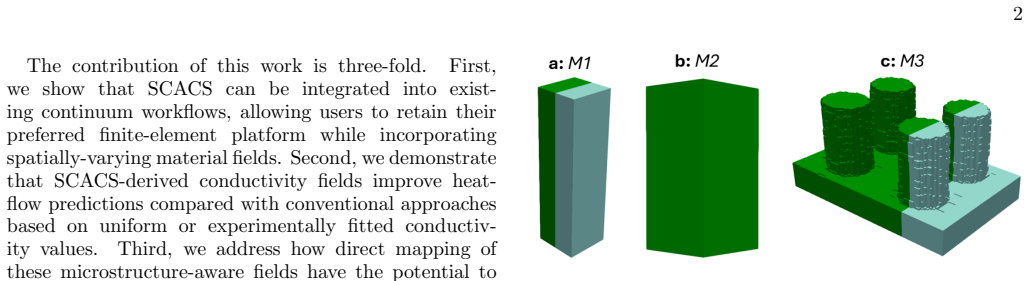
Summary. The paper presents a workflow for transferring atom-informed thermal conductivity fields generated by the SCACS toolkit into Abaqus as spatially varying orthotropic material fields, and it demonstrates the workflow on three silicon nanostructures: a twin-grain-boundary nanowire (M1), an amorphous–crystalline interface (M2), and a nanopillar array (M3). For each structure, the authors run steady-state and transient heat-flow simulations in Abaqus with the SCACS-derived conductivity field and compare the results against Abaqus models that use a uniform scalar conductivity equal to the homogenized effective conductivity. The presented figures show that the heterogeneous field produces nonuniform and microstructure-correlated heat-flux patterns, while the uniform field produces layered or geometry-dominated solutions. The paper claims that this establishes SCACS as a solver-agnostic material-field framework, and it provides input files and a Python conversion utility as supporting material.
Significance. If substantiated, the practical contribution is useful: a reproducible recipe for moving atom-resolved conductivity fields from SCACS point-cloud data into a commercial finite-element solver, with shared data and conversion code. The three geometries cover structurally different cases, and the distinction between geometric and material-driven heat-flow patterns in M3 is a nice illustrative contrast. However, the paper's central claim that the fields are 'solver-agnostic' and can be transferred 'without loss of accuracy' is not actually demonstrated: the only Abaqus-versus-SCACS comparison promised in the Supplemental Material is absent, and the main-text comparisons are only between heterogeneous and uniform conductivity within Abaqus. The reported mesh statistics and the transient density value also contain inconsistencies that cast doubt on the numerical setup as reported. The standard finite-element formulation in Appendix B is sound, and the mapping protocol itself is plausible, but the verification evidence for the paper's main claim is incomplete.
major comments (4)
- [Section IV.A; Supplemental Material Abstract; Section V] The central 'solver-agnostic' claim is not verified by the evidence presented. Section IV.A states that SCACS fields 'can be used in any finite-element platform supporting spatially varying conductivity tensors and material orientations,' but the only solver exercised anywhere in the paper is Abaqus. The Supplemental Material abstract promises a comparison of the Abaqus results 'with those obtained using the native SCACS solver' and states that 'agreement between the two implementations' establishes the transfer, yet no native-SCACS comparison appears in the main text or in the Supplemental Material; Figures S2–S4 only repeat the main-text fields with unnormalized values. The Conclusion also lists 'validation against experiments and other continuum solvers' as future work, which is inconsistent with the assertion that solver-agnosticity has been established. Please add the native-SCACS comparison, or weaken the claim to 'transferable to Abaqus' and remove 'without loss of accuracy.'
- [Table II and Table S2] The reported element and node counts are internally inconsistent. M1 is listed with 1,682,384 elements but only 162,000 nodes, and M2 with 5,417,280 elements and 511,584 nodes, while M3 has 462,372 elements and 504,621 nodes. For conforming DC3D8 hexahedral meshes of the kind described in the text, the node count should generally exceed the element count for well-resolved structured or voxelized domains, and the M3 row shows the expected relationship while the M1 and M2 rows do not. This suggests a transcription error or a mesh problem. Please verify and correct the reported counts, and if the ratios are correct, explain how a conforming hexahedral mesh can have roughly ten elements per node.
- [Section II, 'Finite-element simulations were performed...'] The transient simulations use an unphysical density of approximately 1.2 kg/m^3; crystalline silicon has a density near 2329 kg/m^3. Since density appears in the transient heat equation through the volumetric heat capacity, using 1.2 kg/m^3 changes the thermal diffusivity by about three orders of magnitude and makes any absolute transient timescales nonphysical. If the time snapshots are intended only as fractions of a dimensionless convergence time, this should be stated explicitly and the density value should be corrected or removed; otherwise the transient results do not describe real silicon.
- [Section III and Abstract] The claim that atom-informed fields 'improve realistic prediction and the accuracy of its solution' is not supported because the paper provides no reference solution or experimental data against which accuracy is measured. The comparisons show that a heterogeneous field produces different temperature and heat-flux patterns than a uniform field with the same effective conductivity, but difference is not accuracy. Section III explicitly limits the comparison to 'relative spatial and temporal variations... rather than absolute steady-state differences,' which is appropriate for a demonstration but does not substantiate the accuracy language in the abstract and conclusion. Please either add a quantitative accuracy assessment or rephrase the claims as demonstrations of heterogeneity effects rather than improvements in predictive accuracy.
minor comments (5)
- [Supplemental Material Abstract] The Supplemental Material abstract should be made consistent with the actual content: it promises a comparison with the native SCACS solver, but the supplement contains no such comparison.
- [Various] There are typographical and grammatical errors that should be corrected, including 'subtantially' in Section III, 'Elesvier' in Reference [19], and the incomplete phrase 'This consideration may bear importance for some structures than for others' in Section IV.C.
- [Figures 1 and S1] The captions refer to green and cyan regions, but the figures are difficult to interpret in grayscale print; please use clearly distinguishable labels or hatching so the omitted region and the analyzed slice are unambiguous.
- [Section III, transient snapshots] The transient snapshots are reported at t = 10%, 40%, and 70% of 'convergence time,' but the definition of convergence time and the numerical time-stepping parameters are not given; please define this quantity so the transient results are reproducible.
- [Reference [21]] Reference [21] is a URL to Abaqus documentation; please cite a stable manual version or a persistent identifier instead of a bare web address.
Circularity Check
No derivation step reduces to its inputs; the solver-agnostic claim is unverified but not circular.
full rationale
The paper's derivation chain is not circular in the logical sense used here. Its concrete contributions are a transfer protocol (Appendix A), the finite-element heat equation with elementwise anisotropic conductivity (Appendix B), and homogenization formulas (Appendix C). The SCACS conductivity fields are imported from the authors' prior Ref. [6] as inputs, not re-derived, so the current paper does not define its target result in terms of itself. The main comparison against uniform models assigns the SCACS homogenized K_eff as the uniform value (Table II and Section III), so the reported differences in heat-flux patterns are mathematically forced consequences of retaining spatial heterogeneity in Fourier's law; the paper explicitly frames the comparison as relative spatial and temporal variations rather than absolute steady-state differences. That is a demonstration, not a fitted parameter renamed as a prediction. The load-bearing 'solver-agnostic' assertion is under-validated: the Supplemental abstract promises a comparison with the native SCACS solver, but no such comparison appears in the main text or Supplemental figures, and the Conclusion lists validation against other continuum solvers as future work. This is a missing external check rather than circularity, as is the questionable M1 element/node ratio and the unphysically low density used in transient runs. Self-citations to Ref. [6] supply the input fields but do not substitute for the current paper's independent protocol, so the circularity score remains low.
Assumptions & free parameters
free parameters (1)
- Density for transient simulations =
≈1.2 kg/m3
assumptions (6)
- domain assumption Fourier's law and the continuum heat equation govern the thermal response at the finite-element mesh scale.
- domain assumption The SCACS fields imported from Ref. [6] represent the true local thermal conductivity of the M1-M3 structures.
- domain assumption Principal conductivity axes align with the global x/y/z axes and off-diagonal tensor components are negligible.
- domain assumption The RVE representativeness established in Ref. [6] transfers to the Abaqus meshes used here.
- ad hoc to paper Abaqus field-variable interpolation reproduces the SCACS point-cloud field with sufficient fidelity.
- standard math Galerkin finite-element discretization with C0 shape functions converges to the weak solution of the heat equation.
Cite this review
Pith. "Pith review of Solver-Agnostic Implementation of Atom-Informed Thermal Conductivity Fields in Continuum Heat-Flow Simulations." pith.science (2026). https://pith.science/paper/AYWJEXUA
@misc{pith2026260810099,
  author       = {Pith},
  title        = {Pith review of: Solver-Agnostic Implementation of Atom-Informed Thermal Conductivity Fields in Continuum Heat-Flow Simulations},
  year         = {2026},
  howpublished = {\url{https://pith.science/paper/AYWJEXUA}},
  note         = {Machine review of arXiv:2608.10099}
}
read the original abstract
A recent work introduced the Simulator Collection for Atomic-to-Continuum Scales (SCACS) toolkit, a framework for improving finite element predictions of heat flow by mapping atom-resolved thermal conductivity into the stiffness matrix of the Galerkin finite element formulation [Ugwumadu et al., Phys. Rev. Materials 10, 053804 (2026)]. Here, we demonstrate that SCACS-derived conductivity fields are solver-independent and can be transferred to existing continuum simulation platforms. As a proof of concept, we map SCACS-derived conductivity fields from complex silicon structures onto finite element meshes in Abaqus and compare the resulting heat-flow solutions with that obtained using conventional uniform-conductivity assignment within Abaqus. Comparison of the two implementations shows that atom-informed conductivity fields can be incorporated into existing finite element workflows and improve realistic prediction and the accuracy of its solution. This work supports broader efforts to improve the predictive capability of continuum simulations for efficient materials design and property prediction.
Figures


Figures from the paper (2 more)


Reference graph
Works this paper leans on
-
[1]
O. C. Zienkiewicz, R. L. Taylor, and J. Z. Zhu,The finite element method: Its Basis and Fundamentals, 6th ed. (Elsevier Butterworth-Heinemann, 2005)
work page 2005
-
[2]
M. Kami´ nski and P. Ostrowski, Composite Structures 261, 113555 (2021)
work page 2021
-
[3]
D. Basaula, M. Daeipour, L. Kuna, J. Mangeri, B. Feygelson, and S. Nakhmanson, Acta Materialia228, 117743 (2022)
work page 2022
-
[4]
T. Meng, C. Peng, R. Wang, and Z. Cai, Materials Chem- istry and Physics333, 130392 (2025)
work page 2025
-
[5]
Y. Yang, M. Yan, Z. Zhang, D. Hao, X. Chen, and W. Chen, Finite Elements in Analysis and Design251, 104413 (2025)
work page 2025
-
[6]
C. Ugwumadu, D. A. Drabold, and R. M. Tutchton, Phys. Rev. Mater.10, 053804 (2026)
work page 2026
-
[7]
J. M. Powers, Journal of Heat Transfer126, 670 (2004)
work page 2004
-
[8]
C. Ugwumadu, A. Gautam, Y. G. Lee, and D. A. Drabold, physica status solidi (b) , 2500316 (2025)
work page 2025
Show all 29 references
-
[9]
Gautam, Y
A. Gautam, Y. G. Lee, C. Ugwumadu, K. Nepal, S. Nakhmanson, and D. A. Drabold, physica status solidi (RRL) – Rapid Research Letters19, 2400306 (2025)
2025
-
[10]
Nepal, A
K. Nepal, A. Gautam, R. Hussein, K. Konstantinou, S. Elliott, C. Ugwumadu, and D. Drabold, Solid State Sciences173, 108182 (2026)
2026
-
[11]
Ugwumadu, D
C. Ugwumadu, D. A. Drabold, and R. M. Tutchton, phys- ica status solidi (b)262, 2500109 (2025)
2025
-
[12]
Cheng, H
Z. Cheng, H. Wang, and G.-R. Liu, Engineering Fracture Mechanics258, 108050 (2021)
2021
-
[13]
Ochs and J
J. Ochs and J. Wackerfuß, Proceedings in Applied Math- ematics and Mechanics26, e70097 (2026)
2026
-
[14]
Ugwumadu, W
C. Ugwumadu, W. Downs, C. O’Brien, R. Thapa, R. Ol- son, B. Wisner, M. Ali, J. Trembly, Y. Al-Majali, and D. Drabold, Carbon229, 119506 (2024). 11
2024
-
[15]
M. G. Geers, V. G. Kouznetsova, and W. Brekelmans, Journal of computational and applied mathematics234, 2175 (2010)
2010
-
[16]
Ugwumadu, R
C. Ugwumadu, R. Thapa, K. Nepal, A. Gautam, Y. Al- Majali, J. Trembly, and D. A. Drabold, Journal of Chem- ical Theory and Computation20, 1753 (2024)
2024
-
[17]
S. Liu, M. Zhang, P. Kadam, and C.-C. J. Kuo, in3D Point Cloud Analysis: Traditional, Deep Learning, and Explainable Machine Learning Methods(Springer, 2021) pp. 15–52
2021
-
[18]
Downs, C
W. Downs, C. Ugwumadu, M. Ali, and R. M. Tutch- ton, Zenodo https://doi.org/10.5281/zenodo.21780760 (2026)
2026 doi
-
[19]
Ahrens, B
J. Ahrens, B. Geveci, and C. Law, inVisualization Hand- book(Elesvier, 2005) ISBN 978-0123875822
2005
-
[20]
Schl¨ omer, meshio: Tools for mesh files
N. Schl¨ omer, meshio: Tools for mesh files
-
[21]
[22]Abaqus 2024 Documentation, Dassault Syst` emes SIMU- LIA Corp
Abaqus/CAE User’s Guide: 58.7.1 Creating mapped fields from point cloud data,http://130.149.89.49: 2080/v2016/books/usi/default.htm?startat= pt06ch58s06hlb01.html. [22]Abaqus 2024 Documentation, Dassault Syst` emes SIMU- LIA Corp. (2024), heat-transfer step settings; solu- tio...
2024
-
[23]
See Supplemental Material at [URL will be inserted by publisher] for additional details for this work
-
[24]
R. G. Morris and J. G. Hust, Phys. Rev.124, 1426 (1961)
1961
-
[25]
Isotta, S
E. Isotta, S. Jiang, R. Bueno-Villoro, R. Nagahiro, K. Maeda, D. A. Mattlat, A. R. Odufisan, A. Zevalkink, J. Shiomi, S. Zhang, C. Scheu, G. J. Snyder, and O. Balo- gun, Advanced Functional Materials34, 2405413 (2024)
2024
-
[26]
Ben Amor, D
A. Ben Amor, D. Djomani, M. Fakhfakh, S. Dilhaire, L. Vincent, and S. Grauby, Nanotechnology30, 375704 (2019)
2019
-
[27]
Takeuchi, R
H. Takeuchi, R. Yokogawa, K. Takahashi, K. Ko- mori, T. Morimoto, Y. Yamashita, N. Sawamoto, and A. Ogura, Japanese Journal of Applied Physics59, 075501 (2020)
2020
-
[28]
F. B. Juangsa, Y. Muroya, M. Ryu, J. Morikawa, and T. Nozaki, Applied Physics Letters110, 253105 (2017)
2017
-
[29]
B. L. Davis and M. I. Hussein, Phys. Rev. Lett.112, 055505 (2014)
2014
-
[30]
%) 𝑞(𝑡$"%)𝑞(𝑡%
R. A. Adams and J. J. Fournier,Sobolev spaces, Vol. 140 of Pure and Applied Mathematics (Elsevier, 2003) Chap. 1. Supplemental Material for ‘Solver-Agnostic Implementation of Atom-Informed Thermal Conductivity Fields in Continuum Heat-Flow Simulations’ W. Downs1, C. Ugwumadu*2...
2026
Reviewed August 14, 2026 · model on record in the stance chip above.
Discussion (0). Continue with ORCID to comment.