REVIEW 4 major objections 5 minor 131 references
3D Binary Neutron Star Merger Ejecta Evolution up to Seconds Timescale: Dynamics, Element Distribution, and Light Curves
T0 review · 4 major / 5 minor · reviewed 2026-08-14 · deepseek-v4-flash
Pith's one-line read Full 3D simulations of binary neutron star merger ejecta show that 2D ray-by-ray kilonova light curves are robust upper limits, and that increased dimensionality alone cannot reconcile theoretical models with the AT2017gfo observations.
desk verdict A valuable but slightly over-claimed 3D ejecta evolution paper: the new data and the 2D-vs-3D light-curve comparison are worth engaging, but the central dimensionality conclusion is weakened by a confounded control. read the letter →
The pith
A machine-rendered reading of the paper's core claim, the machinery that carries it, and where it could break.
The reading
What carries the argument
The argument is carried by a pipeline that uses the ejecta crossing a radius of 300 solar masses during the numerical-relativity window as a time-dependent inner boundary for a 3D general-relativistic hydrodynamics evolution on a Schwarzschild background, with a hybrid equation of state that switches from a nuclear-statistical-equilibrium table to a low-density Helmholtz-type EOS, and with nuclear heating injected through fitted heating-rate tables. The identical ejecta are then mapped onto a Lagrangian ray-by-ray radiation-hydrodynamics light-curve code, once as fully 3D multi-angle profiles and once after a mass-weighted azimuthal average, so that the only difference between the two light-curve sets is the dimensionality of the input. A Newtonian homology parameter quantifies how far the ejecta still are from free homologous expansion at one second, and tracer trajectories post-processed through a nuclear reaction network produce the element sky-maps and isotopic yields.
What would settle it
Re-run the same 3D pipeline after adding the missing viscous disk outflows (or otherwise extending the simulation until the remnant disk has finished ejecting): if the 3D bolometric light curve then matches AT2017gfo while the azimuthally averaged 2D curve still falls short, the paper's central claim that dimensionality is not the missing ingredient is falsified.
Extended reading notes
Core claim
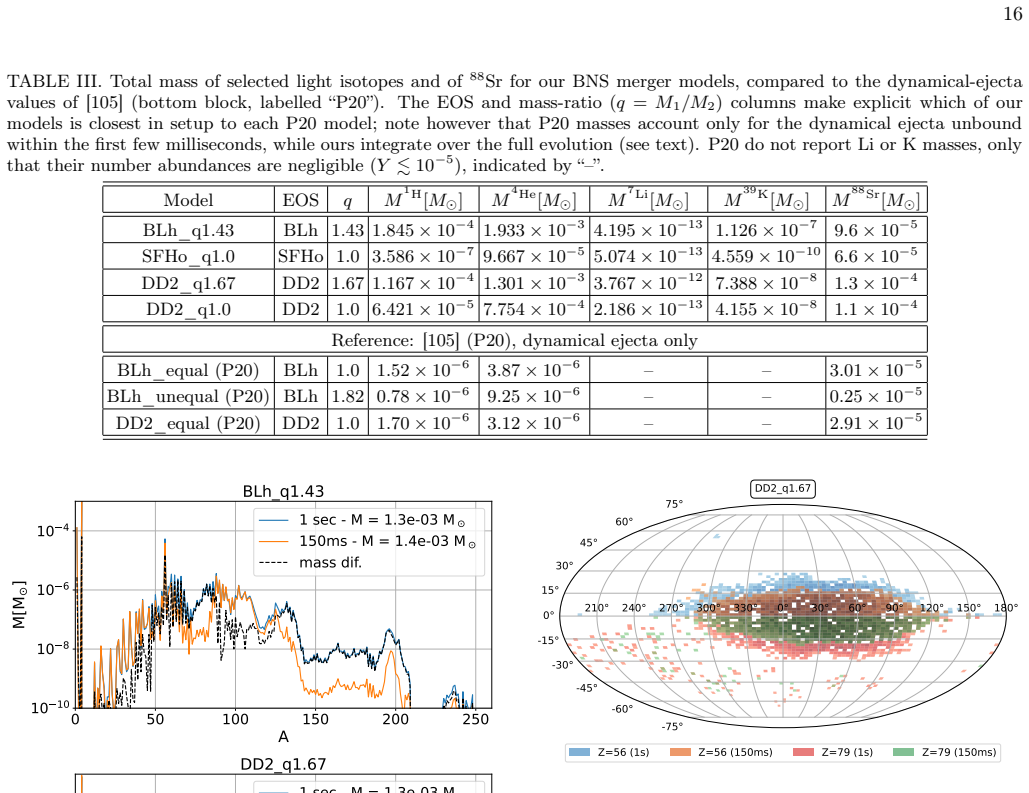
Using four numerical-relativity merger simulations as boundary data, the authors evolve the ejected matter in full 3D for about one second with a transition equation of state and fitted nuclear heating rates. They find that nuclear heating delays the onset of homologous expansion, keeps non-radial motions alive in the most asymmetric binary, and reshuffles heavy elements on the sky: extending the evolution from ~150 ms to ~1 s widens the polar region containing 90% of the heavy-element mass from within 15 degrees of the equator to within 30 degrees. The central comparative discovery is that azimuthally averaged (2D) ray-by-ray light curves are broadly robust but should be treated as upper limits; the 3D light curves peak later, are dimmer, and depend more strongly on viewing angle for unequal-mass binaries, with the 3D emission matching its 2D counterpart only for observers who look straight into the densest part of a lanthanide curtain. From this the authors conclude that dimensionality alone is unlikely to close the gap between ab-initio models and the observed AT2017gfo kilonova, and that the gap points instead to missing ejecta, most plausibly viscous disk outflows.
Load-bearing premise
The comparison assumes that the ejecta recorded in the first ~100 ms of the numerical-relativity simulations are the whole inventory powering the light curve, even though later viscous disk outflows are missing.
Editorial extensions
If this is right
- Published kilonova light curves computed from azimuthally averaged profiles should be interpreted as upper limits on the bolometric luminosity, not as best estimates.
- For unequal-mass mergers, the kilonova's brightness and color depend strongly on viewing angle, with a one-sided 'lanthanide bullet' producing a red, slow-declining direction and a bluer, faster direction opposite to it.
- The 56Ni to 56Co to 56Fe decay chain dominates the heating around 100 days, and the associated gamma-ray lines at 846.77 and 1238.288 keV should be strongest when the binary is viewed close to face-on.
- The residual mismatch with AT2017gfo is more likely explained by missing neutron-rich viscous disk outflows than by the difference between 2D and 3D geometry, redirecting modeling effort toward including late-time disk ejecta.
- Since homologous expansion is not yet reached at one second in the asymmetric models, radiative-transfer light curves that assume homology at earlier times may carry a systematic offset; evolving the ejecta closer to the ~2.5 s homology time would produce more reliable inputs.
Reading between the lines
- If the 2D upper-limit interpretation is right, many previously published kilonova light-curve calculations that azimuthally averaged 3D merger data may have systematically overestimated the emitting mass; re-reading those results as upper limits could revise inferred r-process yields from GW170817/AT2017gfo.
- The predicted one-sided lanthanide bullet in asymmetric mergers implies a measurable late-time spectropolarimetric signature; archival or future polarimetric observations of kilonovae could test this geometry directly.
- The paper's four models span only two equations of state and two mass-ratio ranges; whether the 2D-versus-3D upper-limit behavior is universal across the neutron-star population remains an open question that a broader parameter survey could settle.
- A natural next step the authors do not take is to map the 1 s 3D profiles into a full 3D radiative-transfer solver rather than ray-by-ray sections; the ray-by-ray approximation itself could be tested by comparing its 3D output against a true multi-dimensional transport calculation.
Editorial analysis
A structured set of objections, weighed in public.
Referee Report
Summary. The paper presents long-term (about 1 s) three-dimensional general-relativistic hydrodynamics simulations of ejecta from four binary neutron star merger simulations, using THC numerical-relativity data injected as boundary conditions into Athena++. The code includes a transition from a nuclear-statistical-equilibrium EOS to the Timmes/Helmholtz EOS, an effective nuclear-heating prescription based on reaction-network fits, and passive scalars for electron fraction, entropy, expansion timescale, and injection flag. The authors analyze ejecta dynamics and geometry, report a homology parameter and heating diagnostics, post-process tracers with the WinNet nuclear network to obtain element distributions and nucleosynthesis yields, and compute multi-angle kilonova light curves with KNEC using both 3D and azimuthally-averaged 2D profiles. The main claims are that nuclear heating significantly affects the ejecta dynamics and redistributes heavy elements on the sky, that the 56Ni-56Co-56Fe chain dominates heating around 100 days, that 2D ray-by-ray light curves are broadly robust but should be treated as upper limits, and that increased dimensionality alone cannot bridge the gap between ab-initio simulated light curves and AT2017gfo observations.
Significance. If the central claims hold, this is a valuable step forward: it provides one of the first consistent extensions of NR merger ejecta to second-long timescales in 3D with non-NSE thermodynamics and coupled nuclear heating, and it quantifies how early truncation of the hydrodynamical evolution affects nucleosynthesis and element sky maps. The paper includes useful internal diagnostics, such as the mass-flux comparison in Appendix A, the homology parameter in Fig. 4, and the E_theta^Kinetic diagnostic in Fig. 6, which support the dynamical conclusions. The authors also release tracer data on Zenodo upon acceptance, which is commendable. The heating-rate input is taken from external SkyNet-based fits rather than fitted to observations, and the 56Ni dominance at 100 days is a post-processing result from WinNet, so the light-curve comparison is not circular. However, the headline conclusion about 2D-versus-3D light curves and the AT2017gfo gap is weakened by a methodological confound in the comparison, as detailed below.
major comments (4)
- [Sec. IIE and Sec. IIIC, Fig. 16] The central 2D-versus-3D light-curve comparison conflates dimensionality with the additional ~1 s of hydrodynamical evolution. As stated in Sec. IIE, the 2D KNEC runs are built from azimuthally averaged THC data at r = 300 M_sun, without the Athena++ 3D extension, and the authors explicitly note that the 2D results are 'also representative of an earlier homology assumption.' The BLh_150 run in Fig. 16 is not a control for this comparison: it is a 3D Athena++ run truncated at 150 ms, differing from the 2D calculation in both dimensionality and data origin. Therefore the observed luminosity enhancement of 2D over 3D cannot be uniquely attributed to the axisymmetry assumption. The conclusion in Sec. IV that 'the 2D ray-by-ray approach remains a robust but upper-limit estimate' and that 'increased dimensionality alone is not sufficient' is not yet cleanly supported. A conclusive test would be to azimuthally average the 1 s Athena++ profiles and feed those into KNEC, or otherwise perform a same-time, same-ejecta 2D control.
- [Sec. IIIA and Sec. IIIC] The ejecta inventory used in the comparison is incomplete in a way that limits the AT2017gfo conclusion. The authors state in Sec. IIIA that 'mass ejection from long-lived remnants would still continue past the NR simulated time,' and in Sec. IIIC they attribute a large part of the AT2017gfo gap to missing viscous ejecta. The 3D-vs-2D light-curve comparison, however, is based only on the ejecta that crossed r = 300 M_sun during the ~100 ms covered by the THC simulations. If the later disk outflows are massive and lanthanide-rich, the relative importance of dimensionality versus missing ejecta components could be different for the total ejecta. The paper should either restrict the dimensionality claim to the modeled ejecta component or provide a quantitative estimate of how the missing component would affect the upper-limit interpretation.
- [Sec. IIA and Sec. IIIC] The absence of a resolution study weakens the quantitative claims about light curves and element distributions. The Athena++ grid uses N_theta = 16 and N_phi = 32, which is coarse for capturing the small-scale features of tidal arms and the lanthanide curtain, and the KNEC mapping uses 512 angular sections derived from this grid. No convergence test is presented for the 3D profiles, the opening angles quoted in the abstract (e.g., 15 to 30 degrees), or the light-curve differences in Figs. 16-18. Since several conclusions are phrased in terms of angular structure and luminosity differences of order tens of percent, a resolution study (at least for one model) is needed to establish that the reported 3D features are converged.
- [Sec. IIC and Sec. IIIA] The treatment of Ye as a fixed passive scalar after injection is a potentially load-bearing simplification for the light-curve comparison. The authors note in Sec. IIIA that beta-decay and e± capture can drive Ye to ~0.4 on the second timescale, and the KNEC opacity model in Sec. IIE uses a constant opacity set by the initial Ye. Since the lanthanide fraction and hence the opacity depend on Ye, the 2D-versus-3D luminosity comparison could be affected by the frozen-Ye assumption. The a posteriori pressure-error check in Sec. IIC (12% maximum for 90% of the mass) bounds the thermodynamic impact but does not directly bound the opacity or light-curve impact. A test with a simple Ye-evolution prescription, or at least an estimate of the opacity uncertainty, would strengthen the light-curve conclusions.
minor comments (5)
- [Fig. 6 caption] The last label in the legend reads 'Kinetic Energy' twice; one of the entries should presumably be 'E_theta^Kinetic' as defined in Eq. (19).
- [Sec. IIIA surrounding Eq. (16)] There is a typo: 'accelatation in the Lagrangian grame' should read 'acceleration in the Lagrangian frame.'
- [Sec. IIIC, paragraph near Fig. 18] The sentence 'the AB magnitudes are increased when the dimensionality was increased' is ambiguous; since larger AB magnitudes correspond to dimmer objects, the wording should be clarified (e.g., 'the AB magnitudes become larger, i.e., the model becomes dimmer').
- [Fig. 15 caption] The phrase 'The right captions are insets of the left plots' appears to mean 'the right panels are insets of the left plots' and should be reworded.
- [Sec. IIE, Eq. (14)] The projection weights p_k are defined with a vector solid-angle integral; the notation is somewhat terse. A brief explanation of how the bins are constructed and how the weights are normalized would improve reproducibility.
Circularity Check
No significant circularity: central claims rest on independent hydrodynamics, network nucleosynthesis, and unfitted light-curve comparisons; self-citations are not load-bearing.
full rationale
The paper's central claims do not reduce by construction to their inputs. The long-term Athena++ evolutions are driven by NR boundary data and a transition EOS plus an effective heating prescription; the heating rates of [46,70] are fits to external SkyNet network trajectories, not to the light curves or element yields being predicted. The WinNet post-processing is an independent single-zone network calculation, and the 56Ni->56Co->56Fe dominance at ~100 days is a computed confirmation, not an input constant imposed to match a target. The KNEC light curves use those rates, Ye-dependent opacities, and a thermalization model, and are compared directly with AT2017gfo without fitting; the conclusion that 3D does not close the gap is a null result, not a circular prediction. Self-citations to [35] and [46] serve as comparison benchmarks and methodological sources. [35] is explicitly described as using the same THC data but with a 2D azimuthally averaged, online-network pipeline, and the present paper quantifies why its 56Ni masses differ. The nearest thing to a circularity concern is the 2D-versus-3D light-curve comparison: Sec. II E states that the 2D profiles are constructed directly from azimuthally averaged THC data at r=300 M_sun without the Athena++ extension, so the 2D results combine lower dimensionality, an earlier homology assumption, and a non-mass-conserving averaging. However, the paper explicitly addresses this in Sec. IV, attributing the 2D/3D luminosity differences to positive-flux selection and to the mass-weighted average not preserving total mass, and it includes the BLh_150 control to assess the shorter-evolution-time effect. Whether or not that attribution is fully clean, it is an interpretation of a controlled numerical comparison, not a definitional equivalence; no equation or fitted parameter is recycled as a prediction. The acknowledged missing viscous ejecta and the continued mass ejection from long-lived remnants (Secs. III A and III C) are completeness limitations, not circularity. Overall, the derivation chain is self-contained against external benchmarks and the central claims have independent content.
Assumptions & free parameters
free parameters (2)
- EOS transition boundaries =
T_start=0.7 MeV, T_end=0.05 MeV, n_start=1e-10 fm^-3, n_end=1e-12 fm^-3
- Ejecta definition and heating activation flag cuts =
F in (0.9, 1.1) for heating; |F-1| < 0.01 for ejecta analysis
assumptions (5)
- domain assumption The NR ejecta recorded at r=300 M_sun over the ~100 ms THC simulations constitute the complete ejecta inventory for the first second (no missing disk or viscous outflows).
- domain assumption The fitted heating rates of [46, 70], evaluated with fixed Ye0, s0, tau0, reproduce the true nuclear heating accurately enough for dynamics and light curves.
- domain assumption Hydrodynamics on a Schwarzschild background with mass parameters of each binary is a valid approximation for radii above 300 M_sun.
- domain assumption The WinNet post-processing with free expansion and no neutrino absorption correctly predicts element production from the Athena++ 1s state.
- domain assumption The opacity model (constant opacity set by initial Ye) and thermalization factor f_th=0.5 are adequate for the light curve comparison.
Cite this review
Pith. "Pith review of 3D Binary Neutron Star Merger Ejecta Evolution up to Seconds Timescale: Dynamics, Element Distribution, and Light Curves." pith.science (2026). https://pith.science/paper/DRCB7RYB
@misc{pith2026260810100,
  author       = {Pith},
  title        = {Pith review of: 3D Binary Neutron Star Merger Ejecta Evolution up to Seconds Timescale: Dynamics, Element Distribution, and Light Curves},
  year         = {2026},
  howpublished = {\url{https://pith.science/paper/DRCB7RYB}},
  note         = {Machine review of arXiv:2608.10100}
}
abstract
We present long-term, three-dimensional simulations of ejecta from four binary neutron star mergers to second-long time-scales. Numerical-relativity data serve as boundary conditions for a general-relativistic hydrodynamics evolution incorporating an equation of state valid outside nuclear statistical equilibrium and an effective nuclear-heating prescription based on reaction-network calculations. We investigate the ejecta's dynamical and geometrical properties, the impact of nuclear heating, the formation and spatial distribution of elements, and compute multi-angle kilonova light curves. % Nuclear heating significantly affects ejecta dynamics, delaying homologous expansion beyond second time-scales and reshapes the spatial distribution of heavy nuclei. This effect is largest for asymmetric binaries with long-lived remnants; extending the evolution from ${\sim}150$~ms to ${\sim}1$~s widens the angular polar region containing 90\% of the heavy-element mass (\eg, $Z=56$, $Z=79$) from $|\theta|\lesssim15^{o}$ to $|\theta|\lesssim30^{o}$. Our nucleosynthesis results confirm that the $^{56}$Ni$\rightarrow^{56}$Co$\rightarrow^{56}$Fe decay chain dominates the heating at $\sim$100 days, with cobalt decay producing gamma-ray lines at 846.77 and 1238.288~keV. % Comparing kilonova ray-by-ray light curves obtained from multi-angle 3D profiles and averaged 2D profiles, we find the latter approach broadly robust, although 2D light curves should be treated as upper limits. Increasing dimensionality generally lowers the bolometric luminosity, with binary asymmetry strengthening the viewing-angle dependence. For observers aligned with a lanthanide curtain's densest region, 3D emission can match its 2D counterpart in brightness. We conclude that increased dimensionality alone is unlikely to reconcile current theoretical models with AT2017gfo observations.
Figures


Figures from the paper (17 more)




Reference graph
Works this paper leans on
- [1]
- [2]
-
[3]
J. M. Lattimer and D. N. Schramm, Astrophys. J.192, L145 (1974)
1974
-
[4]
B. Metzger, G. Martinez-Pinedo, S. Darbha, E. Quataert, A. Arcones, et al., Mon.Not.Roy.Astron.Soc.406, 2650 (2010), arXiv:1001.5029 [astro-ph.HE]
arXiv 2010
-
[5]
B. P. Abbottet al. (LIGO Scientific, Virgo), (2018), 10.3847/1538-4357/ab0f3d, arXiv:1810.02581 [gr-qc]. 23
arXiv 2018
-
[6]
B. P. Abbottet al. (LIGO Scientific, Virgo), Phys. Rev. X9, 011001 (2019), arXiv:1805.11579 [gr-qc]
arXiv 2019
-
[7]
B. P. Abbott et al. (GROND, SALT Group, Oz- Grav, DFN, INTEGRAL, Virgo, Insight-Hxmt, MAXI Team, Fermi-LAT, J-GEM, RATIR, IceCube, CAAS- TRO, LWA, ePESSTO, GRAWITA, RIMAS, SKA South Africa/MeerKAT, H.E.S.S., 1M2H Team, IKI- GW Follow-up, Fermi GBM, Pi of Sky, DWF (Deeper Wider Faster Program), Dark Energy Survey, MAS- TER, AstroSat Cadmium Zinc Telluride ...
arXiv 2017
-
[8]
D. A. Coulter et al., Science358, 1556 (2017), arXiv:1710.05452 [astro-ph.HE]
arXiv 2017
Show all 131 references
-
[9]
Arcavi, C
I. Arcavi, C. McCully, G. Hosseinzadeh, D. A. How- ell, S. Vasylyev, D. Poznanski, M. Zaltzman, D. Maoz, L. Singer, S. Valenti, D. Kasen, J. Barnes, T. Piran, and W. fai Fong, The Astrophysical Journal848, L33 (2017)
2017
-
[10]
P. S. Cowperthwaite et al., Astrophys. J.848, L17 (2017), arXiv:1710.05840 [astro-ph.HE]
2017 arXiv
-
[11]
M. C. Díazet al. (TOROS), Submitted to: Astrophys. J. (2017), arXiv:1710.05844 [astro-ph.HE]
2017 arXiv
-
[12]
M. R. Drout et al., Science358, 1570 (2017), arXiv:1710.05443 [astro-ph.HE]
2017 arXiv
-
[13]
P. A. Evans et al., Science358, 1565 (2017), arXiv:1710.05437 [astro-ph.HE]
2017 arXiv
-
[14]
M. M. Kasliwal et al., Science358, 1559 (2017), arXiv:1710.05436 [astro-ph.HE]
2017 arXiv
-
[15]
Pian et al., Nature (2017), 10.1038/nature24298, arXiv:1710.05858 [astro-ph.HE]
E. Pian et al., Nature (2017), 10.1038/nature24298, arXiv:1710.05858 [astro-ph.HE]
2017 arXiv
-
[16]
S.J.Smartt etal.,Nature (2017),10.1038/nature24303, arXiv:1710.05841 [astro-ph.HE]
2017 arXiv
-
[17]
Troja et al., Nature (2017), 10.1038/nature24290, arXiv:1710.05433 [astro-ph.HE]
E. Troja et al., Nature (2017), 10.1038/nature24290, arXiv:1710.05433 [astro-ph.HE]
2017 arXiv
-
[18]
Utsumiet al
Y. Utsumiet al. (J-GEM), Publ. Astron. Soc. Jap.69, 101 (2017), arXiv:1710.05848 [astro-ph.HE]
2017 arXiv
-
[19]
Valenti, D
S. Valenti, D. J. Sand, S. Yang, E. Cappellaro, L. Tartaglia, A. Corsi, S. W. Jha, D. E. Reichart, J. Haislip, and V. Kouprianov, Astrophys. J.848, L24 (2017), arXiv:1710.05854 [astro-ph.HE]
2017 arXiv
-
[20]
V. A. Villar et al., Astrophys. J.851, L21 (2017), arXiv:1710.11576 [astro-ph.HE]
2017 arXiv
- [21]
-
[22]
Radice, A
D. Radice, A. Perego, K. Hotokezaka, S. A. Fromm, S. Bernuzzi, and L. F. Roberts, Astrophys. J.869, 130 (2018), arXiv:1809.11161 [astro-ph.HE]
2018 arXiv
-
[23]
Rosswog, M
S. Rosswog, M. Liebendoerfer, F. Thielemann, M. Davies, W. Benz,et al., Astron.Astrophys.341, 499 (1999), arXiv:astro-ph/9811367 [astro-ph]
1999 arXiv
-
[24]
Rosswog, Philosophical Transactions A373, 2036 (2013)
S. Rosswog, Philosophical Transactions A373, 2036 (2013)
2013
-
[25]
Perego, S
A. Perego, S. Bernuzzi, and D. Radice, Eur. Phys. J. A55, 124 (2019), arXiv:1903.07898 [gr-qc]
2019 arXiv
-
[26]
Nedora, S
V. Nedora, S. Bernuzzi, D. Radice, A. Perego, A. En- drizzi, and N. Ortiz, Astrophys. J.886, L30 (2019), arXiv:1907.04872 [astro-ph.HE]
2019 arXiv
-
[27]
Radice and S
D. Radice and S. Bernuzzi, J. Phys. Conf. Ser.2742, 012009 (2024), arXiv:2310.09934 [astro-ph.HE]
2024 arXiv
-
[28]
Combi and D
L. Combi and D. M. Siegel, Astrophys. J.944, 28 (2023), arXiv:2206.03618 [astro-ph.HE]
2023 arXiv
-
[29]
Dessart, C
L. Dessart, C. Ott, A. Burrows, S. Rosswog, and E. Livne, Astrophys.J.690, 1681 (2009), arXiv:0806.4380 [astro-ph]
2009 arXiv
-
[30]
Perego, S
A. Perego, S. Rosswog, R. Cabezon, O. Korobkin, R. Kaeppeli,et al., Mon.Not.Roy.Astron.Soc.443, 3134 (2014), arXiv:1405.6730 [astro-ph.HE]
2014 arXiv
-
[31]
Martin, A
D. Martin, A. Perego, A. Arcones, F.-K. Thielemann, O. Korobkin, and S. Rosswog, Astrophys. J.813, 2 (2015), arXiv:1506.05048 [astro-ph.SR]
2015 arXiv
-
[32]
Kiuchi, S
K. Kiuchi, S. Fujibayashi, K. Hayashi, K. Kyutoku, Y. Sekiguchi, and M. Shibata, Phys. Rev. Lett.131, 011401 (2023), arXiv:2211.07637 [astro-ph.HE]
2023 arXiv
-
[33]
Goriely, A
S. Goriely, A. Bauswein, and H.-T. Janka, Astrophys.J. 738, L32 (2011), arXiv:1107.0899 [astro-ph.SR]
2011 arXiv
-
[34]
Korobkin, S
O. Korobkin, S. Rosswog, A. Arcones, and C. Win- teler, Mon. Not. Roy. Astron. Soc.426, 1940 (2012), arXiv:1206.2379 [astro-ph.SR]
2012 arXiv
-
[35]
Jacobi, F
M. Jacobi, F. Magistrelli, E. Loffredo, G. Ricigliano, L. Chiesa, S. Bernuzzi, A. Perego, and A. Arcones, Astrophys. J. Lett.999, L16 (2026), arXiv:2503.17445 [astro-ph.HE]
2026 arXiv
-
[36]
A. M. Beloborodov, Astrophys. J.588, 931 (2003), arXiv:astro-ph/0210522
2003 arXiv
-
[37]
D. M. Siegel and B. D. Metzger, Phys. Rev. Lett.119, 231102 (2017), arXiv:1705.05473 [astro-ph.HE]
2017 arXiv
-
[38]
T. M. Sprouse, K. A. Lund, J. M. Miller, G. C. McLaughlin, and M. R. Mumpower, Astrophys. J.962, 79 (2024), arXiv:2309.07966 [astro-ph.HE]
2024 arXiv
-
[39]
Kasen, R
D. Kasen, R. Fernández, and B. Metzger, Mon. Not. Roy. Astron. Soc.450, 1777 (2015), arXiv:1411.3726 [astro-ph.HE]
2015 arXiv
-
[40]
Tanaka et al., Publ
M. Tanaka et al., Publ. Astron. Soc. Jap. (2017), 10.1093/pasj/psx121, arXiv:1710.05850 [astro-ph.HE]
2017 arXiv
-
[41]
Perego, D
A. Perego, D. Radice, and S. Bernuzzi, Astrophys. J. 850, L37 (2017), arXiv:1711.03982 [astro-ph.HE]
2017 arXiv
-
[42]
Nedora, S
V. Nedora, S. Bernuzzi, D. Radice, B. Daszuta, A. En- drizzi, A. Perego, A. Prakash, M. Safarzadeh, F. Schi- anchi, and D. Logoteta, Astrophys. J.906, 98 (2021), arXiv:2008.04333 [astro-ph.HE]
2021 arXiv
-
[43]
Lippuner and L
J. Lippuner and L. F. Roberts, Astrophys. J. Suppl. 233, 18 (2017), arXiv:1706.06198 [astro-ph.HE]
2017 arXiv
-
[44]
Reichertet al., Astrophys
M. Reichertet al., Astrophys. J. Suppl.268, 66 (2023), arXiv:2305.07048 [astro-ph.IM]
2023 arXiv
-
[45]
Magistrelli, S
F. Magistrelli, S. Bernuzzi, A. Perego, and D. Radice, Astrophys. J. Lett.974, L5 (2024), arXiv:2403.13883 [astro-ph.HE]
2024 arXiv
-
[46]
Magistrelli, S
F. Magistrelli, S. Bernuzzi, A. Perego, M. Jacobi, and C. J. Fontes, Astron. Astrophys.708, A126 (2026), arXiv:2512.11032 [astro-ph.HE]
2026 arXiv
-
[47]
Ott, and L
D.Radice, F.Galeazzi, J.Lippuner, L.F.Roberts, C.D. Ott, and L. Rezzolla, Mon. Not. Roy. Astron. Soc.460, 3255 (2016), arXiv:1601.02426 [astro-ph.HE]
2016 arXiv
-
[48]
Radice and L
D. Radice and L. Dai, Eur. Phys. J.A55, 50 (2019), arXiv:1810.12917 [astro-ph.HE]
2019 arXiv
-
[49]
Camilletti, L
A. Camilletti, L. Chiesa, G. Ricigliano, A. Perego, L. C. Lippold, S. Padamata, S. Bernuzzi, D. Radice, D. Lo- goteta, and F. M. Guercilena, Mon. Not. Roy. Astron. 24 Soc.516, 4760 (2022), arXiv:2204.05336 [astro-ph.HE]
2022 arXiv
-
[50]
Neuweiler, T
A. Neuweiler, T. Dietrich, M. Bulla, S. V. Chaurasia, S. Rosswog, and M. Ujevic, Phys. Rev. D107, 023016 (2023), arXiv:2208.13460 [astro-ph.HE]
2023 arXiv
-
[51]
Neuweileret al., Phys
A. Neuweileret al., Phys. Rev. D113, 043038 (2026), arXiv:2510.14850 [astro-ph.HE]
2026
-
[52]
Rosswog, O
S. Rosswog, O. Korobkin, A. Arcones, F. K. Thiele- mann, and T. Piran, Mon. Not. Roy. Astron. Soc.439, 744 (2014), arXiv:1307.2939 [astro-ph.HE]
2014 arXiv
-
[53]
Kawaguchi, N
K. Kawaguchi, N. Domoto, S. Fujibayashi, H. Hami- dani, K. Hayashi, M. Shibata, M. Tanaka, and S. Wanajo, Mon. Not. Roy. Astron. Soc.535, 3711 (2024), arXiv:2404.15027 [astro-ph.HE]
2024 arXiv
-
[54]
Morozova, A
V. Morozova, A. L. Piro, M. Renzo, C. D. Ott, D. Clausen, S. M. Couch, J. Ellis, and L. F. Roberts, Astrophys. J.814, 63 (2015), arXiv:1505.06746 [astro- ph.HE]
2015 arXiv
-
[55]
M.Bulla,Mon.Not.Roy.Astron.Soc.489,5037(2019), arXiv:1906.04205 [astro-ph.HE]
2019 arXiv
-
[56]
C. E. Collins, A. Bauswein, S. A. Sim, V. Vijayan, G. Martínez-Pinedo, O. Just, L. J. Shingles, and M. Kromer, Mon. Not. Roy. Astron. Soc.521, 1858 (2023), arXiv:2209.05246 [astro-ph.HE]
2023 arXiv
-
[57]
L. S. Groenewegen, S. Curtis, P. Mösta, D. Kasen, and D. Brethauer, Mon. Not. Roy. Astron. Soc.543, 2836 (2025), arXiv:2508.00062 [astro-ph.HE]
2025
-
[58]
Breschi, A
M. Breschi, A. Perego, S. Bernuzzi, W. Del Pozzo, V. Nedora, D. Radice, and D. Vescovi, Mon. Not. Roy. Astron. Soc.505, 1661 (2021), arXiv:2101.01201 [astro- ph.HE]
2021 arXiv
-
[59]
Kasen, B
D. Kasen, B. Metzger, J. Barnes, E. Quataert, and E. Ramirez-Ruiz, Nature (2017), 10.1038/nature24453, [Nature551,80(2017)], arXiv:1710.05463 [astro-ph.HE]
2017 arXiv
-
[60]
B. D. Metzger, Living Rev. Rel.23, 1 (2020), arXiv:1910.01617 [astro-ph.HE]
2020 arXiv
-
[61]
Nicholl, B
M. Nicholl, B. Margalit, P. Schmidt, G. P. Smith, E. J. Ridley, and J. Nuttall, (2021), arXiv:2102.02229 [astro- ph.HE]
2021 arXiv
-
[62]
O. Just, V. Vijayan, Z. Xiong, S. Goriely, T. Soulta- nis, A. Bauswein, J. Guilet, H. T. Janka, H.-T. Janka, and G. Martínez-Pinedo, Astrophys. J. Lett.951, L12 (2023), arXiv:2302.10928 [astro-ph.HE]
2023 arXiv
-
[63]
O. Just, M. Obergaulinger, and H. T. Janka, Mon. Not. Roy. Astron. Soc.453, 3386 (2015), arXiv:1501.02999 [astro-ph.HE]
2015 arXiv
-
[64]
thesis, Max-Planck-Institute for Astrophysics, Garching (2008)
M.Obergaulinger, Astrophysical magnetohydrodynamics and radiative transfer: numerical methods and applications, Ph.D. thesis, Max-Planck-Institute for Astrophysics, Garching (2008)
2008
-
[65]
J. M. Stone, K. Tomida, C. J. White, and K. G. Felker, Astrophys. J. Suppl.249, 4 (2020), arXiv:2005.06651 [astro-ph.IM]
2020 arXiv
-
[66]
D.RadiceandS.Bernuzzi,Astrophys.J.959,46(2023), arXiv:2306.13709 [astro-ph.HE]
2023
-
[67]
Bernuzzi, F
S. Bernuzzi, F. Magistrelli, M. Jacobi, D. Logoteta, A. Perego, and D. Radice, Mon. Not. Roy. Astron. Soc. 256, 271 (2025), arXiv:2409.18185 [astro-ph.HE]
2025 arXiv
-
[68]
E. M. Gutierrez, M. Bhattacharya, D. Radice, K. Murase, and S. Bernuzzi, Phys. Rev. D111, 063031 (2025), arXiv:2408.15973 [astro-ph.HE]
2025 arXiv
-
[69]
F. X. Timmes and F. D. Swesty, Astrophys. J. Suppl. 126, 501 (2000)
2000
-
[70]
Z. Wu, G. Ricigliano, R. Kashyap, A. Perego, and D.Radice,Mon.Not.Roy.Astron.Soc.512,328(2022), arXiv:2111.06870 [astro-ph.HE]
2022 arXiv
-
[71]
Banyuls, J
F. Banyuls, J. A. Font, J. M. A. Ibanez, J. M. A. Marti, and J. A. Miralles, Astrophys. J.476, 221 (1997)
1997
-
[72]
Bombaci and D
I. Bombaci and D. Logoteta, Astron. Astrophys.609, A128 (2018), arXiv:1805.11846 [astro-ph.HE]
2018 arXiv
-
[73]
Logoteta, A
D. Logoteta, A. Perego, and I. Bombaci, Astron. As- trophys.646, A55 (2021), arXiv:2012.03599 [nucl-th]
2021 arXiv
-
[74]
A. W. Steiner, J. M. Lattimer, and E. F. Brown, Astro- phys. J.722, 33 (2010), arXiv:1005.0811 [astro-ph.HE]
2010 arXiv
-
[75]
Typel, G
S. Typel, G. Ropke, T. Klahn, D. Blaschke, and H. H. Wolter, Phys. Rev.C81, 015803 (2010), arXiv:0908.2344 [nucl-th]
2010 arXiv
-
[76]
Hempel and J
M. Hempel and J. Schaffner-Bielich, Nucl. Phys.A837, 210 (2010), arXiv:0911.4073 [nucl-th]
2010 arXiv
-
[77]
Radice and L
D. Radice and L. Rezzolla, Astron. Astrophys.547, A26 (2012), arXiv:1206.6502 [astro-ph.IM]
2012 arXiv
-
[78]
Radice, L
D. Radice, L. Rezzolla, and F. Galeazzi, Mon.Not.Roy.Astron.Soc.437, L46 (2014), arXiv:1306.6052 [gr-qc]
2014 arXiv
-
[79]
Radice, L
D. Radice, L. Rezzolla, and F. Galeazzi, Class.Quant.Grav.31, 075012 (2014), arXiv:1312.5004 [gr-qc]
2014 arXiv
-
[80]
Radice, L
D. Radice, L. Rezzolla, and F. Galeazzi, Proceedings, Numerical Modeling of Space Plasma Flows (ASTRONUM-2014): Long Beach, CA, USA, June 23-27, 2014, ASP Conf. Ser.498, 121 (2015), arXiv:1502.00551 [gr- qc]
2015 arXiv
- [81]
-
[82]
Radice, Symmetry12, 1249 (2020), arXiv:2005.09002 [astro-ph.HE]
D. Radice, Symmetry12, 1249 (2020), arXiv:2005.09002 [astro-ph.HE]
2020 arXiv
-
[83]
Radice, S
D. Radice, S. Bernuzzi, A. Perego, and R. Haas, Mon. Not. Roy. Astron. Soc.512, 1499 (2022), arXiv:2111.14858 [astro-ph.HE]
2022 arXiv
-
[84]
M. Gong, K. W. Ho, J. M. Stone, E. C. Os- triker, P. Caselli, T. Grassi, C.-G. Kim, J.-G. Kim, and G. Halevi, Astrophys. J. Suppl.268, 42 (2023), arXiv:2305.04965 [astro-ph.GA]
2023 arXiv
-
[85]
O. Just, Z. Xiong, and G. Martínez-Pinedo, Phys. Rev. D113, 083022 (2026), arXiv:2507.09040 [astro-ph.SR]
2026 arXiv
-
[86]
W. Cook, B. Daszuta, J. Fields, P. Hammond, S. Al- banesi, F. Zappa, S. Bernuzzi, and D. Radice, Astro- phys. J. Suppl.277, 3 (2025), arXiv:2311.04989 [gr-qc]
2025 arXiv
-
[87]
Kastaun, J
W. Kastaun, J. V. Kalinani, and R. Ciolfi, Phys. Rev. D103, 023018 (2021), arXiv:2005.01821 [gr-qc]
2021 arXiv
-
[88]
R. H. Cyburt, A. M. Amthor, R. Ferguson, Z. Meisel, K. Smith, S. Warren, A. Heger, R. D. Hoffman, T. Rauscher, A. Sakharuk, H. Schatz, F. K. Thiele- mann, and M. Wiescher, Astrophys. J. Suppl.189, 240 (2010)
2010
-
[89]
G. M. Fuller, W. A. Fowler, and M. J. Newman, As- trophys. J.293, 1 (1985)
1985
-
[90]
T. Oda, M. Hino, K. Muto, M. Takahara, and K. Sato, Atom. Data Nucl. Data Tabl.56, 231 (1994)
1994
-
[91]
Langanke and G
K. Langanke and G. Martínez-Pinedo, Atom. Data Nucl. Data Tabl.79, 1 (2001)
2001
-
[92]
Pruet and G
J. Pruet and G. M. Fuller, Astrophys. J. Suppl.149, 189 (2003), arXiv:astro-ph/0303235
2003 arXiv
-
[93]
Suzuki, H
T. Suzuki, H. Toki, and K. Nomoto, Astrophys. J.817, 163 (2016), arXiv:1512.00801 [astro-ph.SR]
2016 arXiv
-
[94]
M. R. Mumpower, T. Kawano, and T. M. Sprouse, Phys. Rev. C106, 065805 (2022), arXiv:2201.02889 [nucl-th]
2022 arXiv
-
[95]
I. V. Panov, I. Y. Korneev, T. Rauscher, G. Martínez- Pinedo, A. Kelic-Heil, N. T. Zinner, and F.-K. Thielemann, Astron. Astrophys.513, A61 (2010), 25 arXiv:0911.2181 [astro-ph.SR]
2010 arXiv
-
[96]
Khuyagbaatar, Nucl
J. Khuyagbaatar, Nucl. Phys. A1002, 121958 (2020)
2020
-
[97]
Möller, A
P. Möller, A. J. Sierk, T. Ichikawa, A. Iwamoto, and M. Mumpower, Phys. Rev. C91, 024310 (2015), arXiv:1502.03635 [nucl-th]
2015 arXiv
-
[98]
I. V. Panov, C. Freiburghaus, and F.-K. Thielemann, Nucl. Phys. A688, 587 (2001)
2001
-
[99]
Dong and Z
T. Dong and Z. Ren, Eur. Phys. J. A26, 69 (2005)
2005
-
[100]
Rauscher, Astrophys
T. Rauscher, Astrophys. J. Suppl.147, 403 (2003), arXiv:astro-ph/0304022
2003 arXiv
-
[101]
P. A. Kravchuk and D. G. Yakovlev, Phys. Rev. C89, 015802 (2014), arXiv:1311.7005 [astro-ph.SR]
2014 arXiv
-
[102]
F. X. Timmes and D. Arnett, Astrophys. J. Suppl.125, 277 (1999)
1999
-
[103]
late peak
at lower temperatures as described in [45]. Consistently with the relativistic hydrodynamics evo- lution of the ejecta inAthena++, we calculate the nu- clear power from the analytical fits of [46, 70], based on 1 https://github.com/nuc-astro/WinNet a grid of tabulated thermody...
-
[104]
Paczynski, Astrophys
B. Paczynski, Astrophys. J. Lett.308, L43 (1986)
1986
-
[105]
Lippuner and L
J. Lippuner and L. F. Roberts, Astrophys. J.815, 82 (2015), arXiv:1508.03133 [astro-ph.HE]
2015 arXiv
-
[106]
Perego et al., Astrophys
A. Perego et al., Astrophys. J.925, 22 (2022), arXiv:2009.08988 [astro-ph.HE]
2022 arXiv
-
[107]
Kasen and J
D. Kasen and J. Barnes, Astrophys. J.876, 128 (2019), arXiv:1807.03319 [astro-ph.HE]
2019 arXiv
-
[108]
Curtis, P
S. Curtis, P. Mösta, Z. Wu, D. Radice, L. Roberts, G. Ricigliano, and A. Perego, Mon. Not. Roy. Astron. Soc.518, 5313 (2022), arXiv:2112.00772 [astro-ph.HE]
2022 arXiv
-
[109]
Ricigliano, M
G. Ricigliano, M. Jacobi, and A. Arcones, Mon. Not. Roy. Astron. Soc.533, 2096 (2024), arXiv:2406.03649 [astro-ph.HE]
2024 arXiv
-
[110]
T. E. Hanover and M. D. Leising, Astrophys. J.989, 199 (2025), arXiv:2507.11647 [astro-ph.HE]
2025 arXiv
-
[111]
Kosakowski, M
D. Kosakowski, M. I. Ugalino, R. Fisher, O. Graur, A. Bobrick, and H. B. Perets, Mon. Not. Roy. Astron. Soc.519, L74 (2022), arXiv:2210.10804 [astro-ph.HE]
2022 arXiv
-
[112]
L.-S. The, D. D. Clayton, R. Diehl, D. H. Hartmann, A. F. Iyudin, M. D. Leising, B. S. Meyer, Y. Mo- tizuki, and V. Schonfelder, Astron. Astrophys.450, 1037 (2006), arXiv:astro-ph/0601039
2006 arXiv
-
[113]
Chen and B
J. Chen and B. Singh, Nuclear Data Sheets190, 1 (2023)
2023
-
[114]
Jerkstrand, C
A. Jerkstrand, C. Fransson, and C. Kozma, Astron. and Astrophys.530, A45 (2011), arXiv:1103.3653 [astro- ph.HE]
2011 arXiv
-
[115]
S. A. Grebenev, A. A. Lutovinov, S. S. Tsygankov, and C. Winkler, Nature490, 373 (2012), arXiv:1211.2656 [astro-ph.HE]
2012 arXiv
-
[116]
J. Huo, S. Huo, and D. Yang, Nuclear Data Sheets112, 1513 (2011)
2011
-
[117]
Watson et al., Nature574, 497 (2019), arXiv:1910.10510 [astro-ph.HE]
D. Watson et al., Nature574, 497 (2019), arXiv:1910.10510 [astro-ph.HE]
2019
-
[118]
Domoto, M
N. Domoto, M. Tanaka, S. Wanajo, and K. Kawaguchi, Astrophys. J.913, 26 (2021), arXiv:2103.15284 [astro- ph.HE]
2021 arXiv
-
[119]
J. H. Gillanders, S. J. Smartt, S. A. Sim, A. Bauswein, and S. Goriely, Mon. Not. Roy. Astron. Soc.515, 631 (2022), arXiv:2202.01786 [astro-ph.HE]
2022 arXiv
-
[120]
Tarumi, K
Y. Tarumi, K. Hotokezaka, N. Domoto, and M. Tanaka, (2023), arXiv:2302.13061 [astro-ph.HE]
2023 arXiv
-
[121]
Sneppen, R
A. Sneppen, R. Damgaard, D. Watson, C. E. Collins, L. Shingles, and S. A. Sim, Astron. Astrophys.692, A134 (2024), arXiv:2407.12907 [astro-ph.HE]
2024
-
[122]
A. Arya, R. Damgaard, A. Sneppen, D. J. Dougan, S. A. Sim, C. P. Ballance, and D. Watson, (2026), arXiv:2604.05812 [astro-ph.HE]
2026 arXiv
-
[123]
Fujibayashi, K
S. Fujibayashi, K. Kiuchi, S. Wanajo, K. Kyutoku, Y. Sekiguchi, and M. Shibata, Astrophys. J.942, 39 (2023), arXiv:2205.05557 [astro-ph.HE]
2023 arXiv
-
[124]
Barnes and D
J. Barnes and D. Kasen, Astrophys. J.775, 18 (2013), arXiv:1303.5787 [astro-ph.HE]
2013 arXiv
-
[125]
Kasen, N
D. Kasen, N. R. Badnell, and J. Barnes, Astrophys. J. 774, 25 (2013), arXiv:1303.5788 [astro-ph.HE]
2013 arXiv
-
[126]
W. Even, O. Korobkin, C. L. Fryer, C. J. Fontes, R. Wollaeger, A. Hungerford, J. Lippuner, J. Miller, M. R. Mumpower, and G. W. Misch, Astrophys. J. 899, 24 (2020), arXiv:1904.13298 [astro-ph.HE]
2020 arXiv
-
[127]
Tanaka, D
M. Tanaka, D. Kato, G. Gaigalas, and K. Kawaguchi, Mon. Not. Roy. Astron. Soc.496, 1369 (2020), arXiv:1906.08914 [astro-ph.HE]
2020 arXiv
-
[128]
J. M. Miller, B. R. Ryan, J. C. Dolence, A. Burrows, C. J. Fontes, C. L. Fryer, O. Korobkin, J. Lippuner, M. R. Mumpower, and R. T. Wollaeger, Phys. Rev. D100, 023008 (2019), arXiv:1905.07477 [astro-ph.HE]
2019 arXiv
-
[129]
Curtis, J
S. Curtis, J. M. Miller, C. Fröhlich, T. Sprouse, N. Lloyd-Ronning, and M. Mumpower, Astro- phys. J. Lett. (2023), 10.3847/2041-8213/acba16, arXiv:2212.10691 [astro-ph.HE]
2023 arXiv
-
[130]
W. D. Arnett, Astrophys. J.237, 541 (1980)
1980
-
[131]
W. Cook, E. M. Gutiérrez, S. Bernuzzi, D. Radice, B. Daszuta, J. Fields, P. Hammond, H. Bandyopadhyay, and M. Jacobi, (2025), arXiv:2508.19342 [astro-ph.HE]
2025 arXiv
Reviewed August 14, 2026 · model on record in the stance chip above.
Discussion (0). Continue with ORCID to comment.