REVIEW 3 major objections 5 minor 53 references
PERCEPT: A Corpus for POS Tagging and Analysis of Persian-English Code-Mixing
T0 review · 3 major / 5 minor · reviewed 2026-08-14 · deepseek-v4-flash
Pith's one-line read The PERCEPT corpus is the first large-scale Persian-English code-mixed dataset with Universal Dependencies POS tags for code-mixed words.
desk verdict A genuinely useful new Persian-English code-mixed corpus built with LLM annotation; the corpus is solid, but the paper's quantitative linguistic analyses overstate their support given known annotation error rates. read the letter →
The pith
A machine-rendered reading of the paper's core claim, the machinery that carries it, and where it could break.
The reading
What carries the argument
The central object is the PERCEPT corpus: 6,800 anonymized Persian posts containing 5,660 code-mixed tokens from X, 1,635 from Instagram, and 3,490 from Digikala, each code-mixed token tagged with one of 17 Universal Dependencies POS tags. The mechanism that carries the argument is the LLM-assisted annotation pipeline, which uses platform-specific prompts to identify English and English-transliterated code-mixed words, exclude established loanwords, proper nouns, and platform-specific interface terms, and assign POS tags with the model's temperature set to zero. Human validation on 150 texts (268 code-mixed words) reports a token-level F1 of 90.8%, a POS accuracy of 97.0% on correctly identified tokens, and a POS macro F1 of 76.8%, with an overall pipeline F1 of 88.1%.
What would settle it
Take a random sample of roughly 500 PERCEPT texts, have native-speaker annotators label code-mixed tokens and POS tags following the same instructions, and compare the resulting noun proportions, triggering rates, and platform differences with the LLM-based numbers; if, for example, the Digikala noun share drops toward 40% or the triggering gap narrows below the reported margins, the corpus-level analyses are not robust.
Extended reading notes
Core claim
The central claim is that PERCEPT is the first large-scale, publicly available Persian-English code-mixed corpus whose code-mixed words carry Universal Dependencies POS tags, covering both English-script borrowings and English words transliterated into Persian script. The paper argues that this resource, built from 6,800 posts across X, Instagram, and Digikala, supports the first multi-platform empirical analysis of Persian-English code-mixing. The analyses assert that nouns are the dominant POS category for code-mixed words, that positional distributions are consistent across platforms (roughly one-third each in initial, medial, and final positions, with a chi-square test yielding no significant platform association), that the triggering effect—multiple code-mixed words within one utterance—is stronger in Digikala (42.0% length-controlled) than in X (27.1%) or Instagram (10.2%), and that Industry & Commerce and Brand & Business topics show the highest code-mixing density.
Load-bearing premise
The quantitative conclusions treat the automatically generated POS and topic labels as correct for all 6,800 texts, but only 150 texts (268 code-mixed words) were checked by humans, so systematic annotation errors could change the reported distributions.
Editorial extensions
If this is right
- Persian NLP systems can use PERCEPT to train and evaluate POS taggers, language identifiers, and syntactic parsers on code-mixed input, a setting where such tools are currently weak.
- The prompt-based annotation framework, being tied to the language-independent UD tagset, can be adapted to other low-resource code-mixed language pairs by translating the prompts and adjusting the exclusion lists.
- The finding that nouns dominate code-mixing and that e-commerce platform vocabulary inflates the PROPN category can guide the design of code-mixed lexicons and text-normalization tools.
- The stronger triggering effect in Digikala implies that e-commerce reviews are a particularly concentrated site of code-mixing, which matters for sentiment analysis and product-summary systems.
- Because positional distributions are consistent across platforms, a single positional model may suffice for predicting where code-mixing appears in Persian social media text across genres.
Reading between the lines
- If the reported human-LLM agreement generalizes, it suggests that LLM-assisted annotation can produce linguistic corpora for low-resource code-mixed languages at scale, but the 2.2% validation sample leaves the error bars on the corpus-level statistics unknown.
- The large PROPN share on Digikala (35.0%) is partly a product of prompt design: the annotation instructions exclude established loanwords and platform-specific terms from tagging, so cross-platform differences in PROPN may be amplified by the exclusion lists rather than by underlying language use.
- The triggering-effect operationalization (whether an utterance contains more than one code-mixed word) is a coarse density measure; a more direct test of the triggering hypothesis would model inter-code-mixed-word distances or use a regression that controls for topic and utterance length.
- Because texts labeled as offensive were removed from the source datasets, PERCEPT may underrepresent certain topics and styles, which could bias the reported topic-code-mixing correlations.
Signed reviews
Editorial analysis
A structured set of objections, weighed in public.
Referee Report
Summary. This paper introduces PERCEPT, a corpus of 6,800 Persian–English code-mixed texts from X, Instagram, and Digikala, with Universal Dependencies POS tags for code-mixed words and document-level topic labels generated by Gemini 3.5 Flash and validated by human annotators on a sample. The paper then presents cross-platform analyses of POS distributions, the position of code-mixed words within utterances, a triggering effect measured by co-occurrence of multiple code-mixed words per utterance, and variation in mixing degree across topics. The authors claim that PERCEPT is the first publicly available large-scale POS-annotated Persian–English code-mixed corpus and that their analyses constitute the first cross-platform empirical study of Persian–English code-mixing.
Significance. The dataset fills a clear gap: no existing Persian–English code-mixed corpus provides UD POS annotations, and the resource could support POS tagging, language identification, and other downstream tasks. The release of the corpus, prompts, and analysis code is a concrete contribution. The annotation framework is straightforward, but the human validation protocol (two native annotators, adjudication, explicit instructions without AI assistance) is sound as far as it goes. The quantitative linguistic findings are interesting, but they are only as reliable as the underlying automatic labels; the paper does not currently establish that reliability for the full-corpus statistics.
major comments (3)
- [§4 (Tables 2–4, Figure 2) and §3.1–3.2] The corpus-level statistics in Section 4 are direct aggregates of the LLM-generated labels, but the evaluation errors reported in Section 3.1 are never propagated into them. The LLM's code-mixed token recall is 86.6% (F1 90.8%), its POS macro F1 is 76.8%, and its topic macro F1 is 65.6%. The paper offers no confidence intervals, no sensitivity analysis, and no re-analysis on the 150-text validated subset. Because the abstract and introduction present noun predominance, positional consistency, and the Digikala triggering effect as findings, these are load-bearing claims. For instance, a 13.4% false-negative rate for token identification could shift the Table 2 percentages if missed tokens are non-random with respect to POS or platform, and the Table 4 triggering rates are computed entirely from the same token identifications.
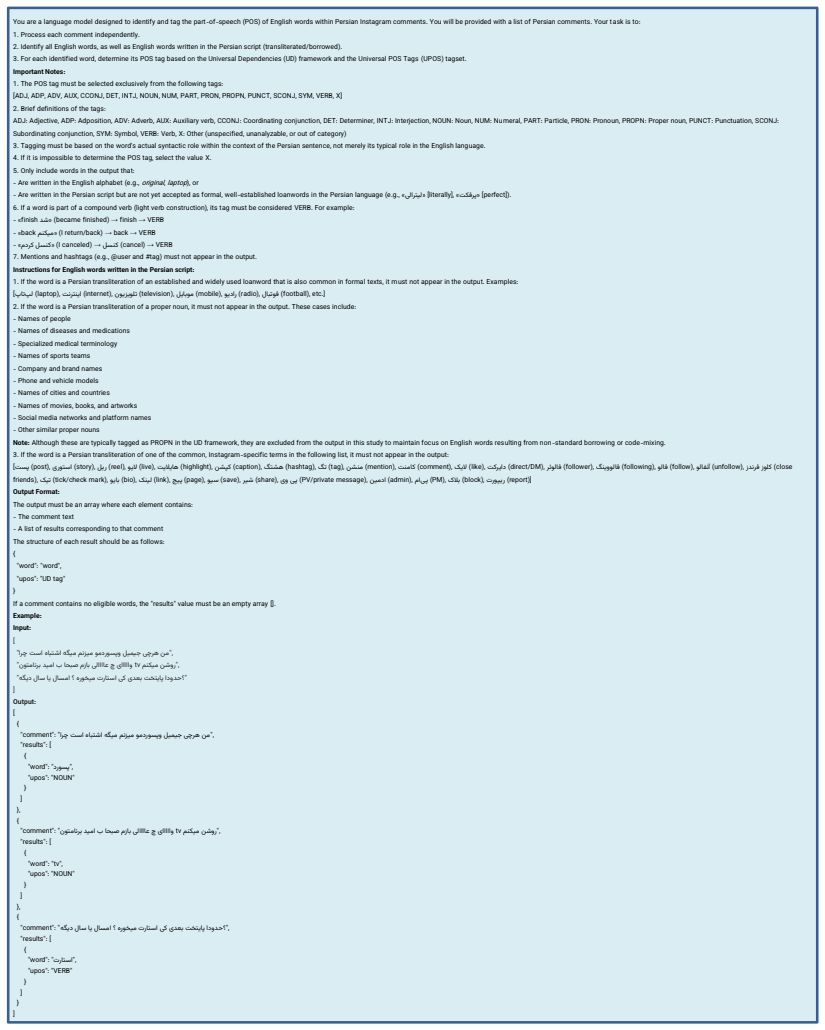
- [§3.1, Appendix A (Figures 7–8), Table 2] The exclusion criteria for code-mixed status are defined by prompt instructions to the LLM, but the prompt contradicts itself: Figure 7 instructs the model to exclude transliterated proper nouns, including company and brand names, yet the same example output tags 'Asus' as PROPN, and Table 2 reports 35.0% PROPN for Digikala, which the text attributes to exactly the brand names the instructions say to exclude. The paper does not report any validation of the exclusion boundary, and the human evaluation does not measure errors in the exclusion decision itself. Since the boundary between NOUN and PROPN directly affects the headline noun-preponderance finding and the platform comparisons, the current validation does not establish that the corpus definition was applied consistently.
- [§3.1] The human validation sample is too small to support the corpus-level claims for the categories that matter. It contains 150 texts and 268 code-mixed words, which is about 2.2% of the texts and roughly 2.5% of the 10,785 code-mixed words in Table 2. No confidence intervals are reported for precision, recall, or F1, and the sample is not stratified by POS category or by lexical type. The macro F1 of 76.8% implies that rare POS tags perform substantially worse than the 97.0% overall accuracy, but no per-category breakdown is given. Given that the paper's platform-specific findings hinge on secondary POS categories (VERB in X, ADJ in Instagram, PROPN in Digikala) and on topic-conditioned rates in Figure 2, the absence of per-category validation makes it difficult to distinguish real patterns from annotation bias.
minor comments (5)
- [§3.1] The reported pipeline F1 of 88.1% appears to be the product of token F1 (90.8%) and POS accuracy (97.0%); using the POS macro F1 of 76.8% instead would yield roughly 69.7%, so the paper should state explicitly which metric is used and why.
- [§4.2] The chi-square test of position by platform treats each code-mixed word as an independent observation, but multiple words from the same utterance are not independent; a test that accounts for within-utterance clustering would be more appropriate.
- [§4.3] The 'length-controlled' triggering rate is described only verbally; the paper should report the length-group definitions, the group-specific rates, and the denominators for the numbers in Table 4.
- [§3.1] The retry policy for 'no code-mixed words' responses is applied only to the keyword-collected X tweets, not to the other subsets; the potential effect of this asymmetric policy on the platform comparisons should be discussed.
- [Figure 2] The white cells for missing topic–platform combinations are not accompanied by a minimum-cell-size threshold, so the reader cannot tell whether some means are based on very few utterances.
Circularity Check
No circularity: the corpus statistics are direct aggregates of explicitly described annotations, with independent human validation; the annotation error rates raise validity concerns but do not make the derivation circular.
full rationale
The paper's derivation chain is transparent and self-contained. PERCEPT is built by filtering public Persian datasets and then using Gemini 3.5 Flash to identify code-mixed words and assign UD POS tags (Section 3.1) and topics (Section 3.2). The Section 4 statistics, including POS distributions, positional distributions, triggering rates, and topic-triggering means, are descriptive aggregates of those labels, not predictions produced by fitting parameters to a subset and then testing on a closely related quantity. There is no equation in which an input is defined in terms of the output, and no fitted parameter is renamed as a result. The human validation sample of 150 texts containing 268 code-mixed words is an external check on the annotations, so the dataset claim is not self-referential even though the validation is limited. The reported errors (86.6% token recall, 76.8% POS macro F1, and 65.6% topic macro F1) mean the corpus-level findings could be biased and lack error propagation; that is a correctness and robustness limitation, not circularity under the definitions used here. The self-citations (Sabri et al. 2021a as an X data source and Sabri et al. 2021b as prior Persian-English sentiment work) are ordinary data-source and related-work citations and are not load-bearing justifications of the central claims. The platform-specific prompt exclusions and the rule that texts without LLM-detected code-mixed words are discarded are explicitly disclosed operational choices; they shape the data but do not make the analysis equal to its inputs by construction.
Assumptions & free parameters
assumptions (3)
- domain assumption Gemini 3.5 Flash annotations are reliable enough to serve as ground truth for all 6,800 texts in the corpus.
- ad hoc to paper The exclusion criteria for code-mixed words, such as excluding established loanwords, proper nouns, and platform-specific terms, can be applied consistently by the LLM and define the boundaries of code-mixing.
- domain assumption The Universal Dependencies UPOS tagset is appropriate for annotating code-mixed words in Persian social media text.
Cite this review
Pith. "Pith review of PERCEPT: A Corpus for POS Tagging and Analysis of Persian-English Code-Mixing." pith.science (2026). https://pith.science/paper/BD2KMSCI
@misc{pith2026260810109,
  author       = {Pith},
  title        = {Pith review of: PERCEPT: A Corpus for POS Tagging and Analysis of Persian-English Code-Mixing},
  year         = {2026},
  howpublished = {\url{https://pith.science/paper/BD2KMSCI}},
  note         = {Machine review of arXiv:2608.10109}
}
read the original abstract
Social media has become a major venue for multilingual communication, where users frequently mix multiple languages within a single utterance. Although code-mixed corpora have been developed for several language pairs, Persian-English code-mixing remains relatively underexplored. Existing Persian resources lack Universal Dependencies (UD) part-of-speech (POS) annotations for code-mixed words, limiting both linguistic analyses and the development of syntax-aware NLP models. To address this gap, we introduce PERCEPT, the first publicly available large-scale Persian-English code-mixed corpus annotated with Universal Dependencies POS tags for code-mixed words. The dataset comprises 6,800 posts collected from X, Instagram, and Digikala. We further present an LLM-assisted annotation framework that automatically assigns POS tags and document-level topics. Human evaluation demonstrates high agreement between the automatically generated annotations and gold annotations, confirming the reliability of the annotations. Using PERCEPT, we conduct the first comprehensive linguistic analysis of Persian-English code-mixing across multiple social media platforms. Our analyses reveal that nouns are the predominant category for code-mixed words, while the distributions of other POS categories vary across platforms. We further find that the positional distribution of code-mixed words is remarkably consistent across platforms, whereas the triggering effect is substantially more pronounced in Digikala. PERCEPT is publicly available at https://github.com/kalhorghazal/PERCEPT.
Figures


Figures from the paper (6 more)




Reference graph
Works this paper leans on
-
[1]
Identify all PersianEnglish code-mixed to- kens
-
[2]
Assign a Universal Dependencies UPOS tag to each identified token
-
[3]
Assign one topic category from the prede- fined taxonomy. B.3 Key Instructions • Treat English words written in either Latin script or Persian transliteration as code- mixed if they are used as English lexical items. • Do not mark platform-specific product or in- terface names (e.g., DigiPay, DigiExpress, Instagram Story) as code-mixed when they function as...
-
[7]
هر توییت را بهصورت مستقل بررسی کنید
-
[19]
اگر کلمه، فارسینویسیشدهی یکی از اصطلاحات رایج و خاص پلتفرم توییتر در فهرست زیر باشد، نباید در خروجی ظاهر شود: [توییت، ترد، ریپلای، منشن، هشتگ، دایرکت، فالوئر، فالووینگ، فالو، آنفالو، تایملاین، لایک، فیو، فیواستار، اسپیس، بایو، پیام، آواتار، پیج، بلاک، پین، ترند، ادمین، بک، تگ، میوت، ریپورت قالب خروجی: خروجی باید یک آرایه باشد که هر عضو آن شامل: - متن تویی...
-
[20]
Process each tweet independently
-
[32]
If the word is a Persian transliteration of one of the common, Twitter -specific terms in the following list, it must not appear in the output: [توییت tweet), ریتوییت retweet), کوت توییت quote tweet), سابتوییت subtweet), ترد thread), ریپلای reply), منشن mention), هشتگ hashtag), دایرکت direct/DM), فالوئر follower), فالووینگ following), فالو follow), آنفالو...
-
[34]
تمام کلمات انگلیسی یا کلمات انگلیسی نوشتهشده با حروف فارسی را شناسایی کنید
Show all 53 references
-
[35]
برای هر کلمهی شناساییشده، برچسب نقش دستوری آن را بر اساس چارچوب Universal Dependencies (UD) و مجموعه برچسبهای Universal POS Tags (UPOS) تعیین کنید توجه:
-
[42]
منشنها و هشتگها (مانند @user وtag) نباید در خروجی ظاهر شوند برای کلمات انگلیسی نوشتهشده با حروف فارسی، دستورالعملهای زیر را رعایت کنید:
-
[43]
نمونهها: [تاپ، اینترنت، تلویزیون، موبایل، رادیو، فوتبال و
اگر کلمه، فارسینویسیشدهی یک وامواژهی جاافتاده و پرکاربرد در زبان فارسی باشد که در متون رسمی نیز رایج است، نباید در خروجی ظاهر شود. نمونهها: [تاپ، اینترنت، تلویزیون، موبایل، رادیو، فوتبال و
-
[45]
word": "کلمه,
اگر کلمه، فارسینویسیشدهی یکی از اصطلاحات رایج و خاص پلتفرم اینستاگرام در فهرست زیر باشد، نباید در خروجی ظاهر شود: [، منشن، کامنت، لایک، دایرکت، فالوئر، فالووینگ، فالو، آنفالو، کلوز فرندز، تیک، بایو، لینک، پیج، سیو، شیر، پی وی، ادمین، پیام، بلاک، ریپورت قالب خروجی: خروجی باید ی...
-
[58]
word": "word
If the word is a Persian transliteration of one of the common, Instagram -specific terms in the following list, it must not appear in the output: [پست post), استوری story), ریل reel), لایو live), هایلایت highlight), کپشن caption), هشتگ hashtag), تگ tag), منشن mention), کامنت c...
-
[59]
هر کامنت را بهصورت مستقل بررسی کنید
-
[60]
3 .برای هر کلمهی شناساییشده، برچسب نقش دستوری آن را بر اساس چارچوب Universal Dependencies (UD) و مجموعه برچسبهای Universal POS Tags (UPOS) تعیین کنید توجه:
تمام کلمات انگلیسی یا کلمات انگلیسی نوشتهشده با حروف فارسی را شناسایی کنید. 3 .برای هر کلمهی شناساییشده، برچسب نقش دستوری آن را بر اساس چارچوب Universal Dependencies (UD) و مجموعه برچسبهای Universal POS Tags (UPOS) تعیین کنید توجه:
-
[61]
برچسب نقش دستوری باید فقط از میان برچسبهای زیر انتخاب شود: [ADJ, ADP, ADV, AUX, CCONJ, DET, INTJ, NOUN, NUM, PART, PRON, PROPN, PUNCT, SCONJ, SYM, VERB, X ]
-
[62]
تعریف مختصر برچسبها: ADJ: صفت ,ADP: حرف اضافه ,ADV: قید ,AUX: فعل کمکی ,CCONJ: حرف ربط همپایه , DET: تعیینگر , INTJ: شبهجمله یا صوت , NOUN: اسم عام ,NUM: عدد ,PART: ادات ,PRON: ضمیر ,PROPN: اسم خاص ,PUNCT: نشانهگذاری , SCONJ: حرف ربط وابسته ,SYM: نماد ,VERB: فعل اصلی , X: موار...
-
[63]
برچسبگذاری باید بر اساس نقش واقعی کلمه در بافت جملهی فارسی انجام شود، نه صرفاً نقش رایج آن در زبان انگلیسی
-
[64]
اگر تشخیص نقش دستوری ممکن نبود، مقدارX را انتخاب کنید
-
[65]
فقط کلماتی را در خروجی بیاورید که - با حروف انگلیسی نوشته شده باشند (مانند original،laptop)، یا - با حروف فارسی نوشته شده باشند اما همچنان بهعنوان وامواژهی رسمی و جاافتاده در زبان فارسی پذیرفته نشده باشند (مانند
-
[66]
برای مثال - «finish شد← finish → VERB - «back میکنم← back → VERB - «← کنسل→ VERB
اگر کلمهای بخشی از یک ترکیب فعلی باشد، برچسب آن باید VERB در نظر گرفته شود. برای مثال - «finish شد← finish → VERB - «back میکنم← back → VERB - «← کنسل→ VERB
-
[67]
نمونهها: [تاپ، اینترنت، تلویزیون، موبایل، رادیو، فوتبال و
منشنها و هشتگها (مانند @user وtag) نباید در خروجی ظاهر شوند برای کلمات انگلیسی نوشتهشده با حروف فارسی، دستورالعملهای زیر را رعایت کنید: 1 .اگر کلمه، فارسینویسیشدهی یک وامواژهی جاافتاده و پرکاربرد در زبان فارسی باشد که در متون رسمی نیز رایج است، نباید در خروجی ظاهر شود. نمونهها...
-
[68]
اگر کلمه، فارسینویسیشدهی یک اسم خاص باشد، نباید در خروجی ظاهر شود. این موارد شامل نمونههای زیر است: - نام اشخاص - نام بیماریها و داروها - اصطلاحات تخصصی پزشکی - نام تیمهای ورزشی - نام شرکتها و برندها - مدلهای گوشی و خودرو - نام شهرها و کشورها - نام فیلمها، کتابها و آثار هنری -...
-
[69]
word": "کلمه,
اگر کلمه، فارسینویسیشدهی یکی از اصطلاحات رایج و خاص پلتفرم دیجیکالا در فهرست زیر باشد، نباید در خروجی ظاهر شود: [کالا، دیجیپی، دیجیاستایل، دیجیکلاب، دیجیاکسپرس قالب خروجی: خروجی باید یک آرایه باشد که هر عضو آن شامل: - متن کامنت - لیست نتایج مربوط به آن کامنت ساختار هر نتیجه با...
-
[70]
Process each comment independently
-
[71]
Identify all English words, as well as English words written in the Persian script (transliterated/borrowed)
-
[72]
Important Notes:
For each identified word, determine its POS tag based on the Universal Dependencies (UD) framework and the Universal POS Tags (UPOS) tagset. Important Notes:
-
[73]
The POS tag must be selected exclusively from the following tags: [ADJ, ADP, ADV, AUX, CCONJ, DET, INTJ, NOUN, NUM, PART, PRON, PROPN, PUNCT, SCONJ, SYM, VERB, X]
-
[74]
Brief definitions of the tags: ADJ: Adjective, ADP: Adposition , ADV: Adverb, AUX: Auxiliary verb, CCONJ: Coordinating conjunction, DET: Determiner, INTJ: Interjection, NOUN: Noun, NUM: Nu meral, PART: Particle, PRON: Pronoun, PROPN: Proper noun, PUNCT: Punctuation, SCONJ: Sub...
-
[75]
Tagging must be based on the word's actual syntactic role within the context of the Persian sentence, not merely its typical role in the English language
-
[76]
If it is impossible to determine the POS tag, select the value X
-
[77]
Only include words in the output that: - Are written in the English alphabet (e.g., original, laptop), or - Are written in the Persian script but are not yet accepted as formal, well -established loanwords in the Persian language (e.g., «لیترالی» [literally], «پرفکت» [perfect])
-
[78]
For example: - «finish شد» (became finished) → finish → VERB - «back میکنم» (I return/back) → back → VERB - «کنسل کردم» (I canceled) → کنسل cancel) → VERB
If a word is part of a compound verb (light verb construction), its tag must be considered VERB. For example: - «finish شد» (became finished) → finish → VERB - «back میکنم» (I return/back) → back → VERB - «کنسل کردم» (I canceled) → کنسل cancel) → VERB
-
[79]
Instructions for English words written in the Persian script:
Mentions and hashtags (e.g., @user and #tag) must not appear in the output. Instructions for English words written in the Persian script:
-
[80]
Examples: [لپتاپ laptop), اینترنت internet), تلویزیون television), موبایل mobile), رادیو radio), فوتبال football), etc.]
If the word is a Persian transliteration of an established and widely used loanword that is also common in formal texts, it m ust not appear in the output. Examples: [لپتاپ laptop), اینترنت internet), تلویزیون television), موبایل mobile), رادیو radio), فوتبال football), etc.]
-
[81]
If the word is a Persian transliteration of a proper noun, it must not appear in the output. These cases include: - Names of people - Names of diseases and medications - Specialized medical terminology - Names of sports teams - Company and brand names - Phone and vehicle model...
-
[82]
word": "word
If the word is a Persian transliteration of one of the common, Digikala -specific terms in the following list, it must not appear in the output: [دیجی Digi), دیجیکالا Digikala), دیجیپی DigiPay), دیجیاستایل DigiStyle), دیجیکلاب DigiClub), دیجیاکسپرس DigiExpress)] Output Format:...
-
[83]
Analyze each text individually
-
[84]
Identify the topic of the given text
-
[85]
Provide the output in JSON format without any additional explanation. Note:
-
[86]
Brand and Business
The topic must be selected exclusively from the following list: ["Brand and Business", "Industry and Commerce", "Current Events and News", "Lifestyle and Personal Interests", "Arts, Enterta inment, and Culture", "Society and Identity", "Platform -Specific Topics"]
-
[87]
Only one topic must be selected for each text
-
[88]
The category descriptions are as follows:
If the text does not relate to any of the above topics, return the value "other". The category descriptions are as follows:
-
[89]
Examples include: - Brand mentions: Direct references to a company or product name (e.g., #Apple, #Tesla)
Brand & Business This category represents social media marketing and reputation management. Examples include: - Brand mentions: Direct references to a company or product name (e.g., #Apple, #Tesla). - Product feedback: Specific compliments or complaints about a product's featu...
-
[90]
Examples include: - Technology: Artificial intelligence, cybersecurity, software updates, gadgets, startups
Industry & Commerce This category is broader than brand -specific topics and covers entire market sectors. Examples include: - Technology: Artificial intelligence, cybersecurity, software updates, gadgets, startups. - Finance and Cryptocurrency: Stock market, investing, digita...
-
[91]
Examples include: - Politics and Elections: Campaigns, political debates, election results, political scandals
Current Events & News Topics in this category are highly dynamic and time -sensitive. Examples include: - Politics and Elections: Campaigns, political debates, election results, political scandals. - Crises and Disasters: Natural disasters (hurricanes, earthquakes), terrorist ...
-
[92]
Examples include: - Health and Fitness: Workout routines, diets (keto, vegan), mental health, supplements
Lifestyle & Personal Interests This category encompasses the personal and social aspects of social media. Examples include: - Health and Fitness: Workout routines, diets (keto, vegan), mental health, supplements. - Food and Beverage: Recipes, restaurant reviews, cooking techni...
-
[93]
pop culture
Arts, Entertainment, & Culture This category represents the core of "pop culture" on social media. Examples include: - Movies and Television: New releases, reviews, fan theories, spoilers, streaming services (Namava, Gap Film). - Music: New album releases, concerts, festivals,...
-
[94]
Examples include: - Social Justice and Activism: Social movements, climate justice, human rights
Society & Identity Topics in this category relate to individual and group identity, values, and social issues. Examples include: - Social Justice and Activism: Social movements, climate justice, human rights. - Environment and Sustainability: Climate change, recycling, renewab...
-
[95]
بعد از اینکه قرارداد اکسو با نیچر تموم شد برندا دارن حمله میکنن سمتشون\nولی من نیچرو بیشتر دوست داشتم\n\n#EXO @username @username…
Platform-Specific & Meta Topics Topics in this category relate to how people use social media platforms themselves. Examples include: - Memes and Viral Trends: Specific meme formats, viral challenges, internet humor. - Influencer Culture: Influencer collaborations, sponsorship...
-
[2016]
In Proceedings of the second workshop on computational approaches to code switching , pages 30–39
Part-of-speech tagging of code-mixed social media content: Pipeline, stacking and joint mod- elling. In Proceedings of the second workshop on computational approaches to code switching , pages 30–39. Bharathi Raja Chakravarthi, Navya Jose, Shardul Suryawanshi, Elizabeth Sherly...
2020
-
[2024]
In SoCal NLP Symposium 2024
The dark side of instagram: A large dataset for identifying persian harmful comments. In SoCal NLP Symposium 2024 . Marie-Catherine De Marneffe, Christopher D Man- ning, Joakim Nivre, and Daniel Zeman. 2021. Uni- versal dependencies. Computational linguistics , 47(2):255–308. ...
2024 arXiv
-
[2025]
In Findings of the Association for Computational Linguistics: EMNLP 2025 , pages 7973–7992, Suzhou, China
COMI-LINGUA: Expert annotated large- scale dataset for multitask NLP in Hindi-English code-mixing. In Findings of the Association for Computational Linguistics: EMNLP 2025 , pages 7973–7992, Suzhou, China. Association for Compu- tational Linguistics. Kushagra Singh, Indira Sen...
2025
Reviewed August 14, 2026 · model on record in the stance chip above.
Discussion (0). Continue with ORCID to comment.