REVIEW 3 major objections 5 minor 66 references
Nanoscale imaging of ferromagnetic vortex dynamics with scanning NV magnetometry
T0 review · 3 major / 5 minor · reviewed 2026-08-14 · deepseek-v4-flash
Pith's one-line read Scanning NV magnetometry images both static and microwave magnetic fields of ferromagnetic vortices at roughly 50 nm resolution, revealing disorder-dependent evanescent decay and a 40-fold field enhancement near a vortex core.
desk verdict A real technical advance—scanning NV imaging of vortex magnon modes at ~50 nm resolution—with the disc-specific quantitative results resting on a tuned disorder model that needs scrutiny. read the letter →
The pith
A machine-rendered reading of the paper's core claim, the machinery that carries it, and where it could break.
The reading
What carries the argument
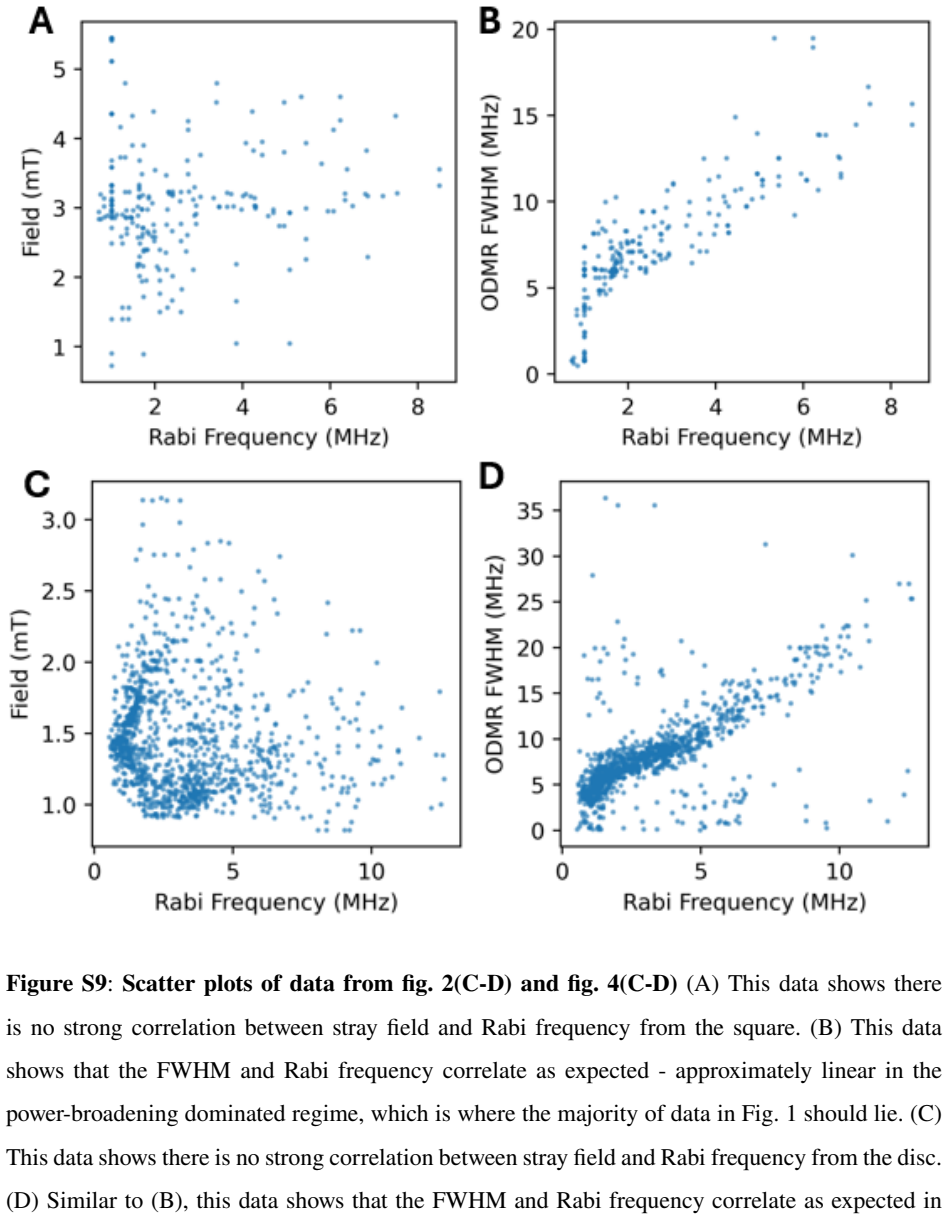
The working mechanism is a rastered diamond tip whose single nitrogen-vacancy (NV) center acts as a local magnetic-field sensor. In the power-broadened regime, the width of the NV's optically detected magnetic resonance (ODMR) line is proportional to the local microwave field amplitude, so mapping the linewidth maps the GHz field; Rabi oscillations at each point make that field quantitative because the Rabi frequency equals $\gamma_{\mathrm{NV}} B_{\mathrm{MW}}/(2\pi\sqrt{2})$. Lifting the tip and fitting the height dependence to $A e^{-kd} + f_{R0}$ extracts the evanescent decay constant $k$. The companion machinery is micromagnetic simulation of the Landau-Lifshitz-Gilbert dynamics, with film disorder represented as 1 µm grains carrying ±5% variations in magnetization and anisotropy and a 5% exchange reduction at the grain boundaries; the predicted stray fields at NV height are compared pixel-by-pixel with the measurements.
What would settle it
Measure the actual grain structure of the same 6 µm permalloy disc, for example with electron backscatter diffraction or transmission electron microscopy, and rerun the 2.85 GHz micromagnetic simulations using those measured grain sizes, orientations, and boundary exchange parameters instead of the assumed 1 µm Voronoi grains. If the simulated azimuthal-mode microwave maps and decay-length maps no longer reproduce the measured ODMR and Rabi images, the vortex-mode assignment and the disorder-dependent decay conclusions would be refuted.
Extended reading notes
Core claim
The central claim is that a scanning NV magnetometer can quantitatively map the GHz microwave magnetic fields produced by vortex spin-wave modes, not just the static vortex texture. In the 1 µm square, the power-broadened ODMR linewidth and the Rabi oscillation frequency trace microwave emission that spreads from the core along the Néel domain walls, identifying the vortex's wall mode. In the 6 µm disc, the static stray field alone cannot unambiguously reveal a vortex, but the microwave map shows a lobed, anisotropic field concentrated near the core that matches simulations of the azimuthal magnon mode in a disordered polycrystalline film. Quantitative Rabi scans measure a 5.5-fold enhancement near the square's core and an 11-fold enhancement at its corner relative to the retracted tip, and a 40-fold enhancement near the disc's core; height-dependent scans give evanescent decay lengths of 58-80 nm for the square's wall mode and roughly 323 nm for the disc's azimuthal mode. The paper concludes that SNVM can image vortex magnon modes at approximately 50 nm resolution, about five times finer than diffraction-limited optical techniques, and can reveal how disorder alters the spatial decay of these microwaves.
Load-bearing premise
The claim that the disc's microwave maps come from a vortex azimuthal mode, and the disorder-dependent decay conclusions, rely on a simulated disorder model whose grain size and strength were chosen to reproduce the data rather than measured on the actual sample.
Editorial extensions
If this is right
- A single tabletop instrument can map GHz-scale vortex magnon fields at roughly 50 nm resolution, about five times better than diffraction-limited optical imaging, without requiring a synchrotron.
- Quantitative Rabi oscillation maps give local microwave field amplitudes, so the same measurement can quantify field enhancement and evanescent decay in operating magnonic devices.
- The spatially varying evanescent decay constants, which differ between a wall mode and an azimuthal mode, can be imaged directly, providing a map of where a nearby qubit would couple most strongly.
- Vortex-supported wall modes in a 1 µm square and azimuthal modes in a 6 µm disc can both be driven at NV-resonant frequencies near 2.85 GHz and identified by their microwave stray-field patterns.
- Because the technique is substrate-agnostic and operates in ambient conditions, it can characterize samples that cannot be measured in X-ray beamlines.
Reading between the lines
- A testable extension: because the measured decay lengths differ sharply between the wall mode (~58-80 nm) and the azimuthal mode (~323 nm), fitting the height dependence at each pixel could serve as a local identifier of which vortex mode is active; the paper reports both decay lengths but does not propose this use.
- The strong dependence of the decay maps on grain structure suggests SNVM evanescent-field imaging could become a non-destructive probe of microstructure: annealing a film to change grain size should measurably shift the fitted $k$ values, a prediction not tested in the paper.
- The 40-fold enhancement was measured at a relatively large NV-sample separation, so combining this technique with recently demonstrated methods for reducing that separation would plausibly yield even larger enhancements; the paper notes the resolution gains possible but does not demonstrate this combination.
- The paper's polarization analysis is partly confounded by frequency-dependent microwave amplitudes from the disc, so in my reading circular-polarization imaging of vortex modes needs heterodyne or frequency-mixing detection, which the authors list as future work, before it becomes a standalone claim.
Signed reviews
Editorial analysis
A structured set of objections, weighed in public.
Referee Report
Summary. The manuscript reports scanning nitrogen-vacancy (NV) magnetometry imaging of static and microwave-frequency magnetic fields emanating from permalloy microstructures hosting magnetic vortices: a 1 µm square and a 6 µm diameter disc. Using ODMR, the authors image static stray fields; using the ODMR linewidth (FWHM) and Rabi oscillation frequencies, they map microwave field amplitudes with ~50 nm resolution. They report a 40× enhancement of the microwave field near the vortex core in the disc, spatially varying evanescent decay constants (k = 17.20 µm⁻¹ and 12.56 µm⁻¹ for the square's wall modes; k = 3.09 µm⁻¹ for the disc's azimuthal mode), and qualitative agreement with micromagnetic simulations that include a disorder model based on 1 µm Voronoi grains with ±5% variations in saturation magnetization and anisotropy and a 5% exchange reduction at grain boundaries.
Significance. If the results hold, this work establishes SNVM as an accessible tabletop technique for nanoscale imaging of vortex magnon modes, with resolution demonstrably better than diffraction-limited optical methods and with quantitative field mapping via Rabi measurements. The paper includes valuable internal consistency checks (FWHM versus Rabi correlation), calibration details, and control simulations of alternative magnetization textures that do not reproduce the data. However, the quantitative disc-specific claims (40× enhancement, decay constants, core localization) rely on a disorder model whose parameters were chosen to reproduce the measurements rather than independently measured, and some decay measurements are taken near the resolution limit of the technique. These caveats do not overturn the core imaging demonstration, but they currently limit the strength of the quantitative conclusions.
major comments (3)
- [Results, disc measurements (Figs. 3–5)] The assignment of the disc's microwave maps to the azimuthal vortex mode and the localization of the vortex core are not established by the static stray-field data alone, as the authors acknowledge in the text; they are inferred from agreement with micromagnetic simulations that include a disorder model (1 µm Voronoi grains, ±5% variations in M_s and anisotropy, 5% exchange reduction at grain boundaries) whose parameters were chosen to match the experiment. This creates a circularity for the quantitative disc claims: the 40× enhancement in Fig. 4(E), the decay constant k = 3.09 µm⁻¹ in Fig. 5(D), and the spatially varying decay maps in Fig. 5(A) all depend on this core/mode assignment. The authors should either characterize the actual microstructure (e.g., by transmission electron microscopy or magnetic force microscopy) or perform a sensitivity study over a plausible range of disorder parameters and grain sizes, showing that the core location, enhancement factor, and decay-length ranges are robust. Without such validation, the disc-specific quantitative results remain model-dependent.
- [Supplementary Materials, 'Additional ODMR data - height dependence' and Fig. 2(F)] The square's decay constants (k = 17.20 µm⁻¹, decay length 58 nm; k = 12.56 µm⁻¹, decay length 80 nm) are quoted from single-point Rabi height scans, yet the supplementary text states that the height-dependent ODMR maps for the square 'contained large errors because of the very rapid measured decays and our tip's fly height, which was comparable to the decay constant.' Since the decay lengths are comparable to or smaller than the NV-sample separation used in the measurements, the single-point fits may not reliably constrain k; the paper should show the height-series data with the fitted exponentials, report confidence intervals, and discuss how the limited height range (relative to the decay length) affects the extracted values. This is important because the contrast between the square and disc decay lengths is used to motivate the qubit-transduction discussion.
- [Results, Fig. 4(E) and Discussion] The 40× enhancement is presented as a key quantitative result, but it is obtained from a single Rabi measurement at a point identified as 'near the vortex core' based on the simulated dynamic map rather than on the measured static stray field. Given the ~56 nm imaging resolution and the uncertainty in the core position (which the authors state cannot be definitively identified from the static map), the paper should provide an uncertainty estimate for this enhancement factor and, ideally, a map of the enhancement across the core region to demonstrate that the quoted value is representative rather than a fortuitous local maximum.
minor comments (5)
- [Abstract and Fig. 4(E)] The text refers to a '40× increase in MW power' in Fig. 4(E), but the measured quantity is the Rabi frequency, which is proportional to the microwave magnetic field amplitude, not the power. Please make the units consistent (e.g., amplitude or Rabi frequency).
- [Supplementary Materials, Fig. S8] The polarization analysis in the supplementary shows that microwave power variations between the two ODMR transitions can produce false polarization signals of up to ~12°. Since polarization analysis is presented as a potential advantage in the main text, a brief note in the main text about this caveat would be appropriate.
- [Materials and Methods] The phrase 'the sample topopgraphy' contains a typo; it should read 'topography.'
- [Figure 1 caption] The text says the central vortex core 'spanned only one pixel' and was filtered out during image processing; it would help to state whether the filtering could affect the apparent core size in the displayed field maps.
- [Supplementary Materials, Fig. S4 caption] The term 'disc' is used for what appears to be the square feature in the Fig. S4 caption; please unify the terminology to avoid confusion.
Circularity Check
No significant circularity: measured Rabi/FWHM maps and 40x enhancement are direct NV measurements; disc mode assignment uses forward simulations with alternative-texture controls, with disorder parameters as unmeasured assumptions rather than fitted predictions.
full rationale
No circularity in the claimed derivation chain. The Rabi-frequency and ODMR-FWHM maps are direct NV measurements; the enhancement numbers (5.5x/12x/40x) are measured Rabi ratios against a retracted tip, not outputs of the simulations or of any fit. The FWHM-to-B_MW relation is a cited standard formula and is corroborated by the correlated Rabi scans. For the disc, identifying the azimuthal vortex mode is an interpretation supported by forward micromagnetic simulations, with control simulations of saturated and transverse-domain-wall textures that fail by factors of 4-20 and single-crystal simulations that do not reproduce the measured anisotropy. That is model comparison, not a fitted parameter renamed as a prediction. The 1 um Voronoi-grain disorder model with +/-5% variations and 5% exchange reduction is a stated modeling assumption rather than a measured microstructure; this weakens the independent evidentiary weight of the agreement but does not make the agreement circular by construction. The paper also flags limitations: the supplementary height-dependent square decay maps 'ultimately contained large errors because of the very rapid measured decays and our tip's fly height, which was comparable to the decay constant'; the polarization analysis 'may contain large errors' because power variations 'are large enough to explain over one fifth of the polarization angles we see'; and for the disc 'a vortex texture cannot be definitively identified through the static stray field map.' These are robustness caveats, not circular steps. The only apparent self-citations (refs 53 and 66) are not load-bearing: ref 53 supports a speculative application sentence about flux channeling, and ref 66 supports a supplementary error approximation. Score 2 reflects these minor non-load-bearing self-citations rather than any circular derivation.
Assumptions & free parameters
free parameters (4)
- Micromagnetic grain size (disc simulations) =
1 micrometer
- Microwave drive angle in simulations =
45 degrees in the YZ plane
- Simulated applied microwave amplitude =
0.1 mT
- Evanescent decay fit parameters (A, k, f_R0) =
k = 17.20 um^-1 (square core), 12.56 um^-1 (square corner), 3.09 um^-1 (disc core)
assumptions (4)
- standard math NV ODMR and Rabi frequency formulas relate measured transitions to B_MW quantitatively
- domain assumption Micromagnetic LLG simulations in Mumax3 with standard permalloy parameters adequately model the sample
- domain assumption The observed dynamic response in the disc is attributed to a vortex azimuthal mode because simulations initialized with a vortex texture match the data better than alternative textures
- domain assumption The tip lift and antenna configuration do not significantly alter the measured microwave field patterns
Cite this review
Pith. "Pith review of Nanoscale imaging of ferromagnetic vortex dynamics with scanning NV magnetometry." pith.science (2026). https://pith.science/paper/3JGOX5A4
@misc{pith2026260810310,
  author       = {Pith},
  title        = {Pith review of: Nanoscale imaging of ferromagnetic vortex dynamics with scanning NV magnetometry},
  year         = {2026},
  howpublished = {\url{https://pith.science/paper/3JGOX5A4}},
  note         = {Machine review of arXiv:2608.10310}
}
abstract
The generation and manipulation of spin waves at the nanoscale via magnetic vortices are of considerable importance because of their broad applications across magnonic and quantum technologies. Previously, fixed nitrogen-vacancy (NV) centers in diamond have been used to locally characterize vortex dynamics, and scanning NV magnetometry (SNVM) has been used to image vortices' static stray fields. Here, we demonstrate SNVM imaging of both the static and microwave fields generated by vortices in mesoscopic permalloy structures with $\sim$50 nm spatial resolution, achieving excellent agreement with micromagnetic simulations, while revealing the effects of disorder. We further demonstrate a 40$\times$ microwave field enhancement near a vortex core and image the disorder-dependent, spatially varying, evanescent decay of these microwaves. Our ambient, tabletop technique surpasses diffraction-limited techniques' resolutions by at least 5$\times$, with far greater accessibility and throughput than synchrotron radiation-based techniques, offering new opportunities in the study and development of magnonic devices.
Figures
Reference graph
Works this paper leans on
-
[1]
C. E. Leiserson,et al., There’s plenty of room at the Top: What will drive computer performance after Moore’s law?Science368(6495), eaam9744 (2020)
work page 2020
-
[2]
H. Yu, J. Xiao, H. Schultheiss, Magnetic texture based magnonics.Physics Reports905, 1–59 (2021)
work page 2021
- [3]
-
[4]
Flebus,et al., The 2024 magnonics roadmap.Journal of Physics: Condensed Matter36(36), 363501 (2024)
B. Flebus,et al., The 2024 magnonics roadmap.Journal of Physics: Condensed Matter36(36), 363501 (2024)
work page 2024
-
[5]
M. Balinskyy, A. Khitun, Magnonic combinatorial memory.npj Spintronics2(1), 2 (2024)
work page 2024
-
[6]
D. R. Candido, G. D. Fuchs, E. Johnston-Halperin, M. E. Flatt ´e, Predicted strong coupling of solid-state spins via a single magnon mode.Mater. Quantum Technol.1(1), 011001 (2020)
work page 2020
- [7]
-
[8]
Fukami,et al., Magnon-mediated qubit coupling determined via dissipation measurements
M. Fukami,et al., Magnon-mediated qubit coupling determined via dissipation measurements. Proceedings of the National Academy of Sciences121(2), e2313754120 (2024)
work page 2024
Show all 66 references
-
[9]
Bejarano,et al., Parametric magnon transduction to spin qubits.Sci
M. Bejarano,et al., Parametric magnon transduction to spin qubits.Sci. Adv.10(12), eadi2042 (2024)
2024
-
[10]
J. Han, P. Zhang, J. T. Hou, S. A. Siddiqui, L. Liu, Mutual control of coherent spin waves and magnetic domain walls in a magnonic device.Science366(6469), 1121–1125 (2019)
2019
-
[11]
Gao,et al., Interplay between spin wave and magnetic vortex.Phys
Z. Gao,et al., Interplay between spin wave and magnetic vortex.Phys. Rev. B107(21), 214418 (2023). 16
2023
-
[12]
Chang,et al., Spin Wave Injection and Propagation in a Magnetic Nanochannel from a Vortex Core.Nano Lett.20(5), 3140–3146 (2020)
L.-J. Chang,et al., Spin Wave Injection and Propagation in a Magnetic Nanochannel from a Vortex Core.Nano Lett.20(5), 3140–3146 (2020)
2020
-
[13]
Carolin Behncke,et al., Spin-wave interference in magnetic vortex stacks.Commun. Phys. 1(50) (2018)
2018
-
[14]
Dieterle,et al., Coherent Excitation of Heterosymmetric Spin Waves with Ultrashort Wave- lengths.Phys
G. Dieterle,et al., Coherent Excitation of Heterosymmetric Spin Waves with Ultrashort Wave- lengths.Phys. Rev. Lett.122(11), 117202 (2019)
2019
-
[15]
Koraltan,et al., Steerable current-driven emission of spin waves in magnetic vortex pairs
S. Koraltan,et al., Steerable current-driven emission of spin waves in magnetic vortex pairs. Sci. Adv.10(39), eado8635 (2024)
2024
-
[16]
Mayr,et al., Spin-Wave Emission from Vortex Cores under Static Magnetic Bias Fields
S. Mayr,et al., Spin-Wave Emission from Vortex Cores under Static Magnetic Bias Fields. Nano Lett.21(4), 1584–1590 (2021)
2021
-
[17]
Van de Wiele, S
B. Van de Wiele, S. J. H ¨am¨al¨ainen, P. Bal´aˇ z, F. Montoncello, S. van Dijken, Tunable short- wavelength spin wave excitation from pinned magnetic domain walls.Sci. Rep.6(1), 21330 (2016)
2016
-
[18]
Wintz,et al., Magnetic vortex cores as tunable spin-wave emitters.Nat
S. Wintz,et al., Magnetic vortex cores as tunable spin-wave emitters.Nat. Nanotechnol.11(11), 948–953 (2016)
2016
-
[19]
S. J. H ¨am¨al¨ainen, F. Brandl, K. J. A. Franke, D. Grundler, S. van Dijken, Tunable Short- Wavelength Spin-Wave Emission and Confinement in Anisotropy-Modulated Multiferroic Heterostructures.Phys. Rev. Appl.8(1), 014020 (2017)
2017
-
[20]
J. P. Park, P. A. Crowell, Interactions of Spin Waves with a Magnetic Vortex.Phys. Rev. Lett. 95(16), 167201 (2005)
2005
-
[21]
Buess,et al., Excitations with negative dispersion in a spin vortex.Phys
M. Buess,et al., Excitations with negative dispersion in a spin vortex.Phys. Rev. B71(10), 104415 (2005)
2005
-
[22]
Trimble,et al., Relaxation of a single defect spin by the low-frequency gyrotropic mode of a magnetic vortex.J
J. Trimble,et al., Relaxation of a single defect spin by the low-frequency gyrotropic mode of a magnetic vortex.J. Appl. Phys.130(8), 083903 (2021)
2021
-
[23]
Neudecker, Modal spectrum of permalloy disks excited by in-plane magnetic fields.Phys
I. Neudecker, Modal spectrum of permalloy disks excited by in-plane magnetic fields.Phys. Rev. B73(13) (2006). 17
2006
-
[24]
K ¨orber,et al., Nonlocal Stimulation of Three-Magnon Splitting in a Magnetic Vortex.Phys
L. K ¨orber,et al., Nonlocal Stimulation of Three-Magnon Splitting in a Magnetic Vortex.Phys. Rev. Lett.125(20), 207203 (2020)
2020
-
[25]
Heins,et al., Self-induced Floquet magnons in magnetic vortices.Science391(6781), 190–194 (2026)
C. Heins,et al., Self-induced Floquet magnons in magnetic vortices.Science391(6781), 190–194 (2026)
2026
-
[26]
Devolder,et al., Time-resolved splitting of magnons into vortex gyration and Floquet spin waves (2025), arXiv:2511.10450 [cond-mat] version: 1
T. Devolder,et al., Time-resolved splitting of magnons into vortex gyration and Floquet spin waves (2025), arXiv:2511.10450 [cond-mat] version: 1
2025 arXiv
-
[27]
Wang,et al., Spin-Wave Frequency Multiplication by Magnetic Vortex Cores.Nano Lett
C.-J. Wang,et al., Spin-Wave Frequency Multiplication by Magnetic Vortex Cores.Nano Lett. 26(6), 2263–2269 (2026)
2026
-
[28]
Trimble,et al., Parallel pumping of magnons in inhomogeneous spin textures probed through NV spin relaxometry.J
J. Trimble,et al., Parallel pumping of magnons in inhomogeneous spin textures probed through NV spin relaxometry.J. Appl. Phys.135(7), 073904 (2024)
2024
-
[29]
Feggeler, A
T. Feggeler, A. Levitan, M. A. Marcus, H. Ohldag, D. A. Shapiro, Scanning transmission X-ray microscopy at the Advanced Light Source.J. Electron Spectrosc. Relat. Phenom.267, 147381 (2023)
2023
-
[30]
Xu,et al., Minimizing Sensor-Sample Distances in Scanning Nitrogen-Vacancy Magnetom- etry.ACS Nano19(8), 8255–8265 (2025)
Z. Xu,et al., Minimizing Sensor-Sample Distances in Scanning Nitrogen-Vacancy Magnetom- etry.ACS Nano19(8), 8255–8265 (2025)
2025
-
[31]
D. A. Broadway,et al., Improved current density and magnetization reconstruction through vector magnetic field measurements.Phys. Rev. Appl.14(2), 024076 (2020)
2020
-
[32]
Sun,et al., Magnetic domains and domain wall pinning in atomically thin CrBr3 revealed by nanoscale imaging.Nat
Q.-C. Sun,et al., Magnetic domains and domain wall pinning in atomically thin CrBr3 revealed by nanoscale imaging.Nat. Commun.12(1), 1989 (2021)
2021
-
[33]
Zhang,et al., ac Susceptometry of 2D van der Waals Magnets Enabled by the Coherent Control of Quantum Sensors.PRX Quantum2(3), 030352 (2021)
X.-Y. Zhang,et al., ac Susceptometry of 2D van der Waals Magnets Enabled by the Coherent Control of Quantum Sensors.PRX Quantum2(3), 030352 (2021)
2021
-
[34]
Appel, M
P. Appel, M. Ganzhorn, E. Neu, P. Maletinsky, Nanoscale microwave imaging with a single electron spin in diamond.New J. Phys.17(11), 112001 (2015)
2015
-
[35]
Tetienne,et al., Quantitative stray field imaging of a magnetic vortex core.Phys
J.-P. Tetienne,et al., Quantitative stray field imaging of a magnetic vortex core.Phys. Rev. B 88(21), 214408 (2013). 18
2013
-
[36]
Rondin,et al., Stray-field imaging of magnetic vortices with a single diamond spin.Nat
L. Rondin,et al., Stray-field imaging of magnetic vortices with a single diamond spin.Nat. Commun.4(1), 2279 (2013)
2013
-
[37]
Sfeir,et al., Room temperature magnetic vortices in the van der Waals magnet Fe 5GeTe2
E. Sfeir,et al., Room temperature magnetic vortices in the van der Waals magnet Fe 5GeTe2. Phys. Rev. Mat.9(11), 114003 (2025)
2025
-
[38]
M. S. Wolf, R. Badea, J. Berezovsky, Fast nanoscale addressability of nitrogen-vacancy spins via coupling to a dynamic ferromagnetic vortex.Nat. Commun. 2016 7:17(1), 1–7 (2016)
2016
-
[39]
Badea, E
R. Badea, E. Haber, J. Berezovsky, Stochastic Dynamics of a Ferromagnetic Vortex Revealed by Single-Spin Magnetometry.Phys. Rev. Appl.10(6), 064031 (2018)
2018
-
[40]
Badea, M
R. Badea, M. S. Wolf, J. Berezovsky, Coherent rotation of a single spin via adiabatic half passage in the presence of a ferromagnetic vortex.Quantum Sci. Technol.8(2), 025008 (2023)
2023
-
[41]
M. S. Wolf, R. Badea, M. Tader, J. Berezovsky, Strong driving of a single coherent spin by a proximal chiral ferromagnet.Phys. Rev. B96(1), 014424 (2017)
2017
-
[42]
Du,et al., Control and local measurement of the spin chemical potential in a magnetic insulator.Science357(6347), 195–198 (2017)
C. Du,et al., Control and local measurement of the spin chemical potential in a magnetic insulator.Science357(6347), 195–198 (2017)
2017
-
[43]
van der Sar, F
T. van der Sar, F. Casola, R. Walsworth, A. Yacoby, Nanometre-scale probing of spin waves using single-electron spins.Nat. Commun.6, 7886 (2015)
2015
-
[44]
Dovzhenko,et al., Magnetostatic twists in room-temperature skyrmions explored by nitrogen-vacancy center spin texture reconstruction.Nat
Y. Dovzhenko,et al., Magnetostatic twists in room-temperature skyrmions explored by nitrogen-vacancy center spin texture reconstruction.Nat. Commun.9(1), 1–7 (2018)
2018
-
[45]
Breitenstein, P
L. Breitenstein, P. Lendecke, S. Bohlens, G. Meier, A. Et., Stray field of a Landau magnetization pattern.J. Appl. Phys.(2008)
2008
-
[46]
B. G. Simon,et al., Filtering and Imaging of Frequency-Degenerate Spin Waves Using Nanopo- sitioning of a Single-Spin Sensor.Nano Lett.22(22), 9198–9204 (2022)
2022
-
[47]
T. X. Zhou,et al., A magnon scattering platform.PNAS118(25) (2021)
2021
-
[48]
B. G. Simon,et al., Directional Excitation of a High-Density Magnon Gas Using Coherently Driven Spin Waves.Nano Lett.21(19), 8213–8219 (2021). 19
2021
-
[49]
Dr ´eau,et al., Avoiding power broadening in optically detected magnetic resonance of single NV defects for enhanced dc magnetic field sensitivity.Phys
A. Dr ´eau,et al., Avoiding power broadening in optically detected magnetic resonance of single NV defects for enhanced dc magnetic field sensitivity.Phys. Rev. B84(19), 195204 (2011)
2011
-
[50]
J. P. Park, P. Eames, D. M. Engebretson, J. Berezovsky, P. A. Crowell, Imaging of spin dynamics in closure domain and vortex structures.Phys. Rev. B67(2), 020403 (2003)
2003
-
[51]
Stoll, A
H. Stoll, A. Puzic, B. van Waeyenberge, P. Fischer, A. Et., High-resolution imaging of fast magnetization dynamics in magnetic nanostructures.Appl. Phys. Lett.84(17), 3328–3330 (2004)
2004
-
[52]
Bailleul, R
M. Bailleul, R. H ¨ollinger, K. Perzlmaier, C. Fermon, Microwave spectrum of square permalloy dots: Multidomain state.Phys. Rev. B76(22), 224401 (2007)
2007
-
[53]
Rable,et al., Flux Channeling Induced Nanoconfinement and Enhancement of Microwaves Imaged by Rabi Oscillation Mapping.Nano Lett.(2025)
J. Rable,et al., Flux Channeling Induced Nanoconfinement and Enhancement of Microwaves Imaged by Rabi Oscillation Mapping.Nano Lett.(2025)
2025
-
[54]
C. M. Purser,et al., Spinwave detection by nitrogen-vacancy centers in diamond as a function of probe-sample separation.Appl. Phys. Lett.116(20) (2020)
2020
-
[55]
S. J. Karlson,et al., Quantum frequency mixing using an N-V diamond microscope.Phys. Rev. Appl.22(6), 064051 (2024)
2024
-
[56]
Z. Yin, J. J. Welter, C. A. Hart, P. V. Petruzzi, R. L. Walsworth, High-resolution and wide- frequency-range magnetic spectroscopy with solid-state spin ensembles.npj Quantum Inf. 11(1), 190 (2025)
2025
-
[57]
Hu,et al., Nonlinear wave-spin interactions in nitrogen-vacancy centers.Phys
Z. Hu,et al., Nonlinear wave-spin interactions in nitrogen-vacancy centers.Phys. Rev. Applied 21(4), 044057 (2024)
2024
-
[58]
Meinel,et al., Heterodyne sensing of microwaves with a quantum sensor.Nat
J. Meinel,et al., Heterodyne sensing of microwaves with a quantum sensor.Nat. Commun. 12(1), 2737 (2021)
2021
-
[59]
Tetienne,et al., The nature of domain walls in ultrathin ferromagnets revealed by scanning nanomagnetometry.Nat
J.-P. Tetienne,et al., The nature of domain walls in ultrathin ferromagnets revealed by scanning nanomagnetometry.Nat. Commun.6, 6733 (2015)
2015
-
[60]
Vansteenkiste,et al., The design and verification of MuMax3.AIP Adv.4(10), 107133 (2014)
A. Vansteenkiste,et al., The design and verification of MuMax3.AIP Adv.4(10), 107133 (2014). 20
2014
-
[61]
T. P. M. Alegre, C. Santori, G. Medeiros-Ribeiro, R. G. Beausoleil, Polarization-selective excitation of nitrogen vacancy centers in diamond.Phys. Rev. B76(16), 165205 (2007)
2007
-
[62]
Mr ´ozek, J
M. Mr ´ozek, J. Mlynarczyk, D. S. Rudnicki, W. Gawlik, Circularly polarized microwaves for magnetic resonance study in the GHz range: Application to nitrogen-vacancy in diamonds. Appl. Phys. Lett.107(1), 013505 (2015)
2015
-
[63]
H. Zheng,et al., Zero-field magnetometry based on nitrogen-vacancy ensembles in diamond, inSymposium Latsis 2019 on Diamond Photonics - Physics, Technologies and Applications (2019), paper 38(2019), p. 38
2019
-
[64]
L. A. V ¨olker, J. M. Abendroth, C. L. Degen, K. Herb, SimOS: A Python Framework for Simulations of Optically Addressable Spins (2025), arXiv:2501.05922 [quant-ph]
2025 arXiv
-
[65]
Welter,et al., Scanning nitrogen-vacancy center magnetometry in large in-plane magnetic fields.Appl
P. Welter,et al., Scanning nitrogen-vacancy center magnetometry in large in-plane magnetic fields.Appl. Phys. Lett.120(7), 074003 (2022)
2022
-
[66]
N. M. Beaver, N. Voce, P. Meisenheimer, R. Ramesh, P. Stevenson, Optimizing off-axis fields for two-axis magnetometry with point defects.Appl. Phys. Lett.124(25), 254001 (2024). Acknowledgments Funding:S.K. and A.B. acknowledge support provided by the National Science Foundati...
2024
Reviewed August 14, 2026 · model on record in the stance chip above.
Discussion (0). Continue with ORCID to comment.