REVIEW 2 major objections 4 minor 168 references
To EFX OR to MMS, That is the Question
T0 review · 2 major / 4 minor · reviewed 2026-08-12 · deepseek-v4-flash
Pith's one-line read The paper proves that letting each agent choose either envy-freeness up to any item (EFX) or maximin share (MMS) as its personal fairness certificate does not guarantee a fair allocation: three-agent instances with eight submodular goods…
desk verdict Solid paper introducing EFX∨MMS with surprising submodular counterexamples and a clean positive theorem; the main risk is unaudited case tables that should be machine-verified. read the letter →
The pith
A machine-rendered reading of the paper's core claim, the machinery that carries it, and where it could break.
The reading
What carries the argument
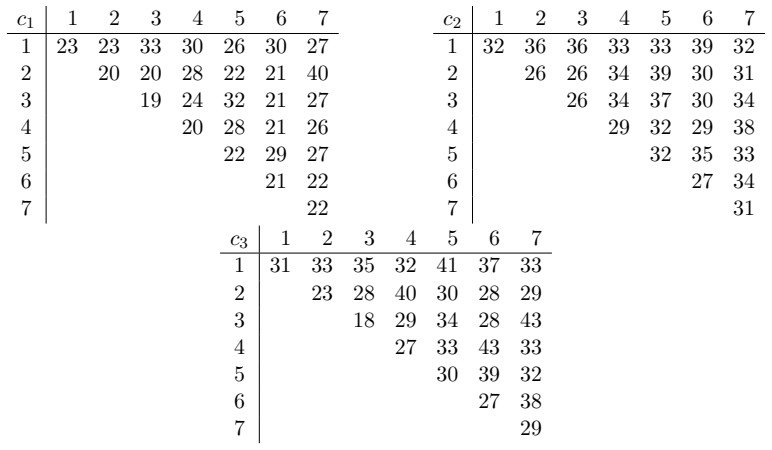
For the impossibilities, the load-bearing object is a structural barrier: each agent has a private partition of the items into three bundles of common maximum value $H$, forcing the MMS value to $H$ so that any agent receiving less must be rescued by EFX. The reduction defines $\beta_i(B)$ as the best value of $B$ after deleting one good and $\lambda_i(S)$ as the minimum over completions of the larger of the two complementary $\beta_i$ values, so that bundle $S$ can be part of an EFX-safe completion exactly when $v_i(S) \geq \lambda_i(S)$; the tables reduce all possible cases to 36 safe-pair configurations for goods and 14 allocations for chores, each exhibiting a witness failing both certificates. The order-preserving geometric transform $f(S)=1-2^{-r(S)}$ converts the monotone instances with ties into strictly monotone submodular ones while preserving the strict comparisons. For the existence results, the machinery is the threshold-preserving EFX transformation (Algorithm 2), which repairs EFX violations by single-item transfers without dropping any bundle below the initial minimum value, using the strictly decreasing potential $\Phi=\sum_i v(A_i)^2$ to terminate; cut-and-choose then yields the $(n_1, n_2, 1)$-type theorem.
What would settle it
Run the published eight-good valuation tables through a program that enumerates all 6561 allocations: if any allocation gives every agent either value 95 or an EFX-feasible bundle, Theorem 1 is false. For the chores instance, enumerate all allocations of seven chores and check each of the fourteen non-special-triple cases against Table 6; a single row with an EFX- and MMS-satisfied agent refutes Theorem 2.
Extended reading notes
Core claim
The paper's central claim is that the agent-wise disjunction EFX∨MMS is not a universal remedy but does move the existence frontier. Theorems 1 and 2 give the first nonexistence results for the disjunction: a monotone submodular goods instance with three agents and eight goods, and a monotone submodular chores instance with three agents and seven chores, in which every allocation leaves some agent failing both certificates simultaneously. The constructions work by aligning each agent's MMS threshold at a common maximum value $H$ and then blocking the “EFX rescue” through pairwise bundle comparisons. On the positive side, Theorem 4 proves that every additive $(n_1, n_2, 1)$-type mixed-item instance admits an EFX∨MMS allocation, leading to a clean separation from both constituent notions; and with identical additive valuations the stronger conjunction EFX∧MMS always exists.
Load-bearing premise
The nonexistence theorems hinge on exhaustive case tables (36 safe-pair cases for goods and 14 chore allocations) that the manuscript presents as human-checkable but does not back with machine-readable certificates; a single missed case or miscalculated value in these tables would invalidate the corresponding theorem.
Editorial extensions
If this is right
- The known three-agent, eight-good submodular counterexamples to EFX cannot be repaired by allowing the affected agents to switch to an MMS certificate; the same agent fails both.
- Every additive mixed-item instance whose agents fall into at most three valuation types, with one type a singleton, has an EFX∨MMS allocation, including instances mixing goods and chores.
- For additive chores with two valuation types, neither EFX nor MMS is guaranteed individually, but EFX∨MMS always exists, so the disjunction is strictly more robust than either constituent.
- Identical additive valuations imply the conjunction EFX∧MMS even with mixed items.
- There are two-agent, three-item additive goods and chores instances where every EFX∨MMS allocation is fractionally Pareto dominated.
Reading between the lines
- The gap between eight goods and seven goods (and between seven chores and six chores) suggests the disjunction's minimal nonexistence threshold sits just above the known EFX thresholds; a search over all three-agent monotone submodular instances with seven goods would test whether the eight-item construction is tight.
- The threshold-preserving EFX transformation looks like a reusable primitive: any partition can be converted to an EFX partition without lowering the minimum value, so variants of the cut-and-choose argument may extend to approximations of MMS or to other share-based guarantees for arbitrary agent counts.
- The appendix's simultaneous incompatibility between epistemic EFX and EF1 for submodular chores hints that disjunctive or epistemic flexibility has its own structural obstructions; one could probe whether EFX∨EEFX or EF1∨MMS inherit the same pathologies.
- If the positive theorem's singleton-agent condition is essential, then four-agent two-type additive instances are the natural next test; the paper leaves open whether EFX∨MMS survives there.
Signed reviews
Editorial analysis
A structured set of objections, weighed in public.
Referee Report
Summary. The paper defines EFX∨MMS, an agent-wise disjunction requiring every agent to be either EFX-satisfied or MMS-satisfied, with the fairness certificate allowed to differ across agents. The main negative results are Theorem 1, a monotone submodular goods instance with three agents and eight goods admitting no EFX∨MMS allocation, and Theorem 2, an analogous submodular chores instance with three agents and seven chores. These are established by an SMT-guided search reduced to a human-checkable case analysis (Tables 1–3 for goods; Tables 4–6 for chores), followed by a rank-based submodularization step. The main positive result, Theorem 4, proves existence of EFX∨MMS allocations for additive mixed-item instances with at most three valuation types of multiplicities (n1,n2,1), via an MMS partition, a threshold-preserving EFX subroutine, and a cut-and-choose step. Corollaries extend this to MMS-feasible goods valuations, give approximation schemes, and show EFX∧MMS for identical additive mixed valuations. Theorem 3 shows incompatibility with fractional Pareto optimality for two agents and three items.
Significance. If the counterexamples are correct, Theorems 1 and 2 are significant: they show that even allowing each agent to choose between two independent fairness certificates does not restore existence in small submodular instances, substantially strengthening recent EFX nonexistence results. The positive results are also valuable: Theorem 4 gives the first structured existence guarantee for the disjunction, and the separation between EFX∨MMS and its constituents for two-type additive chores is clean and clearly explained. The paper's methodological choice—reducing an SMT search to a compact human-checkable case table—is a useful expository device, and the rank-based submodularization argument is elegant. The SMT search and the structural-barrier reduction are genuine strengths. However, the central nonexistence theorems currently rest on large tables that are not machine-auditable, and the main positive lemma has a correctness gap for mixed items; these issues must be resolved before the results can be accepted.
major comments (2)
- [Section 3.1 and Appendix A.2, Tables 3 and 6] The impossibility proofs of Theorems 1 and 2 are reduced to exhaustive case tables (36 safe-pair cases for goods in Table 3 and fourteen allocations for chores in Table 6) that are asserted to be exhaustive and human-checkable but are not accompanied by machine-checkable certificates or by the Z3 code itself. The appendix states that the code is included, but the manuscript text does not reproduce it, and a single erroneous or omitted row would invalidate the corresponding nonexistence theorem. The AI-usage disclosure indicates that these tables were created with AI assistance and later verified by the authors; this makes an independently runnable verifier especially important. Since these tables are the load-bearing step for both central negative results, I ask that the authors provide the search code and an independently runnable verifier that checks each row's witness, or a formal proof of exhaustiveness.
- [Section 4, Algorithm 2 and Lemma 1] Algorithm 2's first branch is triggered by the condition '∃g∈A_j s.t. v(A_i)<v(A_j\{g})' without checking that g is a good. For additive mixed valuations this condition can hold for a chore g in A_j, since v(A_j\{g})>v(A_j), and the algorithm would then transfer a chore from the envied bundle to the envious agent, decreasing the recipient's value and potentially violating the threshold τ. For example, let v(c1)=-1000, v(c')=-2800, v(g1)=g2=1500, A1={c1}, A2={c',g1,g2}; then v(A1)=-1000, v(A2)=200, and τ=-1000. Agent 1 is not EFX-feasible because v(A1\{c1})=0<200, and the condition holds for c' because v(A2\{c'})=3000>v(A1); line 4 would move c' into A1, dropping its value to -3800, below τ. Lemma 1's proof assumes the transferred item is a good only in Case 1, but the pseudocode does not enforce this. The fix is to require v(g)>0 in the 'good' branch and v(c)<0 in the 'chore' branch and to re-examine termination and threshold preservation under this corrected condition. Because Theorem 4 and Corollary 3 invoke this lemma for mixed items, this is a load-bearing correctness issue.
minor comments (4)
- [Section 3.3] The sentence 'Let us now show consider the case of chores' should read 'Let us now consider the case of chores'.
- [Table 3] The caption refers to 'the next two displays' continuing the table, but the table is split across pages without clear continuation headings; adding a header to each continuation would improve readability and reduce the risk of transcription errors.
- [Section 2] In the definition of MMS-feasible valuations, the quantifier ranges over arbitrary subsets S and integers k, but the condition max_j v(Y_j) ≥ min_i v(X_i) implicitly assumes the partitions are ordered; a short clarifying sentence about indexing would be helpful.
- [Appendix C] The EPMMS separation example would be easier to follow if the claimed pairwise-maximin-share values were derived explicitly rather than stated; the current text is correct but somewhat terse.
Circularity Check
No significant circularity: the counterexamples are exact constructions verified by case analysis, and the positive results follow from definitions and external theorems.
full rationale
The paper's derivation chain is self-contained for the claims it makes. The goods counterexample (Theorem 1) is found by an SMT search, but the theorem is not inferred from the solver's assertion: the proof gives the scaled valuations, a structural-barrier argument fixing the MMS value at H=95, safe-pair tables (Tables 1-3) covering all 36 two-item safe-pair cases, and an order-preserving rank transform that preserves the strict comparisons needed for nonexistence. The chores counterexample (Theorem 2) is manually constructed and verified by the MMS-value computation in Table 4 and the exhaustive fourteen-allocation check in Table 6; the submodularization is again an order-preserving transform. These are exact case verifications, not fits renamed as predictions. Theorem 3's fPO incompatibility is proved by explicit fractional dominating allocations, with the Freeman et al. citation only attributing the example. Theorem 4 and its corollaries follow from the definition of an MMS partition, the threshold-preserving Lemma 1 (proved by a potential argument), and external results such as Leximin++ [Plaut and Roughgarden] and standard MMS approximation algorithms; none of these steps assumes EFX-or-MMS existence. The only self-citations are background or example attribution and are not load-bearing. The case tables are not machine-checked in the manuscript, which is an auditability risk, not a circularity.
Assumptions & free parameters
assumptions (6)
- domain assumption EFX and MMS definitions follow Caragiannis et al. [2019] and Budish [2011], including the positive-marginal convention for goods and the removal rule for chores.
- standard math The geometric rank transform f(S)=1-2^{-r(S)} over any linear order respecting subset inclusion yields strictly monotone submodular functions.
- domain assumption The Z3 SMT solver returns correct satisfying assignments for the encoded constraints in the goods counterexample search.
- domain assumption The finite case tables (Tables 1-6) are accurate and exhaustive.
- domain assumption In Corollary 1, v1 is MMS-feasible.
- domain assumption The instance of Freeman et al. [2019] used in Theorem 3 has the claimed EFX and MMS properties.
Cite this review
Pith. "Pith review of To EFX OR to MMS, That is the Question." pith.science (2026). https://pith.science/paper/JOG42BTL
@misc{pith2026260810397,
  author       = {Pith},
  title        = {Pith review of: To EFX OR to MMS, That is the Question},
  year         = {2026},
  howpublished = {\url{https://pith.science/paper/JOG42BTL}},
  note         = {Machine review of arXiv:2608.10397}
}
abstract
We study the agent-wise disjunction of two central fairness notions for indivisible items, where every agent must be either envy-free up to any item (EFX) or maximin-share (MMS) satisfied. One might expect this flexibility to restore existence, especially because the existence of EFX itself resisted resolution for nearly a decade. Surprisingly, it does not. We construct counterexamples with three agents and eight submodular goods, and with three agents and seven submodular chores, significantly strengthening recent EFX impossibility results. On the positive side, we prove existence for additive mixed items with at most three valuation types when one type is a singleton. Our proof extends beyond additivity for goods and yields approximation schemes for goods and three-agent chores instances. We also identify a clean separation between the disjunction and its constituents: For additive chores with two valuation types, EFX and MMS are both known to fail, whereas an EFX$\vee$MMS allocation always exists. Finally, we show that identical additive valuations even admit the conjunction EFX$\wedge$MMS for mixed items. Overall, our results show that allowing flexibility in choosing agent-specific fairness certificates expands the frontier of fair solutions while also uncovering surprising impossibilities.
Figures


Reference graph
Works this paper leans on
-
[1]
ACM Transactions on Economics and Computation , volume=
Caragiannis, Ioannis and Kurokawa, David and Moulin, Herv. ACM Transactions on Economics and Computation , volume=. 2019 , url=
2019
-
[2]
Varian, Hal R , journal=
-
[3]
2011 , url=
Budish, Eric , journal=. 2011 , url=
2011
-
[4]
Brams, Steven J and Taylor, Alan D , year=
-
[5]
Dubins, Lester E and Spanier, Edwin H , journal=
-
[6]
Alon, Noga , journal=
-
[7]
Mathematical Social Sciences , volume=
Segal-Halevi, Erel and Sziklai, Bal. Mathematical Social Sciences , volume=
-
[8]
Amanatidis, Georgios and Birmpas, Georgios and Markakis, Vangelis , booktitle=
Show all 168 references
-
[9]
Proceedings of the 21st European Conference on Artificial Intelligence , pages=
Gourv. Proceedings of the 21st European Conference on Artificial Intelligence , pages=
-
[10]
Goldman, Jonathan and Procaccia, Ariel D , journal=
-
[11]
Conitzer, Vincent and Freeman, Rupert and Shah, Nisarg , booktitle=
-
[12]
1967 , pages=
Foley, Duncan , journal=. 1967 , pages=
1967
-
[13]
Barman, Siddharth and Krishnamurthy, Sanath Kumar and Vaish, Rohit , booktitle=
-
[14]
Lipton, Richard J and Markakis, Evangelos and Mossel, Elchanan and Saberi, Amin , booktitle=
-
[15]
Social Choice and Welfare , year=
Bogomolnaia, Anna and Moulin, Herv. Social Choice and Welfare , year=
-
[16]
1995 , publisher=
Mas-Colell, Andreu and Whinston, Michael Dennis and Green, Jerry R , volume=. 1995 , publisher=
1995
-
[17]
2017 , author=
Information Processing Letters , volume=. 2017 , author=
2017
-
[18]
Darmann, Andreas and Schauer, Joachim , journal=
-
[19]
Bansal, Nikhil and Sviridenko, Maxim , booktitle=
-
[20]
ACM SIGecom Exchanges , volume=
Bez. ACM SIGecom Exchanges , volume=
-
[21]
and Johnson, David S
Garey, Michael R. and Johnson, David S. , year =
-
[22]
Journal of Artificial Intelligence Research , volume=
Bouveret, Sylvain and Lang, J. Journal of Artificial Intelligence Research , volume=
-
[23]
Herreiner, Dorothea K and Puppe, Clemens D , journal=
-
[24]
Chen, Yiling and Lai, John K and Parkes, David C and Procaccia, Ariel D , journal=
-
[25]
Stromquist, Walter , journal=
-
[26]
Brainard, William C and Scarf, Herbert , year=
-
[27]
Aziz, Haris and Caragiannis, Ioannis and Igarashi, Ayumi and Walsh, Toby , booktitle=
-
[28]
Proceedings of the 26th International Joint Conference on Artificial Intelligence , pages=
Bouveret, Sylvain and Cechl. Proceedings of the 26th International Joint Conference on Artificial Intelligence , pages=
-
[29]
Dickerson, John P and Goldman, Jonathan and Karp, Jeremy and Procaccia, Ariel D and Sandholm, Tuomas , booktitle=
-
[30]
Huang, Xin and Lu, Pinyan , journal=
-
[31]
Aziz, Haris and Li, Bo and Wu, Xiaowei , booktitle=
-
[32]
Aziz, Haris and Chan, Hau and Li, Bo , booktitle=
- [33]
-
[34]
2019 , url=
Freeman, Rupert and Sikdar, Sujoy and Vaish, Rohit and Xia, Lirong , booktitle=. 2019 , url=
2019
-
[35]
Aziz, Haris and Rey, Simon , booktitle=
-
[36]
Bogomolnaia, Anna and Moulin, Herve and Sandomirskiy, Fedor and Yanovskaya, Elena , journal=
-
[37]
Autonomous Agents and Multi-Agent Systems , year=
Bouveret, Sylvain and Cechl. Autonomous Agents and Multi-Agent Systems , year=
-
[38]
Traxler, Martino , journal=
-
[39]
Su, Francis Edward , journal=
-
[40]
Heydrich, Sandy and van Stee, Rob , journal=
-
[41]
Peterson, Elisha and Su, Francis Edward , journal=
-
[42]
Segal-Halevi, Erel , booktitle=
-
[43]
Farhadi, Alireza and Hajiaghayi, Mohammad Taghi , booktitle=
-
[44]
Theoretical Computer Science , volume=
Bil. Theoretical Computer Science , volume=. 2016 , pages=
2016
-
[45]
Caragiannis, Ioannis and Kaklamanis, Christos and Kanellopoulos, Panagiotis and Kyropoulou, Maria , journal=
-
[46]
Gardner, Martin , publisher=
-
[47]
Budish, Eric and Che, Yeon-Koo and Kojima, Fuhito and Milgrom, Paul , journal=
-
[48]
Aleksandrov, Martin , journal=
-
[49]
2018 , pages=
Chaudhury, Bhaskar Ray and Cheung, Yun Kuen and Garg, Jugal and Garg, Naveen and Hoefer, Martin and Mehlhorn, Kurt , booktitle=. 2018 , pages=
2018
-
[50]
2017 , url=
Aziz, Haris and Rauchecker, Gerhard and Schryen, Guido and Walsh, Toby , booktitle=. 2017 , url=
2017
-
[51]
Eisenberg, Edmund and Gale, David , journal=
-
[52]
2020 , publisher=
Segal-Halevi, Erel , journal=. 2020 , publisher=
2020
-
[53]
Sandomirskiy, Fedor and Segal-Halevi, Erel , journal=
-
[54]
Israel Journal of Mathematics , volume=
Meunier, Fr. Israel Journal of Mathematics , volume=
-
[55]
Freeman, Rupert and Sikdar, Sujoy and Vaish, Rohit and Xia, Lirong , booktitle=
- [56]
-
[57]
Operations Research Letters , volume=
Aziz, Haris and Moulin, Herv. Operations Research Letters , volume=. 2020 , publisher=
2020
-
[58]
Freeman, Rupert and Shah, Nisarg and Vaish, Rohit , booktitle=
-
[59]
Freeman, Rupert and Shah, Nisarg and Vaish, Rohit , journal=
-
[60]
2020 , organization=
Aleksandrov, Martin and Walsh, Toby , booktitle=. 2020 , organization=
2020
-
[61]
Kulkarni, Rucha and Mehta, Ruta and Taki, Setareh , booktitle=
-
[62]
arXiv preprint arXiv:1911.10009 , year=
Bogomolnaia, Anna and Moulin, Herv. arXiv preprint arXiv:1911.10009 , year=
1911 arXiv
-
[63]
Chen, Xingyu and Liu, Zijie , journal=
-
[64]
Avvakumov, Sergey and Karasev, Roman , journal=
-
[65]
2020 , publisher=
Plaut, Benjamin and Roughgarden, Tim , journal=. 2020 , publisher=
2020
-
[66]
Bei, Xiaohui and Li, Zihao and Liu, Jinyan and Liu, Shengxin and Lu, Xinhang , journal=
-
[67]
arXiv preprint arXiv:2008.00374 , year=
Pathak, Parag A and S. arXiv preprint arXiv:2008.00374 , year=
2008 arXiv
-
[68]
Aziz, Haris and Caragiannis, Ioannis and Igarashi, Ayumi and Walsh, Toby , journal=
-
[69]
2005 , publisher=
Dinur, Irit and Regev, Oded and Smyth, Clifford , journal=. 2005 , publisher=
2005
-
[70]
Guruswami, Venkatesan and Saket, Rishi , booktitle=
-
[71]
2020 , publisher=
Koivisto, Mikko and Laakkonen, Petteri and Lauri, Juho , journal=. 2020 , publisher=
2020
-
[72]
Operations Research , volume=
Budish, Eric and Cachon, G. Operations Research , volume=. 2017 , publisher=
2017
-
[73]
Aziz, Haris , booktitle=
-
[74]
Hosseini, Hadi and Sikdar, Sujoy and Vaish, Rohit and Wang, Hejun and Xia, Lirong , booktitle=
-
[75]
Chaudhury, Bhaskar Ray and Garg, Jugal and McGlaughlin, Peter and Mehta, Ruta , booktitle=
-
[76]
Chaudhury, Bhaskar Ray and Garg, Jugal and McGlaughlin, Peter and Mehta, Ruta , journal=
-
[77]
Social Choice and Welfare , volume=
Bogomolnaia, Anna and Moulin, Herv. Social Choice and Welfare , volume=. 2019 , publisher=
2019
-
[78]
Okano, Yuki and Manabe, Yoshifumi , booktitle=
-
[79]
2020 , publisher=
Benabbou, Nawal and Chakraborty, Mithun and Ho, Xuan-Vinh and Sliwinski, Jakub and Zick, Yair , journal=. 2020 , publisher=
2020
-
[80]
Othman, Abraham and Sandholm, Tuomas and Budish, Eric , booktitle=
-
[81]
2015 , organization=
Procaccia, Ariel D , booktitle=. 2015 , organization=
2015
-
[82]
Robertson, Jack and Webb, William , year=
-
[83]
1980 , publisher=
Stromquist, Walter , journal=. 1980 , publisher=
1980
-
[84]
2016 , organization=
Aziz, Haris and Mackenzie, Simon , booktitle=. 2016 , organization=
2016
-
[85]
Alijani, Reza and Farhadi, Majid and Ghodsi, Mohammad and Seddighin, Masoud and Tajik, Ahmad S , booktitle=
-
[86]
Cohler, Yuga J and Lai, John K and Parkes, David C and Procaccia, Ariel D , booktitle=
-
[87]
2014 , organization=
Aziz, Haris and Ye, Chun , booktitle=. 2014 , organization=
2014
-
[88]
Kurokawa, David and Lai, John K and Procaccia, Ariel D , booktitle=
-
[89]
2019 , organization=
Halpern, Daniel and Shah, Nisarg , booktitle=. 2019 , organization=
2019
-
[90]
Brustle, Johannes and Dippel, Jack and Narayan, Vishnu V and Suzuki, Mashbat and Vetta, Adrian , booktitle=
-
[91]
Caragiannis, Ioannis and Ioannidis, Stavros , journal=
-
[92]
Garg, Jugal and McGlaughlin, Peter and Taki, Setareh , booktitle=
-
[93]
Bei, Xiaohui and Liu, Shengxin and Lu, Xinhang and Wang, Hongao , journal=
-
[94]
Barman, Siddharth and Rathi, Nidhi , booktitle=
-
[95]
Chaudhury, Bhaskar Ray and Garg, Jugal and Mehta, Ruta , booktitle=
-
[96]
McGlaughlin, Peter and Garg, Jugal , journal=
-
[97]
Amanatidis, Georgios and Markakis, Evangelos and Ntokos, Apostolos , journal=
-
[98]
1991 , publisher=
Alkan, Ahmet and Demange, Gabrielle and Gale, David , journal=. 1991 , publisher=
1991
-
[99]
1995 , publisher=
Aragones, Enriqueta , journal=. 1995 , publisher=
1995
-
[100]
2000 , publisher=
Klijn, Flip , journal=. 2000 , publisher=
2000
-
[101]
1987 , publisher=
Maskin, Eric S , booktitle=. 1987 , publisher=
1987
-
[102]
2002 , publisher=
Meertens, Marc and Potters, Jos and Reijnierse, Hans , journal=. 2002 , publisher=
2002
-
[103]
2002 , publisher=
Haake, Claus-Jochen and Raith, Matthias G and Su, Francis Edward , journal=. 2002 , publisher=
2002
-
[104]
Garg, Jugal and McGlaughlin, Peter , booktitle=
-
[105]
2018 , organization=
Dehghani, Sina and Farhadi, Alireza and HajiAghayi, MohammadTaghi and Yami, Hadi , booktitle=. 2018 , organization=
2018
-
[106]
Benabbou, Nawal and Chakraborty, Mithun and Igarashi, Ayumi and Zick, Yair , booktitle=
-
[107]
Aleksandrov, Martin and Walsh, Toby , journal=
-
[108]
Conitzer, Vincent and Freeman, Rupert and Shah, Nisarg and Vaughan, Jennifer Wortman , booktitle=
-
[109]
Farhadi, Alireza and Hajiaghayi, MohammadTaghi and Latifian, Mohamad and Seddighin, Masoud and Yami, Hadi , booktitle=
-
[110]
Chaudhury, Bhaskar Ray and Kavitha, Telikepalli and Mehlhorn, Kurt and Sgouritsa, Alkmini , journal=
-
[111]
Bhaskar, Umang and Sricharan, AR and Vaish, Rohit , booktitle=
-
[112]
Berger, Ben and Cohen, Avi and Feldman, Michal and Fiat, Amos , journal=
-
[113]
Gafni, Yotam and Huang, Xin and Lavi, Ron and Talgam-Cohen, Inbal , booktitle=
-
[114]
Li, Bo and Li, Yingkai and Wu, Xiaowei , journal=
-
[115]
Autonomous Agents and Multi-Agent Systems , volume=
Bouveret, Sylvain and Lema. Autonomous Agents and Multi-Agent Systems , volume=
-
[116]
Caragiannis, Ioannis and Gravin, Nick and Huang, Xin , booktitle=
-
[117]
Zhou, Shengwei and Wu, Xiaowei , journal=
-
[118]
2024 , publisher=
Mahara, Ryoga , journal=. 2024 , publisher=
2024
-
[119]
2021 , url=
Hosseini, Hadi and Sikdar, Sujoy and Vaish, Rohit and Xia, Lirong , journal=. 2021 , url=
2021
-
[120]
2020 , url=
Chaudhury, Bhaskar Ray and Garg, Jugal and Mehlhorn, Kurt , booktitle=. 2020 , url=
2020
-
[121]
Hosseini, Hadi and Sikdar, Sujoy and Vaish, Rohit and Xia, Lirong , booktitle=
-
[122]
Garg, Jugal and Murhekar, Aniket , booktitle=
-
[123]
Gamow, George and Stern, Marvin , pages=
-
[124]
Halpern, Daniel and Procaccia, Ariel D and Psomas, Alexandros and Shah, Nisarg , booktitle=
-
[125]
2020 , organization=
Aziz, Haris , booktitle=. 2020 , organization=
2020
-
[126]
Babaioff, Moshe and Ezra, Tomer and Feige, Uriel , journal=
-
[127]
Caragiannis, Ioannis and Kanellopoulos, Panagiotis and Kyropoulou, Maria , booktitle=
-
[128]
Manshadi, Vahideh and Niazadeh, Rad and Rodilitz, Scott , booktitle=
-
[129]
Journal of Economic Theory , volume=
Bogomolnaia, Anna and Moulin, Herv. Journal of Economic Theory , volume=
-
[130]
2015 , publisher=
Aziz, Haris and Gaspers, Serge and Mackenzie, Simon and Walsh, Toby , journal=. 2015 , publisher=
2015
-
[131]
Proceedings of the 19th European Conference on Artificial Intelligence , pages=
Bouveret, Sylvain and Endriss, Ulle and Lang, J. Proceedings of the 19th European Conference on Artificial Intelligence , pages=
-
[132]
Hosseini, Hadi and Larson, Kate , journal=
-
[133]
Babaioff, Moshe and Ezra, Tomer and Feige, Uriel , booktitle=
-
[134]
Barman, Siddharth and Biswas, Arpita and Krishnamurthy, Sanath and Narahari, Yadati , booktitle=
-
[135]
Hylland, Aanund and Zeckhauser, Richard , journal=
-
[136]
Aleksandrov, Martin Damyanov and Aziz, Haris and Gaspers, Serge and Walsh, Toby , booktitle=
-
[137]
Steinhaus, Hugo , journal=
-
[138]
2018 , url=
Kurokawa, David and Procaccia, Ariel D and Wang, Junxing , journal=. 2018 , url=
2018
-
[139]
Birkhoff, Garrett , journal=
-
[140]
von Neumann, John , journal=
-
[141]
2009 , publisher=
Lov. 2009 , publisher=
2009
-
[142]
Theoretical Computer Science , volume=
Aziz, Haris and Bir. Theoretical Computer Science , volume=
-
[143]
Feige, Uriel , journal=
-
[144]
2025 , url=
Akrami, Hannaneh and Rathi, Nidhi , booktitle=. 2025 , url=
2025
-
[145]
2024 , organization=
Akrami, Hannaneh and Garg, Jugal , booktitle=. 2024 , organization=
2024
-
[146]
2020 , publisher=
Barman, Siddharth and Krishnamurthy, Sanath Kumar , journal=. 2020 , publisher=
2020
-
[147]
1997 , publisher=
Woeginger, Gerhard J , journal=. 1997 , publisher=
1997
-
[148]
Huang, Xin and Zhou, Shengwei , journal=
-
[149]
2026 , eprint=
Babaioff, Moshe and Frosh, Gefen , journal=. 2026 , eprint=
2026
-
[150]
2026 , url=
Akrami, Hannaneh and Mahara, Ryoga and Mehlhorn, Kurt and Rathi, Nidhi , journal=. 2026 , url=
2026
-
[151]
2021 , organization=
Feige, Uriel and Sapir, Ariel and Tauber, Laliv , booktitle=. 2021 , organization=
2021
-
[152]
arXiv preprint arXiv:2302.11530 , year=
Fair chore division under binary supermodular costs , author=. arXiv preprint arXiv:2302.11530 , year=
-
[153]
2025 , url=
HV, Vishwa Prakash and Ghosal, Pratik and Nimbhorkar, Prajakta and Varma, Nithin , booktitle=. 2025 , url=
2025
-
[154]
2026 , url=
Akrami, Hannaneh and Mayorov, Alexander and Mehlhorn, Kurt and Srinivas, Shreyas and Weidenbach, Christoph , journal=. 2026 , url=
2026
-
[155]
2026 , url=
Mackenzie, Simon and Suzuki, Mashbat , journal=. 2026 , url=
2026
-
[156]
2026 , url=
Christoforidis, Vasilis , journal=. 2026 , url=
2026
-
[157]
2026 , url=
He, Wentao and Tao, Biaoshuai , journal=. 2026 , url=
2026
-
[158]
2024 , url=
Christoforidis, Vasilis and Santorinaios, Christodoulos , booktitle=. 2024 , url=
2024
-
[159]
2025 , publisher=
Akrami, Hannaneh and Alon, Noga and Chaudhury, Bhaskar Ray and Garg, Jugal and Mehlhorn, Kurt and Mehta, Ruta , journal=. 2025 , publisher=
2025
-
[160]
2025 , doi=
Akrami, Hannaneh and Rathi, Nidhi , booktitle=. 2025 , doi=
2025
-
[161]
2026 , eprint=
Feldman, Michal and Fiat, Amos and Nissan, Yael and Ponitka, Tomasz , journal=. 2026 , eprint=
2026
-
[162]
2023 , url=
Akrami, Hannaneh and Chaudhury, Bhaskar Ray and Garg, Jugal and Mehlhorn, Kurt and Mehta, Ruta , booktitle=. 2023 , url=
2023
-
[163]
2023 , doi=
Caragiannis, Ioannis and Garg, Jugal and Rathi, Nidhi and Sharma, Eklavya and Varricchio, Giovanna , booktitle=. 2023 , doi=
2023
-
[164]
and Shmoys, David B
Hochbaum, Dorit S. and Shmoys, David B. , journal=. 1987 , doi=
1987
-
[165]
1976 , publisher=
Sahni, Sartaj K , journal=. 1976 , publisher=
1976
-
[166]
2023 , url =
Hosseini, Hadi and Mammadov, Aghaheybat and Was, Tomasz , journal=. 2023 , url =
2023
-
[167]
2026 , url=
Qiu, Jiawei and Wu, Xiaowei and Zhang, Cong and Zhou, Shengwei , booktitle=. 2026 , url=
2026
-
[168]
2021 , url=
Hosseini, Hadi and Searns, Andrew , journal=. 2021 , url=
2021
Reviewed August 12, 2026 · model on record in the stance chip above.
Discussion (0). Continue with ORCID to comment.