REVIEW 3 major objections 5 minor 86 references
Do Judges Behave Like Algorithms?
T0 review · 3 major / 5 minor · reviewed 2026-08-15 · deepseek-v4-flash
Pith's one-line read Most Harris County magistrates decide bail by small, predictable rules; the rules differ by judge.
desk verdict A genuinely useful Rashomon-set framework for studying judicial consistency, but the headline that judges 'behave algorithmically' rests on removing the very cases where they used unmeasured, substantive judgment. read the letter →
The pith
A machine-rendered reading of the paper's core claim, the machinery that carries it, and where it could break.
The reading
What carries the argument
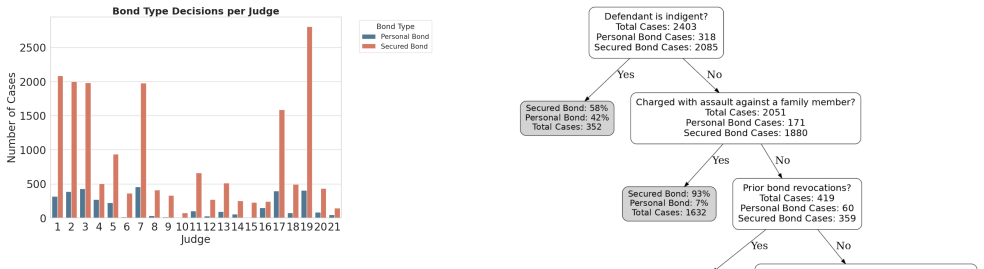
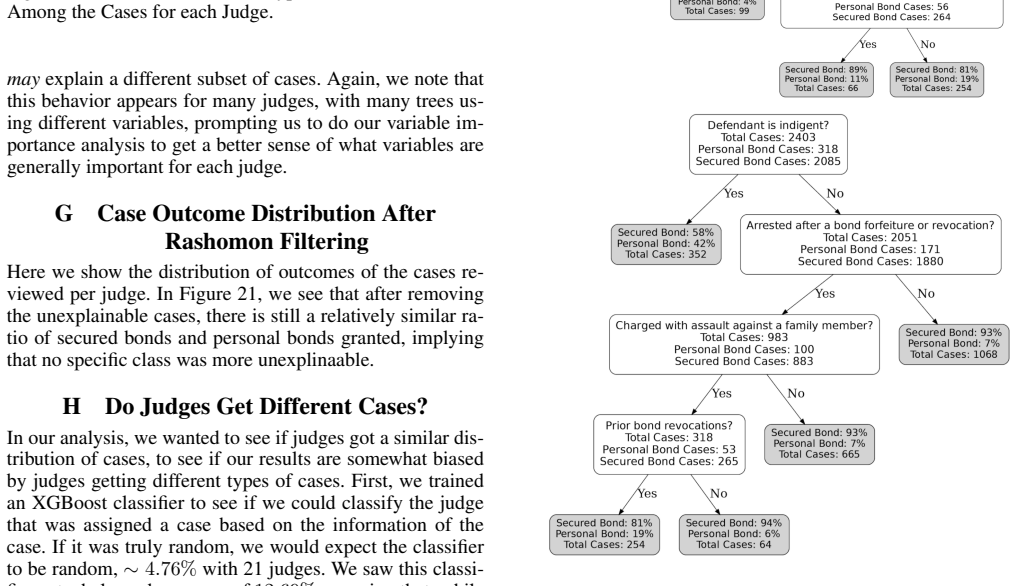
The load-bearing object is the Rashomon set of sparse decision trees: for each judge, the complete collection of near-optimal trees of depth at most five, kept within a 1% tolerance of the best objective. This set does three jobs. First, it defines "unexplainable" cases as those every tree in the set gets wrong, which is how the paper isolates noise and standards-driven outliers. Second, it supports variable importance averaged over many equally good models instead of one model, avoiding the common flaw of attributing importance to a single fitted tree. Third, it supplies the source models for cross-judge loss distributions and for frequent-pattern rule mining that identifies disagreement conditions such as defendants aged 24 or younger. A second mechanism, globally optimal sparse decision-tree fitting, selects one representative shallow tree per judge to quantify how algorithm-like each judge is.
What would settle it
A direct falsifier: take the removed unexplainable cases, obtain the hearing transcripts, and code the qualitative details the judges cited (severity of injury, out-of-county history, defendant statements); if those details predict the bond ruling consistently across judges, the 18% are structured judgment, not noise, and the central claim fails. A simpler version is to rerun the entire pipeline without deleting unexplainable cases and check whether most judges' depth-five trees still capture at least 85% of decisions.
Extended reading notes
Core claim
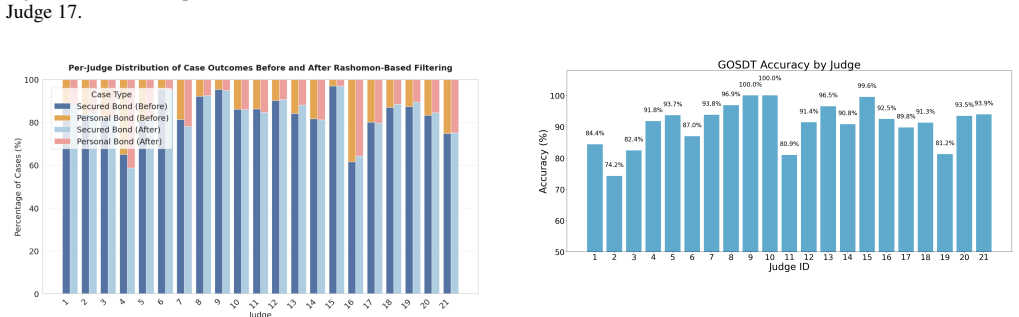
The paper's central discovery is that judicial behavior at these bail hearings is largely rule-like and formulaic, but the formula is judge-specific. The authors define "unexplainable" cases as those that no near-optimal shallow decision tree (a tree of depth at most five within the Rashomon set) can predict correctly, identify about 18% of cases this way, and find by manual review of a sample that all such cases trace to data-entry errors, out-of-county criminal history missing from the dataset, or case-specific qualitative details the judge heard but the structured data do not record. After removing those cases, globally optimal sparse trees reconstruct 75–100% of each judge's decisions, and for 17 of 21 judges at least 85% of rulings are captured. Across judges, the same variables (age, warrant count, and rule-based flags) recur but with different weights and additional variables; when a model trained on one judge is applied to another, accuracy drops sharply, and on matched similar cases judges agree only about 55% of the time, close to chance. The paper concludes that judges behave algorithmically yet inconsistently: the justice system's outcomes depend heavily on which magistrate is assigned.
Load-bearing premise
The load-bearing premise is that the roughly 18% of cases no good tree can explain are mostly noise — form errors, missing out-of-county history, or unrecorded case-specific details — rather than a systematic standards-based mode of judging; if those cases represent real, consistent judicial reasoning, then the conclusion that judges generally behave algorithmically is an artifact of deleting them.
Editorial extensions
If this is right
- If judges are broadly rule-following, improving judicial behavior can be framed as improving the rules: better data and standardized guidelines can be targeted rather than treated as inscrutable discretion.
- Cases that no reasonable tree explains are where individualized standards actually operate; focusing oversight there, rather than on routine cases, can surface data errors, missing criminal history, and case-specific factors.
- Because each judge's algorithm differs, aggregating judicial behavior into a single model is misleading; models must be judge-specific, and alignment interventions should target judge pairs with strong disagreement rules.
- Inter-judge agreement near chance on similar cases means the assignment of a magistrate materially changes detention outcomes, a direct challenge to consistency as a due-process value.
- Feature importance averaged over the Rashomon set is more robust than single-model importance; applying it to judges can reveal which demographic characteristics, such as race, each judge relies on.
Reading between the lines
- Because the paper operationalizes "algorithmic" as depth at most five with an 85% match, the headline conclusion is partly definitional; rerunning with depth three or a 90% threshold would reclassify some judges, and we predict the ordering of judges by algorithmic-ness would remain stable even if the "generally" qualifier would shift.
- The near-chance cross-judge agreement implies an audit design: match cases on all structured features, compare release outcomes across magistrates, and test whether judge identity remains predictive; if it does, assignment is effectively a lottery.
- The unexplainable-case detector could be inverted into a real-time monitoring tool that flags a ruling falling outside a judge's own Rashomon set before detention, prompting a second look at exactly the cases where standards rather than rules may be operating.
- The variable-importance result that race matters for some judges suggests a concrete next test: whether the mined disagreement rules involving age, family assault, and prior warrants differentially affect defendants by race; the paper does not report that demographic breakdown.
Signed reviews
Editorial analysis
A structured set of objections, weighed in public.
Referee Report
Summary. The paper investigates whether 21 magistrate judges in Harris County, Texas behave "algorithmically" in misdemeanor bail hearings, operationalizing algorithmic behavior as predictability by sparse decision trees (depth ≤ 5) within a Rashomon set. The authors generate Rashomon sets with TreeFARMS, identify "unexplainable" cases that no near-optimal tree predicts correctly, manually review 100 such cases, classify them as noise (form errors, out-of-county criminal history, case-specific qualitative details), and remove them. On the filtered data, they fit GOSDT trees, report that 17 of 21 judges have at least 85% of decisions captured by a tree, analyze variable importance, and run cross-judge consistency, rule-mining, and triplet experiments. The paper concludes that judges generally behave algorithmically but follow different algorithms, leading to inter-judge inconsistency.
Significance. If the conclusions held on the full data, this would be a significant empirical contribution to the rules-versus-standards debate and to the literature on judicial decision-making under the O'Donnell Consent Decree. The paper's methodological strengths include the use of Rashomon sets to avoid single-model artifacts, public code, a fully documented data-processing pipeline, and a manual audit of unexplainable cases. However, the central empirical claim currently depends on the contested removal of 18% of cases, including cases where judges used individualized information absent from the structured data; this is precisely the standards-based behavior the study aims to distinguish from algorithmic rule-following. As a result, the headline claim is underdetermined as written.
major comments (3)
- ['When do judges not follow any reasonable algorithm?' and subsequent filtering step] The paper's definition of 'unexplainable' is not limited to noise: the third category identified in the manual review (case-specific qualitative details such as crime intensity, Figure 6) consists of judges using information outside the structured feature set, which is exactly the standards-based behavior the research question is designed to detect. Removing these cases before fitting the GOSDT trees means the reported accuracy (17 of 21 judges with ≥85% of decisions explained) is computed on the subset of cases that are representable in the feature space, not on the full set of decisions the paper claims to characterize. The abstract's conclusion that 'judges generally behave algorithmically' is therefore not supported unless the paper reports the fraction of the 18% of unexplainable cases attributable to each of the three categories and shows that the conclusion is robust to including category (c) cases, e.g., by fitting trees on the full data or treating category (c) as a distinct outcome.
- [Manual review of 100 unexplainable cases] The manual review of 100 unexplainable cases is used to justify the claim that 'all of them were unexplainable due to noise,' but the paper does not describe how the sample was selected or how the three categories were coded. Without a random, stratified sampling scheme and a documented classification protocol, the extrapolation from 100 cases to the roughly 4,000 unexplainable cases is not statistically grounded. The paper should report the sampling method, the per-judge and per-category breakdown of the sample, and inter-rater reliability.
- [Appendix D: Rashomon set bound multiplier] Appendix D states that the Rashomon set is generated with a bound multiplier of 0.01 (1% tolerance). The per-judge unexplainable fraction (2%-33%) and hence the size of the filtered subset are direct functions of this tolerance; a different tolerance would change which cases are excluded and could change the 17-of-21 result. The paper should include a sensitivity analysis over the Rashomon tolerance to demonstrate that the headline accuracy is not an artifact of this parameter.
minor comments (5)
- [Table 3 and surrounding text] The caption of Table 3 says 'Judge 4 (left) and Judge 16 (right)' but the text refers to Judges 4 and 6; the mismatch should be corrected.
- [Throughout] The paper contains several typos, e.g., 'Harrasement' in Table 3, 'unexplinaable' in Appendix G, 'signifigance' and 'differnt' in Appendix H, and 'comnplex' in Appendix K; a careful proofread is needed.
- [Abstract] The abstract's statement that judges 'generally behave algorithmically' should be qualified to refer to the cases that remain after the proposed filtering, until the robustness analysis is provided.
- [Appendix L and main text references] The main text refers to 'Figure 28' for additional pairwise loss comparisons, but the figure numbering in the appendix is inconsistent with the text; please check all cross-references.
- [Appendix H] Appendix H reports that some case types (e.g., ICE holds, indigency flags) differ across judges; the paper should explain more directly how this affects the interpretation of the disagreement rules in Table 4.
Circularity Check
The 'judges behave algorithmically' headline is partly self-definitional: the 85% capture rate is measured only after deleting the cases that no Rashomon-set tree could predict, and the 'noise' category includes exactly the case-specific standards-based behavior the paper claims to distinguish.
-
self definitional
[Experiments and Results: 'When do judges not follow any reasonable algorithm?' (unexplainable-case definition and removal, Figs.]
"For each magistrate, we identified cases that were misclassified for every function in the Rashomon set; these “unexplainable cases” are judicial decisions where no good model can predict the judge’s ruling correctly. ... In what follows, we will remove all the unexplainable cases and only use the remaining cases. ... For 17 of the 21 judges, the models capture at least 85% of the judge’s decisions."
Unexplainable cases are defined as decisions that no tree in the Rashomon set predicts correctly; the paper then removes them and measures how algorithmic each judge is on the remainder. The 85% capture figure is computed on the complement of cases removed precisely because they failed the algorithmic-capture test, so the hard cases are excluded from the denominator by construction. The circularity is sharpened by category (c): 'case-specific qualitative details that judges referenced but were absent from structured data' (e.g., crime intensity) is exactly the individualized, standards-based behavior the introduction says would make decisions harder to model. Calling it noise and deleting it makes 'judges generally behave algorithmically' true only for cases representable in the dataset.
full rationale
The paper is methodologically transparent about the filtering step, but the filtering is what makes the central claim true. The Rashomon-set and GOSDT tools are standard, public algorithms with code; the self-citations to Rudin and coauthors (TreeFARMS, GOSDT, Rashomon-set concept) are legitimate method citations, not load-bearing circularity. The cross-judge loss distributions, rule mining, and triplet analyses are independent empirical results that do not depend on the algorithmic-capture claim. However, the headline 'judges generally behave algorithmically' is operationalized on the filtered subset: unexplainable cases are defined as those no good tree predicts, then removed, and the 85%-capture figure is computed on what remains. Category (c) of the manual 'noise' review—case-specific qualitative details such as crime intensity—is precisely the individualized, standards-based information the paper's introduction says would make judicial decisions hard to model; treating it as noise and deleting it means the conclusion describes only the cases representable in the structured data. Because the paper does not report the breakdown of the ~18% unexplainable cases across the three categories, the extent to which the headline is an artifact of the exclusion is unquantified. This is a partial, construction-based circularity rather than a fully tautological derivation, since the 85% figure is not logically guaranteed and other analyses stand independently.
Assumptions & free parameters
free parameters (8)
- Rashomon bound multiplier =
0.01
- Tree depth budget =
5
- TreeFARMS regularization =
0.005
- GOSDT regularization =
0.001
- Rule mining minimum support =
0.02
- Rule mining minimum confidence =
0.60
- Number of bootstraps and top features =
100, 50
- Triplet distance weights =
not specified
assumptions (5)
- domain assumption The engineered court data are an adequate representation of the information available to the judge, except for manually identified categories.
- domain assumption Sparse decision trees (depth <=5) within 1% of optimal form a suitable function class for defining 'algorithmic behavior'.
- domain assumption The manually reviewed 100 unexplainable cases are representative of all unexplainable cases.
- domain assumption The target variable 'personal bond granted' is a valid indicator of the bail decision.
- domain assumption Judge assignment is sufficiently random that cross-judge comparisons are meaningful.
Cite this review
Pith. "Pith review of Do Judges Behave Like Algorithms?." pith.science (2026). https://pith.science/paper/KMCXQMIG
@misc{pith2026260810400,
  author       = {Pith},
  title        = {Pith review of: Do Judges Behave Like Algorithms?},
  year         = {2026},
  howpublished = {\url{https://pith.science/paper/KMCXQMIG}},
  note         = {Machine review of arXiv:2608.10400}
}
read the original abstract
What if judges already behave like algorithms? As artificial intelligence and algorithms are deployed in many settings, including the judicial system, many have debated whether judges should be allowed to rely on them. Instead, we ask whether judges follow predictable, algorithmic-like rules already. If judges already follow consistent, formula-like rules based on discrete and static factors such as criminal history, age, and charge type, then judicial behavior may be improved. However, if judges rely on individualized information that cannot be identified through court data, then standards-based decision-making may be more challenging to understand or improve. This work explores these questions by studying judicial decision-making in misdemeanor bail hearings in Harris County, Texas. Using available court data, we investigate whether magistrate judges follow what resembles an algorithm; whether they consider the same variables in their decision-making; and whether they are consistent with themselves and with each other. To do this, we train machine learning models for each judge, measure variable importance metrics to determine important variables for each judge's decision-making, and analyze outcomes of similar cases for judges. Our results reveal that these judges generally behave algorithmically: their decisions can be captured by small, interpretable formulas. However, in some cases, judges differ substantially, leading to surprising inconsistency and unequal treatment across similar defendants. Identifying cases where algorithms do not explain judicial decision-making can improve the justice system by focusing attention on decisions where individualized standards, rather than rules, better explains outcomes.
Figures


Figures from the paper (18 more)






Reference graph
Works this paper leans on
-
[1]
2016 , url=
Julia Angwin and Jeff Larson and Surya Mattu and Lauren Kirchner , title=. 2016 , url=
2016
-
[2]
The Age of Secrecy and Unfairness in Recidivism Prediction , volume =
Rudin, Cynthia and Wang, Caroline and Coker, Beau , date =. The Age of Secrecy and Unfairness in Recidivism Prediction , volume =. Harvard Data Science Review , number =. 2020 , month =
2020
-
[3]
2023 , title =
Wang, Caroline and Han, Bin and Patel, Bhrij and Rudin, Cynthia , journal =. 2023 , title =
2023
-
[4]
Schlag , Title =
Pierre J. Schlag , Title =. 1985 , URL =
1985
-
[5]
Duke Law Journal , volume =
Louis Kaplow , Title =. Duke Law Journal , volume =
-
[6]
The Quarterly Journal of Economics , volume=
Human decisions and machine predictions , author=. The Quarterly Journal of Economics , volume=. 2018 , publisher=
2018
-
[7]
1982 , publisher=
Judgment under uncertainty: Heuristics and biases , author=. 1982 , publisher=
1982
- [8]
Show all 86 references
-
[9]
Stanford Technology Law Review , page =
Developing Artificially Intelligent Justice , author =. Stanford Technology Law Review , page =. 2019 , URL =
2019
-
[10]
and Wistrich, Andrew J
Rachlinkski, Jeffrey J. and Wistrich, Andrew J. , Title =. Annual Review of Law and Social Science , year =
-
[11]
2023 , Author =
Racializing Algorithms , volume=. 2023 , Author =
2023
-
[12]
Southern California Law Review , year =
The impact of artificial intelligence on rules, standards, and judicial discretion , author =. Southern California Law Review , year =
-
[13]
and Thompson, Sandra Guerra and Carmichael, Dottie and Shi, David and Kang, Songman , journal =
Garrett, Brandon L. and Thompson, Sandra Guerra and Carmichael, Dottie and Shi, David and Kang, Songman , journal =. Liberty,. 2024 , month =
2024
-
[14]
The Quarterly Journal of Economics , volume =
Kleinberg, Jon and Lakkaraju, Himabindu and Leskovec, Jure and Ludwig, Jens and Mullainathan, Sendhil , title =. The Quarterly Journal of Economics , volume =. 2017 , month =. doi:10.1093/qje/qjx032 , url =
2017 doi
-
[15]
The Quarterly Journal of Economics , volume =
Rambachan, Ashesh , title =. The Quarterly Journal of Economics , volume =. 2024 , month =. doi:10.1093/qje/qjae013 , url =
2024 doi
-
[16]
Harris Cty
ODonnell v. Harris Cty. , author =. 2019 , note =
2019
-
[17]
American Economic Review , Volume =
Arnold, David and Dobbie, Will and Hull, Peter , Title =. American Economic Review , Volume =. 2022 , Month =. doi:10.1257/aer.20201653 , URL =
2022 doi
-
[18]
Dhami , title =
Mandeep K. Dhami , title =. Psychological Science , volume =. 2003 , doi =
2003
-
[19]
2024 , eprint=
Does AI help humans make better decisions? A statistical evaluation framework for experimental and observational studies , author=. 2024 , eprint=
2024
-
[20]
2017 , editor =
Lakkaraju, Himabindu and Rudin, Cynthia , booktitle =. 2017 , editor =
2017
-
[21]
and Davidian, Marie , title =
Lunceford, Jared K. and Davidian, Marie , title =. Statistics in Medicine , volume =. doi:https://doi.org/10.1002/sim.1903 , url =. https://onlinelibrary.wiley.com/doi/pdf/10.1002/sim.1903 , abstract =
1903 doi
-
[22]
and Doleac, Jennifer L
Stevenson, Megan T. and Doleac, Jennifer L. , Title =. American Economic Journal: Economic Policy , Volume =. 2024 , Month =. doi:10.1257/pol.20220620 , URL =
2024 doi
-
[23]
Algorithmic Recommendations and Human Discretion
Angelova, Victoria and Dobbie, Will S and Yang, Crystal. Algorithmic Recommendations and Human Discretion. 2023
2023
-
[24]
The Quarterly Journal of Economics , volume =
Chan, David C and Gentzkow, Matthew and Yu, Chuan , title =. The Quarterly Journal of Economics , volume =. 2022 , month =. doi:10.1093/qje/qjab048 , url =
2022 doi
-
[25]
, title =
Jung, Jongbin and Concannon, Connor and Shroff, Ravi and Goel, Sharad and Goldstein, Daniel G. , title =. Journal of the Royal Statistical Society Series. 2020 , month =. doi:10.1111/rssa.12576 , url =
2020 doi
-
[26]
Marewski and Gerd Gigerenzer , title =
Julian N. Marewski and Gerd Gigerenzer , title =. Dialogues in Clinical Neuroscience , volume =. 2012 , publisher =. doi:10.31887/DCNS.2012.14.1/jmarewski , note =
2012 doi
-
[27]
2018 , journal =
Lindemeier, Emma and Landow, Paul , Title =. 2018 , journal =
2018
-
[28]
Using machine learning to predict decisions of the European Court of Human Rights , journal =
Medvedeva, Masha and Vols, Michel and Wieling, Martijn , year =. Using machine learning to predict decisions of the European Court of Human Rights , journal =
-
[29]
Peterson and Daniel Reichman and Thomas L
Ori Plonsky and Reut Apel and Eyal Ert and Moshe Tennenholtz and David Bourgin and Joshua C. Peterson and Daniel Reichman and Thomas L. Griffiths and Stuart J. Russell and Evan C. Carter and James F. Cavanagh and Ido Erev , title =. CoRR , volume =. 2019 , url =. 1904.06866 , ...
2019 arXiv
-
[30]
Comparative Analysis of Bail Judgements , year=
Bansal, Arunita and Chaudhary, Sunidhi and Rani, Ritu and Kaur, Inderdeep and Goel, Nidhi and Dev, Amita , booktitle=. Comparative Analysis of Bail Judgements , year=
-
[31]
Rethinking the field of automatic prediction of court decisions , journal =
Medvedeva, Masha and Wieling, Martijn and Vols, Michel , year =. Rethinking the field of automatic prediction of court decisions , journal =
-
[32]
Karl and Pfeifer, Craig and Brown, Bradford and Ferro, Lisa and Aberdeen, John and Weiss, Brandy and Pfaff, Mark and Liao, Bill , year =
Branting, L. Karl and Pfeifer, Craig and Brown, Bradford and Ferro, Lisa and Aberdeen, John and Weiss, Brandy and Pfaff, Mark and Liao, Bill , year =. Scalable and explainable legal prediction , journal =
-
[33]
Journal of the Royal Statistical Society Series A: Statistics in Society , volume =
Imai, Kosuke and Jiang, Zhichao and Greiner, D James and Halen, Ryan and Shin, Sooahn , title =. Journal of the Royal Statistical Society Series A: Statistics in Society , volume =. 2023 , month =. doi:10.1093/jrsssa/qnad010 , url =
2023 doi
-
[34]
and Ayton, Peter , title =
Dhami, Mandeep K. and Ayton, Peter , title =. Journal of Behavioral Decision Making , volume =. doi:https://doi.org/10.1002/bdm.371 , url =. https://onlinelibrary.wiley.com/doi/pdf/10.1002/bdm.371 , year =
-
[35]
and Ackerman, Alissa R
Sacks, Meghan and Sainato, Vincenzo A. and Ackerman, Alissa R. , year =. Sentenced to Pretrial Detention: A Study of Bail Decisions and Outcomes , journal =
-
[36]
and Gottfredson, Michael R
Goldkamp, John S. and Gottfredson, Michael R. , year =. Bail decision making and pretrial detention , journal =
-
[37]
Proceedings of the 36th International Conference on Machine Learning , pages =
Cognitive model priors for predicting human decisions , author =. Proceedings of the 36th International Conference on Machine Learning , pages =. 2019 , editor =
2019
-
[38]
Predicting Human Decision-Making
Rosenfeld, Ariel and Kraus, Sarit. Predicting Human Decision-Making. Predicting Human Decision-Making: From Prediction to Action. 2018. doi:10.1007/978-3-031-01578-6 \_ 3
2018 doi
-
[39]
NBER WORKING PAPER SERIES , year =
UNDERSTANDING DOCTOR DECISION MAKING: THE CASE OF DEPRESSION , author =. NBER WORKING PAPER SERIES , year =
-
[40]
Interpretable machine learning models for hospital readmission prediction: a two-step extracted regression tree approach , journal =
Gao, Xiaoquan and Alam, Sabriya and Shi, Pengyi and Dexter, Franklin and Kong, Nan , year =. Interpretable machine learning models for hospital readmission prediction: a two-step extracted regression tree approach , journal =
-
[41]
2018 , url=
Interpreting Predictive Models for Human-in-the-Loop Analytics , author=. 2018 , url=
2018
- [42]
-
[43]
Data & Policy , volume=
Artificial intelligence at the bench: Legal and ethical challenges of informing—or misinforming—judicial decision-making through generative AI , author=. Data & Policy , volume=. 2024 , publisher=
2024
-
[44]
2005 , journal =
Hansen, Brooke Marie , title =. 2005 , journal =
2005
-
[45]
Proceedings of the National Academy of Sciences , volume =
Shai Danziger and Jonathan Levav and Liora Avnaim-Pesso , title =. Proceedings of the National Academy of Sciences , volume =. 2011 , doi =
2011
-
[46]
CoRR , volume =
Jackson Sargent and Melanie Weber , title =. CoRR , volume =. 2021 , url =. 2109.09946 , timestamp =
2021 arXiv
-
[47]
Big Data & Society , volume =
Daan Kolkman and Floris Bex and Nitin Narayan and Manuella van der Put , title =. Big Data & Society , volume =. 2024 , doi =. https://doi.org/10.1177/20539517241255101 , abstract =
2024 doi
-
[48]
2023 , institution =
Rt Hon Sir Robert Buckland KBE KC MP , title =. 2023 , institution =
2023
-
[49]
, year =
Capurso, Timothy J. , year =. How Judges Judge: Theories on Judicial Decision Making , journal =
-
[50]
2021 , journal =
Cofone, Ignacio , title =. 2021 , journal =
2021
-
[51]
Desmarais and John Monahan and James Austin , title =
Sarah L. Desmarais and John Monahan and James Austin , title =. Criminal Justice and Behavior , volume =. 2022 , doi =. https://doi.org/10.1177/00938548211041651 , abstract =
2022 doi
-
[52]
and Gigerenzer, Gerd , title =
Todd, Peter M. and Gigerenzer, Gerd , title =. 2012 , month =. doi:10.1093/acprof:oso/9780195315448.001.0001 , url =
2012
-
[53]
Research Evaluation , volume =
Hug, Sven E and Ochsner, Michael , title =. Research Evaluation , volume =. 2021 , month =. doi:10.1093/reseval/rvab034 , url =
2021 doi
-
[54]
Applied Cognitive Psychology , volume=
Training fast and frugal heuristics in military decision making , author=. Applied Cognitive Psychology , volume=. 2020 , publisher=
2020
-
[55]
2024 , eprint=
Contextualized Policy Recovery: Modeling and Interpreting Medical Decisions with Adaptive Imitation Learning , author=. 2024 , eprint=
2024
-
[56]
2018 , eprint=
Learning Certifiably Optimal Rule Lists for Categorical Data , author=. 2018 , eprint=
2018
-
[57]
Review of Finance , volume =
Tantri, Prasanna , title =. Review of Finance , volume =. 2020 , month =. doi:10.1093/rof/rfaa039 , url =
2020 doi
-
[58]
Torres and Joshua H
Luis C. Torres and Joshua H. Williams , title =. Criminal Justice and Behavior , volume =. 2022 , doi =. https://doi.org/10.1177/00938548221081072 , abstract =
2022 doi
-
[59]
Dhami, M. K. and Belton, I. K. , year =. On getting inside the judge’s mind. , journal =
-
[60]
Dhami , title =
Brent Snook and Mandeep K. Dhami , title =. Law and Human Behavior , year =
-
[61]
Abrams and Marianne Bertrand and Sendhil Mullainathan , journal =
David S. Abrams and Marianne Bertrand and Sendhil Mullainathan , journal =. Do Judges Vary in Their Treatment of Race? , urldate =
-
[62]
2017 , journal =
Paul Heaton and Sandra Mayson and Megan Stevenson , title =. 2017 , journal =
2017
-
[63]
Judgment under Uncertainty: Heuristics and Biases , urldate =
Amos Tversky and Daniel Kahneman , journal =. Judgment under Uncertainty: Heuristics and Biases , urldate =
-
[64]
, title =
Garrett, Brandon L. , title =. 2025 , journal =
2025
-
[65]
, title =
Deeks, Ashley S. , title =. 2019 , journal =
2019
-
[66]
Humans in the Loop , author=. Vand. L. Rev. , volume=. 2023 , publisher=
2023
-
[67]
and Rudin, Cynthia , title =
Garrett, Brandon L. and Rudin, Cynthia , title =. 2024 , journal =
2024
-
[68]
Handbook of Quantitative Criminology 353 (A
John Pepper and Carol Petrie and Sean Sullivan , title =. Handbook of Quantitative Criminology 353 (A. Piquero & D. Weisburd eds., 2010) , year=
2010
-
[69]
Opper and Leah Dion , title =
Shamena Anwar and John Engberg and Isaac M. Opper and Leah Dion , title =
-
[70]
Loeffler and Ben Grunwald , title =
Charles E. Loeffler and Ben Grunwald , title =. Journal of Research in Crime and Delinquency , volume =. 2015 , doi =
2015
-
[71]
AEA Papers and Proceedings , Volume =
Ludwig, Jens and Mullainathan, Sendhil and Rambachan, Ashesh , Title =. AEA Papers and Proceedings , Volume =. 2024 , Month =. doi:10.1257/pandp.20241072 , URL =
2024 doi
-
[72]
2024 , booktitle=
Amazing Things Come From Having Many Good Models , author=. 2024 , booktitle=
2024
-
[73]
Journal of Machine Learning Research , year =
Aaron Fisher and Cynthia Rudin and Francesca Dominici , title =. Journal of Machine Learning Research , year =
-
[74]
2023 , author=
A Path to Simpler Models Starts With Noise , booktitle=. 2023 , author=
2023
-
[75]
On the Existence of Simpler Machine Learning Models , author=
-
[76]
Exploring the Whole
Rui Xin and Chudi Zhong and Zhi Chen and Takuya Takagi and Margo Seltzer and Cynthia Rudin , booktitle=. Exploring the Whole
-
[77]
Stevenson and Christopher Slobogin , title =
Megan T. Stevenson and Christopher Slobogin , title =. Wash. U. L. Rev. 681 , year =
-
[78]
2019 , eprint=
The age of secrecy and unfairness in recidivism prediction , author=. 2019 , eprint=
2019
-
[79]
2000 , issue_date =
Han, Jiawei and Pei, Jian and Yin, Yiwen , title =. 2000 , issue_date =. doi:10.1145/335191.335372 , journal =
2000
-
[80]
2021 , volume =
Matthew DeMichele and Magan Comfort and Kelle Barrick and Peter Baumgartner , title =. 2021 , volume =
2021
-
[81]
Texas Code of Criminal Procedure , year =
-
[82]
Texas Constitution , year =
-
[83]
International Conference on Machine Learning
Generalized and Scalable Optimal Sparse Decision Trees , author=. International Conference on Machine Learning
-
[84]
Controlling the false discovery rate via knockoffs , author=
-
[85]
Journal of the Royal Statistical Society Series B: Statistical Methodology , volume=
Panning for gold:‘model-X’knockoffs for high dimensional controlled variable selection , author=. Journal of the Royal Statistical Society Series B: Statistical Methodology , volume=. 2018 , publisher=
2018
-
[86]
Proceedings of the AAAI Conference on Artificial Intelligence , volume=
Fast sparse decision tree optimization via reference ensembles , author=. Proceedings of the AAAI Conference on Artificial Intelligence , volume=
Reviewed August 15, 2026 · model on record in the stance chip above.
Discussion (0). Continue with ORCID to comment.