REVIEW 3 major objections 5 minor 60 references
GeoSeg-OV: Bridging Geospatial Gaps with Structural Guidance for Open-Vocabulary Remote Sensing Segmentation
T0 review · 3 major / 5 minor · reviewed 2026-08-15 · deepseek-v4-flash
Pith's one-line read GeoSeg-OV claims that frozen vision foundation model features should steer cost aggregation as structural biases rather than join the visual–text matching process, and reports state-of-the-art cross-dataset open-vocabulary remote sensing…
desk verdict Genuinely new VFM-as-structural-prior design with a clean controlled test, but headline gains come from single runs and need multi-seed corroboration. read the letter →
The pith
A machine-rendered reading of the paper's core claim, the machinery that carries it, and where it could break.
The reading
What carries the argument
The load-bearing object is the pairwise structural bias $A_{\text{bias}}$, computed from frozen VFM features as $q_s k_s^\top / \sqrt{d_h}$ and added to the base attention logits in SGA's spatial aggregation. Because the values propagated are still cost tokens, the VFM shapes where evidence flows without ever being scored against text, which is exactly the decoupling the paper argues for. The second mechanism is CAD's decoder-conditioned gate $\sigma(P_l \odot U_l)$, where $P_l$ is a projection of the category-pooled decoder context and $U_l$ is either the semantic or structural guidance stream; this decides how much of each guidance to inject at each decoding scale. The input to both is the multi-rotation cost volume $C_{\text{clip}}$, built by encoding the image under four rotations, counter-rotating the features, and taking dense cosine similarity with CLIP text embeddings.
What would settle it
Take the HRLC benchmark and replace the structural bias with a constant zero bias, and separately with a bias from a VFM trained only on natural images with no overhead data. If the zero-bias or mismatched-bias variant keeps most of the +2.5/+2.7 average mIoU gain, or if the gain is concentrated in one encoder rather than the paradigm, the transferability premise fails. A second check: compute the intra-class attention ratio per evaluation dataset; if datasets with the largest resolution shift (Potsdam, Vaihingen) do not show higher intra-class attention under SGA than AVTM, then the structural bias is not doing the claimed region-coherence work.
Extended reading notes
Core claim
GeoSeg-OV's central claim is that the Auxiliary Visual–Text Matching (AVTM) paradigm—correlating features from a second encoder with CLIP text embeddings to build an extra cost volume—is the wrong use of auxiliary VFMs under geospatial domain shift. Auxiliary encoders lack explicit visual–text alignment, so their similarity scores can disagree with CLIP's matching space; their structure-sensitive representations (region coherence, boundaries, layout) are what degrades least when resolution, platform, and geography change. The system therefore constructs the cost volume from CLIP alone, encoding the image under four rotations for orientation robustness, and uses a frozen VFM to compute a pairwise structural bias $A_{\text{bias}}$ that is added to the attention logits of Structure-Guided Aggregation (SGA), so cost-token propagation stays within coherent regions. Cost-Aware Decoding (CAD) then refines the semantic and structural guidance streams with gates conditioned on the current decoder state. On the HRLC benchmark, GeoSeg-OV reports 44.2 and 41.6 average mIoU under FLAIR and OpenEarthMap training, +2.5 and +2.7 over the best prior methods, and a controlled comparison shows SGA beats AVTM with the same frozen encoder by +2.0/+1.2 mIoU with Depth Anything V2 and +1.3/+1.1 with RSIB-DINO.
Load-bearing premise
The method's gains rest on the premise that a frozen vision foundation model's sense of where object boundaries lie and which regions cohere transfers across large resolution and geographic shifts more reliably than appearance statistics do, so steering the matching evidence with that sense helps rather than hurts.
Editorial extensions
If this is right
- With both training settings on the HRLC benchmark, GeoSeg-OV reports the top average mIoU (44.2 and 41.6), and its biggest margins come on Potsdam, the evaluation dataset with the largest resolution gap from training.
- Using the same frozen encoder, SGA outperforms AVTM by +2.0/+1.2 mIoU with Depth Anything V2 and +1.3/+1.1 with RSIB-DINO, showing the gain comes from the utilization paradigm rather than the specific VFM.
- Unseen-class IoU improves by +5.0 on FLAIR→OpenEarthMap and +2.3 on OpenEarthMap→FLAIR over the second-best method, with developed space rising from 1.2 (GSNet) to 24.0 IoU, so structural guidance helps classes never named in training.
- Boundary IoU rises to 26.2% and 26.6%, beating the second-best method by +1.7 and +2.6 percentage points, so the structural bias tightens boundaries rather than merely smoothing predictions.
- Removing multi-rotation encoding still leaves SGA+CAD at 42.9/40.4 average mIoU, above every prior method, separating the structural-guidance contribution from the rotation augmentation.
Reading between the lines
- The decoupling principle suggests a general recipe for open-vocabulary segmentation under domain shift: keep visual–text matching in a single aligned space and use auxiliary encoders to modulate aggregation. The same recipe could be tested in medical imaging or underwater scenes, where appearance shifts but spatial layout persists.
- The paper reports, but does not recommend, the efficiency trade-off: dropping the four-rotation encoding saves 0.11 s/iteration at a cost of about 1.3 mIoU. For large-area zero-shot mapping, the no-rotation variant may be the practical sweet spot.
- Because the benchmark's categories are mostly land-cover types with strong spatial structure, an untested boundary of the claim is category sets defined by subtle texture or color, such as crop species; there the structural bias may add little or suppress discriminating appearance evidence.
- A testable prediction follows: if structural guidance is category-agnostic, then adding a VFM-derived bias to the aggregation stage of any frozen-CLIP open-vocabulary segmenter should improve cross-domain transfer, not just the CAT-Seg-style pipeline studied here.
Signed reviews
Editorial analysis
A structured set of objections, weighed in public.
Referee Report
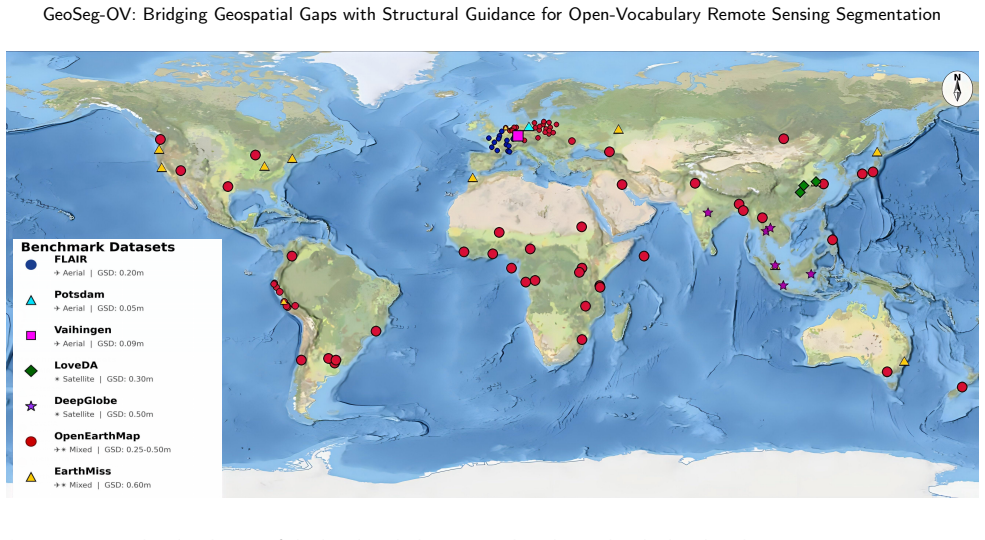
Summary. The paper proposes GeoSeg-OV, a trainable open-vocabulary remote sensing segmentation framework. It constructs a multi-rotation CLIP cost volume as the sole visual–text matching evidence, uses a frozen auxiliary vision foundation model (Depth Anything V2 by default) to derive pairwise structural biases and multi-scale guidance outside the matching space, introduces Structure-Guided Aggregation (SGA) with text-conditioned class-wise reasoning, and proposes Cost-Aware Decoding (CAD) to adaptively fuse semantic and structural guidance. A new benchmark (HRLC) spanning seven datasets across six continents is introduced. Under FLAIR and OpenEarthMap training, the method reports average mIoU gains of +2.5 and +2.7 over the best prior cost-aggregation methods, with extensive ablations comparing SGA with the AVTM paradigm, three auxiliary encoders, boundary quality, efficiency, and a large-scale zero-shot case study.
Significance. If the reported gains are statistically stable, the paper makes a useful conceptual contribution: it challenges the AVTM paradigm of using auxiliary VFM features as additional matching evidence and instead uses them as structural priors. The experimental design is generally careful: all cost-aggregation baselines share the same CLIP backbone, data splits, iteration counts, batch sizes, and multi-rotation construction where applicable; Table 3 is a clean controlled comparison; Table 4 shows robustness across three VFMs; the HRLC benchmark is a valuable resource; and code/benchmark availability strengthens reproducibility. There is no indication of circularity: training and evaluation splits are disjoint and no target-domain annotations are used. The main unresolved issue is that all headline numbers are single-run, which is load-bearing for the empirical superiority claim.
major comments (3)
- [Section 4.2, Tables 1–5] All results in Tables 1–5 are single training runs, with no error bars, seed counts, or significance tests reported. The average gains of +2.5/+2.7 mIoU are the central claim, while per-dataset differences swing from +5.7 to -1.2 (e.g., DeepGlobe under FLAIR), and single-seed segmentation runs commonly vary by 1–2 mIoU. The paper should report mean ± std over at least three seeds for the main methods and apply a paired significance test (e.g., paired t-test or Wilcoxon signed-rank) for GeoSeg-OV versus OVRS and RSKT-Seg under both training settings. Without this, the 'state-of-the-art' conclusion is not statistically established.
- [Section 4.4.2, Table 3] The key controlled comparison that attributes the gain to the SGA design principle (decoupling VFM features from matching) also rests on single runs. The margins here are smaller (+1.1 to +2.0 mIoU across encoders and settings), so they are especially exposed to training noise. Please provide multi-seed results and a significance test for this comparison as well, and specify the exact AVTM construction (e.g., whether the VFM cost volume is concatenated or averaged with the CLIP cost) to ensure implementation parity.
- [Sections 3.2.1 and 4.4.5] The mechanism assumes that frozen-VFM pairwise structural biases transfer across the large resolution and geographic shifts in the benchmark. Table 4 shows the method tolerates different VFMs, but it does not directly validate this transferability. I would like to see either a per-dataset analysis of A_bias behavior (e.g., intra-class attention ratio conditioned on resolution gap) or a failure-case analysis for cases where structural guidance could suppress valid CLIP evidence, particularly DeepGlobe under FLAIR where GeoSeg-OV trails OVRS by 1.2 mIoU. This concern is secondary to the statistical one, but it would substantiate the claimed mechanism.
minor comments (5)
- [Table 3 caption] The caption spells 'A VTM' where 'AVTM' is meant; please correct the typo.
- [Table 6] The paper reports parameter counts without specifying whether frozen encoders are included; please state whether these are trainable parameters or total model parameters.
- [Figure 3(b)] The intra-class attention ratio is reported without a precise definition or the evaluation protocol; please specify how it is computed and over which images or splits it is averaged.
- [Section 4.4.6] Boundary IoU is reported as a single number; a short definition or citation would help readers reproduce the metric.
- [Abstract and Highlights] The abstract states 'large-scale zero-shot case study' as a demonstration of generalization, but the SinoLC-1 comparison is qualitative; the text already notes this, but the abstract and highlights could be read as implying a quantitative evaluation, so please qualify the wording.
Circularity Check
No significant circularity: the central claim is an empirical held-out benchmark result, not a quantity defined into existence.
full rationale
GeoSeg-OV's central claim is an empirical superiority claim measured under a held-out cross-dataset protocol: models are trained on one source dataset and evaluated on all other datasets without fine-tuning or adaptation (Sec. 4.1.3), and no target-domain annotations are used. The +2.5/+2.7 mIoU gains (Sec. 4.2, Table 1) compare against independently specified baselines and are not derived from any equation that defines the improvement. The SGA-versus-AVTM comparison (Table 3) is a controlled ablation in which the only difference is whether auxiliary features enter the visual-text matching space or are used as structural bias; both variants use the same cost volume, training configuration, and evaluation protocol, so the comparison is not circular. The self-citation overlap (SegEarth-OV is listed as a training-free baseline and shares a co-author with the present paper) is not load-bearing: no design choice or superiority claim is justified by that citation. The qualitative zero-shot case study is explicitly labeled as qualitative and is not needed to support the benchmark claim. The absence of error bars or multi-seed significance tests is a statistical robustness concern, not a circularity concern, because the reported numbers are measurements rather than consequences of definitions.
Assumptions & free parameters
free parameters (7)
- Number of aggregation layers L =
2
- Attention heads N_h =
4
- Cost embedding dimension C =
128
- Swin window size W =
12
- Input resolution =
384x384
- Base learning rate =
2e-4 with 0.01x CLIP multiplier
- Training iterations =
30,000
assumptions (4)
- domain assumption CLIP's vision-language alignment transfers to remote sensing imagery, including unseen categories.
- domain assumption Frozen VFM features encode spatial structure that transfers across geospatial domain shifts better than appearance statistics.
- domain assumption The HRLC benchmark and its category and prompt protocol fairly measure open-vocabulary cross-dataset generalization.
- standard math Standard attention machinery (softmax attention, shifted windows, linear attention) is correct and suitable for cost aggregation.
Cite this review
Pith. "Pith review of GeoSeg-OV: Bridging Geospatial Gaps with Structural Guidance for Open-Vocabulary Remote Sensing Segmentation." pith.science (2026). https://pith.science/paper/PJCFC3J5
@misc{pith2026260810426,
  author       = {Pith},
  title        = {Pith review of: GeoSeg-OV: Bridging Geospatial Gaps with Structural Guidance for Open-Vocabulary Remote Sensing Segmentation},
  year         = {2026},
  howpublished = {\url{https://pith.science/paper/PJCFC3J5}},
  note         = {Machine review of arXiv:2608.10426}
}
read the original abstract
Open-vocabulary remote sensing segmentation has recently emerged as a promising paradigm that enables pixel-level recognition of arbitrary categories specified by natural language, including classes unseen during training. However, geospatial domain shifts caused by heterogeneous regions, spatial resolutions, and acquisition platforms weaken visual-text matching and limit cross-dataset generalization. Recent attempts have begun to incorporate auxiliary vision foundation models (VFMs), typically coupling their features with text embeddings as additional matching evidence. However, this strategy may introduce inconsistent matching signals while leaving the structure-sensitive representations of VFMs insufficiently exploited. We therefore propose GeoSeg-OV, which decouples auxiliary VFM features from visual-text matching and repurposes them as structural guidance for cost aggregation and decoding. GeoSeg-OV constructs an orientation-robust cost volume from multi-rotation CLIP features, while a frozen VFM extracts multi-scale structure-sensitive features in parallel. We propose Structure-Guided Aggregation (SGA), which integrates cost tokens and CLIP semantic guidance with VFM-derived pairwise structural biases for coherent spatial propagation, followed by text-conditioned class-wise reasoning. We further introduce Cost-Aware Decoding (CAD) to adaptively refine and fuse multi-scale semantic and structural guidance based on the current decoder context. On the global High-Resolution Land Cover (HRLC) benchmark spanning seven datasets across six continents, GeoSeg-OV outperforms the state-of-the-art by +2.5 and +2.7 average mIoU under two training settings. A large-scale zero-shot case study further demonstrates its generalization across geographic domains and category systems without target-domain annotations or retraining.
Figures


Figures from the paper (7 more)


Reference graph
Works this paper leans on
-
[1]
Proceedings of the IEEE Conference on Computer Vision and Pattern Recognition , pages=
Fully convolutional networks for semantic segmentation , author=. Proceedings of the IEEE Conference on Computer Vision and Pattern Recognition , pages=
-
[2]
Chen, Liang-Chieh and Papandreou, George and Kokkinos, Iasonas and Murphy, Kevin and Yuille, Alan L. , journal=. DeepLab: Semantic Image Segmentation with Deep Convolutional Nets, Atrous Convolution, and Fully Connected CRFs , year=
-
[3]
ISPRS Journal of Photogrammetry and Remote Sensing , volume=
UNetFormer: A UNet-like transformer for efficient semantic segmentation of remote sensing urban scene imagery , author=. ISPRS Journal of Photogrammetry and Remote Sensing , volume=. 2022 , publisher=
2022
-
[4]
IEEE Transactions on Geoscience and Remote Sensing , volume=
CrossMatch: Cross-view matching for semi-supervised remote sensing image segmentation , author=. IEEE Transactions on Geoscience and Remote Sensing , volume=. 2024 , publisher=
work page 2024
-
[5]
ISPRS Journal of Photogrammetry and Remote Sensing , volume=
A novel scene coupling semantic mask network for remote sensing image segmentation , author=. ISPRS Journal of Photogrammetry and Remote Sensing , volume=. 2025 , publisher=
work page 2025
-
[6]
arXiv preprint arXiv:2601.12052 , year=
Task-Driven Prompt Learning: A Joint Framework for Multi-modal Cloud Removal and Segmentation , author=. arXiv preprint arXiv:2601.12052 , year=
-
[7]
ISPRS Journal of Photogrammetry and Remote Sensing , volume =
ECRformer: An Efficient Cloud Removal Transformer with Semantic-Decoupled Learning for Multimodal Satellite Imagery , author =. ISPRS Journal of Photogrammetry and Remote Sensing , volume =. 2026 , publisher =
work page 2026
-
[8]
Zhang, Zaiyan and Yuan, Qiangqiang and Li, Jie and Lihe, Ziyang and Wan, Yu and Chen, Yuzeng and Su, Xin and Zhang, Liangpei , journal =. 2026 , month =
work page 2026
Show all 60 references
-
[9]
IEEE Transactions on Geoscience and Remote Sensing , year=
Multiscale restoration of missing data in optical time-series images with masked spatial-temporal attention network , author=. IEEE Transactions on Geoscience and Remote Sensing , year=
-
[10]
Nature Communications , year=
Satellite mapping of every building’s function in urban China reveals deep built environment disparities , author=. Nature Communications , year=
-
[11]
Proceedings of the IEEE/CVF International Conference on Computer Vision , pages=
A simple framework for open-vocabulary segmentation and detection , author=. Proceedings of the IEEE/CVF International Conference on Computer Vision , pages=
-
[12]
Proceedings of the IEEE/CVF Conference on Computer Vision and Pattern Recognition , pages=
Open-vocabulary semantic segmentation with mask-adapted clip , author=. Proceedings of the IEEE/CVF Conference on Computer Vision and Pattern Recognition , pages=
-
[13]
European Conference on Computer Vision , pages=
Scaling open-vocabulary image segmentation with image-level labels , author=. European Conference on Computer Vision , pages=. 2022 , organization=
2022
-
[14]
International Conference on Machine Learning , pages=
Learning transferable visual models from natural language supervision , author=. International Conference on Machine Learning , pages=. 2021 , organization=
2021
-
[15]
Proceedings of the IEEE/CVF Winter Conference on Applications of Computer Vision , pages=
Reclip: Refine contrastive language image pre-training with source free domain adaptation , author=. Proceedings of the IEEE/CVF Winter Conference on Applications of Computer Vision , pages=
-
[16]
Earth System Science Data , volume=
SinoLC-1: The first 1 m resolution national-scale land-cover map of China created with a deep learning framework and open-access data , author=. Earth System Science Data , volume=. 2023 , publisher=
2023
-
[17]
Earth System Science Data , volume=
BRIGHT: A globally distributed multimodal building damage assessment dataset with very-high-resolution for all-weather disaster response , author=. Earth System Science Data , volume=. 2025 , publisher=
2025
-
[18]
Proceedings of the IEEE/CVF Conference on Computer Vision and Pattern Recognition , pages=
Cat-seg: Cost aggregation for open-vocabulary semantic segmentation , author=. Proceedings of the IEEE/CVF Conference on Computer Vision and Pattern Recognition , pages=
-
[19]
IEEE Transactions on Geoscience and Remote Sensing , year=
Open-vocabulary high-resolution remote sensing image semantic segmentation , author=. IEEE Transactions on Geoscience and Remote Sensing , year=
-
[20]
Proceedings of the AAAI Conference on Artificial Intelligence , volume=
Towards open-vocabulary remote sensing image semantic segmentation , author=. Proceedings of the AAAI Conference on Artificial Intelligence , volume=
-
[21]
Proceedings of the AAAI Conference on Artificial Intelligence , volume=
Exploring efficient open-vocabulary segmentation in the remote sensing , author=. Proceedings of the AAAI Conference on Artificial Intelligence , volume=
-
[22]
arXiv preprint arXiv:2304.07193 , year=
Dinov2: Learning robust visual features without supervision , author=. arXiv preprint arXiv:2304.07193 , year=
-
[23]
Advances in Neural Information Processing Systems , volume=
Depth anything v2 , author=. Advances in Neural Information Processing Systems , volume=
-
[24]
Proceedings of the IEEE/CVF International Conference on Computer Vision , pages=
Emerging properties in self-supervised vision transformers , author=. Proceedings of the IEEE/CVF International Conference on Computer Vision , pages=
-
[25]
arXiv preprint arXiv:2508.10104 , year=
Dinov3 , author=. arXiv preprint arXiv:2508.10104 , year=
-
[26]
Proceedings of the IEEE/CVF International Conference on Computer Vision , pages=
Segment anything , author=. Proceedings of the IEEE/CVF International Conference on Computer Vision , pages=
-
[27]
arXiv preprint arXiv:2408.00714 , year=
Sam 2: Segment anything in images and videos , author=. arXiv preprint arXiv:2408.00714 , year=
-
[28]
arXiv preprint arXiv:2506.09881 , year=
Leveraging Depth and Language for Open-Vocabulary Domain-Generalized Semantic Segmentation , author=. arXiv preprint arXiv:2506.09881 , year=
-
[29]
Proceedings of the IEEE/CVF Conference on Computer Vision and Pattern Recognition , pages=
Open-vocabulary panoptic segmentation with text-to-image diffusion models , author=. Proceedings of the IEEE/CVF Conference on Computer Vision and Pattern Recognition , pages=
-
[30]
Proceedings of the IEEE/CVF Conference on Computer Vision and Pattern Recognition , pages=
Sed: A simple encoder-decoder for open-vocabulary semantic segmentation , author=. Proceedings of the IEEE/CVF Conference on Computer Vision and Pattern Recognition , pages=
-
[31]
Proceedings of the IEEE/CVF Conference on Computer Vision and Pattern Recognition , pages=
Side adapter network for open-vocabulary semantic segmentation , author=. Proceedings of the IEEE/CVF Conference on Computer Vision and Pattern Recognition , pages=
-
[32]
Advances in Neural Information Processing Systems , volume=
Convolutions die hard: Open-vocabulary segmentation with single frozen convolutional clip , author=. Advances in Neural Information Processing Systems , volume=
-
[33]
Proceedings of the IEEE/CVF International Conference on Computer Vision , pages=
Vision transformers for dense prediction , author=. Proceedings of the IEEE/CVF International Conference on Computer Vision , pages=
-
[34]
Proceedings of the IEEE/CVF Conference on Computer Vision and Pattern Recognition , pages=
Depth anything: Unleashing the power of large-scale unlabeled data , author=. Proceedings of the IEEE/CVF Conference on Computer Vision and Pattern Recognition , pages=
-
[35]
Pattern Recognition , pages=
Towards Open-Vocabulary Semantic Segmentation for Remote Sensing Images , author=. Pattern Recognition , pages=. 2026 , publisher=
2026
-
[36]
IEEE Transactions on Geoscience and Remote Sensing , year=
Logcan++: Adaptive local-global class-aware network for semantic segmentation of remote sensing images , author=. IEEE Transactions on Geoscience and Remote Sensing , year=
-
[37]
ISPRS Journal of Photogrammetry and Remote Sensing , volume=
Breaking the resolution barrier: A low-to-high network for large-scale high-resolution land-cover mapping using low-resolution labels , author=. ISPRS Journal of Photogrammetry and Remote Sensing , volume=. 2022 , publisher=
2022
-
[38]
Advances in Neural Information Processing Systems , volume=
FLAIR: a country-scale land cover semantic segmentation dataset from multi-source optical imagery , author=. Advances in Neural Information Processing Systems , volume=
-
[39]
Proceedings of the IEEE/CVF Winter Conference on Applications of Computer Vision , pages=
Openearthmap: A benchmark dataset for global high-resolution land cover mapping , author=. Proceedings of the IEEE/CVF Winter Conference on Applications of Computer Vision , pages=
-
[40]
2012 , publisher=
The ISPRS benchmark on urban object classification and 3D building reconstruction , author=. 2012 , publisher=
2012
-
[41]
arXiv preprint arXiv:2110.08733 , year=
LoveDA: A remote sensing land-cover dataset for domain adaptive semantic segmentation , author=. arXiv preprint arXiv:2110.08733 , year=
-
[42]
Proceedings of the IEEE conference on Computer Vision and Pattern Recognition Workshops , pages=
Deepglobe 2018: A challenge to parse the earth through satellite images , author=. Proceedings of the IEEE conference on Computer Vision and Pattern Recognition Workshops , pages=
2018
-
[43]
Remote Sensing of Environment , volume=
Remote sensing meta modal representation for missing modality land cover mapping: From EarthMiss dataset to MetaRS method , author=. Remote Sensing of Environment , volume=. 2026 , publisher=
2026
-
[44]
Proceedings of the Computer Vision and Pattern Recognition Conference , pages=
Segearth-ov: Towards training-free open-vocabulary segmentation for remote sensing images , author=. Proceedings of the Computer Vision and Pattern Recognition Conference , pages=
-
[45]
arXiv preprint arXiv:2508.18067 , year=
Annotation-free open-vocabulary segmentation for remote-sensing images , author=. arXiv preprint arXiv:2508.18067 , year=
-
[46]
Proceedings of the IEEE/CVF International Conference on Computer Vision , pages=
Swin transformer: Hierarchical vision transformer using shifted windows , author=. Proceedings of the IEEE/CVF International Conference on Computer Vision , pages=
-
[47]
ISPRS Journal of Photogrammetry and Remote Sensing , volume=
Multimodal remote sensing change detection: An image matching perspective , author=. ISPRS Journal of Photogrammetry and Remote Sensing , volume=. 2026 , publisher=
2026
-
[48]
ISPRS Journal of Photogrammetry and Remote Sensing , volume=
Progressive uncertainty-guided network for binary segmentation in high-resolution remote sensing imagery , author=. ISPRS Journal of Photogrammetry and Remote Sensing , volume=. 2026 , publisher=
2026
-
[49]
International Conference on Machine Learning , pages=
Scaling up visual and vision-language representation learning with noisy text supervision , author=. International Conference on Machine Learning , pages=. 2021 , organization=
2021
-
[50]
International Conference on Machine Learning , pages=
Segclip: Patch aggregation with learnable centers for open-vocabulary semantic segmentation , author=. International Conference on Machine Learning , pages=. 2023 , organization=
2023
-
[51]
ISPRS Journal of Photogrammetry and Remote Sensing , volume=
Reducing semantic ambiguity in open-vocabulary remote sensing image segmentation via knowledge graph-enhanced class representations , author=. ISPRS Journal of Photogrammetry and Remote Sensing , volume=. 2026 , publisher=
2026
-
[52]
ISPRS Journal of Photogrammetry and Remote Sensing , volume=
Learning transferable land cover semantics for open vocabulary interactions with remote sensing images , author=. ISPRS Journal of Photogrammetry and Remote Sensing , volume=. 2025 , publisher=
2025
-
[53]
European Conference on Computer Vision , pages=
Clearclip: Decomposing clip representations for dense vision-language inference , author=. European Conference on Computer Vision , pages=. 2024 , organization=
2024
-
[54]
arXiv preprint arXiv:2501.00877 , year=
FGAseg: Fine-Grained Pixel-Text Alignment for Open-Vocabulary Semantic Segmentation , author=. arXiv preprint arXiv:2501.00877 , year=
-
[55]
Results of the
Rottensteiner, Franz and Sohn, Gunho and Gerke, Markus and Wegner, Jan Dirk and Breitkopf, Uwe and Jung, Jaewook , journal=. Results of the. 2014 , publisher=
2014
-
[56]
International Conference on Machine Learning , pages=
Transformers are rnns: Fast autoregressive transformers with linear attention , author=. International Conference on Machine Learning , pages=. 2020 , organization=
2020
-
[57]
IEEE Transactions on Multimedia , year=
Stroke-Based Perception: Discover Novel Oracle Characters , author=. IEEE Transactions on Multimedia , year=
-
[58]
arXiv preprint arXiv:2608.03147 , year=
CROSS: Cascaded Distillation and Dual-Constraint Grounding for Remote Sensing Referring Segmentation , author=. arXiv preprint arXiv:2608.03147 , year=
-
[59]
Proceedings of the IEEE/CVF Conference on Computer Vision and Pattern Recognition , pages=
Exploring the underwater world segmentation without extra training , author=. Proceedings of the IEEE/CVF Conference on Computer Vision and Pattern Recognition , pages=
-
[60]
Proceedings of the IEEE/CVF Conference on Computer Vision and Pattern Recognition , pages=
MARIS: Marine Open-Vocabulary Instance Segmentation , author=. Proceedings of the IEEE/CVF Conference on Computer Vision and Pattern Recognition , pages=
Reviewed August 15, 2026 · model on record in the stance chip above.
Discussion (0). Continue with ORCID to comment.