REVIEW 4 major objections 5 minor 52 references
Secure Cooperative THz ISAC via Mamba Empowered Graph Neural Network Precoding
T0 review · 4 major / 5 minor · reviewed 2026-08-15 · deepseek-v4-flash
Pith's one-line read A Mamba-empowered graph neural network can jointly design secure THz ISAC transmissions, and simulations show it beats both optimization-based and learning-based benchmarks.
desk verdict Competent new architecture, but the constrained-feasibility claim is unverified; deserves peer review with major revisions. read the letter →
The pith
A machine-rendered reading of the paper's core claim, the machinery that carries it, and where it could break.
The reading
What carries the argument
The machinery is a heterogeneous graph whose vertices are users, targets, transmitting-BS RF chains, and a receiving antenna array, with edges carrying the relevant channel vectors. Message passing over this graph produces the analog phase-shifter matrix, the true-time-delay matrix, and the sensing covariance, while a zero-forcing null-space projection and a power-allocation block settle the digital precoder. The Mamba block — a state-space sequence model with an input-dependent selection mechanism — refines the aggregated features and is claimed to keep the overall computational cost linear in the number of users and RF chains.
What would settle it
Run the trained network on test samples where target positions and RCS values are withheld and only the channel-state information presumed available at deployment is fed in; if the minimum secrecy rate drops below the baselines or any $\mathrm{CRB}_m > \Omega$ appears, the deployment claim fails.
Extended reading notes
Core claim
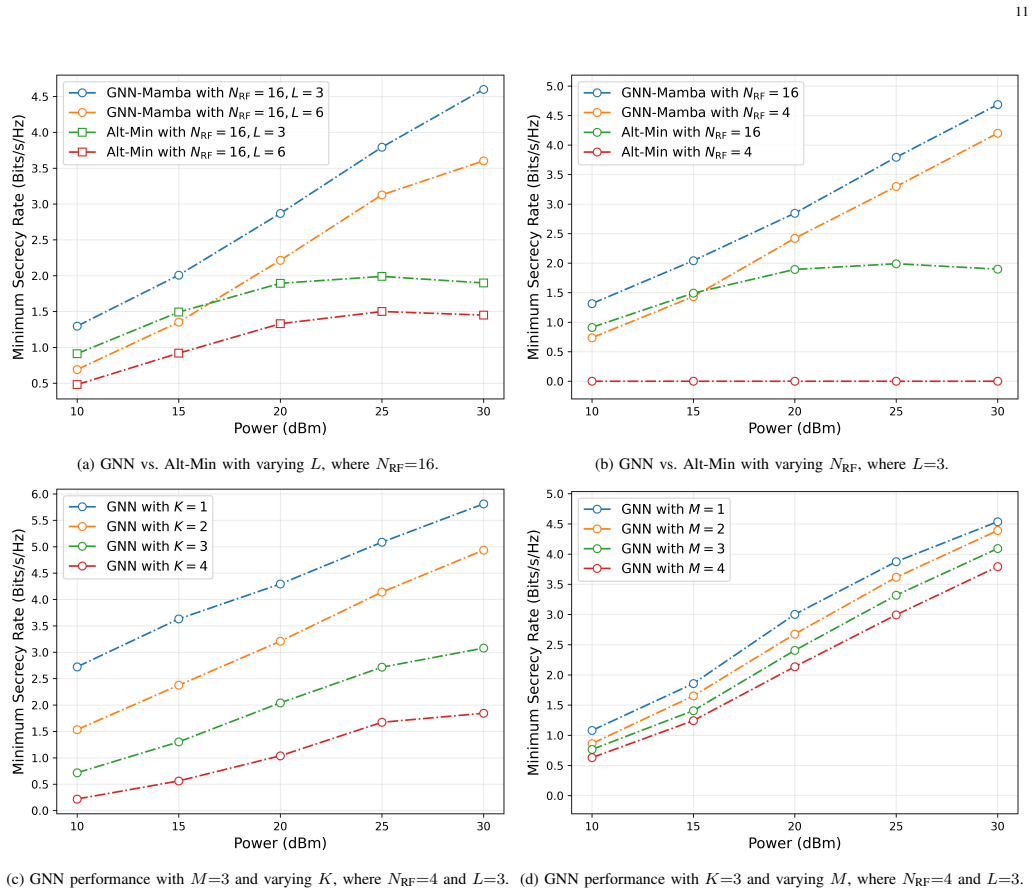
The paper's central claim is that problem (14) — maximize the worst-case secrecy rate among users and subcarriers subject to a Cramér-Rao bound constraint on each target's location estimate — can be solved by learned inference instead of iterative optimization. The proposed Mamba-empowered GNN encodes the network as a heterogeneous graph of users, targets, transmitting BS RF chains, and a receiving antenna array, and through message passing produces the phase-shifter matrix, the true-time-delay matrix, and the sensing covariance matrix. A zero-forcing null-space projection supplies the digital precoder, and a power-allocation block splits power between communication and sensing. The paper reports that this learned design achieves higher minimum secrecy rates than the alternating-minimization baseline and the deep-learning baselines while satisfying the sensing constraint, and that it generalizes across different numbers of users and targets.
Load-bearing premise
The network is trained with exact target positions and reflection strengths, but at deployment it is supposed to work using only channel measurements, and the paper provides no evidence that those measurements alone are enough to steer nulls at the right targets.
Editorial extensions
If this is right
- Secure ISAC precoding for many users becomes a single forward inference, taking around $10^{-2}$ seconds per sample rather than an iterative solve.
- One trained model can serve network topologies with different numbers of users and targets, because the graph representation is permutation-invariant.
- The sensing constraint is enforced as a soft penalty during training, so the same architecture can trade secrecy rate against localization accuracy by adjusting the loss weights.
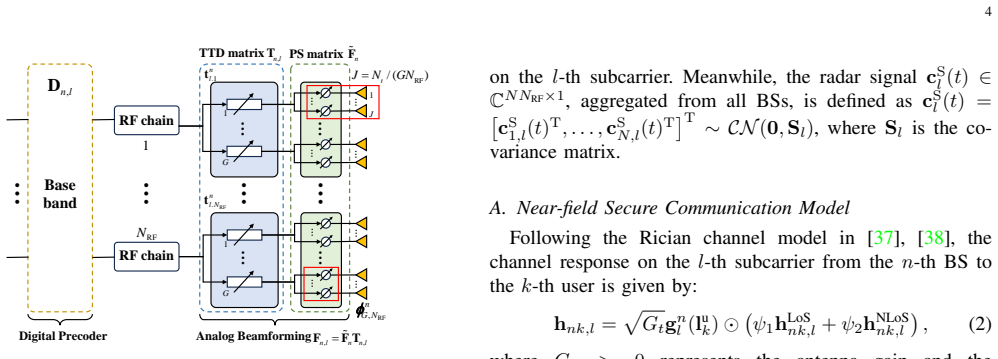
- The TTD-assisted hybrid architecture mitigates beam split across subcarriers, making wideband THz secure links more practical.
- If the performance advantage holds at scale, learning-based design becomes a viable replacement for alternating optimization in near-field ELAA ISAC systems.
Reading between the lines
- The largest unexamined step is the jump from training with exact target locations and RCS values to deployment with channel state information only; a testable extension is to train with CSI-only features and compare secrecy and CRB on the same test set.
- Because the digital precoder nulls the sensing channels, the claimed secrecy depends on how accurately the BS knows the eavesdropper channels; imperfect or adversarial channel knowledge could be probed by adding estimation error.
- The same graph-plus-Mamba pattern could be applied to covert ISAC or network-level resource allocation, since the message-passing structure is not specific to THz.
Signed reviews
Editorial analysis
A structured set of objections, weighed in public.
Referee Report
Summary. The manuscript studies a cooperative THz bistatic ISAC system in which multiple BSs equipped with ELAA serve K users while localizing M targets, some of which are treated as malicious eavesdroppers. It formulates problem (14), which maximizes the worst-case secrecy rate subject to per-target CRB constraints, with optimization over phase-shifter matrices, TTD delays, digital precoders, and the sensing covariance matrix. The authors derive the FIM and CRB in Theorem 1 and Appendix B, encode the network as a heterogeneous graph, and train a Mamba-empowered GNN with an unsupervised loss that combines the secrecy-rate objective and a penalty on CRB exceedance. Simulations compare the proposed scheme against an Alt-Min optimization benchmark and two learning-based baselines, reporting secrecy-rate gains, generalization over K and M, beampatterns, runtime, and sensitivity to the number of message-passing layers.
Significance. If the central claims were established, the paper would offer a scalable learning-based solution for a genuinely difficult nonconvex, tightly coupled, near-field secure ISAC design problem. The CRB derivation is systematic, the unsupervised training avoids a labeled-data requirement, and the graph architecture is designed to be permutation-invariant and to have linear complexity, all of which are strengths. The paper is also explicit about the limitations of its own power-allocation step. However, the constrained optimization problem is not actually solved as stated: the CRB constraint is only penalized, no feasibility evidence is provided, and the deployment setting appears inconsistent with the information used during training. These are load-bearing gaps, so the current evidence does not support the headline comparison.
major comments (4)
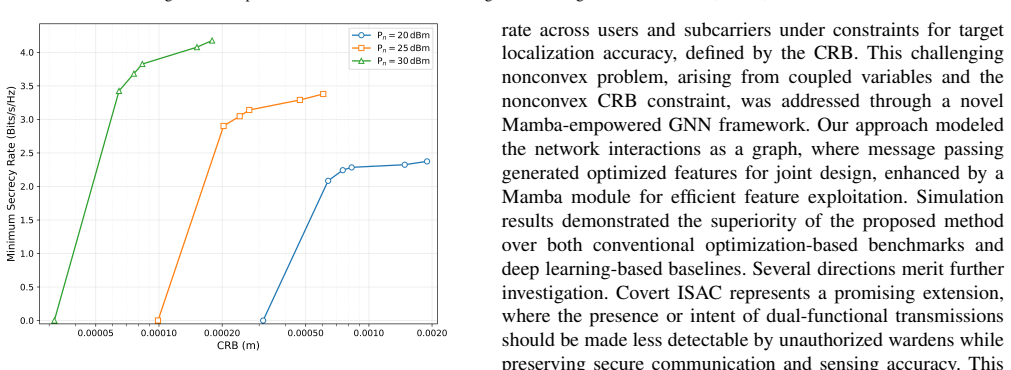
- [Section III-D and Section IV] The CRB constraint in (14) is implemented only as the penalty term omega_2 * sum_m (CRB_m - Omega)_+ in L(Theta), and a finite weighted penalty does not enforce CRB_m <= Omega. Section IV reports secrecy rates, runtime, beampatterns, and tradeoff curves, but it provides no test-time CRB values, no violation rates, and no per-BS power-budget verification. Figure 11 shows a secrecy-rate/CRB tradeoff but does not compare the achieved CRB against the threshold Omega for the tested configurations. The paper therefore does not establish that the reported secrecy-rate gains are obtained at feasible points of problem (14). Please add a CRB feasibility evaluation and either enforce the constraint by projection, augmented Lagrangian, or a similar mechanism, or explicitly reframe the claim as a penalized tradeoff rather than a solution of (14).
- [Section III-B7] The power-allocation normalization in Section III-B7 is explicitly admitted to introduce inconsistent scaling across BSs and to degrade interference suppression and leakage mitigation. This is not a cosmetic caveat: the digital precoder D_l is constructed by projecting onto the nullspace of the target-channel matrix A_eq_l, and independently rescaling the per-BS blocks D_{n,l} by different lambda_D-dependent factors generally takes the concatenated precoder out of that nullspace. The resulting transmit design may leak information to the targets and may also violate the per-BS power budget. Please verify after normalization that A_eq_l D_l is zero (or negligible) and that the per-BS power constraints are satisfied, or modify the power-allocation step so that it preserves the null-space property.
- [Section III-D, deployment footnote] The training loss L(Theta) and the CRB penalty require exact target locations, RCS values, and target channel responses, because the CRB depends on theta, Q, A_l, and B_l. The footnote in Section III-D states that during deployment the network uses only available CSI without exact target locations, but no experiment or analytical argument demonstrates that a model trained with full target geometry transfers to this CSI-only deployment setting. Please either evaluate the deployment scenario explicitly, for example using estimated target parameters, or restrict the claimed operational regime to one in which target locations and RCS values remain available.
- [Appendix B, Eq. (29) and Eq. (32)] The FIM derivation appears to have a factor-of-two ambiguity: Eq. (29) includes the standard factor 2 in front of the real part, while the typical-entry expression in Eq. (32) and the block expression in Eq. (13) do not show this factor. If the factor is absorbed into the outer 2 in Theorem 1, please state this explicitly, because the numerical CRB values used in the training loss depend on the correct scaling.
minor comments (5)
- [Notations] The Notations paragraph contains a typo: "matirx" should be "matrix".
- [Section III-A] In the paragraph on vertices and features, "TDD matrix" should read "TTD matrix" to match the terminology used throughout the paper.
- [Table III] The table entry "Racian factor" should be "Rician factor".
- [Abstract and body] The spacing in "Cram ´er-Rao" is inconsistent; it should be typeset as "Cramér-Rao" throughout.
- [Figure 4 and Algorithm 1] The notation for the digital precoder before and after normalization is not always distinguished; please clarify when D_l denotes the unnormalized ZF output and when it denotes the final power-normalized precoder.
Circularity Check
No circularity: the learned precoder is trained with a penalty-based loss and tested against external baselines; the only self-citation is a non-load-bearing conference baseline.
full rationale
The paper's derivation chain is self-contained. Lemma 1 derives the received-signal Gaussian distribution from the stated signal model, and Theorem 1 derives the FIM and CRB from that distribution, so the CRB constraint in problem (14) is an internal analytical object rather than an input imported from the authors' prior work. The training loss L(Theta) in Section III-D is a standard penalty-based surrogate for the same max-min secrecy-rate objective and CRB constraint; using the same rate expression at train and test time is direct optimization of the stated objective, not a fitted parameter renamed as a prediction. The comparison baselines are external (Alt-Min [32] and CNN-LSTM [33]), and the only self-citation, the GLOBECOM conference version [1], is used as a learning baseline and as a point of contrast for the added TTD and Mamba components. No load-bearing claim rests on that self-citation, no uniqueness theorem is imported from it, and no ansatz is smuggled in through it. The Mamba block is credited to [42] and the ZF precoding step to [41], both external and independently verifiable. The paper itself flags limitations in Section III-B7 (PAB normalization causes inconsistent scaling and degrades interference suppression) and in the Section III-D footnote (CRB is used offline during training while deployment relies on CSI without exact target locations), but these are feasibility and generalization concerns, not circular reductions that make the claimed output equivalent to its inputs. No circular step is therefore established.
Assumptions & free parameters
free parameters (4)
- Loss weighting parameters omega1, omega2 =
-0.3 and 0.1
- CRB thresholds Omega =
[0.025, 0.0084, 0.0038, 0.0012, 0.00038]
- Hidden dimension D in message passing and Mamba blocks =
not disclosed
- Number of message-passing layers I =
2 according to Fig. 12
assumptions (5)
- domain assumption Perfect CSI for both scheduled users and sensing targets, including potential eavesdroppers, is available at the base stations.
- domain assumption The near-field Rician channel model with independent NLoS components across subcarriers is accurate.
- domain assumption The radar cross-section q of each target is known and used in the CRB computation.
- domain assumption The received sensing signal is complex Gaussian with the covariance given in Lemma 1, valid for sufficiently large P.
- domain assumption The SVD-based null-space design requires N*N_RF > M and that the equivalent sensing channel has full rank.
Cite this review
Pith. "Pith review of Secure Cooperative THz ISAC via Mamba Empowered Graph Neural Network Precoding." pith.science (2026). https://pith.science/paper/YNXELOUA
@misc{pith2026260810467,
  author       = {Pith},
  title        = {Pith review of: Secure Cooperative THz ISAC via Mamba Empowered Graph Neural Network Precoding},
  year         = {2026},
  howpublished = {\url{https://pith.science/paper/YNXELOUA}},
  note         = {Machine review of arXiv:2608.10467}
}
read the original abstract
The terahertz (THz) band offers abundant spectrum resources for high-throughput communication and ultra high-precision localization. This paper investigates secure communication in cooperative THz orthogonal frequency-division multiplexing (OFDM) bistatic integrated sensing and communications (ISAC) systems, where multiple base stations (BSs) equipped with extremely large-scale antenna arrays (ELAAs) collaboratively serve downlink users while concurrently locating multiple targets. Malicious targets are assumed to act as potential eavesdroppers attempting to intercept confidential information intended for legitimate users. To mitigate these threats, we formulate a joint optimization problem for analog beamforming, digital precoding, true-time delayers (TTDs), and sensing signal covariance matrix design. The objective is to maximize the minimum secrecy rate subject to Cramer-Rao bound (CRB) constraints that ensure localization accuracy. This problem is highly challenging due to the non-convex CRB constraint, strongly coupled variables, high computational complexity from ELAA, and near-field channel modeling. To address these challenges, we propose a novel data-driven framework that integrates graph neural networks (GNNs) with the Mamba architecture. Our proposed framework first encodes the interactions among users, targets, and BSs into a heterogeneous graph and then employs message passing to optimize vertex features. The Mamba blocks further enhance this process through their selection mechanism and state space modeling capabilities, enabling dynamic and context-aware optimization of beamforming, TTD configurations, and sensing parameters. Numerical simulations validate that the proposed method outperforms both conventional and learning-based baselines, while offering high computational efficiency and strong generalization across different network conditions.
Figures


Figures from the paper (9 more)





Reference graph
Works this paper leans on
-
[1]
Unsupervised CVNN hybrid beamforming for secure near-field THz-ISAC in XL- MIMO,
X. Zhou, C. Wang, H. Zhang, L. Jin, and D. W. Kwan Ng, “Unsupervised CVNN hybrid beamforming for secure near-field THz-ISAC in XL- MIMO,” inGLOBECOM 2025 - 2025 IEEE Global Communications Conference, 2025, pp. 3611–3617
work page 2025
-
[2]
S. Chen, Y .-C. Liang, S. Sun, S. Kang, W. Cheng, and M. Peng, “Vision, requirements, and technology trend of 6G: How to tackle the challenges of system coverage, capacity, user data-rate and movement speed,”IEEE Wireless Commun., vol. 27, no. 2, pp. 218–228, Apr. 2020
work page 2020
-
[3]
Y . Wang, C. Han, S. Sun, and J. Zhang, “Cross far- and near-field channel measurement and modeling in extremely large-scale antenna array (ELAA) systems,”arXiv preprint arXiv: 2405.16893, pp. 1–14, 2024
work page Pith review arXiv 2024
-
[4]
Dynamic hybrid beamforming designs for ELAA near-field communications,
M. Liu, M. Li, R. Liu, and Q. Liu, “Dynamic hybrid beamforming designs for ELAA near-field communications,”IEEE J Sel. Areas Commun., vol. 43, no. 3, pp. 644–658, Mar. 2025
work page 2025
-
[5]
Joint delay-phase precoding under true-time delay constraints in wideband sub-THz hybrid massive MIMO systems,
D. Q. Nguyen and T. Kim, “Joint delay-phase precoding under true-time delay constraints in wideband sub-THz hybrid massive MIMO systems,” IEEE Trans. Commun., vol. 72, no. 10, pp. 6633–6646, Oct. 2024
2024
-
[6]
Terahertz communications and sensing for 6G and beyond: A comprehensive review,
W. Jiang, Q. Zhou, J. He, M. A. Habibi, S. Melnyk, M. El-Absi, B. Han, M. D. Renzo, H. D. Schotten, F.-L. Luo, T. S. El-Bawab, M. Juntti, M. Debbah, and V . C. M. Leung, “Terahertz communications and sensing for 6G and beyond: A comprehensive review,”IEEE Commun Surv. Tut., vol. 26, no. 4, pp. 2326–2381, 4th Quart. 2024
work page 2024
-
[7]
Near-field integrated sensing, positioning, and communication: A downlink and uplink frame- work,
H. Li, Z. Wang, X. Mu, P. Zhiwen, and Y . Liu, “Near-field integrated sensing, positioning, and communication: A downlink and uplink frame- work,”IEEE J. Sel. Areas Commun., vol. 42, no. 9, pp. 2196–2212, Sept. 2024
work page 2024
-
[8]
Fluid antenna system liberating multiuser MIMO for ISAC via deep reinforcement learning,
C. Wang, G. Li, H. Zhang, K.-K. Wong, Z. Li, D. W. K. Ng, and C.-B. Chae, “Fluid antenna system liberating multiuser MIMO for ISAC via deep reinforcement learning,”IEEE Trans. Wireless Commun., vol. 23, no. 9, pp. 10 879–10 894, 2024
work page 2024
Show all 52 references
-
[9]
Wideband near-field integrated sensing and communication with sparse transceiver design,
X. Wang, W. Zhai, X. Wang, M. G. Amin, and K. Cai, “Wideband near-field integrated sensing and communication with sparse transceiver design,”IEEE J. Sel. Top. Signal Process., vol. 18, no. 4, pp. 662–677, May 2024
2024
-
[10]
Integrated sensing and communications: Recent advances and ten open challenges,
S. Lu, F. Liu, Y . Li, K. Zhang, H. Huang, J. Zou, X. Li, Y . Dong, F. Dong, J. Zhu, Y . Xiong, W. Yuan, Y . Cui, and L. Hanzo, “Integrated sensing and communications: Recent advances and ten open challenges,” IEEE Internet Things J., vol. 11, no. 11, pp. 19 094–19 120, Jun. 2024
2024
-
[11]
THz ISAC: A physical- layer perspective of terahertz integrated sensing and communication,
C. Han, Y . Wu, Z. Chen, Y . Chen, and G. Wang, “THz ISAC: A physical- layer perspective of terahertz integrated sensing and communication,” IEEE Commun. Mag., vol. 62, no. 2, pp. 102–108, Feb. 2024
2024
-
[12]
Network-level ISAC: An analytical study of antenna topologies ranging from massive to cell- free MIMO,
K. Meng, K. Han, C. Masouros, and L. Hanzo, “Network-level ISAC: An analytical study of antenna topologies ranging from massive to cell- free MIMO,”IEEE Trans. Wireless Commun., pp. 1–16, Accepted for publication, Jun. 2025
2025
-
[13]
Secure transmission for active RIS-assisted THz ISAC systems with delay alignment modulation,
G. Sun, H. Shi, B. Shang, and W. Hao, “Secure transmission for active RIS-assisted THz ISAC systems with delay alignment modulation,” IEEE Commun. Lett., vol. 28, no. 5, pp. 1019–1023, May 2024
2024
-
[14]
STAR-RIS-enabled secure dual-functional radar-communications: Joint waveform and reflective beamforming op- timization,
C. Wang, C.-C. Wang, Z. Li, D. W. K. Ng, K.-K. Wong, N. Al- Dhahir, and D. Niyato, “STAR-RIS-enabled secure dual-functional radar-communications: Joint waveform and reflective beamforming op- timization,”IEEE Trans. Inf. Forensics Secur., vol. 18, pp. 4577–4592, Jul. 2023
2023
-
[15]
Secure cell-free integrated sensing and communication in the presence of information and sensing eavesdroppers,
Z. Ren, J. Xu, L. Qiu, and D. Wing Kwan Ng, “Secure cell-free integrated sensing and communication in the presence of information and sensing eavesdroppers,”IEEE J. Sel. Areas Commun., vol. 42, no. 11, pp. 3217–3231, Nov. 2024
2024
-
[16]
Covert ISAC against collusive wardens,
Y . Wu, C. Xing, J. Tang, N. Zhao, X. Y . Zhang, K.-K. Wong, and G. K. Karagiannidis, “Covert ISAC against collusive wardens,”IEEE Trans. Wireless Commun., pp. 1–15, Accepted for publication, 2025
2025
-
[17]
Intelligent covert communication: Recent advances and future research trends,
Z. Li, J. Shi, J. Si, L. Lv, L. Guan, B. Hao, Z. Tie, D. Wang, C. Xing, and T. Q. Quek, “Intelligent covert communication: Recent advances and future research trends,”Engineering, vol. 44, pp. 101–111, 2025. [Online]. Available: https://www.sciencedirect.com/science/article/pi...
2025
-
[18]
Near-field assisted secure ISAC system: Synergistic enhancement between sensing and secure transmission,
Z. Chen, S. Zhu, and X. Li, “Near-field assisted secure ISAC system: Synergistic enhancement between sensing and secure transmission,” IEEE Commun. Lett., pp. 1–1, Accepted for publication, 2025
2025
-
[19]
Physical layer security for integrated sensing and communication: A survey,
T. Matsumine, H. Ochiai, and J. Shikata, “Physical layer security for integrated sensing and communication: A survey,”arXiv preprint arXiv: 2504.18097, pp. 1–44, 2025
2025
-
[20]
Absolute security in terahertz wireless links,
A. Cohen, R. G. L. D’Oliveira, C.-Y . Yeh, H. Guerboukha, R. Shrestha, Z. Fang, E. W. Knightly, M. M ´edard, and D. M. Mittleman, “Absolute security in terahertz wireless links,”IEEE J. Sel. Top. Signal Process., vol. 17, no. 4, pp. 819–833, 2023
2023
-
[21]
AI- empowered fluid antenna systems: Opportunities, challenges, and future directions,
C. Wang, Z. Li, K.-K. Wong, R. Murch, C.-B. Chae, and S. Jin, “AI- empowered fluid antenna systems: Opportunities, challenges, and future directions,”IEEE Wireless Commun., vol. 31, no. 5, pp. 34–41, 2024
2024
-
[22]
Large language model empowered design of fluid antenna systems: Challenges, frame- works, and case studies for 6G,
C. Wang, K.-K. Wong, Z. Li, L. Jin, and C.-B. Chae, “Large language model empowered design of fluid antenna systems: Challenges, frame- works, and case studies for 6G,”IEEE Wireless Commun., vol. 33, no. 2, pp. 117–125, 2026
2026
-
[23]
Towards AI-native 6G systems: Standards enablers for 6G network automation,
S. Majumdar, Q. Wei, S. Schwarzmann, R. Trivisonno, and G. Carle, “Towards AI-native 6G systems: Standards enablers for 6G network automation,”IEEE Commun. Stand. Mag., pp. 1–8, Accepted for publi- cation, 2025
2025
-
[24]
SLP-based dual- functional waveform design for ISAC systems: A deep learning ap- proach,
P. Jiang, M. Li, R. Liu, W. Wang, and Q. Liu, “SLP-based dual- functional waveform design for ISAC systems: A deep learning ap- proach,”IEEE Trans. Veh. Technol., vol. 74, no. 7, pp. 11 105–11 119, Jul. 2025
2025
-
[25]
Deep unfolding learning aided ISAC transceiver design,
J. Zhang, Y . Zhu, N. Zhao, S. Jin, X. Wang, D. W. K. Ng, and N. Al- Dhahir, “Deep unfolding learning aided ISAC transceiver design,”IEEE Trans. Wireless Commun., pp. 1–16, Accepted for publication, May 2025
2025
-
[26]
Deep learning-empowered secure predictive beamforming design for integrated sensing and communications systems,
J. Zhang, Z. Qiao, F. A. Khan, G. Liu, Z. Wei, J. Xue, Z. Xu, and D. W. K. Ng, “Deep learning-empowered secure predictive beamforming design for integrated sensing and communications systems,”IEEE Trans. Wireless Commun., pp. 1–16, Accepted for publication, May 2025
2025
-
[27]
Graph neural networks meet wire- less communications: Motivation, applications, and future directions,
M. Lee, G. Yu, H. Dai, and G. Y . Li, “Graph neural networks meet wire- less communications: Motivation, applications, and future directions,” IEEE Wireless Commun., vol. 29, no. 5, pp. 12–19, Oct. 2022
2022
-
[28]
Coordinated beamforming for multi-cell ISAC using graph neural networks,
X. Liu and C. Fischione, “Coordinated beamforming for multi-cell ISAC using graph neural networks,”IEEE Trans. Wireless Commun., vol. 25, pp. 5876–5889, Oct. 2026
2026
-
[29]
Agentic graph neural networks for wireless commu- nications and networking toward edge general intelligence: A survey,
Y . Lu, S. Zhang, C. Liu, R. Zhang, B. Ai, D. Niyato, W. Ni, X. Wang, and A. Jamalipour, “Agentic graph neural networks for wireless commu- nications and networking toward edge general intelligence: A survey,” IEEE Commun. Surv. Tutorials, vol. 28, pp. 4519–4554, Jan. 2026
2026
-
[30]
Attention-based spatial-temporal GCN for sensing-aided beam prediction in RIS-assisted 16 ISAC systems,
J. Li, W. Wang, R. Jiang, X. Wang, Z. Fei, and S. Ren, “Attention-based spatial-temporal GCN for sensing-aided beam prediction in RIS-assisted 16 ISAC systems,”IEEE Trans. Cognit. Commun. Networking, vol. 12, pp. 6119–6134, Mar. 2026
2026
-
[31]
Learning to beamform for integrated sensing and communication: A graph neu- ral network with implicit projection approach,
Y . Zhao, Y . Zhou, Z. Wang, Y . Shi, N. Cheng, and H. Zhou, “Learning to beamform for integrated sensing and communication: A graph neu- ral network with implicit projection approach,”IEEE Trans. Wireless Commun., vol. 24, no. 7, pp. 5931–5945, Jul. 2025
2025
-
[32]
TTD configurations for near- field beamforming: Parallel, serial, or hybrid?
Z. Wang, X. Mu, Y . Liu, and R. Schober, “TTD configurations for near- field beamforming: Parallel, serial, or hybrid?”IEEE Trans. Commun, vol. 72, no. 6, pp. 3783–3799, Jun. 2024
2024
-
[33]
A CNN-LSTM-based fusion separation deep neural network for 6G ultra-massive MIMO hybrid beamforming,
R. U. Murshed, Z. B. Ashraf, A. H. Hridhon, K. Munasinghe, A. Ja- malipour, and M. F. Hossain, “A CNN-LSTM-based fusion separation deep neural network for 6G ultra-massive MIMO hybrid beamforming,” IEEE Access, vol. 11, pp. 38 614–38 630, 2023
2023
-
[34]
Robust and secure beamforming design for STAR-RIS-enabled IoE ISAC systems,
T. Zhou, K. Xu, G. Hu, X. Xia, C. Li, C. Wei, and C. Liao, “Robust and secure beamforming design for STAR-RIS-enabled IoE ISAC systems,” IEEE Internet Things J., vol. 12, no. 7, pp. 8742–8758, Nov. 2025
2025
-
[35]
Improving physical-layer security in ISAC-AA V system: Beamforming and trajec- tory optimization,
Y . Xiu, W. Lyu, P. L. Yeoh, Y . Ai, Y . Li, and N. Wei, “Improving physical-layer security in ISAC-AA V system: Beamforming and trajec- tory optimization,”IEEE Trans. Veh. Technol., vol. 74, no. 2, pp. 3503– 3508, Nov. 2025
2025
-
[36]
Joint antenna position and beamforming optimization for movable antenna-enabled secure IRS- ISAC network,
X. Cao, P. Jiang, G. Zhu, Y . He, and M. Guizani, “Joint antenna position and beamforming optimization for movable antenna-enabled secure IRS- ISAC network,”IEEE Trans. Network Sci. Eng., vol. 13, pp. 4440–4454, Sep. 2026
2026
-
[37]
Radiation footprint control in cell-free coopera- tive ISAC: Optimal joint BS activation and beamforming coordination,
J. Chen and X. Wang, “Radiation footprint control in cell-free coopera- tive ISAC: Optimal joint BS activation and beamforming coordination,” IEEE Trans. Commun., vol. 73, no. 12, pp. 14 874–14 889, Jul. 2025
2025
-
[38]
Parametric channel estima- tion for RIS-assisted wideband systems,
A. Kosasih, ¨O. T. Demir, and E. Bj ¨ornson, “Parametric channel estima- tion for RIS-assisted wideband systems,” inGLOBECOM 2024 - 2024 IEEE Global Communications Conference, 2024, pp. 2876–2881
2024
-
[39]
The hitran 2008 molec- ular spectroscopic database,
L. S. Rothman, I. E. Gordon, and A. e. a. Barbe, “The hitran 2008 molec- ular spectroscopic database,”J. Quantum Spectrosc. Radiat. Transf., vol. 110, no. 9, pp. 533–572, 2009
2008
-
[40]
Near-field integrated sensing and communication with extremely large-scale antenna array,
H. Hua, J. Xu, and R. Zhang, “Near-field integrated sensing and communication with extremely large-scale antenna array,”IEEE Trans. Wireless Commun., vol. 24, no. 12, pp. 9962–9977, 2025
2025
-
[41]
On ergodic energy efficiency of mmWave heterogeneous cell-free systems with ZF hybrid precoders,
J. Guo, D. Zhang, C. Cui, and X. Liu, “On ergodic energy efficiency of mmWave heterogeneous cell-free systems with ZF hybrid precoders,” IEEE Trans. Veh. Technol., vol. 72, no. 11, pp. 14 380–14 395, Nov. 2023
2023
-
[42]
Mamba: Linear-time sequence modeling with selective state spaces,
A. Gu and T. Dao, “Mamba: Linear-time sequence modeling with selective state spaces,”arXiv preprint arXiv: 2312.00752, pp. 1–36, 2024
2024 arXiv
-
[43]
Searching for activation functions,
P. Ramachandran, B. Zoph, and Q. V . Le, “Searching for activation functions,”arXiv preprint arXiv: 1710.05941, pp. 1–13, 2017
2017 arXiv
-
[44]
Deep learning using rectified linear units (ReLU),
A. F. Agarap, “Deep learning using rectified linear units (ReLU),”arXiv preprint arXiv: 1803.08375, pp. 1–7, 2019
2019 arXiv
-
[45]
Spectrum allocation with adaptive sub-band bandwidth for terahertz communication systems,
A. Shafie, N. Yang, S. A. Alvi, C. Han, S. Durrani, and J. M. Jornet, “Spectrum allocation with adaptive sub-band bandwidth for terahertz communication systems,”IEEE Trans. Commun., vol. 70, no. 2, pp. 1407–1422, Feb. 2022
2022
-
[46]
An unsupervised learning approach for spectrum allocation in terahertz communication systems,
A. Shafie, C. Li, N. Yang, X. Zhou, and T. Q. Duong, “An unsupervised learning approach for spectrum allocation in terahertz communication systems,” inIEEE Global Communications Conference(GLOBECOM 2022). Rio de Janeiro, Brazil, 2022, pp. 3447–3453
2022
-
[47]
Beamforming design for the distributed RISs-aided THz communications with double-layer true time delays,
G. Sun, W. Yan, W. Hao, C. Huang, and C. Yuen, “Beamforming design for the distributed RISs-aided THz communications with double-layer true time delays,”IEEE Trans. Veh. Technol., vol. 73, no. 3, pp. 3886– 3900, Mar. 2024
2024
-
[48]
Channel estimation for extremely large-scale MIMO: Far-field or near-field?
M. Cui and L. Dai, “Channel estimation for extremely large-scale MIMO: Far-field or near-field?”IEEE Trans. Commun., vol. 70, no. 4, pp. 2663–2677, Apr. 2022
2022
-
[49]
Joint spectrum, precoding, and phase shifts design for RIS-aided multiuser MIMO THz systems,
A. Mehrabian and V . W. S. Wong, “Joint spectrum, precoding, and phase shifts design for RIS-aided multiuser MIMO THz systems,”IEEE Trans. Commun., vol. 72, no. 8, pp. 5087–5101, Aug. 2024
2024
-
[50]
Hybrid beamforming for terahertz multi-carrier systems over frequency selective fading,
H. Yuan, N. Yang, K. Yang, C. Han, and J. An, “Hybrid beamforming for terahertz multi-carrier systems over frequency selective fading,”IEEE Trans. Commun., vol. 68, no. 10, pp. 6186–6199, Oct. 2020
2020
-
[51]
Joint beamforming for CRB-constrained IRS-aided ISAC system via product manifold methods,
Y . Geng, T. Hiang Cheng, K. Zhong, K. Chan Teh, and Q. Wu, “Joint beamforming for CRB-constrained IRS-aided ISAC system via product manifold methods,”IEEE Trans. Wireless Commun., vol. 24, no. 1, pp. 691–705, Jan. 2025
2025
-
[52]
Near-field rainbow: Wideband beam training for XL-MIMO,
M. Cui, L. Dai, Z. Wang, S. Zhou, and N. Ge, “Near-field rainbow: Wideband beam training for XL-MIMO,”IEEE Trans. Wireless Com- mun., vol. 22, no. 6, pp. 3899–3912, Jun. 2023
2023
Reviewed August 15, 2026 · model on record in the stance chip above.
Discussion (0). Continue with ORCID to comment.